

Where to Buy Research-Grade GLP2-T and GLP2 Tirz Peptides: Navigating Naming Confusion, Certificates of Analysis, and Storage
More than a dozen vendor aliases now circulate for what is essentially the same class of incretin-analog research compound, and that naming chaos is costing laboratories time, money, and experimental validity. For any researcher trying to understand where to buy research-grade GLP2-T and GLP2 Tirz peptides: navigating naming confusion, certificates of analysis, and storage is not a minor administrative task; it is a prerequisite for reproducible science.
Key Takeaways
- GLP2-T and GLP2 Tirz are distinct compounds: the first is a teduglutide-type GLP-2 analog; the second is a tirzepatide analog (LY3298176 scaffold), confusing them leads to flawed experimental design.
- Vendor naming inconsistency is widespread in 2026; always map the alias back to the confirmed amino acid sequence before ordering.
- A legitimate Certificate of Analysis (COA) must include HPLC purity, mass spectrometry confirmation, lot number, and test date.
- Lyophilized GLP2-T and GLP2 Tirz peptides should be stored at -20°C; reconstituted solutions degrade rapidly above 4°C.
- These compounds are sold strictly for laboratory research purposes and are not approved for human use.
Understanding the Naming Confusion Around GLP2-T and GLP2 Tirz
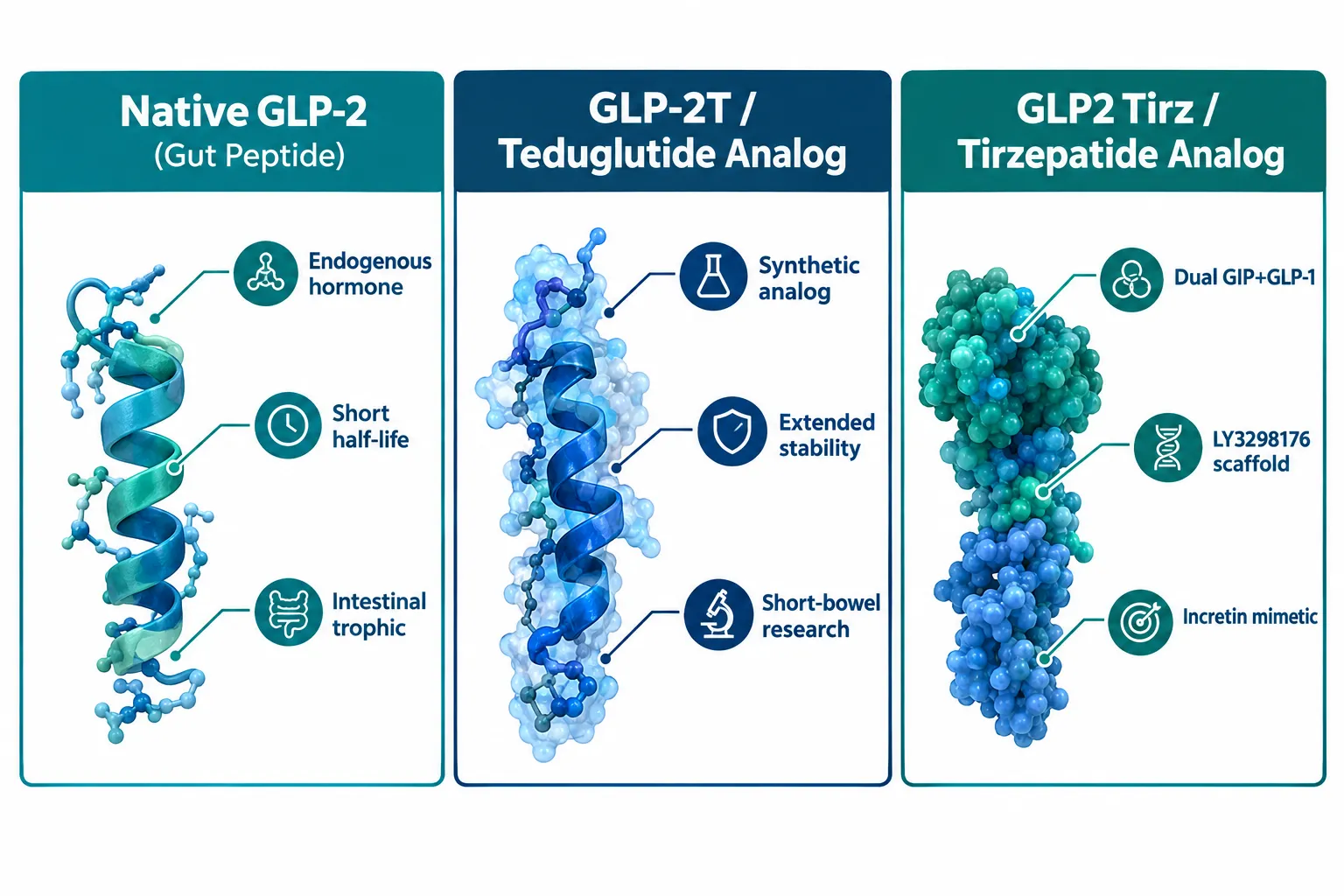
Three distinct molecules share overlapping abbreviations in current vendor catalogs, and conflating them is a serious research error.
Native GLP-2 is an endogenous gut peptide secreted by intestinal L-cells. It promotes intestinal growth and barrier function but has a very short half-life in circulation. It is not the same as either research compound discussed here.
GLP-2T (sometimes written GLP2-T or GLP-2 Tirz in some catalogs) most accurately refers to a synthetic teduglutide-type analog, a longer-acting GLP-2 derivative designed to resist dipeptidyl peptidase-4 degradation. It is studied for intestinal adaptation models and short-bowel syndrome research.
GLP2 Tirz, by contrast, is a tirzepatide analog built on the LY3298176 scaffold. Tirzepatide is a dual GIP and GLP-1 receptor agonist. When vendors use the label "GLP2 Tirz," they are almost always referring to this incretin mimetic, not to a GLP-2 gut peptide at all. The "GLP2" prefix in this context is a vendor shorthand, not a pharmacological classification.
"The single most common sourcing mistake in 2026 is ordering a GLP-2 gut peptide when the research protocol calls for a tirzepatide analog, or vice versa."
Researchers exploring the broader incretin peptide landscape may also find it useful to review GLP-1 peptides to understand how receptor-targeting profiles differ across this compound class. For those specifically investigating GLP-3-type analogs, browsing GLP-3 peptides for sale provides additional context on related naming conventions.
Quick alias mapping table:
| Vendor Label | Likely Identity | Primary Receptor Target |
|---|---|---|
| GLP2-T | Teduglutide analog | GLP-2 receptor |
| GLP2 Tirz | Tirzepatide analog (LY3298176) | GIP + GLP-1 receptors |
| GLP-2 | Native gut peptide | GLP-2 receptor |
| GLP-3R | GLP-3 receptor-targeted analog | GLP-3 receptor |
Always request the full amino acid sequence from the vendor before ordering. A sequence confirmation eliminates alias ambiguity entirely.
Where to Buy Research-Grade GLP2-T and GLP2 Tirz Peptides: Vendor Selection and COA Standards
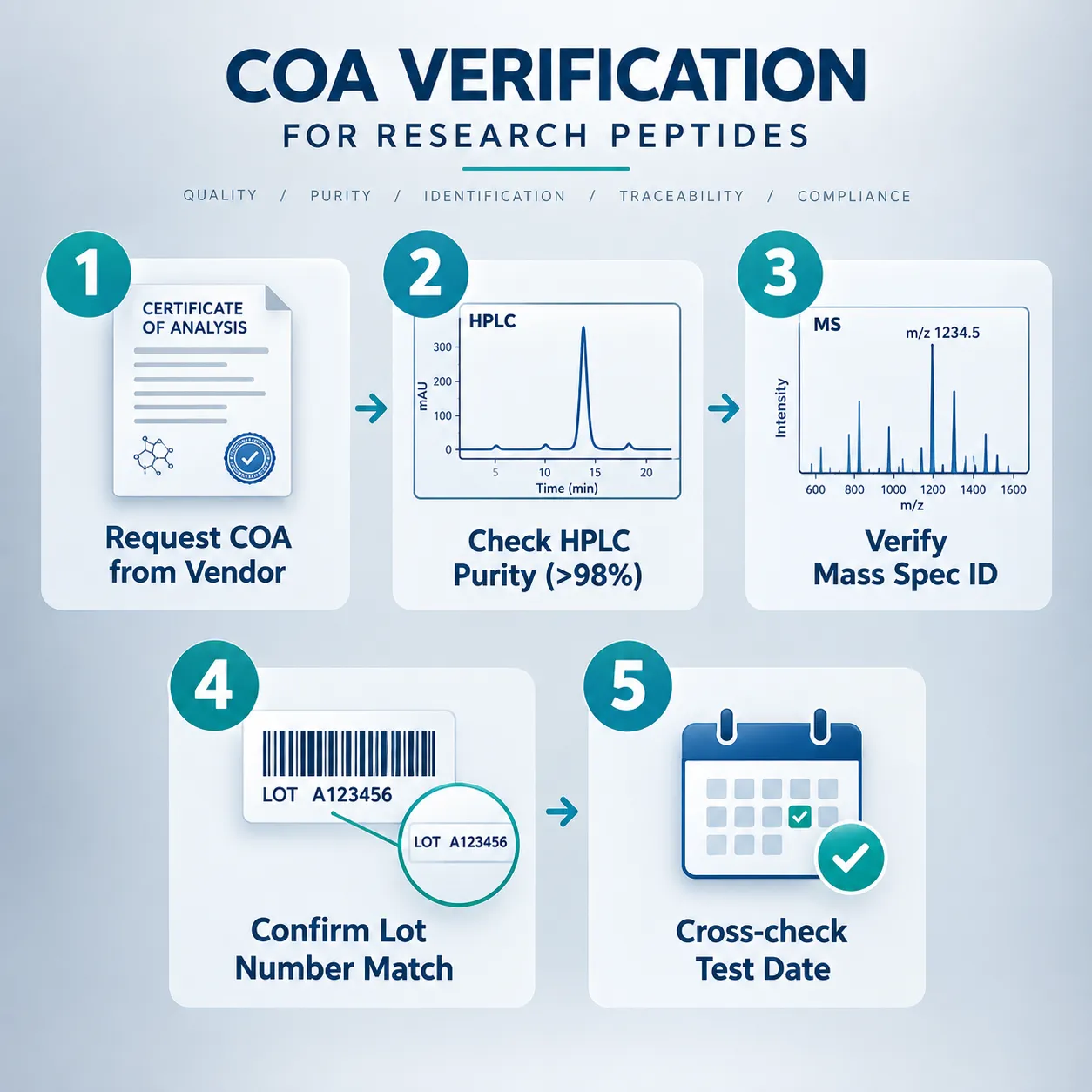
When navigating where to buy research-grade GLP2-T and GLP2 Tirz peptides, the Certificate of Analysis is the single most important document a vendor can provide. In 2026, reputable suppliers now offer multi-point COAs as a baseline expectation, not a premium feature.
A compliant COA for GLP2-T or GLP2 Tirz should include:
- HPLC purity result: Minimum 98% purity is the accepted research-grade threshold. Results below 95% indicate insufficient purification.
- Mass spectrometry (MS) confirmation: Confirms the molecular weight matches the stated sequence. This is non-negotiable for peptides above 3,000 Da.
- Lot number: Enables batch-level traceability. If a vendor cannot supply lot-specific COAs, treat that as a disqualifying red flag.
- Test date: COA data older than 18 months should be treated with caution, particularly for reconstituted or improperly stored stock.
- Endotoxin testing: Increasingly standard for injectable-grade research peptides.
Vendors offering GLP-3 peptide products alongside GLP2-T analogs often apply the same COA standards across their incretin catalog, which simplifies cross-compound procurement for multi-peptide research programs.
Vendor red flags to avoid:
- No third-party testing; only in-house COA claims
- Purity stated as a range (e.g., "95-99%") rather than a specific lot result
- No mass spec data provided
- Inability to confirm the amino acid sequence on request
Legal status in 2026 remains firm: GLP2-T and GLP2 Tirz peptides are research chemicals sold exclusively for in vitro and preclinical laboratory use. FDA enforcement activity has increased around vendors marketing these compounds with clinical language or dosing guidance. Researchers should purchase only from suppliers who clearly label products as "for research use only" and do not provide human-use instructions.
For researchers working across multiple peptide classes, understanding how endocrine pharmacology intersects with receptor biology is valuable context, the article on peptides and polypeptides in endocrine pharmacology covers relevant mechanistic background.
Storage Best Practices for Lyophilized and Reconstituted GLP2-T and GLP2 Tirz
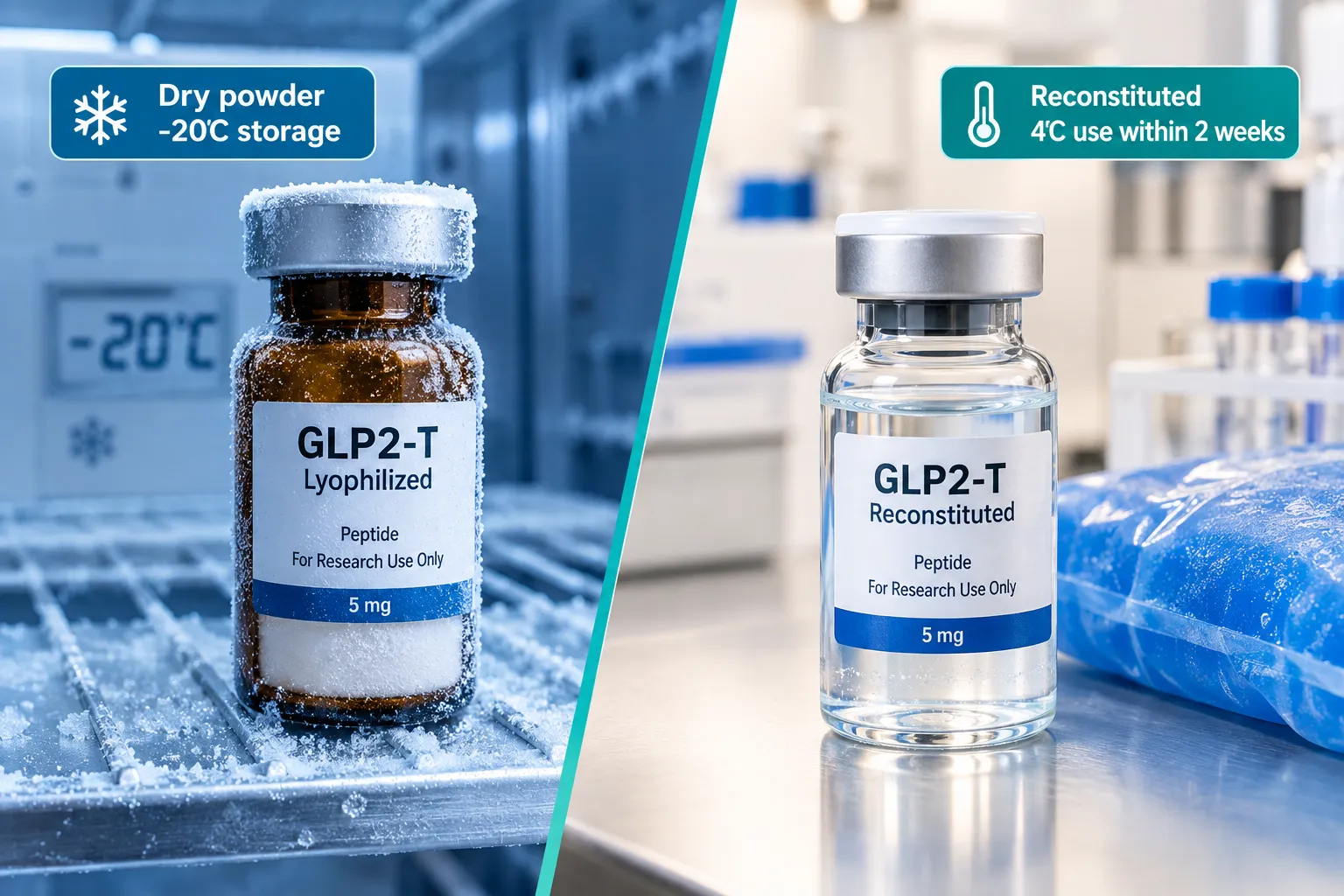
Improper storage is the leading cause of peptide degradation in research settings, and GLP2-T and GLP2 Tirz analogs are particularly sensitive given their longer amino acid chains and susceptibility to oxidation.
Lyophilized (dry powder) storage:
- Store at -20°C in a frost-free freezer, away from repeated freeze-thaw cycling
- Keep vials sealed and desiccated until use
- Avoid storing near the freezer door where temperature fluctuates
- Shelf stability at -20°C: typically 24 months from manufacture date when properly sealed
After reconstitution:
- Use sterile bacteriostatic water or the diluent specified in the COA
- Store reconstituted solution at 4°C (standard laboratory refrigerator)
- Use within 14 days of reconstitution; many researchers treat 7 days as the conservative limit for high-sensitivity assays
- Avoid repeated freeze-thaw of reconstituted solution, aliquot before freezing if longer storage is needed
- Protect from light; amber vials or foil wrapping are recommended
Common storage mistakes:
- Reconstituting with plain sterile water instead of bacteriostatic water (accelerates microbial contamination)
- Storing lyophilized peptide at 4°C instead of -20°C (reduces shelf life significantly)
- Failing to aliquot before freezing reconstituted stock (freeze-thaw degradation compounds with each cycle)
Researchers sourcing related mitochondria-targeted peptides alongside GLP2-T may find parallel storage guidance applicable, the SS-31 kidney health research resource addresses cold-chain handling for similarly sensitive compounds.
For those building multi-peptide research stacks, the IPA Sermorelin stack research article provides useful context on how storage compatibility across peptide classes affects experimental design.
Conclusion
The path to reliable GLP2-T and GLP2 Tirz research starts before the order is placed. Confirm the compound identity by sequence, not by vendor label. Demand a lot-specific COA with HPLC purity above 98%, mass spec confirmation, and a recent test date. Store lyophilized peptide at -20°C and work quickly once reconstituted. Avoid any vendor that uses clinical language, omits third-party testing, or cannot clarify which molecule they are actually selling.
Actionable next steps:
- Map the vendor's alias to the confirmed amino acid sequence before purchasing.
- Request a current, lot-specific COA and verify all five key data points before use.
- Establish a cold-chain protocol before the shipment arrives, not after.
- Monitor FDA guidance updates, as enforcement around incretin-analog marketing language is expected to tighten through late 2026.


Leave a Reply
Want to join the discussion?Feel free to contribute!