

Enclomiphene Research Materials: Enclomiphene Base vs Citrate for Identity, Solubility, and COA Review
Fewer than a handful of small-molecule research compounds generate as much procurement confusion as enclomiphene, largely because researchers routinely receive materials labeled under two chemically distinct forms without clear guidance on how that distinction affects their assay design. Selecting the correct form from the outset, and then verifying it through proper documentation, is not a minor administrative step. For anyone sourcing enclomiphene research materials: enclomiphene base vs citrate for identity, solubility, and COA review, understanding the chemical and analytical differences between these two forms is the foundation of reproducible, well-documented laboratory work.
Key Takeaways
- Enclomiphene base and enclomiphene citrate are chemically distinct forms with different molecular weights, solubility profiles, and documentation requirements.
- Enclomiphene citrate offers meaningfully higher aqueous solubility, making it preferable for buffer-based in vitro assays.
- Enclomiphene base is better suited to organic solvent systems such as DMSO or ethanol.
- A high-quality Certificate of Analysis must explicitly state the salt form, CAS number, purity method, and solubility data, not just a percentage purity figure.
- As of 2026, enclomiphene holds no FDA-approved indication in any form; all procurement and use remains within a research-only context.
Chemical Identity: What Separates Enclomiphene Base from Its Citrate Salt
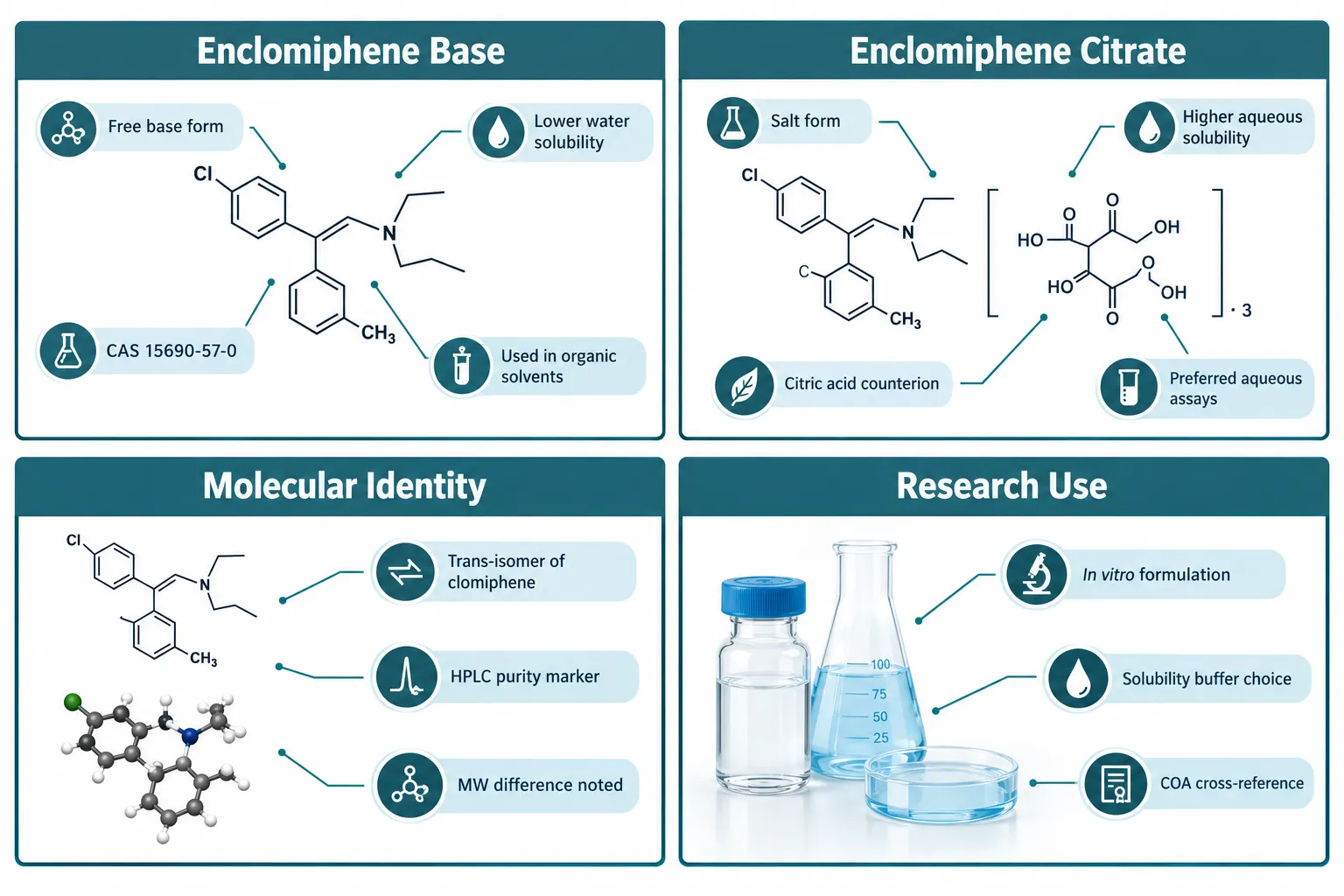
Enclomiphene is the trans-isomer of clomiphene, a selective estrogen receptor modulator (serm) that has been studied for its effects on the hypothalamic-pituitary-gonadal axis. The base form (free base) carries CAS number 15690-57-0 and represents the compound in its uncharged, non-salt state. The citrate salt is formed when the base is combined with citric acid, producing a counterion pair that significantly alters the compound's physical and chemical behavior.
This distinction matters immediately at the procurement stage. A supplier listing "enclomiphene" without specifying salt form is providing incomplete information. Researchers should confirm:
- Exact CAS number (base vs. citrate have different registry entries)
- Molecular weight (the citrate salt is heavier due to the citric acid moiety)
- IUPAC name or systematic name confirming the trans-configuration
- Salt ratio (typically 1:1 for citrate salts, but this should be stated explicitly)
Clomiphene citrate, the racemic mixture containing both enclomiphene and zuclomiphene, has a long clinical history. Enclomiphene as an isolated isomer is a more refined research material, and its documentation standards should reflect that precision. Researchers comparing enclomiphene to other research-grade serms can find relevant context in the serm 10mg product documentation as a reference point for how salt-form labeling should appear on supplier listings.
Solubility Profiles: Matching the Form to the Assay
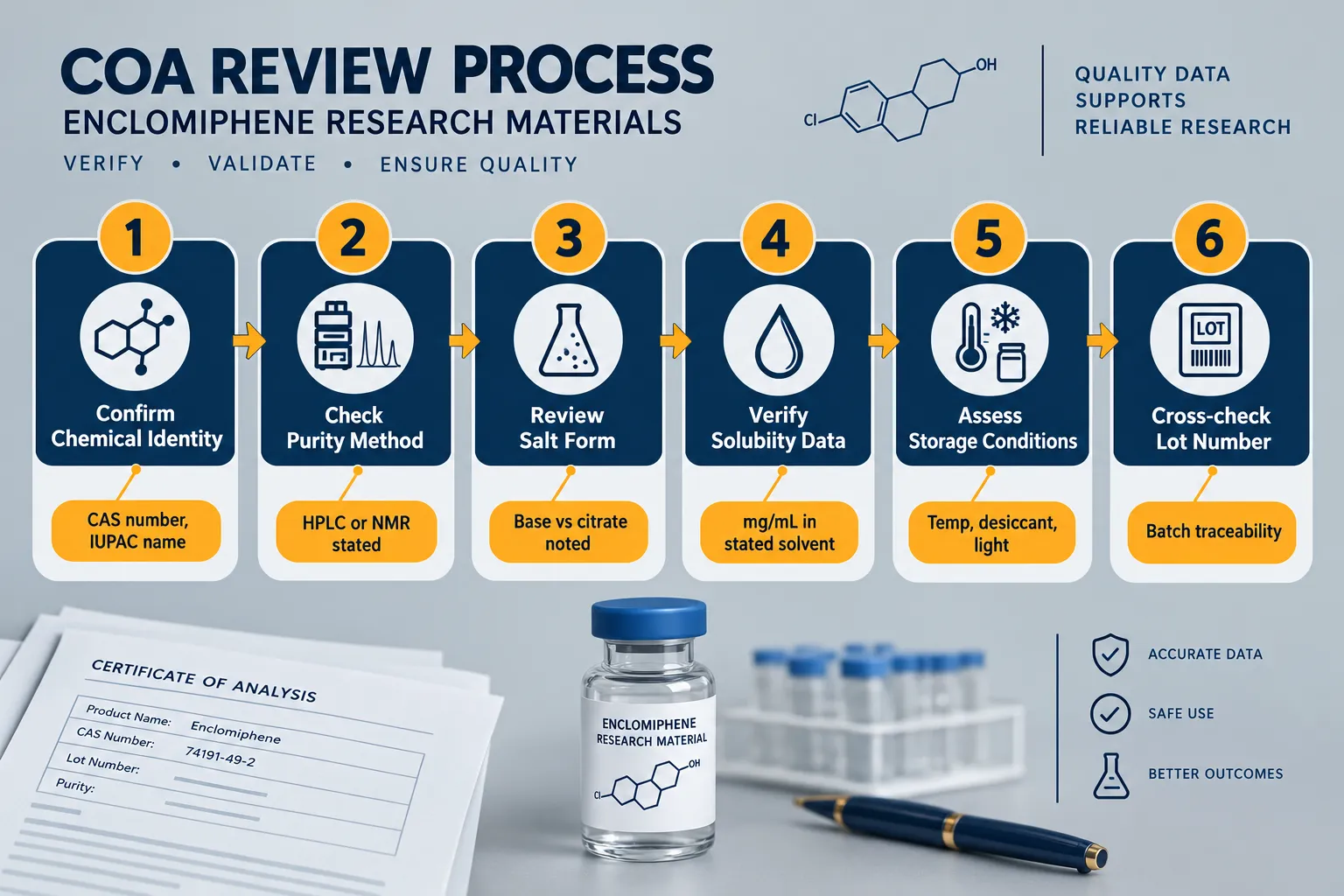
Solubility is where the base-versus-citrate distinction has the most direct impact on experimental planning. The two forms behave very differently across common laboratory solvents.
Enclomiphene Base, Solubility Summary
| Solvent | Solubility |
|---|---|
| DMSO | Moderate to good (~10-25 mg/mL typical) |
| Ethanol | Moderate |
| Water | Very low (practically insoluble) |
| Aqueous buffers | Not suitable without co-solvent |
Enclomiphene Citrate, Solubility Summary
| Solvent | Solubility |
|---|---|
| Water | Measurably higher than base form |
| Aqueous buffers (pH 4-7) | Acceptable for in vitro use |
| DMSO | Also soluble |
| Ethanol | Soluble |
The citrate salt form improves aqueous solubility because the ionic character of the salt increases hydrophilicity. This is consistent with the broader pharmacology of clomiphene citrate, where the citrate counterion has historically been used precisely to improve handling in aqueous media. For researchers designing cell-based assays or receptor binding studies in aqueous buffer systems, enclomiphene citrate is the more practical choice. For organic solvent stock solutions intended for dilution into non-aqueous matrices, the base form is workable.
"Choosing the wrong salt form for an aqueous assay can introduce solubility artifacts that invalidate dose-response data, a problem that is entirely avoidable with upfront documentation review."
Researchers working with other peptides and small molecules that require careful solubility planning, such as those reviewing Bachem and reference standards for building robust peptide benchmarks, will recognize this as a standard quality-control consideration across compound classes.
COA Review: What a High-Quality Document Must Contain
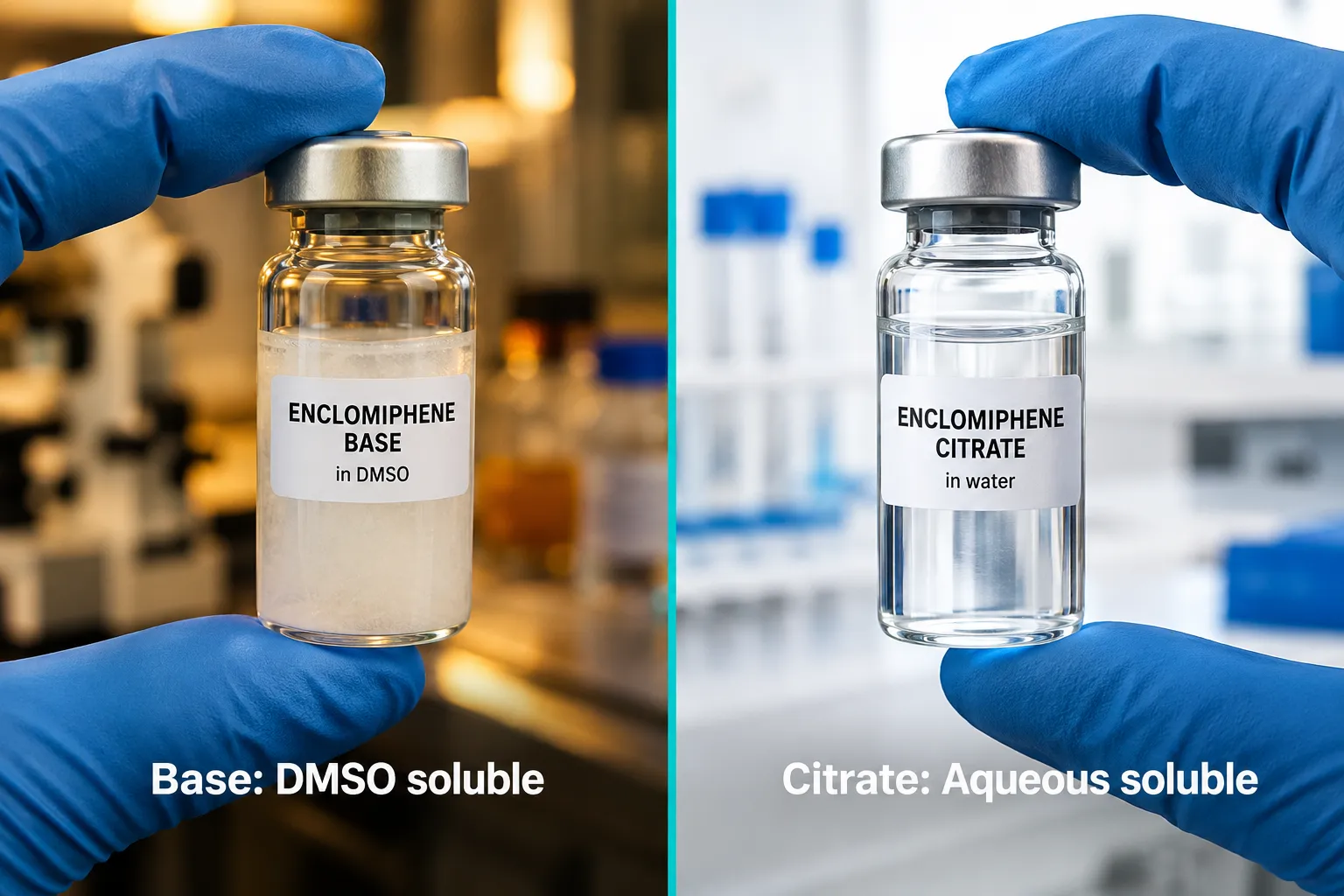
A Certificate of Analysis (COA) is not simply a purity number on a page. For enclomiphene research materials, whether base or citrate, a complete COA should contain the following elements, and researchers should decline materials where any of these are absent.
Required COA Elements for Enclomiphene Research Materials
- Chemical name and salt form, explicitly stating "enclomiphene citrate" or "enclomiphene free base," not just "enclomiphene"
- CAS number, matching the stated form
- Molecular formula and molecular weight, allowing the researcher to verify the correct form independently
- Purity method, HPLC is the standard; NMR is acceptable as a supplementary identity confirmation
- Purity result, expressed as area percentage from HPLC, with the method conditions (column type, mobile phase, wavelength) ideally referenced
- Isomeric confirmation, documentation that the material is the trans-isomer (enclomiphene), not the cis-isomer (zuclomiphene) or the racemate
- Solubility data, stated solvent, concentration, and whether the solution was clear or required sonication
- Lot or batch number, for traceability
- Storage conditions, temperature, desiccant requirement, light sensitivity
- Manufacturer or testing laboratory identity
As of 2026, enclomiphene citrate appears in some NDC (National Drug Code) listings, but this does not constitute FDA approval of any enclomiphene product. Researchers should not interpret an NDC listing as a regulatory clearance signal. All procurement of enclomiphene in any form remains strictly within research contexts, and COA documentation should be evaluated accordingly.
Researchers familiar with documentation standards for other well-characterized compounds, such as those reviewing SS-31 mechanism and research sourcing considerations, will find the same principles apply: supplier transparency, third-party testing, and explicit lot traceability are non-negotiable.
Formulation Strategies and Assay Planning Considerations
Knowing the form is only the first step. Translating that knowledge into a working formulation requires a few additional decisions.
For enclomiphene citrate in aqueous systems:
- Prepare stock solutions in sterile water or phosphate-buffered saline
- Confirm clarity visually and via UV absorbance baseline before use
- Note that pH can affect solubility, acidic conditions (pH 4-5) generally favor dissolution
For enclomiphene base in organic solvent systems:
- DMSO stocks at 10 mg/mL are a common starting point
- Dilute into aqueous media at no more than 0.1% DMSO final concentration to avoid solvent cytotoxicity in cell assays
- Sonication in a water bath (37°C, 15-30 minutes) can aid dissolution
Researchers sourcing other research-grade materials that require similar formulation planning, including those exploring IPA sermorelin stack research or reviewing tesa dosage considerations, will recognize that solvent compatibility and stock preparation protocols are just as important as compound identity.
For researchers also working with compounds in the aging support category, cross-referencing COA documentation practices across compound classes is a useful habit that strengthens overall laboratory quality standards.
Conclusion
Procuring enclomiphene research materials without first resolving the base-versus-citrate distinction is a preventable source of experimental error. The two forms differ in molecular weight, aqueous solubility, and the documentation that should accompany them. A COA that fails to specify salt form, purity method, or isomeric identity is insufficient for rigorous research use.
Actionable next steps for researchers in 2026:
- Request full COA documentation before purchase, and verify that salt form and CAS number are explicitly stated
- Match the form to the solvent system: citrate for aqueous assays, base for organic solvent stocks
- Cross-check the stated molecular weight against published values for the specific form to catch mislabeling
- Confirm isomeric purity (trans-enclomiphene vs. cis-zuclomiphene) through HPLC or NMR data on the COA
- Treat any NDC listing as administrative, not as a regulatory approval signal
Rigorous identity verification and documentation review are the difference between reproducible data and ambiguous results. Applying these standards consistently, across enclomiphene and every other research compound in the laboratory, is the hallmark of credible, defensible research practice.


Leave a Reply
Want to join the discussion?Feel free to contribute!