

Semax Nasal Spray Reviews for Research Use: How to Evaluate Concentration, Excipients, and Batch Documentation
Fewer than one in ten research peptide products arrives with documentation detailed enough to support reproducible laboratory work, and Semax nasal spray is no exception. As demand for Semax nasal spray reviews for research use grows in 2026, the most useful evaluations focus not on subjective impressions but on measurable formulation attributes: verified concentration, disclosed excipients, and traceable batch records. This guide explains exactly what to look for and why it matters.
Key Takeaways
- Assay values on a Certificate of Analysis (COA) often differ slightly from label claims, so always compare both before drawing conclusions about dose.
- A research-grade COA should confirm peptide identity via mass spectrometry, demonstrate purity by HPLC, and report endotoxin, sterility, and heavy metal results.
- Excipient disclosure, solvents, buffers, preservatives, pH, and osmolarity, is part of batch documentation, not a bonus detail.
- Batch traceability requires lot numbers, manufacturing and testing dates, and ideally access to raw chromatograms or spectra.
- Regulatory approval for Semax exists only in Russia; researchers in other jurisdictions should treat it strictly as an experimental compound and prioritize rigorous documentation over anecdotal claims.
Why Concentration Labeling Deserves Scrutiny
The nominal strength printed on a nasal spray label is a starting point, not a guarantee. When evaluating Semax nasal spray reviews for research use, the first task is to locate the assay value on the accompanying COA and compare it against the label claim.
Real-world data from 2026 batch reports illustrate the typical range of variation. A 10 mg labeled vial may test at 9.90-10.15 mg measured content. A 30 mg labeled nasal spray can come back at 33 mg confirmed by an independent laboratory. Neither result is necessarily alarming, but both change the effective per-spray dose calculation. Researchers who rely on the label alone will introduce systematic error into their work.
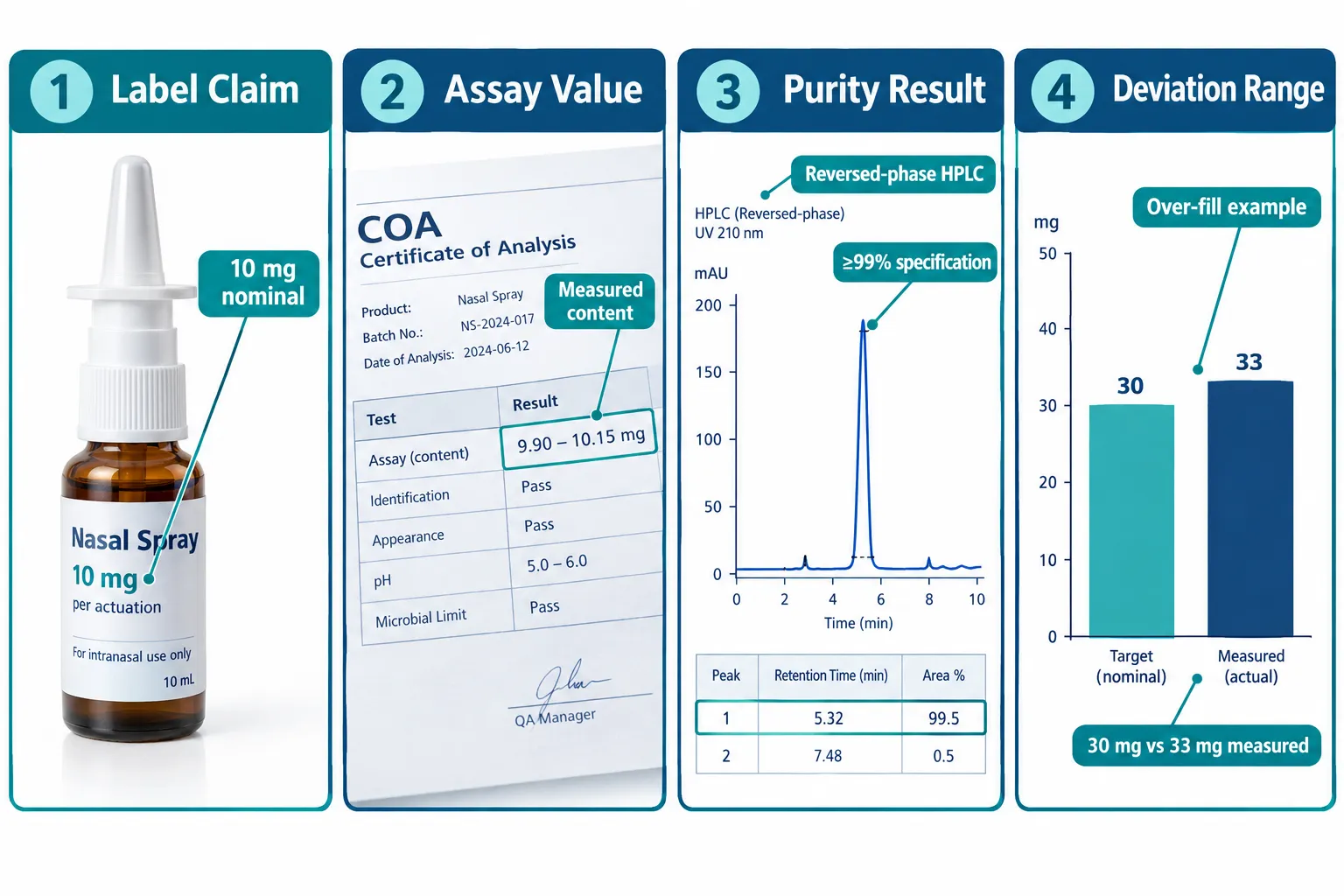
Key questions to ask about concentration:
- What is the labeled mg per container and the labeled volume (mL)?
- What is the measured content (mg) on the COA, and what is the percentage deviation from label?
- How many actuations does the container deliver, and what is the calculated dose per spray based on assay content, not nominal content?
- Is the purity specification stated (typically 95-99% or higher), and does the assay value meet it?
Suppliers now advertising purity verified at 99% or above by reversed-phase HPLC and mass spectrometry are setting a useful benchmark. The expected average molecular mass for the Semax heptapeptide (C37H51N9O10S) is 813.93 Da; a COA that confirms this value via ESI-MS or MALDI-TOF provides identity assurance that a purity number alone cannot.
For broader context on how related nasal spray peptides are sourced and evaluated, see guidance on where to buy Selank nasal spray, a structurally related compound that faces similar documentation requirements.
A Practical Framework for Evaluating COA Quality
The most actionable Semax nasal spray reviews for research use are structured around four pillars: identity, purity, safety, and documentation. Researchers who apply this framework systematically can compare suppliers on objective grounds rather than marketing language.
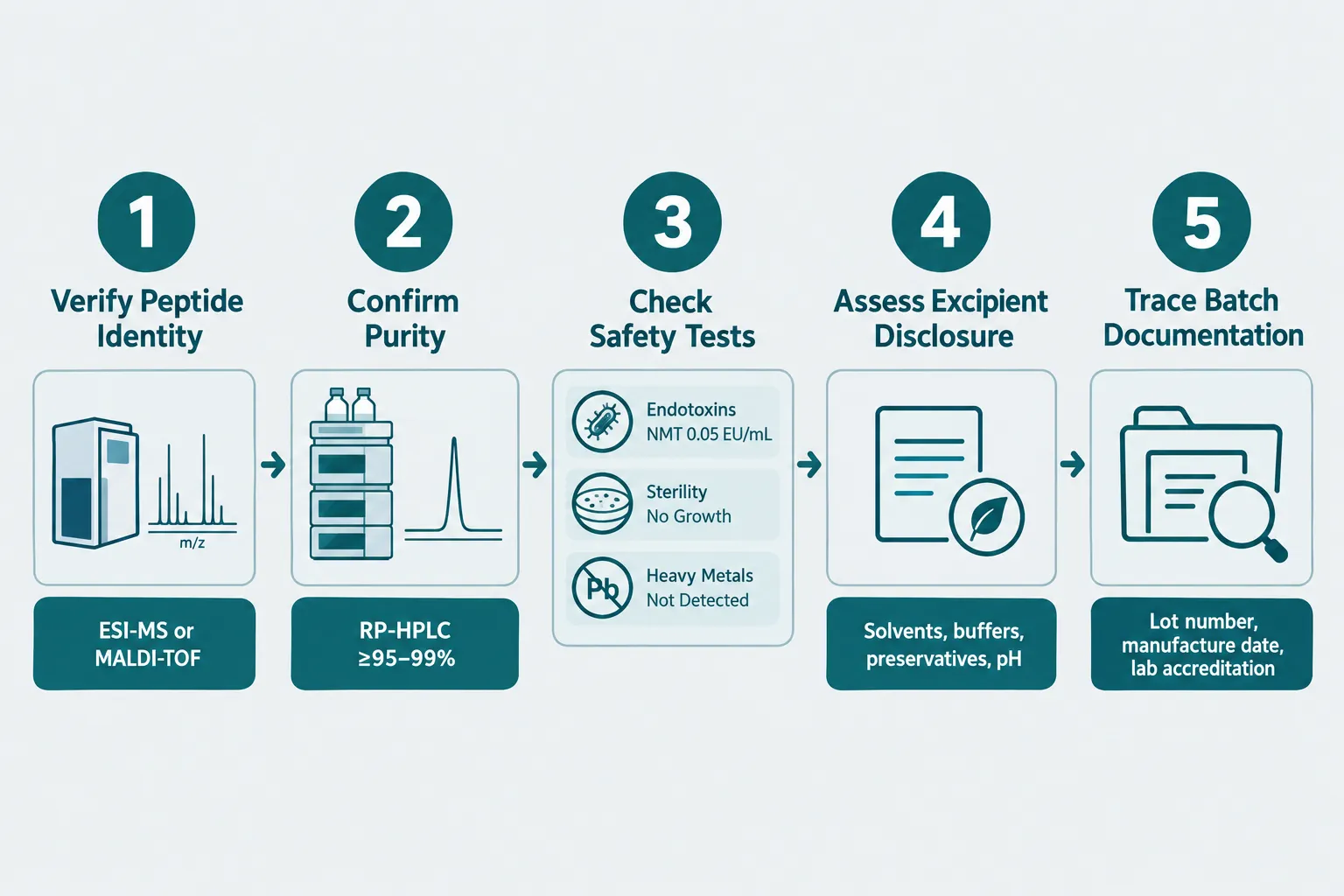
Step 1, Confirm Peptide Identity
Mass spectrometry is the only reliable tool for sequence confirmation. The COA should state the analytical method (ESI-MS or MALDI-TOF), the theoretical molecular mass, and the observed mass. A purity figure without identity confirmation is insufficient for research use.
Step 2, Verify Chromatographic Purity
Reversed-phase HPLC is the standard method. Look for the stated specification (e.g., ≥99%), the measured result, and ideally access to the chromatogram itself. Some vendors now offer COA libraries where researchers can download raw chromatograms and impurity profiles per lot.
Step 3, Review Safety-Related Metrics
This step is non-negotiable for any compound delivered via nasal mucosa. A complete safety panel includes:
| Test | Acceptable Result Example |
|---|---|
| Endotoxins | NMT 0.05 EU/mL |
| Sterility | No Growth |
| Heavy Metals | Not Detected |
Batch reports from leading suppliers in 2026 show that these metrics are now routinely included. If a COA omits them entirely, that absence is itself a red flag.
Step 4, Assess Excipient and Formulation Disclosure
Excipients affect nasal mucosal compatibility, peptide stability, and osmolarity. A research-grade product should disclose solvents, buffers, preservatives, pH, and osmolarity. When vendors treat excipient lists as proprietary, researchers lose the ability to assess formulation-related variables in their own protocols.
Step 5, Trace Batch Documentation
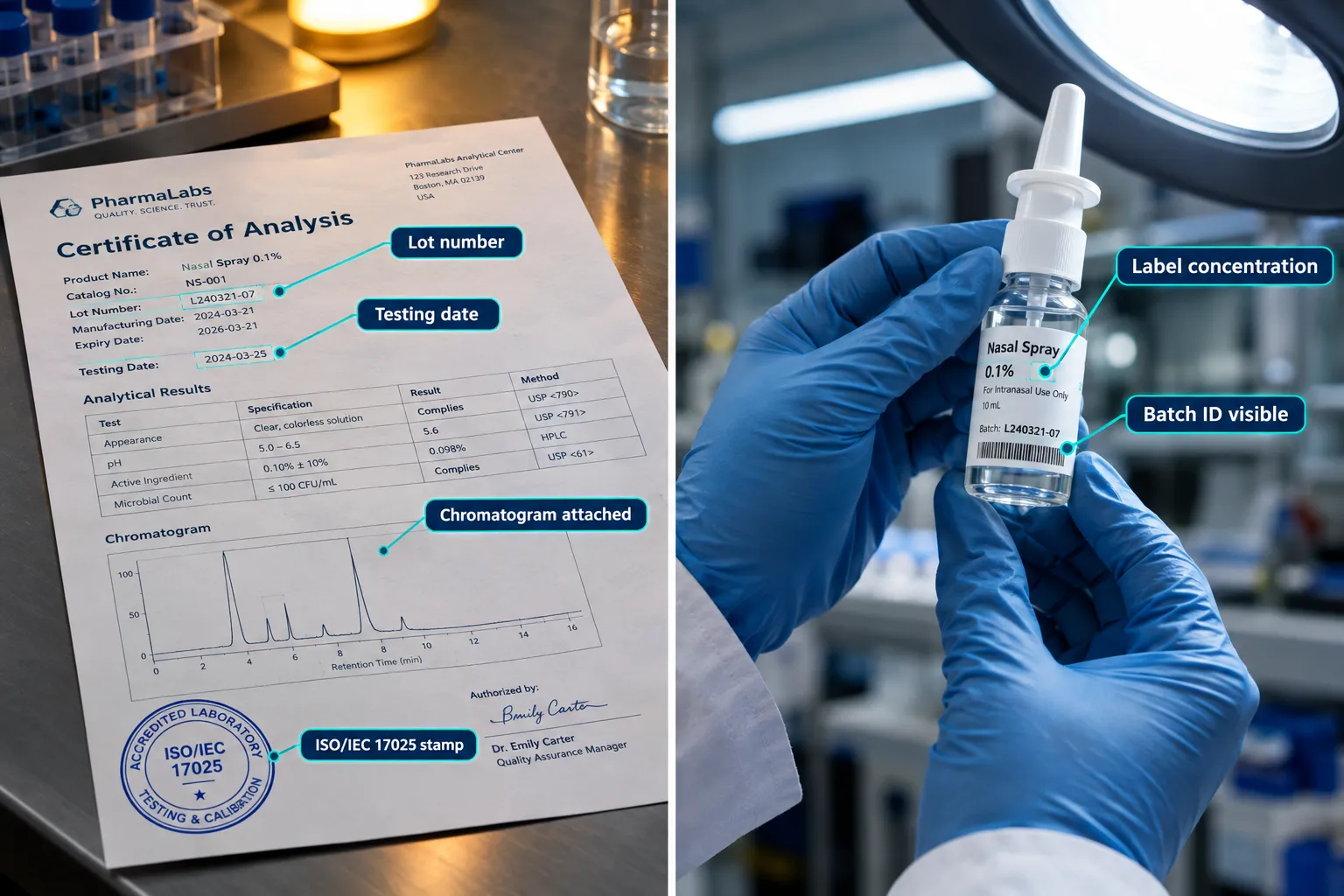
Full traceability means: lot number, manufacturing date, testing date, testing laboratory name, and ideally a statement of laboratory accreditation (ISO/IEC 17025 is the relevant standard for analytical testing labs). Some suppliers now offer searchable batch-report portals; others provide only a sparse index with no recorded measured values, requiring manual inspection of each PDF.
"Fewer accurate data points are more valuable than a dense document that omits the testing laboratory name."
This principle applies directly when comparing vendors. A COA that records the lot number, dates, accredited lab, chromatogram, and safety panel is categorically more useful than a glossy product page with a purity claim and no supporting data. Researchers interested in how documentation standards apply across the peptide category can explore the Semax peptide resource library for additional batch-level context.
Regulatory Context and Research-Only Use
Understanding the regulatory landscape is essential before procuring Semax nasal spray for any purpose. Semax has been approved as a nasal spray in Russia since 1994, primarily for cerebrovascular indications. It is not approved in the United States, the European Union, or most other jurisdictions.
A 2024 FDA scientific review, widely discussed in 2026 commentaries, found no human pharmacokinetic studies for Semax by any route of administration and judged the efficacy evidence insufficient for the nominated compounding uses. FDA staff recommended against placing Semax on the U.S. compounding list. An advisory committee vote in July 2026 reportedly favored inclusion by a narrow margin (8-5, one abstention), but no regulatory approval followed from that vote alone.
What this means for researchers:
- Semax nasal spray must be treated as an experimental compound, not a validated therapeutic.
- Trial data that does exist is largely from small, often unblinded studies concentrated in Russian research institutions.
- The mismatch between Russian approval and Western regulatory standards makes COA scrutiny more important, not less, because researchers bear the burden of quality verification themselves.
For comparison, researchers working with other investigational peptides face similar documentation demands. The CJC-1295 mechanism and pharmacokinetic comparison resource illustrates how analytical rigor applies across the broader peptide research field. Similarly, those exploring metabolic research themes may find the SS-31 mitochondrial research themes overview useful for understanding how documentation standards translate across compound classes.
Conclusion
Evaluating Semax nasal spray reviews for research use in 2026 means moving past subjective reports and into the language of analytical chemistry. The most reliable suppliers distinguish themselves through measurable attributes: assay values that can be cross-checked against label claims, purity results backed by chromatograms, safety panels covering endotoxins and sterility, and batch documentation that includes lot numbers, testing dates, and accredited laboratory names.
Actionable next steps for researchers:
- Request or download the batch-specific COA before purchasing, not after.
- Calculate the per-spray dose using assay content, not the nominal label strength.
- Confirm that identity testing (MS) and purity testing (HPLC) are both present and method-described.
- Verify that endotoxin, sterility, and heavy metal results are explicitly stated.
- Check whether the testing laboratory is named and, ideally, ISO/IEC 17025 accredited.
- Demand explicit excipient disclosure to assess nasal mucosal compatibility and formulation stability.
Researchers sourcing other nasal spray peptides can apply the same framework. The where to buy Selank nasal spray guide and the GLP-3 RT 20mg peptide nasal spray product page both provide examples of how batch documentation can be presented at the point of purchase. Documentation quality is the single most controllable variable in research-grade peptide procurement, and it is the one most often overlooked.


Leave a Reply
Want to join the discussion?Feel free to contribute!