

Creatine Supplementation vs MOTS-c and 5-Amino-1MQ: Comparing Phosphagen and Mitochondrial Peptide Pathways in Muscle Cell Models
Creatine monohydrate has more randomized controlled trial data behind it than almost any other supplement in sports science, yet two mitochondrial-pathway agents, MOTS-c and 5-amino-1MQ, are generating significant research interest in 2026. Understanding what separates these three compounds requires looking at where they act, what evidence supports them, and why comparing phosphagen energy buffering with mitochondrial peptide signaling is not as straightforward as it might seem. This article breaks down the science of Creatine Supplementation vs MOTS-c and 5-Amino-1MQ: Comparing Phosphagen and Mitochondrial Peptide Pathways in Muscle Cell Models so researchers and informed readers can evaluate each agent on its actual merits.
Key Takeaways
- Creatine monohydrate directly boosts intramuscular phosphocreatine, with decades of human RCT data confirming benefits for high-intensity performance.
- MOTS-c is a mitochondrial-derived peptide currently in a Phase 2a prediabetes trial (NCT07505745, started February 2026); no completed human efficacy data exist for muscle or performance endpoints.
- 5-Amino-1MQ is a small-molecule NNMT inhibitor with promising preclinical metabolic data but zero registered or published human clinical trials as of mid-2026.
- All three compounds act through fundamentally different biological pathways, phosphagen buffering versus mitochondrial/NAD-linked metabolic signaling.
- MOTS-c and 5-amino-1MQ should be regarded as experimental research tools, not practical replacements for creatine in muscle energy models.
The Phosphagen System: How Creatine Works in Muscle Cells
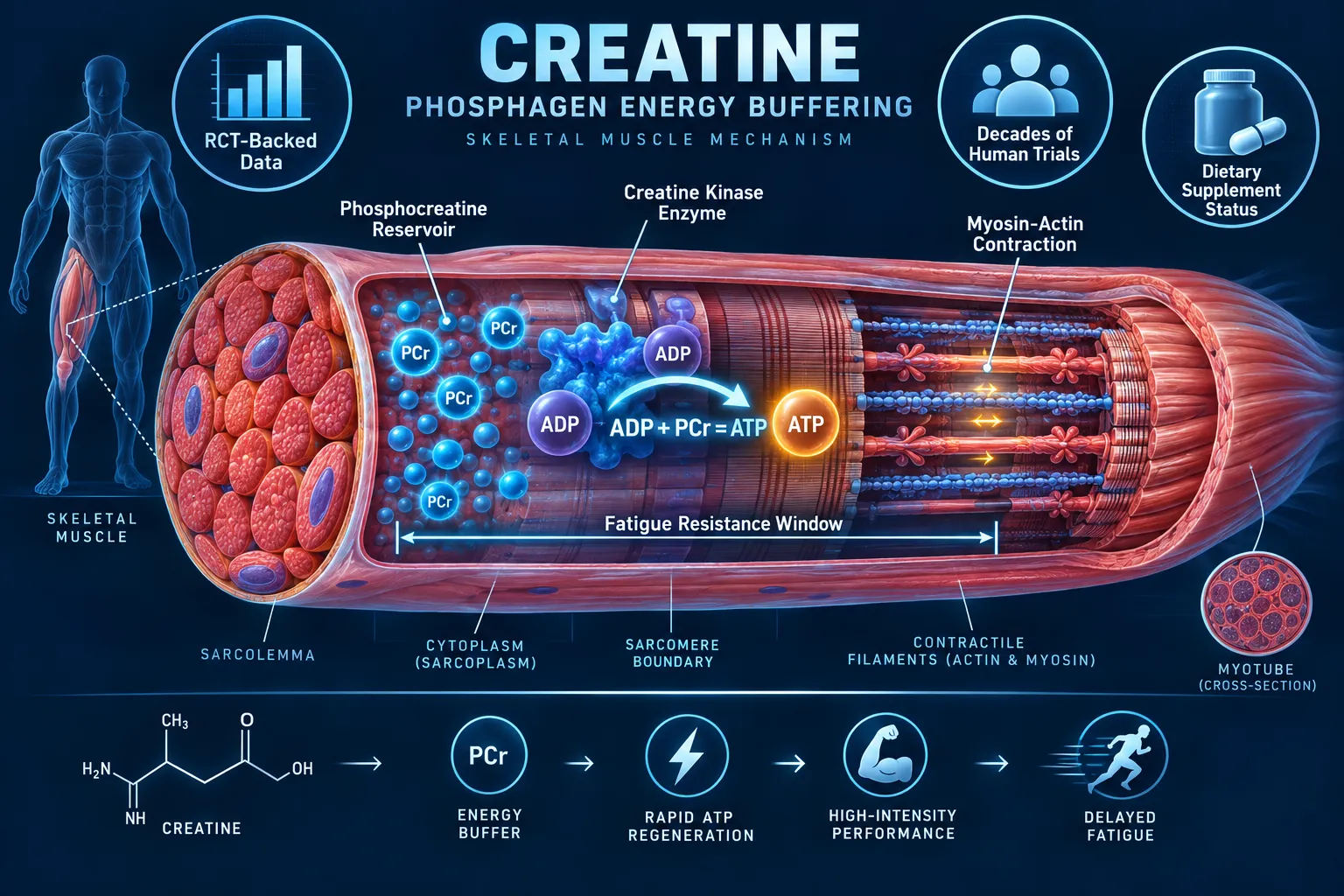
Creatine's mechanism is well-defined and directly tied to the phosphagen energy system. When a muscle fiber contracts at high intensity, ATP is consumed faster than oxidative phosphorylation can replenish it. Phosphocreatine (PCr) stored in the cytoplasm donates a phosphate group to ADP via the creatine kinase enzyme, rapidly regenerating ATP. Supplementing with creatine monohydrate increases the intramuscular PCr reservoir, extending the window of high-power output before fatigue sets in.
This is not a theoretical model. Human skeletal muscle biopsy studies and in vitro myotube experiments have consistently shown that elevated creatine loading increases PCr content, improves repeated-sprint performance, and supports resistance-training adaptations including lean mass gains. Creatine is a dietary supplement available without prescription, and its safety profile in healthy adults is well-established across multiple decades of research.
Key phosphagen-system facts:
| Feature | Detail |
|---|---|
| Primary target | Intramuscular phosphocreatine pool |
| Energy system | Phosphagen (immediate ATP resynthesis) |
| Evidence level | Multiple human RCTs, meta-analyses |
| Regulatory status | Dietary supplement (no prescription needed) |
| Muscle model data | Extensive in vitro myotube and in vivo human data |
MOTS-c and 5-Amino-1MQ: Mitochondrial Peptide Pathways Explained
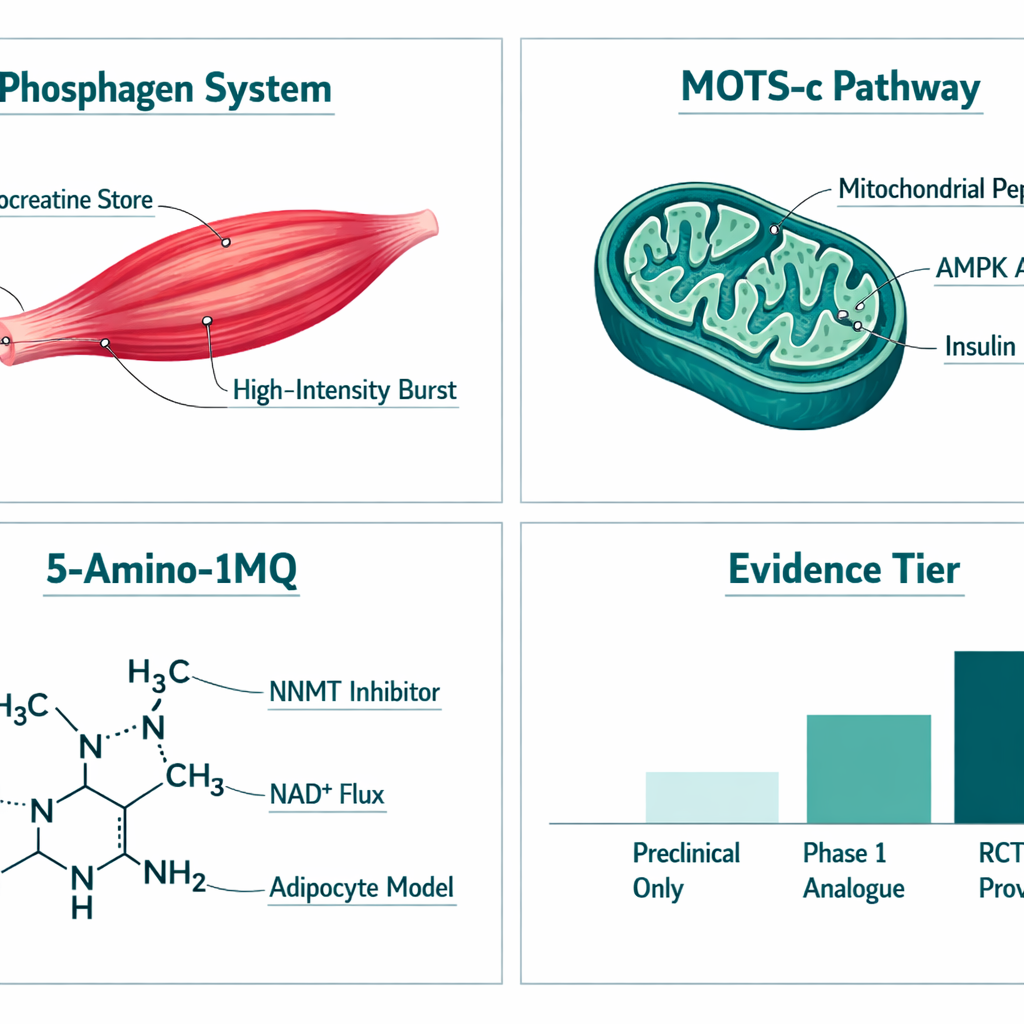
MOTS-c and 5-amino-1MQ operate through entirely different biological machinery. Neither targets the phosphagen system directly. Instead, both influence mitochondrial and NAD-linked metabolic pathways that affect systemic energy metabolism, insulin sensitivity, and adiposity.
MOTS-c: A Mitochondrial-Derived Peptide
MOTS-c is encoded within the mitochondrial genome and functions as a signaling peptide that activates AMPK and modulates metabolic stress responses. In preclinical models, it has been shown to improve insulin sensitivity, reduce fat accumulation, and support mitochondrial function. A CB4211 analogue of MOTS-c demonstrated reductions in liver enzymes (roughly 21% for ALT and 28% for AST) in overweight adults with non-alcoholic fatty liver disease, but those studies were small, short, and included no exercise-performance endpoints.
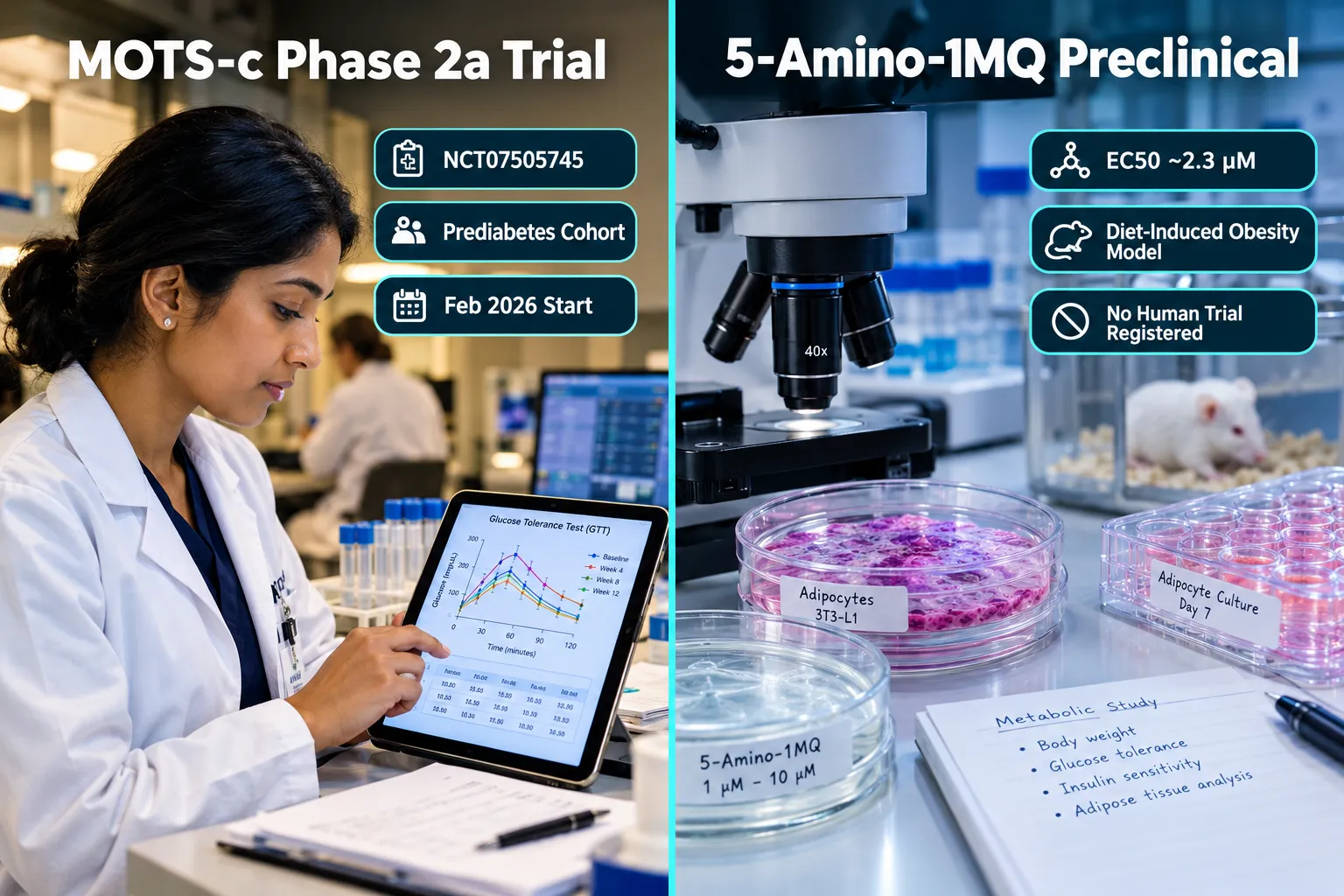
As of 2026, the most significant clinical development is a randomized, double-blind, placebo-controlled Phase 2a trial (NCT07505745) enrolling approximately 120 adults with prediabetes and overweight/obesity. The trial began in February 2026 and focuses on insulin sensitivity via oral glucose tolerance testing, HbA1c, and safety. No results have been posted. Researchers interested in MOTS-c peptide research materials can explore available options, though all use remains strictly preclinical.
5-Amino-1MQ: An NNMT Inhibitor
5-Amino-1MQ inhibits nicotinamide N-methyltransferase (NNMT), an enzyme that consumes methyl groups and suppresses NAD-dependent metabolic flux. In differentiated adipocytes, it shows an EC50 of approximately 2.3 µM with a well-fitted sigmoidal dose-response curve. In diet-induced obese mice, NNMT inhibition increased NAD-linked metabolic activity, reduced weight gain, and improved glucose handling.
"No human clinical trial of 5-amino-1MQ has been published or registered as of mid-2026. All available evidence is classified as preclinical only."
There is no FDA-approved indication, no publicly documented Investigational New Drug application, and no completed Phase 1 safety data for 5-amino-1MQ in humans. Expert commentary in 2026 consistently classifies any claims about human fat loss, muscle gain, or longevity as speculative extrapolations from animal and cell-culture data.
Comparing Phosphagen and Mitochondrial Peptide Pathways in Muscle Cell Models
When evaluating Creatine Supplementation vs MOTS-c and 5-Amino-1MQ: Comparing Phosphagen and Mitochondrial Peptide Pathways in Muscle Cell Models, the most important distinction is the type of muscle model each compound has actually been tested in.
Creatine has extensive dedicated skeletal-muscle data, myotube cultures, human biopsy studies, and exercise trials measuring fatigue resistance and hypertrophy. MOTS-c and 5-amino-1MQ data come primarily from systemic metabolic models: rodent obesity studies, adipocyte cultures, and hepatic cell lines. Neither has been tested as a direct substitute for creatine in phosphagen-system or muscle-performance models.
Side-by-side pathway comparison:
| Compound | Primary Pathway | Muscle Model Evidence | Human Trial Status |
|---|---|---|---|
| Creatine | Phosphagen (PCr/ATP buffering) | Extensive myotube and human RCT data | Decades of completed trials |
| MOTS-c | Mitochondrial peptide / AMPK signaling | Systemic metabolic and adipocyte models | Phase 2a ongoing (metabolic endpoints) |
| 5-Amino-1MQ | NNMT inhibition / NAD+ flux | Adipocyte and rodent obesity models | No registered human trial |
Researchers exploring mitochondrial-targeted compounds alongside creatine may also find value in reviewing SS-31 peptide research considerations, as SS-31 represents another mitochondria-focused peptide with a distinct cardiolipin-binding mechanism. The SS-31 peptide category offers additional context for comparing mitochondrial-targeting agents.
If MOTS-c or 5-amino-1MQ were eventually shown to improve mitochondrial efficiency and body composition in humans, experts suggest they might serve as adjuncts to established interventions, diet, exercise, and creatine, rather than replacements. The MOTS-c Phase 2a trial targets primary completion in February 2027, with final completion around May 2028. Any muscle-specific or performance-oriented trials would likely follow only after convincing metabolic efficacy and safety data are available. For 5-amino-1MQ, near-term development would almost certainly focus on obesity and diabetes indications before any sports-performance application.
Those researching peptide purity and sourcing standards for experimental compounds can consult resources on evaluating research-grade peptide purity and compatibility for broader quality-assessment frameworks. For context on how peptides interact with endocrine and receptor biology, the overview of peptides and polypeptides in endocrine pharmacology provides useful mechanistic background.
Conclusion
The comparison of Creatine Supplementation vs MOTS-c and 5-Amino-1MQ: Comparing Phosphagen and Mitochondrial Peptide Pathways in Muscle Cell Models reveals a clear evidence hierarchy. Creatine remains the only compound of the three with robust, reproducible human data for high-intensity exercise performance, supported by direct skeletal-muscle research. MOTS-c is a promising mitochondrial-derived peptide now entering Phase 2a human testing for metabolic endpoints, not muscle performance. 5-Amino-1MQ is a potent preclinical NNMT inhibitor with no human trial data at all.
Actionable next steps for researchers:
- Treat creatine as the established reference point for phosphagen-system support in any muscle cell model comparison.
- Monitor NCT07505745 for MOTS-c Phase 2a results expected in early-to-mid 2027 before drawing conclusions about metabolic efficacy.
- Classify 5-amino-1MQ strictly as a preclinical tool; do not extrapolate adipocyte or rodent findings to human muscle performance without registered trial data.
- When designing comparative in vitro studies, distinguish clearly between ATP-buffering endpoints (relevant to creatine) and mitochondrial signaling or NAD-flux endpoints (relevant to MOTS-c and 5-amino-1MQ).
- Source all research-grade peptides from suppliers with verified third-party purity testing to maintain experimental integrity.


Leave a Reply
Want to join the discussion?Feel free to contribute!