

Optimizing Epithalon Lyophilization and Storage: Temperature-Dependent Degradation Rates in Telomere Research
A single degree of temperature deviation during peptide storage can cost researchers months of experimental validity. For laboratories working with Epithalon in telomere and telomerase studies, this is not a theoretical concern. Quantitative stability data from 2026 laboratory documentation now make it possible to map exactly how purity erodes across four distinct temperature conditions, and the differences are striking. Optimizing Epithalon lyophilization and storage, with a clear understanding of temperature-dependent degradation rates in telomere research, is no longer optional for labs that require reproducible results across longitudinal studies.
Key Takeaways
- Lyophilized Epithalon stored at -20 °C maintains purity above 97% for two or more years; at 40 °C, purity falls to 90% within just seven days.
- Frost-free freezers accelerate peptide degradation through repeated thaw-refreeze cycles and should be avoided for long-term Epithalon stocks.
- Moisture, light, and atmospheric oxygen are the three primary non-thermal degradation drivers, each contributing to isomerisation and oxidation of the peptide backbone.
- Reconstituted Epithalon solutions must be kept at 2-8 °C and used within 24-48 hours for optimal biological activity, or within 28-30 days under strict cold-chain conditions.
- Uncontrolled storage conditions introduce variability into telomerase activation and telomere-length assays by altering effective dose and peptide profile over time.
How Temperature Drives Peptide Bond Degradation in Epithalon
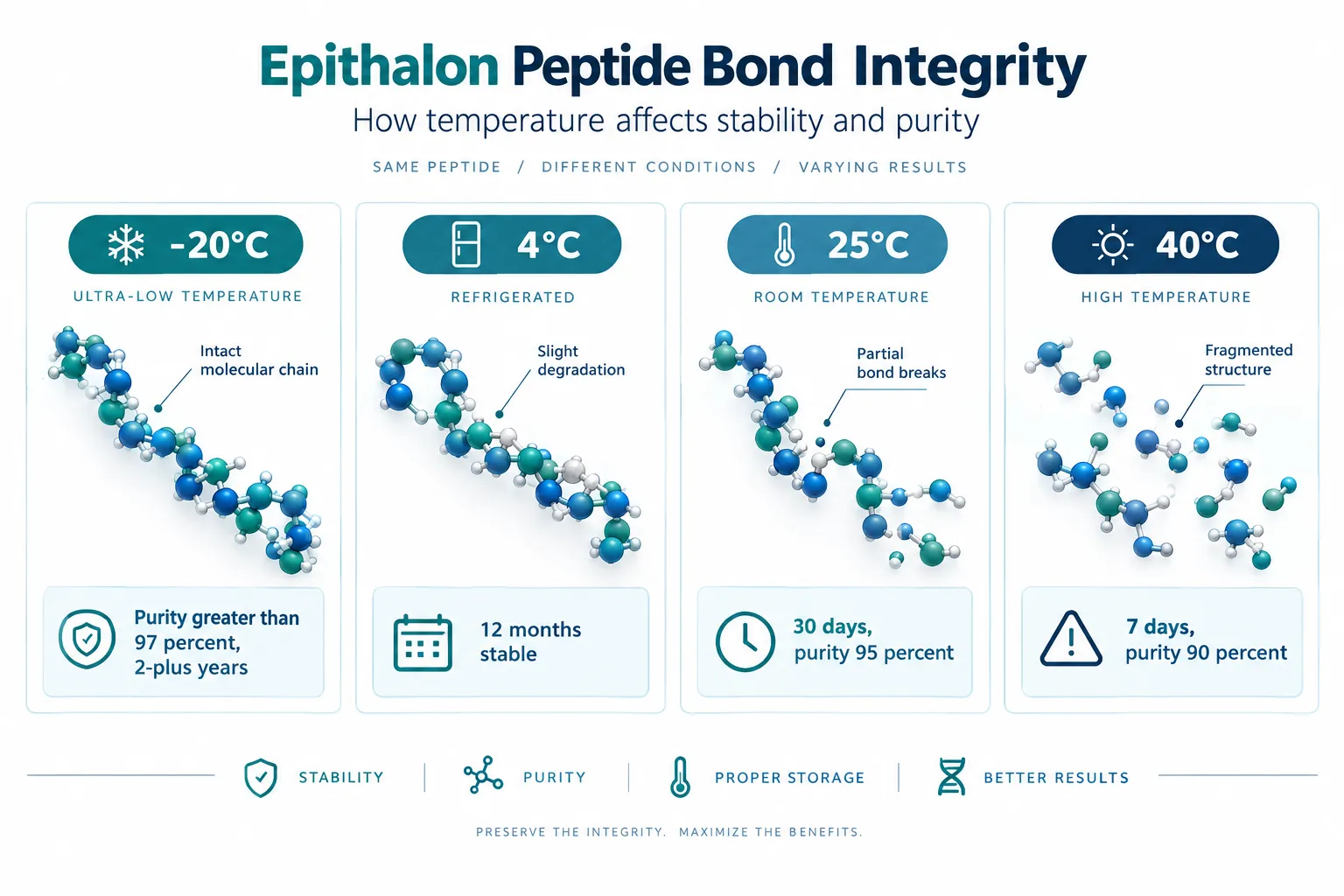
Epithalon is a synthetic tetrapeptide (Ala-Glu-Asp-Gly) studied extensively for its role in telomerase activation and telomere maintenance. Its short chain makes it relatively stable compared to larger peptides, but it is not immune to temperature-driven degradation pathways.
Current stability data across four temperature points tell a clear story:
| Storage Temperature | Purity Threshold | Duration |
|---|---|---|
| -20 °C | ≥97% | 2+ years |
| 4 °C | ≥97% | ~12 months |
| 25 °C | ≥95% | ~30 days |
| 40 °C | ≥90% | ~7 days |
At -20 °C, the peptide bond network remains intact because molecular mobility is severely restricted. As temperature rises, thermal energy accelerates hydrolysis, deamidation, and oxidation. At 40 °C, the combination of heat and ambient moisture creates conditions where degradation compounds rapidly, a 90% purity floor reached in a single week represents a significant loss of research-grade material.
Key degradation pathways to understand:
- Hydrolysis, water molecules attack peptide bonds, cleaving the chain
- Oxidation, atmospheric oxygen attacks methionine and cysteine residues (less relevant for Epithalon's sequence, but still a concern at elevated temperatures)
- Isomerisation, aspartate residues, present in Epithalon's sequence, are particularly susceptible to converting between L- and D-forms, altering biological activity without a visible change in purity percentage
For telomere research specifically, isomerisation is a critical concern. A peptide that appears 95% pure by HPLC may contain a significant proportion of isomerised species with altered receptor binding profiles, introducing silent variability into telomerase assays.
Optimizing Epithalon Lyophilization and Storage: Protocols That Protect Peptide Integrity
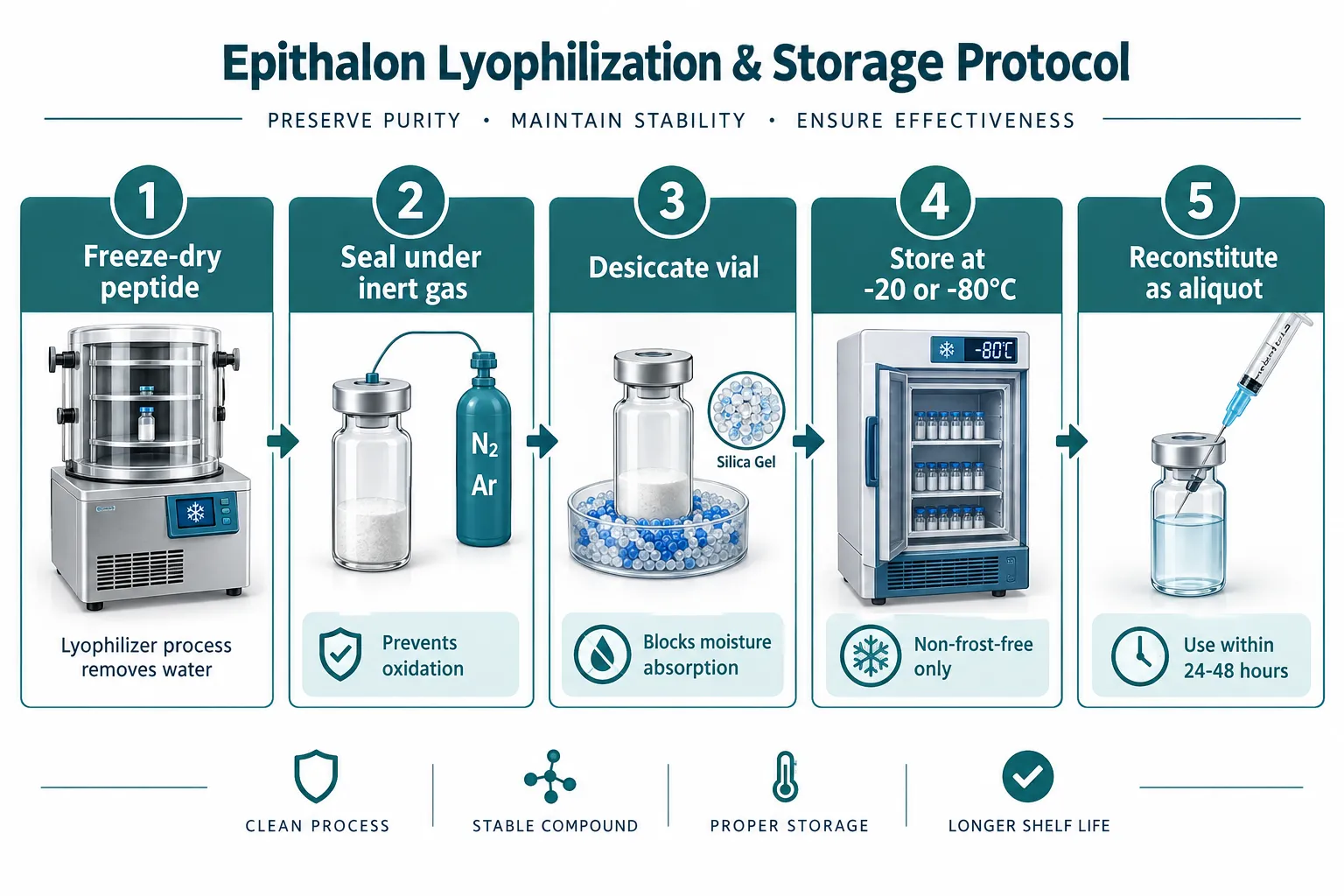
Lyophilization, freeze-drying, is the gold standard for long-term Epithalon preservation because it removes water without heat damage. However, the process only protects the peptide if post-lyophilization handling is equally rigorous.
The three pillars of effective Epithalon storage:
-
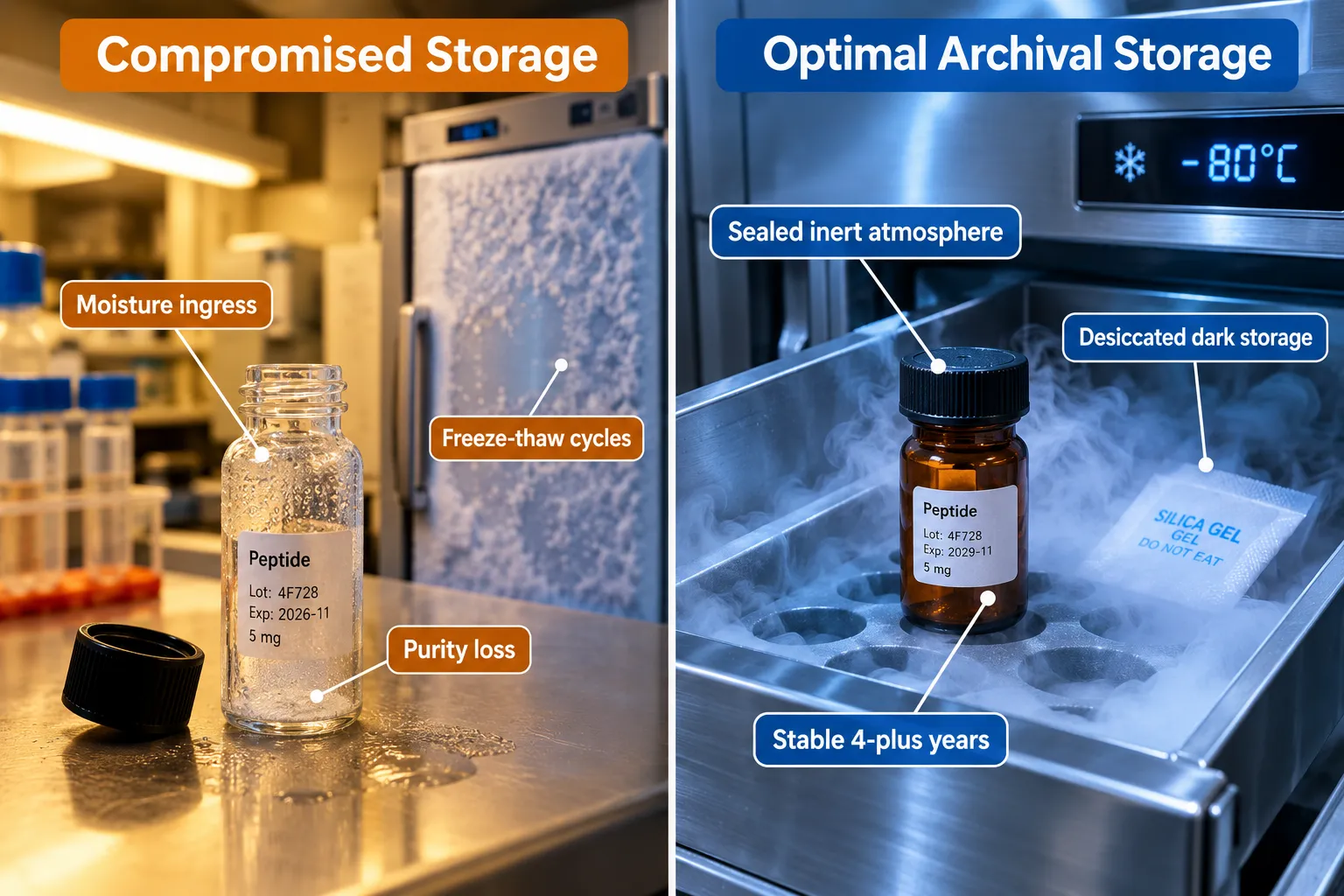
Temperature control, Sealed lyophilized vials belong at -20 °C as the standard research condition. For archival batches intended for studies extending beyond 24 months, -80 °C is increasingly recommended. At -80 °C, minimal degradation has been documented for four or more years, making it the preferred condition for high-value telomere research stocks.
-
Moisture exclusion, Epithalon is hygroscopic. Left unsealed or stored in a humid environment, the lyophilized powder will absorb atmospheric water, initiating the same hydrolytic degradation that elevated temperatures accelerate. Desiccant packs inside storage containers and sealed vials with crimped caps are non-negotiable.
-
Atmosphere and light, Storage under an inert gas atmosphere (nitrogen or argon) minimizes oxidative degradation. Darkness prevents photodegradation of the peptide backbone.
"Sealed, dry, dark, -20 °C storage yields the longest stability window for lyophilized Epithalon, and 2-8 °C is reserved only for vials actively in use."
One often-overlooked hazard is the frost-free freezer. These units maintain temperature through repeated heating and cooling cycles that prevent ice buildup. For food, this is convenient. For lyophilized peptides, each micro-thaw cycle introduces mechanical stress and brief moisture exposure that cumulatively accelerates degradation. Long-term Epithalon stocks must be kept in a manual-defrost (non-frost-free) freezer.
Researchers sourcing material for extended studies can explore 50mg Epithalon formats that allow for proper aliquoting before archival storage, reducing the number of freeze-thaw cycles applied to the main stock.
For context on how complementary research peptides are handled under similar storage constraints, the SS-31 10mg research peptide considerations page provides parallel guidance on mitochondria-targeted peptide stability.
Reconstituted Epithalon and the Cold Chain in Telomere Experiments
Optimizing Epithalon lyophilization and storage in the context of temperature-dependent degradation rates in telomere research requires a clear distinction between two states: the dry lyophilized powder and the reconstituted solution.
Lyophilized (dry) powder:
- Primary storage: -20 °C or -80 °C in sealed, desiccated, dark conditions
- Acceptable short-term working storage: 2-8 °C for up to six months, provided the vial will be fully consumed within that window
- Room temperature (25 °C): acceptable only as a worst-case allowance for shipping delays, not as an intentional storage strategy; cumulative room-temperature exposure should not exceed 72 hours
Reconstituted solution:
- Store strictly at 2-8 °C immediately after reconstitution
- For optimal biological activity in telomerase assays: use within 24-48 hours
- Under strict sterility and cold-chain maintenance: some laboratory protocols allow use within 28-30 days
- Never refreeze a reconstituted solution
The practical implication for telomere research programs is significant. Longitudinal experiments, which may span weeks or months, require consistent dosing with a peptide of stable purity and configuration. If reconstituted Epithalon degrades between dosing intervals, the effective concentration and isomeric profile shift, introducing variables that cannot be controlled for in data analysis.
Recommended aliquoting strategy for telomere studies:
- Divide the bulk lyophilized stock into single-use aliquots before first use
- Store aliquots at -20 °C (or -80 °C for multi-year programs)
- Thaw only one aliquot per experimental session
- Reconstitute immediately before use and discard any unused reconstituted volume after 48 hours
Researchers comparing peptide sourcing options for telomere programs can find useful procurement context at where to buy SS31 and Epithalon online, which addresses quality verification alongside sourcing. For mitochondrial co-administration studies that often accompany telomere research, SS-31 kidney health research and SS-31 ideal dosage and timing provide relevant handling parallels.
The connection between storage integrity and biological readouts is direct. Purity declines at 25 °C and 40 °C documented in 2026 stability tables correspond to progressive losses of functional integrity, meaning uncontrolled storage conditions can alter telomerase activation outcomes not by changing the experimental design, but simply by degrading the compound before it reaches the assay. Researchers interested in broader peptide stability comparisons may also find the MOTS-C and Elamipretide handling overview instructive for multi-peptide telomere research protocols.
Conclusion
The data available in 2026 leave little ambiguity: temperature is the most controllable variable in Epithalon stability management, and the difference between -20 °C and room temperature is the difference between years of research-grade material and weeks. For telomere and telomerase research programs that depend on consistent peptide dosing across longitudinal experiments, the following steps are actionable immediately:
- Audit current freezer type, replace frost-free units with manual-defrost models for peptide storage
- Aliquot before first use, divide bulk stocks into single-session volumes to eliminate repeated freeze-thaw cycles
- Seal under inert gas with desiccant, nitrogen or argon atmospheres with desiccant packs halt the two primary non-thermal degradation pathways
- Upgrade archival stocks to -80 °C, for programs extending beyond 24 months, ultra-low temperature storage is the only condition with documented stability beyond four years
- Establish a 48-hour reconstitution rule, prepare fresh solutions per session and discard unused reconstituted material rather than risking isomeric drift in stored solutions
Reproducible telomere research depends on compound integrity at every stage. Treating Epithalon storage as a precision variable, not an afterthought, is the foundation on which reliable biological data is built.


Leave a Reply
Want to join the discussion?Feel free to contribute!