

Research-Use Nasal Spray Peptides: A Buyer’s Comparison of Excipient Disclosure, Pump Performance, and Stability Records
Less than 40% of research-use peptide vendors publicly disclose the full excipient list for their nasal spray formats, yet those undisclosed ingredients can fundamentally alter dose delivery, peptide stability, and experimental reproducibility. For procurement teams and research scientists evaluating suppliers in 2026, this gap is not a minor detail. It is the central quality problem.
This guide frames the evaluation of research-use nasal spray peptides: a buyer's comparison of excipient disclosure, pump performance, and stability records as a structured procurement decision, covering the three pillars that separate credible suppliers from opaque ones.
Key Takeaways
- Full excipient disclosure and batch Certificates of Analysis (COAs) are non-negotiable quality markers when sourcing nasal spray peptides for research.
- Pump performance, including actuation force, metered dose volume, and plume characteristics, directly affects dose uniformity across experiments.
- Stability records should cover storage orientation, leachables testing, and delivered-dose robustness over the product's shelf life.
- Preservative-free, device-centric nasal spray designs are the emerging standard; buyers should weight vendors moving toward this model.
- Supplier transparency on formulation details correlates strongly with overall quality control culture.
Why Excipient Disclosure Is the Starting Point for Any Nasal Spray Peptide Comparison
When a research team orders a nasal spray peptide, they are not just buying the active compound. They are buying a complete formulation: buffers, preservatives, stabilizers, tonicity agents, and the solvent system that holds everything together. Each component affects how the peptide behaves in solution and what happens when it contacts mucosal tissue in a study model.
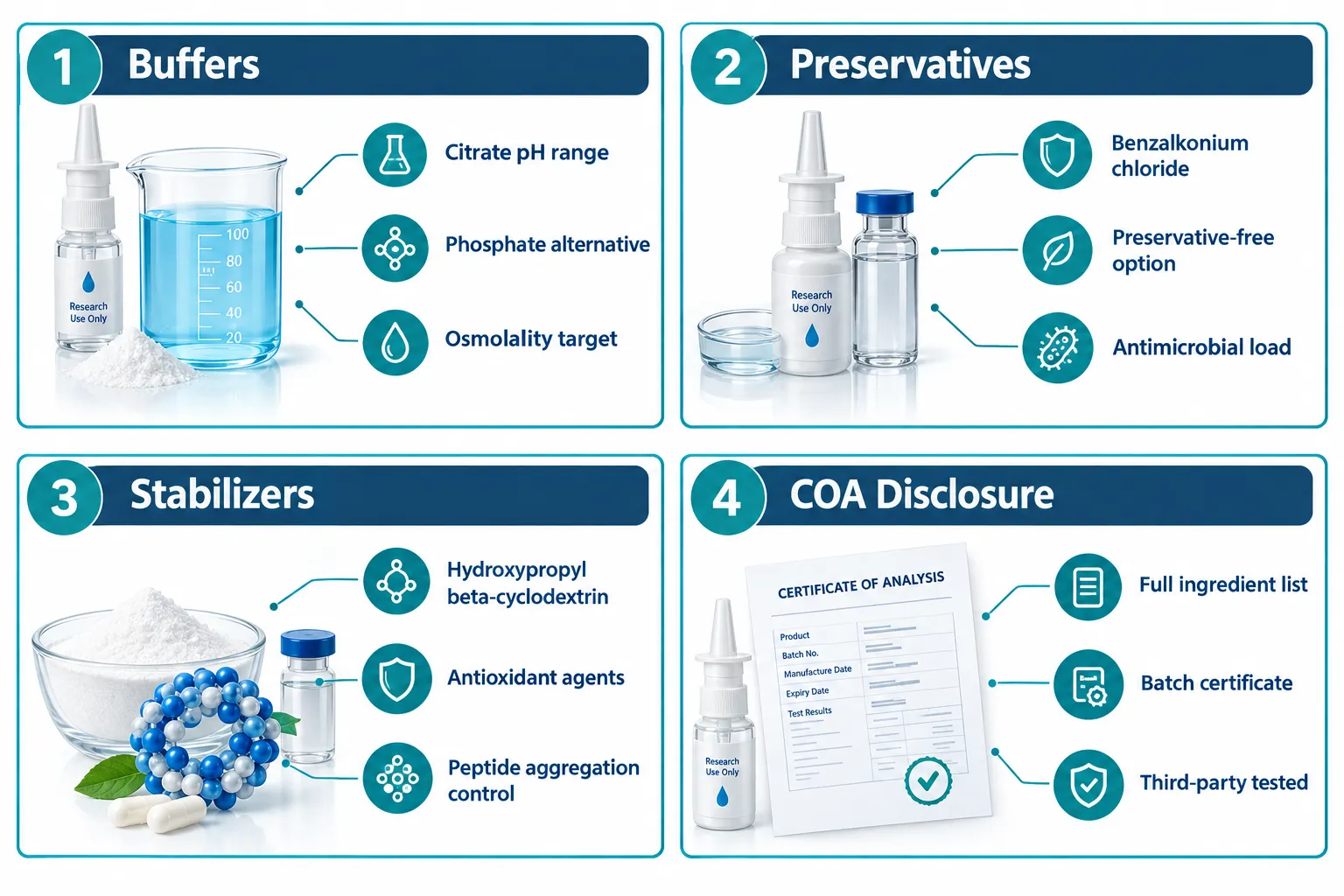
Regulators reviewing nasal drug products now expect full disclosure of every excipient, not just the active ingredient. Expert buying guides for research peptides treat this same standard as the minimum bar. The specific excipients to scrutinize include:
| Excipient Category | Role in Formulation | Red Flag if Missing |
|---|---|---|
| Buffer system | Controls pH, prevents peptide degradation | No pH data on COA |
| Preservative | Antimicrobial protection across use cycles | No antimicrobial class stated |
| Stabilizer (e.g., cyclodextrin) | Reduces aggregation, protects peptide integrity | Vague "inactive ingredients" language |
| Tonicity agent | Matches nasal mucosal osmolality | No osmolality range provided |
Buyers should request the full inactive ingredient list before purchase, not after. Vendors offering nose-to-brain delivery formats, relevant to peptides like Semax, which researchers can explore via the Semax peptide research tag, face especially high scrutiny here because the olfactory route amplifies the impact of any formulation variable on experimental outcomes.
The PT-141 peptide for sale research context and QA controls page illustrates how a vendor that publishes QA methodology signals a higher commitment to formulation transparency than one offering a bare-bones product listing.
Pump Performance: The Most Underrated Variable in Research-Use Nasal Spray Peptides Comparisons
A technically pure peptide delivered through a poorly characterized pump is unreliable data. Pump performance is not a packaging afterthought; it is a dosing instrument.
Regulatory and patent documents that govern nasal drug devices now link pump performance tests directly to dosing accuracy and user safety. The parameters that matter most for a research-use buyer are:
- Metered dose volume: Typically 100 µL per actuation for research formats. Deviations beyond ±10% compromise reproducibility.
- Actuation force: Should be consistent across the full bottle. High variability at low fill levels signals a poor dip-tube design.
- Plume geometry: Droplet size and spray angle determine deposition pattern. Fine droplets favor upper nasal deposition; larger droplets favor anterior deposits.
- Number of priming strokes: Fewer priming strokes needed equals less wasted material, which matters in small-batch research formats.
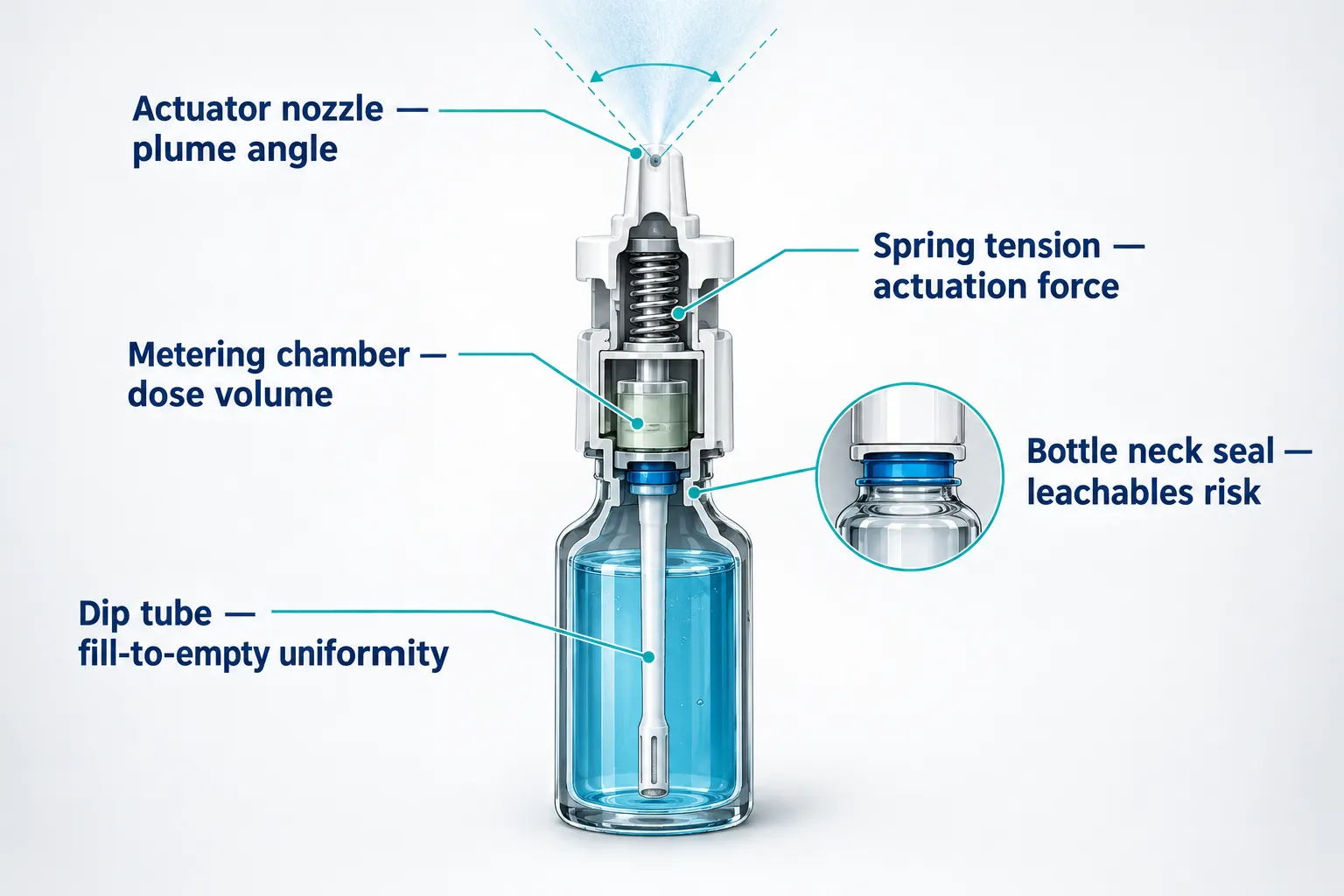
The trend in device-centric design is toward preservative-free pumps with unit-dose or multidose systems that use filtration membranes rather than chemical preservatives to maintain sterility. For buyers comparing nasal spray peptides, this distinction is worth flagging explicitly in supplier inquiries.
GLP-1 class peptides offered in nasal formats, such as those listed under GLP peptide for sale categories, benefit specifically from tight pump tolerances because their dose-response curves in research models are steep. A 20% dose variance at the pump level can translate to a meaningless data point.
For a broader framework on how vendor documentation quality predicts product reliability, the peptide supplier comparisons guide interpreting PeptideTech and PeptideSC provides a useful methodology that applies directly to nasal spray procurement.
Stability Records: What Serious Suppliers Must Provide
Stability data for nasal spray peptides is more complex than for lyophilized powders. Liquid formulations degrade through hydrolysis, oxidation, and aggregation. The container-closure system introduces additional variables: leachables from the pump mechanism and bottle material can contaminate the solution over time.
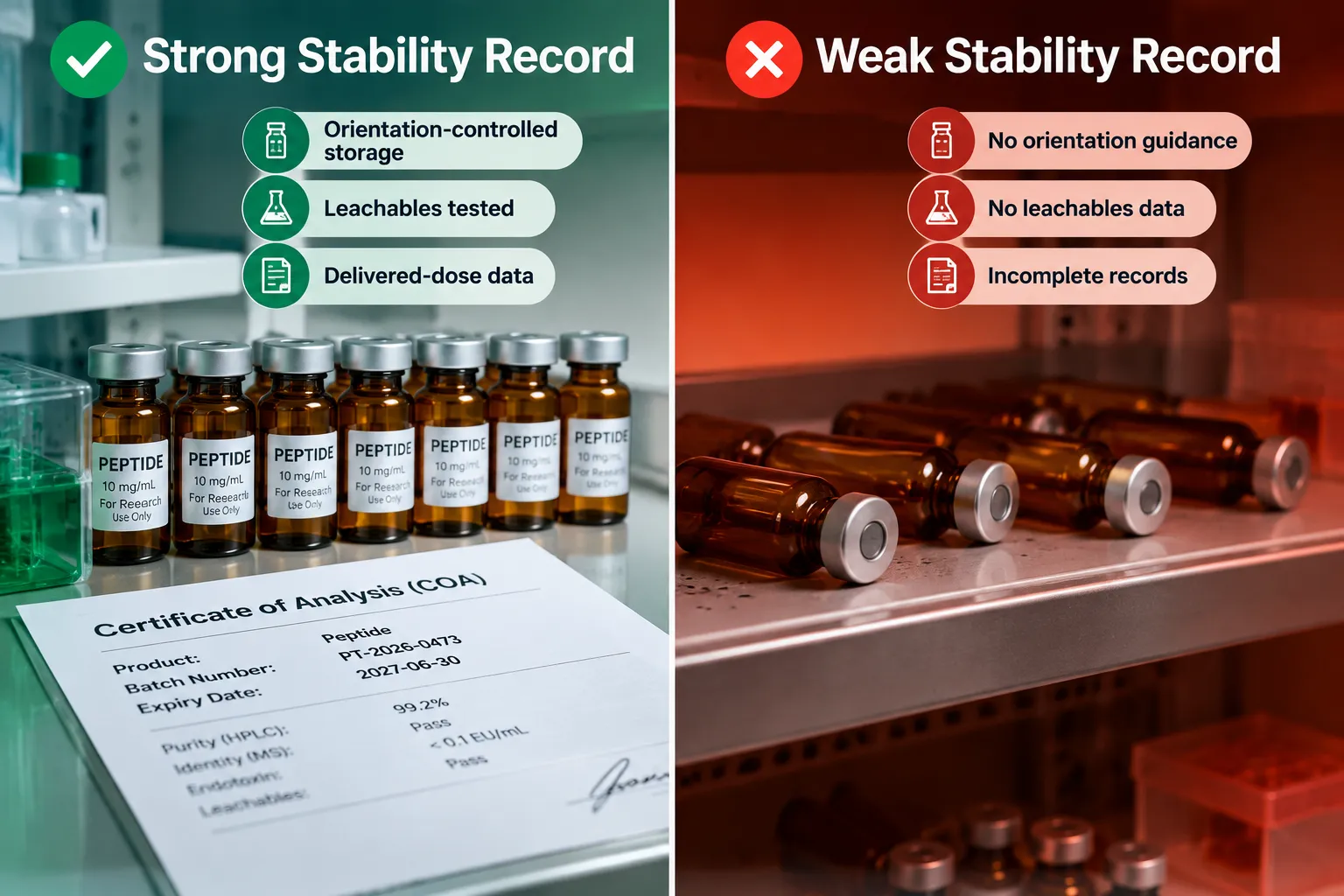
A credible stability record for a research-use nasal spray peptide should include:
- Real-time stability data at the intended storage temperature (typically 2-8°C refrigerated or 25°C ambient).
- Orientation testing, whether the bottle was stored upright or inverted affects contact between the formulation and the pump seal, which drives leachable migration.
- Delivered-dose uniformity over time, not just assay purity at T=0, but whether the pump still delivers the labeled dose at T=6 months and T=12 months.
- Leachables and extractables profile, particularly relevant for peptides sensitive to metal ion contamination.
Vendors selling research peptides with mitochondrial-targeting or renal-protective applications, such as those found under SS-31 kidney health research, should be held to especially rigorous stability standards, since oxidative degradation directly undermines the mechanism of interest.
Copper peptide formulations present a related challenge; the GHK-Cu peptide purchase and copper peptide research sourcing guide addresses how metal-ion activity in aqueous solutions affects storage and container selection, principles that translate to nasal spray formats as well.
A vendor that cannot produce a multi-timepoint stability report on request should be deprioritized, regardless of how competitive their pricing appears.
Building a Practical Comparison Framework
When evaluating multiple vendors side by side, the following scorecard approach keeps the analysis objective:
Tier 1, Disqualifying gaps (reject if absent):
- No batch COA available
- No excipient list disclosed
- No pump specification sheet
Tier 2, Differentiating factors (score and compare):
- Stability data depth (timepoints, conditions, orientation)
- Leachables/extractables testing
- Preservative-free option available
- Independent third-party testing
Tier 3, Supporting signals (positive but not decisive):
- Published research citations using the product
- Clear "not for human consumption" labeling on research formats
- Responsive technical support for formulation questions
For teams sourcing GLP-1 class peptides in nasal delivery formats, the GLP-1 peptide buy generational research concepts and sourcing notes page offers additional context on what responsible sourcing documentation looks like in practice.
Conclusion
The evaluation of research-use nasal spray peptides: a buyer's comparison of excipient disclosure, pump performance, and stability records ultimately comes down to a single question: can the vendor prove what is in the bottle and how reliably it exits the pump across the product's full shelf life?
Actionable next steps for buyers in 2026:
- Before submitting a purchase order, request the full excipient list, batch COA, and pump specification sheet in writing.
- Ask specifically whether stability data includes orientation-controlled storage and delivered-dose uniformity at multiple timepoints.
- Inquire about leachables testing if the peptide is oxidation-sensitive or metal-ion reactive.
- Use the three-tier scorecard above to compare at least two vendors before committing to a supplier relationship.
- Prioritize vendors moving toward preservative-free, device-centric formats as a signal of forward-leaning quality standards.
Formulation transparency is not a luxury specification. In nasal spray peptide research, it is the foundation of reproducible data.


Leave a Reply
Want to join the discussion?Feel free to contribute!