Call or Text 727-513-9780
  • Shopping Cart Shopping Cart
    0Shopping Cart
Pure Tested Peptides | America's most trusted Peptides for sale online
  • Peptides for sale
    • Oral Peptides for sale
      • Peptide Capsules for sale
      • BPC 157 Capsules 1000mcg
      • SLU-PP-332 Capsules | 1000 mcg
      • 5-Amino-1MQ 50mg Capsules
      • Tesofensine 500mcg
    • All Peptides for sale
    • Peptide Sprays
      • BPC 157 Nasal Spray Kit
      • BPC-157 TB500 Nasal Spray Kit
      • Semax Nasal Spray 10mg
      • Selank – Nasal Spray Kit – 10mg
      • Epithalon 50MG Nasal Spray Kit
      • Ipamorelin 10mg Nasal Spray
      • Klow Nasal Spray (BPC-157 + TB-500 + GHK-Cu + KPV) | 80mg
      • Hulk Nasal Spray Tesa / Ipa Blend 6/3 MG
      • Klow Nasal Spray
      • NAD + 500 mg Nasal Spray
      • PT-141 Nasal Spray Kit
    • GHRH Peptides
      • Ipa Peptides
      • CJC-1295 Peptides
        • CJC-1295 with DAC 5 mg
        • CJC-1295 without DAC 5 mg
        • CJC-1295 Ipa 10mg
      • Tesa Peptides
        • Tesa Peptide
        • Tesa 20 mg
    • GHK-Cu Peptides
      • All GHK-Cu Peptides
      • GHK-Cu 100mg
      • KLOW Peptide Blend – Buy KLOW blend online
    • BPC Peptides
      • All BPC Peptides
      • BPC-157
      • BPC-157 TB-500
      • BPC 157 capsules 1000mcg
    • SLU-PP-332 Peptides
      • All SLU-PP-332 Peptides
      • SLU-PP-332 5mg
    • GLP3 Peptides
    • PT-141 Peptides
      • PT-141 Peptides for sale
      • PT-141 10mg
      • PT-141 Nasal Spray
    • CAG Peptides
      • Lipo-C Peptide Blend
      • CAG 5mg
      • CAG 10mg
    • MOTS-C Peptides
      • MOTS-C Peptides for sale
      • MOTS-c peptide
      • MOTS-c 10mg *6 pack*
    • 5 Amino 1MQ Peptides
      • 5 Amino 1MQ Peptides for sale
      • 5-Amino-1MQ 50mg Capsules
      • 5-Amino-1MQ 5mg
    • Epithalon Peptides
      • Epithalon Peptides for sale
      • Epithalon 10mg
      • Epithalon 50mg
  • Shop
    • GLPs
      • 5-Amino-1MQ 50mg Capsules
      • 5-Amino-1MQ 5mg
      • L-Carnitine 500mg/ml
      • Tesofensine 500mcg
      • SLU-PP-332 5mg
      • MOTS-c 10mg *6 pack*
    • Epithalon & BPC Peptides
      • Epithalon 10mg
      • Epithalon 50mg
      • BPC-157
      • BPC 157 capsules 1000mcg
      • BPC-157 TB-500
      • BPC-157 TB500 Nasal Spray Kit
      • BPC 157 Nasal Spray Kit
    • BPC TB-500 & NAD+ Peptides
      • NAD+ 500 mg
      • KLOW Peptide Blend – Buy KLOW blend online
      • GLOW Peptide Blend
      • TB 500 5mg
      • BPC 157 capsules 1000mcg – Supplement
      • BPC 157 Nasal Spray Kit
      • BPC-157
      • BPC-157 TB500 Nasal Spray Kit
      • BPC-157 TB-500
      • BPC 157 capsules 1000mcg
    • LL-37 Peptide
      • LL-37 10 mg
    • MOTS-C & Selank
      • MOTS-c peptide
      • Selank 10mg
    • GHK Peptides
      • GHK-Cu 100mg
      • GLOW Peptide Blend
      • KLOW Peptide Blend – Buy KLOW blend online
  • COAs
  • Wholesale
    • Wholesale Peptides for sale
  • PTP FAQ
  • Affiliates
    • Selank Peptide: Advanced Pharmacological Mechanisms Underlying Its Anxiolytic and Nootropic Effects in Research
      • 5-Amino-1MQ Peptide: Detailed Mechanisms of NNMT Inhibition and Its Impact on Cellular Metabolism Research
        • MOTS-C Peptide: Unraveling Its Role in Mitochondrial Dynamics and Energy Metabolism Research
          • Epithalon Peptide and Telomerase Regulation: Investigating Its Impact on Cellular Senescence and Lifespan Research Models
            • GLP2-T vs GLP2 Tirz Peptide: Understanding the Naming, Mechanistic Nuances, and Research Implications for Gut Health
      • Peptides and Polypeptides in Modern Pharmacology: What Research on Metoprolol, Prednisone, and Amlodipine Reveals
        • Polypeptide Peptides vs NSAIDs: What Naproxen and Diclofenac Teach Tissue-Repair Researchers About BPC‑157 and TB‑500
          • Peptides and Polypeptides in Endocrine Pharmacology: How GLP-1, GLP-2, and GLP-3 Retatrutide Differ From Classic Drugs Like Prednisone and Amlodipine
          • 5‑Amino‑1MQ Peptide and NNMT Inhibition: How It Compares With Statins Like Atorvastatin in Adipose and Lipid Metabolism Research
      • Enclomiphene, Estrogen Receptor Signaling, and Luteinizing Phase Biology: What Hormone Researchers Should Measure
        • Mesenchymal Stem Cells, BPC‑157, and GHK‑Cu: How Tissue Repair Peptides Compare With Classic NSAIDs Like Naproxen in Injury Models
          • Peptide Calculator Use Cases Beyond Growth Hormone: Working Through GLP‑3 Retatrutide, MOTS‑c, and BPC‑157 Research Dosing
        • Polypeptide Peptides in Endocrine and Metabolic Pharmacology: Lessons From Amlodipine, Prednisone, and Metoprolol
        • Peptides Calculator for Advanced Blends: Worked Examples for Tesamorelin, CJC‑1295, and Ipamorelin Stacks
          • Peptides and Polypeptides in Human Physiology: How Molecular Size Shapes Research Applications
            • Selank Peptide: Advanced Pharmacological Mechanisms Underlying Its Anxiolytic and Nootropic Effects in Research
          • 5-Amino-1MQ Peptide: Detailed Mechanisms of NNMT Inhibition and Its Impact on Cellular Metabolism Research
            • MOTS-C Peptide: Unraveling Its Role in Mitochondrial Dynamics and Energy Metabolism Research
              • Epithalon Peptide and Telomerase Regulation: Investigating Its Impact on Cellular Senescence and Lifespan Research Models
                • GLP2-T vs GLP2 Tirz Peptide: Understanding the Naming, Mechanistic Nuances, and Research Implications for Gut Health
                  • Peptides and Polypeptides in Endocrine Pharmacology: How GLP-1, GLP-2, and GLP-3 Retatrutide Differ From Classic Drugs Like Prednisone and Amlodipine
                    • Polypeptide Peptides vs NSAIDs: What Naproxen and Diclofenac Teach Tissue-Repair Researchers About BPC‑157 and TB‑500
                      • Peptides and Polypeptides in Modern Pharmacology: What Research on Metoprolol, Prednisone, and Amlodipine Reveals
                        • 5‑Amino‑1MQ Peptide and NNMT Inhibition: How It Compares With Statins Like Atorvastatin in Adipose and Lipid Metabolism Research
                        • Enclomiphene, Estrogen Receptor Signaling, and Luteinizing Phase Biology: What Hormone Researchers Should Measure
                        • Mesenchymal Stem Cells, BPC‑157, and GHK‑Cu: How Tissue Repair Peptides Compare With Classic NSAIDs Like Naproxen in Injury Models
                        • Peptide Calculator Use Cases Beyond Growth Hormone: Working Through GLP‑3 Retatrutide, MOTS‑c, and BPC‑157 Research Dosing
                        • Polypeptide Peptides in Endocrine and Metabolic Pharmacology: Lessons From Amlodipine, Prednisone, and Metoprolol
                        • Peptides Calculator for Advanced Blends: Worked Examples for Tesamorelin, CJC‑1295, and Ipamorelin Stacks
                        • Peptides and Polypeptides in Human Physiology: How Molecular Size Shapes Research Applications
                        • Selank Peptide: Advanced Pharmacological Mechanisms Underlying Its Anxiolytic and Nootropic Effects in Research
                        • MOTS-C Peptide: Unraveling Its Role in Mitochondrial Dynamics and Energy Metabolism Research
                        • Peptides and Polypeptides in Modern Pharmacology: What Research on Metoprolol, Prednisone, and Amlodipine Reveals
                        • Peptides and Polypeptides in Endocrine Pharmacology: How GLP-1, GLP-2, and GLP-3 Retatrutide Differ From Classic Drugs Like Prednisone and Amlodipine
                        • 5-Amino-1MQ Peptide: Detailed Mechanisms of NNMT Inhibition and Its Impact on Cellular Metabolism Research
                        • Mesenchymal Stem Cells, BPC‑157, and GHK‑Cu: How Tissue Repair Peptides Compare With Classic NSAIDs Like Naproxen in Injury Models
                        • Peptide Calculator Use Cases Beyond Growth Hormone: Working Through GLP‑3 Retatrutide, MOTS‑c, and BPC‑157 Research Dosing
                        • GLP2-T vs GLP2 Tirz Peptide: Understanding the Naming, Mechanistic Nuances, and Research Implications for Gut Health
                        • Polypeptide Peptides in Endocrine and Metabolic Pharmacology: Lessons From Amlodipine, Prednisone, and Metoprolol
                        • Polypeptide Peptides vs NSAIDs: What Naproxen and Diclofenac Teach Tissue-Repair Researchers About BPC‑157 and TB‑500
                        • Peptides and Polypeptides in Human Physiology: How Molecular Size Shapes Research Applications
                        • Peptides Calculator for Advanced Blends: Worked Examples for Tesamorelin, CJC‑1295, and Ipamorelin Stacks
                        • 5‑Amino‑1MQ Peptide and NNMT Inhibition: How It Compares With Statins Like Atorvastatin in Adipose and Lipid Metabolism Research
                        • Enclomiphene, Estrogen Receptor Signaling, and Luteinizing Phase Biology: What Hormone Researchers Should Measure
                        • Epithalon Peptide and Telomerase Regulation: Investigating Its Impact on Cellular Senescence and Lifespan Research Models
                        • Best research protocol Klow blend
                        • best time to take BPC-157
                        • best time to take DSIP (Delta Sleep Inducing Peptide)
                        • best time to take CJC-1295
                        • best time to take AOD-9604
                        • best time to take Follistatin 344
                        • best time to take Ipamorelin
                        • best time to take MK-677 (Ibutamoren)
                        • best time to take Ligandrol (LGD-4033) — research compound
                        • best time to take Ostarine (MK-2866) — research compound
                        • best time to take GHK-CU
                        • best time to take TB-500
                        • best time to take MOTS-c
                        • best time to take Semax
                        • best time to take RAD-140 (Testolone) — research compound
                        • best time to take Thymosin Alpha-1
                        • best time to take PEG-MGF
                        • Biolife Plasma, Octapharma Plasma, and Research Peptides: How Plasma Donation Labs Differ From Peptide Suppliers
                        • best time to take YK-11 — research compound
                        • best time to take PT-141 (Bremelanotide)
                        • Best research protocol Klow blend
                        • 5-Amino-1MQ and MOTS-C Synergy: Metabolic Signaling, Mitochondria, and Research Design
                        • BPC-157 and TB-500: Investigating Their Combined Effects on Angiogenesis and Cellular Migration in Tissue Repair Models
                        • BPC-157 Peptide: Gut Barrier Function, Inflammation, and Tissue-Recovery Research
                        • 5‑Amino‑1MQ and MOTS‑c Synergy in Metabolic Research: Designing NNMT and Mitochondrial Biogenesis Stacks
                        • CJC-1295 with DAC vs. Without DAC: Half-Life, Release Kinetics, and Research Implications
                        • CJC‑1295 with DAC vs. Without DAC: Expanding on Half‑Life Differences Using Tesamorelin and Ipamorelin Blend Case Studies
                        • Collagen Biology and Copper‑Binding Peptides: How GHK‑Cu, Glow Blend, and Klow Blend Interact with Skin and Connective Tissue
                        • Collagen Biology and Regenerative Peptides: How GHK‑Cu, Glow Blend, and Klow Blend Affect Extracellular Matrix Research
                    • DNA, Telomeres, and Longevity Peptides: Positioning Epithalon and MOTS‑c in Genetic Aging Research
                      • Enclomiphene Citrate: serm Mechanism, Testosterone Research, and Stack Compatibility
                        • Enclomiphene vs Enclomiphene Citrate: Formulation, Bioavailability, and Research Distinctions
                        • Epithalon Peptide Research: Telomerase Activation, Aging, and Pineal Gland Function
                        • Estrogen Receptor Signaling and Enclomiphene: How Selective Modulators Compare with Classic Polypeptide Hormones
                        • GHK-Cu Peptide: Advanced Mechanisms in Extracellular Matrix Remodeling and Wound Healing Research
                        • GHK-Cu Peptide: Collagen Synthesis, Wound Repair, and Skin-Barrier Research Models
                        • GLP-1 vs GLP-3 vs GLP-2: Peptide Classification and Research Applications
                        • GLP-2 Peptide Research Guide: Gut Barrier Function, Nutrient Absorption, and Intestinal Recovery Models
                        • GLP-3 Retatrutide vs. GLP-1 Drugs: What Triple-Agonist Biology Changes in Research Models
                        • Ipamorelin and Tesamorelin Combination: Synergistic GH Secretagogue Research and Dosing Protocols
                        • GLP2 Tirz Peptide: What It Is, Why the Name Exists, and How Researchers Should Interpret It
                        • Klow Blend Peptide Nasal Spray: What the Formulation Is Trying to Do in Cognitive Research
                        • Mitochondria, NNMT Inhibition, and Peptide Modulators: Where MOTS‑c and 5‑Amino‑1MQ Fit in Cellular Energy Research
                        • MOTS-c Peptide: Mitochondrial Function, Energy Metabolism, and What Researchers Measure
                        • MOTS-c vs. 5-Amino-1MQ: Which Metabolic Research Questions Each Compound Actually Answers
                        • Nasal Spray Peptides: Bioavailability, Administration, and Semax/Selank Research Applications
                        • PT-141 Peptide Research: Mechanism of Action and Melanocortin Receptor Signaling
                        • Retatrutide for Research: Mechanism, Structure, and GLP-1/GLP-3 Dual Action
                        • Retatrutide for Obesity and Type 2 Diabetes: What the Latest Trial Data Suggest
                        • Tesofensine Peptide Research: Mechanism, Appetite Suppression, and Neuropeptide Y Pathways
  • Contact
    • Contact Customer Service
    • Text Customer Support
  • About US
  • Shop all peptides
  • Affiliate Program
    • Affiliate Signup
  • Login / Register Login / Register Page Link Login / Register Page Link
  • Click to open the search input field Click to open the search input field Search
  • Menu Menu
What Is BPC-157? A Research Guide to Barrier Function, Angiogenesis, and Tissue-Repair Readouts

What Is BPC-157? A Research Guide to Barrier Function, Angiogenesis, and Tissue-Repair Readouts

November 1, 2026/0 Comments/in Uncategorized/by

Fewer than two dozen human participants have completed controlled trials on BPC-157, yet this 15-amino-acid peptide now appears in sports recovery forums, military wellness programs, and compounding pharmacy catalogs across the United States. That gap between limited clinical evidence and widespread interest makes a clear-headed, mechanism-focused explainer essential for researchers and informed readers alike.

This guide to What Is BPC-157? A Research Guide to Barrier Function, Angiogenesis, and Tissue-Repair Readouts separates molecular hypotheses from measurable laboratory assays across four key research models: epithelial, vascular, tendon, and gastrointestinal tissue.

Key Takeaways

  • BPC-157 is a synthetic pentadecapeptide derived from a human gastric juice protein, studied primarily in preclinical (animal and cell) models.
  • Its most documented mechanisms involve nitric oxide (NO) system modulation, VEGF-driven angiogenesis, and tight-junction stabilization.
  • Measurable assays, TEER, tube-formation, scratch assays, and histological scoring, are the practical tools researchers use to evaluate these effects.
  • Human clinical data remain sparse, with ongoing trials as of 2026 still in early phases.
  • Regulatory status is unresolved; the FDA has expressed skepticism, and WADA has banned the peptide in competitive sport.

Core Biology: What BPC-157 Is and Where It Comes From

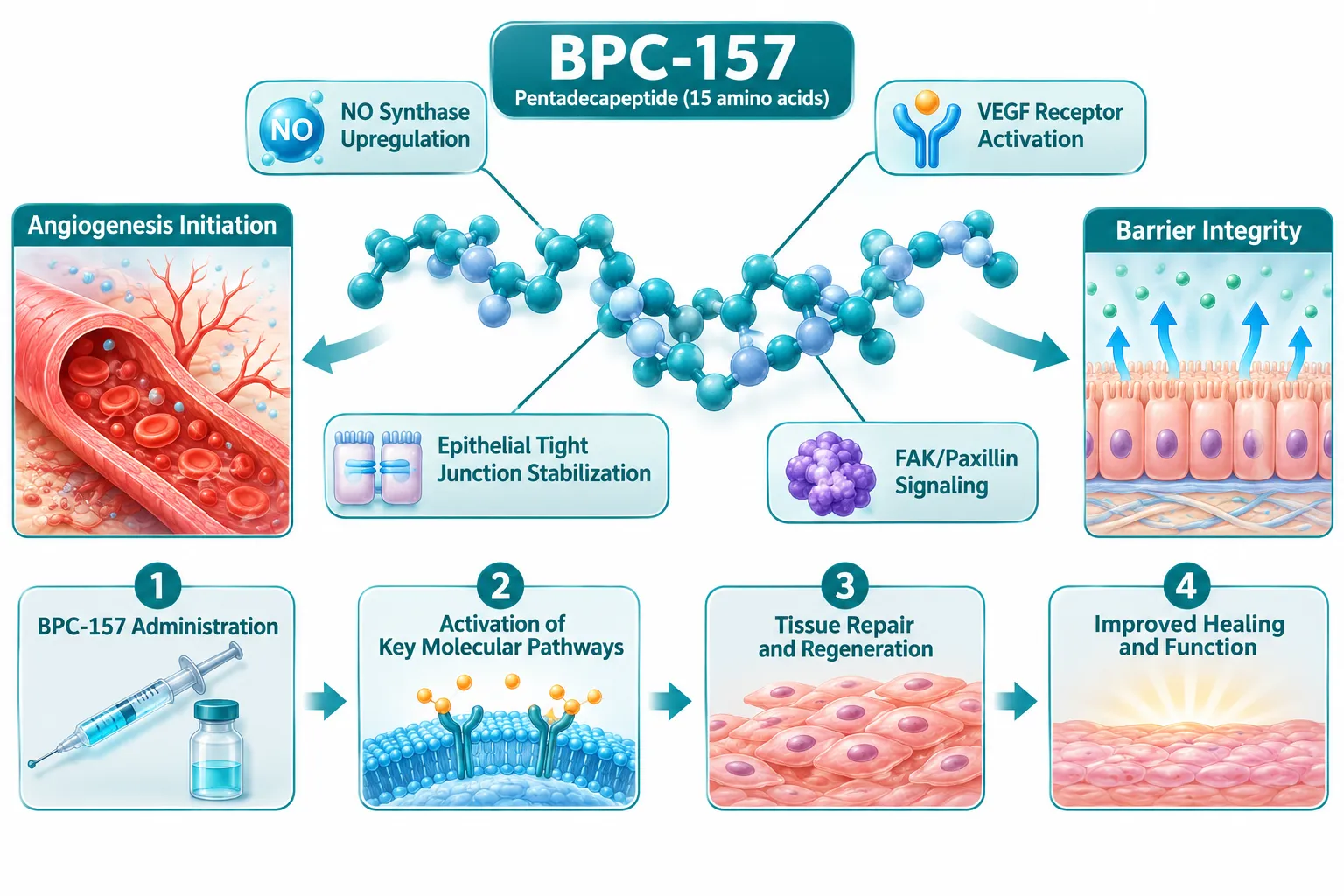
BPC-157 (Body Protection Compound-157) is a synthetic, stable pentadecapeptide consisting of 15 amino acids. Researchers derived its sequence from a larger protein found in human gastric juice. The "stable" designation is important: unlike many peptides, BPC-157 retains its structure in aqueous solution, making it practical for cell culture and animal studies.
Core Biology: What BPC-157 Is and Where It Comes From

The peptide does not bind to a single, well-characterized receptor in the way classical drugs do. Instead, preclinical evidence points to three overlapping mechanistic axes:

  1. Nitric Oxide (NO) system modulation, BPC-157 appears to influence endothelial NO synthase (eNOS) activity, which regulates vasodilation, vascular permeability, and cellular survival signals.
  2. Growth factor cross-talk, Studies report upregulation of vascular endothelial growth factor (VEGF) and its receptors, a key step in new blood vessel formation.
  3. Cytoskeletal and adhesion signaling, Evidence from tendon and gut models implicates FAK (focal adhesion kinase) and paxillin pathways, which govern how cells attach to their surroundings and migrate during repair.

These three axes are not mutually exclusive. In gastrointestinal models, for example, NO modulation and VEGF cross-talk appear to work together to accelerate mucosal healing. Understanding which axis dominates in a given tissue type is a central challenge for researchers designing assays.


Measuring the Key Effects: Assays Across Tissue Models

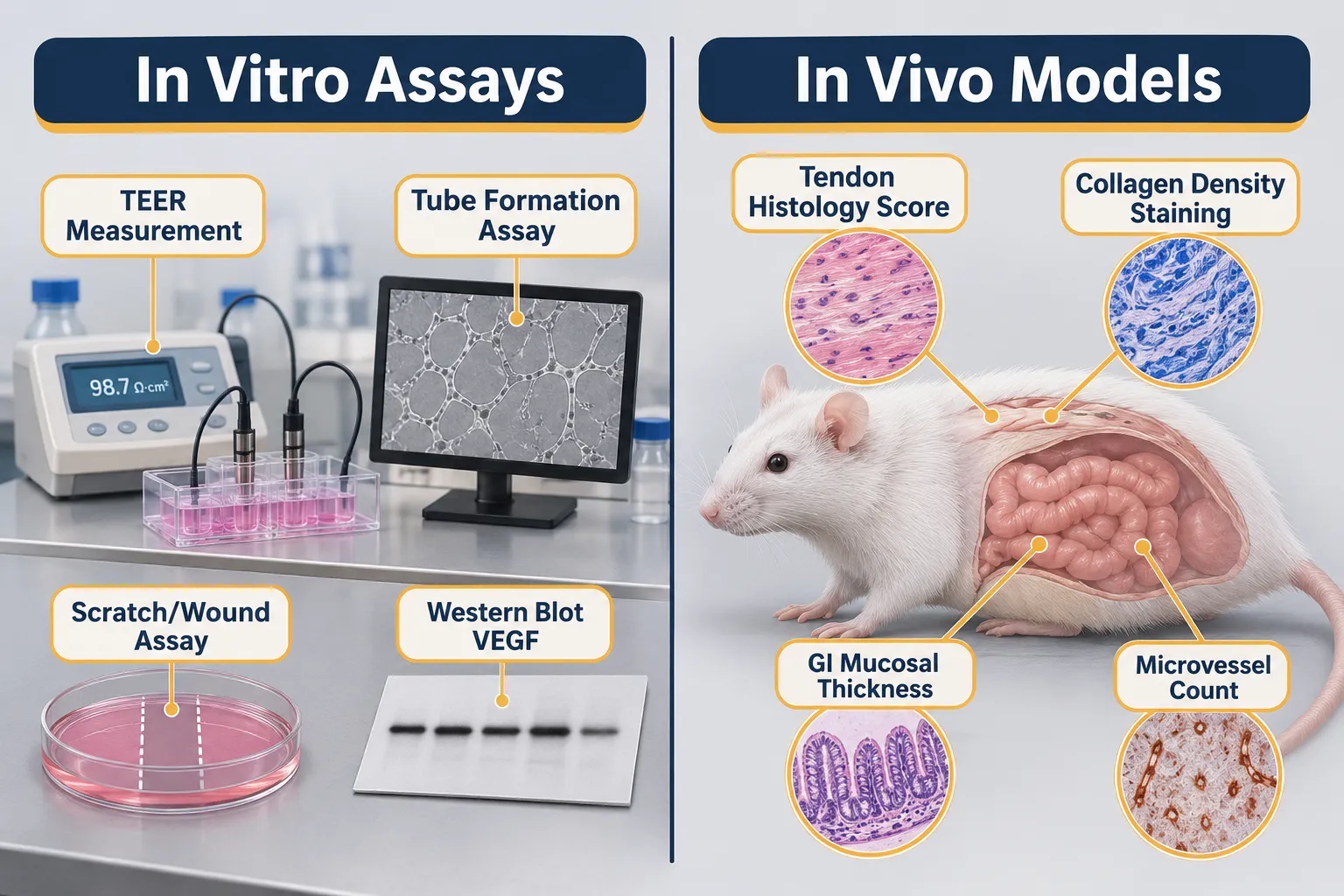
Understanding What Is BPC-157? A Research Guide to Barrier Function, Angiogenesis, and Tissue-Repair Readouts requires knowing which laboratory tools actually capture its effects. Each proposed mechanism maps onto specific, reproducible readouts.
Measuring the Key Effects: Assays Across Tissue Models

Barrier Function Readouts

Barrier function refers to a tissue's ability to restrict unwanted passage of molecules and pathogens between compartments. For BPC-157 research, two models dominate:

  • Intestinal epithelial monolayers, Researchers grow Caco-2 or T84 cells on permeable supports and measure Trans-Epithelial Electrical Resistance (TEER). Higher TEER signals tighter junctions. BPC-157-treated monolayers in several preclinical reports show increased TEER alongside elevated expression of claudin and occludin, the proteins that physically seal tight junctions.
  • Gastric mucosal models, In rodent studies, barrier integrity is assessed histologically by measuring mucosal thickness, goblet cell density, and the depth of stress-induced lesions.

Pull quote: "TEER measurement remains the gold-standard in vitro readout for peptide-driven barrier restoration, it is quantitative, reproducible, and translatable across cell lines."

Angiogenesis Readouts

Angiogenesis, the sprouting of new blood vessels from existing ones, is central to tissue repair because oxygen and nutrient delivery must keep pace with cellular proliferation. Key assays include:

Assay What It Measures Model Type
Tube formation (Matrigel) Endothelial cell network assembly In vitro
Scratch / wound-closure Cell migration rate In vitro
Aortic ring sprouting Vessel outgrowth ex vivo Ex vivo
Microvessel density staining CD31+ vessel count per field In vivo

Emerging 2026 work has focused on the FBXO22-BACH1 axis, a ubiquitin-proteasome pathway that regulates transcription factors controlling angiogenic gene expression. Early data suggest BPC-157 may influence BACH1 degradation, freeing pro-angiogenic target genes. This is a molecular hypothesis requiring further validation, but it represents a more precise mechanistic target than earlier general VEGF claims.

Tendon and Musculoskeletal Readouts

Tendon healing is slow and scar-prone. In rodent Achilles and rotator-cuff transection models, BPC-157 effects are quantified through:

  • Histological collagen scoring (Bonar scale or custom rubric)
  • Biomechanical load-to-failure testing
  • Immunohistochemistry for tenascin-C and type I/III collagen ratio

Results across multiple rodent studies are generally positive, but editorials published through 2026 have flagged concerns about study design quality, small sample sizes, and the absence of large-animal or human replication. A recurring phrase in expert commentary is "Regeneration or Risk?", highlighting that accelerating cell proliferation in poorly controlled conditions could theoretically promote fibrosis rather than true regeneration.


Regulatory Landscape and Research Outlook in 2026

The regulatory and competitive sport context shapes how researchers must frame their work. As of late 2026:

  • The FDA has not approved BPC-157 for any indication and has expressed explicit skepticism about compounding pharmacy preparations. An advisory committee vote on compounded peptides earlier this year reflected significant caution.
  • WADA lists BPC-157 as a prohibited substance in competition, classifying it under peptide hormones and growth factors. Sports researchers and athletes face strict prohibitions.
  • Off-label use continues to grow despite no approval, driven largely by anecdotal reports and social media visibility.

Regulatory Landscape and Research Outlook in 2026

Clinical trials registered as of 2026 remain in early phases, targeting gastrointestinal conditions such as inflammatory bowel disease and post-surgical mucosal healing. Dentistry has emerged as an exploratory niche, with pilot-scale work examining BPC-157 effects on periodontal barrier tissue. For researchers comparing peptide study designs, context from related compounds like SS-31 peptide research considerations or LL-37 versus SS-31 benefits can inform assay selection and controls.

Understanding broader peptide categories also helps place BPC-157 in context. Researchers studying metabolic and tissue-repair agents may find comparative value in resources on what constitutes the strongest peptide for weight loss or the design considerations behind CJC1295 Ipamorelin dosage protocols. For those sourcing verified compounds for preclinical work, reviewing lab-tested peptides supply standards is an important step. Additionally, comparing growth hormone-axis peptides such as tesa versus sermorelin illustrates how different peptide classes target overlapping but distinct tissue-repair pathways.


Conclusion

What Is BPC-157? A Research Guide to Barrier Function, Angiogenesis, and Tissue-Repair Readouts ultimately points to a peptide with a rich preclinical profile and a thin clinical one. The molecular mechanisms, NO-system modulation, VEGF-pathway activation, tight-junction reinforcement, and the emerging FBXO22-BACH1 angiogenesis axis, are scientifically plausible and measurable with established assays.

Actionable next steps for researchers:

  • Prioritize assay selection based on the specific tissue model: TEER for barrier studies, tube-formation and microvessel density for angiogenesis, Bonar scoring for tendon.
  • Apply rigorous controls and pre-register study designs to address the reproducibility concerns flagged in 2026 expert commentary.
  • Monitor FDA and WADA guidance updates before designing any translational or human-adjacent protocol.
  • Treat FBXO22-BACH1 data as a hypothesis-generating finding requiring independent replication.
  • Cross-reference BPC-157 findings with structurally distinct cytoprotective peptides to build comparative mechanistic understanding.

The evidence base is growing, but the gap between preclinical promise and human-validated outcomes remains wide. Disciplined assay design and transparent reporting are the tools that will close it.

Tags: angiogenesis, barrier function, bpc-157, nitric oxide signaling, peptide research, tendon healing, tissue repair, vegf pathway
https://www.puretestedpeptides.com/wp-content/uploads/2026/11/what-is-bpc-157-a-research-guide-to-barrier-function-angiogenesis-and-tissue-rep.webp 1024 1536 https://www.puretestedpeptides.com/wp-content/uploads/2026/01/buy-peptides-online.jpg 2026-11-01 14:04:052026-11-01 14:04:05What Is BPC-157? A Research Guide to Barrier Function, Angiogenesis, and Tissue-Repair Readouts
You might also like
Phosphate-Buffered Saline for Peptide Research: Osmolality, pH Drift, and Vehicle-Control Design Phosphate-Buffered Saline for Peptide Research: Osmolality, pH Drift, and Vehicle-Control Design
Meloxicam and Tissue-Repair Peptides: Comparing Nonsteroidal Anti-Inflammatory Drugs with BPC-157 in In Vitro Models Meloxicam and Tissue-Repair Peptides: Comparing Nonsteroidal Anti-Inflammatory Drugs with BPC-157 in In Vitro Models
Peptides: How Researchers Classify Chains, Polypeptides, and Hormone Analogues in Lab Use Peptides: How Researchers Classify Chains, Polypeptides, and Hormone Analogues in Lab Use
BPC-157 Peptide: Understanding Its Regenerative Mechanisms and Diverse Research Applications BPC-157 Peptide: Understanding Its Regenerative Mechanisms and Diverse Research Applications
Klow Peptide Nasal Spray vs Single-Agent Semax or Selank: Designing a Formulation-First Comparison Klow Peptide Nasal Spray vs Single-Agent Semax or Selank: Designing a Formulation-First Comparison
Complement-Dependent Cytotoxicity: What Peptide Researchers Need to Know About Immune Assays and Safety Complement-Dependent Cytotoxicity: What Peptide Researchers Need to Know About Immune Assays and Safety
Meloxicam vs BPC-157 and TB-500: How NSAIDs and Tissue-Repair Peptides Differ in In Vitro Injury Models Meloxicam vs BPC-157 and TB-500: How NSAIDs and Tissue-Repair Peptides Differ in In Vitro Injury Models
Where to Buy Glow Blend, Klow Blend, and Klow Nasal Peptide Sprays: Lab-Grade vs Cosmetic-Grade Options Where to Buy Glow Blend, Klow Blend, and Klow Nasal Peptide Sprays: Lab-Grade vs Cosmetic-Grade Options
0 replies

Leave a Reply

Want to join the discussion?
Feel free to contribute!

Leave a Reply Cancel reply

Your email address will not be published. Required fields are marked *

×

Helpful Links

  • My account
  • Cart
  • Checkout
  • Refund and Returns Policy
  • Privacy Policy
  • SMS Privacy Policy
  • Login
  • My Account
  • Logout

USA Made Lab Tested Peptides

All products are sold for research, laboratory, or analytical purposes only, and are not for human consumption


Pure Tested Peptides is a chemical supplier. Pure Tested Peptides is not a compounding / chemical compounding facility as defined under 503A of the Federal Food, Drug, and Cosmetic act. Pure Tested Peptides is not an outsourcing facility as defined under 503B of the Federal Food, Drug, and Cosmetic act.

The statements made within this website have not been evaluated by the US Food and Drug Administration. The products we offer are not intended to diagnose, treat, cure or prevent any disease.

Human/Animal Consumption Prohibited. Laboratory/In-Vitro Experimental Use Only

Link to: Enclomiphene Base vs Enclomiphene Citrate: Solubility, Salt-Form Identity, and Analytical Method Selection Link to: Enclomiphene Base vs Enclomiphene Citrate: Solubility, Salt-Form Identity, and Analytical Method Selection Enclomiphene Base vs Enclomiphene Citrate: Solubility, Salt-Form Identity, and...Enclomiphene Base vs Enclomiphene Citrate: Solubility, Salt-Form Identity, and Analytical Method Selection Link to: What Is GHK-Cu? Copper-Dependent Matrix Remodeling and Fibroblast, Keratinocyte Crosstalk in Research Models Link to: What Is GHK-Cu? Copper-Dependent Matrix Remodeling and Fibroblast, Keratinocyte Crosstalk in Research Models What Is GHK-Cu? Copper-Dependent Matrix Remodeling and Fibroblast, Keratinocyte Crosstalk in Research ModelsWhat Is GHK-Cu? Copper-Dependent Matrix Remodeling and Fibroblast, Keratinocyte...
Scroll to top Scroll to top Scroll to top