Call or Text 727-513-9780
  • Shopping Cart Shopping Cart
    0Shopping Cart
Pure Tested Peptides | America's most trusted Peptides for sale online
  • Peptides for sale
    • Oral Peptides for sale
      • Peptide Capsules for sale
      • BPC 157 Capsules 1000mcg
      • SLU-PP-332 Capsules | 1000 mcg
      • 5-Amino-1MQ 50mg Capsules
      • Tesofensine 500mcg
    • All Peptides for sale
    • Peptide Sprays
      • BPC 157 Nasal Spray Kit
      • BPC-157 TB500 Nasal Spray Kit
      • Semax Nasal Spray 10mg
      • Selank – Nasal Spray Kit – 10mg
      • Epithalon 50MG Nasal Spray Kit
      • Ipamorelin 10mg Nasal Spray
      • Klow Nasal Spray (BPC-157 + TB-500 + GHK-Cu + KPV) | 80mg
      • Hulk Nasal Spray Tesa / Ipa Blend 6/3 MG
      • Klow Nasal Spray
      • NAD + 500 mg Nasal Spray
      • PT-141 Nasal Spray Kit
    • GHRH Peptides
      • Ipa Peptides
      • CJC-1295 Peptides
        • CJC-1295 with DAC 5 mg
        • CJC-1295 without DAC 5 mg
        • CJC-1295 Ipa 10mg
      • Tesa Peptides
        • Tesa Peptide
        • Tesa 20 mg
    • GHK-Cu Peptides
      • All GHK-Cu Peptides
      • GHK-Cu 100mg
      • KLOW Peptide Blend – Buy KLOW blend online
    • BPC Peptides
      • All BPC Peptides
      • BPC-157
      • BPC-157 TB-500
      • BPC 157 capsules 1000mcg
    • SLU-PP-332 Peptides
      • All SLU-PP-332 Peptides
      • SLU-PP-332 5mg
    • GLP3 Peptides
    • PT-141 Peptides
      • PT-141 Peptides for sale
      • PT-141 10mg
      • PT-141 Nasal Spray
    • CAG Peptides
      • Lipo-C Peptide Blend
      • CAG 5mg
      • CAG 10mg
    • MOTS-C Peptides
      • MOTS-C Peptides for sale
      • MOTS-c peptide
      • MOTS-c 10mg *6 pack*
    • 5 Amino 1MQ Peptides
      • 5 Amino 1MQ Peptides for sale
      • 5-Amino-1MQ 50mg Capsules
      • 5-Amino-1MQ 5mg
    • Epithalon Peptides
      • Epithalon Peptides for sale
      • Epithalon 10mg
      • Epithalon 50mg
  • Shop
    • GLPs
      • 5-Amino-1MQ 50mg Capsules
      • 5-Amino-1MQ 5mg
      • L-Carnitine 500mg/ml
      • Tesofensine 500mcg
      • SLU-PP-332 5mg
      • MOTS-c 10mg *6 pack*
    • Epithalon & BPC Peptides
      • Epithalon 10mg
      • Epithalon 50mg
      • BPC-157
      • BPC 157 capsules 1000mcg
      • BPC-157 TB-500
      • BPC-157 TB500 Nasal Spray Kit
      • BPC 157 Nasal Spray Kit
    • BPC TB-500 & NAD+ Peptides
      • NAD+ 500 mg
      • KLOW Peptide Blend – Buy KLOW blend online
      • GLOW Peptide Blend
      • TB 500 5mg
      • BPC 157 capsules 1000mcg – Supplement
      • BPC 157 Nasal Spray Kit
      • BPC-157
      • BPC-157 TB500 Nasal Spray Kit
      • BPC-157 TB-500
      • BPC 157 capsules 1000mcg
    • LL-37 Peptide
      • LL-37 10 mg
    • MOTS-C & Selank
      • MOTS-c peptide
      • Selank 10mg
    • GHK Peptides
      • GHK-Cu 100mg
      • GLOW Peptide Blend
      • KLOW Peptide Blend – Buy KLOW blend online
  • COAs
  • Wholesale
    • Wholesale Peptides for sale
  • PTP FAQ
  • Affiliates
    • Selank Peptide: Advanced Pharmacological Mechanisms Underlying Its Anxiolytic and Nootropic Effects in Research
      • 5-Amino-1MQ Peptide: Detailed Mechanisms of NNMT Inhibition and Its Impact on Cellular Metabolism Research
        • MOTS-C Peptide: Unraveling Its Role in Mitochondrial Dynamics and Energy Metabolism Research
          • Epithalon Peptide and Telomerase Regulation: Investigating Its Impact on Cellular Senescence and Lifespan Research Models
            • GLP2-T vs GLP2 Tirz Peptide: Understanding the Naming, Mechanistic Nuances, and Research Implications for Gut Health
      • Peptides and Polypeptides in Modern Pharmacology: What Research on Metoprolol, Prednisone, and Amlodipine Reveals
        • Polypeptide Peptides vs NSAIDs: What Naproxen and Diclofenac Teach Tissue-Repair Researchers About BPC‑157 and TB‑500
          • Peptides and Polypeptides in Endocrine Pharmacology: How GLP-1, GLP-2, and GLP-3 Retatrutide Differ From Classic Drugs Like Prednisone and Amlodipine
          • 5‑Amino‑1MQ Peptide and NNMT Inhibition: How It Compares With Statins Like Atorvastatin in Adipose and Lipid Metabolism Research
      • Enclomiphene, Estrogen Receptor Signaling, and Luteinizing Phase Biology: What Hormone Researchers Should Measure
        • Mesenchymal Stem Cells, BPC‑157, and GHK‑Cu: How Tissue Repair Peptides Compare With Classic NSAIDs Like Naproxen in Injury Models
          • Peptide Calculator Use Cases Beyond Growth Hormone: Working Through GLP‑3 Retatrutide, MOTS‑c, and BPC‑157 Research Dosing
        • Polypeptide Peptides in Endocrine and Metabolic Pharmacology: Lessons From Amlodipine, Prednisone, and Metoprolol
        • Peptides Calculator for Advanced Blends: Worked Examples for Tesamorelin, CJC‑1295, and Ipamorelin Stacks
          • Peptides and Polypeptides in Human Physiology: How Molecular Size Shapes Research Applications
            • Selank Peptide: Advanced Pharmacological Mechanisms Underlying Its Anxiolytic and Nootropic Effects in Research
          • 5-Amino-1MQ Peptide: Detailed Mechanisms of NNMT Inhibition and Its Impact on Cellular Metabolism Research
            • MOTS-C Peptide: Unraveling Its Role in Mitochondrial Dynamics and Energy Metabolism Research
              • Epithalon Peptide and Telomerase Regulation: Investigating Its Impact on Cellular Senescence and Lifespan Research Models
                • GLP2-T vs GLP2 Tirz Peptide: Understanding the Naming, Mechanistic Nuances, and Research Implications for Gut Health
                  • Peptides and Polypeptides in Endocrine Pharmacology: How GLP-1, GLP-2, and GLP-3 Retatrutide Differ From Classic Drugs Like Prednisone and Amlodipine
                    • Polypeptide Peptides vs NSAIDs: What Naproxen and Diclofenac Teach Tissue-Repair Researchers About BPC‑157 and TB‑500
                      • Peptides and Polypeptides in Modern Pharmacology: What Research on Metoprolol, Prednisone, and Amlodipine Reveals
                        • 5‑Amino‑1MQ Peptide and NNMT Inhibition: How It Compares With Statins Like Atorvastatin in Adipose and Lipid Metabolism Research
                        • Enclomiphene, Estrogen Receptor Signaling, and Luteinizing Phase Biology: What Hormone Researchers Should Measure
                        • Mesenchymal Stem Cells, BPC‑157, and GHK‑Cu: How Tissue Repair Peptides Compare With Classic NSAIDs Like Naproxen in Injury Models
                        • Peptide Calculator Use Cases Beyond Growth Hormone: Working Through GLP‑3 Retatrutide, MOTS‑c, and BPC‑157 Research Dosing
                        • Polypeptide Peptides in Endocrine and Metabolic Pharmacology: Lessons From Amlodipine, Prednisone, and Metoprolol
                        • Peptides Calculator for Advanced Blends: Worked Examples for Tesamorelin, CJC‑1295, and Ipamorelin Stacks
                        • Peptides and Polypeptides in Human Physiology: How Molecular Size Shapes Research Applications
                        • Selank Peptide: Advanced Pharmacological Mechanisms Underlying Its Anxiolytic and Nootropic Effects in Research
                        • MOTS-C Peptide: Unraveling Its Role in Mitochondrial Dynamics and Energy Metabolism Research
                        • Peptides and Polypeptides in Modern Pharmacology: What Research on Metoprolol, Prednisone, and Amlodipine Reveals
                        • Peptides and Polypeptides in Endocrine Pharmacology: How GLP-1, GLP-2, and GLP-3 Retatrutide Differ From Classic Drugs Like Prednisone and Amlodipine
                        • 5-Amino-1MQ Peptide: Detailed Mechanisms of NNMT Inhibition and Its Impact on Cellular Metabolism Research
                        • Mesenchymal Stem Cells, BPC‑157, and GHK‑Cu: How Tissue Repair Peptides Compare With Classic NSAIDs Like Naproxen in Injury Models
                        • Peptide Calculator Use Cases Beyond Growth Hormone: Working Through GLP‑3 Retatrutide, MOTS‑c, and BPC‑157 Research Dosing
                        • GLP2-T vs GLP2 Tirz Peptide: Understanding the Naming, Mechanistic Nuances, and Research Implications for Gut Health
                        • Polypeptide Peptides in Endocrine and Metabolic Pharmacology: Lessons From Amlodipine, Prednisone, and Metoprolol
                        • Polypeptide Peptides vs NSAIDs: What Naproxen and Diclofenac Teach Tissue-Repair Researchers About BPC‑157 and TB‑500
                        • Peptides and Polypeptides in Human Physiology: How Molecular Size Shapes Research Applications
                        • Peptides Calculator for Advanced Blends: Worked Examples for Tesamorelin, CJC‑1295, and Ipamorelin Stacks
                        • 5‑Amino‑1MQ Peptide and NNMT Inhibition: How It Compares With Statins Like Atorvastatin in Adipose and Lipid Metabolism Research
                        • Enclomiphene, Estrogen Receptor Signaling, and Luteinizing Phase Biology: What Hormone Researchers Should Measure
                        • Epithalon Peptide and Telomerase Regulation: Investigating Its Impact on Cellular Senescence and Lifespan Research Models
                        • Best research protocol Klow blend
                        • best time to take BPC-157
                        • best time to take DSIP (Delta Sleep Inducing Peptide)
                        • best time to take CJC-1295
                        • best time to take AOD-9604
                        • best time to take Follistatin 344
                        • best time to take Ipamorelin
                        • best time to take MK-677 (Ibutamoren)
                        • best time to take Ligandrol (LGD-4033) — research compound
                        • best time to take Ostarine (MK-2866) — research compound
                        • best time to take GHK-CU
                        • best time to take TB-500
                        • best time to take MOTS-c
                        • best time to take Semax
                        • best time to take RAD-140 (Testolone) — research compound
                        • best time to take Thymosin Alpha-1
                        • best time to take PEG-MGF
                        • Biolife Plasma, Octapharma Plasma, and Research Peptides: How Plasma Donation Labs Differ From Peptide Suppliers
                        • best time to take YK-11 — research compound
                        • best time to take PT-141 (Bremelanotide)
                        • Best research protocol Klow blend
                        • 5-Amino-1MQ and MOTS-C Synergy: Metabolic Signaling, Mitochondria, and Research Design
                        • BPC-157 and TB-500: Investigating Their Combined Effects on Angiogenesis and Cellular Migration in Tissue Repair Models
                        • BPC-157 Peptide: Gut Barrier Function, Inflammation, and Tissue-Recovery Research
                        • 5‑Amino‑1MQ and MOTS‑c Synergy in Metabolic Research: Designing NNMT and Mitochondrial Biogenesis Stacks
                        • CJC-1295 with DAC vs. Without DAC: Half-Life, Release Kinetics, and Research Implications
                        • CJC‑1295 with DAC vs. Without DAC: Expanding on Half‑Life Differences Using Tesamorelin and Ipamorelin Blend Case Studies
                        • Collagen Biology and Copper‑Binding Peptides: How GHK‑Cu, Glow Blend, and Klow Blend Interact with Skin and Connective Tissue
                        • Collagen Biology and Regenerative Peptides: How GHK‑Cu, Glow Blend, and Klow Blend Affect Extracellular Matrix Research
                    • DNA, Telomeres, and Longevity Peptides: Positioning Epithalon and MOTS‑c in Genetic Aging Research
                      • Enclomiphene Citrate: serm Mechanism, Testosterone Research, and Stack Compatibility
                        • Enclomiphene vs Enclomiphene Citrate: Formulation, Bioavailability, and Research Distinctions
                        • Epithalon Peptide Research: Telomerase Activation, Aging, and Pineal Gland Function
                        • Estrogen Receptor Signaling and Enclomiphene: How Selective Modulators Compare with Classic Polypeptide Hormones
                        • GHK-Cu Peptide: Advanced Mechanisms in Extracellular Matrix Remodeling and Wound Healing Research
                        • GHK-Cu Peptide: Collagen Synthesis, Wound Repair, and Skin-Barrier Research Models
                        • GLP-1 vs GLP-3 vs GLP-2: Peptide Classification and Research Applications
                        • GLP-2 Peptide Research Guide: Gut Barrier Function, Nutrient Absorption, and Intestinal Recovery Models
                        • GLP-3 Retatrutide vs. GLP-1 Drugs: What Triple-Agonist Biology Changes in Research Models
                        • Ipamorelin and Tesamorelin Combination: Synergistic GH Secretagogue Research and Dosing Protocols
                        • GLP2 Tirz Peptide: What It Is, Why the Name Exists, and How Researchers Should Interpret It
                        • Klow Blend Peptide Nasal Spray: What the Formulation Is Trying to Do in Cognitive Research
                        • Mitochondria, NNMT Inhibition, and Peptide Modulators: Where MOTS‑c and 5‑Amino‑1MQ Fit in Cellular Energy Research
                        • MOTS-c Peptide: Mitochondrial Function, Energy Metabolism, and What Researchers Measure
                        • MOTS-c vs. 5-Amino-1MQ: Which Metabolic Research Questions Each Compound Actually Answers
                        • Nasal Spray Peptides: Bioavailability, Administration, and Semax/Selank Research Applications
                        • PT-141 Peptide Research: Mechanism of Action and Melanocortin Receptor Signaling
                        • Retatrutide for Research: Mechanism, Structure, and GLP-1/GLP-3 Dual Action
                        • Retatrutide for Obesity and Type 2 Diabetes: What the Latest Trial Data Suggest
                        • Tesofensine Peptide Research: Mechanism, Appetite Suppression, and Neuropeptide Y Pathways
  • Contact
    • Contact Customer Service
    • Text Customer Support
  • About US
  • Shop all peptides
  • Affiliate Program
    • Affiliate Signup
  • Login / Register Login / Register Page Link Login / Register Page Link
  • Click to open the search input field Click to open the search input field Search
  • Menu Menu
Meloxicam vs BPC-157 and TB-500: How NSAIDs and Tissue-Repair Peptides Differ in In Vitro Injury Models

Meloxicam vs BPC-157 and TB-500: How NSAIDs and Tissue-Repair Peptides Differ in In Vitro Injury Models

September 20, 2026/0 Comments/in Uncategorized/by

Selective COX-2 inhibition reduces myofiber cross-sectional area by up to 33% during the first three weeks after muscle injury, a finding that challenges the routine use of NSAIDs like meloxicam in early musculoskeletal recovery. This single data point captures the central tension explored in Meloxicam vs BPC-157 and TB-500: How NSAIDs and Tissue-Repair Peptides Differ in In Vitro Injury Models: two fundamentally different pharmacological strategies, one aimed at quieting inflammation and one aimed at rebuilding tissue, produce strikingly different outcomes at the cellular level.

Key Takeaways

  • Meloxicam suppresses COX-2-dependent prostaglandin signaling, which reduces inflammation but may simultaneously impair early tissue regeneration in muscle, bone, and tendon models.
  • BPC-157 activates FAK-paxillin, PI3K/Akt, VEGF, and TGF-beta pathways in vitro, supporting fibroblast proliferation, collagen synthesis, and angiogenesis.
  • TB-500 promotes actin polymerization, progenitor cell recruitment, and collagen fiber organization through MAPK, NF-kB, and cytoskeletal repair pathways.
  • No robust human randomized controlled trials currently compare BPC-157 or TB-500 with meloxicam in musculoskeletal injury; all comparative evidence comes from cell and rodent studies.
  • Both peptides remain unapproved, are excluded from FDA compounding lists, and are prohibited under WADA rules, making them strictly research-use compounds as of 2026.

How Meloxicam Works in Tissue-Injury Cell Models

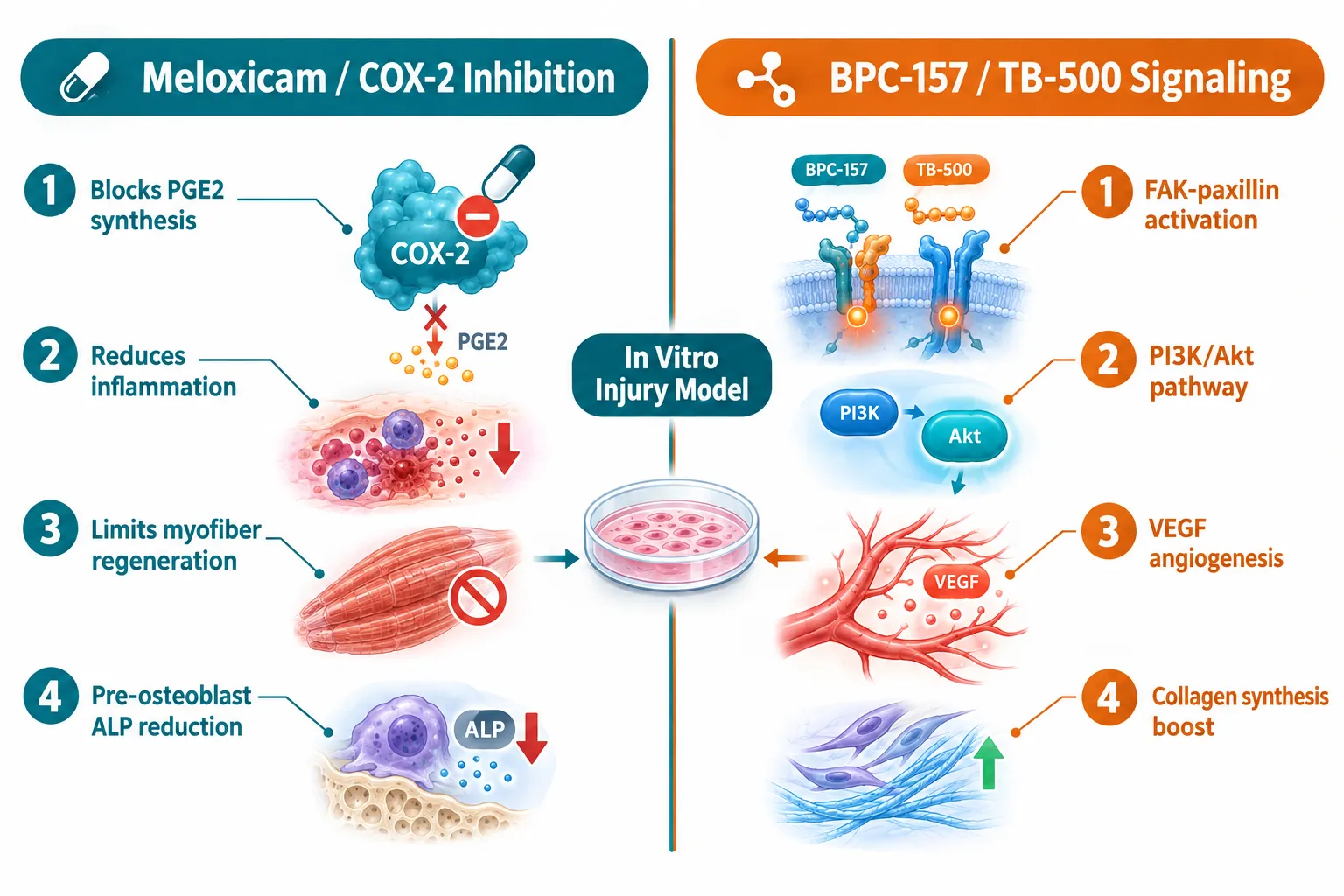
Meloxicam is a COX-2-preferential NSAID with a COX-2:COX-1 IC50 ratio of approximately 0.09 in human whole-blood assays, meaning it inhibits COX-2 at concentrations far below those needed to affect COX-1. This selectivity drives its analgesic and anti-inflammatory profile, but it also places COX-2-dependent regenerative signaling directly in the line of fire.
How Meloxicam Works in Tissue-Injury Cell Models

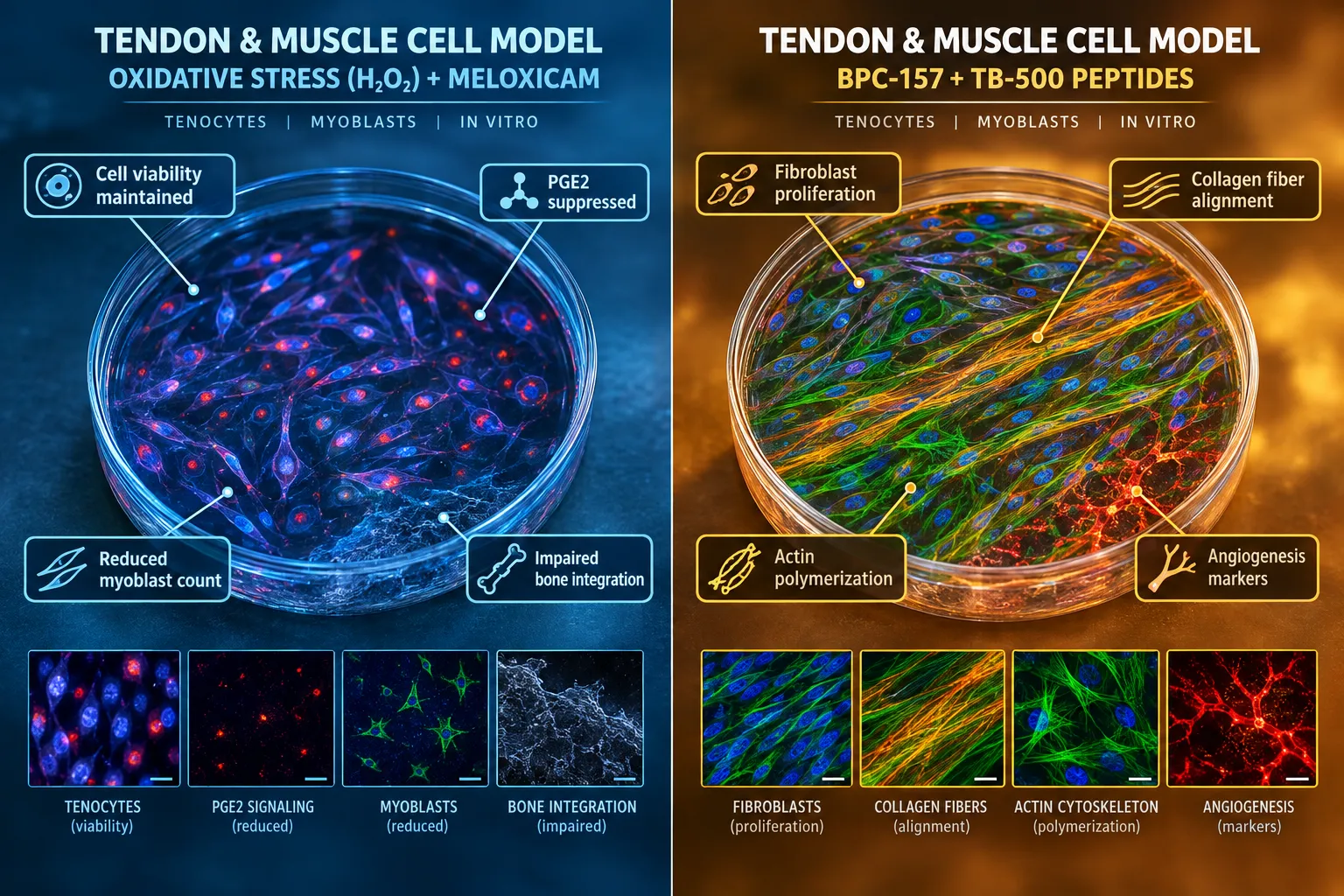
In human Achilles tendon-derived tenocytes exposed to oxidative stress via hydrogen peroxide, 24-hour meloxicam treatment can increase cell metabolic activity relative to untreated controls. At the same time, it consistently reduces prostaglandin E2 (PGE2) production through COX-2 inhibition. This creates a mechanistic paradox: the drug may support short-term cell viability under stress while simultaneously blunting the prostaglandin signals that coordinate early repair cascades.

The downstream consequences vary by tissue type:

  • Muscle: COX-2 inhibitors analogous to meloxicam reduce myoblast count and inflammatory cell recruitment, impairing fiber regeneration during the first three weeks post-injury.
  • Bone: Preclinical fracture models show impaired healing with COX-2 inhibitors, including meloxicam, and animal tendon-to-bone repair studies report compromised integration compared with acetaminophen controls.
  • Cartilage: In osteoarthritic canine chondrocytes, up to 30 days of meloxicam exposure does not increase matrix metalloproteinase production, suggesting the cartilage matrix is relatively preserved.
  • Osteogenesis: Meloxicam reduces alkaline phosphatase activity in pre-osteoblasts, yet some selective COX-2 inhibitors leave osteogenic differentiation of human adipose-derived stromal cells unaltered.

"The data on meloxicam in musculoskeletal cell models are mechanistically coherent but contextually mixed, tissue type and injury timing determine whether COX-2 inhibition helps or hinders."

These nuances are directly relevant to researchers designing wound models that use meloxicam as a reference compound.

BPC-157 and TB-500 Signaling in the Same In Vitro Systems

When examining Meloxicam vs BPC-157 and TB-500: How NSAIDs and Tissue-Repair Peptides Differ in In Vitro Injury Models, the peptide side of the comparison reveals a fundamentally different mechanistic profile. Rather than suppressing a single enzymatic pathway, both peptides activate multiple pro-repair cascades simultaneously.
BPC-157 and TB-500 Signaling in the Same In Vitro Systems

BPC-157 is a 15-amino-acid synthetic peptide with a broad signaling footprint in tendon and ligament models:

  • Enhances tendon fibroblast proliferation and collagen synthesis
  • Activates focal adhesion kinase (FAK)-paxillin signaling, rescuing tendocyte growth under oxidative stress
  • Upregulates growth hormone receptor expression and signals through PI3K/Akt, VEGF, NO/eNOS, and TGF-beta pathways
  • Accelerates tendon explant outgrowth and supports extracellular matrix remodeling

In transected rat Achilles tendon models, BPC-157 improves biomechanical endpoints including failure load and Young's modulus, outcomes that reflect genuine structural repair rather than pain suppression alone.

TB-500, a synthetic fragment of thymosin beta-4, works through complementary but distinct biology:

  • Promotes actin polymerization and progenitor cell recruitment
  • Enhances cell migration indices in ligament repair models
  • Produces more uniform collagen fiber bundles and larger fibril diameters at four weeks
  • Activates MAPK, NF-kB, FAK, and cytoskeletal repair pathways alongside pro-angiogenic activity

Researchers exploring these mechanisms can find relevant wound repair peptides and resources on wound repair and wound healing peptides for further context on how these compounds are studied in controlled settings.

A 2023 rat Achilles rupture-repair study found that both BPC-157 and TB-500 improved histopathological organization and extracellular matrix remodeling during early repair. However, direct head-to-head comparisons of both peptides within the same in vitro model remain sparse, and the preponderance of BPC-157 data comes from a single research group.

Regulatory Status, Research Gaps, and Lab Safety Considerations

Understanding Meloxicam vs BPC-157 and TB-500: How NSAIDs and Tissue-Repair Peptides Differ in In Vitro Injury Models requires an honest accounting of where the evidence stands and what the regulatory environment looks like as of 2026.
Regulatory Status, Research Gaps, and Lab Safety Considerations

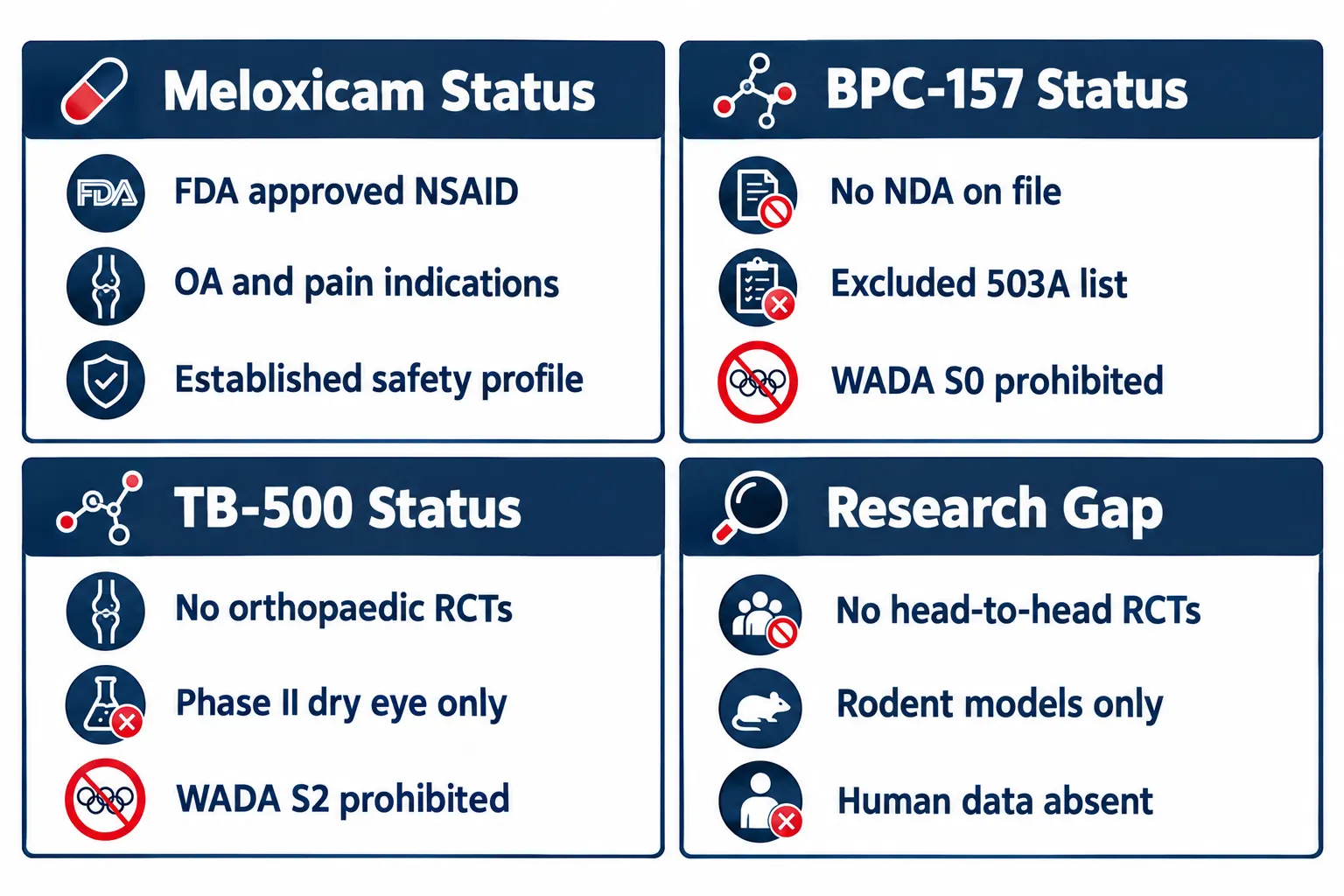
Meloxicam is an established, FDA-approved NSAID with well-characterized pharmacokinetics, approved indications for osteoarthritis and other pain conditions, and decades of human safety data.

BPC-157 and TB-500 occupy a very different position:

Dimension Meloxicam BPC-157 TB-500
FDA approval Yes No No
Human RCT data (orthopaedic) Extensive None None
WADA status Permitted S0 prohibited S2 prohibited
503A compounding Permitted Excluded Excluded
Highest-quality evidence Phase III/IV trials Rodent + cell studies Phase II (dry eye only)

Both peptides have been excluded from the FDA's 503A bulk-drug compounding list, are not listed for 503B outsourcing compounding, and remain unapproved with no New Drug Applications on file. The FDA's Pharmacy Compounding Advisory Committee reviewed both compounds in July 2026 in the context of wound-healing and orthopaedic compounding, but neither has moved to an approved status.

For researchers sourcing compounds for in vitro work, using a best peptide supplier with verified purity documentation is essential. Researchers should also review resources on wholesale peptides for sale to ensure laboratory-grade material is used strictly within approved research protocols.

The only human data for BPC-157 in a musculoskeletal context is a single small case series of 17 patients receiving intra-articular injections for knee tendon and ligament symptoms, a study with significant methodological limitations. TB-500 has completed two Phase II trials, both in dry eye disease, with no orthopaedic RCTs published to date.

Conclusion

The comparison of Meloxicam vs BPC-157 and TB-500: How NSAIDs and Tissue-Repair Peptides Differ in In Vitro Injury Models reveals two pharmacological philosophies operating at opposite ends of the repair spectrum. Meloxicam suppresses a single enzymatic node, COX-2, with well-understood consequences for inflammation and, depending on tissue type and timing, potentially for regeneration itself. BPC-157 and TB-500 activate broad, overlapping pro-repair networks in cell and animal models, producing structural improvements in collagen organization, cell migration, and biomechanical endpoints that no NSAID is designed to achieve.

Actionable next steps for researchers:

  1. When using meloxicam as a reference NSAID in injury models, account for tissue type, muscle and bone models are more sensitive to COX-2 inhibition than cartilage models.
  2. Treat BPC-157 and TB-500 data critically: most evidence is rodent-derived, and human orthopaedic outcome data are essentially absent as of 2026.
  3. Source peptides only from suppliers with verified purity certificates and use them exclusively within approved institutional research frameworks.
  4. Monitor FDA Pharmacy Compounding Advisory Committee deliberations, as the regulatory status of both peptides remains under active review.
  5. Design future in vitro studies with direct head-to-head comparisons of NSAID and peptide conditions within the same cell model to generate more translatable mechanistic data.

The mechanistic gap between these compound classes is large and scientifically meaningful. Closing it will require well-designed, independently replicated human trials, work that has not yet been done.

Tags: bpc-157, cox-2 inhibition, in vitro injury models, meloxicam, nsaids, tb-500, tissue repair peptides, wound repair
https://www.puretestedpeptides.com/wp-content/uploads/2026/09/meloxicam-vs-bpc-157-and-tb-500-how-nsaids-and-tissue-repair-peptides-differ-in.webp 1024 1536 https://www.puretestedpeptides.com/wp-content/uploads/2026/01/buy-peptides-online.jpg 2026-09-20 13:06:102026-09-20 13:06:10Meloxicam vs BPC-157 and TB-500: How NSAIDs and Tissue-Repair Peptides Differ in In Vitro Injury Models
You might also like
GHK-Cu Peptide: Collagen Synthesis, Tissue Repair, and Longevity Research Applications GHK-Cu Peptide: Collagen Synthesis, Tissue Repair, and Longevity Research Applications
BPC-157 and TB-500 Synergy: Advanced Tissue Repair and Regeneration Protocols BPC-157 and TB-500 Synergy: Advanced Tissue Repair and Regeneration Protocols
Complete Guide to Research Peptides: Types, Mechanisms, and Laboratory Use Cases Complete Guide to Research Peptides: Types, Mechanisms, and Laboratory Use Cases
Glow Blend vs. Klow Blend In Vitro Fibroblast Response: Epidermal Matrix Synthesis and Dermal Repair Protocols Glow Blend vs. Klow Blend In Vitro Fibroblast Response: Epidermal Matrix Synthesis and Dermal Repair Protocols
Spironolactone, Cardiorenal Pathways, and Tissue-Repair Peptides: How BPC-157 and TB-500 Complement Classic Heart and Kidney Drug Models Spironolactone, Cardiorenal Pathways, and Tissue-Repair Peptides: How BPC-157 and TB-500 Complement Classic Heart and Kidney Drug Models
Methylprednisolone, Dexamethasone, and Peptide-Based Immunomodulation: Designing Inflammation Studies With BPC-157 and GLP-Class Adjuncts Methylprednisolone, Dexamethasone, and Peptide-Based Immunomodulation: Designing Inflammation Studies With BPC-157 and GLP-Class Adjuncts
BPC-157 and TB-500 Synergy: What Researchers Should Know About Combined Tissue Repair Models BPC-157 and TB-500 Synergy: What Researchers Should Know About Combined Tissue Repair Models
Klow Blend and Glow Blend Peptides: Comparing Skin-Focused Peptide Formulations in Research Settings Klow Blend and Glow Blend Peptides: Comparing Skin-Focused Peptide Formulations in Research Settings
0 replies

Leave a Reply

Want to join the discussion?
Feel free to contribute!

Leave a Reply Cancel reply

Your email address will not be published. Required fields are marked *

×

Helpful Links

  • My account
  • Cart
  • Checkout
  • Refund and Returns Policy
  • Privacy Policy
  • SMS Privacy Policy
  • Login
  • My Account
  • Logout

USA Made Lab Tested Peptides

All products are sold for research, laboratory, or analytical purposes only, and are not for human consumption


Pure Tested Peptides is a chemical supplier. Pure Tested Peptides is not a compounding / chemical compounding facility as defined under 503A of the Federal Food, Drug, and Cosmetic act. Pure Tested Peptides is not an outsourcing facility as defined under 503B of the Federal Food, Drug, and Cosmetic act.

The statements made within this website have not been evaluated by the US Food and Drug Administration. The products we offer are not intended to diagnose, treat, cure or prevent any disease.

Human/Animal Consumption Prohibited. Laboratory/In-Vitro Experimental Use Only

Link to: Lisinopril, ACE Pathways, and Growth Hormone Secretagogues: Designing Safe Peptide Research With Cardiovascular Readouts Link to: Lisinopril, ACE Pathways, and Growth Hormone Secretagogues: Designing Safe Peptide Research With Cardiovascular Readouts Lisinopril, ACE Pathways, and Growth Hormone Secretagogues: Designing Safe Peptide...Lisinopril, ACE Pathways, and Growth Hormone Secretagogues: Designing Safe Peptide Research With Cardiovascular Readouts Link to: Prednisone and Peptide Immunomodulation: How Classic Steroids Compare With BPC-157, GHK-Cu, and GLP-Class Peptides in Inflammatory Research Link to: Prednisone and Peptide Immunomodulation: How Classic Steroids Compare With BPC-157, GHK-Cu, and GLP-Class Peptides in Inflammatory Research Prednisone and Peptide Immunomodulation: How Classic Steroids Compare With BPC-157, GHK-Cu, and GLP-Class Peptides in Inflammatory ResearchPrednisone and Peptide Immunomodulation: How Classic Steroids Compare With BPC-157,...
Scroll to top Scroll to top Scroll to top