

Lisinopril, Losartan, and Amlodipine: Selecting Cardiovascular Controls for Peptide Studies
Fewer than 30% of published peptide cardiovascular trials explicitly justify their choice of active comparator drug, a gap that quietly undermines the validity of blood-pressure and vascular outcome data. When a study tests an investigational peptide alongside a poorly matched pharmacological control, it becomes nearly impossible to know whether observed effects are driven by the peptide, the control drug, or their interaction. A disciplined framework built around lisinopril, losartan, and amlodipine: selecting cardiovascular controls for peptide studies solves this problem by anchoring control selection to mechanism, tolerability, and guideline alignment.
Key Takeaways
- Lisinopril (ACE inhibitor), losartan (ARB), and amlodipine (CCB) operate through distinct vascular pathways, making control selection a mechanistic decision, not a default one.
- Combining lisinopril and losartan as dual RAS blockade is explicitly discouraged by current regulatory guidance due to increased adverse events without added benefit.
- Amlodipine with losartan is a well-evidenced combination control that outperforms losartan monotherapy for blood-pressure reduction in trial settings.
- Peptide interventions are adjuncts to, not replacements for, guideline-directed antihypertensive therapy; stable background regimens are required before randomization.
- Class-specific side-effect profiles, particularly ACE inhibitor cough versus ARB tolerability, directly affect participant retention and data integrity.
Understanding the Three Drug Classes and Their Vascular Pathways
Before applying lisinopril, losartan, and amlodipine: selecting cardiovascular controls for peptide studies to a protocol, researchers must understand exactly where each agent intervenes in cardiovascular physiology.
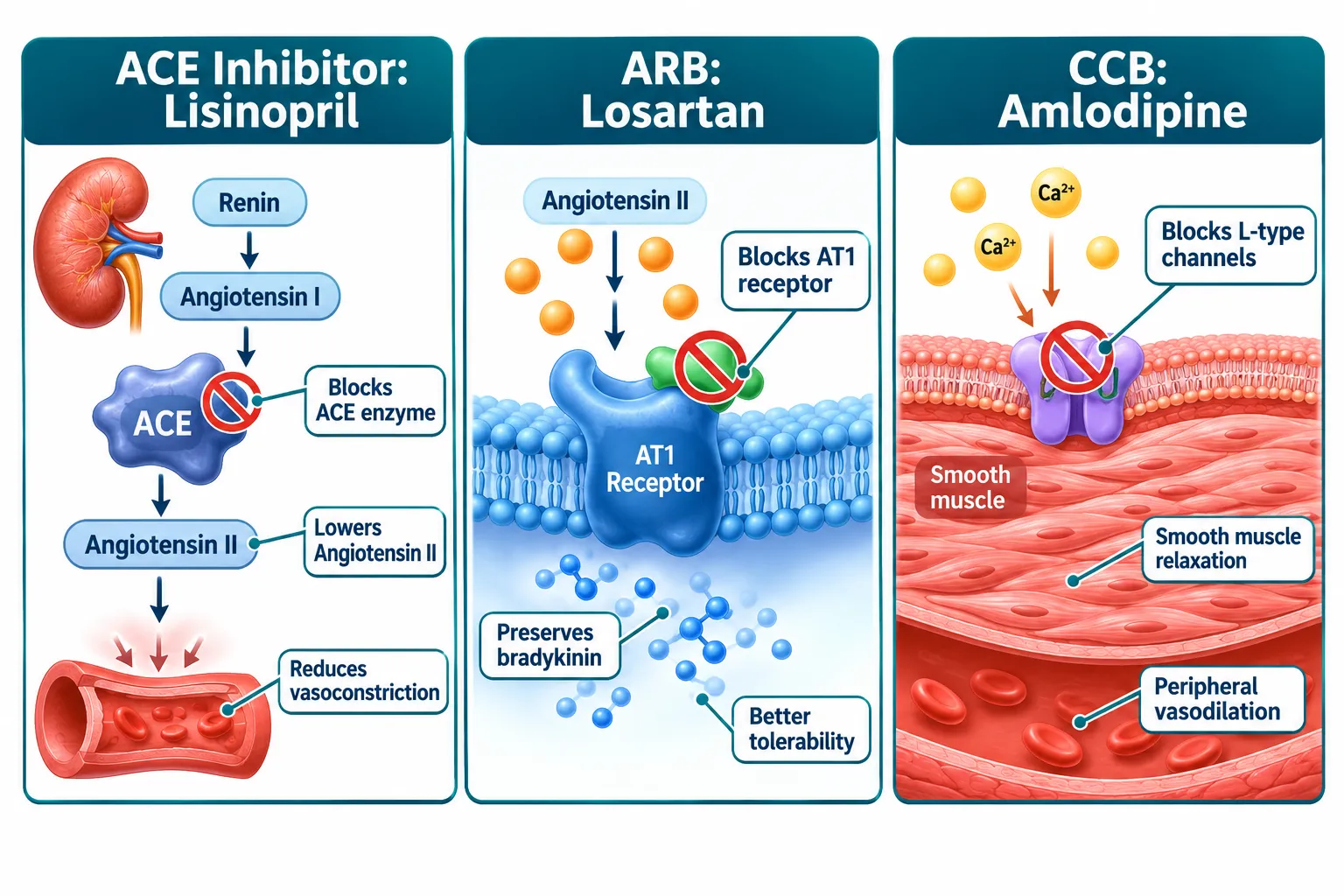
Lisinopril is an ACE inhibitor. It blocks the angiotensin-converting enzyme, preventing the conversion of angiotensin I to angiotensin II. The result is lower vasoconstriction, reduced aldosterone release, and a secondary rise in bradykinin, the last point being the primary cause of the dry cough reported in 10-15% of patients.
Losartan is an angiotensin II receptor blocker (ARB). Rather than blocking angiotensin II production, it blocks the AT1 receptor that angiotensin II binds to. Bradykinin is not affected, so cough rates are substantially lower. This tolerability advantage makes losartan the preferred RAS-targeting control when study dropout rates are a concern, as consistently noted in nephrology education materials.
Amlodipine operates through an entirely different mechanism. As a dihydropyridine calcium-channel blocker (CCB), it inhibits L-type calcium channels in vascular smooth muscle, causing peripheral vasodilation without any direct effect on the renin-angiotensin system (RAS).
| Drug | Class | Primary Target | Key Side Effect |
|---|---|---|---|
| Lisinopril | ACEi | ACE enzyme | Dry cough, hyperkalemia |
| Losartan | ARB | AT1 receptor | Minimal; rare angioedema |
| Amlodipine | CCB | L-type Ca2+ channels | Peripheral edema |
This mechanistic separation is not merely academic. Any investigational peptide that modulates the RAS, such as peptides with angiotensin-like or natriuretic properties, will produce confounded results if placed alongside a lisinopril or losartan control without deliberate matching.
Applying the Framework: Lisinopril, Losartan, and Amlodipine in Peptide Study Design
Researchers studying cardioprotective peptides, including mitochondria-targeted compounds explored in SS-31 peptide research considerations and broader cardiovascular peptide lines, benefit from a structured decision process when choosing controls.

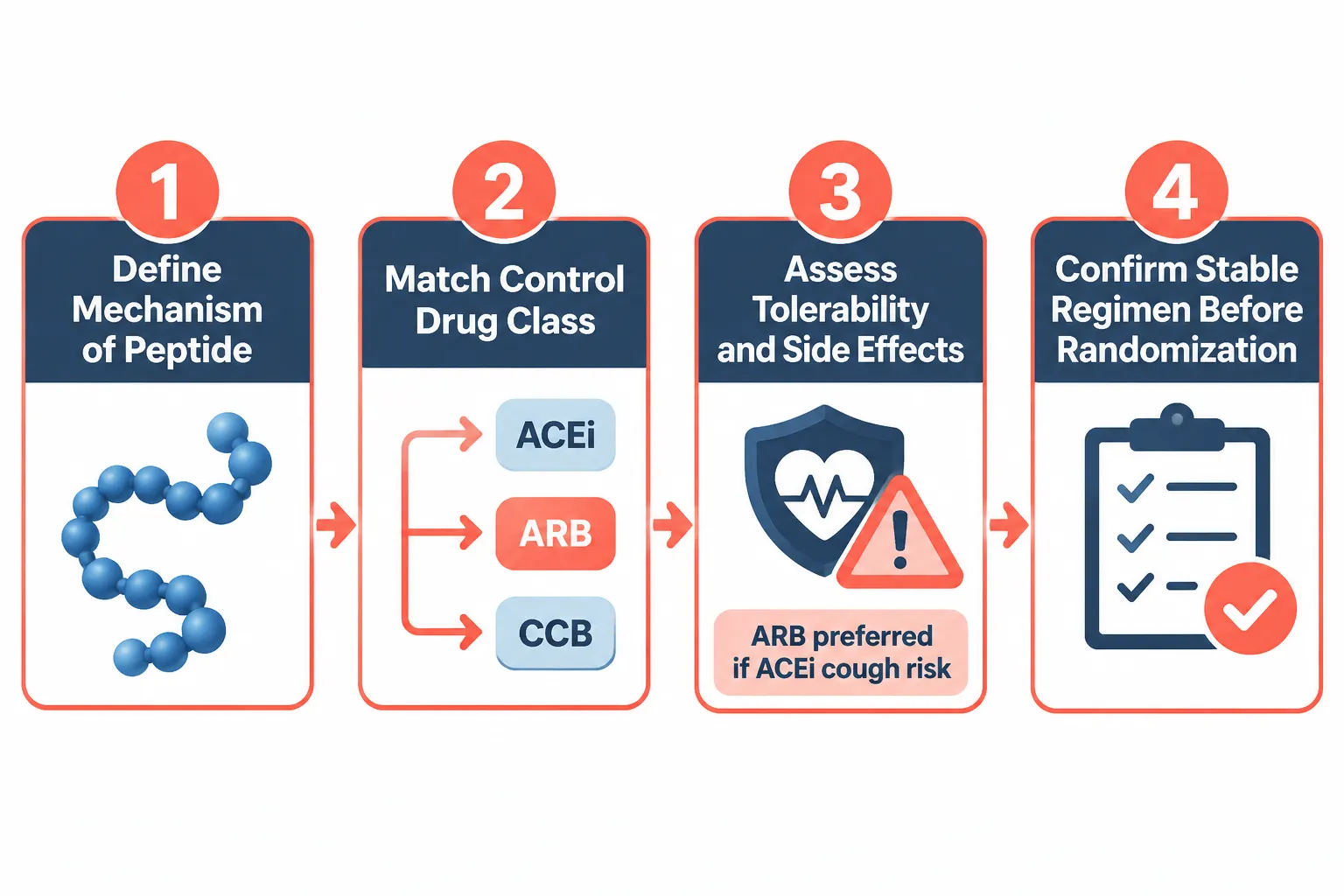
Step 1: Define the peptide's proposed mechanism. Does the investigational peptide affect vascular tone via the RAS, via calcium flux, via oxidative stress pathways, or via endothelial nitric oxide? This question determines which drug class can serve as a credible active comparator and which would introduce mechanistic overlap.
Step 2: Match the control class to the mechanism. A peptide hypothesized to act on oxidative vascular injury, as studied in contexts involving SS-31 peptide benefits, may legitimately pair with amlodipine as a control, since both reduce cardiovascular stress through non-RAS pathways. By contrast, pairing such a peptide with lisinopril would merge RAS-dependent and RAS-independent signals in ways difficult to disentangle.
Step 3: Avoid dual RAS blockade. Current regulatory labeling updated in 2026 reiterates that combining lisinopril and losartan increases adverse renal and cardiovascular events without added antihypertensive benefit. No peptide study design should incorporate this combination as a comparator arm.
Step 4: Consider the amlodipine-losartan combination for blood-pressure benchmarking. Evidence consistently shows the amlodipine/losartan combination produces superior blood-pressure reduction compared with losartan alone. When a study needs a robust active comparator to benchmark a peptide's antihypertensive effect, this combination offers a high-bar reference without RAS-overlap concerns.
"Peptide interventions are adjuncts to guideline-directed therapy, not replacements. Stable antihypertensive regimens must be established before randomization."
Studies examining compounds like those found in GLP peptide research or metabolic peptides with cardiovascular secondary endpoints similarly depend on stable background regimens to isolate peptide-specific signals. The GLP-3 peptide signaling pathway literature, for instance, illustrates how vascular endpoints can be confounded when background pharmacotherapy is inconsistent.
Practical Control Selection and Tolerability Considerations
Tolerability is not a secondary concern, it is a data integrity concern. A participant who stops taking lisinopril due to cough mid-trial introduces an uncontrolled variable. Nephrology education and pharmacology CE materials from 2025 uniformly recommend ARBs over ACE inhibitors when study population characteristics raise dropout risk.
The ALLHAT trial framework, referenced in pharmacy committee analyses through 2025, demonstrated comparable primary coronary outcomes across chlorthalidone, amlodipine, and lisinopril arms. This equivalency supports using either amlodipine or lisinopril as a "reference" comparator without systematically disadvantaging one drug class over another from an efficacy standpoint.
For researchers sourcing lab-tested peptides intended for cardiovascular investigations, the principle is clear: the purity and characterization of the investigational compound must be matched by the rigor of control selection. Poorly chosen controls waste well-characterized peptides.
Preferred combinations by study type:
- RAS-targeting peptide studies: Use amlodipine as solo control to avoid mechanistic overlap.
- Vasodilatory/endothelial peptide studies: Use losartan or amlodipine; avoid lisinopril if cough is a concern.
- Blood-pressure benchmarking studies: Use amlodipine + losartan combination as the high-bar active comparator.
- Cardioprotective/oxidative peptide studies: Amlodipine preferred; losartan acceptable as secondary control.
For researchers exploring related cardiovascular peptides such as those comparing LL-37 versus SS-31 peptide benefits, the same framework applies: separate the drug-class pharmacology from the peptide-driven effects before drawing mechanistic conclusions.
Conclusion
Selecting cardiovascular controls is one of the most consequential methodological choices in peptide research. The discipline of lisinopril, losartan, and amlodipine: selecting cardiovascular controls for peptide studies provides a mechanistic, evidence-grounded framework that separates RAS-dependent, angiotensin-receptor, and calcium-channel effects from peptide-driven vascular changes.
Actionable next steps for researchers:
- Map the investigational peptide's mechanism before selecting any control drug.
- Default to losartan or amlodipine when participant tolerability could compromise retention.
- Never combine lisinopril and losartan in the same control arm.
- Use the amlodipine-losartan combination as the benchmark when rigorous blood-pressure comparisons are needed.
- Confirm stable antihypertensive background therapy for all participants at least four weeks before randomization.
A well-matched control does not compete with the peptide, it clarifies it.


Leave a Reply
Want to join the discussion?Feel free to contribute!