

Retatrutide 2026 Trial Results: What the New Obstructive Sleep Apnea Data Mean for Research Models
{"cover":"Professional landscape format (1536×1024) hero image with bold text overlay 'Retatrutide 2026 Trial Results' in crisp white sans-serif on a deep navy semi-transparent overlay bar, centered with 8% safe margins from every edge. Background: editorial close-up of a polysomnography sleep lab with illuminated monitoring screens showing AHI waveforms, oxygen saturation traces, and sleep-stage graphs in cool blue and teal tones, shallow depth of field, high-contrast medical magazine aesthetic. Color palette: deep navy, clinical teal, and white. No pricing tables, no dollar amounts, no checkmark grids.","content":["Annotated four-panel infographic diagram (1536×1024) illustrating the TRIUMPH-1-OSA trial architecture and dose-response data for retatrutide 2026 trial results and obstructive sleep apnea research models. Panel 1 labeled 'Trial Design' shows a timeline bar: Baseline → Week 24 → Week 80 with polysomnography icons at each point. Panel 2 labeled 'AHI Reductions' shows three descending bar segments for 4mg, 9mg, 12mg doses with short callout labels showing event-per-hour drops. Panel 3 labeled 'Placebo Comparison' shows a minimal bar for 9.9 events/hour. Panel 4 labeled 'Disease Stage Shift' shows a before-after gradient from moderate-severe to mild OSA. Clean white background, teal-and-navy palette, thin callout lines, editorial medical-guide polish, all labels 1-6 words, inside 5% safe margin.","Split-screen mechanism diagram (1536×1024) for the research framework separating AHI, body weight, glycemic control, oxygenation, and respiratory-event mechanisms relevant to retatrutide 2026 obstructive sleep apnea research models. Left panel labeled 'Weight-Driven Pathway' shows an illustrated cross-section of upper airway anatomy with callout lines pointing to 'Adipose tissue reduction,' 'Airway dilation,' and 'Reduced collapsibility.' Right panel labeled 'Metabolic Pathway' shows a stylized GIP/GLP-1/glucagon receptor diagram with callout lines for 'Glycemic modulation,' 'Inflammatory signaling,' and 'Oxygenation improvement.' Warm amber and slate-blue split palette, clean medical illustration style, no full sentences as text, all labels 1-6 words, inside 5% safe margin, editorial quality.","Numbered step-by-step research modeling flow diagram (1536×1024) for integrating retatrutide multi-system obstructive sleep apnea trial data into health-economic and pharmacological research models. Five sequential horizontal stages connected by arrows: Step 1 'Establish AHI Baseline' with polysomnography icon; Step 2 'Separate Weight vs. Metabolic Input' with branching pathway icons; Step 3 'Map OSA Severity Trajectory' with a small curved timeline; Step 4 'Model Cardiometabolic Co-outcomes' with heart and glucose icons; Step 5 'Compare vs. CPAP Controls' with a device silhouette. Cool clinical green and charcoal palette, flat vector illustration style, short callout labels for each stage, fully inside 5% safe margin, editorial medical-research quality, no pricing or checkmark grids."]

A 60.6% reduction in sleep apnea severity is not an incidental side effect, it is a signal that demands a new research framework. The Retatrutide 2026 Trial Results: What the New Obstructive Sleep Apnea Data Mean for Research Models has become one of the most discussed developments in obesity pharmacology this year. Data from the TRIUMPH-1-OSA phase 3 trial, published in October 2026, demonstrate that retatrutide, a triple hormone receptor agonist targeting GIP, GLP-1, and glucagon pathways, produces statistically significant, dose-dependent reductions in apnea-hypopnea index (AHI) over 80 weeks. For research teams, the implications stretch far beyond a single efficacy metric.
Key Takeaways
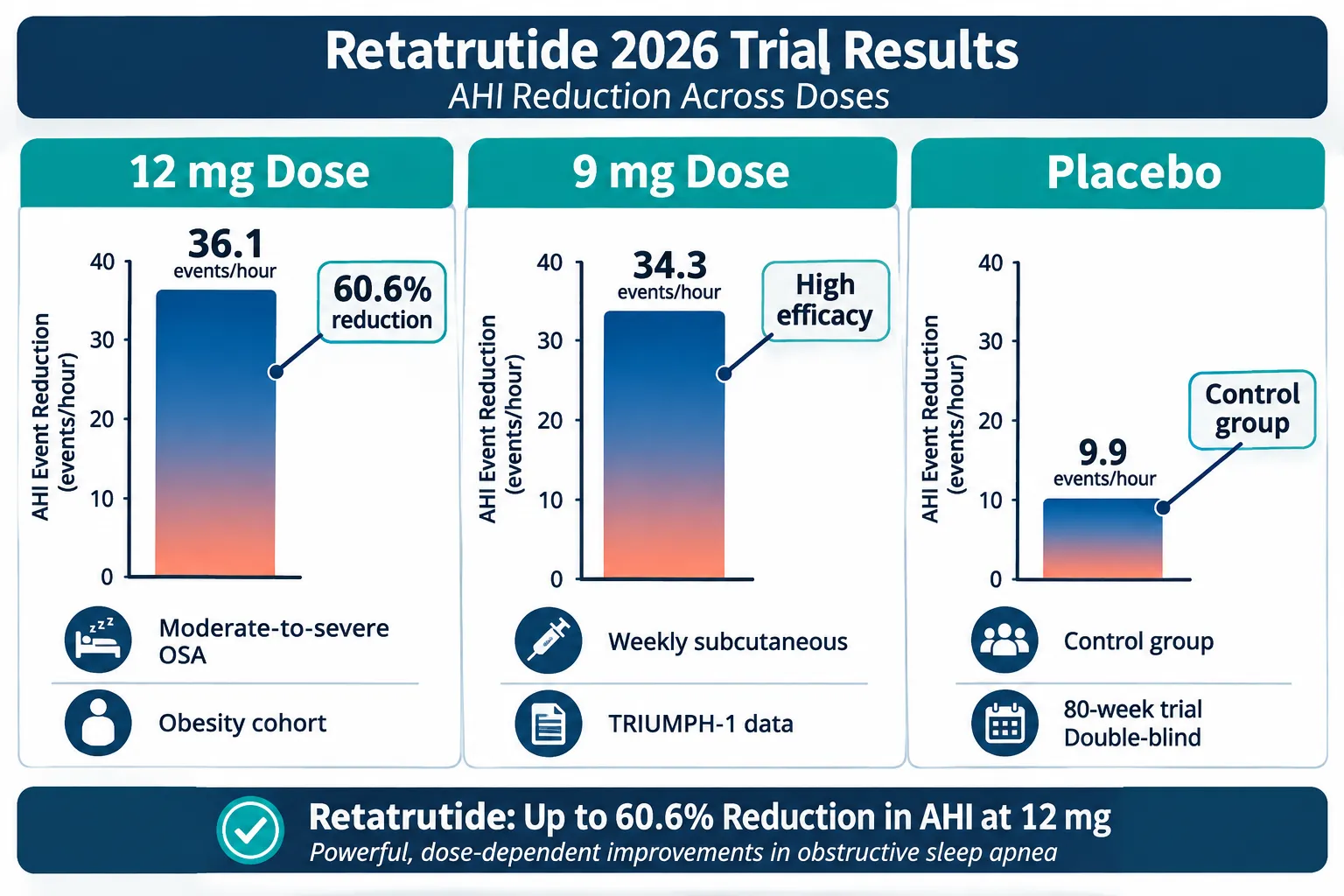
- Retatrutide reduced AHI by up to 36.1 events per hour, a 60.6% reduction, in adults with obesity and moderate-to-severe OSA
- The 9 mg and 12 mg doses produced the largest AHI reductions: 34.3 and 31.7 events per hour versus 9.9 events per hour with placebo
- Up to half of participants shifted from moderate-to-severe OSA to only mild disease by week 80
- OSA benefit was consistent regardless of type 2 diabetes status, pointing to mechanisms beyond glycemic control alone
- Research models must treat retatrutide as a multi-system intervention, separating AHI, body weight, oxygenation, and metabolic inputs rather than bundling them
Understanding the TRIUMPH-1-OSA Trial Design
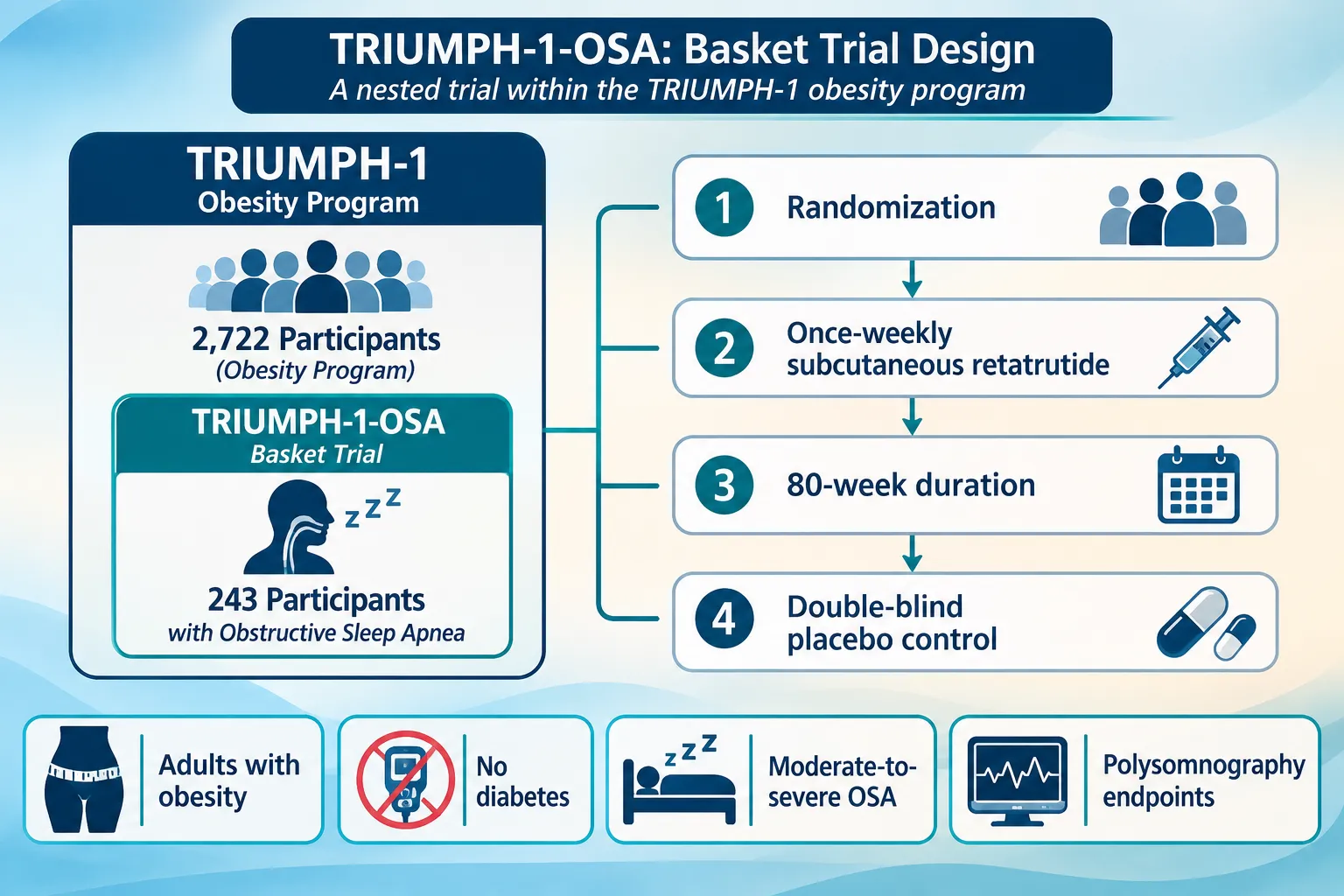
The TRIUMPH-1 program is a randomized, double-blind, 80-week master obesity trial of once-weekly subcutaneous retatrutide versus placebo in adults with obesity who do not have diabetes. Nested within it, the TRIUMPH-1-OSA basket trial enrolled 243 participants with obstructive sleep apnea and used polysomnography-based AHI as its primary outcome. Three doses, 4 mg, 9 mg, and 12 mg, were evaluated under the same long-duration, weekly-injection design.
The 80-week horizon is notably longer than the 6-12 months typical of earlier OSA intervention studies. Sleep-lab polysomnography was performed at baseline, week 24, and week 80, giving researchers an unusually detailed longitudinal picture of how AHI evolves under metabolic pharmacotherapy. This design supports modeling of both early response and long-term durability, including the possibility of plateauing or partial relapse.
Key efficacy figures from TRIUMPH-1-OSA:
| Dose | Mean AHI Reduction (events/hr) | Between-Group Difference vs. Placebo |
|---|---|---|
| 4 mg | 22.9 | -13.0 (95% CI: -23.0 to -3.0) |
| 9 mg | 34.3 | -24.4 (95% CI: -34.1 to -14.7) |
| 12 mg | 31.7 | -21.9 (95% CI: -32.2 to -11.5) |
| Placebo | 9.9 | , |
All between-group differences reached statistical significance. A parallel phase 3 trial including participants with type 2 diabetes reported AHI reductions of 19.2, 24.7, and 25.4 events per hour for the 4, 9, and 12 mg doses respectively, confirming that the OSA benefit persists across glycemic subgroups.
Researchers interested in the Reta GLP product context should note how the triple-agonist mechanism distinguishes retatrutide from single-pathway agents in terms of multi-system effects.
Building a Research Framework: Separating AHI from Body Weight and Metabolic Inputs
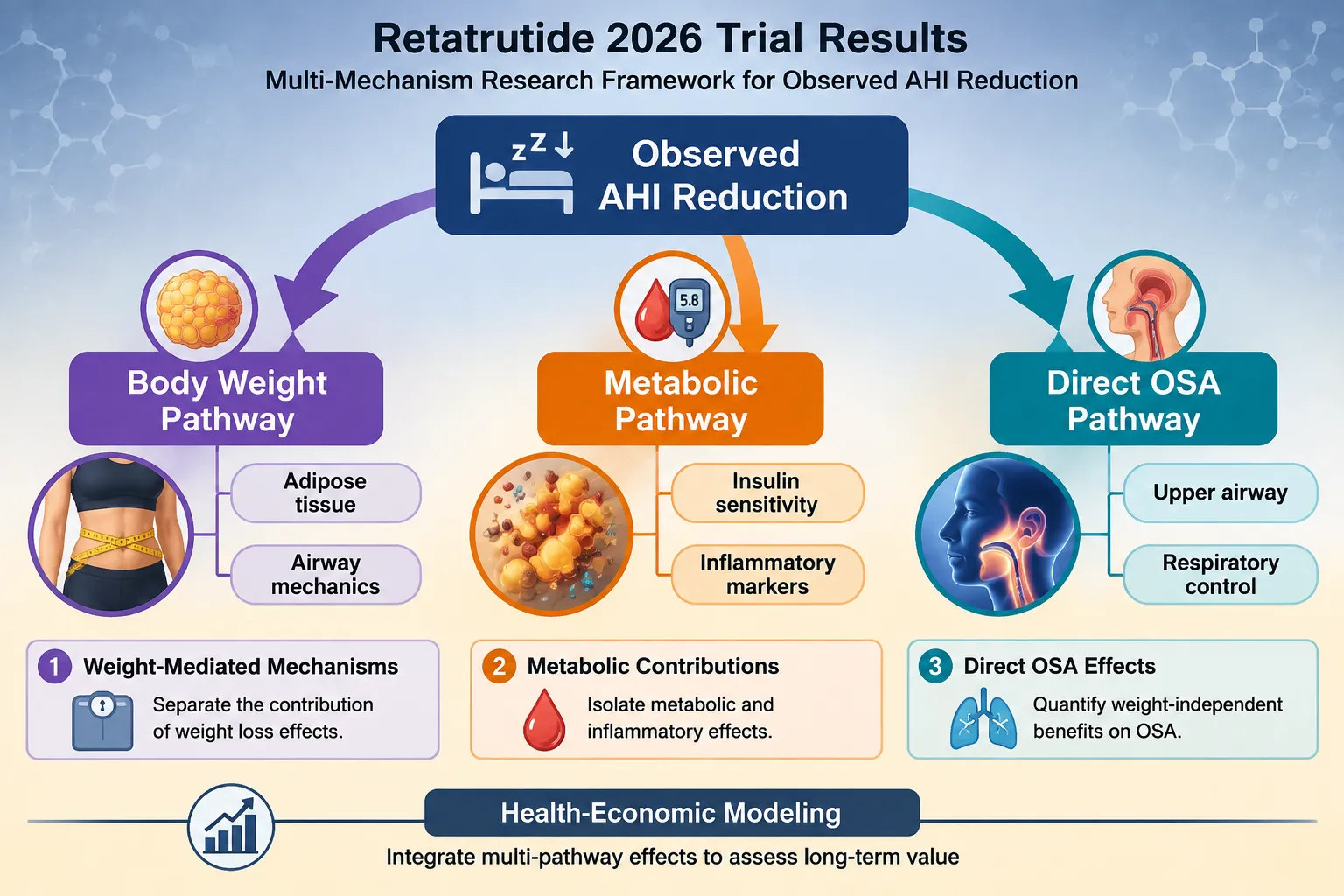
The Retatrutide 2026 Trial Results: What the New Obstructive Sleep Apnea Data Mean for Research Models extends well beyond one headline number. The central methodological challenge is decomposing the observed AHI reduction into its contributing pathways, because retatrutide acts simultaneously on body weight, glucose metabolism, and potentially airway inflammation.
Three distinct mechanisms warrant separate modeling tracks:
- Mechanical/anatomical pathway: Weight loss reduces peripharyngeal adipose tissue, widens the upper airway, and decreases collapsibility, a well-established biomechanical link between obesity and OSA severity.
- Metabolic/glycemic pathway: Glucagon and GLP-1 receptor activity modulates insulin sensitivity, inflammation, and potentially respiratory muscle tone. The fact that OSA benefit occurs irrespective of type 2 diabetes status suggests this pathway is not purely glycemia-dependent.
- Oxygenation and arousal threshold pathway: Improvements in oxygen saturation and sleep architecture may reflect neurological and cardiovascular adaptations downstream of weight and metabolic change, rather than a direct drug effect on respiratory drive.
For research teams examining related metabolic peptide frameworks, the SS-31 mitochondrial research themes resource provides useful context on cellular energy and oxidative stress mechanisms that may intersect with OSA pathophysiology.
"Up to about half of participants had only mild sleep apnea by the end of the 80-week study", a disease-stage shift with direct implications for how models categorize treatment response.
The TRIUMPH basket-trial architecture, four coordinated trials spanning obesity, OSA, osteoarthritis, cardiovascular disease, and metabolic liver disease, provides a unique framework for modeling retatrutide's impact across comorbidities simultaneously. Models that isolate OSA as a standalone outcome will underestimate both the drug's value and its mechanistic complexity.
For researchers sourcing compounds for preclinical investigations, the GLP-1 Reta product tag and buy Reta online resource offer relevant procurement context.
What the New OSA Data Mean for Research Model Architecture
The Retatrutide 2026 Trial Results: What the New Obstructive Sleep Apnea Data Mean for Research Models has clear structural consequences for health-economic and pharmacological research models. Three design principles emerge from the TRIUMPH-1 data.
Principle 1, Multi-system co-outcome representation. TRIUMPH-1 data show AHI reductions occurring in parallel with significant weight loss and up to a 4.3-point (73.1%) improvement in knee osteoarthritis pain. Models treating OSA in isolation will miss important interaction effects between airway, musculoskeletal, and cardiometabolic outcomes. The Tesamorelin science and research overview offers a parallel example of how metabolic peptides affect body composition and secondary outcomes simultaneously.
Principle 2, Long-duration trajectory modeling. The 80-week design supports durability analysis. Models should map AHI response curves at 24 weeks and 80 weeks separately, assess whether benefits plateau after weight stabilization, and incorporate potential relapse scenarios, none of which is possible with a 6-month horizon.
Principle 3, CPAP comparator integration. Because retatrutide addresses OSA through metabolic and anatomical weight-loss mechanisms rather than device-based airway pressure, models comparing the two approaches must account for adherence differentials, cardiovascular endpoints, and quality-of-life trajectories over the same 80-week or longer timeframe.
Retatrutide is now in phase 3 development for at least seven indications, including obesity, type 2 diabetes, moderate-to-severe OSA, knee osteoarthritis, chronic low back pain, cardiovascular/renal outcomes, and metabolic liver disease. Future models will need to address cross-indication treatment sequencing and combined outcome trajectories, a level of complexity that standard single-indication frameworks are not designed to handle.
Researchers building multi-peptide study designs may also find the BPC-157 core peptides documentation guide useful for understanding how rigorous documentation standards apply across varied peptide research contexts.
Conclusion
The TRIUMPH-1-OSA data represent a methodological inflection point, not just a clinical milestone. Research teams working with retatrutide in 2026 should immediately separate AHI-driven endpoints from body weight endpoints and metabolic endpoints in their model architectures. Each mechanism warrants its own input assumptions, time-course parameters, and uncertainty ranges.
Actionable next steps for research teams:
- Reconstruct existing OSA models to include at minimum three input pathways: mechanical weight loss, metabolic modulation, and oxygenation/arousal threshold
- Extend model time horizons to at least 80 weeks to match TRIUMPH-1 follow-up
- Build CPAP comparator arms that account for adherence, cardiovascular co-outcomes, and quality-adjusted life years
- Monitor upcoming regulatory submissions for a dedicated OSA indication, which will trigger further health-economic modeling requirements
- Review the TRIUMPH basket-trial architecture to understand how osteoarthritis and cardiovascular co-outcomes should be represented alongside OSA in multi-morbidity models
The scale of AHI reduction seen with retatrutide challenges the assumption that OSA is primarily a respiratory device problem. Treating it as a metabolic research question, with properly separated mechanistic inputs, is now the scientifically defensible approach.


Leave a Reply
Want to join the discussion?Feel free to contribute!