

Tadalafil and Sildenafil in PT-141 Research: Separating Erectile, Vascular, and Behavioral Effects
Men who fail standard PDE5 inhibitor therapy represent nearly one-third of all erectile dysfunction cases, a clinical reality that pushed researchers to look beyond vascular mechanisms entirely. That search led directly to melanocortin signaling and the growing body of work examining tadalafil and sildenafil in PT-141 research: separating erectile, vascular, and behavioral effects into distinct, measurable endpoints.
This article provides a receptor- and endpoint-based framework for understanding how melanocortin agonism (PT-141 / bremelanotide) and PDE5 inhibition (tadalafil, sildenafil) operate through fundamentally different pathways, and what current research reveals when those pathways are studied together.
Key Takeaways
- PT-141 acts centrally via hypothalamic MC3R/MC4R receptors to increase sexual desire and arousal; it does not directly affect penile blood flow.
- Tadalafil and sildenafil act peripherally by enhancing nitric-oxide-mediated vasodilation; they do not directly modify sexual desire.
- Combination trials show significantly greater erectile responses than PDE5 monotherapy alone, with limited added adverse events.
- PT-141 monotherapy produced erections sufficient for intercourse in roughly 80% of subjects, including about 67% who had previously failed sildenafil.
- Regulatory status is a key constraint: PT-141 is FDA-approved only for hypoactive sexual desire disorder in premenopausal women, making male ED use entirely off-label.
How the Receptor Pharmacology Separates These Agents
Understanding the mechanistic divide is the foundation of any research design that seeks to isolate behavioral from vascular endpoints.
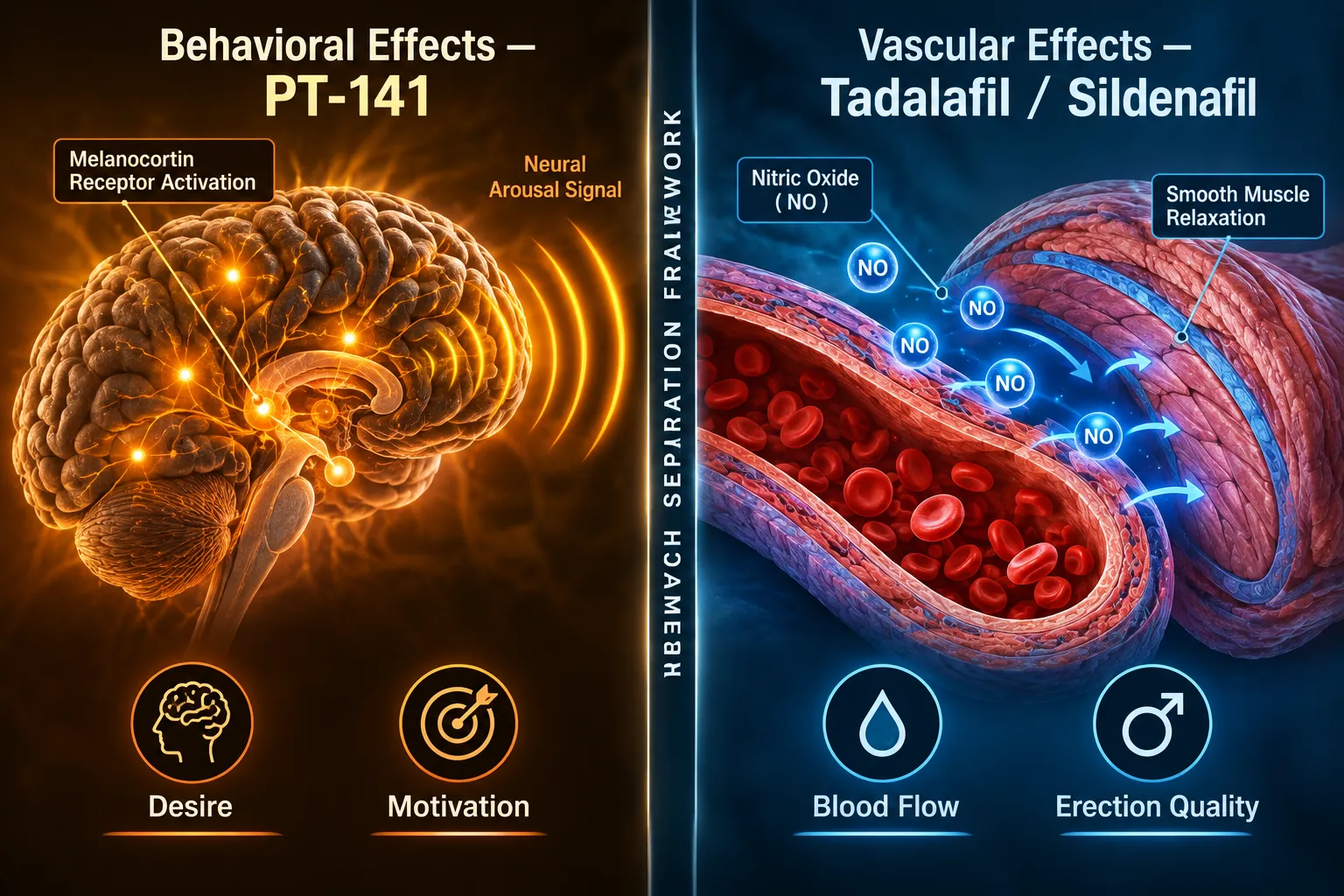
PT-141 (bremelanotide) is a synthetic melanocortin peptide that binds MC3R and MC4R receptors in the hypothalamus. Activation of these receptors produces downstream increases in sexual desire, motivation, and arousal. Critically, this pathway does not directly dilate blood vessels or alter penile smooth-muscle tone. PT-141's effect is central, it modifies the brain's sexual motivation circuitry, not the hydraulics of erection.
Tadalafil and sildenafil work in the opposite anatomical direction. Both are phosphodiesterase type 5 (PDE5) inhibitors that prevent the breakdown of cyclic GMP in penile vascular smooth muscle. More cyclic GMP means sustained nitric oxide-mediated vasodilation, increased blood flow, and improved erection quality. Neither drug meaningfully alters sexual desire or the behavioral drive to pursue sexual activity.
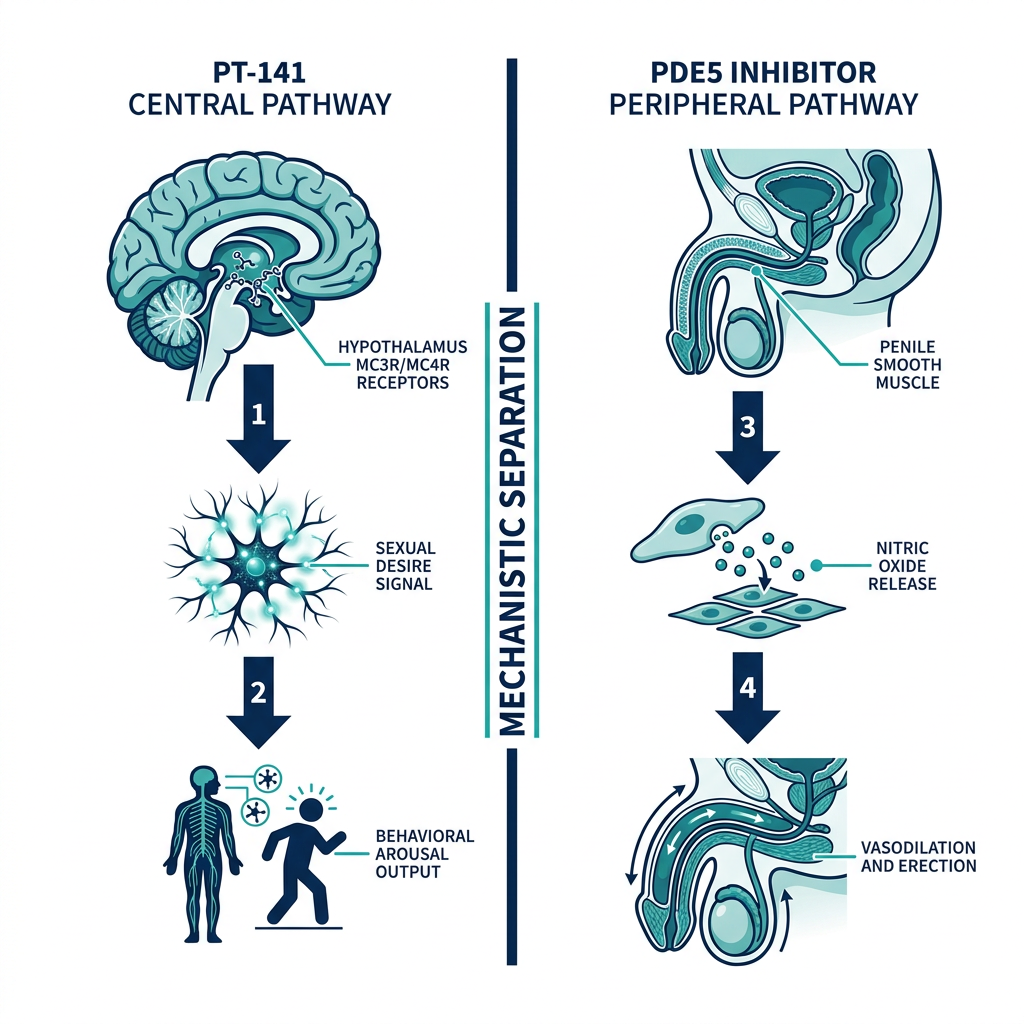
This mechanistic separation is not merely academic. It defines which research endpoints are attributable to which agent:
| Endpoint | PT-141 | Tadalafil / Sildenafil |
|---|---|---|
| Sexual desire / arousal | Primary effect | Minimal |
| Penile blood flow | Minimal | Primary effect |
| Erection rigidity | Indirect (via arousal) | Direct |
| Orgasm / satisfaction (subjective) | Improved | Modest |
| Systemic blood pressure | Transient increase | Decrease |
Tadalafil and Sildenafil in PT-141 Research: What Monotherapy Trials Reveal
Before examining combination designs, monotherapy data establish each agent's independent contribution to sexual function outcomes.
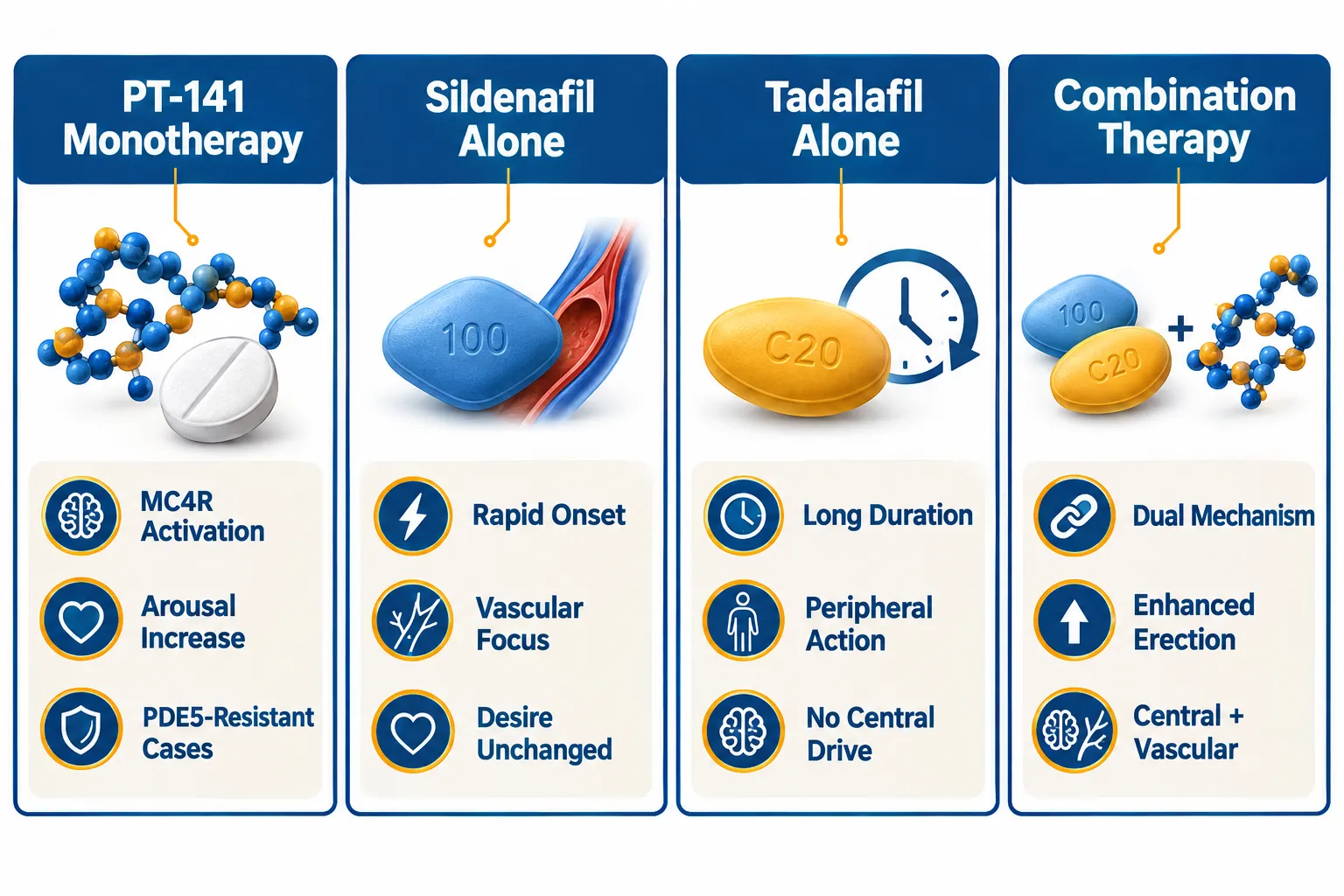
PT-141 monotherapy findings are striking precisely because they bypass PDE5 pathways entirely. In dose-ranging trials, intranasal PT-141 at doses above roughly 7-7.5 mg produced statistically significant increases in erectile activity. RigiScan monitoring documented first erections within approximately 30 minutes of administration, with sustained improvements over the monitoring period. Phase II studies in men with erectile dysfunction showed erections sufficient for intercourse in about 80% of subjects.
Most clinically significant: approximately 67% of men who had an inadequate response to sildenafil still showed meaningful improvement with PT-141. That finding is the clearest evidence that PT-141 engages a non-overlapping mechanism, one that can overcome PDE5 resistance by driving sexual response from the central nervous system downward.
In women, bremelanotide improved arousal, desire, and orgasm domains on the Female Sexual Function Index (FSFI), reinforcing that its primary action is behavioral and motivational rather than hemodynamic.
PDE5 monotherapy predictably improves erectile rigidity and penile blood flow but leaves desire and arousal domains essentially unchanged on validated scales. This is precisely why a substantial subgroup of men on tadalafil or sildenafil report adequate erections but reduced subjective sexual satisfaction, the vascular plumbing is functional, but the central drive remains muted.
For researchers studying peptide actions broadly, the mechanistic logic here parallels the approach used when examining other centrally acting peptides. Research into agents like those discussed in MT-2 peptide studies and nasal Semax spray also demonstrates the importance of separating central nervous system endpoints from peripheral physiological effects.
Tadalafil and Sildenafil in PT-141 Research: Combination Study Designs and Findings
When researchers ask how melanocortin signaling and PDE5 inhibition interact, the most informative designs are crossover trials that isolate each agent and then measure additive or synergistic effects.
A randomized crossover study in 19 men, all confirmed responders to sildenafil or vardenafil, compared three conditions: low-dose sildenafil (25 mg) plus intranasal PT-141 (7.5 mg), sildenafil plus placebo spray, and control arms. The combination produced significantly greater erectile responses than sildenafil alone. Crucially, no meaningful increase in adverse events was observed, suggesting the mechanisms complement rather than amplify each other's side-effect profiles.
A larger double-blind, placebo-controlled study in 342 men who were non-responders to sildenafil found improved erectile function when bremelanotide was co-administered with a PDE5 inhibitor. This "rescue" effect strongly supports the central-plus-peripheral model: PT-141 provides the arousal signal that the central nervous system was failing to generate, while the PDE5 inhibitor handles the downstream vascular execution.
Palatin Technologies has formalized this logic into regulated clinical programs. A Phase 2 study of bremelanotide co-administered with a PDE5 inhibitor in PDE5-resistant men was initiated in mid-2024. An updated development roadmap published in late 2024 outlined pharmacokinetics studies starting in Q1 2025, Phase 3 recruitment in the second half of 2025, and topline results targeted for the first half of 2026, making this one of the most authoritative ongoing efforts specifically designed to disentangle central behavioral effects from vascular erectile support.
Understanding how peptide sourcing and purity affect research reproducibility is equally important in this field. Resources such as the peptide supplier comparisons guide offer useful context on quality control standards that affect study reliability.
Compounded Formulations and the Evolving Role of PT-141
The dual-mechanism model has moved beyond clinical trials into compounded pharmaceutical products, though with important caveats.
As of mid-2026, at least one compounded sublingual formulation combined two PDE5 inhibitors (sildenafil and tadalafil), PT-141, and L-citrulline into a single dose. Commentaries on such products note that concurrent use of two PDE5 inhibitors "is not the typical way ED medications are prescribed" and that these are off-label, high-intensity approaches.
By September 2026, at least one major compounded ED product replaced PT-141 with apomorphine, a dopaminergic central agent, while retaining the dual PDE5 inhibitor plus L-citrulline base. This pivot signals that the field is actively reassessing which central agent best complements vascular PDE5 support, likely driven by PT-141's regulatory constraints, tolerability issues (nausea, transient blood pressure increases), and supply considerations. The role of PT-141 in multi-drug compounded formulations remains unsettled.
A separate model separates the two mechanisms entirely by dosing: the vascular base (tadalafil, sildenafil, and citrulline in a single sublingual tablet) is administered together, while PT-141 is prescribed and titrated independently by the provider. This design allows clinicians to adjust the central arousal component without changing the vascular PDE5 load, arguably the most research-aligned approach to disentangling behavioral from erectile endpoints in practice.
Researchers interested in parallel multi-mechanism peptide strategies may also find value in reviewing growth hormone peptide comparisons such as ipamorelin vs. sermorelin vs. hexarelin, where similar questions of additive versus independent mechanism arise.
Safety Framework for Combination Use
Blood pressure is the primary hemodynamic concern when combining PT-141 with tadalafil or sildenafil.
- PT-141 causes a transient blood pressure increase even as a standalone agent, documented consistently across trials.
- PDE5 inhibitors cause a blood pressure decrease through systemic vasodilation.
- In combination, the net hemodynamic effect can be unpredictable, and potentially hazardous in patients on nitrates or with underlying cardiovascular disease.
Additional adverse effects documented with PT-141 include:
- Flushing (reported in roughly 20% of users)
- Nausea (dose-dependent)
- Facial and neck flushing
- Transient heart rate changes
Clinical guidance consistently recommends strict clinician oversight for any combination of PT-141 with sildenafil or tadalafil. This is not a stack appropriate for unsupervised use.
Regulatory Context and Research Classification
PT-141 (bremelanotide) is FDA-approved as a subcutaneous injection under the brand name Vyleesi, specifically for acquired, generalized hypoactive sexual desire disorder in premenopausal women. That approval covers no other indication.
Use of PT-141 in:
- Men (any indication)
- Erectile dysfunction specifically
- Intranasal, sublingual, or oral forms
- Compounded combination products with tadalafil or sildenafil
…is entirely off-label and lacks regulatory approval. This distinguishes PT-141 research from standard PDE5 pharmacology and means current combination use is driven by specialist judgment and compounding pharmacy practices rather than approved labeling.
For researchers evaluating compound sourcing and traceability within this context, established quality-control workflows, such as those described for TB-500 research models and QC workflow, provide relevant methodological benchmarks.
Conclusion
The research examining tadalafil and sildenafil in PT-141 research: separating erectile, vascular, and behavioral effects has produced a clear, actionable framework. PT-141 operates at the level of hypothalamic MC3R/MC4R receptors to drive sexual desire and arousal. Tadalafil and sildenafil operate peripherally to enable nitric oxide-mediated vasodilation and erection. These are parallel, non-overlapping mechanisms, and that distinction is the entire point.
Actionable next steps for researchers and clinicians:
- Design studies with separated endpoints, use validated desire/arousal scales (FSFI, IIEF desire subdomain) for PT-141 effects and objective measures (RigiScan, penile plethysmography) for PDE5 effects.
- Monitor hemodynamics closely in any combination protocol, particularly in patients with cardiovascular risk factors or concurrent nitrate use.
- Track Palatin Technologies Phase 3 data, expected in the first half of 2026, as the most rigorous regulated evidence on combination outcomes in PDE5-resistant men.
- Evaluate central agent selection critically, the 2026 shift from PT-141 to apomorphine in some compounded products signals that melanocortin agonism is one of several central mechanisms under active evaluation.
- Apply strict purity and sourcing standards to any peptide research, ensuring reproducibility and safety across experimental protocols.
The dual-mechanism model is scientifically sound. How it ultimately performs in regulated Phase 3 data, and which central agent proves most compatible with PDE5 inhibition, will define the next chapter of combination sexual medicine research.


Leave a Reply
Want to join the discussion?Feel free to contribute!