Call or Text 727-513-9780
  • Shopping Cart Shopping Cart
    0Shopping Cart
Pure Tested Peptides | America's most trusted Peptides for sale online
  • Peptides for sale
    • Oral Peptides for sale
      • Peptide Capsules for sale
      • BPC 157 Capsules 1000mcg
      • SLU-PP-332 Capsules | 1000 mcg
      • 5-Amino-1MQ 50mg Capsules
      • Tesofensine 500mcg
    • All Peptides for sale
    • Peptide Sprays
      • BPC 157 Nasal Spray Kit
      • BPC-157 TB500 Nasal Spray Kit
      • Semax Nasal Spray 10mg
      • Selank – Nasal Spray Kit – 10mg
      • Epithalon 50MG Nasal Spray Kit
      • Ipamorelin 10mg Nasal Spray
      • Klow Nasal Spray (BPC-157 + TB-500 + GHK-Cu + KPV) | 80mg
      • Hulk Nasal Spray Tesa / Ipa Blend 6/3 MG
      • Klow Nasal Spray
      • NAD + 500 mg Nasal Spray
      • PT-141 Nasal Spray Kit
    • GHRH Peptides
      • Ipa Peptides
      • CJC-1295 Peptides
        • CJC-1295 with DAC 5 mg
        • CJC-1295 without DAC 5 mg
        • CJC-1295 Ipa 10mg
      • Tesa Peptides
        • Tesa Peptide
        • Tesa 20 mg
    • GHK-Cu Peptides
      • All GHK-Cu Peptides
      • GHK-Cu 100mg
      • KLOW Peptide Blend – Buy KLOW blend online
    • BPC Peptides
      • All BPC Peptides
      • BPC-157
      • BPC-157 TB-500
      • BPC 157 capsules 1000mcg
    • SLU-PP-332 Peptides
      • All SLU-PP-332 Peptides
      • SLU-PP-332 5mg
    • GLP3 Peptides
      • GLP3-R
      • GLP3-R CAG 10mg
      • GLP3-R 20mg
    • PT-141 Peptides
      • PT-141 Peptides for sale
      • PT-141 10mg
      • PT-141 Nasal Spray
    • CAG Peptides
      • Lipo-C Peptide Blend
      • CAG 5mg
      • CAG 10mg
    • MOTS-C Peptides
      • MOTS-C Peptides for sale
      • MOTS-c peptide
      • MOTS-c 10mg *6 pack*
    • 5 Amino 1MQ Peptides
      • 5 Amino 1MQ Peptides for sale
      • 5-Amino-1MQ 50mg Capsules
      • 5-Amino-1MQ 5mg
    • Epithalon Peptides
      • Epithalon Peptides for sale
      • Epithalon 10mg
      • Epithalon 50mg
  • Shop
    • GLPs
      • 5-Amino-1MQ 50mg Capsules
      • 5-Amino-1MQ 5mg
      • GLP3-Reta
      • L-Carnitine 500mg/ml
      • Tesofensine 500mcg
      • SLU-PP-332 5mg
      • MOTS-c 10mg *6 pack*
    • Epithalon & BPC Peptides
      • Epithalon 10mg
      • Epithalon 50mg
      • BPC-157
      • BPC 157 capsules 1000mcg
      • BPC-157 TB-500
      • BPC-157 TB500 Nasal Spray Kit
      • BPC 157 Nasal Spray Kit
    • BPC TB-500 & NAD+ Peptides
      • NAD+ 500 mg
      • KLOW Peptide Blend – Buy KLOW blend online
      • GLOW Peptide Blend
      • TB 500 5mg
      • BPC 157 capsules 1000mcg – Supplement
      • BPC 157 Nasal Spray Kit
      • BPC-157
      • BPC-157 TB500 Nasal Spray Kit
      • BPC-157 TB-500
      • BPC 157 capsules 1000mcg
    • LL-37 Peptide
      • LL-37 10 mg
    • MOTS-C & Selank
      • MOTS-c peptide
      • Selank 10mg
    • GHK Peptides
      • GHK-Cu 100mg
      • GLOW Peptide Blend
      • KLOW Peptide Blend – Buy KLOW blend online
  • COAs
  • Wholesale
    • Wholesale Peptides for sale
  • PTP FAQ
  • Affiliates
    • Affiliate Program
    • Affiliate Signup
  • Contact
    • Contact Customer Service
    • Text Customer Support
  • About US
  • Shop all peptides
  • Login / Register Login / Register Page Link Login / Register Page Link
  • Click to open the search input field Click to open the search input field Search
  • Menu Menu

Tag Archive for: bacteriostatic water

Peptides Calculator 101: How Researchers Accurately Reconstitute CJC‑1295, Ipamorelin, PT‑141, and BPC‑157

Peptides Calculator 101: How Researchers Accurately Reconstitute CJC‑1295, Ipamorelin, PT‑141, and BPC‑157

July 15, 2026/0 Comments/in Uncategorized/by

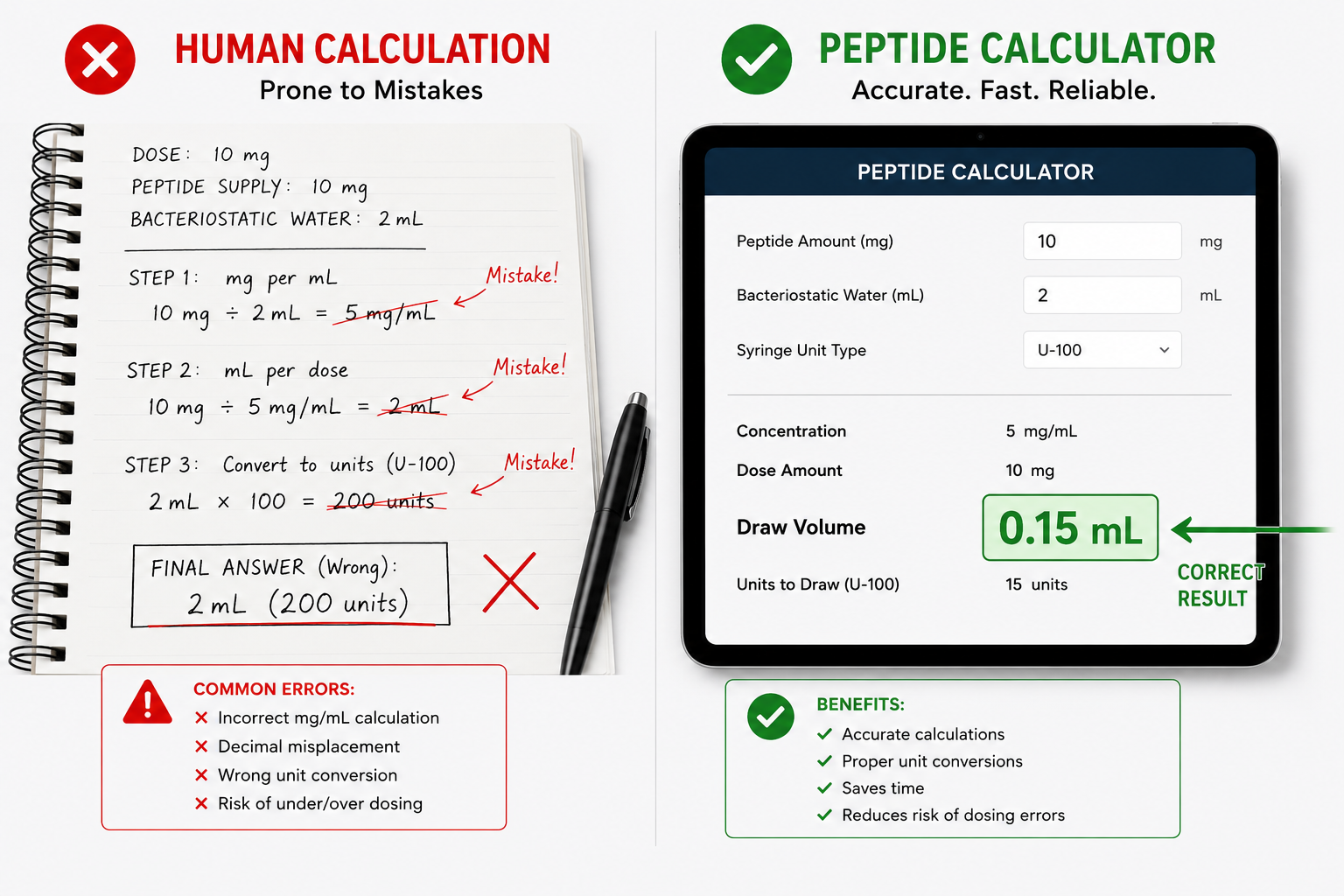
A single miscalculation during peptide reconstitution can render an entire vial useless, or worse, compromise months of research data. Yet dosing math errors remain one of the most common mistakes in laboratory peptide work, often stemming from skipped steps rather than complex chemistry.

This guide applies the core principles of Peptides Calculator 101: How Researchers Accurately Reconstitute CJC‑1295, Ipamorelin, PT‑141, and BPC‑157 to give researchers worked math examples, practical dilution tables, and error-avoidance strategies for four of the most studied research peptides in 2026.

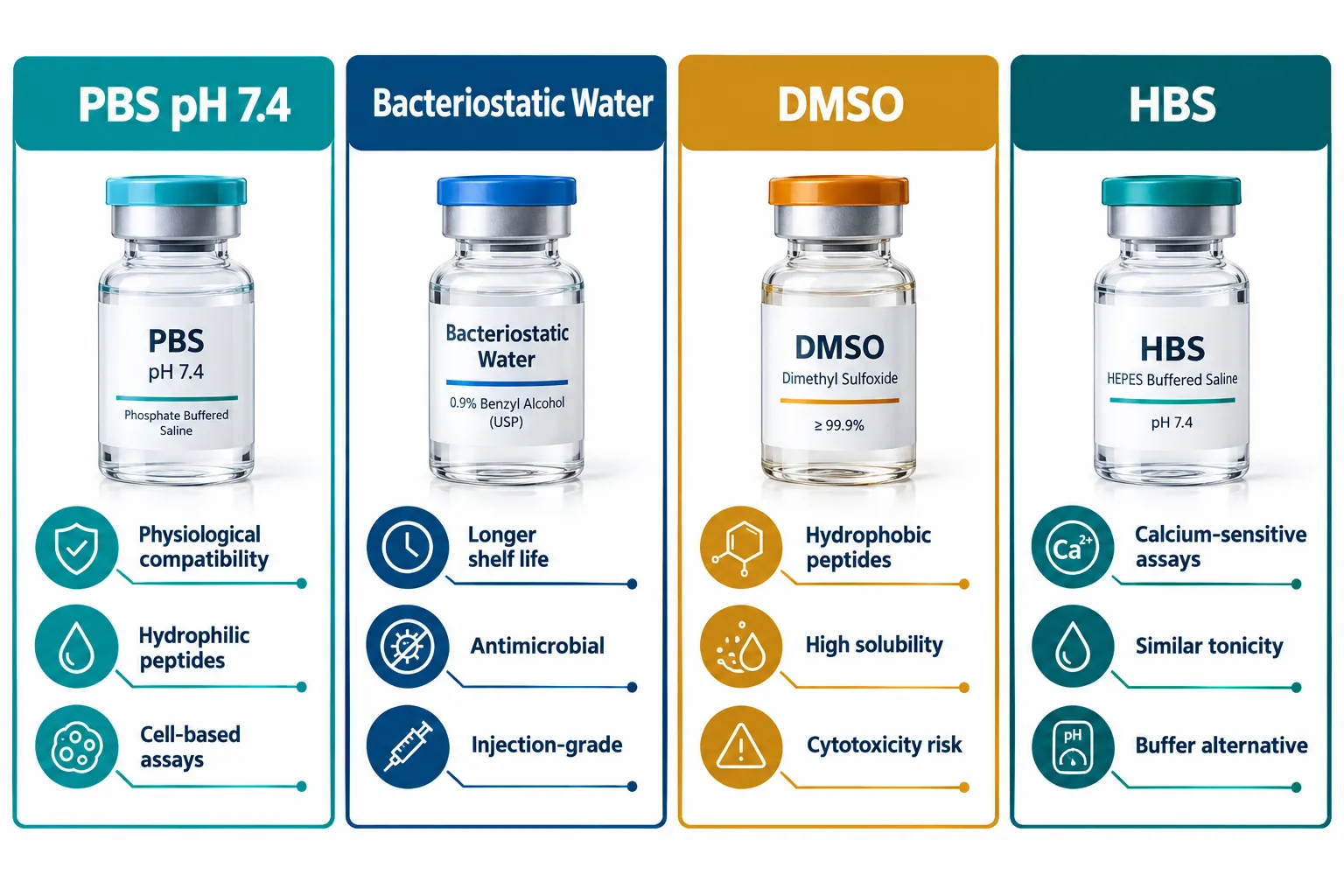
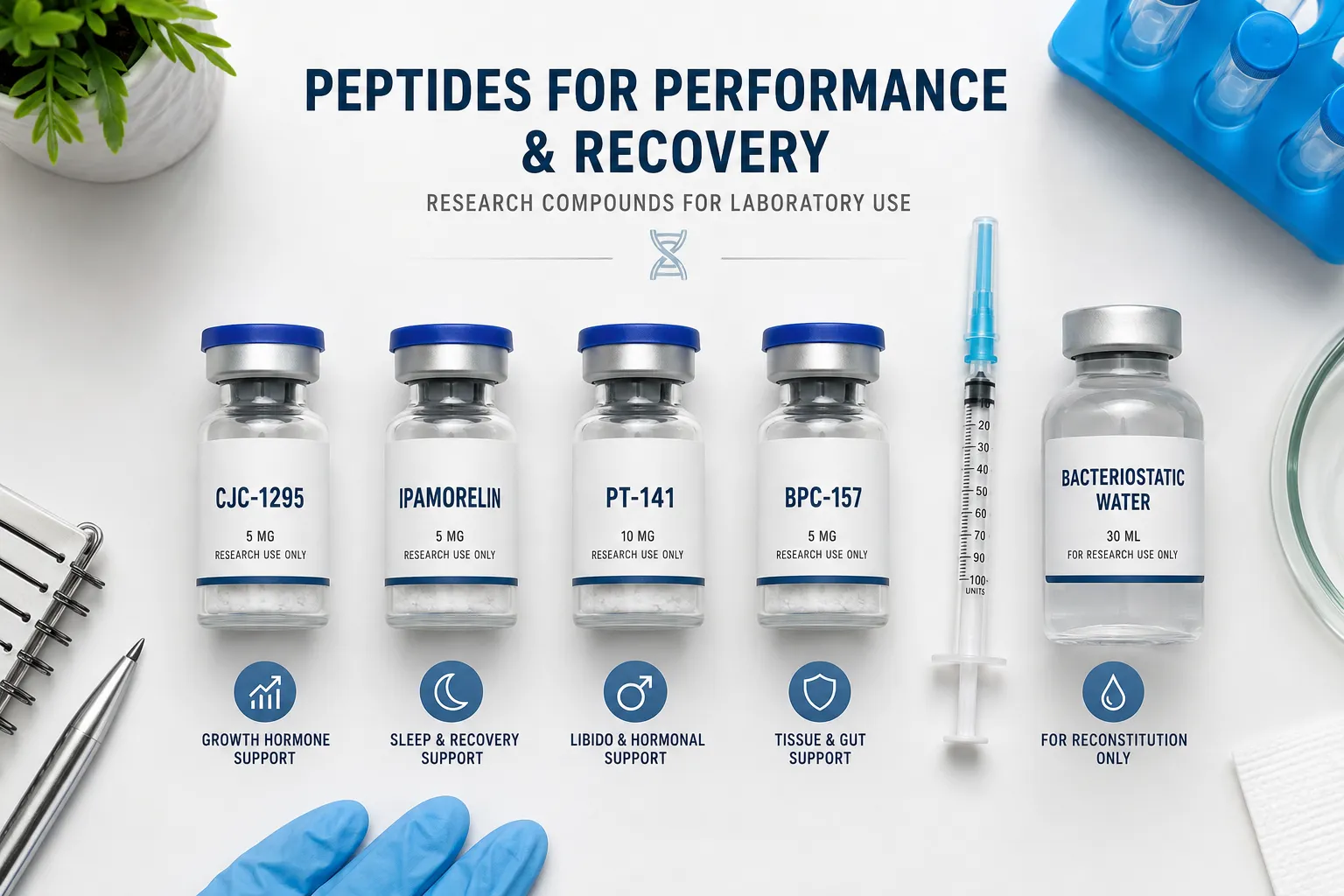
Bright editorial infographic-style landscape image (): overhead flat-lay of a laboratory workstation showing four labeled

Key Takeaways

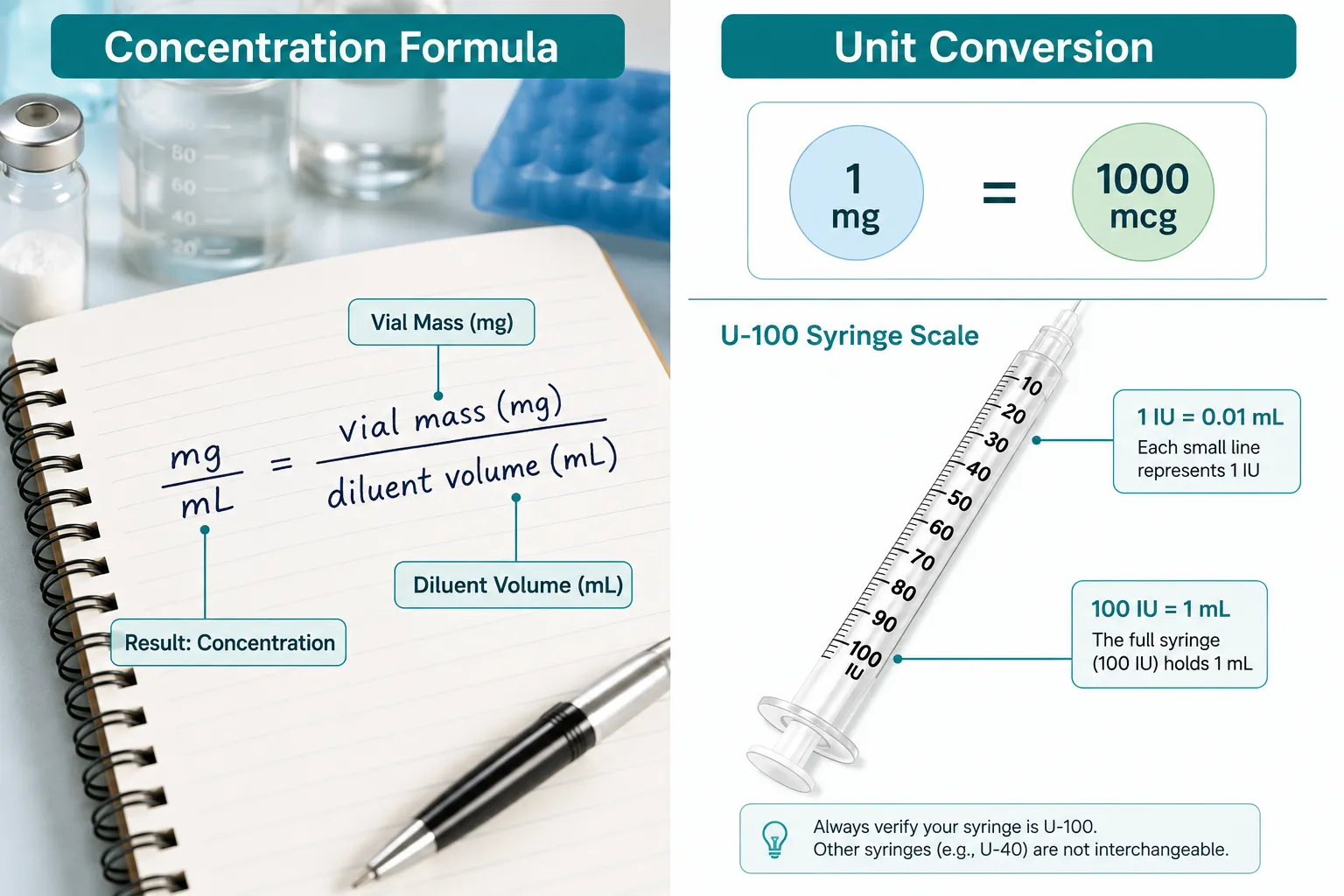
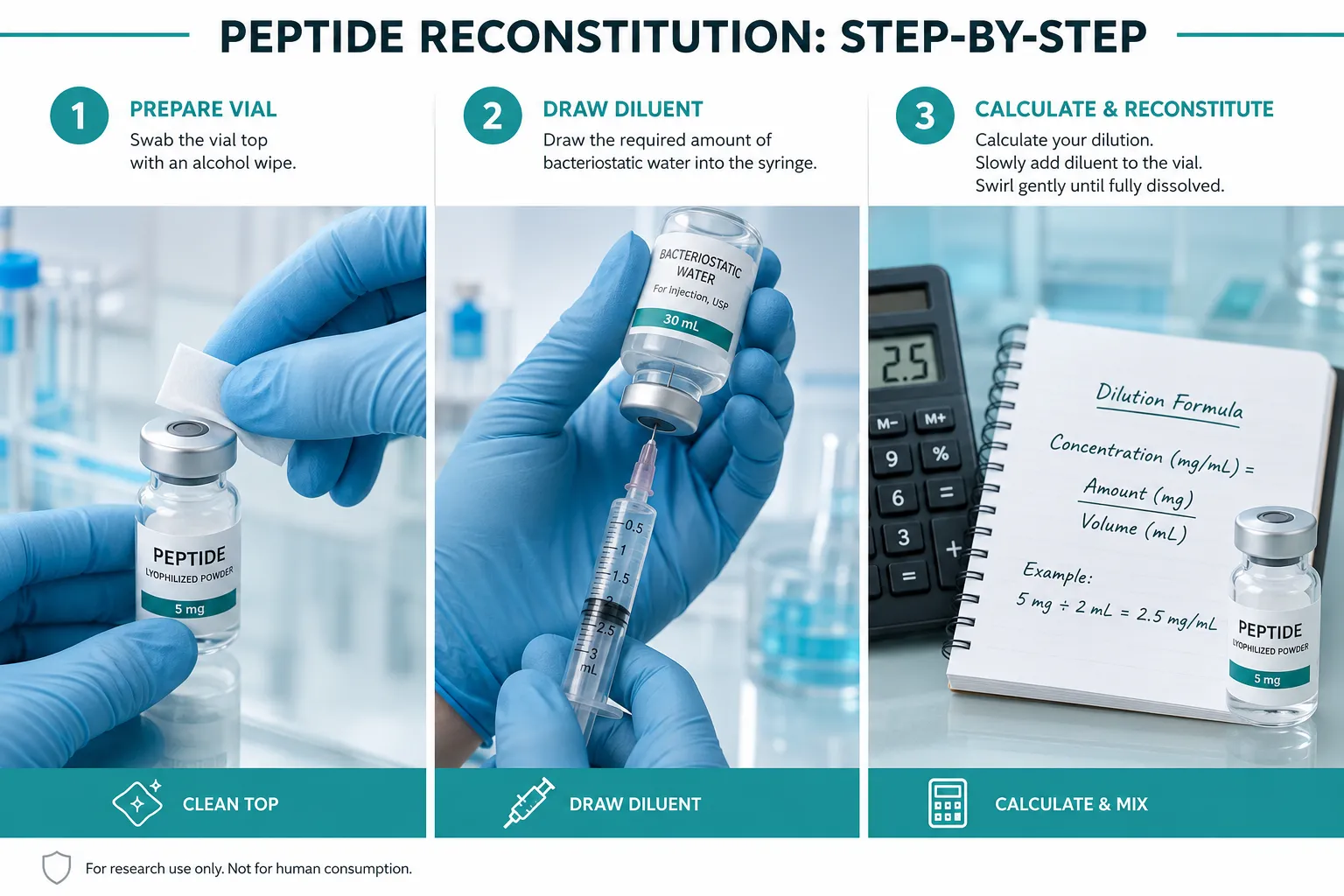
  • Accurate reconstitution starts with a simple formula: Concentration (mg/mL) = Peptide mass (mg) / Volume of solvent added (mL)
  • Bacteriostatic water is the standard solvent for CJC‑1295, Ipamorelin, PT‑141, and BPC‑157
  • A 5 mg vial + 2 mL bacteriostatic water yields a 2.5 mg/mL working solution
  • Blend vials require calculating concentration per peptide, not total mass
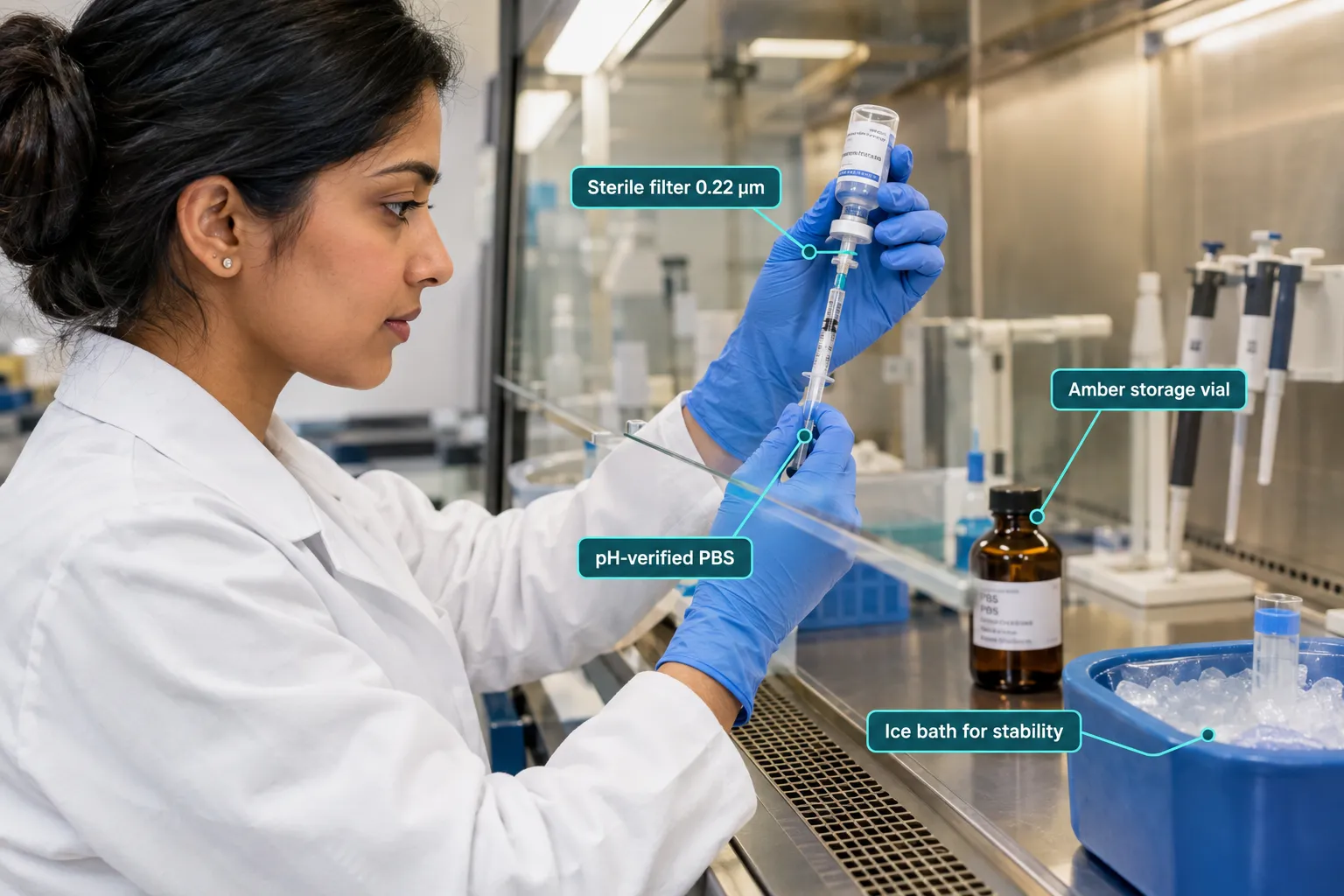
  • Aseptic technique, gloves, alcohol swabs, clean workspace, is non-negotiable before any math begins

The Core Formula Every Researcher Must Know

Before running any peptide-specific calculation, one formula governs all reconstitution work:

Concentration (mg/mL) = Peptide mass (mg) / Solvent volume added (mL)

This is the foundation of every peptide calculator table. Once concentration is known, the volume needed for any target dose is:

Volume to draw (mL) = Target dose (mg) / Concentration (mg/mL)

Worked Example: CJC‑1295 (5 mg vial)

  • Vial contains: 5 mg lyophilized CJC‑1295
  • Bacteriostatic water added: 2 mL
  • Resulting concentration: 5 ÷ 2 = 2.5 mg/mL

To deliver a 0.5 mg research dose:

  • Volume to draw: 0.5 ÷ 2.5 = 0.2 mL (20 units on a 1 mL/100-unit insulin syringe)

For a deeper look at CJC‑1295 pharmacology and research context, the CJC-1295 with DAC deeper dive resource provides useful background.

Worked Example: Ipamorelin (5 mg vial)

The same logic applies. Researchers frequently explore whether Ipamorelin is among the most beneficial peptides for GH secretagogue research, and accurate dosing is central to that work.

  • Vial: 5 mg Ipamorelin + 2 mL bacteriostatic water = 2.5 mg/mL
  • For a 0.3 mg dose: 0.3 ÷ 2.5 = 0.12 mL (12 units)

Dilution Tables for CJC‑1295, Ipamorelin, PT‑141, and BPC‑157

Applying Peptides Calculator 101: How Researchers Accurately Reconstitute CJC‑1295, Ipamorelin, PT‑141, and BPC‑157 across four peptides reveals how vial size and solvent volume interact.

Dilution Tables for CJC‑1295, Ipamorelin, PT‑141, and BPC‑157

Peptide Vial Size BAC Water Added Concentration Units per 0.5 mg dose
CJC‑1295 5 mg 2 mL 2.5 mg/mL 20 units
Ipamorelin 5 mg 2 mL 2.5 mg/mL 20 units
PT‑141 10 mg 2 mL 5 mg/mL 10 units
BPC‑157 5 mg 2 mL 2.5 mg/mL 20 units

Blend Vials: The Extra Step Researchers Miss

When working with combination vials, such as a 10 mg CJC‑1295 no-DAC + Ipamorelin blend reconstituted with 3.0 mL bacteriostatic water, total concentration is 3.33 mg/mL, but each peptide contributes only 1.67 mg/mL. Researchers must calculate per-peptide concentration, not total mass.

For PT‑141 research context and sourcing details, the PT‑141 peptide research Q&A page offers useful supporting information. BPC‑157 researchers can also reference the dedicated BPC‑157 research overview for peptide-specific notes.


Aseptic Technique and Common Calculation Errors

No peptide calculator produces reliable results if preparation technique is flawed. Updated 2026 protocols from research-oriented suppliers consistently emphasize the following pre-calculation steps:

  • Equilibrate the vial at room temperature for 10-15 minutes before adding solvent
  • Swab all rubber stoppers with 70% isopropyl alcohol and allow to air-dry
  • Wear nitrile gloves and work on a clean, disinfected surface
  • Add solvent slowly by directing the stream along the vial wall, never inject directly onto the lyophilized cake, as this can degrade the peptide

The Three Most Common Errors

  1. Forgetting to account for dead volume in syringes, always draw slightly more than needed and confirm the final volume
  2. Using sterile water instead of bacteriostatic water, without the preservative (benzyl alcohol), multi-use vials degrade rapidly
  3. Misreading insulin syringe units as mL, on a standard U-100 syringe, 10 units = 0.1 mL

Researchers sourcing verified compounds should review lab-tested peptide products and check available certificates of analysis to confirm purity before any reconstitution begins.

The Three Most Common Errors

For those working with related secretagogue combinations, the resource on combining Tesamorelin with CJC and Ipamorelin addresses multi-peptide protocol considerations in detail.


Conclusion

Accurate peptide reconstitution is not guesswork, it is straightforward arithmetic applied within a disciplined aseptic framework. The principles covered in Peptides Calculator 101: How Researchers Accurately Reconstitute CJC‑1295, Ipamorelin, PT‑141, and BPC‑157 reduce to three actionable steps: confirm vial mass, choose the correct solvent volume, and apply the concentration formula before drawing any dose.

Next steps for researchers in 2026:

  • Build a personal reference table using the dilution examples above for every vial size used in active protocols
  • Always verify purity through third-party certificates of analysis before reconstitution
  • Store reconstituted vials at 2-8 °C and label each with the preparation date and calculated concentration
  • Cross-reference blend vials against per-peptide concentration, not total mass

Consistent application of these principles protects both data integrity and research investment.

https://www.puretestedpeptides.com/wp-content/uploads/2026/07/peptides-calculator-101-how-researchers-accurately-reconstitute-cjc-1295-ipamore.webp 672 1008 https://www.puretestedpeptides.com/wp-content/uploads/2026/01/buy-peptides-online.jpg 2026-07-15 13:05:232026-07-15 13:05:23Peptides Calculator 101: How Researchers Accurately Reconstitute CJC‑1295, Ipamorelin, PT‑141, and BPC‑157

Using a Peptides Calculator for Accurate Reconstitution: Worked Examples for CJC‑1295, Ipamorelin, PT‑141, and BPC‑157

July 13, 2026/0 Comments/in Uncategorized/by

Cover Image

A dosing error as small as 0.05 mL can mean the difference between delivering 100 mcg and 250 mcg of a research peptide, a 150% overshoot from a single misread syringe line. Using a peptides calculator for accurate reconstitution: worked examples for CJC‑1295, Ipamorelin, PT‑141, and BPC‑157 removes that guesswork entirely by converting vial weight, bacteriostatic water (BAC water) volume, and target dose into a precise syringe unit every time.

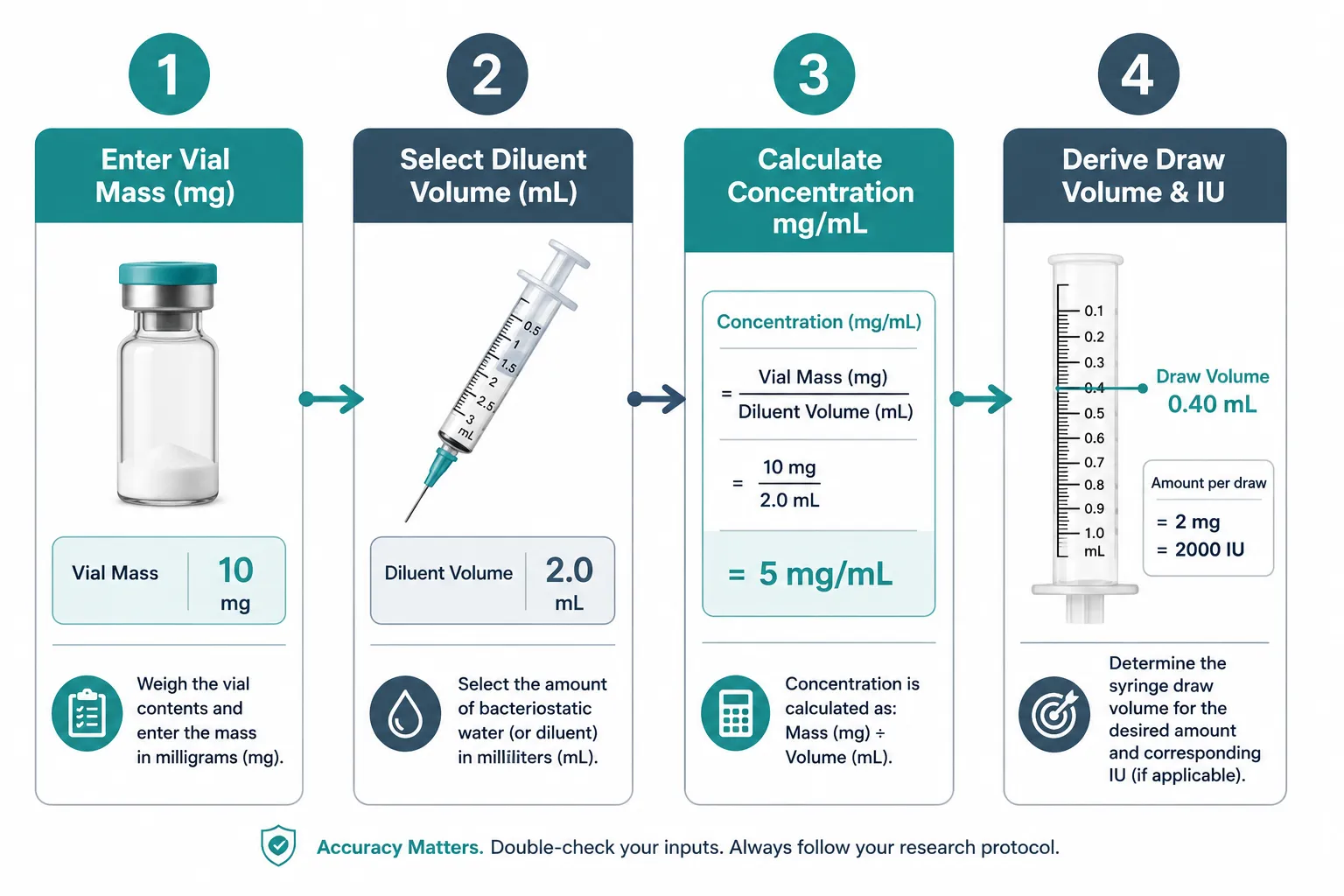
Peptide reconstitution step-flow infographic showing vial, water, and syringe

Key Takeaways

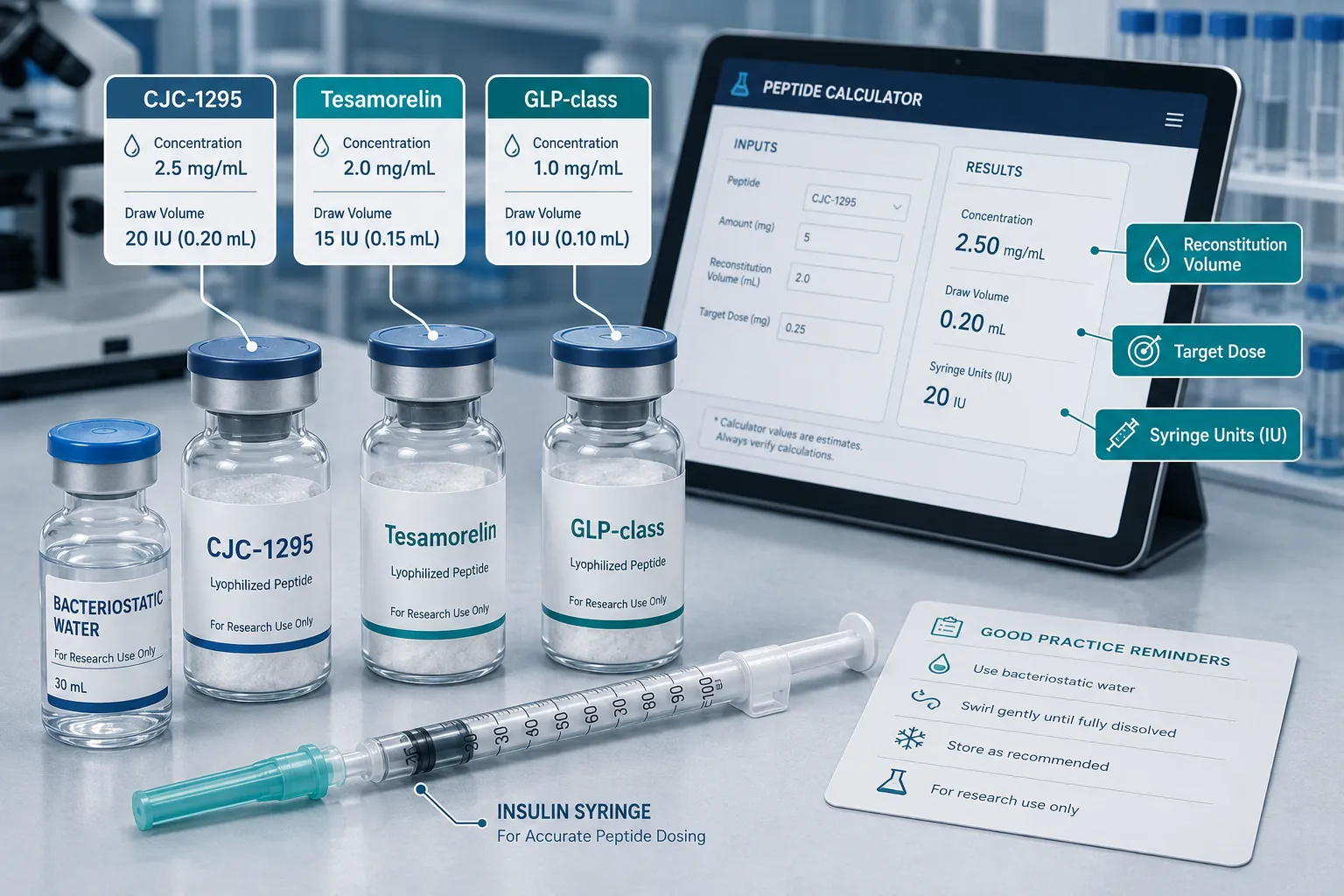
  • A peptides calculator requires only three inputs: vial size (mg), BAC water volume (mL), and desired dose (mcg).
  • The core formula is: Draw volume (mL) = Desired dose (mcg) / Concentration (mcg/mL).
  • Concentration is set entirely by how much BAC water is added, not by the peptide itself.
  • Standard U-100 insulin syringes read in units; 1 unit = 0.01 mL, so 10 units = 0.10 mL.
  • Running the same math through a dedicated calculator tool eliminates manual arithmetic errors.

The Core Formula Behind Every Peptides Calculator

Before working through individual compounds, it helps to lock in the two-step math that every peptides calculator runs automatically.

Step 1, Calculate concentration:

Concentration (mcg/mL) = Vial size (mcg) / BAC water added (mL)

Step 2, Calculate draw volume:

Draw volume (mL) = Desired dose (mcg) / Concentration (mcg/mL)

Step 3, Convert mL to insulin syringe units (U-100):

Syringe units = Draw volume (mL) × 100

That is the entire engine. Tools such as PeptiTools, DrawDose, and VialDex automate these three steps and add a visual syringe guide so researchers can verify the correct fill line at a glance.


Using a Peptides Calculator for Accurate Reconstitution: Worked Examples for CJC‑1295, Ipamorelin, PT‑141, and BPC‑157

CJC‑1295 (No DAC), 2 mg Vial, 100 mcg Dose

CJC‑1295 without DAC is a short-acting growth hormone-releasing hormone analogue commonly studied at doses between 100-300 mcg. For CJC‑1295 no-DAC research applications, a 2 mg vial reconstituted with 2 mL BAC water is a practical starting point.

Variable Value
Vial size 2,000 mcg
BAC water added 2.0 mL
Concentration 1,000 mcg/mL
Target dose 100 mcg
Draw volume 0.10 mL
Syringe units (U-100) 10 units

Ipamorelin, 5 mg Vial, 200 mcg Dose

Ipamorelin is a selective ghrelin mimetic often paired with CJC‑1295. Research on the CJC‑1295 plus Ipamorelin combination typically targets 200-300 mcg of Ipamorelin per injection.

Variable Value
Vial size 5,000 mcg
BAC water added 2.5 mL
Concentration 2,000 mcg/mL
Target dose 200 mcg
Draw volume 0.10 mL
Syringe units (U-100) 10 units

Note how a higher concentration still produces the same draw volume, a counterintuitive result that a peptides calculator makes immediately clear.

PT‑141 (Bremelanotide), 10 mg Vial, 1 mg Dose

PT‑141 is a melanocortin receptor agonist. For PT‑141 research contexts, doses are typically expressed in milligrams rather than micrograms, so the unit conversion is slightly different.

Variable Value
Vial size 10,000 mcg
BAC water added 2.0 mL
Concentration 5,000 mcg/mL
Target dose 1,000 mcg (1 mg)
Draw volume 0.20 mL
Syringe units (U-100) 20 units

BPC‑157-5 mg Vial, 250 mcg Dose

BPC‑157 is a synthetic pentadecapeptide studied for tissue repair and angiogenesis. Researchers exploring BPC‑157 angiogenesis and tendon research often work in the 250-500 mcg range.

Variable Value
Vial size 5,000 mcg
BAC water added 2.0 mL
Concentration 2,500 mcg/mL
Target dose 250 mcg
Draw volume 0.10 mL
Syringe units (U-100) 10 units

Four research peptide vials with syringe and handwritten calculations


Practical Tips for Reducing Reconstitution Errors

Even with a calculator, lab technique matters. The following practices reduce error at the bench:

  • Always use bacteriostatic water, not sterile water, for multi-use vials. BAC water contains 0.9% benzyl alcohol, which inhibits microbial growth.
  • Inject BAC water slowly down the vial wall, never directly onto the lyophilized cake, to preserve peptide structure.
  • Swirl gently; never vortex. Aggressive agitation can degrade fragile peptide bonds.
  • Store reconstituted vials at 2-8°C and use within the manufacturer's recommended window.
  • Double-check units vs. mL. The most common syringe error is confusing "units" on an insulin syringe with milliliters. On a U-100 syringe, 10 units = 0.10 mL, always.

For researchers working with multi-peptide protocols, tools like VialDex and PepPal support blend calculations, which is especially useful when studying Tesamorelin/CJC‑1295/Ipamorelin 12 mg blends where each component has a different concentration within the same vial.

Researchers interested in broader peptide categories can also explore the full peptide blends research catalog for additional compound options, or review the GH-axis product line overview for context on growth hormone secretagogue research.

Those studying recovery-focused compounds should also reference the recovery and tissue biology overview for dosing context alongside BPC‑157 reconstitution work.

Scientist using peptide calculator tablet beside reconstitution vials


Conclusion

Using a peptides calculator for accurate reconstitution, with worked examples for CJC‑1295, Ipamorelin, PT‑141, and BPC‑157, reduces the three-step math to a reliable, repeatable process. The formula never changes: divide vial micrograms by BAC water volume to get concentration, then divide target dose by concentration to get draw volume, and multiply by 100 to read off syringe units.

Actionable next steps for 2026 research protocols:

  1. Select a dedicated calculator tool (PeptiTools, DrawDose, VialDex, or EZ PepCalc) and bookmark it before any reconstitution session.
  2. Record every reconstitution in a lab notebook: vial lot, BAC water volume, date, and resulting concentration.
  3. Cross-reference calculated draw volumes against a visual syringe guide before each draw.
  4. Review compound-specific dosing literature, such as the Sermorelin/Ipamorelin/CJC‑1295 dosage reference, to confirm that target doses fall within studied research ranges.

Precision at the reconstitution stage is the foundation of reproducible peptide research. A calculator does not replace scientific judgment, but it does eliminate the arithmetic errors that undermine it.

https://www.puretestedpeptides.com/wp-content/uploads/2026/01/buy-peptides-online.jpg 0 0 https://www.puretestedpeptides.com/wp-content/uploads/2026/01/buy-peptides-online.jpg 2026-07-13 13:18:112026-07-13 13:18:11Using a Peptides Calculator for Accurate Reconstitution: Worked Examples for CJC‑1295, Ipamorelin, PT‑141, and BPC‑157
Understanding Peptide Stability: A Guide to Optimizing Storage and Handling for Research Purity

Understanding Peptide Stability: A Guide to Optimizing Storage and Handling for Research Purity

July 6, 2026/0 Comments/in Uncategorized/by

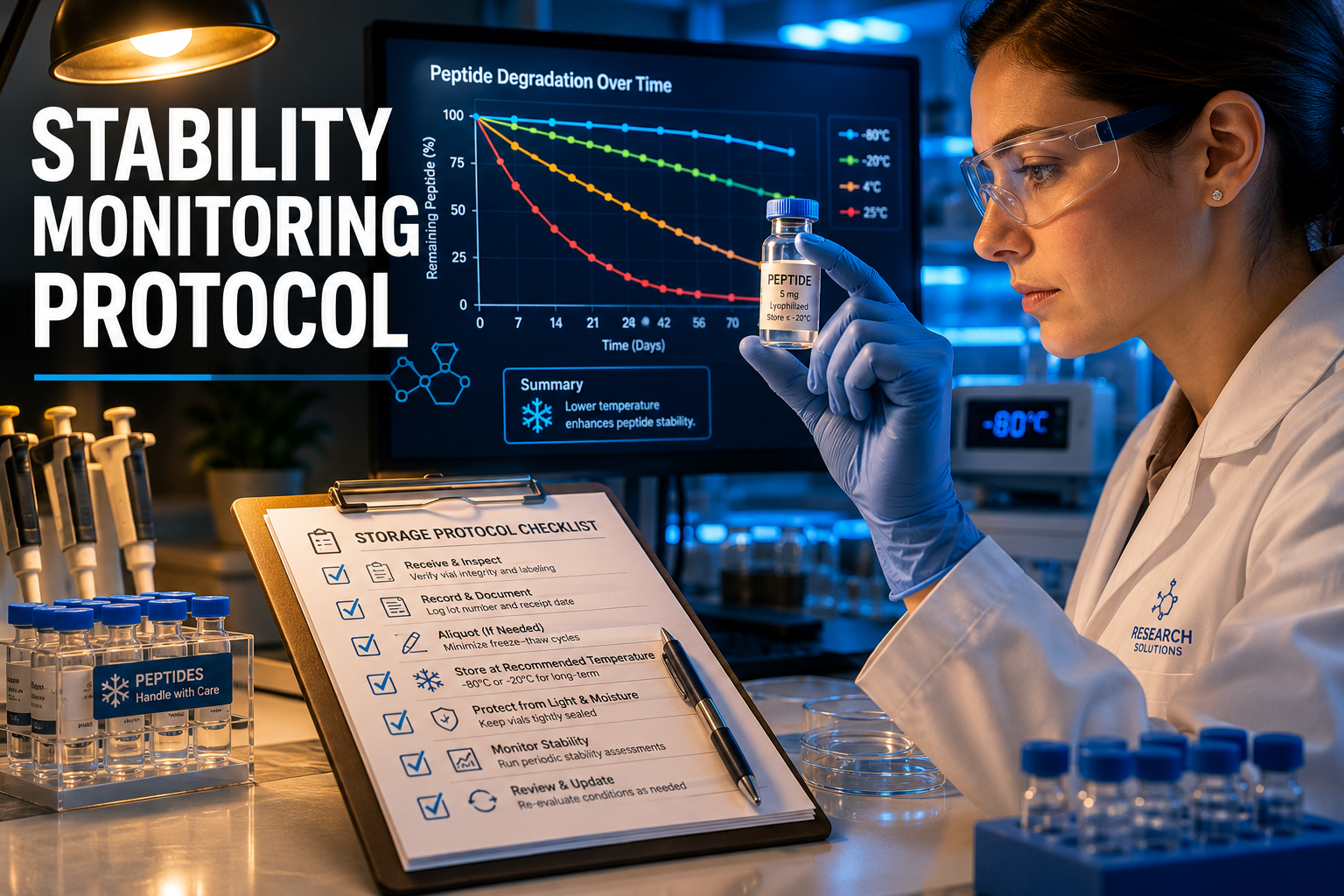
A single improper storage decision can reduce a peptide's purity from over 98% to below 90% in less than four weeks. For researchers who depend on precise, reproducible results, that loss is not just inconvenient, it can invalidate entire experimental protocols. This guide to understanding peptide stability covers the essential storage and handling practices that protect research-grade compounds from the most common degradation threats.

Key Takeaways

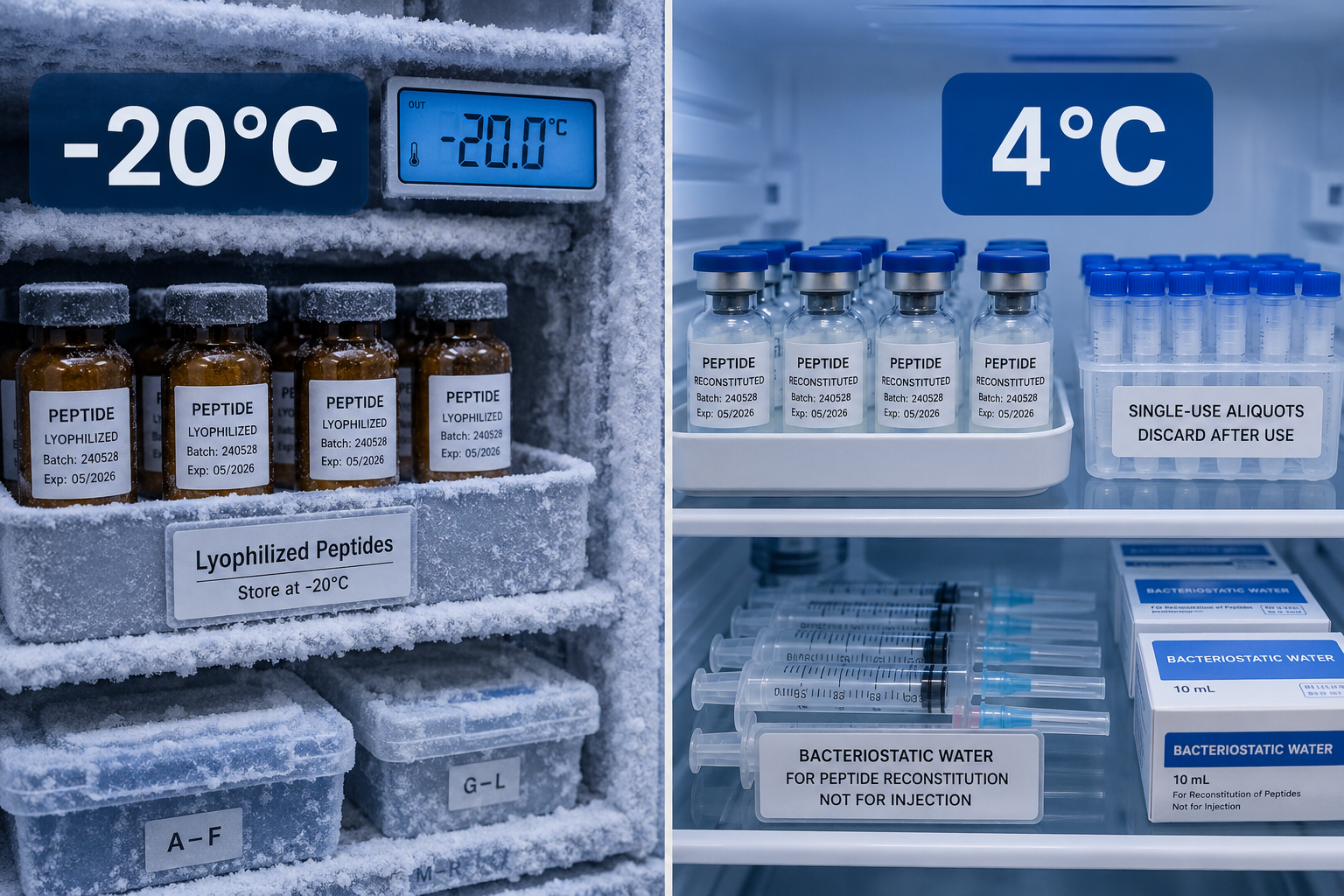
  • Lyophilized peptides stored at -20°C or below can remain stable for 2 to 3 years; reconstituted peptides degrade far more quickly.
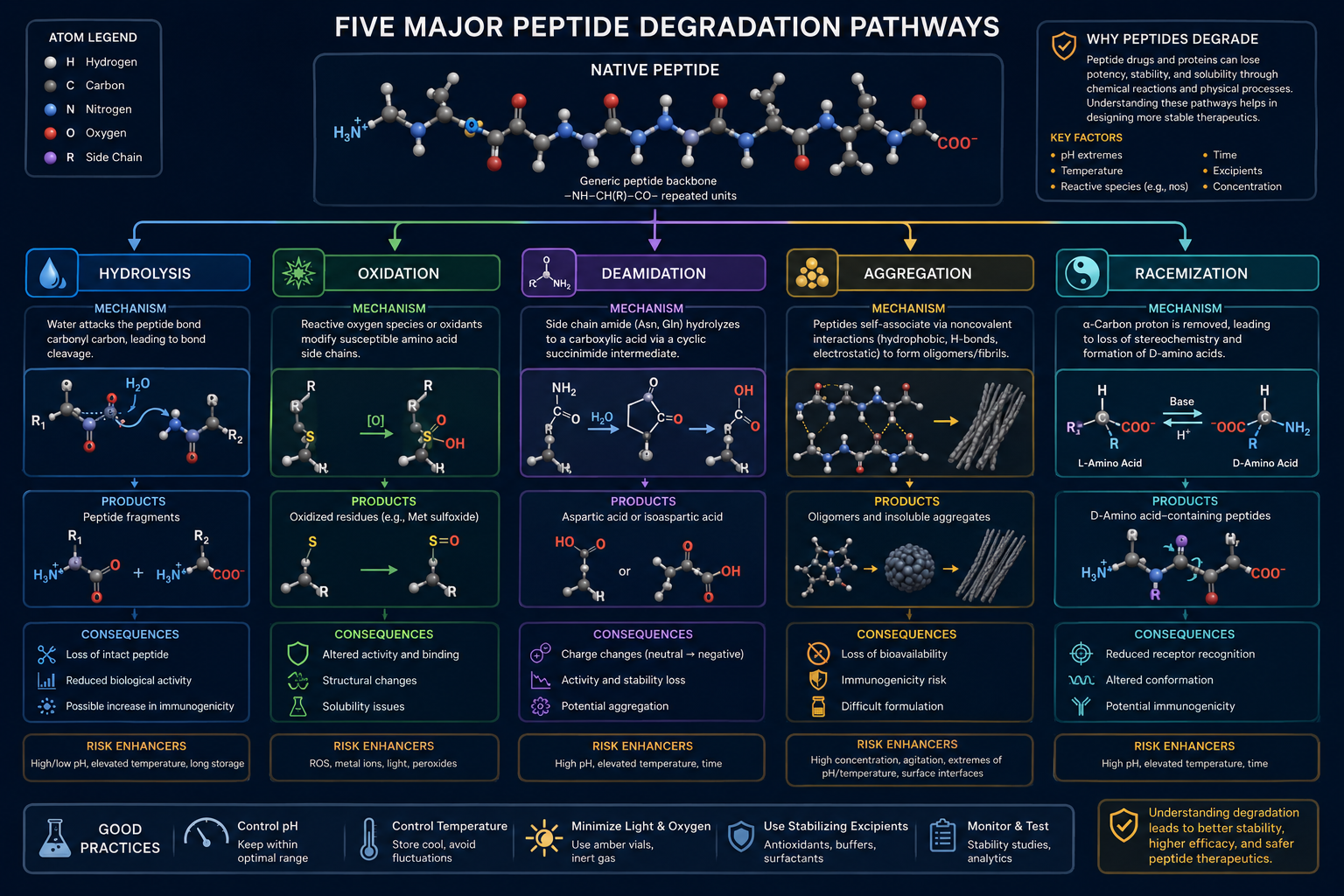
  • Five primary degradation pathways, hydrolysis, oxidation, deamidation, aggregation, and racemization, threaten purity at every stage.
  • Aliquoting reconstituted peptides into single-use portions dramatically reduces freeze-thaw damage.
  • Bacteriostatic water extends the usable life of reconstituted peptides compared to sterile water alone.
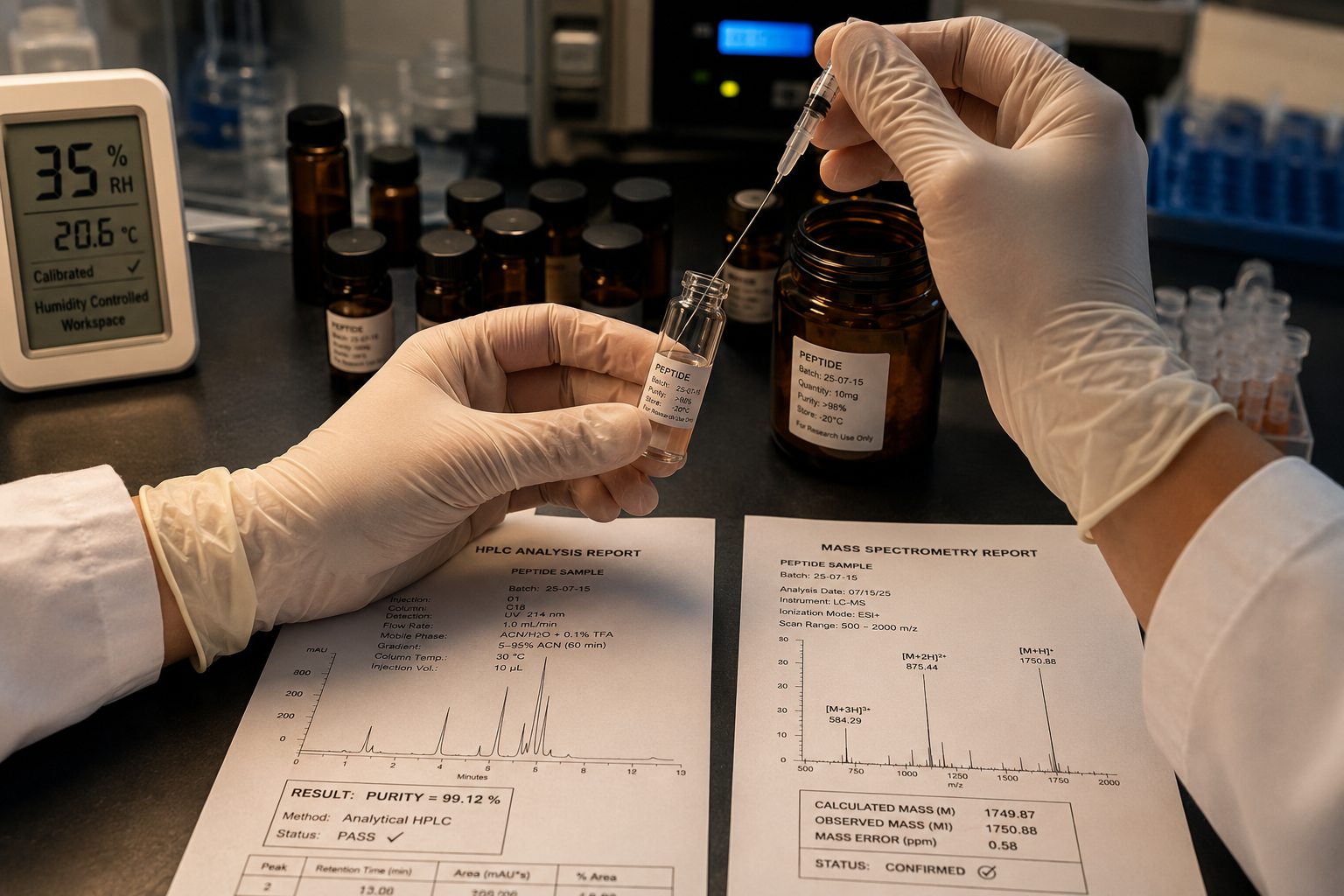
  • HPLC and mass spectrometry remain the gold-standard methods for verifying purity after storage.

Key Takeaways

The Five Degradation Pathways Every Researcher Must Know

A foundational part of understanding peptide stability is recognizing how compounds break down. Peptides degrade through five main chemical and physical pathways:

Degradation Pathway Primary Trigger Key Prevention Strategy
Hydrolysis Moisture exposure Sealed vials, low-humidity handling
Oxidation Oxygen, light Amber containers, inert atmosphere
Deamidation Heat, alkaline pH Cold storage, correct solvent pH
Aggregation Freeze-thaw cycling Single-use aliquots
Racemization Heat, extreme pH Stable temperature, proper solvent

Each pathway can occur independently or in combination. Hydrolysis is among the most common, triggered by even trace moisture entering a vial. Oxidation is accelerated by light exposure, which is why amber or opaque containers are standard in professional research settings. Aggregation, where peptide chains clump together and lose bioactivity, is most often caused by repeated freeze-thaw cycles.

Researchers working with sensitive compounds such as those explored in longevity peptide research or mitochondria-targeted molecules like those covered in the MOTS-C mitochondrial peptide overview must be especially attentive to these pathways, as structural integrity directly affects experimental outcomes.


The Five Degradation Pathways Every Researcher Must Know

Storage Conditions: Lyophilized vs. Reconstituted Peptides

Understanding peptide stability requires treating lyophilized and reconstituted peptides as two distinct categories with very different requirements.

Lyophilized (freeze-dried) peptides are the more stable form. When stored at -20°C or below in sealed, moisture-protected vials, they can remain viable for 2 to 3 years. The freeze-drying process removes water, which is the primary driver of hydrolytic breakdown. Handling lyophilized peptides in low-humidity environments and ensuring vials are tightly sealed before returning them to cold storage is essential.

Reconstituted peptides are considerably more vulnerable. Research monitoring eight common peptides in bacteriostatic water at 4°C over 30 days found average purity retention of 98.2% at day 7, dropping to 91.3% by day 28. This decline underscores the importance of using reconstituted peptides promptly and storing them correctly.

"Bacteriostatic water extends the usable life of reconstituted peptides by inhibiting microbial growth, a meaningful advantage over sterile water for short-term research use."

Standard short-term storage for reconstituted peptides is 2 to 8°C, typically supporting a usable window of 30 to 60 days depending on the specific compound. For peptides like those discussed in the TB-500 muscle recovery research overview or GHK-Cu longevity research themes, following these guidelines helps ensure data reliability.


Storage Conditions: Lyophilized vs. Reconstituted Peptides

Practical Handling Protocols for Maintaining Research Purity

Optimizing storage and handling for research purity extends beyond temperature settings. The physical act of reconstitution matters.

Best practices for reconstitution:

  • Add solvent slowly along the inside wall of the vial rather than directly onto the lyophilized cake.
  • Swirl gently, never vortex, to dissolve the peptide without causing mechanical denaturation.
  • Allow the vial to reach room temperature before opening to prevent condensation from entering.

Aliquoting strategy is equally important. Dividing a reconstituted batch into single-use portions before freezing eliminates the need to repeatedly thaw and refreeze the same vial. Each freeze-thaw cycle risks aggregation and structural damage.

For researchers sourcing compounds, peptide purity testing provides a clear framework for evaluating quality before storage even begins. Verifying purity at the point of purchase using HPLC and mass spectrometry data ensures the baseline is sound. Those exploring newer compounds can also review what is new in peptide research for evolving best practices.

Light protection is another often-overlooked factor. Peptides susceptible to photodegradation, including many aromatic amino acid-containing sequences, should be stored in amber containers and handled away from direct light sources.

For those interested in sourcing verified compounds, lab-tested peptides with documented purity certificates reduce the variables that compromise downstream research integrity.


Conclusion

Protecting peptide purity is not a passive process. It requires deliberate decisions at every stage, from the moment a lyophilized vial arrives to the final use of a reconstituted aliquot. The core actions are clear: store lyophilized peptides at -20°C or below, reconstitute with bacteriostatic water, aliquot before freezing, shield from light and moisture, and verify purity with HPLC or mass spectrometry before critical experiments. Researchers who treat these protocols as non-negotiable will see more consistent, reproducible results and fewer compromised data sets. Start by auditing current storage conditions, identify any gaps against the guidelines above, and implement changes systematically to build a more reliable research workflow.


https://www.puretestedpeptides.com/wp-content/uploads/2026/07/Understanding-Peptide-Stability-A-Guide-to-Optimizing-Storage-and-Handling-for-Research-Purity.png 1024 1536 https://www.puretestedpeptides.com/wp-content/uploads/2026/01/buy-peptides-online.jpg 2026-07-06 13:04:302026-07-06 13:04:30Understanding Peptide Stability: A Guide to Optimizing Storage and Handling for Research Purity
How Peptide Calculator Tools Aid in Accurate Research Dosing and Reconstitution

How Peptide Calculator Tools Aid in Accurate Research Dosing and Reconstitution

July 1, 2026/0 Comments/in Uncategorized/by

A single decimal point error during peptide reconstitution can render an entire research protocol meaningless. As peptide research expands in 2026, digital calculator tools have moved from optional convenience to essential infrastructure. Understanding how peptide calculator tools aid in accurate research dosing and reconstitution is now a foundational skill for any serious researcher working with lyophilized compounds.

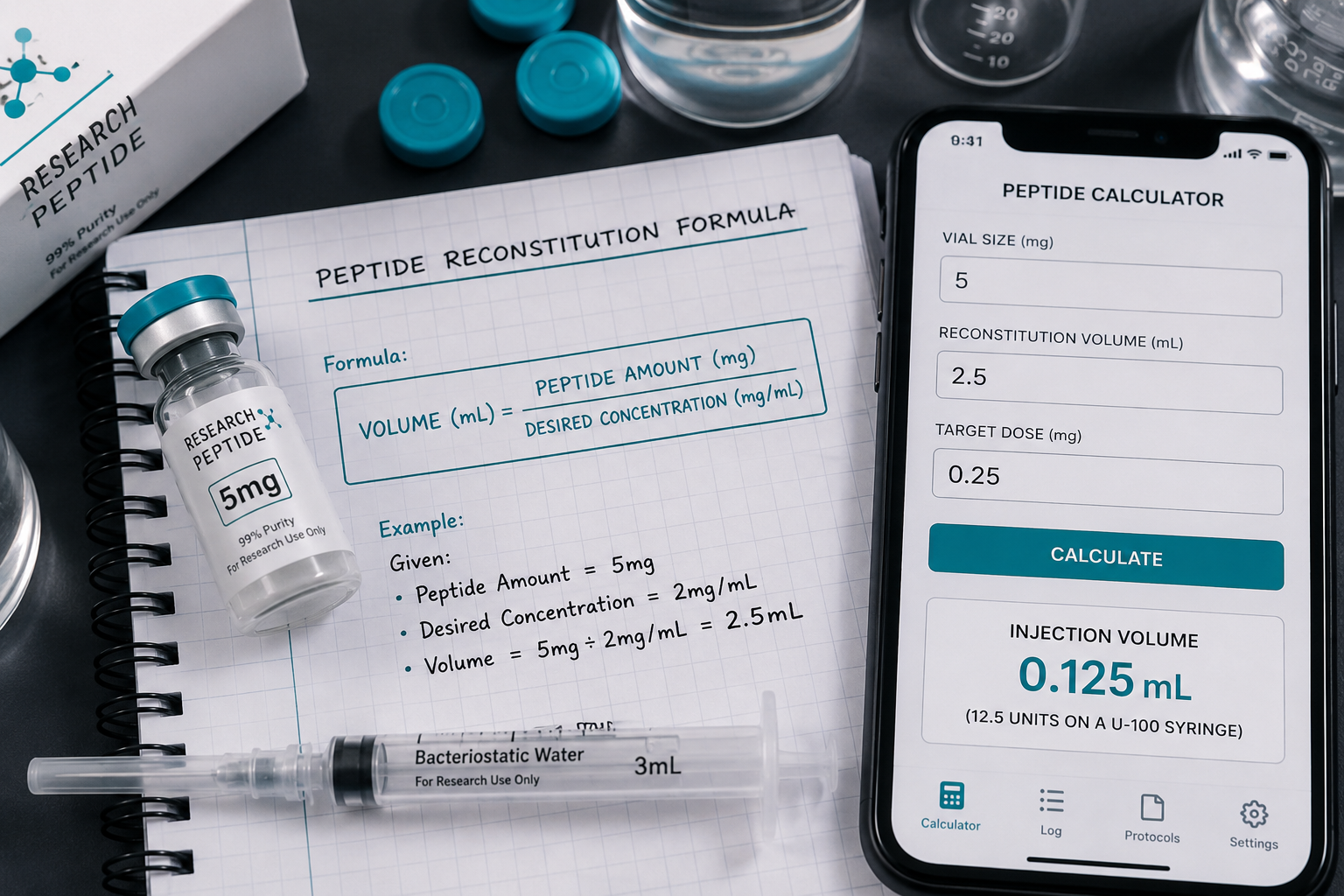
() close-up overhead flat-lay of a research lab workspace showing a peptide vial labeled '5mg', a 3mL bacteriostatic water

Key Takeaways

  • Peptide calculator tools automate the three-variable reconstitution formula, eliminating common unit conversion errors.
  • A standardized calculation approach converts vial size, reconstitution volume, and target dose into a precise draw volume in milliliters.
  • Digital platforms now offer integrated research suites combining dosing calculators with protocol planners and stack compatibility tools.
  • As of mid-2026, leading peptide calculator apps have logged over one million dose events, confirming widespread real-world adoption.
  • Accurate reconstitution math is especially critical for multi-compound protocols and blended peptide formulations.

The Core Math Behind Peptide Reconstitution

Every reconstitution calculation relies on three variables:

  1. Vial size (total peptide content, expressed in mg)
  2. Reconstitution volume (amount of bacteriostatic water added, in mL)
  3. Target research dose (desired dose per administration, in mcg or mg)

The formula is straightforward:

Draw volume (mL) = (Target dose / Total vial content) x Reconstitution volume

A practical example makes this concrete. A 5 mg vial reconstituted with 3 mL of bacteriostatic water, with a target dose of 250 mcg, produces a draw volume of 0.15 mL, which corresponds to 15 units on a standard insulin syringe.

Without a calculator, researchers must manually convert mg to mcg, divide, and then translate mL into syringe units. Each step introduces potential error. Calculator tools codify this formula, embed unit toggles between mcg and mg, and include vial-size presets, removing the most common failure points.

This matters enormously for complex compounds. Researchers working with a Tesamorelin/CJC-1295/Ipamorelin blend face a higher-mg vial requiring precise dilution math to avoid under- or over-dosing any single peptide component.


How Peptide Calculator Tools Aid in Accurate Research Dosing and Reconstitution Across Platforms

How Peptide Calculator Tools Aid in Accurate Research Dosing and Reconstitution Across Platforms

The landscape of available tools has expanded significantly. As of March 2026, platforms like Peptide Protocol Wiki launched 18 free interactive research tools, including dosing calculators, protocol planners, stack compatibility checkers, and evidence explorers. This shift reflects a broader trend: calculators are no longer standalone utilities but components of integrated research suites tied directly to published literature.

Key features researchers should look for in a quality peptide calculator:

Feature Why It Matters
Unit toggle (mcg/mg) Prevents the most common conversion error
Vial size presets Speeds input for standard commercial vials
Reconstitution volume input Accounts for researcher-defined dilution ratios
Draw volume in syringe units Translates mL into practical insulin syringe markings
Protocol logging Tracks dose consistency over time

For researchers using compounds like GHK-Cu or CJC-1295, where dosing windows are relatively narrow, these features directly support protocol integrity.


Longitudinal Tracking and the Future of Research Dosing Tools

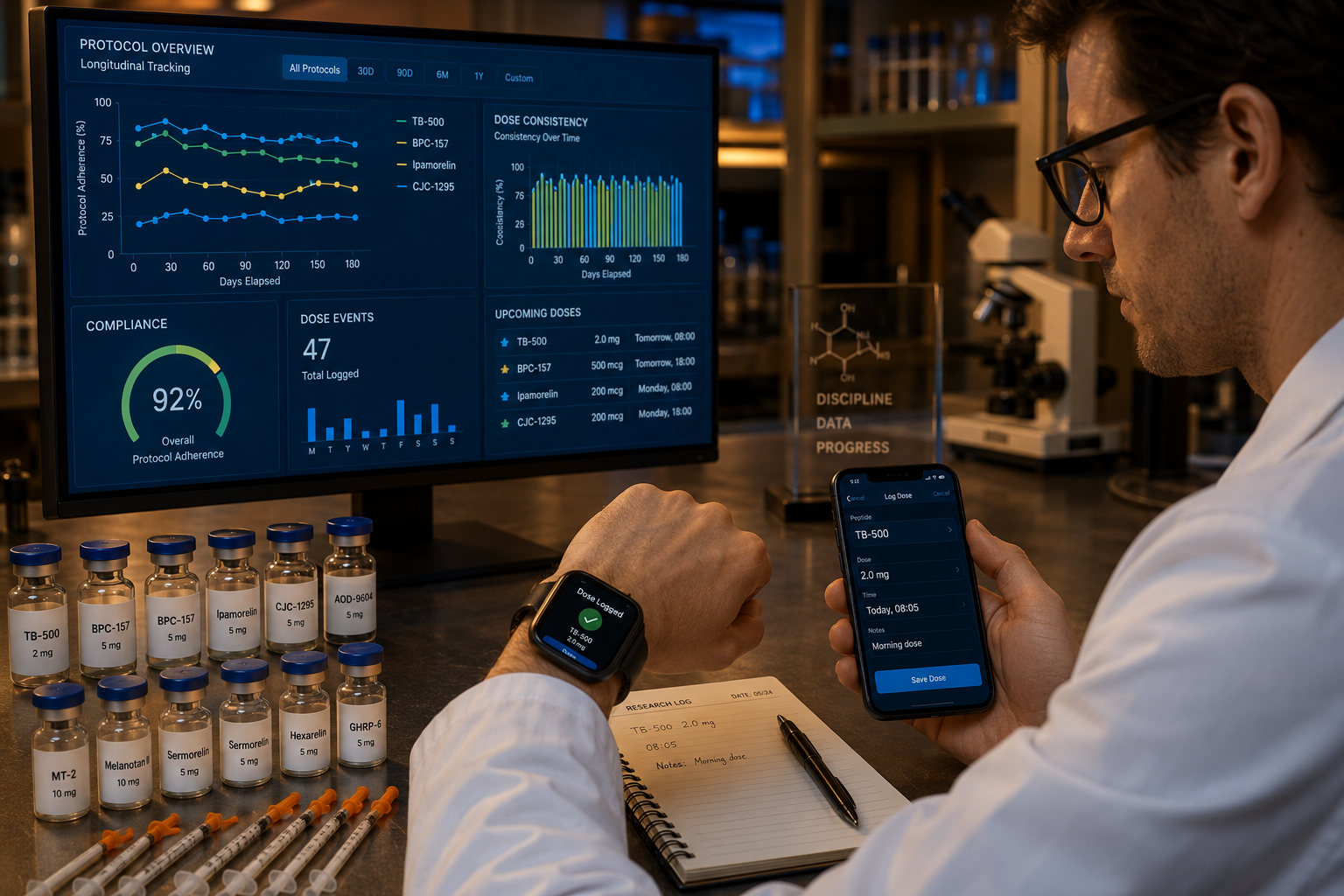
How peptide calculator tools aid in accurate research dosing and reconstitution extends beyond single-dose math. The Peptides Calculator iOS and Apple Watch app surpassed 50,000 users and logged over one million recorded dose events by June 2026. This scale of data demonstrates that researchers are using these tools for longitudinal protocol tracking, not just one-time calculations.

Consistent dose logging enables researchers to:

  • Identify administration timing patterns across a protocol window
  • Confirm dose-to-dose reproducibility
  • Flag deviations that could confound results

This is particularly relevant for multi-peptide research programs. Protocols involving compounds like PT-141 or GLP-1 pathway agents often span weeks, making consistent dosing records a research quality control asset.

Researchers exploring blended formulations, such as the Klow Blend multi-pathway protocol, benefit especially from tools that handle multiple compounds simultaneously rather than requiring separate calculations for each.

Longitudinal Tracking and the Future of Research Dosing Tools

Pairing a reliable calculator with a verified peptide supplier and a well-documented tesa dosage reference creates a complete accuracy framework from sourcing through administration.


Conclusion

Peptide calculator tools are not a luxury for researchers who value precision. They are a practical safeguard against the arithmetic errors that undermine reproducibility. The actionable steps are clear: adopt a calculator that handles unit conversion, vial presets, and draw volume output in syringe units; use longitudinal logging features to maintain dose consistency across a full protocol; and integrate dosing tools with evidence-based stack compatibility resources. As research compounds grow more complex and protocols longer, the role of these tools in maintaining data integrity will only grow.

https://www.puretestedpeptides.com/wp-content/uploads/2026/07/How-Peptide-Calculator-Tools-Aid-in-Accurate-Research-Dosing-and-Reconstitution.png 1024 1536 https://www.puretestedpeptides.com/wp-content/uploads/2026/01/buy-peptides-online.jpg 2026-07-01 13:04:382026-07-01 13:04:38How Peptide Calculator Tools Aid in Accurate Research Dosing and Reconstitution
Peptide Reconstitution, Storage, and Stability: A Complete Research Protocol Guide

Peptide Reconstitution, Storage, and Stability: A Complete Research Protocol Guide

June 22, 2026/0 Comments/in Uncategorized/by

Roughly 30% of research setbacks involving peptide compounds trace back not to flawed experimental design, but to improper handling before the experiment even begins. For researchers working with sensitive biological molecules in 2026, mastering the fundamentals of this Peptide Reconstitution, Storage, and Stability: A Complete Research Protocol Guide is not optional — it is the foundation of reproducible, reliable results.

Key Takeaways

  • Lyophilized peptides remain stable at 2-8 degrees Celsius for 12-24 months; long-term storage requires -20 degrees Celsius.
  • Always use bacteriostatic water for reconstitution to extend solution stability to 4-6 weeks under refrigeration.
  • Reconstituted peptides should be used within approximately 28 days and never left at room temperature for more than a few hours.
  • Divide reconstituted solutions into single-use aliquots to avoid damaging freeze-thaw cycles.
  • Visual inspection alone cannot confirm peptide integrity — degraded peptides often look identical to intact ones.

Key Takeaways

Reconstitution Best Practices for Research-Grade Peptides

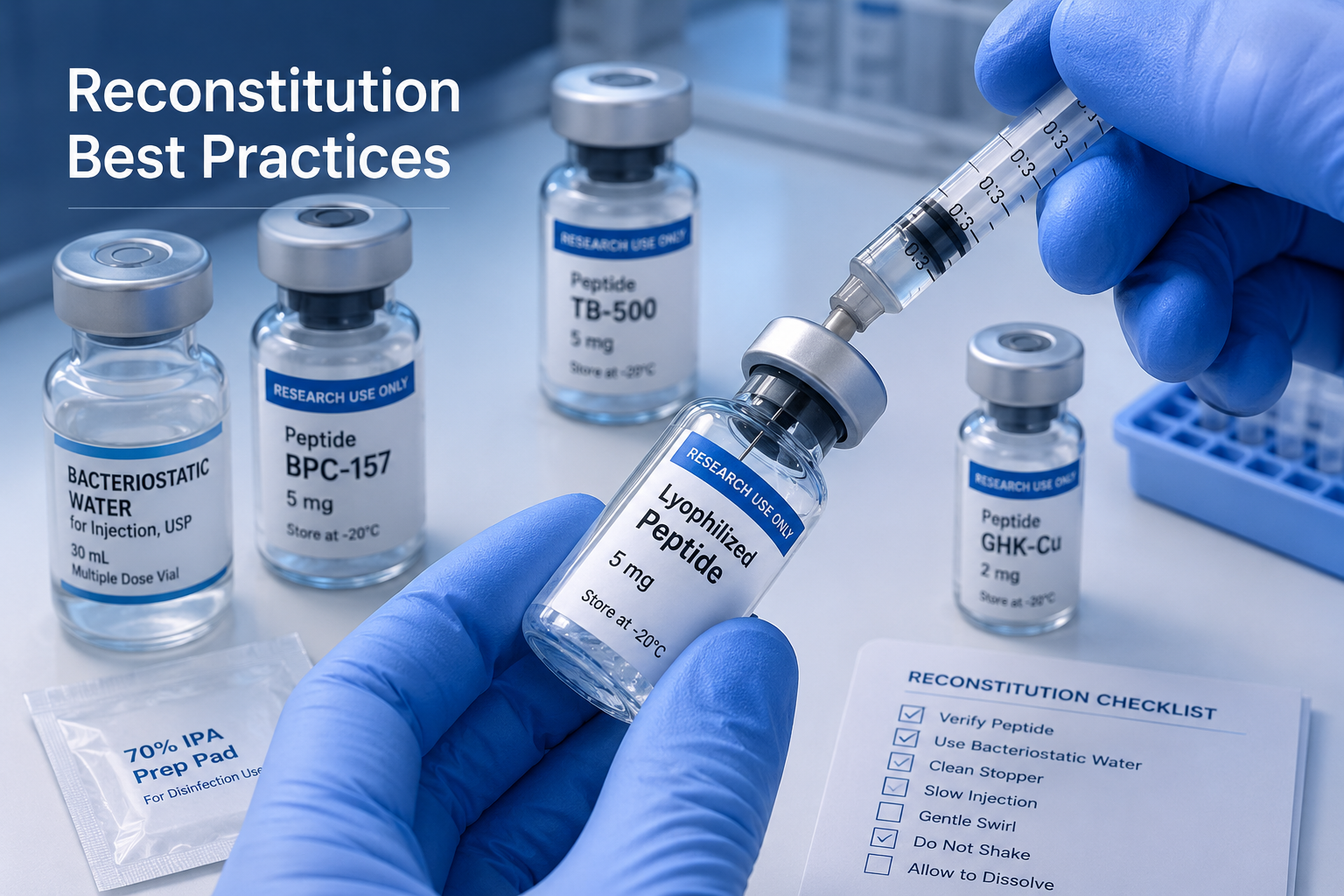
Proper reconstitution is the first critical step in any peptide research protocol. Done incorrectly, it can denature the compound before a single experiment runs.

Choosing the right diluent matters enormously. Bacteriostatic water — containing 0.9% benzyl alcohol — is the preferred choice for most research peptides. The benzyl alcohol inhibits microbial growth, extending the stability of the reconstituted solution to 4-6 weeks under refrigeration. Sterile water is an acceptable alternative but offers no antimicrobial protection, shortening the usable window significantly.

Reconstitution technique:

  1. Allow the lyophilized vial to reach room temperature before opening to reduce condensation risk.
  2. Draw the appropriate volume of diluent into a clean syringe.
  3. Inject the diluent slowly along the inner glass wall of the vial — never directly onto the peptide powder.
  4. Gently swirl (do not shake) until the peptide fully dissolves.
  5. Avoid foaming, which can cause denaturation and compromise yield.

This slow-wall technique is especially important for fragile sequences. Researchers exploring compounds like GHK-Cu or TB-500 and BPC-157 blends should pay particular attention to gentle handling during this step, as both are sensitive to mechanical agitation.

For those working with multi-peptide formulations, the Tesamorelin/CJC-1295/Ipamorelin blend reconstitution guide provides compound-specific volume and diluent recommendations.


Reconstitution Best Practices for Research-Grade Peptides

Storage Protocols: Temperature, Location, and Aliquoting

Following this Peptide Reconstitution, Storage, and Stability: A Complete Research Protocol Guide means understanding that storage is not a passive step — it is an active variable that determines outcome quality.

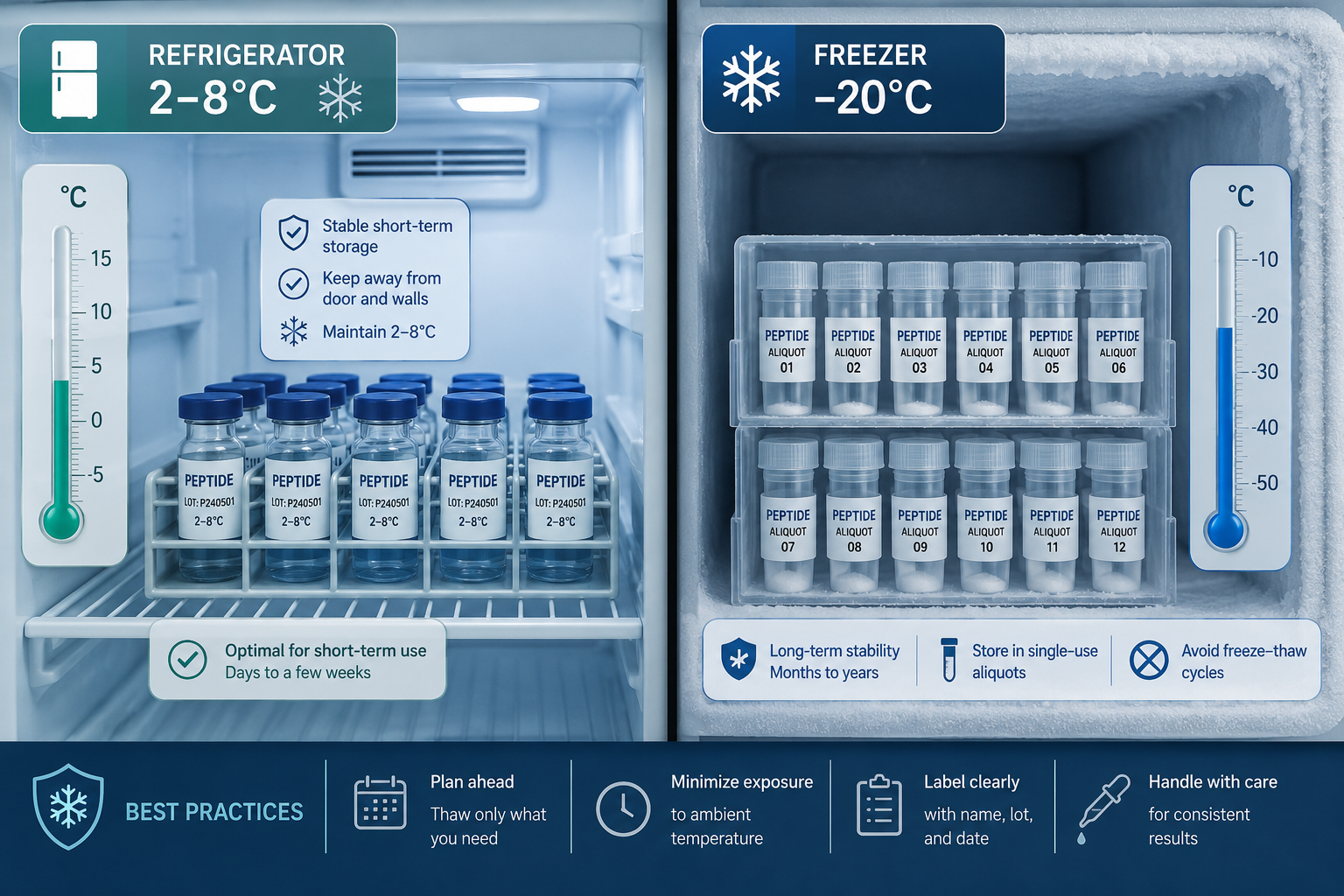
Lyophilized (Unreconstituted) Peptides

Storage Condition Temperature Stability Window
Short-term / Room Temp 15-25 degrees Celsius Days to weeks
Refrigerated 2-8 degrees Celsius 12-24 months
Frozen (long-term) -20 degrees Celsius Beyond 12 months

Keep lyophilized vials sealed, dry, and away from light. Moisture is the primary enemy at this stage.

Reconstituted Peptide Solutions

Once reconstituted, the stability window narrows considerably:

  • Refrigerate immediately at 2-8 degrees Celsius after reconstitution.
  • Use within 28 days under standard refrigerated conditions.
  • Never store at room temperature for more than a few hours — degradation accelerates sharply above 10 degrees Celsius.
  • Store vials in the main body of the refrigerator, not the door, to avoid temperature swings from repeated opening.

"Consistent temperature is not a convenience — it is a research variable. Fluctuations above 10 degrees Celsius can accelerate peptide degradation in ways that are invisible to the naked eye."

Aliquoting to Prevent Freeze-Thaw Damage

Repeated freeze-thaw cycles are one of the most common causes of peptide degradation in research settings. The solution is straightforward: divide reconstituted solutions into single-use aliquots immediately after reconstitution. Thaw each portion only once when needed, then discard any unused volume.

This practice is particularly relevant for longer research cycles involving compounds studied through resources like the longevity peptide research overview or MOTS-C metabolic flexibility research, where consistency across multiple sessions is essential.


Aliquoting to Prevent Freeze-Thaw Damage

Stability Monitoring and Quality Assurance in Peptide Research

This section of the Peptide Reconstitution, Storage, and Stability: A Complete Research Protocol Guide addresses a widely misunderstood risk: assuming a peptide is still viable based on appearance alone.

Degraded peptides often look identical to intact ones. Clarity, color, and consistency do not confirm biological activity. Researchers must rely on documented storage timelines, proper labeling, and sourcing from suppliers with verified quality testing protocols.

Practical stability checklist:

  • Label every vial with reconstitution date and diluent used.
  • Track cumulative freeze-thaw events per aliquot.
  • Discard any solution stored beyond its recommended window, regardless of appearance.
  • Source peptides from suppliers who provide third-party purity verification.

For researchers sourcing compounds such as AOD-9604 for metabolic research or GLP-1 peptides, purity documentation at the point of purchase directly affects downstream stability outcomes.


Conclusion

Applying the principles outlined in this Peptide Reconstitution, Storage, and Stability: A Complete Research Protocol Guide protects both the integrity of the research and the investment in high-quality compounds. The actionable next steps are clear: use bacteriostatic water for reconstitution, store reconstituted solutions at 2-8 degrees Celsius in the main refrigerator body, aliquot immediately to avoid freeze-thaw damage, and never rely on visual inspection as a stability indicator. Source peptides from suppliers who provide transparent purity testing, label every vial with date and diluent, and adhere strictly to the 28-day reconstituted use window. Rigorous handling at every stage is what separates reproducible research from wasted resources.

https://www.puretestedpeptides.com/wp-content/uploads/2026/06/Peptide-Reconstitution-Storage-and-Stability-A-Complete-Research-Protocol-Guide.png 1024 1536 https://www.puretestedpeptides.com/wp-content/uploads/2026/01/buy-peptides-online.jpg 2026-06-22 13:03:092026-06-22 13:03:09Peptide Reconstitution, Storage, and Stability: A Complete Research Protocol Guide
×

Helpful Links

  • My account
  • Cart
  • Checkout
  • Refund and Returns Policy
  • Privacy Policy
  • SMS Privacy Policy
  • Login
  • My Account
  • Logout

USA Made Lab Tested Peptides

All products are sold for research, laboratory, or analytical purposes only, and are not for human consumption


Pure Tested Peptides is a chemical supplier. Pure Tested Peptides is not a compounding / chemical compounding facility as defined under 503A of the Federal Food, Drug, and Cosmetic act. Pure Tested Peptides is not an outsourcing facility as defined under 503B of the Federal Food, Drug, and Cosmetic act.

The statements made within this website have not been evaluated by the US Food and Drug Administration. The products we offer are not intended to diagnose, treat, cure or prevent any disease.

Human/Animal Consumption Prohibited. Laboratory/In-Vitro Experimental Use Only

Scroll to top Scroll to top Scroll to top