Call or Text 727-513-9780
  • Shopping Cart Shopping Cart
    0Shopping Cart
Pure Tested Peptides | America's most trusted Peptides for sale online
  • Peptides for sale
    • Oral Peptides for sale
      • Peptide Capsules for sale
      • BPC 157 Capsules 1000mcg
      • SLU-PP-332 Capsules | 1000 mcg
      • 5-Amino-1MQ 50mg Capsules
      • Tesofensine 500mcg
    • All Peptides for sale
    • Peptide Sprays
      • BPC 157 Nasal Spray Kit
      • BPC-157 TB500 Nasal Spray Kit
      • Semax Nasal Spray 10mg
      • Selank – Nasal Spray Kit – 10mg
      • Epithalon 50MG Nasal Spray Kit
      • Ipamorelin 10mg Nasal Spray
      • Klow Nasal Spray (BPC-157 + TB-500 + GHK-Cu + KPV) | 80mg
      • Hulk Nasal Spray Tesa / Ipa Blend 6/3 MG
      • Klow Nasal Spray
      • NAD + 500 mg Nasal Spray
      • PT-141 Nasal Spray Kit
    • GHRH Peptides
      • Ipa Peptides
      • CJC-1295 Peptides
        • CJC-1295 with DAC 5 mg
        • CJC-1295 without DAC 5 mg
        • CJC-1295 Ipa 10mg
      • Tesa Peptides
        • Tesa Peptide
        • Tesa 20 mg
    • GHK-Cu Peptides
      • All GHK-Cu Peptides
      • GHK-Cu 100mg
      • KLOW Peptide Blend – Buy KLOW blend online
    • BPC Peptides
      • All BPC Peptides
      • BPC-157
      • BPC-157 TB-500
      • BPC 157 capsules 1000mcg
    • SLU-PP-332 Peptides
      • All SLU-PP-332 Peptides
      • SLU-PP-332 5mg
    • GLP3 Peptides
      • GLP3-R
      • GLP3-R CAG 10mg
      • GLP3-R 20mg
    • PT-141 Peptides
      • PT-141 Peptides for sale
      • PT-141 10mg
      • PT-141 Nasal Spray
    • CAG Peptides
      • Lipo-C Peptide Blend
      • CAG 5mg
      • CAG 10mg
    • MOTS-C Peptides
      • MOTS-C Peptides for sale
      • MOTS-c peptide
      • MOTS-c 10mg *6 pack*
    • 5 Amino 1MQ Peptides
      • 5 Amino 1MQ Peptides for sale
      • 5-Amino-1MQ 50mg Capsules
      • 5-Amino-1MQ 5mg
    • Epithalon Peptides
      • Epithalon Peptides for sale
      • Epithalon 10mg
      • Epithalon 50mg
  • Shop
    • GLPs
      • 5-Amino-1MQ 50mg Capsules
      • 5-Amino-1MQ 5mg
      • GLP3-Reta
      • L-Carnitine 500mg/ml
      • Tesofensine 500mcg
      • SLU-PP-332 5mg
      • MOTS-c 10mg *6 pack*
    • Epithalon & BPC Peptides
      • Epithalon 10mg
      • Epithalon 50mg
      • BPC-157
      • BPC 157 capsules 1000mcg
      • BPC-157 TB-500
      • BPC-157 TB500 Nasal Spray Kit
      • BPC 157 Nasal Spray Kit
    • BPC TB-500 & NAD+ Peptides
      • NAD+ 500 mg
      • KLOW Peptide Blend – Buy KLOW blend online
      • GLOW Peptide Blend
      • TB 500 5mg
      • BPC 157 capsules 1000mcg – Supplement
      • BPC 157 Nasal Spray Kit
      • BPC-157
      • BPC-157 TB500 Nasal Spray Kit
      • BPC-157 TB-500
      • BPC 157 capsules 1000mcg
    • LL-37 Peptide
      • LL-37 10 mg
    • MOTS-C & Selank
      • MOTS-c peptide
      • Selank 10mg
    • GHK Peptides
      • GHK-Cu 100mg
      • GLOW Peptide Blend
      • KLOW Peptide Blend – Buy KLOW blend online
  • COAs
  • Wholesale
    • Wholesale Peptides for sale
  • PTP FAQ
  • Affiliates
    • Selank Peptide: Advanced Pharmacological Mechanisms Underlying Its Anxiolytic and Nootropic Effects in Research
      • 5-Amino-1MQ Peptide: Detailed Mechanisms of NNMT Inhibition and Its Impact on Cellular Metabolism Research
        • MOTS-C Peptide: Unraveling Its Role in Mitochondrial Dynamics and Energy Metabolism Research
          • Epithalon Peptide and Telomerase Regulation: Investigating Its Impact on Cellular Senescence and Lifespan Research Models
            • GLP2-T vs GLP2 Tirz Peptide: Understanding the Naming, Mechanistic Nuances, and Research Implications for Gut Health
      • Peptides and Polypeptides in Modern Pharmacology: What Research on Metoprolol, Prednisone, and Amlodipine Reveals
        • Polypeptide Peptides vs NSAIDs: What Naproxen and Diclofenac Teach Tissue-Repair Researchers About BPC‑157 and TB‑500
          • Peptides and Polypeptides in Endocrine Pharmacology: How GLP-1, GLP-2, and GLP-3 Retatrutide Differ From Classic Drugs Like Prednisone and Amlodipine
          • 5‑Amino‑1MQ Peptide and NNMT Inhibition: How It Compares With Statins Like Atorvastatin in Adipose and Lipid Metabolism Research
      • Enclomiphene, Estrogen Receptor Signaling, and Luteinizing Phase Biology: What Hormone Researchers Should Measure
        • Mesenchymal Stem Cells, BPC‑157, and GHK‑Cu: How Tissue Repair Peptides Compare With Classic NSAIDs Like Naproxen in Injury Models
          • Peptide Calculator Use Cases Beyond Growth Hormone: Working Through GLP‑3 Retatrutide, MOTS‑c, and BPC‑157 Research Dosing
        • Polypeptide Peptides in Endocrine and Metabolic Pharmacology: Lessons From Amlodipine, Prednisone, and Metoprolol
        • Peptides Calculator for Advanced Blends: Worked Examples for Tesamorelin, CJC‑1295, and Ipamorelin Stacks
          • Peptides and Polypeptides in Human Physiology: How Molecular Size Shapes Research Applications
            • Selank Peptide: Advanced Pharmacological Mechanisms Underlying Its Anxiolytic and Nootropic Effects in Research
          • 5-Amino-1MQ Peptide: Detailed Mechanisms of NNMT Inhibition and Its Impact on Cellular Metabolism Research
            • MOTS-C Peptide: Unraveling Its Role in Mitochondrial Dynamics and Energy Metabolism Research
              • Epithalon Peptide and Telomerase Regulation: Investigating Its Impact on Cellular Senescence and Lifespan Research Models
                • GLP2-T vs GLP2 Tirz Peptide: Understanding the Naming, Mechanistic Nuances, and Research Implications for Gut Health
                  • Peptides and Polypeptides in Endocrine Pharmacology: How GLP-1, GLP-2, and GLP-3 Retatrutide Differ From Classic Drugs Like Prednisone and Amlodipine
                    • Polypeptide Peptides vs NSAIDs: What Naproxen and Diclofenac Teach Tissue-Repair Researchers About BPC‑157 and TB‑500
                      • Peptides and Polypeptides in Modern Pharmacology: What Research on Metoprolol, Prednisone, and Amlodipine Reveals
                        • 5‑Amino‑1MQ Peptide and NNMT Inhibition: How It Compares With Statins Like Atorvastatin in Adipose and Lipid Metabolism Research
                        • Enclomiphene, Estrogen Receptor Signaling, and Luteinizing Phase Biology: What Hormone Researchers Should Measure
                        • Mesenchymal Stem Cells, BPC‑157, and GHK‑Cu: How Tissue Repair Peptides Compare With Classic NSAIDs Like Naproxen in Injury Models
                        • Peptide Calculator Use Cases Beyond Growth Hormone: Working Through GLP‑3 Retatrutide, MOTS‑c, and BPC‑157 Research Dosing
                        • Polypeptide Peptides in Endocrine and Metabolic Pharmacology: Lessons From Amlodipine, Prednisone, and Metoprolol
                        • Peptides Calculator for Advanced Blends: Worked Examples for Tesamorelin, CJC‑1295, and Ipamorelin Stacks
                        • Peptides and Polypeptides in Human Physiology: How Molecular Size Shapes Research Applications
                        • Selank Peptide: Advanced Pharmacological Mechanisms Underlying Its Anxiolytic and Nootropic Effects in Research
                        • MOTS-C Peptide: Unraveling Its Role in Mitochondrial Dynamics and Energy Metabolism Research
                        • Peptides and Polypeptides in Modern Pharmacology: What Research on Metoprolol, Prednisone, and Amlodipine Reveals
                        • Peptides and Polypeptides in Endocrine Pharmacology: How GLP-1, GLP-2, and GLP-3 Retatrutide Differ From Classic Drugs Like Prednisone and Amlodipine
                        • 5-Amino-1MQ Peptide: Detailed Mechanisms of NNMT Inhibition and Its Impact on Cellular Metabolism Research
                        • Mesenchymal Stem Cells, BPC‑157, and GHK‑Cu: How Tissue Repair Peptides Compare With Classic NSAIDs Like Naproxen in Injury Models
                        • Peptide Calculator Use Cases Beyond Growth Hormone: Working Through GLP‑3 Retatrutide, MOTS‑c, and BPC‑157 Research Dosing
                        • GLP2-T vs GLP2 Tirz Peptide: Understanding the Naming, Mechanistic Nuances, and Research Implications for Gut Health
                        • Polypeptide Peptides in Endocrine and Metabolic Pharmacology: Lessons From Amlodipine, Prednisone, and Metoprolol
                        • Polypeptide Peptides vs NSAIDs: What Naproxen and Diclofenac Teach Tissue-Repair Researchers About BPC‑157 and TB‑500
                        • Peptides and Polypeptides in Human Physiology: How Molecular Size Shapes Research Applications
                        • Peptides Calculator for Advanced Blends: Worked Examples for Tesamorelin, CJC‑1295, and Ipamorelin Stacks
                        • 5‑Amino‑1MQ Peptide and NNMT Inhibition: How It Compares With Statins Like Atorvastatin in Adipose and Lipid Metabolism Research
                        • Enclomiphene, Estrogen Receptor Signaling, and Luteinizing Phase Biology: What Hormone Researchers Should Measure
                        • Epithalon Peptide and Telomerase Regulation: Investigating Its Impact on Cellular Senescence and Lifespan Research Models
                        • Best research protocol Klow blend
                        • best time to take BPC-157
                        • best time to take DSIP (Delta Sleep Inducing Peptide)
                        • best time to take CJC-1295
                        • best time to take AOD-9604
                        • best time to take Follistatin 344
                        • best time to take Ipamorelin
                        • best time to take MK-677 (Ibutamoren)
                        • best time to take Ligandrol (LGD-4033) — research compound
                        • best time to take Ostarine (MK-2866) — research compound
                        • best time to take GHK-CU
                        • best time to take TB-500
                        • best time to take MOTS-c
                        • best time to take Semax
                        • best time to take RAD-140 (Testolone) — research compound
                        • best time to take Thymosin Alpha-1
                        • best time to take PEG-MGF
                        • Biolife Plasma, Octapharma Plasma, and Research Peptides: How Plasma Donation Labs Differ From Peptide Suppliers
                        • best time to take YK-11 — research compound
                        • best time to take PT-141 (Bremelanotide)
                        • Best research protocol Klow blend
                        • 5-Amino-1MQ and MOTS-C Synergy: Metabolic Signaling, Mitochondria, and Research Design
                        • BPC-157 and TB-500: Investigating Their Combined Effects on Angiogenesis and Cellular Migration in Tissue Repair Models
                        • BPC-157 Peptide: Gut Barrier Function, Inflammation, and Tissue-Recovery Research
                        • 5‑Amino‑1MQ and MOTS‑c Synergy in Metabolic Research: Designing NNMT and Mitochondrial Biogenesis Stacks
                        • CJC-1295 with DAC vs. Without DAC: Half-Life, Release Kinetics, and Research Implications
                        • CJC‑1295 with DAC vs. Without DAC: Expanding on Half‑Life Differences Using Tesamorelin and Ipamorelin Blend Case Studies
                        • Collagen Biology and Copper‑Binding Peptides: How GHK‑Cu, Glow Blend, and Klow Blend Interact with Skin and Connective Tissue
                        • Collagen Biology and Regenerative Peptides: How GHK‑Cu, Glow Blend, and Klow Blend Affect Extracellular Matrix Research
                    • DNA, Telomeres, and Longevity Peptides: Positioning Epithalon and MOTS‑c in Genetic Aging Research
                      • Enclomiphene Citrate: serm Mechanism, Testosterone Research, and Stack Compatibility
                        • Enclomiphene vs Enclomiphene Citrate: Formulation, Bioavailability, and Research Distinctions
                        • Epithalon Peptide Research: Telomerase Activation, Aging, and Pineal Gland Function
                        • Estrogen Receptor Signaling and Enclomiphene: How Selective Modulators Compare with Classic Polypeptide Hormones
                        • GHK-Cu Peptide: Advanced Mechanisms in Extracellular Matrix Remodeling and Wound Healing Research
                        • GHK-Cu Peptide: Collagen Synthesis, Wound Repair, and Skin-Barrier Research Models
                        • GLP-1 vs GLP-3 vs GLP-2: Peptide Classification and Research Applications
                        • GLP-2 Peptide Research Guide: Gut Barrier Function, Nutrient Absorption, and Intestinal Recovery Models
                        • GLP-3 Retatrutide vs. GLP-1 Drugs: What Triple-Agonist Biology Changes in Research Models
                        • Ipamorelin and Tesamorelin Combination: Synergistic GH Secretagogue Research and Dosing Protocols
                        • GLP2 Tirz Peptide: What It Is, Why the Name Exists, and How Researchers Should Interpret It
                        • Klow Blend Peptide Nasal Spray: What the Formulation Is Trying to Do in Cognitive Research
                        • Mitochondria, NNMT Inhibition, and Peptide Modulators: Where MOTS‑c and 5‑Amino‑1MQ Fit in Cellular Energy Research
                        • MOTS-c Peptide: Mitochondrial Function, Energy Metabolism, and What Researchers Measure
                        • MOTS-c vs. 5-Amino-1MQ: Which Metabolic Research Questions Each Compound Actually Answers
                        • Nasal Spray Peptides: Bioavailability, Administration, and Semax/Selank Research Applications
                        • PT-141 Peptide Research: Mechanism of Action and Melanocortin Receptor Signaling
                        • Retatrutide for Research: Mechanism, Structure, and GLP-1/GLP-3 Dual Action
                        • Retatrutide for Obesity and Type 2 Diabetes: What the Latest Trial Data Suggest
                        • Tesofensine Peptide Research: Mechanism, Appetite Suppression, and Neuropeptide Y Pathways
  • Contact
    • Contact Customer Service
    • Text Customer Support
  • About US
  • Shop all peptides
  • Affiliate Program
    • Affiliate Signup
  • Login / Register Login / Register Page Link Login / Register Page Link
  • Click to open the search input field Click to open the search input field Search
  • Menu Menu

Tag Archive for: estrogen receptor pharmacology

Estrogen Receptor Pharmacology, Enclomiphene, and Polypeptide Hormones: A Researcher’s Guide to serm–Peptide Interface

Estrogen Receptor Pharmacology, Enclomiphene, and Polypeptide Hormones: A Researcher’s Guide to serm–Peptide Interface

September 5, 2026/0 Comments/in Uncategorized/by

Fewer than 15% of preclinical endocrine studies formally account for estrogen receptor subtype selectivity when co-administering peptide hormones, a gap that routinely distorts biomarker interpretation and undermines reproducibility. For researchers designing assays at the intersection of selective estrogen receptor modulation and polypeptide signaling, that oversight is costly. This guide to Estrogen Receptor Pharmacology, Enclomiphene, and Polypeptide Hormones: A Researcher's Guide to serm, Peptide Interface bridges that gap, walking through receptor biology, enclomiphene's mechanism, and the practical considerations that arise when serms and peptide hormones share the same experimental model.

Key Takeaways

  • Estrogen receptors ERα, ERβ, and GPER each produce distinct downstream signals that interact differently with polypeptide hormone pathways.
  • Enclomiphene, the trans-isomer of clomiphene, acts as a pure ER antagonist at the hypothalamic, pituitary level without the estrogenic residual activity of its zuclomiphene counterpart.
  • serm activity modulates the HPG axis in ways that directly alter LH, FSH, and downstream peptide hormone output, making receptor subtype mapping essential before assay design.
  • Next-generation ER-targeted agents, including SERDs, PROTACs, and CERANs, introduce new variables when combined with polypeptide research compounds.
  • Rigorous third-party peptide testing and validated biomarker panels are non-negotiable for reliable serm, peptide interface data.

Estrogen Receptor Basics: ERα, ERβ, and GPER
Estrogen Receptor Basics: ERα, ERβ, and GPER

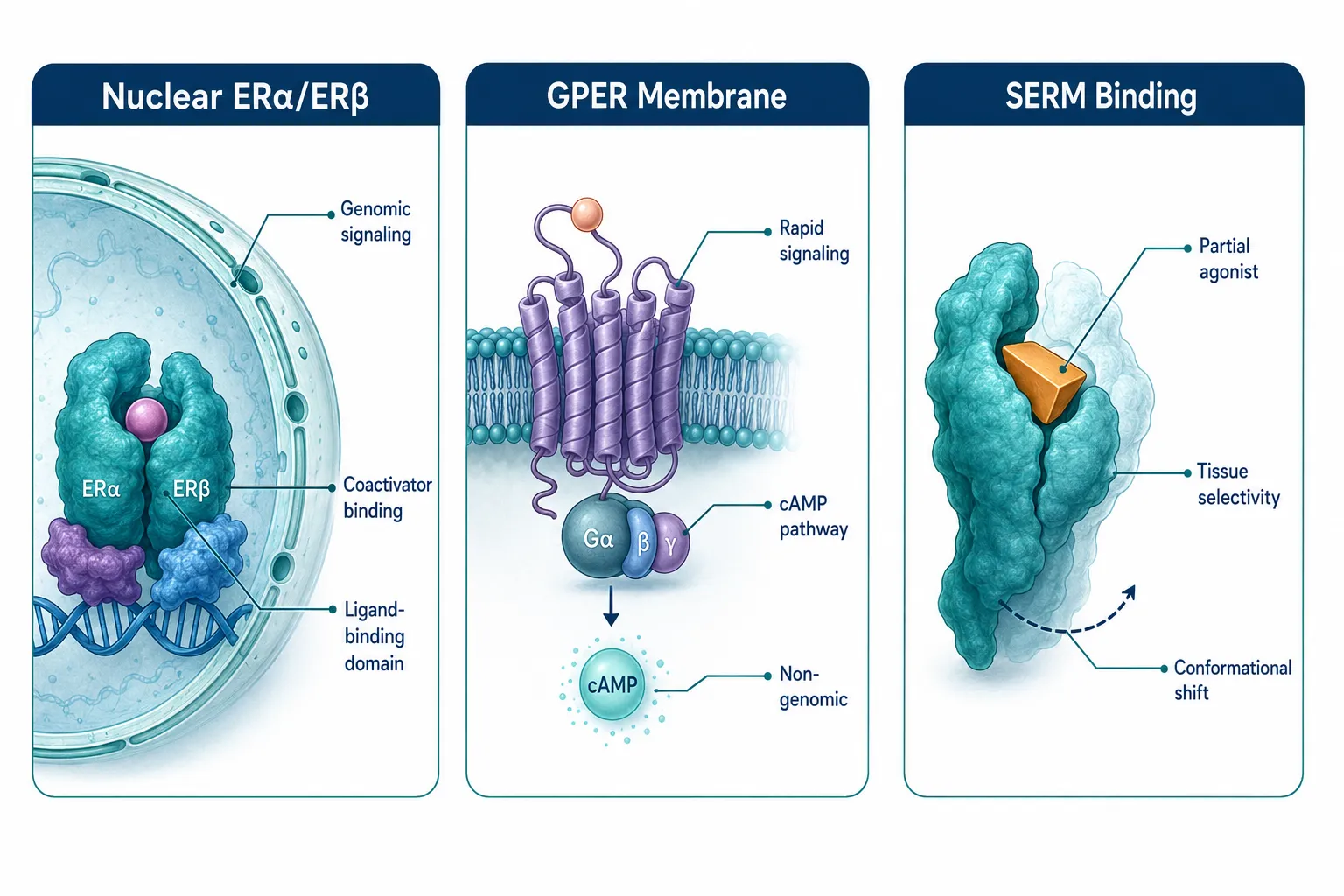
Estrogen receptors are not a single target. Three pharmacologically distinct subtypes govern estrogen signaling across tissues:

Receptor Location Primary Signaling Mode Key Research Relevance
ERα Uterus, breast, liver, bone Genomic (nuclear) Proliferative responses, HPG feedback
ERβ Brain, ovary, vasculature Genomic + non-genomic Neuroprotection, anti-proliferative
GPER (GPR30) Membrane-bound, widespread Rapid non-genomic (cAMP) Fast estrogenic responses, peptide cross-talk

When a serm like enclomiphene binds ERα, it induces a conformational shift in the ligand-binding domain that prevents coactivator recruitment. The result is tissue-selective antagonism, blocking estrogenic negative feedback at the hypothalamus while potentially acting differently at other ERα-expressing sites. ERβ binding profiles vary widely across serm scaffolds, and GPER remains incompletely characterized for most clinical-stage serms as of 2026.

For researchers exploring selective estrogen receptor modulation, understanding which subtype dominates in the target tissue is the first design decision, not an afterthought.

Why this matters for peptide co-administration: Growth hormone (GH), GLP-class peptides, and gonadotropin-releasing hormone (GnRH) analogs all operate within tissues that co-express estrogen receptors. Signal cross-talk is not hypothetical; it is structural.

Enclomiphene Pharmacology and the HPG Axis
Enclomiphene Pharmacology and the HPG Axis

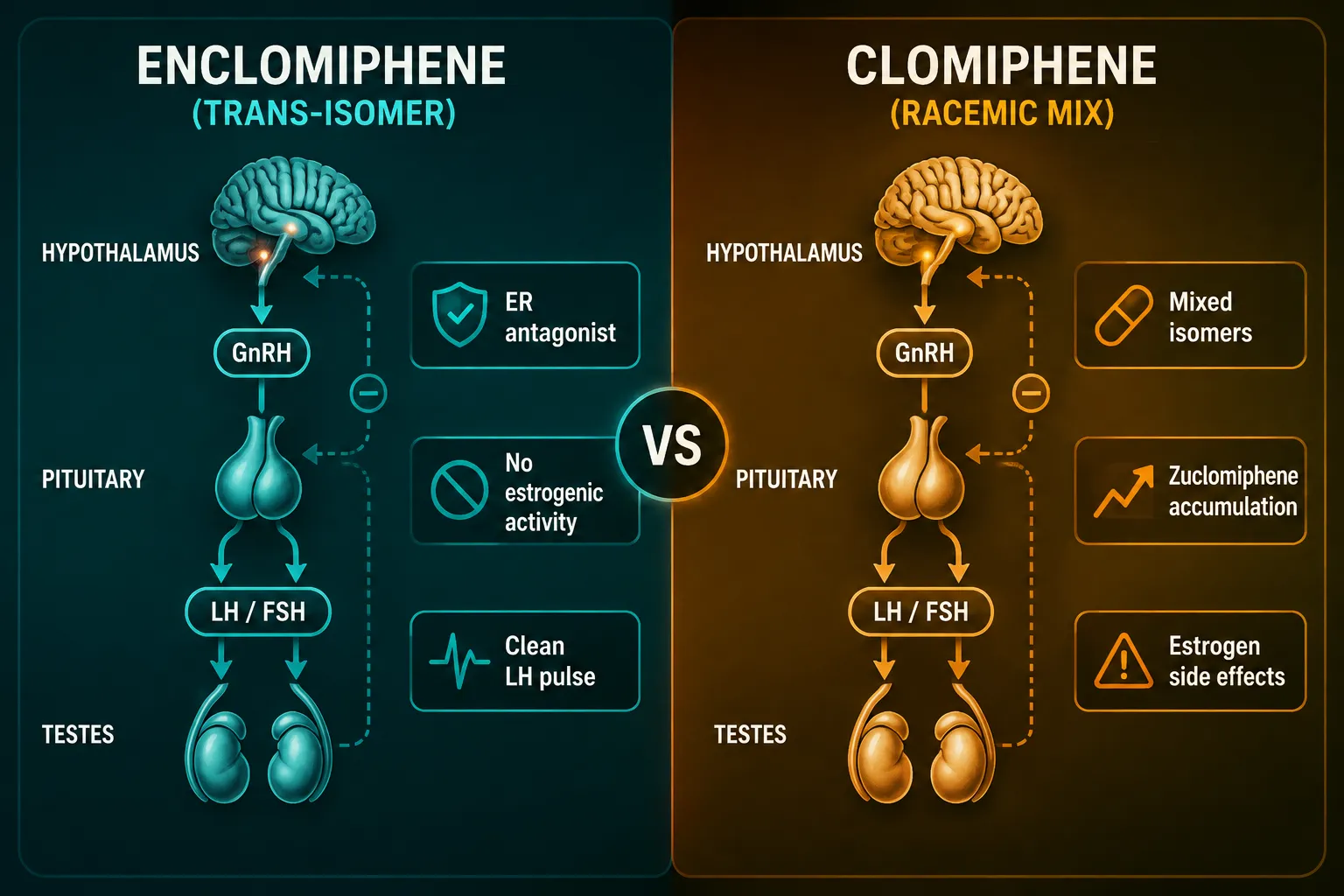
Clomiphene citrate is a racemic mixture of two geometric isomers: zuclomiphene (cis) and enclomiphene (trans). Their pharmacological profiles diverge sharply.

Enclomiphene (trans-isomer):

  • Half-life approximately 10 hours, clears rapidly
  • Pure ER antagonist at hypothalamic ERα
  • Blocks estrogen-mediated suppression of GnRH pulsatility
  • Elevates LH and FSH without residual estrogenic activity

Zuclomiphene (cis-isomer):

  • Half-life exceeding 30 days, accumulates with repeated dosing
  • Partial ER agonist activity
  • Responsible for most estrogen-related side effects attributed to clomiphene

"Isolating the trans-isomer eliminates the pharmacological noise introduced by zuclomiphene accumulation, producing a cleaner HPG axis stimulus for research models."

In male hypogonadism research, enclomiphene has demonstrated the ability to restore LH and testosterone levels while preserving spermatogenesis, an outcome that racemic clomiphene compromises through its estrogenic component. This distinction is central to serm pharmacology research and to any serm comparison study evaluating HPG axis stimulation.

Regulatory status as of 2026 remains investigational for enclomiphene as a standalone agent in most jurisdictions, though research use continues under appropriate institutional frameworks.

The serm, Peptide Interface: Assay Design and Biomarker Interpretation
The serm, Peptide Interface: Assay Design and Biomarker Interpretation

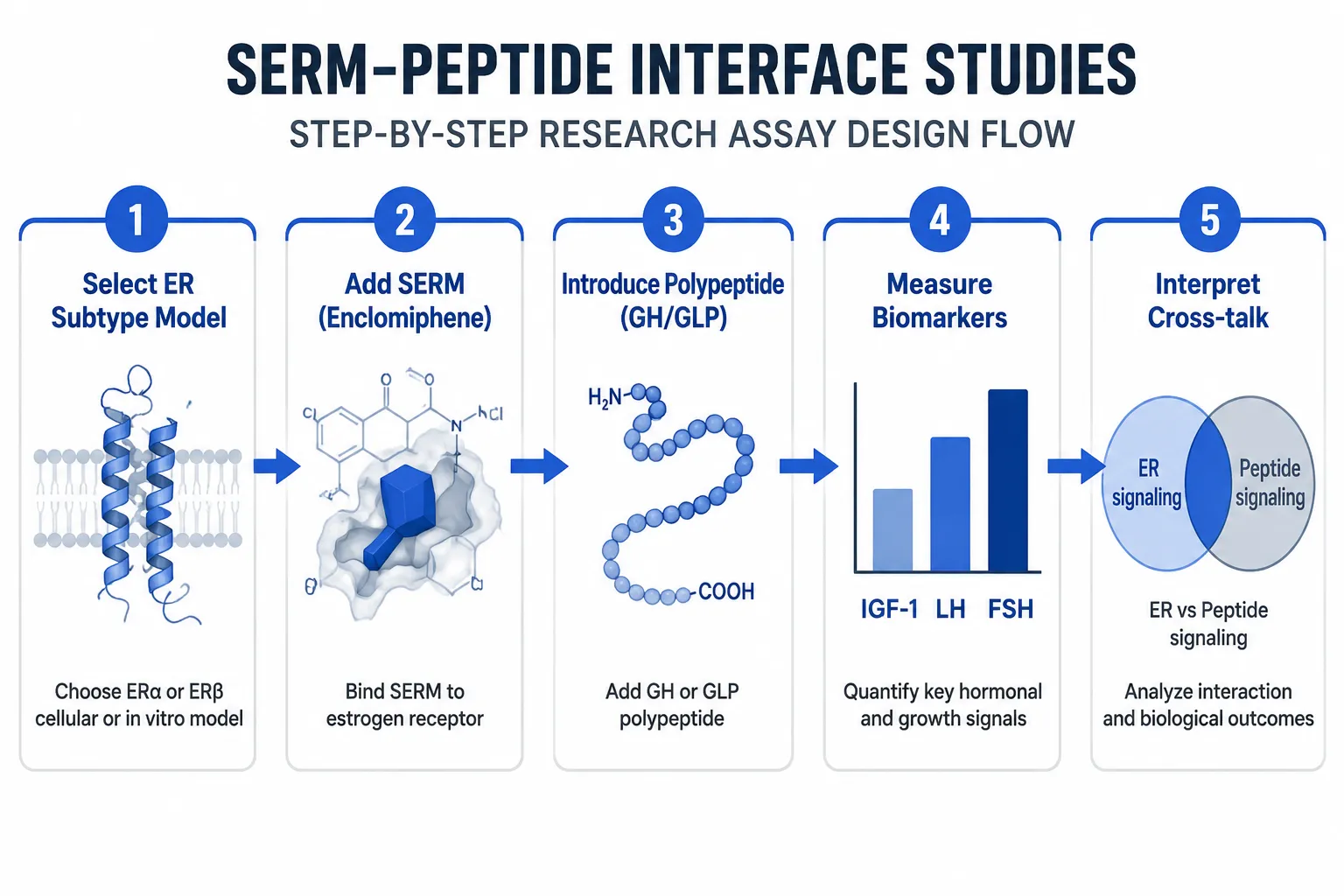
This is where Estrogen Receptor Pharmacology, Enclomiphene, and Polypeptide Hormones: A Researcher's Guide to serm, Peptide Interface becomes most practically demanding. When enclomiphene or any serm is co-administered with polypeptide hormones in a research model, at least three layers of interaction require pre-planned biomarker coverage.

Layer 1, HPG Axis Peptide Output

Enclomiphene's antagonism at hypothalamic ERα increases GnRH pulse frequency. This directly elevates LH and FSH, which in turn stimulate testicular steroidogenesis. Researchers co-administering GH secretagogues or systemic peptide research compounds must account for the fact that elevated LH can alter the hormonal milieu in which GH and IGF-1 are being measured.

Recommended baseline biomarkers before serm, peptide co-administration:

  • LH, FSH, total and free testosterone
  • Estradiol (E2), confirms ER blockade efficacy
  • IGF-1, GH axis baseline
  • SHBG, modulates free hormone fractions

Layer 2, Receptor Cross-talk at Target Tissues

Bone, brain, and breast tissue each express combinations of ERα, ERβ, and GPER. GH and GLP-class peptides also act at receptors in these tissues. Overlapping signaling through PI3K/Akt and MAPK pathways means that a serm-induced shift in ER conformation can amplify or attenuate peptide hormone responses at the same downstream node.

For steroidogenesis research models, this cross-talk is especially pronounced in gonadal tissue where both LH-driven steroidogenesis and local ER signaling converge.

Layer 3, Next-Generation ER Agents as Research Variables

SERDs (selective estrogen receptor degraders), PROTACs targeting ER for proteasomal degradation, CERANs (complete estrogen receptor antagonists), and SERCAs (selective ER covalent antagonists) are increasingly present in translational research pipelines as of 2026. Unlike enclomiphene, which modulates receptor conformation, SERDs and PROTACs reduce receptor protein levels entirely. This fundamentally changes baseline ER availability when peptide co-administration begins, requiring separate receptor quantification steps in the assay protocol.

Researchers building multi-compound models should consult translational research design frameworks to pre-specify which ER measurement endpoints will be collected at each timepoint.

Practical Assay Checklist

  • Map ER subtype expression in the target tissue before compound introduction
  • Establish serm washout periods appropriate to the isomer's half-life
  • Use multiplexed immunoassay panels to capture LH, FSH, IGF-1, and E2 simultaneously
  • Include vehicle-only and peptide-only control arms to isolate serm contribution
  • Validate peptide compound purity through independent analysis, compound quality directly affects signal interpretation

Conclusion

Estrogen Receptor Pharmacology, Enclomiphene, and Polypeptide Hormones: A Researcher's Guide to serm, Peptide Interface converges on one central principle: receptor subtype specificity is not optional when peptide hormones share the experimental environment. Enclomiphene's clean ER antagonism at the HPG axis makes it a valuable research tool precisely because it avoids the estrogenic noise of racemic clomiphene, but that advantage is only realized when assay design accounts for downstream peptide hormone interactions.

Actionable next steps for researchers in 2026:

  1. Profile ER subtype expression in your target tissue before any co-administration protocol.
  2. Choose enclomiphene over racemic clomiphene when a pure HPG axis stimulus is required.
  3. Build multiplexed biomarker panels that capture both ER-mediated and peptide-mediated endpoints simultaneously.
  4. Account for next-generation ER agents (SERDs, PROTACs) as distinct variables that alter receptor availability, not just conformation.
  5. Source research compounds with verified purity, impure peptide preparations introduce confounders that no statistical correction can fully remove.

The serm, peptide interface is one of the most mechanistically rich areas in current endocrine research. Rigorous design at this intersection does not just improve data quality, it makes the science translatable.

https://www.puretestedpeptides.com/wp-content/uploads/2026/09/estrogen-receptor-pharmacology-enclomiphene-and-polypeptide-hormones-a-researche.webp 1024 1536 https://www.puretestedpeptides.com/wp-content/uploads/2026/01/buy-peptides-online.jpg 2026-09-05 13:05:572026-09-05 13:05:57Estrogen Receptor Pharmacology, Enclomiphene, and Polypeptide Hormones: A Researcher’s Guide to serm–Peptide Interface
×

Helpful Links

  • My account
  • Cart
  • Checkout
  • Refund and Returns Policy
  • Privacy Policy
  • SMS Privacy Policy
  • Login
  • My Account
  • Logout

USA Made Lab Tested Peptides

All products are sold for research, laboratory, or analytical purposes only, and are not for human consumption


Pure Tested Peptides is a chemical supplier. Pure Tested Peptides is not a compounding / chemical compounding facility as defined under 503A of the Federal Food, Drug, and Cosmetic act. Pure Tested Peptides is not an outsourcing facility as defined under 503B of the Federal Food, Drug, and Cosmetic act.

The statements made within this website have not been evaluated by the US Food and Drug Administration. The products we offer are not intended to diagnose, treat, cure or prevent any disease.

Human/Animal Consumption Prohibited. Laboratory/In-Vitro Experimental Use Only

Scroll to top Scroll to top Scroll to top