Call or Text 727-513-9780
  • Shopping Cart Shopping Cart
    0Shopping Cart
Pure Tested Peptides | America's most trusted Peptides for sale online
  • Peptides for sale
    • Oral Peptides for sale
      • Peptide Capsules for sale
      • BPC 157 Capsules 1000mcg
      • SLU-PP-332 Capsules | 1000 mcg
      • 5-Amino-1MQ 50mg Capsules
      • Tesofensine 500mcg
    • All Peptides for sale
    • Peptide Sprays
      • BPC 157 Nasal Spray Kit
      • BPC-157 TB500 Nasal Spray Kit
      • Semax Nasal Spray 10mg
      • Selank – Nasal Spray Kit – 10mg
      • Epithalon 50MG Nasal Spray Kit
      • Ipamorelin 10mg Nasal Spray
      • Klow Nasal Spray (BPC-157 + TB-500 + GHK-Cu + KPV) | 80mg
      • Hulk Nasal Spray Tesa / Ipa Blend 6/3 MG
      • Klow Nasal Spray
      • NAD + 500 mg Nasal Spray
      • PT-141 Nasal Spray Kit
    • GHRH Peptides
      • Ipa Peptides
      • CJC-1295 Peptides
        • CJC-1295 with DAC 5 mg
        • CJC-1295 without DAC 5 mg
        • CJC-1295 Ipa 10mg
      • Tesa Peptides
        • Tesa Peptide
        • Tesa 20 mg
    • GHK-Cu Peptides
      • All GHK-Cu Peptides
      • GHK-Cu 100mg
      • KLOW Peptide Blend – Buy KLOW blend online
    • BPC Peptides
      • All BPC Peptides
      • BPC-157
      • BPC-157 TB-500
      • BPC 157 capsules 1000mcg
    • SLU-PP-332 Peptides
      • All SLU-PP-332 Peptides
      • SLU-PP-332 5mg
    • GLP3 Peptides
    • PT-141 Peptides
      • PT-141 Peptides for sale
      • PT-141 10mg
      • PT-141 Nasal Spray
    • CAG Peptides
      • Lipo-C Peptide Blend
      • CAG 5mg
      • CAG 10mg
    • MOTS-C Peptides
      • MOTS-C Peptides for sale
      • MOTS-c peptide
      • MOTS-c 10mg *6 pack*
    • 5 Amino 1MQ Peptides
      • 5 Amino 1MQ Peptides for sale
      • 5-Amino-1MQ 50mg Capsules
      • 5-Amino-1MQ 5mg
    • Epithalon Peptides
      • Epithalon Peptides for sale
      • Epithalon 10mg
      • Epithalon 50mg
  • Shop
    • GLPs
      • 5-Amino-1MQ 50mg Capsules
      • 5-Amino-1MQ 5mg
      • L-Carnitine 500mg/ml
      • Tesofensine 500mcg
      • SLU-PP-332 5mg
      • MOTS-c 10mg *6 pack*
    • Epithalon & BPC Peptides
      • Epithalon 10mg
      • Epithalon 50mg
      • BPC-157
      • BPC 157 capsules 1000mcg
      • BPC-157 TB-500
      • BPC-157 TB500 Nasal Spray Kit
      • BPC 157 Nasal Spray Kit
    • BPC TB-500 & NAD+ Peptides
      • NAD+ 500 mg
      • KLOW Peptide Blend – Buy KLOW blend online
      • GLOW Peptide Blend
      • TB 500 5mg
      • BPC 157 capsules 1000mcg – Supplement
      • BPC 157 Nasal Spray Kit
      • BPC-157
      • BPC-157 TB500 Nasal Spray Kit
      • BPC-157 TB-500
      • BPC 157 capsules 1000mcg
    • LL-37 Peptide
      • LL-37 10 mg
    • MOTS-C & Selank
      • MOTS-c peptide
      • Selank 10mg
    • GHK Peptides
      • GHK-Cu 100mg
      • GLOW Peptide Blend
      • KLOW Peptide Blend – Buy KLOW blend online
  • COAs
  • Wholesale
    • Wholesale Peptides for sale
  • PTP FAQ
  • Affiliates
    • Selank Peptide: Advanced Pharmacological Mechanisms Underlying Its Anxiolytic and Nootropic Effects in Research
      • 5-Amino-1MQ Peptide: Detailed Mechanisms of NNMT Inhibition and Its Impact on Cellular Metabolism Research
        • MOTS-C Peptide: Unraveling Its Role in Mitochondrial Dynamics and Energy Metabolism Research
          • Epithalon Peptide and Telomerase Regulation: Investigating Its Impact on Cellular Senescence and Lifespan Research Models
            • GLP2-T vs GLP2 Tirz Peptide: Understanding the Naming, Mechanistic Nuances, and Research Implications for Gut Health
      • Peptides and Polypeptides in Modern Pharmacology: What Research on Metoprolol, Prednisone, and Amlodipine Reveals
        • Polypeptide Peptides vs NSAIDs: What Naproxen and Diclofenac Teach Tissue-Repair Researchers About BPC‑157 and TB‑500
          • Peptides and Polypeptides in Endocrine Pharmacology: How GLP-1, GLP-2, and GLP-3 Retatrutide Differ From Classic Drugs Like Prednisone and Amlodipine
          • 5‑Amino‑1MQ Peptide and NNMT Inhibition: How It Compares With Statins Like Atorvastatin in Adipose and Lipid Metabolism Research
      • Enclomiphene, Estrogen Receptor Signaling, and Luteinizing Phase Biology: What Hormone Researchers Should Measure
        • Mesenchymal Stem Cells, BPC‑157, and GHK‑Cu: How Tissue Repair Peptides Compare With Classic NSAIDs Like Naproxen in Injury Models
          • Peptide Calculator Use Cases Beyond Growth Hormone: Working Through GLP‑3 Retatrutide, MOTS‑c, and BPC‑157 Research Dosing
        • Polypeptide Peptides in Endocrine and Metabolic Pharmacology: Lessons From Amlodipine, Prednisone, and Metoprolol
        • Peptides Calculator for Advanced Blends: Worked Examples for Tesamorelin, CJC‑1295, and Ipamorelin Stacks
          • Peptides and Polypeptides in Human Physiology: How Molecular Size Shapes Research Applications
            • Selank Peptide: Advanced Pharmacological Mechanisms Underlying Its Anxiolytic and Nootropic Effects in Research
          • 5-Amino-1MQ Peptide: Detailed Mechanisms of NNMT Inhibition and Its Impact on Cellular Metabolism Research
            • MOTS-C Peptide: Unraveling Its Role in Mitochondrial Dynamics and Energy Metabolism Research
              • Epithalon Peptide and Telomerase Regulation: Investigating Its Impact on Cellular Senescence and Lifespan Research Models
                • GLP2-T vs GLP2 Tirz Peptide: Understanding the Naming, Mechanistic Nuances, and Research Implications for Gut Health
                  • Peptides and Polypeptides in Endocrine Pharmacology: How GLP-1, GLP-2, and GLP-3 Retatrutide Differ From Classic Drugs Like Prednisone and Amlodipine
                    • Polypeptide Peptides vs NSAIDs: What Naproxen and Diclofenac Teach Tissue-Repair Researchers About BPC‑157 and TB‑500
                      • Peptides and Polypeptides in Modern Pharmacology: What Research on Metoprolol, Prednisone, and Amlodipine Reveals
                        • 5‑Amino‑1MQ Peptide and NNMT Inhibition: How It Compares With Statins Like Atorvastatin in Adipose and Lipid Metabolism Research
                        • Enclomiphene, Estrogen Receptor Signaling, and Luteinizing Phase Biology: What Hormone Researchers Should Measure
                        • Mesenchymal Stem Cells, BPC‑157, and GHK‑Cu: How Tissue Repair Peptides Compare With Classic NSAIDs Like Naproxen in Injury Models
                        • Peptide Calculator Use Cases Beyond Growth Hormone: Working Through GLP‑3 Retatrutide, MOTS‑c, and BPC‑157 Research Dosing
                        • Polypeptide Peptides in Endocrine and Metabolic Pharmacology: Lessons From Amlodipine, Prednisone, and Metoprolol
                        • Peptides Calculator for Advanced Blends: Worked Examples for Tesamorelin, CJC‑1295, and Ipamorelin Stacks
                        • Peptides and Polypeptides in Human Physiology: How Molecular Size Shapes Research Applications
                        • Selank Peptide: Advanced Pharmacological Mechanisms Underlying Its Anxiolytic and Nootropic Effects in Research
                        • MOTS-C Peptide: Unraveling Its Role in Mitochondrial Dynamics and Energy Metabolism Research
                        • Peptides and Polypeptides in Modern Pharmacology: What Research on Metoprolol, Prednisone, and Amlodipine Reveals
                        • Peptides and Polypeptides in Endocrine Pharmacology: How GLP-1, GLP-2, and GLP-3 Retatrutide Differ From Classic Drugs Like Prednisone and Amlodipine
                        • 5-Amino-1MQ Peptide: Detailed Mechanisms of NNMT Inhibition and Its Impact on Cellular Metabolism Research
                        • Mesenchymal Stem Cells, BPC‑157, and GHK‑Cu: How Tissue Repair Peptides Compare With Classic NSAIDs Like Naproxen in Injury Models
                        • Peptide Calculator Use Cases Beyond Growth Hormone: Working Through GLP‑3 Retatrutide, MOTS‑c, and BPC‑157 Research Dosing
                        • GLP2-T vs GLP2 Tirz Peptide: Understanding the Naming, Mechanistic Nuances, and Research Implications for Gut Health
                        • Polypeptide Peptides in Endocrine and Metabolic Pharmacology: Lessons From Amlodipine, Prednisone, and Metoprolol
                        • Polypeptide Peptides vs NSAIDs: What Naproxen and Diclofenac Teach Tissue-Repair Researchers About BPC‑157 and TB‑500
                        • Peptides and Polypeptides in Human Physiology: How Molecular Size Shapes Research Applications
                        • Peptides Calculator for Advanced Blends: Worked Examples for Tesamorelin, CJC‑1295, and Ipamorelin Stacks
                        • 5‑Amino‑1MQ Peptide and NNMT Inhibition: How It Compares With Statins Like Atorvastatin in Adipose and Lipid Metabolism Research
                        • Enclomiphene, Estrogen Receptor Signaling, and Luteinizing Phase Biology: What Hormone Researchers Should Measure
                        • Epithalon Peptide and Telomerase Regulation: Investigating Its Impact on Cellular Senescence and Lifespan Research Models
                        • Best research protocol Klow blend
                        • best time to take BPC-157
                        • best time to take DSIP (Delta Sleep Inducing Peptide)
                        • best time to take CJC-1295
                        • best time to take AOD-9604
                        • best time to take Follistatin 344
                        • best time to take Ipamorelin
                        • best time to take MK-677 (Ibutamoren)
                        • best time to take Ligandrol (LGD-4033) — research compound
                        • best time to take Ostarine (MK-2866) — research compound
                        • best time to take GHK-CU
                        • best time to take TB-500
                        • best time to take MOTS-c
                        • best time to take Semax
                        • best time to take RAD-140 (Testolone) — research compound
                        • best time to take Thymosin Alpha-1
                        • best time to take PEG-MGF
                        • Biolife Plasma, Octapharma Plasma, and Research Peptides: How Plasma Donation Labs Differ From Peptide Suppliers
                        • best time to take YK-11 — research compound
                        • best time to take PT-141 (Bremelanotide)
                        • Best research protocol Klow blend
                        • 5-Amino-1MQ and MOTS-C Synergy: Metabolic Signaling, Mitochondria, and Research Design
                        • BPC-157 and TB-500: Investigating Their Combined Effects on Angiogenesis and Cellular Migration in Tissue Repair Models
                        • BPC-157 Peptide: Gut Barrier Function, Inflammation, and Tissue-Recovery Research
                        • 5‑Amino‑1MQ and MOTS‑c Synergy in Metabolic Research: Designing NNMT and Mitochondrial Biogenesis Stacks
                        • CJC-1295 with DAC vs. Without DAC: Half-Life, Release Kinetics, and Research Implications
                        • CJC‑1295 with DAC vs. Without DAC: Expanding on Half‑Life Differences Using Tesamorelin and Ipamorelin Blend Case Studies
                        • Collagen Biology and Copper‑Binding Peptides: How GHK‑Cu, Glow Blend, and Klow Blend Interact with Skin and Connective Tissue
                        • Collagen Biology and Regenerative Peptides: How GHK‑Cu, Glow Blend, and Klow Blend Affect Extracellular Matrix Research
                    • DNA, Telomeres, and Longevity Peptides: Positioning Epithalon and MOTS‑c in Genetic Aging Research
                      • Enclomiphene Citrate: serm Mechanism, Testosterone Research, and Stack Compatibility
                        • Enclomiphene vs Enclomiphene Citrate: Formulation, Bioavailability, and Research Distinctions
                        • Epithalon Peptide Research: Telomerase Activation, Aging, and Pineal Gland Function
                        • Estrogen Receptor Signaling and Enclomiphene: How Selective Modulators Compare with Classic Polypeptide Hormones
                        • GHK-Cu Peptide: Advanced Mechanisms in Extracellular Matrix Remodeling and Wound Healing Research
                        • GHK-Cu Peptide: Collagen Synthesis, Wound Repair, and Skin-Barrier Research Models
                        • GLP-1 vs GLP-3 vs GLP-2: Peptide Classification and Research Applications
                        • GLP-2 Peptide Research Guide: Gut Barrier Function, Nutrient Absorption, and Intestinal Recovery Models
                        • GLP-3 Retatrutide vs. GLP-1 Drugs: What Triple-Agonist Biology Changes in Research Models
                        • Ipamorelin and Tesamorelin Combination: Synergistic GH Secretagogue Research and Dosing Protocols
                        • GLP2 Tirz Peptide: What It Is, Why the Name Exists, and How Researchers Should Interpret It
                        • Klow Blend Peptide Nasal Spray: What the Formulation Is Trying to Do in Cognitive Research
                        • Mitochondria, NNMT Inhibition, and Peptide Modulators: Where MOTS‑c and 5‑Amino‑1MQ Fit in Cellular Energy Research
                        • MOTS-c Peptide: Mitochondrial Function, Energy Metabolism, and What Researchers Measure
                        • MOTS-c vs. 5-Amino-1MQ: Which Metabolic Research Questions Each Compound Actually Answers
                        • Nasal Spray Peptides: Bioavailability, Administration, and Semax/Selank Research Applications
                        • PT-141 Peptide Research: Mechanism of Action and Melanocortin Receptor Signaling
                        • Retatrutide for Research: Mechanism, Structure, and GLP-1/GLP-3 Dual Action
                        • Retatrutide for Obesity and Type 2 Diabetes: What the Latest Trial Data Suggest
                        • Tesofensine Peptide Research: Mechanism, Appetite Suppression, and Neuropeptide Y Pathways
  • Contact
    • Contact Customer Service
    • Text Customer Support
  • About US
  • Shop all peptides
  • Affiliate Program
    • Affiliate Signup
  • Login / Register Login / Register Page Link Login / Register Page Link
  • Click to open the search input field Click to open the search input field Search
  • Menu Menu

5-Amino-1MQ and MOTS-c in Skeletal Muscle: How to Measure Glucose Uptake, Mitochondrial Flux, and Myotube Viability Together

November 2, 2026/0 Comments/in Uncategorized/by

Skeletal muscle consumes more than 80 percent of insulin-stimulated glucose in the human body, yet most in vitro assay designs test only one metabolic variable at a time. That single-readout approach creates a dangerous blind spot: a compound can appear to boost glucose uptake simply because it stresses mitochondria or reduces cell number, not because it genuinely improves metabolic capacity. Studying 5-Amino-1MQ and MOTS-c in skeletal muscle together demands a coordinated, three-readout strategy that keeps cytotoxicity, glucose handling, and mitochondrial flux in view simultaneously.

Key Takeaways

  • 5-Amino-1MQ inhibits NNMT to raise NAD+ availability, while MOTS-c activates AMPK and CK2 signaling, targeting overlapping but distinct nodes in muscle metabolism.
  • Neither compound has published co-administration data in skeletal muscle as of late 2026, making rigorous assay design essential before drawing mechanistic conclusions.
  • Measuring glucose uptake, mitochondrial oxygen consumption rate (OCR), and myotube viability in parallel prevents false-positive metabolic readings caused by cytotoxicity or mitochondrial stress.
  • Assay sequence matters: viability checks must bookend the protocol, not just follow it.
  • Differentiation state and passage number of myotubes are major confounders that must be standardized before any treatment is applied.

The Mechanistic Case for Combining 5-Amino-1MQ and MOTS-c
The Mechanistic Case for Combining 5-Amino-1MQ and MOTS-c

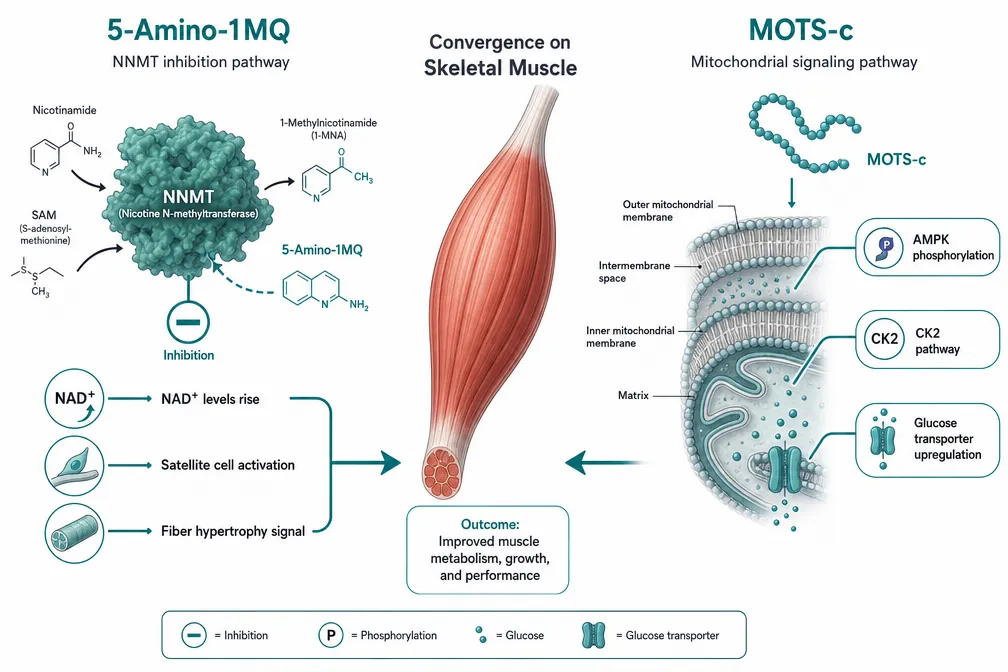
5-Amino-1MQ is a small-molecule inhibitor of nicotinamide N-methyltransferase (NNMT), an enzyme highly expressed in aged and metabolically compromised muscle tissue. When NNMT is inhibited, the methyl donor pool shifts, NAD+ precursor availability increases, and downstream sirtuin and PARP signaling becomes more active. In aged rodent models, this change correlates with satellite cell re-entry into the cell cycle, greater fiber cross-sectional area, and measurable improvements in grip strength. Early mitochondrial respiration data suggest that NNMT inhibition also raises electron transport chain capacity, though the dose-response relationship in human primary myotubes is still being characterized as of 2026.

MOTS-c is a mitochondria-derived peptide encoded within the 12S rRNA region of the mitochondrial genome. Its best-characterized action in skeletal muscle is AMPK activation, which drives GLUT4 translocation and glucose uptake independent of insulin. More recent work has identified CK2 (casein kinase 2) as a direct upstream activator of MOTS-c nuclear translocation, broadening its role from a metabolic peptide to a stress-responsive transcriptional co-regulator. MOTS-c also reduces muscle atrophy triggered by immobilization, an effect tied to suppression of atrogene expression rather than to direct anabolic signaling.

Because 5-Amino-1MQ works primarily through epigenetic and NAD+ remodeling while MOTS-c acts through rapid kinase signaling, the two agents target the same metabolic outcome, improved muscle glucose handling and mitochondrial efficiency, through non-overlapping pathways. That complementarity is exactly why parallel assay measurement is non-negotiable: additive effects, antagonism, or off-target cytotoxicity each produce distinct fingerprints only visible when all three readouts run concurrently.

Researchers interested in mitochondrial-targeted peptides may also find value in reviewing SS-31 mitochondrial dynamics research, which provides a useful methodological reference for flux-based assay design in muscle cells.


Building the Assay Matrix: Sequence, Tools, and Confounders
Building the Assay Matrix: Sequence, Tools, and Confounders

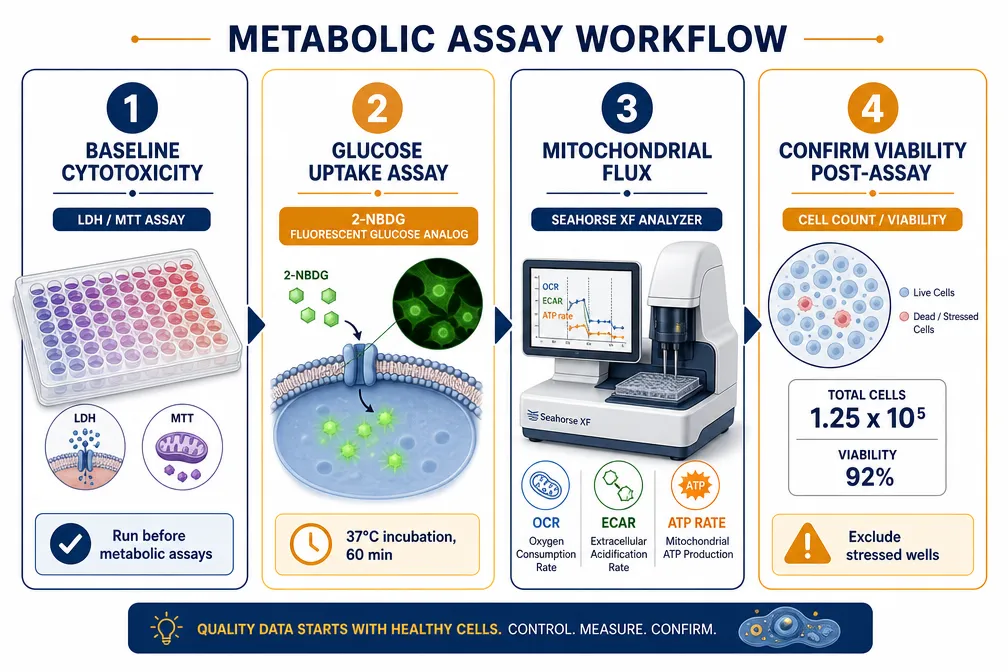
The table below outlines the recommended assay architecture for studying 5-Amino-1MQ and MOTS-c in skeletal muscle: how to measure glucose uptake, mitochondrial flux, and myotube viability together within a single experimental run.

Assay Step Method Key Output Why It Matters Here
Pre-treatment viability MTT or CellTiter-Glo Baseline ATP/cell count Confirms uniform differentiation across wells
Glucose uptake 2-NBDG fluorescent analog or 3H-2-DG Relative glucose flux per cell Distinguishes GLUT4 translocation from passive diffusion
Mitochondrial flux Seahorse XF Analyzer (OCR/ECAR) Basal respiration, ATP-linked OCR, spare capacity Separates genuine OXPHOS gain from uncoupling artifacts
ROS quantification MitoSOX or CM-H2DCFDA Mitochondrial superoxide level Elevated ROS can inflate apparent glucose uptake
Post-treatment viability LDH release assay Membrane integrity / cytotoxicity Flags wells where metabolic signal reflects cell death, not improvement

Differentiation State as a Hidden Confounder

Primary human skeletal muscle cells must be differentiated for at least five to seven days before treatment. Underdifferentiated cultures express low levels of GLUT4 and lack the contractile architecture needed for meaningful MOTS-c responses. Passage number should stay below passage six; beyond that, satellite cell identity markers decline and NNMT expression patterns shift, potentially masking 5-Amino-1MQ effects.

Dosing Windows and Timing

For 5-Amino-1MQ, the research literature in myotube models points toward a 24- to 48-hour pre-incubation window at sub-micromolar concentrations to allow NAD+ pool remodeling before metabolic readouts are collected. MOTS-c, being a peptide, acts more acutely: significant AMPK activation is detectable within 30 to 60 minutes. A staggered dosing design, MOTS-c added during the assay window after overnight 5-Amino-1MQ pre-loading, avoids timing confounds and mirrors a biologically plausible sequence. For labs sourcing mitochondrial peptides for such work, SS-31 peptide research considerations offer a practical quality-control reference for peptide-based in vitro protocols.


Interpreting the Triple-Readout Results Without Misreading the Data
Interpreting the Triple-Readout Results Without Misreading the Data

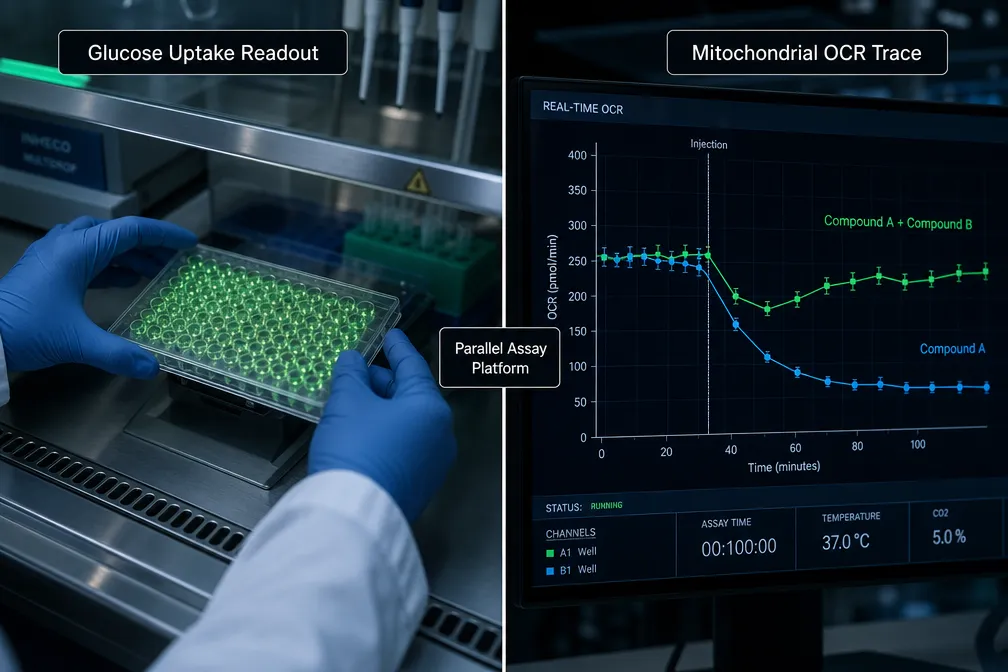
The central value of measuring 5-Amino-1MQ and MOTS-c in skeletal muscle: how to measure glucose uptake, mitochondrial flux, and myotube viability together is the ability to cross-reference outcomes and eliminate artifactual signals.

Three common misinterpretation scenarios to guard against:

  1. Elevated glucose uptake with reduced cell viability, LDH release rises alongside glucose signal. This pattern indicates membrane disruption is driving passive glucose influx, not active transporter-mediated uptake. Discard the glucose data from those wells.

  2. Increased OCR with elevated ROS and suppressed ATP-linked respiration, This is the classic mitochondrial uncoupling artifact. Oxygen consumption rises, but it is dissipated as heat rather than converted to ATP. A compound appearing to "boost metabolism" under this pattern is actually inducing mitochondrial stress.

  3. No change in glucose uptake but improved spare respiratory capacity, This result is genuinely informative. It suggests the compound improved mitochondrial resilience without altering basal glucose flux, a distinct physiological outcome worth reporting separately.

A key interpretive principle: improvements in OCR are only metabolically meaningful when ATP production rate rises in parallel and LDH remains at baseline levels.

Researchers exploring multi-peptide experimental designs may also find the synergy of LL-37 and SS-31 research useful as a methodological template for interpreting combined-agent assay results. For labs sourcing research peptides, reviewing where to buy SS-31 and Epithalon provides guidance on quality standards relevant to any peptide used in metabolic assays. Those interested in the broader mitochondrial peptide landscape should also consult the SS-31 mechanism and research overview for cross-compound context. For labs working with lab-tested peptides, purity documentation is a prerequisite before any flux assay results can be considered interpretable.


Conclusion

The only reliable way to study 5-Amino-1MQ and MOTS-c in skeletal muscle: how to measure glucose uptake, mitochondrial flux, and myotube viability together is to treat all three readouts as a single integrated panel, not as separate experiments. The immediate actionable steps for any research team are:

  • Standardize differentiation to day 5-7, passage 3-5, before any compound treatment.
  • Run pre- and post-treatment viability assays in every experiment, not as an afterthought.
  • Include ROS quantification alongside OCR to distinguish genuine OXPHOS improvement from uncoupling.
  • Apply staggered dosing (5-Amino-1MQ overnight pre-load, MOTS-c acute treatment) to respect each agent's pharmacodynamic timeline.
  • Cross-reference all five data layers before drawing conclusions about metabolic improvement.

As of 2026, no published study has used this combined assay framework with both compounds simultaneously. That gap is not a reason for caution, it is an open invitation for rigorous, well-designed research.

Tags: 5-amino-1mq, ampk activation, glucose uptake assay, mitochondrial flux, mots-c, myotube viability, nnmt inhibition, skeletal muscle metabolism
https://www.puretestedpeptides.com/wp-content/uploads/2026/01/buy-peptides-online.jpg 0 0 https://www.puretestedpeptides.com/wp-content/uploads/2026/01/buy-peptides-online.jpg 2026-11-02 14:14:182026-11-02 14:14:185-Amino-1MQ and MOTS-c in Skeletal Muscle: How to Measure Glucose Uptake, Mitochondrial Flux, and Myotube Viability Together
You might also like
Mesenchymal Stem Cells and Peptide Signaling: Where MOTS-c, BPC-157, and GHK-Cu Fit in Regenerative Research Mesenchymal Stem Cells and Peptide Signaling: Where MOTS-c, BPC-157, and GHK-Cu Fit in Regenerative Research
Peptides and Polypeptides in Mitochondrial Biology: How MOTS-c and 5-Amino-1MQ Compare With Classic Mitochondrial Pathways Peptides and Polypeptides in Mitochondrial Biology: How MOTS-c and 5-Amino-1MQ Compare With Classic Mitochondrial Pathways
5-Amino-1MQ and Slupp332 Co-Administration: Inhibiting NNMT and ERRα Signaling in Adipocyte Cell Lines 5-Amino-1MQ and Slupp332 Co-Administration: Inhibiting NNMT and ERRα Signaling in Adipocyte Cell Lines
5-Amino-1MQ and MOTS-c in Adipose Organoids: Separating NNMT Inhibition From Mitochondrial Stress 5-Amino-1MQ and MOTS-c in Adipose Organoids: Separating NNMT Inhibition From Mitochondrial Stress
Photosynthesis, Cellular Energy, and Mitochondrial Peptides: How MOTS‑c Research Connects Plant Biology Concepts to Human Metabolism Photosynthesis, Cellular Energy, and Mitochondrial Peptides: How MOTS‑c Research Connects Plant Biology Concepts to Human Metabolism
Mitochondria and Research Peptides: What Labs Measure When Studying Cellular Energy Signaling Mitochondria and Research Peptides: What Labs Measure When Studying Cellular Energy Signaling
Statin Therapy and Liver Enzymatic Readouts in Metabolic Peptide Models: Atorvastatin vs. MOTS-c and 5-Amino-1MQ Statin Therapy and Liver Enzymatic Readouts in Metabolic Peptide Models: Atorvastatin vs. MOTS-c and 5-Amino-1MQ
Top 5 Research Peptides for Metabolic Health: An Updated Buyer's Guide Top 5 Research Peptides for Metabolic Health: An Updated Buyer’s Guide
0 replies

Leave a Reply

Want to join the discussion?
Feel free to contribute!

Leave a Reply Cancel reply

Your email address will not be published. Required fields are marked *

×

Helpful Links

  • My account
  • Cart
  • Checkout
  • Refund and Returns Policy
  • Privacy Policy
  • SMS Privacy Policy
  • Login
  • My Account
  • Logout

USA Made Lab Tested Peptides

All products are sold for research, laboratory, or analytical purposes only, and are not for human consumption


Pure Tested Peptides is a chemical supplier. Pure Tested Peptides is not a compounding / chemical compounding facility as defined under 503A of the Federal Food, Drug, and Cosmetic act. Pure Tested Peptides is not an outsourcing facility as defined under 503B of the Federal Food, Drug, and Cosmetic act.

The statements made within this website have not been evaluated by the US Food and Drug Administration. The products we offer are not intended to diagnose, treat, cure or prevent any disease.

Human/Animal Consumption Prohibited. Laboratory/In-Vitro Experimental Use Only

Link to: What Is GHK-Cu? Copper-Dependent Matrix Remodeling and Fibroblast, Keratinocyte Crosstalk in Research Models Link to: What Is GHK-Cu? Copper-Dependent Matrix Remodeling and Fibroblast, Keratinocyte Crosstalk in Research Models What Is GHK-Cu? Copper-Dependent Matrix Remodeling and Fibroblast, Keratinocyte...What Is GHK-Cu? Copper-Dependent Matrix Remodeling and Fibroblast, Keratinocyte Crosstalk in Research Models Link to: GLP-3 Retatrutide and Appetite Research: Measuring Food Intake Without Confounding Gastric Emptying, Nausea, or Sedation Link to: GLP-3 Retatrutide and Appetite Research: Measuring Food Intake Without Confounding Gastric Emptying, Nausea, or Sedation GLP-3 Retatrutide and Appetite Research: Measuring Food Intake Without Confounding Gastric Emptying, Nausea, or SedationGLP-3 Retatrutide and Appetite Research: Measuring Food Intake Without Confounding...
Scroll to top Scroll to top Scroll to top