Call or Text 727-513-9780
  • Shopping Cart Shopping Cart
    0Shopping Cart
Pure Tested Peptides | America's most trusted Peptides for sale online
  • Peptides for sale
    • Oral Peptides for sale
      • Peptide Capsules for sale
      • BPC 157 Capsules 1000mcg
      • SLU-PP-332 Capsules | 1000 mcg
      • 5-Amino-1MQ 50mg Capsules
      • Tesofensine 500mcg
    • All Peptides for sale
    • Peptide Sprays
      • BPC 157 Nasal Spray Kit
      • BPC-157 TB500 Nasal Spray Kit
      • Semax Nasal Spray 10mg
      • Selank – Nasal Spray Kit – 10mg
      • Epithalon 50MG Nasal Spray Kit
      • Ipamorelin 10mg Nasal Spray
      • Klow Nasal Spray (BPC-157 + TB-500 + GHK-Cu + KPV) | 80mg
      • Hulk Nasal Spray Tesa / Ipa Blend 6/3 MG
      • Klow Nasal Spray
      • NAD + 500 mg Nasal Spray
      • PT-141 Nasal Spray Kit
    • GHRH Peptides
      • Ipa Peptides
      • CJC-1295 Peptides
        • CJC-1295 with DAC 5 mg
        • CJC-1295 without DAC 5 mg
        • CJC-1295 Ipa 10mg
      • Tesa Peptides
        • Tesa Peptide
        • Tesa 20 mg
    • GHK-Cu Peptides
      • All GHK-Cu Peptides
      • GHK-Cu 100mg
      • KLOW Peptide Blend – Buy KLOW blend online
    • BPC Peptides
      • All BPC Peptides
      • BPC-157
      • BPC-157 TB-500
      • BPC 157 capsules 1000mcg
    • SLU-PP-332 Peptides
      • All SLU-PP-332 Peptides
      • SLU-PP-332 5mg
    • GLP3 Peptides
      • GLP3-R
      • GLP3-R CAG 10mg
      • GLP3-R 20mg
    • PT-141 Peptides
      • PT-141 Peptides for sale
      • PT-141 10mg
      • PT-141 Nasal Spray
    • CAG Peptides
      • Lipo-C Peptide Blend
      • CAG 5mg
      • CAG 10mg
    • MOTS-C Peptides
      • MOTS-C Peptides for sale
      • MOTS-c peptide
      • MOTS-c 10mg *6 pack*
    • 5 Amino 1MQ Peptides
      • 5 Amino 1MQ Peptides for sale
      • 5-Amino-1MQ 50mg Capsules
      • 5-Amino-1MQ 5mg
    • Epithalon Peptides
      • Epithalon Peptides for sale
      • Epithalon 10mg
      • Epithalon 50mg
  • Shop
    • GLPs
      • 5-Amino-1MQ 50mg Capsules
      • 5-Amino-1MQ 5mg
      • GLP3-Reta
      • L-Carnitine 500mg/ml
      • Tesofensine 500mcg
      • SLU-PP-332 5mg
      • MOTS-c 10mg *6 pack*
    • Epithalon & BPC Peptides
      • Epithalon 10mg
      • Epithalon 50mg
      • BPC-157
      • BPC 157 capsules 1000mcg
      • BPC-157 TB-500
      • BPC-157 TB500 Nasal Spray Kit
      • BPC 157 Nasal Spray Kit
    • BPC TB-500 & NAD+ Peptides
      • NAD+ 500 mg
      • KLOW Peptide Blend – Buy KLOW blend online
      • GLOW Peptide Blend
      • TB 500 5mg
      • BPC 157 capsules 1000mcg – Supplement
      • BPC 157 Nasal Spray Kit
      • BPC-157
      • BPC-157 TB500 Nasal Spray Kit
      • BPC-157 TB-500
      • BPC 157 capsules 1000mcg
    • LL-37 Peptide
      • LL-37 10 mg
    • MOTS-C & Selank
      • MOTS-c peptide
      • Selank 10mg
    • GHK Peptides
      • GHK-Cu 100mg
      • GLOW Peptide Blend
      • KLOW Peptide Blend – Buy KLOW blend online
  • COAs
  • Wholesale
    • Wholesale Peptides for sale
  • PTP FAQ
  • Affiliates
    • Selank Peptide: Advanced Pharmacological Mechanisms Underlying Its Anxiolytic and Nootropic Effects in Research
      • 5-Amino-1MQ Peptide: Detailed Mechanisms of NNMT Inhibition and Its Impact on Cellular Metabolism Research
        • MOTS-C Peptide: Unraveling Its Role in Mitochondrial Dynamics and Energy Metabolism Research
          • Epithalon Peptide and Telomerase Regulation: Investigating Its Impact on Cellular Senescence and Lifespan Research Models
            • GLP2-T vs GLP2 Tirz Peptide: Understanding the Naming, Mechanistic Nuances, and Research Implications for Gut Health
      • Peptides and Polypeptides in Modern Pharmacology: What Research on Metoprolol, Prednisone, and Amlodipine Reveals
        • Polypeptide Peptides vs NSAIDs: What Naproxen and Diclofenac Teach Tissue-Repair Researchers About BPC‑157 and TB‑500
          • Peptides and Polypeptides in Endocrine Pharmacology: How GLP-1, GLP-2, and GLP-3 Retatrutide Differ From Classic Drugs Like Prednisone and Amlodipine
          • 5‑Amino‑1MQ Peptide and NNMT Inhibition: How It Compares With Statins Like Atorvastatin in Adipose and Lipid Metabolism Research
      • Enclomiphene, Estrogen Receptor Signaling, and Luteinizing Phase Biology: What Hormone Researchers Should Measure
        • Mesenchymal Stem Cells, BPC‑157, and GHK‑Cu: How Tissue Repair Peptides Compare With Classic NSAIDs Like Naproxen in Injury Models
          • Peptide Calculator Use Cases Beyond Growth Hormone: Working Through GLP‑3 Retatrutide, MOTS‑c, and BPC‑157 Research Dosing
        • Polypeptide Peptides in Endocrine and Metabolic Pharmacology: Lessons From Amlodipine, Prednisone, and Metoprolol
        • Peptides Calculator for Advanced Blends: Worked Examples for Tesamorelin, CJC‑1295, and Ipamorelin Stacks
          • Peptides and Polypeptides in Human Physiology: How Molecular Size Shapes Research Applications
            • Selank Peptide: Advanced Pharmacological Mechanisms Underlying Its Anxiolytic and Nootropic Effects in Research
          • 5-Amino-1MQ Peptide: Detailed Mechanisms of NNMT Inhibition and Its Impact on Cellular Metabolism Research
            • MOTS-C Peptide: Unraveling Its Role in Mitochondrial Dynamics and Energy Metabolism Research
              • Epithalon Peptide and Telomerase Regulation: Investigating Its Impact on Cellular Senescence and Lifespan Research Models
                • GLP2-T vs GLP2 Tirz Peptide: Understanding the Naming, Mechanistic Nuances, and Research Implications for Gut Health
                  • Peptides and Polypeptides in Endocrine Pharmacology: How GLP-1, GLP-2, and GLP-3 Retatrutide Differ From Classic Drugs Like Prednisone and Amlodipine
                    • Polypeptide Peptides vs NSAIDs: What Naproxen and Diclofenac Teach Tissue-Repair Researchers About BPC‑157 and TB‑500
                      • Peptides and Polypeptides in Modern Pharmacology: What Research on Metoprolol, Prednisone, and Amlodipine Reveals
                        • 5‑Amino‑1MQ Peptide and NNMT Inhibition: How It Compares With Statins Like Atorvastatin in Adipose and Lipid Metabolism Research
                        • Enclomiphene, Estrogen Receptor Signaling, and Luteinizing Phase Biology: What Hormone Researchers Should Measure
                        • Mesenchymal Stem Cells, BPC‑157, and GHK‑Cu: How Tissue Repair Peptides Compare With Classic NSAIDs Like Naproxen in Injury Models
                        • Peptide Calculator Use Cases Beyond Growth Hormone: Working Through GLP‑3 Retatrutide, MOTS‑c, and BPC‑157 Research Dosing
                        • Polypeptide Peptides in Endocrine and Metabolic Pharmacology: Lessons From Amlodipine, Prednisone, and Metoprolol
                        • Peptides Calculator for Advanced Blends: Worked Examples for Tesamorelin, CJC‑1295, and Ipamorelin Stacks
                        • Peptides and Polypeptides in Human Physiology: How Molecular Size Shapes Research Applications
                        • Selank Peptide: Advanced Pharmacological Mechanisms Underlying Its Anxiolytic and Nootropic Effects in Research
                        • MOTS-C Peptide: Unraveling Its Role in Mitochondrial Dynamics and Energy Metabolism Research
                        • Peptides and Polypeptides in Modern Pharmacology: What Research on Metoprolol, Prednisone, and Amlodipine Reveals
                        • Peptides and Polypeptides in Endocrine Pharmacology: How GLP-1, GLP-2, and GLP-3 Retatrutide Differ From Classic Drugs Like Prednisone and Amlodipine
                        • 5-Amino-1MQ Peptide: Detailed Mechanisms of NNMT Inhibition and Its Impact on Cellular Metabolism Research
                        • Mesenchymal Stem Cells, BPC‑157, and GHK‑Cu: How Tissue Repair Peptides Compare With Classic NSAIDs Like Naproxen in Injury Models
                        • Peptide Calculator Use Cases Beyond Growth Hormone: Working Through GLP‑3 Retatrutide, MOTS‑c, and BPC‑157 Research Dosing
                        • GLP2-T vs GLP2 Tirz Peptide: Understanding the Naming, Mechanistic Nuances, and Research Implications for Gut Health
                        • Polypeptide Peptides in Endocrine and Metabolic Pharmacology: Lessons From Amlodipine, Prednisone, and Metoprolol
                        • Polypeptide Peptides vs NSAIDs: What Naproxen and Diclofenac Teach Tissue-Repair Researchers About BPC‑157 and TB‑500
                        • Peptides and Polypeptides in Human Physiology: How Molecular Size Shapes Research Applications
                        • Peptides Calculator for Advanced Blends: Worked Examples for Tesamorelin, CJC‑1295, and Ipamorelin Stacks
                        • 5‑Amino‑1MQ Peptide and NNMT Inhibition: How It Compares With Statins Like Atorvastatin in Adipose and Lipid Metabolism Research
                        • Enclomiphene, Estrogen Receptor Signaling, and Luteinizing Phase Biology: What Hormone Researchers Should Measure
                        • Epithalon Peptide and Telomerase Regulation: Investigating Its Impact on Cellular Senescence and Lifespan Research Models
                        • Best research protocol Klow blend
                        • best time to take BPC-157
                        • best time to take DSIP (Delta Sleep Inducing Peptide)
                        • best time to take CJC-1295
                        • best time to take AOD-9604
                        • best time to take Follistatin 344
                        • best time to take Ipamorelin
                        • best time to take MK-677 (Ibutamoren)
                        • best time to take Ligandrol (LGD-4033) — research compound
                        • best time to take Ostarine (MK-2866) — research compound
                        • best time to take GHK-CU
                        • best time to take TB-500
                        • best time to take MOTS-c
                        • best time to take Semax
                        • best time to take RAD-140 (Testolone) — research compound
                        • best time to take Thymosin Alpha-1
                        • best time to take PEG-MGF
                        • Biolife Plasma, Octapharma Plasma, and Research Peptides: How Plasma Donation Labs Differ From Peptide Suppliers
                        • best time to take YK-11 — research compound
                        • best time to take PT-141 (Bremelanotide)
                        • Best research protocol Klow blend
                        • 5-Amino-1MQ and MOTS-C Synergy: Metabolic Signaling, Mitochondria, and Research Design
                        • BPC-157 and TB-500: Investigating Their Combined Effects on Angiogenesis and Cellular Migration in Tissue Repair Models
                        • BPC-157 Peptide: Gut Barrier Function, Inflammation, and Tissue-Recovery Research
                        • 5‑Amino‑1MQ and MOTS‑c Synergy in Metabolic Research: Designing NNMT and Mitochondrial Biogenesis Stacks
                        • CJC-1295 with DAC vs. Without DAC: Half-Life, Release Kinetics, and Research Implications
                        • CJC‑1295 with DAC vs. Without DAC: Expanding on Half‑Life Differences Using Tesamorelin and Ipamorelin Blend Case Studies
                        • Collagen Biology and Copper‑Binding Peptides: How GHK‑Cu, Glow Blend, and Klow Blend Interact with Skin and Connective Tissue
                        • Collagen Biology and Regenerative Peptides: How GHK‑Cu, Glow Blend, and Klow Blend Affect Extracellular Matrix Research
                    • DNA, Telomeres, and Longevity Peptides: Positioning Epithalon and MOTS‑c in Genetic Aging Research
                      • Enclomiphene Citrate: serm Mechanism, Testosterone Research, and Stack Compatibility
                        • Enclomiphene vs Enclomiphene Citrate: Formulation, Bioavailability, and Research Distinctions
                        • Epithalon Peptide Research: Telomerase Activation, Aging, and Pineal Gland Function
                        • Estrogen Receptor Signaling and Enclomiphene: How Selective Modulators Compare with Classic Polypeptide Hormones
                        • GHK-Cu Peptide: Advanced Mechanisms in Extracellular Matrix Remodeling and Wound Healing Research
                        • GHK-Cu Peptide: Collagen Synthesis, Wound Repair, and Skin-Barrier Research Models
                        • GLP-1 vs GLP-3 vs GLP-2: Peptide Classification and Research Applications
                        • GLP-2 Peptide Research Guide: Gut Barrier Function, Nutrient Absorption, and Intestinal Recovery Models
                        • GLP-3 Retatrutide vs. GLP-1 Drugs: What Triple-Agonist Biology Changes in Research Models
                        • Ipamorelin and Tesamorelin Combination: Synergistic GH Secretagogue Research and Dosing Protocols
                        • GLP2 Tirz Peptide: What It Is, Why the Name Exists, and How Researchers Should Interpret It
                        • Klow Blend Peptide Nasal Spray: What the Formulation Is Trying to Do in Cognitive Research
                        • Mitochondria, NNMT Inhibition, and Peptide Modulators: Where MOTS‑c and 5‑Amino‑1MQ Fit in Cellular Energy Research
                        • MOTS-c Peptide: Mitochondrial Function, Energy Metabolism, and What Researchers Measure
                        • MOTS-c vs. 5-Amino-1MQ: Which Metabolic Research Questions Each Compound Actually Answers
                        • Nasal Spray Peptides: Bioavailability, Administration, and Semax/Selank Research Applications
                        • PT-141 Peptide Research: Mechanism of Action and Melanocortin Receptor Signaling
                        • Retatrutide for Research: Mechanism, Structure, and GLP-1/GLP-3 Dual Action
                        • Retatrutide for Obesity and Type 2 Diabetes: What the Latest Trial Data Suggest
                        • Tesofensine Peptide Research: Mechanism, Appetite Suppression, and Neuropeptide Y Pathways
  • Contact
    • Contact Customer Service
    • Text Customer Support
  • About US
  • Shop all peptides
  • Affiliate Program
    • Affiliate Signup
  • Login / Register Login / Register Page Link Login / Register Page Link
  • Click to open the search input field Click to open the search input field Search
  • Menu Menu
Epithalon Peptide: Unveiling Its Research Potential in Telomere Maintenance and Anti-Aging Studies

Epithalon Peptide: Unveiling Its Research Potential in Telomere Maintenance and Anti-Aging Studies

August 23, 2026/0 Comments/in Uncategorized/by

Telomeres shorten with every cell division, and that biological clock may hold the key to understanding why cells age. At the center of a growing body of scientific inquiry sits a four-amino-acid synthetic peptide called Epithalon, whose documented ability to activate the enzyme telomerase has made it one of the most discussed compounds in cellular longevity research as of 2026.

This article examines what the current evidence actually shows about Epithalon peptide: unveiling its research potential in telomere maintenance and anti-aging studies, separating confirmed mechanisms from speculative claims, and mapping where the science stands today.

Key Takeaways

  • Epithalon is a tetrapeptide (Ala-Glu-Asp-Gly) that has demonstrated the ability to upregulate hTERT, the catalytic subunit of telomerase, in laboratory settings.
  • Systematic reviews of available studies report an average telomere length increase of approximately 33% in treated cell models.
  • Cross-species evidence, including 2025 bovine oocyte research, adds mechanistic weight to telomerase activation findings.
  • No large-scale, modern randomized controlled trials in humans have been completed as of mid-2026.
  • Theoretical safety concerns, particularly around telomerase activation and cancer risk, remain an active area of scientific discussion.

What Is Epithalon and How Does It Work

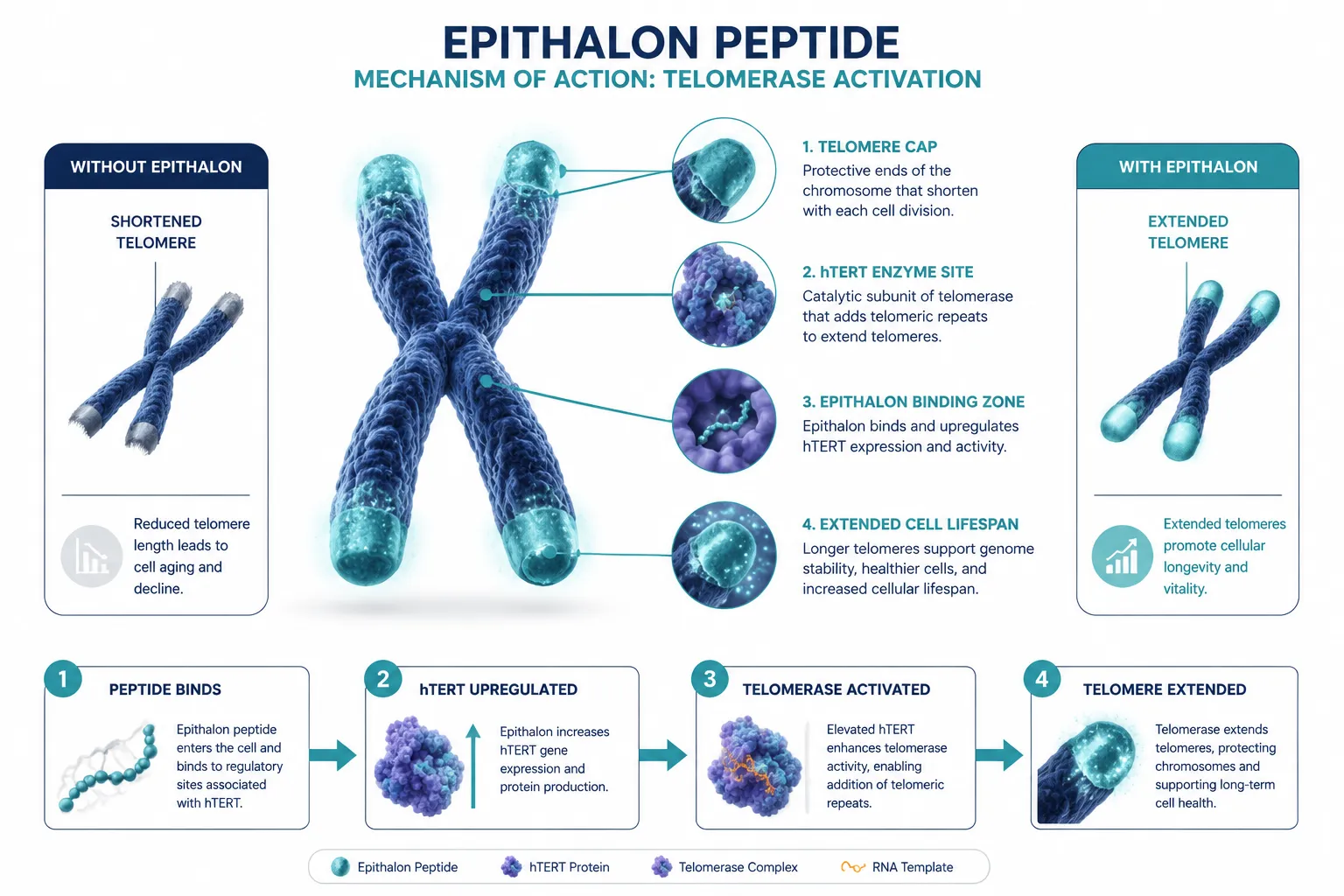
Epithalon (also written Epitalon or Epithalone) was originally derived from Epithalamin, a polypeptide extract from the bovine pineal gland, through research conducted in Russia beginning in the 1980s. The synthetic version, a simple tetrapeptide sequence of alanine, glutamic acid, aspartic acid, and glycine, was developed to replicate the bioregulatory properties of its natural precursor.
What Is Epithalon and How Does It Work

The core mechanism that has drawn research interest is straightforward: Epithalon appears to stimulate the expression of hTERT (human telomerase reverse transcriptase), the enzyme responsible for rebuilding telomere sequences at chromosome ends. When hTERT activity increases, telomerase is activated, and the progressive shortening of telomeres that accompanies normal cell division is slowed or partially reversed.

This is significant because telomere length is widely regarded as a biological marker of cellular age. Shorter telomeres correlate with reduced cell replication capacity, increased senescence, and a range of age-associated conditions. Understanding how to modulate this process is a central goal of modern biogerontology.

To understand how molecular size and structure influence peptide function in research models, the overview of peptides and polypeptides in modern research provides useful foundational context.

Epithalon Peptide: Unveiling Its Research Potential in Telomere Maintenance, What the Studies Show

In Vitro and Cell Line Evidence

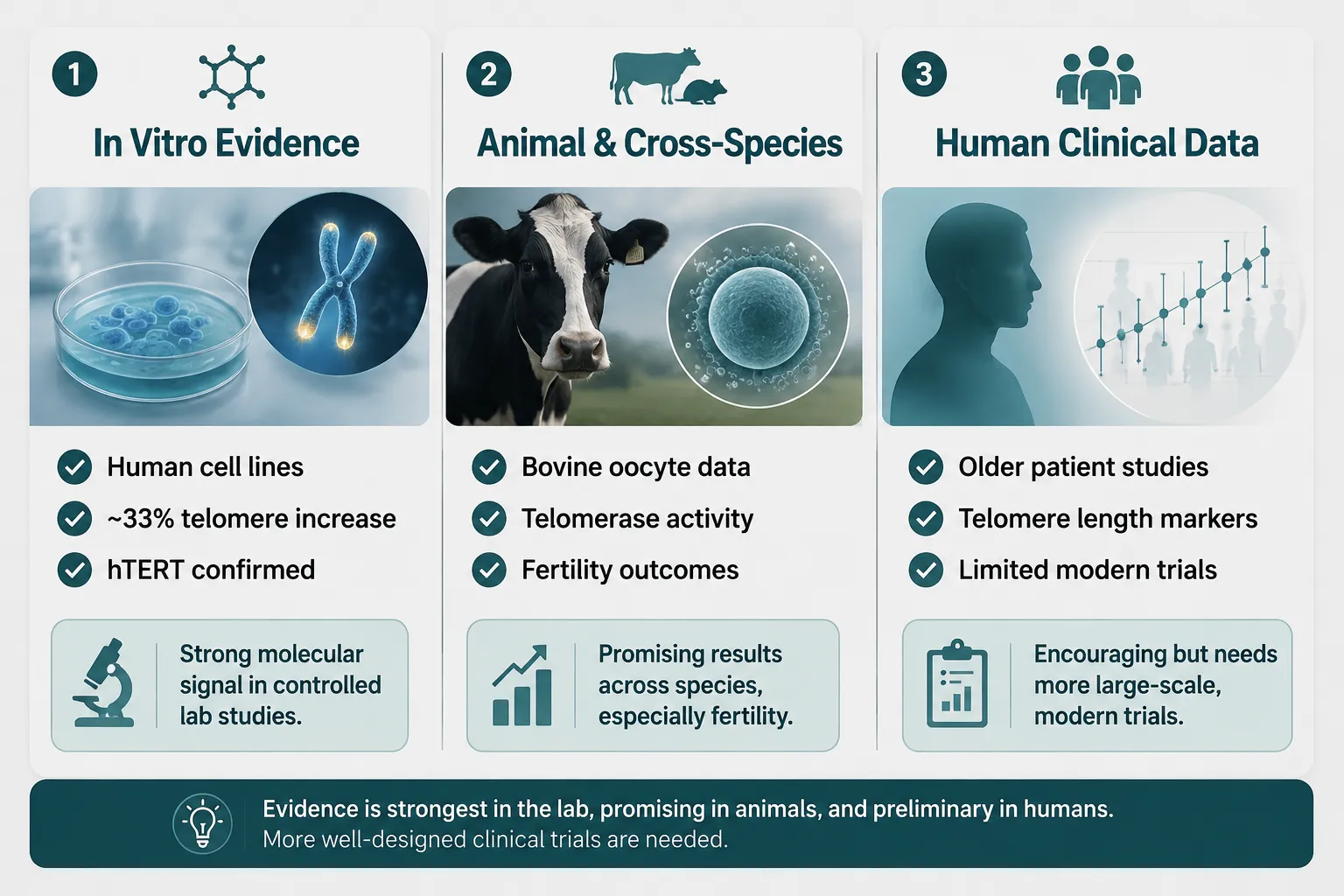
The most robust category of evidence comes from human cell line studies. A 2025 investigation by Al-Dulaimi and colleagues examined Epithalon's effects on telomere dynamics in human cell lines and confirmed both hTERT upregulation and measurable telomere elongation. Systematic analysis across available studies has reported an average telomere length increase of approximately 33% in Epithalon-treated models compared to controls.

These findings are consistent with earlier mechanistic work that identified telomerase activation as the primary pathway through which Epithalon exerts its effects. Treated cells demonstrated extended replicative lifespan, meaning they were able to divide more times before entering senescence.

Cross-Species and Fertility-Related Findings

A separate line of 2025 research examined Epithalon's effects on bovine oocytes, finding that telomerase activity was meaningfully elevated in treated samples. This cross-species evidence strengthens the mechanistic argument that Epithalon's telomerase-activating properties are not limited to a single model system.

The fertility-adjacent implications of these findings are notable: telomere maintenance in reproductive cells is closely linked to embryo viability and developmental outcomes, making this a potentially significant area of translational research.
Cross-Species and Fertility-Related Findings

Older Human Data and Current Interpretation

Earlier human studies, conducted primarily in aging patient populations, documented changes in telomere length markers following Epithalon administration. While these older datasets lack the methodological rigor of modern clinical trials, they provided the initial translational signal that encouraged continued investigation.

Integrative medicine narratives published between 2024 and 2026 have revisited this data, generally concluding that the evidence is mechanistically plausible but insufficient to support definitive claims about lifespan extension in humans.

Researchers interested in how other peptides operate across similar cellular pathways may find value in reviewing work on mesenchymal stem cells and peptide-based modulators, which covers regenerative research contexts involving BPC-157 and GHK-Cu.

Epithalon Peptide: Unveiling Its Research Potential, Limitations, Safety Considerations, and Research Gaps

The Evidence Grade Problem

Despite promising mechanistic data, the evidence base for Epithalon carries important limitations:

Evidence Category Status (2026)
In vitro cell line studies Multiple, consistent findings
Animal and cross-species models Supportive, growing dataset
Small human observational studies Limited, older methodology
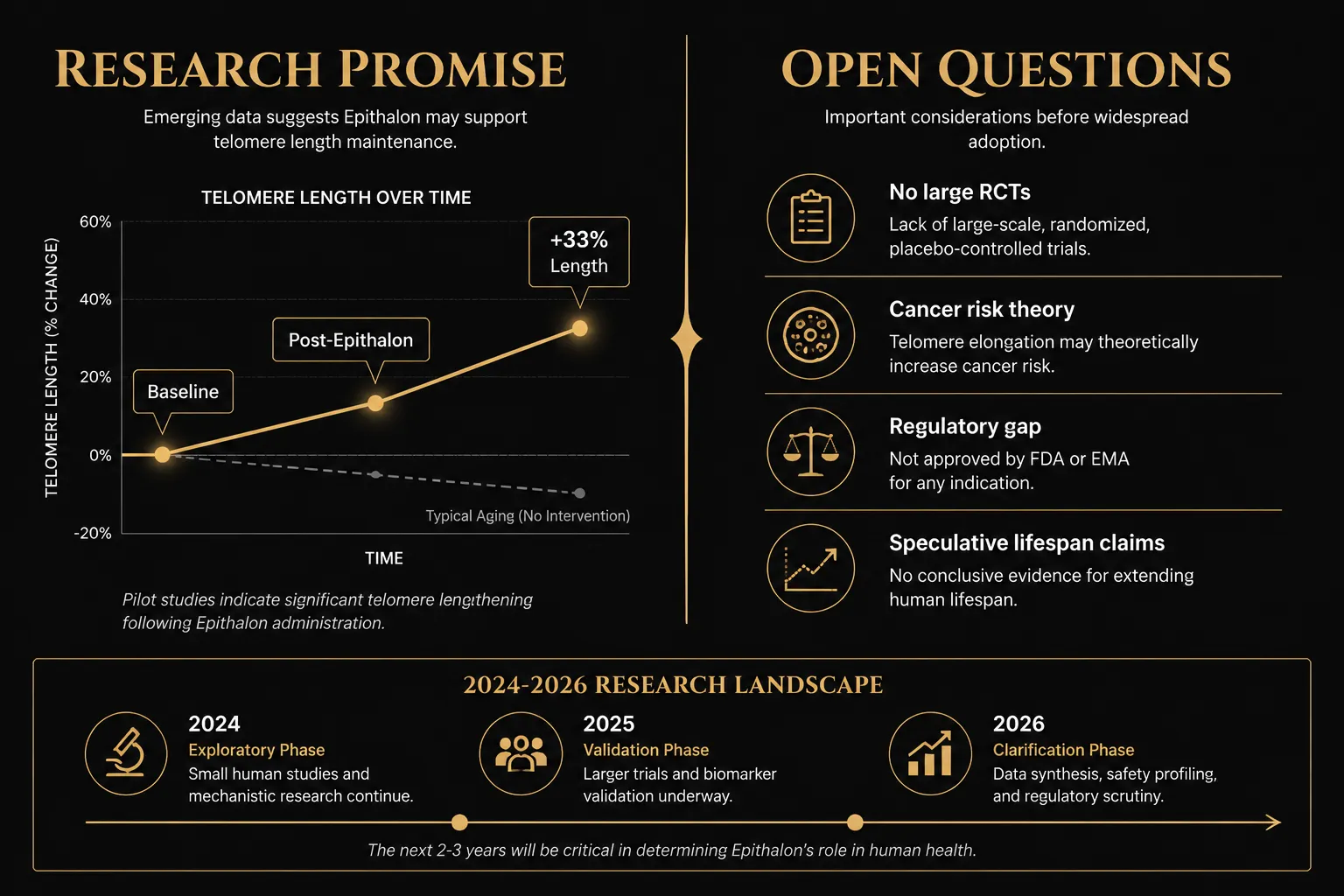
Modern randomized controlled trials None completed
Regulatory approval (any jurisdiction) Not approved for clinical use

The absence of large, well-controlled human trials means that translating laboratory findings into clinical recommendations is not currently justified by the evidence.

Theoretical Cancer Risk

A critical concern in telomerase research is the relationship between telomerase activation and oncogenesis. Telomerase is upregulated in the majority of human cancers, where it enables unlimited cell replication. Any compound that activates telomerase therefore carries a theoretical risk of promoting malignant cell proliferation.

This concern does not invalidate Epithalon research but underscores why controlled, long-duration safety studies are essential before any clinical application could be responsibly considered.

Regulatory and Clinical Status

As of mid-2026, Epithalon holds no regulatory approval in any major jurisdiction for therapeutic use. Its current status is strictly that of a research compound, used in laboratory and preclinical settings. Researchers sourcing peptides for legitimate study should prioritize verified purity and documentation, guidance on evaluating suppliers is available through resources like this peptide supplier comparisons guide.

Those exploring the broader landscape of research peptides may also benefit from understanding related compounds. The GHK-Cu peptide sourcing guide and the Semax and Selank comparative research article offer parallel perspectives on peptide research methodology and sourcing standards.
Regulatory and Clinical Status

Conclusion

The current body of evidence positions Epithalon as one of the more mechanistically compelling peptides in cellular aging research. The confirmed upregulation of hTERT, the documented ~33% increase in telomere length across treated cell models, and the cross-species corroboration from 2025 bovine oocyte studies collectively represent a meaningful scientific foundation.

However, the gap between laboratory findings and proven human benefit remains substantial. No modern clinical trials have been completed, theoretical oncogenic risks from telomerase activation require rigorous long-term evaluation, and regulatory status remains strictly preclinical.

Actionable next steps for researchers:

  • Review the 2025 Al-Dulaimi cell line data and cross-species telomerase findings as primary reference points.
  • Treat any claims about lifespan extension in humans as speculative until supported by controlled clinical evidence.
  • Ensure peptide sourcing meets documented purity standards; consult verified supplier resources before procurement.
  • Monitor emerging literature closely, the 2024-2026 period has seen accelerating interest in translational Epithalon research, and new study data is anticipated.
  • Consider Epithalon's mechanistic profile alongside other research peptides with cellular protective roles, such as those covered in the SS-31 10mg research peptide considerations resource.

The science of telomere maintenance is advancing rapidly. Epithalon peptide sits at a genuinely interesting intersection of molecular biology and longevity research, but rigorous, patient-centered clinical investigation remains the essential next chapter.

Tags: anti-aging research, biogerontology, cellular longevity, epithalon peptide, htert upregulation, peptide research, telomerase activation, telomere maintenance
https://www.puretestedpeptides.com/wp-content/uploads/2026/08/epithalon-peptide-unveiling-its-research-potential-in-telomere-maintenance-and-a.webp 1024 1536 https://www.puretestedpeptides.com/wp-content/uploads/2026/01/buy-peptides-online.jpg 2026-08-23 13:04:082026-08-23 13:04:08Epithalon Peptide: Unveiling Its Research Potential in Telomere Maintenance and Anti-Aging Studies
You might also like
Estrogen Receptor Biology for Peptide Researchers: How Enclomiphene and Related serms Interface With Endocrine Pathways Estrogen Receptor Biology for Peptide Researchers: How Enclomiphene and Related serms Interface With Endocrine Pathways
Adenosine Triphosphate, Mitochondrial Function, and Why Peptide Researchers Care About Cellular Energy Adenosine Triphosphate, Mitochondrial Function, and Why Peptide Researchers Care About Cellular Energy
Peptides Mechanism 101: From GLP‑3 Retatrutide to CJC‑1295 and MOTS‑c in Cellular and Receptor-Level Research Peptides Mechanism 101: From GLP‑3 Retatrutide to CJC‑1295 and MOTS‑c in Cellular and Receptor-Level Research
Collagen, GHK-Cu, and Glow Blend: How Classic Collagen Biology Intersects With Copper Peptide Research Collagen, GHK-Cu, and Glow Blend: How Classic Collagen Biology Intersects With Copper Peptide Research
Nasal Spray Peptides: Delivery Methods, Bioavailability, and Research Advantages Nasal Spray Peptides: Delivery Methods, Bioavailability, and Research Advantages
MOTS-c Peptide: Mitochondrial Signaling, Metabolic Research, and Why Researchers Study It MOTS-c Peptide: Mitochondrial Signaling, Metabolic Research, and Why Researchers Study It
Epithalon Peptide in Longevity Research: Telomeres, Cellular Aging, and What Labs Measure Epithalon Peptide in Longevity Research: Telomeres, Cellular Aging, and What Labs Measure
Epithalon Peptide Formulations: How Labs Compare Lyophilized vs Solution Stability in Telomere Research Epithalon Peptide Formulations: How Labs Compare Lyophilized vs Solution Stability in Telomere Research
0 replies

Leave a Reply

Want to join the discussion?
Feel free to contribute!

Leave a Reply Cancel reply

Your email address will not be published. Required fields are marked *

×

Helpful Links

  • My account
  • Cart
  • Checkout
  • Refund and Returns Policy
  • Privacy Policy
  • SMS Privacy Policy
  • Login
  • My Account
  • Logout

USA Made Lab Tested Peptides

All products are sold for research, laboratory, or analytical purposes only, and are not for human consumption


Pure Tested Peptides is a chemical supplier. Pure Tested Peptides is not a compounding / chemical compounding facility as defined under 503A of the Federal Food, Drug, and Cosmetic act. Pure Tested Peptides is not an outsourcing facility as defined under 503B of the Federal Food, Drug, and Cosmetic act.

The statements made within this website have not been evaluated by the US Food and Drug Administration. The products we offer are not intended to diagnose, treat, cure or prevent any disease.

Human/Animal Consumption Prohibited. Laboratory/In-Vitro Experimental Use Only

Link to: CJC-1295 with Ipamorelin: Optimizing Growth Hormone Release for Advanced Research Protocols Link to: CJC-1295 with Ipamorelin: Optimizing Growth Hormone Release for Advanced Research Protocols CJC-1295 with Ipamorelin: Optimizing Growth Hormone Release for Advanced Research...CJC-1295 with Ipamorelin: Optimizing Growth Hormone Release for Advanced Research Protocols Link to: Slupp332 with 5-Amino-1MQ: An Advanced Look at Synergistic Metabolic Pathways in Research Link to: Slupp332 with 5-Amino-1MQ: An Advanced Look at Synergistic Metabolic Pathways in Research Slupp332 with 5-Amino-1MQ: An Advanced Look at Synergistic Metabolic Pathways in ResearchSlupp332 with 5-Amino-1MQ: An Advanced Look at Synergistic Metabolic Pathways...
Scroll to top Scroll to top Scroll to top