Call or Text 727-513-9780
  • Shopping Cart Shopping Cart
    0Shopping Cart
Pure Tested Peptides | America's most trusted Peptides for sale online
  • Peptides for sale
    • Oral Peptides for sale
      • Peptide Capsules for sale
      • BPC 157 Capsules 1000mcg
      • SLU-PP-332 Capsules | 1000 mcg
      • 5-Amino-1MQ 50mg Capsules
      • Tesofensine 500mcg
    • All Peptides for sale
    • Peptide Sprays
      • BPC 157 Nasal Spray Kit
      • BPC-157 TB500 Nasal Spray Kit
      • Semax Nasal Spray 10mg
      • Selank – Nasal Spray Kit – 10mg
      • Epithalon 50MG Nasal Spray Kit
      • Ipamorelin 10mg Nasal Spray
      • Klow Nasal Spray (BPC-157 + TB-500 + GHK-Cu + KPV) | 80mg
      • Hulk Nasal Spray Tesa / Ipa Blend 6/3 MG
      • Klow Nasal Spray
      • NAD + 500 mg Nasal Spray
      • PT-141 Nasal Spray Kit
    • GHRH Peptides
      • Ipa Peptides
      • CJC-1295 Peptides
        • CJC-1295 with DAC 5 mg
        • CJC-1295 without DAC 5 mg
        • CJC-1295 Ipa 10mg
      • Tesa Peptides
        • Tesa Peptide
        • Tesa 20 mg
    • GHK-Cu Peptides
      • All GHK-Cu Peptides
      • GHK-Cu 100mg
      • KLOW Peptide Blend – Buy KLOW blend online
    • BPC Peptides
      • All BPC Peptides
      • BPC-157
      • BPC-157 TB-500
      • BPC 157 capsules 1000mcg
    • SLU-PP-332 Peptides
      • All SLU-PP-332 Peptides
      • SLU-PP-332 5mg
    • GLP3 Peptides
    • PT-141 Peptides
      • PT-141 Peptides for sale
      • PT-141 10mg
      • PT-141 Nasal Spray
    • CAG Peptides
      • Lipo-C Peptide Blend
      • CAG 5mg
      • CAG 10mg
    • MOTS-C Peptides
      • MOTS-C Peptides for sale
      • MOTS-c peptide
      • MOTS-c 10mg *6 pack*
    • 5 Amino 1MQ Peptides
      • 5 Amino 1MQ Peptides for sale
      • 5-Amino-1MQ 50mg Capsules
      • 5-Amino-1MQ 5mg
    • Epithalon Peptides
      • Epithalon Peptides for sale
      • Epithalon 10mg
      • Epithalon 50mg
  • Shop
    • GLPs
      • 5-Amino-1MQ 50mg Capsules
      • 5-Amino-1MQ 5mg
      • L-Carnitine 500mg/ml
      • Tesofensine 500mcg
      • SLU-PP-332 5mg
      • MOTS-c 10mg *6 pack*
    • Epithalon & BPC Peptides
      • Epithalon 10mg
      • Epithalon 50mg
      • BPC-157
      • BPC 157 capsules 1000mcg
      • BPC-157 TB-500
      • BPC-157 TB500 Nasal Spray Kit
      • BPC 157 Nasal Spray Kit
    • BPC TB-500 & NAD+ Peptides
      • NAD+ 500 mg
      • KLOW Peptide Blend – Buy KLOW blend online
      • GLOW Peptide Blend
      • TB 500 5mg
      • BPC 157 capsules 1000mcg – Supplement
      • BPC 157 Nasal Spray Kit
      • BPC-157
      • BPC-157 TB500 Nasal Spray Kit
      • BPC-157 TB-500
      • BPC 157 capsules 1000mcg
    • LL-37 Peptide
      • LL-37 10 mg
    • MOTS-C & Selank
      • MOTS-c peptide
      • Selank 10mg
    • GHK Peptides
      • GHK-Cu 100mg
      • GLOW Peptide Blend
      • KLOW Peptide Blend – Buy KLOW blend online
  • COAs
  • Wholesale
    • Wholesale Peptides for sale
  • PTP FAQ
  • Affiliates
    • Selank Peptide: Advanced Pharmacological Mechanisms Underlying Its Anxiolytic and Nootropic Effects in Research
      • 5-Amino-1MQ Peptide: Detailed Mechanisms of NNMT Inhibition and Its Impact on Cellular Metabolism Research
        • MOTS-C Peptide: Unraveling Its Role in Mitochondrial Dynamics and Energy Metabolism Research
          • Epithalon Peptide and Telomerase Regulation: Investigating Its Impact on Cellular Senescence and Lifespan Research Models
            • GLP2-T vs GLP2 Tirz Peptide: Understanding the Naming, Mechanistic Nuances, and Research Implications for Gut Health
      • Peptides and Polypeptides in Modern Pharmacology: What Research on Metoprolol, Prednisone, and Amlodipine Reveals
        • Polypeptide Peptides vs NSAIDs: What Naproxen and Diclofenac Teach Tissue-Repair Researchers About BPC‑157 and TB‑500
          • Peptides and Polypeptides in Endocrine Pharmacology: How GLP-1, GLP-2, and GLP-3 Retatrutide Differ From Classic Drugs Like Prednisone and Amlodipine
          • 5‑Amino‑1MQ Peptide and NNMT Inhibition: How It Compares With Statins Like Atorvastatin in Adipose and Lipid Metabolism Research
      • Enclomiphene, Estrogen Receptor Signaling, and Luteinizing Phase Biology: What Hormone Researchers Should Measure
        • Mesenchymal Stem Cells, BPC‑157, and GHK‑Cu: How Tissue Repair Peptides Compare With Classic NSAIDs Like Naproxen in Injury Models
          • Peptide Calculator Use Cases Beyond Growth Hormone: Working Through GLP‑3 Retatrutide, MOTS‑c, and BPC‑157 Research Dosing
        • Polypeptide Peptides in Endocrine and Metabolic Pharmacology: Lessons From Amlodipine, Prednisone, and Metoprolol
        • Peptides Calculator for Advanced Blends: Worked Examples for Tesamorelin, CJC‑1295, and Ipamorelin Stacks
          • Peptides and Polypeptides in Human Physiology: How Molecular Size Shapes Research Applications
            • Selank Peptide: Advanced Pharmacological Mechanisms Underlying Its Anxiolytic and Nootropic Effects in Research
          • 5-Amino-1MQ Peptide: Detailed Mechanisms of NNMT Inhibition and Its Impact on Cellular Metabolism Research
            • MOTS-C Peptide: Unraveling Its Role in Mitochondrial Dynamics and Energy Metabolism Research
              • Epithalon Peptide and Telomerase Regulation: Investigating Its Impact on Cellular Senescence and Lifespan Research Models
                • GLP2-T vs GLP2 Tirz Peptide: Understanding the Naming, Mechanistic Nuances, and Research Implications for Gut Health
                  • Peptides and Polypeptides in Endocrine Pharmacology: How GLP-1, GLP-2, and GLP-3 Retatrutide Differ From Classic Drugs Like Prednisone and Amlodipine
                    • Polypeptide Peptides vs NSAIDs: What Naproxen and Diclofenac Teach Tissue-Repair Researchers About BPC‑157 and TB‑500
                      • Peptides and Polypeptides in Modern Pharmacology: What Research on Metoprolol, Prednisone, and Amlodipine Reveals
                        • 5‑Amino‑1MQ Peptide and NNMT Inhibition: How It Compares With Statins Like Atorvastatin in Adipose and Lipid Metabolism Research
                        • Enclomiphene, Estrogen Receptor Signaling, and Luteinizing Phase Biology: What Hormone Researchers Should Measure
                        • Mesenchymal Stem Cells, BPC‑157, and GHK‑Cu: How Tissue Repair Peptides Compare With Classic NSAIDs Like Naproxen in Injury Models
                        • Peptide Calculator Use Cases Beyond Growth Hormone: Working Through GLP‑3 Retatrutide, MOTS‑c, and BPC‑157 Research Dosing
                        • Polypeptide Peptides in Endocrine and Metabolic Pharmacology: Lessons From Amlodipine, Prednisone, and Metoprolol
                        • Peptides Calculator for Advanced Blends: Worked Examples for Tesamorelin, CJC‑1295, and Ipamorelin Stacks
                        • Peptides and Polypeptides in Human Physiology: How Molecular Size Shapes Research Applications
                        • Selank Peptide: Advanced Pharmacological Mechanisms Underlying Its Anxiolytic and Nootropic Effects in Research
                        • MOTS-C Peptide: Unraveling Its Role in Mitochondrial Dynamics and Energy Metabolism Research
                        • Peptides and Polypeptides in Modern Pharmacology: What Research on Metoprolol, Prednisone, and Amlodipine Reveals
                        • Peptides and Polypeptides in Endocrine Pharmacology: How GLP-1, GLP-2, and GLP-3 Retatrutide Differ From Classic Drugs Like Prednisone and Amlodipine
                        • 5-Amino-1MQ Peptide: Detailed Mechanisms of NNMT Inhibition and Its Impact on Cellular Metabolism Research
                        • Mesenchymal Stem Cells, BPC‑157, and GHK‑Cu: How Tissue Repair Peptides Compare With Classic NSAIDs Like Naproxen in Injury Models
                        • Peptide Calculator Use Cases Beyond Growth Hormone: Working Through GLP‑3 Retatrutide, MOTS‑c, and BPC‑157 Research Dosing
                        • GLP2-T vs GLP2 Tirz Peptide: Understanding the Naming, Mechanistic Nuances, and Research Implications for Gut Health
                        • Polypeptide Peptides in Endocrine and Metabolic Pharmacology: Lessons From Amlodipine, Prednisone, and Metoprolol
                        • Polypeptide Peptides vs NSAIDs: What Naproxen and Diclofenac Teach Tissue-Repair Researchers About BPC‑157 and TB‑500
                        • Peptides and Polypeptides in Human Physiology: How Molecular Size Shapes Research Applications
                        • Peptides Calculator for Advanced Blends: Worked Examples for Tesamorelin, CJC‑1295, and Ipamorelin Stacks
                        • 5‑Amino‑1MQ Peptide and NNMT Inhibition: How It Compares With Statins Like Atorvastatin in Adipose and Lipid Metabolism Research
                        • Enclomiphene, Estrogen Receptor Signaling, and Luteinizing Phase Biology: What Hormone Researchers Should Measure
                        • Epithalon Peptide and Telomerase Regulation: Investigating Its Impact on Cellular Senescence and Lifespan Research Models
                        • Best research protocol Klow blend
                        • best time to take BPC-157
                        • best time to take DSIP (Delta Sleep Inducing Peptide)
                        • best time to take CJC-1295
                        • best time to take AOD-9604
                        • best time to take Follistatin 344
                        • best time to take Ipamorelin
                        • best time to take MK-677 (Ibutamoren)
                        • best time to take Ligandrol (LGD-4033) — research compound
                        • best time to take Ostarine (MK-2866) — research compound
                        • best time to take GHK-CU
                        • best time to take TB-500
                        • best time to take MOTS-c
                        • best time to take Semax
                        • best time to take RAD-140 (Testolone) — research compound
                        • best time to take Thymosin Alpha-1
                        • best time to take PEG-MGF
                        • Biolife Plasma, Octapharma Plasma, and Research Peptides: How Plasma Donation Labs Differ From Peptide Suppliers
                        • best time to take YK-11 — research compound
                        • best time to take PT-141 (Bremelanotide)
                        • Best research protocol Klow blend
                        • 5-Amino-1MQ and MOTS-C Synergy: Metabolic Signaling, Mitochondria, and Research Design
                        • BPC-157 and TB-500: Investigating Their Combined Effects on Angiogenesis and Cellular Migration in Tissue Repair Models
                        • BPC-157 Peptide: Gut Barrier Function, Inflammation, and Tissue-Recovery Research
                        • 5‑Amino‑1MQ and MOTS‑c Synergy in Metabolic Research: Designing NNMT and Mitochondrial Biogenesis Stacks
                        • CJC-1295 with DAC vs. Without DAC: Half-Life, Release Kinetics, and Research Implications
                        • CJC‑1295 with DAC vs. Without DAC: Expanding on Half‑Life Differences Using Tesamorelin and Ipamorelin Blend Case Studies
                        • Collagen Biology and Copper‑Binding Peptides: How GHK‑Cu, Glow Blend, and Klow Blend Interact with Skin and Connective Tissue
                        • Collagen Biology and Regenerative Peptides: How GHK‑Cu, Glow Blend, and Klow Blend Affect Extracellular Matrix Research
                    • DNA, Telomeres, and Longevity Peptides: Positioning Epithalon and MOTS‑c in Genetic Aging Research
                      • Enclomiphene Citrate: serm Mechanism, Testosterone Research, and Stack Compatibility
                        • Enclomiphene vs Enclomiphene Citrate: Formulation, Bioavailability, and Research Distinctions
                        • Epithalon Peptide Research: Telomerase Activation, Aging, and Pineal Gland Function
                        • Estrogen Receptor Signaling and Enclomiphene: How Selective Modulators Compare with Classic Polypeptide Hormones
                        • GHK-Cu Peptide: Advanced Mechanisms in Extracellular Matrix Remodeling and Wound Healing Research
                        • GHK-Cu Peptide: Collagen Synthesis, Wound Repair, and Skin-Barrier Research Models
                        • GLP-1 vs GLP-3 vs GLP-2: Peptide Classification and Research Applications
                        • GLP-2 Peptide Research Guide: Gut Barrier Function, Nutrient Absorption, and Intestinal Recovery Models
                        • GLP-3 Retatrutide vs. GLP-1 Drugs: What Triple-Agonist Biology Changes in Research Models
                        • Ipamorelin and Tesamorelin Combination: Synergistic GH Secretagogue Research and Dosing Protocols
                        • GLP2 Tirz Peptide: What It Is, Why the Name Exists, and How Researchers Should Interpret It
                        • Klow Blend Peptide Nasal Spray: What the Formulation Is Trying to Do in Cognitive Research
                        • Mitochondria, NNMT Inhibition, and Peptide Modulators: Where MOTS‑c and 5‑Amino‑1MQ Fit in Cellular Energy Research
                        • MOTS-c Peptide: Mitochondrial Function, Energy Metabolism, and What Researchers Measure
                        • MOTS-c vs. 5-Amino-1MQ: Which Metabolic Research Questions Each Compound Actually Answers
                        • Nasal Spray Peptides: Bioavailability, Administration, and Semax/Selank Research Applications
                        • PT-141 Peptide Research: Mechanism of Action and Melanocortin Receptor Signaling
                        • Retatrutide for Research: Mechanism, Structure, and GLP-1/GLP-3 Dual Action
                        • Retatrutide for Obesity and Type 2 Diabetes: What the Latest Trial Data Suggest
                        • Tesofensine Peptide Research: Mechanism, Appetite Suppression, and Neuropeptide Y Pathways
  • Contact
    • Contact Customer Service
    • Text Customer Support
  • About US
  • Shop all peptides
  • Affiliate Program
    • Affiliate Signup
  • Login / Register Login / Register Page Link Login / Register Page Link
  • Click to open the search input field Click to open the search input field Search
  • Menu Menu
Where to Buy Research-Grade MOTS-c, 5-Amino-1MQ, and GLP-3 Retatrutide Together: Vendor Selection for Advanced Metabolic Stacks

Where to Buy Research-Grade MOTS-c, 5-Amino-1MQ, and GLP-3 Retatrutide Together: Vendor Selection for Advanced Metabolic Stacks

September 6, 2026/0 Comments/in Uncategorized/by

Only one of the three compounds in this stack can actually be purchased today, and knowing which one cannot be sourced from any vendor is the most important piece of information a research lab can have before spending time on procurement.

The question of where to buy research-grade MOTS-c, 5-Amino-1MQ, and GLP-3 Retatrutide together for advanced metabolic stacks is asked frequently in 2026, but the honest answer is more nuanced than a vendor list. Two of these compounds have active research-chemical marketplaces. The third, retatrutide, is a proprietary investigational drug owned by Eli Lilly, accessible only inside formal clinical trials, and cannot be legally sold or marketed by any third-party supplier.

This guide breaks down each compound's sourcing reality, the vendor criteria that matter most, and how to build the strongest possible metabolic research stack within legal and regulatory boundaries.

Key Takeaways

  • MOTS-c is available from multiple vetted peptide vendors as a lyophilized research compound; prioritize lot-matched COAs, LC-MS identity testing, and USP endotoxin screening.
  • 5-Amino-1MQ is a small-molecule NNMT inhibitor classified as Research Use Only (RUO); it is not a peptide, and several reputable chemical suppliers offer it in research-grade vials.
  • Retatrutide (LY3437943) is an investigational triple hormone receptor agonist that cannot be legally purchased from any retail or research-chemical source in 2026.
  • When sourcing multiple compounds for a metabolic stack, vendor transparency, third-party testing, and RUO labeling are the non-negotiable baseline criteria.
  • The practical "advanced metabolic stack" available to researchers today pairs MOTS-c with 5-Amino-1MQ; retatrutide remains a future consideration pending potential regulatory approval.

Understanding the Three Compounds Before Sourcing Them
Understanding the Three Compounds Before Sourcing Them

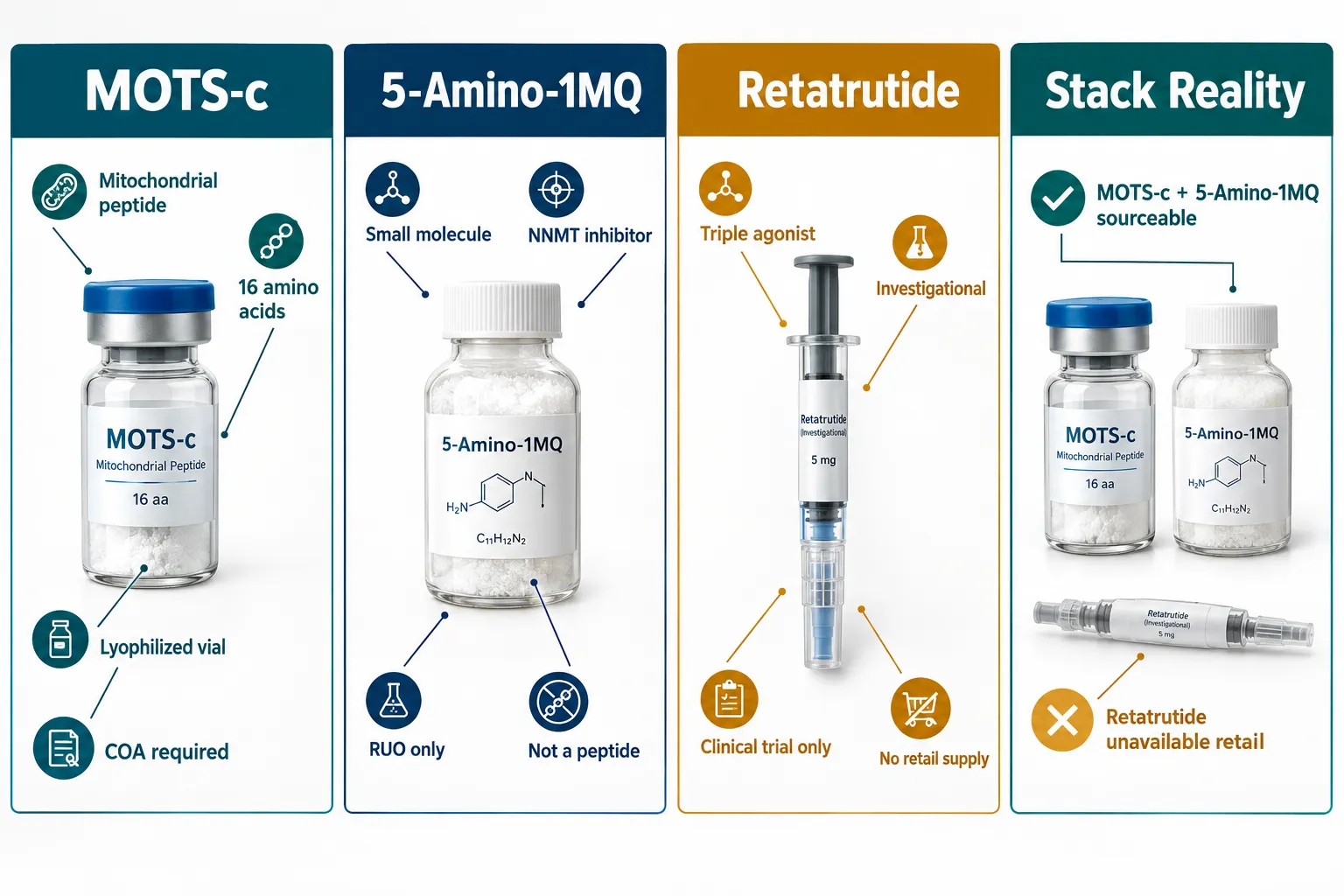
Before evaluating any vendor, researchers need a clear picture of what each compound is, and what category it falls into.

MOTS-c is a 16-amino-acid mitochondrial-derived peptide. It is synthesized via solid-phase peptide synthesis, supplied as a lyophilized powder, and framed as a research compound for in vitro and laboratory use. For a deeper look at how this peptide fits into cellular energy research, the article on mitochondria, adenosine triphosphate, and peptide signaling where MOTS-c and 5-Amino-1MQ fit in cellular energy research provides useful mechanistic context.

5-Amino-1MQ is a small-molecule quinolinium heteroaromatic compound, not a peptide. It contains no amino acids and no peptide bonds. It acts as an NNMT (nicotinamide N-methyltransferase) inhibitor and is classified strictly as a Research Use Only laboratory reagent. Mislabeling it as a peptide is common among vendors; this is a red flag. For mechanism detail, see the resource on 5-Amino-1MQ peptide mechanism, metabolic research, and how it differs from mitochondrial peptides.

Retatrutide (also referred to as GLP-3 in some search contexts) is Eli Lilly's investigational triple hormone receptor agonist, activating GIP, GLP-1, and glucagon receptors simultaneously. As of 2026, Lilly's TRIUMPH Phase 3 program has reported positive topline results across obesity-related indications, but the compound remains unapproved and is classified as investigational. No authorized research-reagent distribution channel exists. For more on how it differs from other GLP-class compounds, see what is GLP-3 peptide and how researchers distinguish it from retatrutide in search intent and lab context.

Critical point: Any vendor claiming to sell retatrutide as a research chemical or metabolic stack component in 2026 is not operating within a legitimate regulatory framework. There is no lawful third-party supply channel.

Vendor Selection Criteria for Research-Grade MOTS-c and 5-Amino-1MQ
Vendor Selection Criteria for Research-Grade MOTS-c and 5-Amino-1MQ

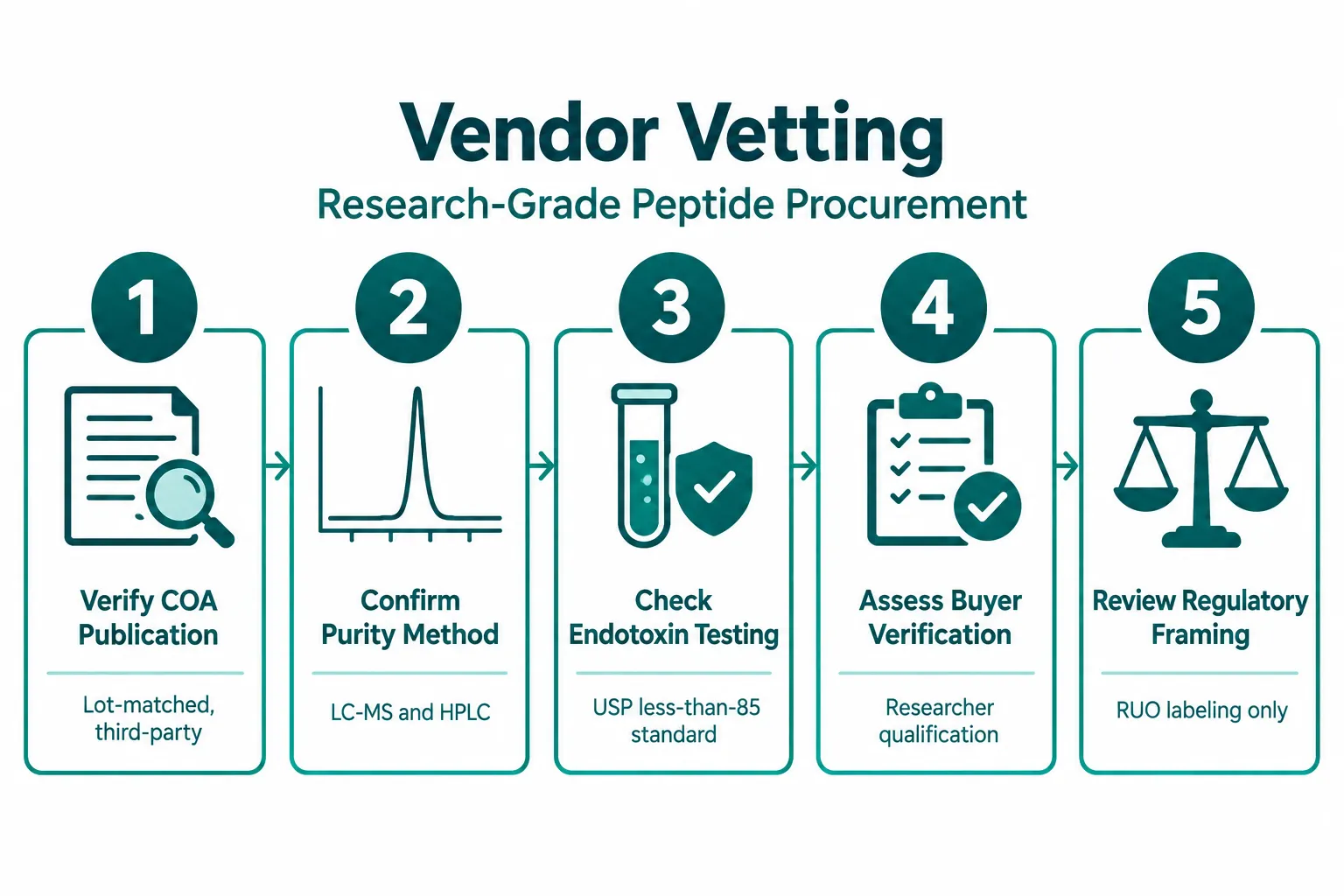
For the two compounds that can be legitimately sourced, the quality gap between vendors is significant. The following criteria should drive every procurement decision.

Certificate of Analysis Standards

A COA is the minimum baseline, but not all COAs are equal. The strongest vendors publish lot-matched COAs, meaning the document corresponds to the exact batch being shipped, not a generic or outdated test. Key elements to verify:

  • LC-MS identity confirmation, confirms the compound is what the label claims
  • HPLC purity result, reputable MOTS-c suppliers consistently report purity at or above 99%
  • USP less-than-85 endotoxin screening, critical for any compound used in cell-based research
  • Third-party lab origin, COAs from independent labs carry more weight than in-house testing

MOTS-c Vendor Landscape in 2026

Independent vendor comparisons in 2026 identify several consistently cited sources for research-grade MOTS-c. Vendors such as Peptide Sciences, Core Peptides, and Limitless Life Nootropics are frequently noted for publishing third-party COAs, claiming purity at or above 99%, and using US-based production or fulfillment. Some comparisons rank Protide Health as a leading option based on lot-matched COA practices and endotoxin screening on every batch. The 5-Amino-1MQ and MOTS-c synergy article on how mitochondrial peptides target adiposity and insulin resistance in experimental models offers useful framing for why these two compounds are studied together.

5-Amino-1MQ Vendor Landscape in 2026

Multiple research-chemical suppliers, including Core Research Peptides, Nextday Peptides, Peptronic Labs, American Peptides, and Profound Aminos, offer 5-Amino-1MQ in small-volume vials (typically 5 mg or 50 mg). All legitimate listings frame it explicitly as an in vitro research compound with no diagnostic or therapeutic use. Researchers should verify:

  • RUO labeling is present and explicit
  • The compound is described as an NNMT inhibitor, not a peptide
  • No health claims or human-use framing appears anywhere on the product page

For additional context on how researchers frame NAD+ and metabolic pathway questions around this compound, see 5-Amino-1MQ peptide: how researchers frame NAD+ and metabolic pathway questions.

Building the Stack: What Labs Can and Cannot Source Today
Building the Stack: What Labs Can and Cannot Source Today

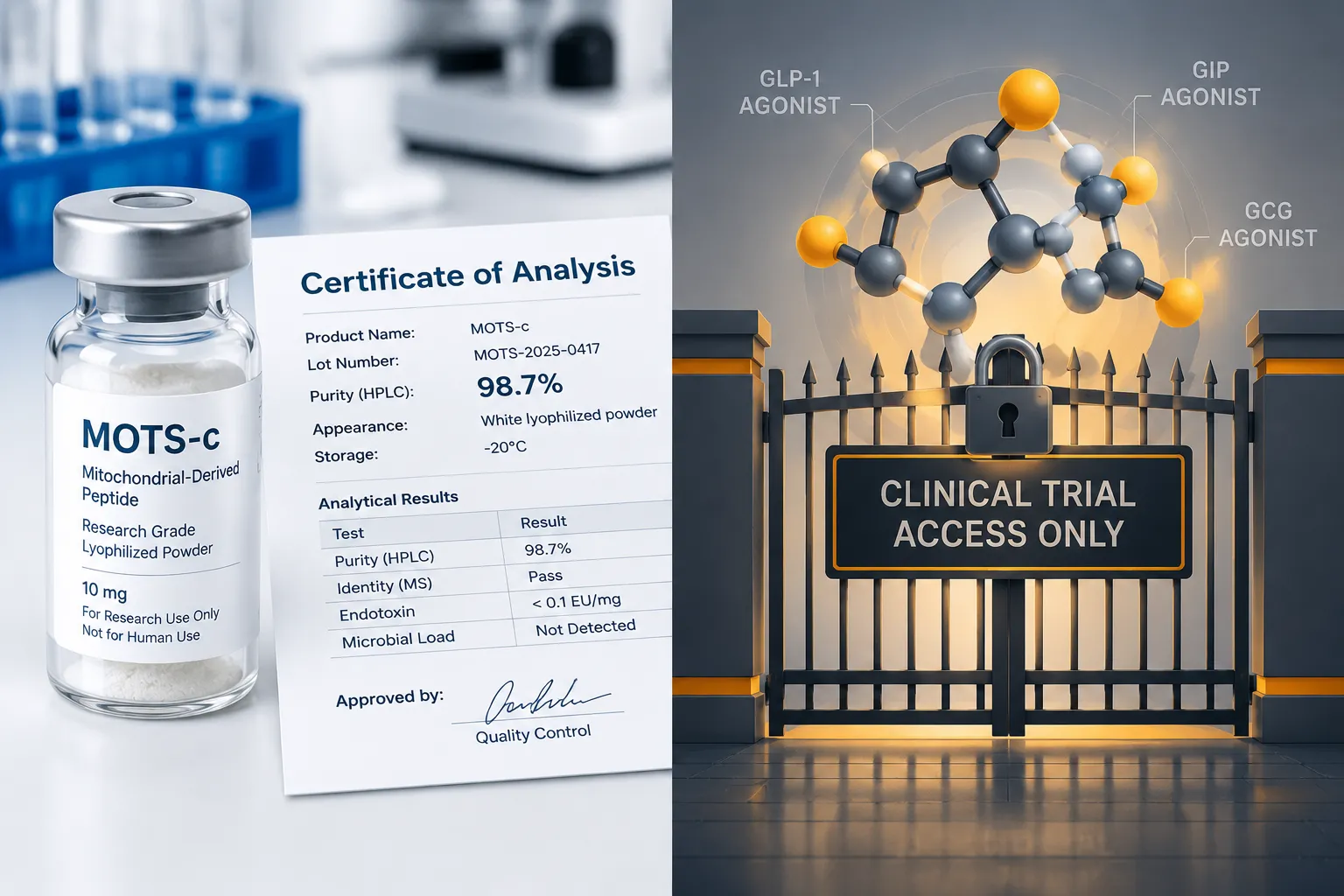
The practical metabolic research stack available in 2026 pairs MOTS-c with 5-Amino-1MQ. Retatrutide cannot be added from any retail or research-chemical source. The table below summarizes the sourcing reality.

Compound Category Sourceable in 2026? Key Procurement Criteria
MOTS-c Mitochondrial peptide Yes, multiple vetted vendors Lot-matched COA, LC-MS, endotoxin testing
5-Amino-1MQ Small molecule (RUO) Yes, RUO chemical suppliers RUO labeling, NNMT inhibitor framing, no health claims
Retatrutide Investigational drug (Lilly) No, clinical trials only Not applicable; no lawful retail channel exists

Bundle Ordering Considerations

Most peptide vendors do not stock 5-Amino-1MQ alongside peptides, since it is a small molecule rather than a peptide. Labs should expect to source from two separate suppliers. When evaluating vendors for multi-compound orders:

  • Confirm each compound ships under its own accurate regulatory framing, a vendor bundling MOTS-c and 5-Amino-1MQ while labeling both as "peptides" is demonstrating a quality-control gap.
  • Check reconstitution and storage compatibility, lyophilized MOTS-c and 5-Amino-1MQ have different handling requirements. The resource on peptide calculators in research: how labs estimate dosing, concentration, and reconstitution covers practical lab preparation steps.
  • Verify buyer qualification processes, vendors that require researcher verification before completing a sale signal a higher standard of compliance.

For broader context on how GLP-3-class polypeptides fit into cardiometabolic research models, the article on peptides and polypeptides in cardiometabolic research: how atorvastatin and GLP-3 retatrutide answer different questions provides useful comparative framing.

Conclusion

The search for where to buy research-grade MOTS-c, 5-Amino-1MQ, and GLP-3 Retatrutide together for advanced metabolic stacks leads to a clear, actionable answer in 2026: source MOTS-c from vendors with lot-matched COAs, LC-MS identity testing, and USP endotoxin screening; source 5-Amino-1MQ from reputable RUO chemical suppliers that correctly frame it as a small-molecule NNMT inhibitor; and recognize that retatrutide cannot be added to any stack from a third-party vendor under any legitimate procurement pathway.

Actionable next steps for research labs:

  1. Audit current vendor COAs, confirm they are lot-matched and include third-party LC-MS and endotoxin data.
  2. Verify that any 5-Amino-1MQ listing carries explicit RUO labeling and makes no health or peptide claims.
  3. Remove retatrutide from any procurement shortlist until FDA approval and authorized distribution channels exist.
  4. Monitor Lilly's regulatory submission timeline, positive Phase 3 data in 2026 suggests potential submissions in late 2026 or 2027, which could eventually open legitimate supply channels.
  5. Use separate, specialized vendors for the peptide and small-molecule components of the stack, and confirm each ships with compound-specific documentation.
Tags: 5-amino-1mq vendor, advanced metabolic stack, certificate of analysis, mots-c research peptide, nnmt inhibitor, research grade peptides, retatrutide investigational drug, vendor selection criteria
https://www.puretestedpeptides.com/wp-content/uploads/2026/09/where-to-buy-research-grade-mots-c-5-amino-1mq-and-glp-3-retatrutide-together-ve.webp 1024 1536 https://www.puretestedpeptides.com/wp-content/uploads/2026/01/buy-peptides-online.jpg 2026-09-06 13:05:222026-09-06 13:05:22Where to Buy Research-Grade MOTS-c, 5-Amino-1MQ, and GLP-3 Retatrutide Together: Vendor Selection for Advanced Metabolic Stacks
You might also like
Where to Buy Research-Grade MOTS‑c and 5‑Amino‑1MQ: Quality Criteria for Mitochondrial Peptide Studies Where to Buy Research-Grade MOTS‑c and 5‑Amino‑1MQ: Quality Criteria for Mitochondrial Peptide Studies
Klow Blend Peptide: Investigating Its Unique Formulation and Research Applications for Wellness Studies Klow Blend Peptide: Investigating Its Unique Formulation and Research Applications for Wellness Studies
Best Research-Grade Hair Follicle and Tissue Compounds: Finasteride vs. GHK-Cu and Copper Peptide Formulations Best Research-Grade Hair Follicle and Tissue Compounds: Finasteride vs. GHK-Cu and Copper Peptide Formulations
Mitochondria, Adenosine Triphosphate, and Peptide Signaling: Where MOTS-c and 5-Amino-1MQ Fit in Cellular Energy Research Mitochondria, Adenosine Triphosphate, and Peptide Signaling: Where MOTS-c and 5-Amino-1MQ Fit in Cellular Energy Research
Klow Blend vs Glow Blend: Choosing Skin and Wellness Peptide Formulations for Different Research Endpoints Klow Blend vs Glow Blend: Choosing Skin and Wellness Peptide Formulations for Different Research Endpoints
Peptides and Polypeptides Explained: Connecting DNA, Mitochondria, and Modern Research-Use Compounds Like MOTS-c and 5-Amino-1MQ Peptides and Polypeptides Explained: Connecting DNA, Mitochondria, and Modern Research-Use Compounds Like MOTS-c and 5-Amino-1MQ
Where Researchers Compare Enclomiphene vs Enclomiphene Citrate in Lab-Use Planning Where Researchers Compare Enclomiphene vs Enclomiphene Citrate in Lab-Use Planning
5-Amino-1MQ Peptide: Mechanism, Metabolic Research, and How It Differs From Mitochondrial Peptides 5-Amino-1MQ Peptide: Mechanism, Metabolic Research, and How It Differs From Mitochondrial Peptides
0 replies

Leave a Reply

Want to join the discussion?
Feel free to contribute!

Leave a Reply Cancel reply

Your email address will not be published. Required fields are marked *

×

Helpful Links

  • My account
  • Cart
  • Checkout
  • Refund and Returns Policy
  • Privacy Policy
  • SMS Privacy Policy
  • Login
  • My Account
  • Logout

USA Made Lab Tested Peptides

All products are sold for research, laboratory, or analytical purposes only, and are not for human consumption


Pure Tested Peptides is a chemical supplier. Pure Tested Peptides is not a compounding / chemical compounding facility as defined under 503A of the Federal Food, Drug, and Cosmetic act. Pure Tested Peptides is not an outsourcing facility as defined under 503B of the Federal Food, Drug, and Cosmetic act.

The statements made within this website have not been evaluated by the US Food and Drug Administration. The products we offer are not intended to diagnose, treat, cure or prevent any disease.

Human/Animal Consumption Prohibited. Laboratory/In-Vitro Experimental Use Only

Link to: Where to Buy Research-Grade Enclomiphene and Enclomiphene Citrate: serm Formulation, COA Standards, and Peptide-Adjunct Study Design Link to: Where to Buy Research-Grade Enclomiphene and Enclomiphene Citrate: serm Formulation, COA Standards, and Peptide-Adjunct Study Design Where to Buy Research-Grade Enclomiphene and Enclomiphene Citrate: serm Formulation,...Where to Buy Research-Grade Enclomiphene and Enclomiphene Citrate: serm Formulation, COA Standards, and Peptide-Adjunct Study Design Link to: Best Research-Use Peptides for Sexual Function Studies: Comparing PT-141, Sildenafil, and GLP-Class Metabolic Adjuncts Link to: Best Research-Use Peptides for Sexual Function Studies: Comparing PT-141, Sildenafil, and GLP-Class Metabolic Adjuncts Best Research-Use Peptides for Sexual Function Studies: Comparing PT-141, Sildenafil, and GLP-Class Metabolic AdjunctsBest Research-Use Peptides for Sexual Function Studies: Comparing PT-141, Sildenafil,...
Scroll to top Scroll to top Scroll to top