Call or Text 727-513-9780
  • Shopping Cart Shopping Cart
    0Shopping Cart
Pure Tested Peptides | America's most trusted Peptides for sale online
  • Peptides for sale
    • Oral Peptides for sale
      • Peptide Capsules for sale
      • BPC 157 Capsules 1000mcg
      • SLU-PP-332 Capsules | 1000 mcg
      • 5-Amino-1MQ 50mg Capsules
      • Tesofensine 500mcg
    • All Peptides for sale
    • Peptide Sprays
      • BPC 157 Nasal Spray Kit
      • BPC-157 TB500 Nasal Spray Kit
      • Semax Nasal Spray 10mg
      • Selank – Nasal Spray Kit – 10mg
      • Epithalon 50MG Nasal Spray Kit
      • Ipamorelin 10mg Nasal Spray
      • Klow Nasal Spray (BPC-157 + TB-500 + GHK-Cu + KPV) | 80mg
      • Hulk Nasal Spray Tesa / Ipa Blend 6/3 MG
      • Klow Nasal Spray
      • NAD + 500 mg Nasal Spray
      • PT-141 Nasal Spray Kit
    • GHRH Peptides
      • Ipa Peptides
      • CJC-1295 Peptides
        • CJC-1295 with DAC 5 mg
        • CJC-1295 without DAC 5 mg
        • CJC-1295 Ipa 10mg
      • Tesa Peptides
        • Tesa Peptide
        • Tesa 20 mg
    • GHK-Cu Peptides
      • All GHK-Cu Peptides
      • GHK-Cu 100mg
      • KLOW Peptide Blend – Buy KLOW blend online
    • BPC Peptides
      • All BPC Peptides
      • BPC-157
      • BPC-157 TB-500
      • BPC 157 capsules 1000mcg
    • SLU-PP-332 Peptides
      • All SLU-PP-332 Peptides
      • SLU-PP-332 5mg
    • GLP3 Peptides
      • GLP3-R
      • GLP3-R CAG 10mg
      • GLP3-R 20mg
    • PT-141 Peptides
      • PT-141 Peptides for sale
      • PT-141 10mg
      • PT-141 Nasal Spray
    • CAG Peptides
      • Lipo-C Peptide Blend
      • CAG 5mg
      • CAG 10mg
    • MOTS-C Peptides
      • MOTS-C Peptides for sale
      • MOTS-c peptide
      • MOTS-c 10mg *6 pack*
    • 5 Amino 1MQ Peptides
      • 5 Amino 1MQ Peptides for sale
      • 5-Amino-1MQ 50mg Capsules
      • 5-Amino-1MQ 5mg
    • Epithalon Peptides
      • Epithalon Peptides for sale
      • Epithalon 10mg
      • Epithalon 50mg
  • Shop
    • GLPs
      • 5-Amino-1MQ 50mg Capsules
      • 5-Amino-1MQ 5mg
      • GLP3-Reta
      • L-Carnitine 500mg/ml
      • Tesofensine 500mcg
      • SLU-PP-332 5mg
      • MOTS-c 10mg *6 pack*
    • Epithalon & BPC Peptides
      • Epithalon 10mg
      • Epithalon 50mg
      • BPC-157
      • BPC 157 capsules 1000mcg
      • BPC-157 TB-500
      • BPC-157 TB500 Nasal Spray Kit
      • BPC 157 Nasal Spray Kit
    • BPC TB-500 & NAD+ Peptides
      • NAD+ 500 mg
      • KLOW Peptide Blend – Buy KLOW blend online
      • GLOW Peptide Blend
      • TB 500 5mg
      • BPC 157 capsules 1000mcg – Supplement
      • BPC 157 Nasal Spray Kit
      • BPC-157
      • BPC-157 TB500 Nasal Spray Kit
      • BPC-157 TB-500
      • BPC 157 capsules 1000mcg
    • LL-37 Peptide
      • LL-37 10 mg
    • MOTS-C & Selank
      • MOTS-c peptide
      • Selank 10mg
    • GHK Peptides
      • GHK-Cu 100mg
      • GLOW Peptide Blend
      • KLOW Peptide Blend – Buy KLOW blend online
  • COAs
  • Wholesale
    • Wholesale Peptides for sale
  • PTP FAQ
  • Affiliates
    • Selank Peptide: Advanced Pharmacological Mechanisms Underlying Its Anxiolytic and Nootropic Effects in Research
      • 5-Amino-1MQ Peptide: Detailed Mechanisms of NNMT Inhibition and Its Impact on Cellular Metabolism Research
        • MOTS-C Peptide: Unraveling Its Role in Mitochondrial Dynamics and Energy Metabolism Research
          • Epithalon Peptide and Telomerase Regulation: Investigating Its Impact on Cellular Senescence and Lifespan Research Models
            • GLP2-T vs GLP2 Tirz Peptide: Understanding the Naming, Mechanistic Nuances, and Research Implications for Gut Health
      • Peptides and Polypeptides in Modern Pharmacology: What Research on Metoprolol, Prednisone, and Amlodipine Reveals
        • Polypeptide Peptides vs NSAIDs: What Naproxen and Diclofenac Teach Tissue-Repair Researchers About BPC‑157 and TB‑500
          • Peptides and Polypeptides in Endocrine Pharmacology: How GLP-1, GLP-2, and GLP-3 Retatrutide Differ From Classic Drugs Like Prednisone and Amlodipine
          • 5‑Amino‑1MQ Peptide and NNMT Inhibition: How It Compares With Statins Like Atorvastatin in Adipose and Lipid Metabolism Research
      • Enclomiphene, Estrogen Receptor Signaling, and Luteinizing Phase Biology: What Hormone Researchers Should Measure
        • Mesenchymal Stem Cells, BPC‑157, and GHK‑Cu: How Tissue Repair Peptides Compare With Classic NSAIDs Like Naproxen in Injury Models
          • Peptide Calculator Use Cases Beyond Growth Hormone: Working Through GLP‑3 Retatrutide, MOTS‑c, and BPC‑157 Research Dosing
        • Polypeptide Peptides in Endocrine and Metabolic Pharmacology: Lessons From Amlodipine, Prednisone, and Metoprolol
        • Peptides Calculator for Advanced Blends: Worked Examples for Tesamorelin, CJC‑1295, and Ipamorelin Stacks
          • Peptides and Polypeptides in Human Physiology: How Molecular Size Shapes Research Applications
            • Selank Peptide: Advanced Pharmacological Mechanisms Underlying Its Anxiolytic and Nootropic Effects in Research
          • 5-Amino-1MQ Peptide: Detailed Mechanisms of NNMT Inhibition and Its Impact on Cellular Metabolism Research
            • MOTS-C Peptide: Unraveling Its Role in Mitochondrial Dynamics and Energy Metabolism Research
              • Epithalon Peptide and Telomerase Regulation: Investigating Its Impact on Cellular Senescence and Lifespan Research Models
                • GLP2-T vs GLP2 Tirz Peptide: Understanding the Naming, Mechanistic Nuances, and Research Implications for Gut Health
                  • Peptides and Polypeptides in Endocrine Pharmacology: How GLP-1, GLP-2, and GLP-3 Retatrutide Differ From Classic Drugs Like Prednisone and Amlodipine
                    • Polypeptide Peptides vs NSAIDs: What Naproxen and Diclofenac Teach Tissue-Repair Researchers About BPC‑157 and TB‑500
                      • Peptides and Polypeptides in Modern Pharmacology: What Research on Metoprolol, Prednisone, and Amlodipine Reveals
                        • 5‑Amino‑1MQ Peptide and NNMT Inhibition: How It Compares With Statins Like Atorvastatin in Adipose and Lipid Metabolism Research
                        • Enclomiphene, Estrogen Receptor Signaling, and Luteinizing Phase Biology: What Hormone Researchers Should Measure
                        • Mesenchymal Stem Cells, BPC‑157, and GHK‑Cu: How Tissue Repair Peptides Compare With Classic NSAIDs Like Naproxen in Injury Models
                        • Peptide Calculator Use Cases Beyond Growth Hormone: Working Through GLP‑3 Retatrutide, MOTS‑c, and BPC‑157 Research Dosing
                        • Polypeptide Peptides in Endocrine and Metabolic Pharmacology: Lessons From Amlodipine, Prednisone, and Metoprolol
                        • Peptides Calculator for Advanced Blends: Worked Examples for Tesamorelin, CJC‑1295, and Ipamorelin Stacks
                        • Peptides and Polypeptides in Human Physiology: How Molecular Size Shapes Research Applications
                        • Selank Peptide: Advanced Pharmacological Mechanisms Underlying Its Anxiolytic and Nootropic Effects in Research
                        • MOTS-C Peptide: Unraveling Its Role in Mitochondrial Dynamics and Energy Metabolism Research
                        • Peptides and Polypeptides in Modern Pharmacology: What Research on Metoprolol, Prednisone, and Amlodipine Reveals
                        • Peptides and Polypeptides in Endocrine Pharmacology: How GLP-1, GLP-2, and GLP-3 Retatrutide Differ From Classic Drugs Like Prednisone and Amlodipine
                        • 5-Amino-1MQ Peptide: Detailed Mechanisms of NNMT Inhibition and Its Impact on Cellular Metabolism Research
                        • Mesenchymal Stem Cells, BPC‑157, and GHK‑Cu: How Tissue Repair Peptides Compare With Classic NSAIDs Like Naproxen in Injury Models
                        • Peptide Calculator Use Cases Beyond Growth Hormone: Working Through GLP‑3 Retatrutide, MOTS‑c, and BPC‑157 Research Dosing
                        • GLP2-T vs GLP2 Tirz Peptide: Understanding the Naming, Mechanistic Nuances, and Research Implications for Gut Health
                        • Polypeptide Peptides in Endocrine and Metabolic Pharmacology: Lessons From Amlodipine, Prednisone, and Metoprolol
                        • Polypeptide Peptides vs NSAIDs: What Naproxen and Diclofenac Teach Tissue-Repair Researchers About BPC‑157 and TB‑500
                        • Peptides and Polypeptides in Human Physiology: How Molecular Size Shapes Research Applications
                        • Peptides Calculator for Advanced Blends: Worked Examples for Tesamorelin, CJC‑1295, and Ipamorelin Stacks
                        • 5‑Amino‑1MQ Peptide and NNMT Inhibition: How It Compares With Statins Like Atorvastatin in Adipose and Lipid Metabolism Research
                        • Enclomiphene, Estrogen Receptor Signaling, and Luteinizing Phase Biology: What Hormone Researchers Should Measure
                        • Epithalon Peptide and Telomerase Regulation: Investigating Its Impact on Cellular Senescence and Lifespan Research Models
                        • Best research protocol Klow blend
                        • best time to take BPC-157
                        • best time to take DSIP (Delta Sleep Inducing Peptide)
                        • best time to take CJC-1295
                        • best time to take AOD-9604
                        • best time to take Follistatin 344
                        • best time to take Ipamorelin
                        • best time to take MK-677 (Ibutamoren)
                        • best time to take Ligandrol (LGD-4033) — research compound
                        • best time to take Ostarine (MK-2866) — research compound
                        • best time to take GHK-CU
                        • best time to take TB-500
                        • best time to take MOTS-c
                        • best time to take Semax
                        • best time to take RAD-140 (Testolone) — research compound
                        • best time to take Thymosin Alpha-1
                        • best time to take PEG-MGF
                        • Biolife Plasma, Octapharma Plasma, and Research Peptides: How Plasma Donation Labs Differ From Peptide Suppliers
                        • best time to take YK-11 — research compound
                        • best time to take PT-141 (Bremelanotide)
                        • Best research protocol Klow blend
                        • 5-Amino-1MQ and MOTS-C Synergy: Metabolic Signaling, Mitochondria, and Research Design
                        • BPC-157 and TB-500: Investigating Their Combined Effects on Angiogenesis and Cellular Migration in Tissue Repair Models
                        • BPC-157 Peptide: Gut Barrier Function, Inflammation, and Tissue-Recovery Research
                        • 5‑Amino‑1MQ and MOTS‑c Synergy in Metabolic Research: Designing NNMT and Mitochondrial Biogenesis Stacks
                        • CJC-1295 with DAC vs. Without DAC: Half-Life, Release Kinetics, and Research Implications
                        • CJC‑1295 with DAC vs. Without DAC: Expanding on Half‑Life Differences Using Tesamorelin and Ipamorelin Blend Case Studies
                        • Collagen Biology and Copper‑Binding Peptides: How GHK‑Cu, Glow Blend, and Klow Blend Interact with Skin and Connective Tissue
                        • Collagen Biology and Regenerative Peptides: How GHK‑Cu, Glow Blend, and Klow Blend Affect Extracellular Matrix Research
                    • DNA, Telomeres, and Longevity Peptides: Positioning Epithalon and MOTS‑c in Genetic Aging Research
                      • Enclomiphene Citrate: serm Mechanism, Testosterone Research, and Stack Compatibility
                        • Enclomiphene vs Enclomiphene Citrate: Formulation, Bioavailability, and Research Distinctions
                        • Epithalon Peptide Research: Telomerase Activation, Aging, and Pineal Gland Function
                        • Estrogen Receptor Signaling and Enclomiphene: How Selective Modulators Compare with Classic Polypeptide Hormones
                        • GHK-Cu Peptide: Advanced Mechanisms in Extracellular Matrix Remodeling and Wound Healing Research
                        • GHK-Cu Peptide: Collagen Synthesis, Wound Repair, and Skin-Barrier Research Models
                        • GLP-1 vs GLP-3 vs GLP-2: Peptide Classification and Research Applications
                        • GLP-2 Peptide Research Guide: Gut Barrier Function, Nutrient Absorption, and Intestinal Recovery Models
                        • GLP-3 Retatrutide vs. GLP-1 Drugs: What Triple-Agonist Biology Changes in Research Models
                        • Ipamorelin and Tesamorelin Combination: Synergistic GH Secretagogue Research and Dosing Protocols
                        • GLP2 Tirz Peptide: What It Is, Why the Name Exists, and How Researchers Should Interpret It
                        • Klow Blend Peptide Nasal Spray: What the Formulation Is Trying to Do in Cognitive Research
                        • Mitochondria, NNMT Inhibition, and Peptide Modulators: Where MOTS‑c and 5‑Amino‑1MQ Fit in Cellular Energy Research
                        • MOTS-c Peptide: Mitochondrial Function, Energy Metabolism, and What Researchers Measure
                        • MOTS-c vs. 5-Amino-1MQ: Which Metabolic Research Questions Each Compound Actually Answers
                        • Nasal Spray Peptides: Bioavailability, Administration, and Semax/Selank Research Applications
                        • PT-141 Peptide Research: Mechanism of Action and Melanocortin Receptor Signaling
                        • Retatrutide for Research: Mechanism, Structure, and GLP-1/GLP-3 Dual Action
                        • Retatrutide for Obesity and Type 2 Diabetes: What the Latest Trial Data Suggest
                        • Tesofensine Peptide Research: Mechanism, Appetite Suppression, and Neuropeptide Y Pathways
  • Contact
    • Contact Customer Service
    • Text Customer Support
  • About US
  • Shop all peptides
  • Affiliate Program
    • Affiliate Signup
  • Login / Register Login / Register Page Link Login / Register Page Link
  • Click to open the search input field Click to open the search input field Search
  • Menu Menu
Peptides and Polypeptides in Cardiometabolic Research: How Atorvastatin and GLP-3 Retatrutide Answer Different Questions

Peptides and Polypeptides in Cardiometabolic Research: How Atorvastatin and GLP-3 Retatrutide Answer Different Questions

August 25, 2026/0 Comments/in Uncategorized/by

Cardiovascular disease still accounts for roughly one in three deaths worldwide, yet the research tools available to study it have never been more mechanistically diverse. Peptides and polypeptides in cardiometabolic research, alongside small-molecule agents like atorvastatin, now occupy distinct but complementary niches, and understanding those niches is essential for any researcher designing a rigorous cardiometabolic model in 2026. Retatrutide, Lilly's triple hormone receptor agonist, and atorvastatin, a well-characterized HMG-CoA reductase inhibitor, are not rivals. They answer fundamentally different scientific questions.

Key Takeaways

  • Atorvastatin targets LDL cholesterol through hepatic enzyme inhibition and has decades of hard cardiovascular endpoint data behind it.
  • Retatrutide is a large polypeptide triple agonist (GLP-1, GIP, and glucagon receptors) that produces simultaneous weight loss, glycemic improvement, and multi-factor lipid and inflammatory marker changes.
  • Phase 3 TRIUMPH data from 2026 show retatrutide delivering roughly 20.8% body-weight loss and a 1.6-point HbA1c reduction in people with type 2 diabetes and obesity.
  • Hard cardiovascular outcomes data for retatrutide are still prospective; atorvastatin remains the benchmark for proven event reduction.
  • Future cardiometabolic research protocols are likely to combine both classes rather than substitute one for the other.

Two Mechanistic Niches, One Research Field
Two Mechanistic Niches, One Research Field

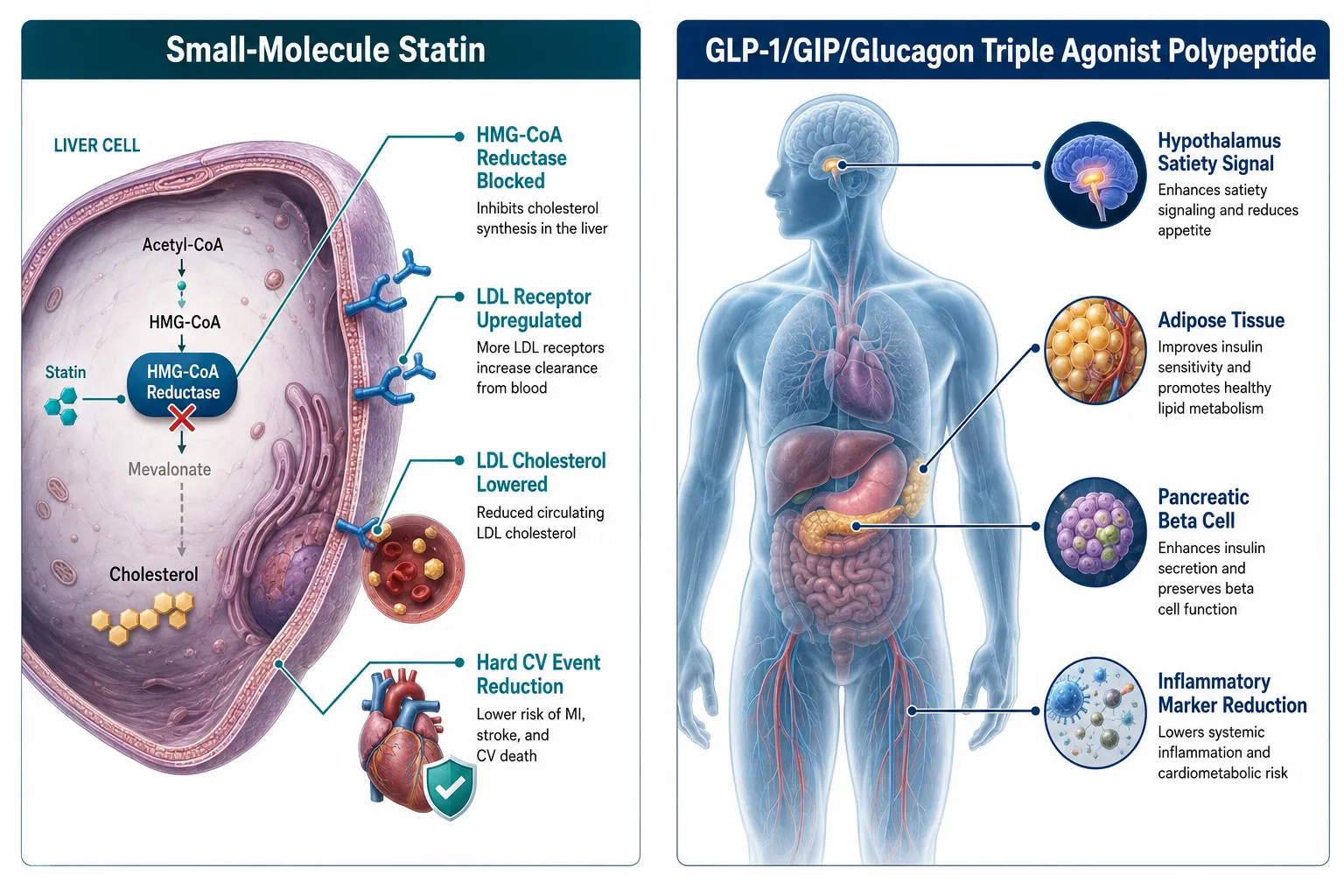
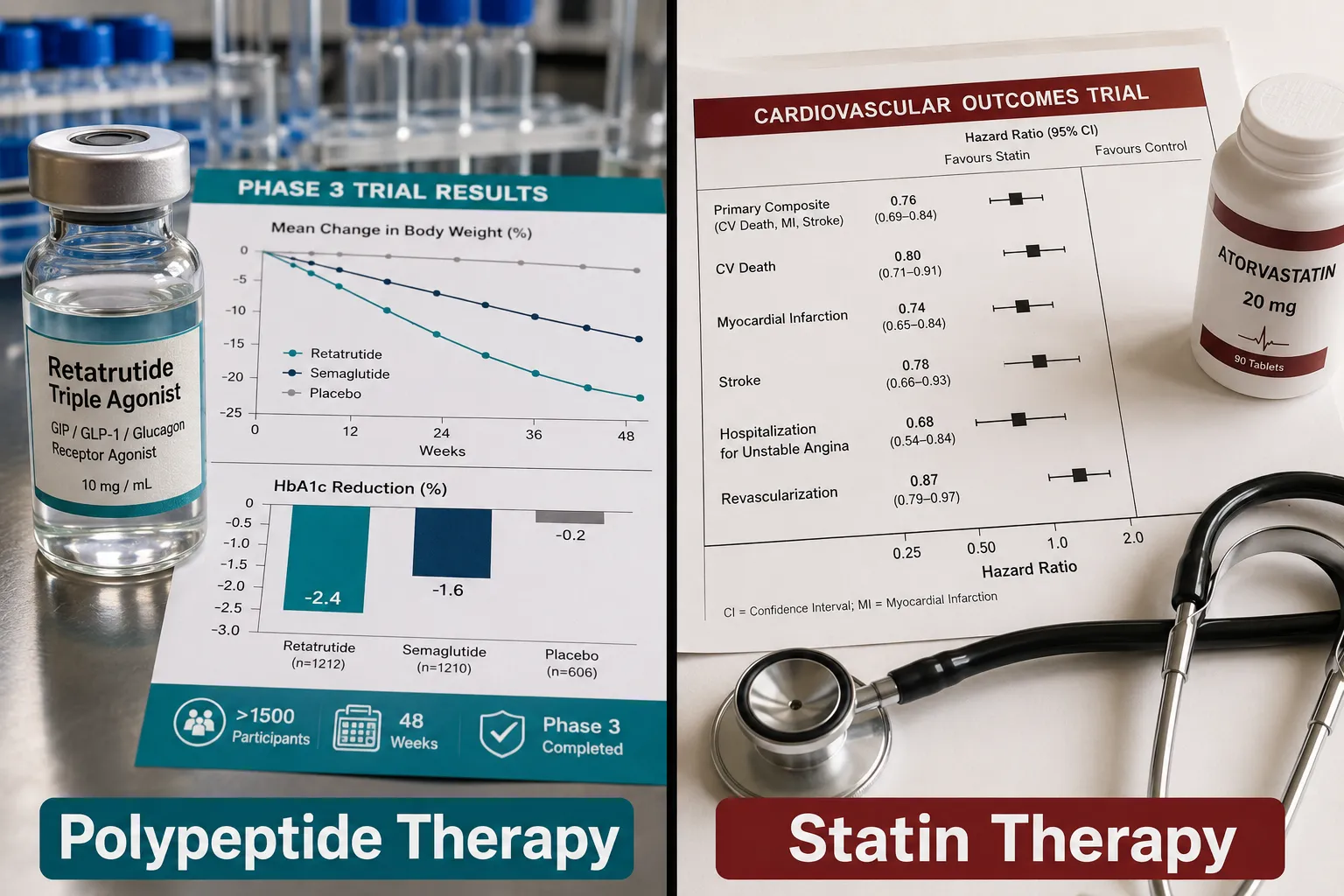
The clearest way to understand peptides and polypeptides in cardiometabolic research is to start with mechanism. Atorvastatin is a small molecule, it diffuses into hepatocytes and competitively inhibits HMG-CoA reductase, the rate-limiting enzyme in cholesterol synthesis. The liver responds by upregulating LDL receptors, pulling LDL particles out of circulation. The result is a focused, well-quantified reduction in a single atherogenic driver. Extended follow-up of atorvastatin trials shows a hazard ratio of 0.81 for nonfatal myocardial infarction plus fatal coronary heart disease, 0.88 for total coronary events, and 0.86 for cardiovascular mortality versus placebo. These are hard endpoints, not surrogate markers.

Retatrutide works at an entirely different level of biological complexity. As a polypeptide agonist, it simultaneously activates three hormone receptors:

  • GLP-1 receptor, suppresses appetite, slows gastric emptying, improves insulin secretion
  • GIP receptor, enhances insulin sensitivity and modulates fat storage
  • Glucagon receptor, drives hepatic fat oxidation and energy expenditure

This triple-receptor engagement produces a cascade of downstream effects that no small molecule currently replicates. Researchers exploring the broader GLP-3, GLP-1, and GLP-2 peptide family will recognize that incretin-class polypeptides are structurally and functionally distinct from statins at every level of analysis.

Key distinction: Atorvastatin answers the question "How do we lower LDL and prevent myocardial infarction?" Retatrutide answers the question "How do we simultaneously reduce body weight, improve glycemia, and shift multiple cardiometabolic risk factors in obesity?"

What Phase 3 Retatrutide Data Reveal in 2026
What Phase 3 Retatrutide Data Reveal in 2026

The TRIUMPH phase 3 program has produced some of the most discussed cardiometabolic data of 2026. In an 80-week trial in adults with type 2 diabetes and obesity or overweight, the highest retatrutide dose delivered approximately 20.8% body-weight loss and a 1.6-point HbA1c reduction. Separate 40-week data from the TRANSCEND-T2D program showed roughly a 1.9-percentage-point HbA1c reduction versus 0.8 points with placebo, alongside 15.3% body-weight loss versus 2.6% with placebo.

Beyond weight and glycemia, post-hoc analysis of two phase 2 trials documented striking changes in atherogenic lipoproteins and inflammatory markers:

Biomarker Change with Retatrutide
Non-HDL cholesterol (no diabetes) Down ~26.9%
Apolipoprotein B Down ~21-24%
Large triglyceride-rich particles Down ~76-84%
Small LDL particles Down ~32%
High-sensitivity CRP Down ~54.8%
Interleukin-6 Down ~29.6%

These numbers explain why researchers sourcing GLP-3 triple agonist research compounds are designing multi-endpoint protocols rather than single-biomarker studies.

However, one critical caveat applies. Safety data presented in June 2026 identified seven arrhythmia events and three major cardiovascular complications among 403 retatrutide participants, compared with none in the placebo group. Formal cardiovascular outcomes trials are underway, but the evidence base as of mid-2026 remains dominated by surrogate endpoints. Researchers following hormone research protocols should account for this distinction when designing study endpoints.

How Peptide and Statin Research Protocols Complement Each Other
How Peptide and Statin Research Protocols Complement Each Other

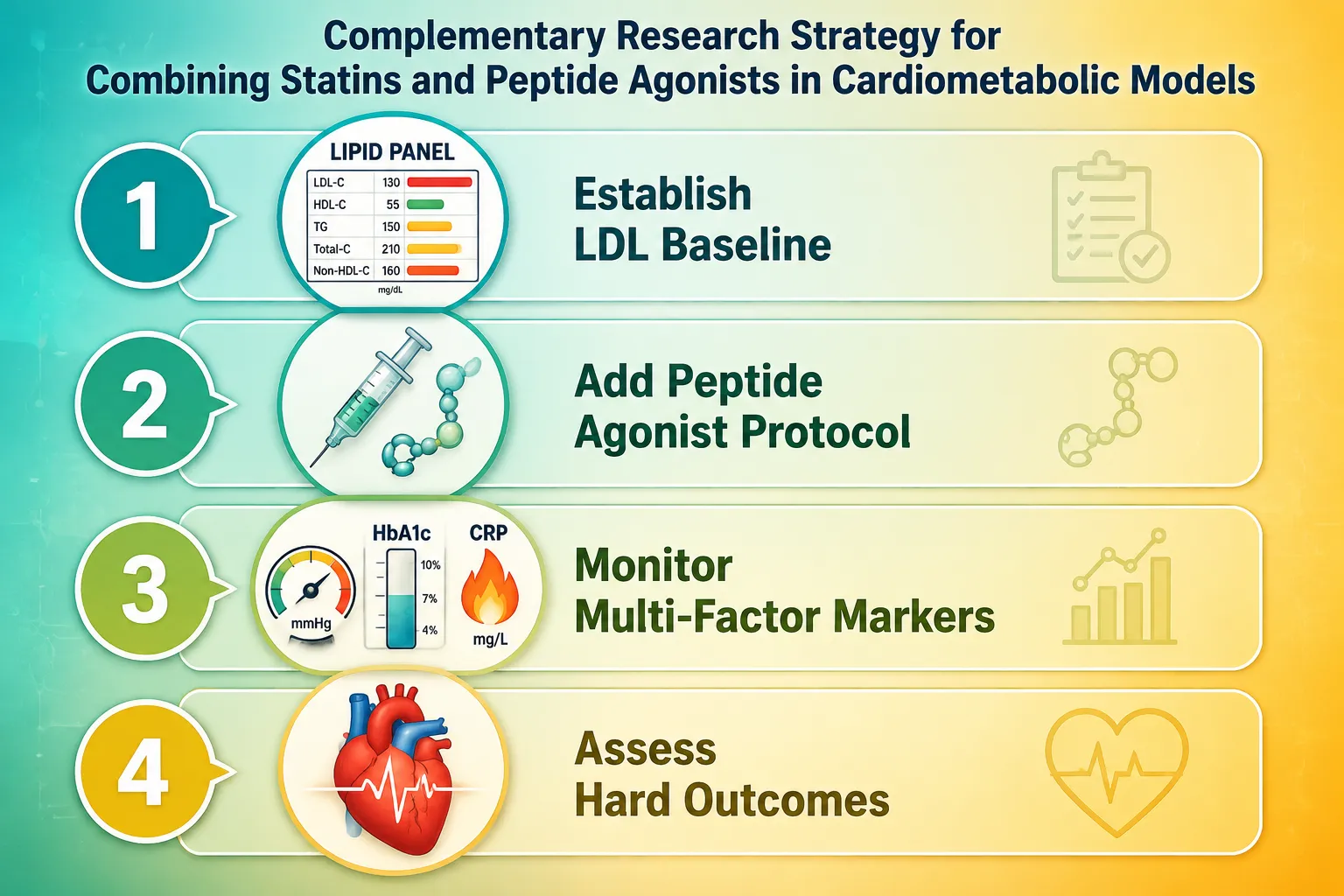
The practical implication for cardiometabolic researchers is that these two compound classes are additive, not interchangeable. A well-designed protocol might use atorvastatin as the LDL-lowering backbone, where decades of outcomes data provide a reliable comparator, while layering a polypeptide agonist like retatrutide to interrogate weight-dependent, inflammation-dependent, and glycemia-dependent pathways simultaneously.

Three research design principles follow from this:

  1. Define the primary endpoint clearly. If the question is "Does this intervention reduce hard cardiovascular events?", atorvastatin-class data remain the gold standard comparator. If the question involves weight loss, metabolic syndrome reversal, or multi-factor risk reduction, polypeptide agonists open new model territory.

  2. Use purity-verified compounds. Both small-molecule and peptide research depends on compound integrity. Resources on peptide COA verification and high purity peptide sourcing are essential starting points before any protocol is finalized.

  3. Track complementary biomarker panels. Retatrutide's lipid effects (non-HDL, ApoB, triglycerides) overlap with but do not duplicate statin effects (LDL-C, coronary event risk). Running both panels in parallel captures the full mechanistic picture.

Researchers working on metabolic comorbidities, particularly sarcopenia alongside obesity, may also find value in reviewing sarcopenia research resources, since muscle-mass preservation is an emerging consideration in aggressive weight-loss peptide protocols.

For those building broader incretin-focused models, GLP-1 peptide research compounds provide a useful baseline comparator against the triple-agonist profile of retatrutide.

Conclusion

Peptides and polypeptides in cardiometabolic research occupy a mechanistic space that small-molecule statins were never designed to fill, and the reverse is equally true. Atorvastatin remains the benchmark for durable LDL reduction and hard cardiovascular event prevention. Retatrutide, as a polypeptide triple agonist, is redefining what simultaneous weight loss, glycemic control, and multi-factor risk reduction can look like in a single compound. The TRIUMPH phase 3 data of 2026 make the case for retatrutide's surrogate-marker efficacy compellingly; the hard outcomes question is the next frontier.

Actionable next steps for researchers:

  • Audit current protocols to identify whether the primary question is LDL-centric (statin-appropriate) or multi-factor metabolic (polypeptide-appropriate), then design accordingly.
  • Verify compound purity through COA documentation before initiating any peptide-based cardiometabolic model.
  • Monitor the TRIUMPH cardiovascular outcomes arm as data mature toward Lilly's anticipated regulatory submission around Q1 2027.
  • Consider combination protocols that use both compound classes to capture the full breadth of cardiometabolic biology.

The field is not moving away from statins. It is building a more complete picture around them, one polypeptide at a time.

Tags: atorvastatin, cardiometabolic research, glp-1 receptor agonist, hba1c reduction, lipid biomarkers, peptides and polypeptides, retatrutide, triple agonist peptide
https://www.puretestedpeptides.com/wp-content/uploads/2026/08/peptides-and-polypeptides-in-cardiometabolic-research-how-atorvastatin-and-glp-3.webp 1024 1536 https://www.puretestedpeptides.com/wp-content/uploads/2026/01/buy-peptides-online.jpg 2026-08-25 13:05:402026-08-25 13:05:40Peptides and Polypeptides in Cardiometabolic Research: How Atorvastatin and GLP-3 Retatrutide Answer Different Questions
You might also like
Peptides and Polypeptides: Complete Research Guide for GLP-1, GLP-2, GLP-3, and Growth Hormone Peptides Peptides and Polypeptides: Complete Research Guide for GLP-1, GLP-2, GLP-3, and Growth Hormone Peptides
GLP‑3 Retatrutide in Phase 3 Trials: How Triple Agonism Is Reshaping Obesity and MASLD Research Endpoints GLP‑3 Retatrutide in Phase 3 Trials: How Triple Agonism Is Reshaping Obesity and MASLD Research Endpoints
Retatrutide Phase 3 Results: What the New GLP-3 Data Mean for Obesity and Diabetes Research Retatrutide Phase 3 Results: What the New GLP-3 Data Mean for Obesity and Diabetes Research
Triple Agonist Therapies Beyond GLP‑3: What Retatrutide’s Success Means for Future Multi-Target Peptide Design Triple Agonist Therapies Beyond GLP‑3: What Retatrutide’s Success Means for Future Multi-Target Peptide Design
Retatrutide (GLP-3) Peptide: Triple GLP Receptor Agonist Mechanism and Research Applications Retatrutide (GLP-3) Peptide: Triple GLP Receptor Agonist Mechanism and Research Applications
GLP-3 Retatrutide: Exploring the Mechanism of Action and Research Potential Beyond GLP-1 and GLP-2 GLP-3 Retatrutide: Exploring the Mechanism of Action and Research Potential Beyond GLP-1 and GLP-2
Peptides and Polypeptides in Modern Research: How Molecular Size Shapes Function, Stability, and Experimental Design Peptides and Polypeptides in Modern Research: How Molecular Size Shapes Function, Stability, and Experimental Design
Peptides and Polypeptides Explained: Connecting DNA, Mitochondria, and Modern Research-Use Compounds Like MOTS-c and 5-Amino-1MQ Peptides and Polypeptides Explained: Connecting DNA, Mitochondria, and Modern Research-Use Compounds Like MOTS-c and 5-Amino-1MQ
0 replies

Leave a Reply

Want to join the discussion?
Feel free to contribute!

Leave a Reply Cancel reply

Your email address will not be published. Required fields are marked *

×

Helpful Links

  • My account
  • Cart
  • Checkout
  • Refund and Returns Policy
  • Privacy Policy
  • SMS Privacy Policy
  • Login
  • My Account
  • Logout

USA Made Lab Tested Peptides

All products are sold for research, laboratory, or analytical purposes only, and are not for human consumption


Pure Tested Peptides is a chemical supplier. Pure Tested Peptides is not a compounding / chemical compounding facility as defined under 503A of the Federal Food, Drug, and Cosmetic act. Pure Tested Peptides is not an outsourcing facility as defined under 503B of the Federal Food, Drug, and Cosmetic act.

The statements made within this website have not been evaluated by the US Food and Drug Administration. The products we offer are not intended to diagnose, treat, cure or prevent any disease.

Human/Animal Consumption Prohibited. Laboratory/In-Vitro Experimental Use Only

Link to: Mitochondria, Adenosine Triphosphate, and Peptide Signaling: Where MOTS-c and 5-Amino-1MQ Fit in Cellular Energy Research Link to: Mitochondria, Adenosine Triphosphate, and Peptide Signaling: Where MOTS-c and 5-Amino-1MQ Fit in Cellular Energy Research Mitochondria, Adenosine Triphosphate, and Peptide Signaling: Where MOTS-c and...Mitochondria, Adenosine Triphosphate, and Peptide Signaling: Where MOTS-c and 5-Amino-1MQ Fit in Cellular Energy Research
Scroll to top Scroll to top Scroll to top