

Mesenchymal Stem Cells, BPC-157, and GHK-Cu: How Regenerative Peptides Complement Classic Collagen and Collagen Supplements
Collagen accounts for roughly 30% of total body protein, yet the body's ability to synthesize and organize it declines measurably after age 25. That single biological fact has driven decades of collagen supplementation research, and now it sits at the center of a much larger conversation. The emerging science of Mesenchymal Stem Cells, BPC-157, and GHK-Cu: How Regenerative Peptides Complement Classic Collagen and Collagen Supplements reveals that traditional collagen support is only one layer of a far more complex regenerative system. Newer peptide-based approaches work upstream, at the level of fibroblasts, extracellular matrix (ECM) signaling, and cellular secretomes, offering mechanisms that collagen supplements alone cannot replicate.
Key Takeaways
- Mesenchymal stem cell (MSC) exosomes act upstream of collagen synthesis, signaling fibroblasts and remodeling the ECM before any collagen molecule is deposited.
- GHK-Cu carries the strongest human clinical evidence among regenerative skin peptides and directly stimulates fibroblast collagen production.
- BPC-157 remains a research-only compound with minimal human data and tightening regulatory status as of 2026.
- Collagen supplements provide the amino acid substrate that makes MSC and peptide-driven synthesis more effective, the relationship is synergistic, not competitive.
- Sourcing purity and proper handling are critical for any peptide used in research contexts.
How Mesenchymal Stem Cells Interact With the Extracellular Matrix
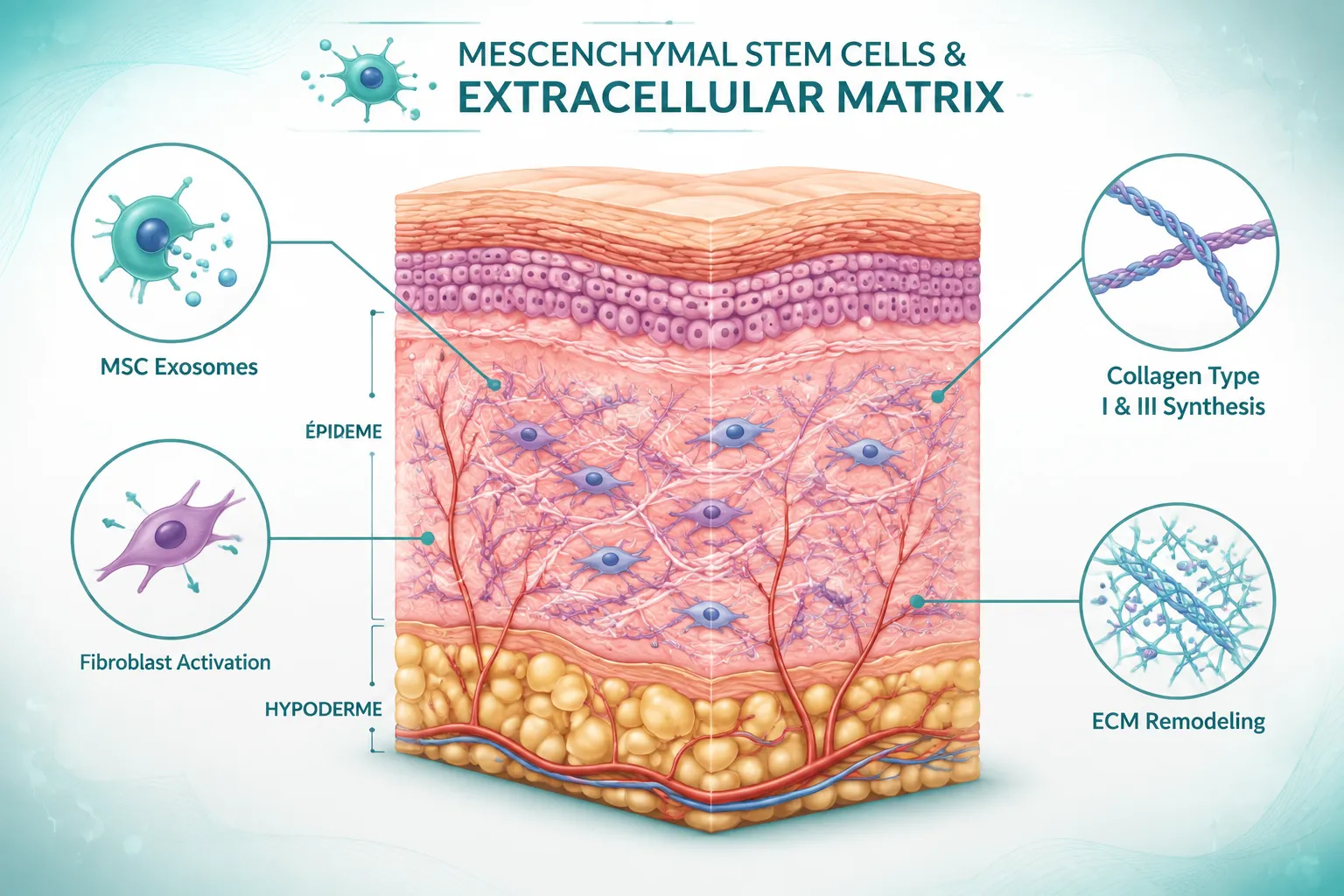
Mesenchymal stem cells do not build collagen directly. Instead, they operate as master coordinators of the regenerative environment. Their exosomes, tiny membrane-bound vesicles released into surrounding tissue, carry growth factors, microRNAs, and signaling proteins that instruct resident fibroblasts to upregulate collagen synthesis. Research into MSC secretomes has confirmed that this paracrine signaling can increase production of collagen Type I and Type III, two of the most structurally important forms in skin and connective tissue.
What makes MSC activity particularly relevant to the broader topic of Mesenchymal Stem Cells, BPC-157, and GHK-Cu is the upstream nature of that signaling. Rather than supplying collagen directly, MSC exosomes prime the cellular machinery that produces it. Studies examining scalp skin rejuvenation have shown that MSC-derived exosomes can restore fibroblast activity in aged tissue, effectively resetting the ECM environment to a more youthful functional state.
The collagen connection is direct: when collagen supplementation provides abundant hydroxyproline and glycine precursors, fibroblasts already activated by MSC signals have the raw material needed to accelerate matrix production. This is why researchers increasingly describe collagen supplements as a potentiating substrate for MSC-based therapies rather than a competing approach.
"MSC therapies act upstream of collagen supplements, they set the stage; supplements supply the building blocks."
For researchers working with peptide compounds, research peptide handling protocols are essential to preserving the biological activity of any signaling molecule used alongside these pathways.
GHK-Cu and BPC-157: Comparing Two Regenerative Peptides
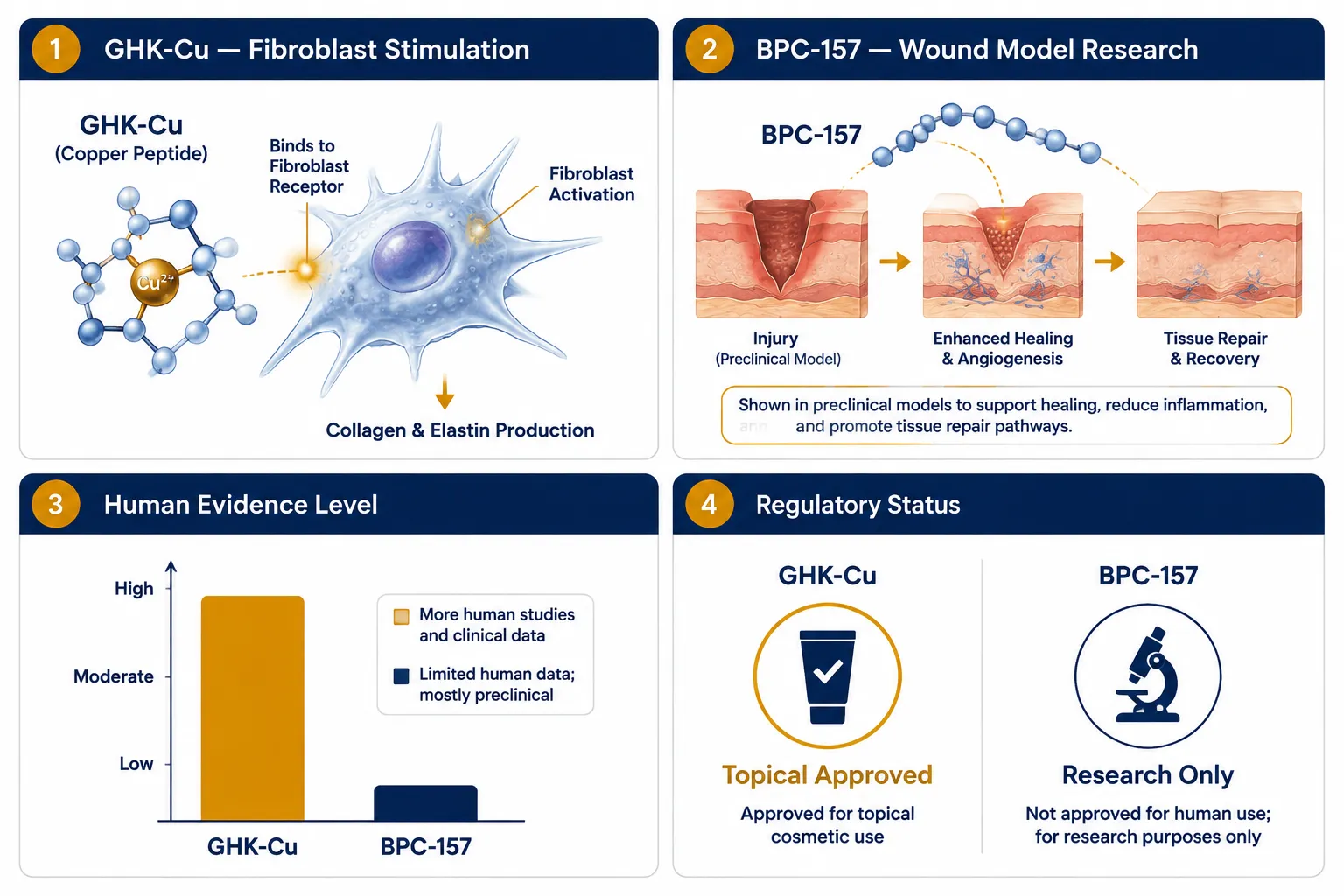
Among the peptides most frequently discussed alongside MSC therapies, GHK-Cu and BPC-157 represent very different profiles of evidence, mechanism, and regulatory standing.
GHK-Cu: The Strongest Human Evidence
GHK-Cu (copper tripeptide-1) is a naturally occurring peptide found in human plasma, saliva, and urine. Its mechanism of action is well-characterized: it binds copper ions and delivers them to fibroblasts, directly stimulating collagen, elastin, and glycosaminoglycan synthesis. It also activates matrix metalloproteinase (MMP) systems that clear damaged ECM components, making room for newly synthesized matrix proteins.
As of 2026, GHK-Cu holds the strongest human clinical evidence among regenerative skin peptides. Multiple controlled trials have documented measurable improvements in skin density, fine lines, and wound healing. Topical formulations are widely available and legally sold in cosmetic products.
Key GHK-Cu properties:
- Directly stimulates fibroblast collagen synthesis
- Activates ECM remodeling enzymes
- Antioxidant and anti-inflammatory secondary effects
- Strong topical delivery data; formulation challenges remain for systemic use
- Legally available in cosmetic and research contexts
BPC-157: Research-Only Status
BPC-157 (Body Protection Compound-157) is a synthetic pentadecapeptide derived from a gastric protein. Preclinical wound-healing models, primarily in rodents, have shown promising effects on tendon repair, gut lining integrity, and angiogenesis. However, human clinical trial data remains extremely limited.
Critically, BPC-157's regulatory status tightened significantly in late 2025 and into 2026. The FDA moved to restrict its use in compounded medications, classifying it as a substance that raises significant safety concerns due to insufficient human data. As of 2026, BPC-157 is considered a research-only compound in the United States, and its long-term risk profile in humans remains unknown.
| Feature | GHK-Cu | BPC-157 |
|---|---|---|
| Human clinical trials | Multiple controlled studies | Minimal |
| Mechanism established | Yes, fibroblast/ECM | Preclinical models only |
| Regulatory status (2026) | Cosmetic/topical approved | Research-only, FDA restricted |
| Long-term human safety | Well-characterized | Unknown |
Researchers sourcing either compound should prioritize high purity peptide sourcing to ensure experimental integrity and minimize confounding variables.
The Synergy Stack: Collagen Supplements, Peptides, and MSC Pathways
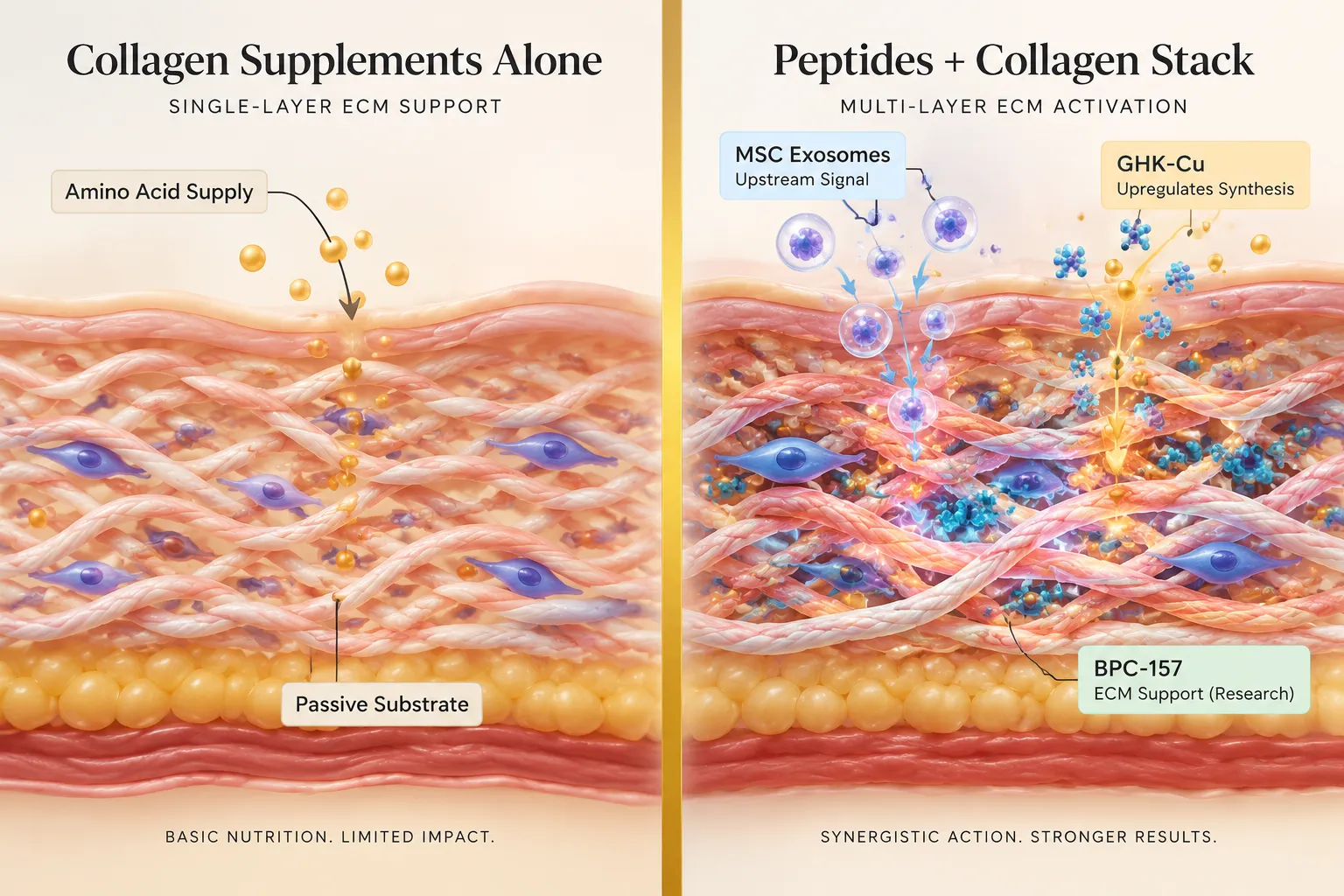
Understanding Mesenchymal Stem Cells, BPC-157, and GHK-Cu: How Regenerative Peptides Complement Classic Collagen and Collagen Supplements requires viewing each modality as part of a layered system rather than a standalone intervention.
The layered regenerative model works as follows:
- MSC exosomes signal fibroblasts to enter an active collagen-producing state and clear damaged ECM.
- GHK-Cu amplifies fibroblast collagen synthesis and facilitates ECM remodeling at the molecular level.
- Collagen supplements supply the amino acid precursors (glycine, proline, hydroxyproline) that fibroblasts need to execute that synthesis efficiently.
- BPC-157 (in research contexts only) may support angiogenesis and tissue repair in wound models, potentially improving nutrient delivery to active repair sites.
Classic hydrolyzed collagen supplements on their own are passive, they provide substrate but do not activate the cellular machinery. Peptides like GHK-Cu and, in controlled research settings, BPC-157, act on the signaling layer. MSC therapies operate at the most upstream level of all, resetting the cellular environment itself.
For researchers exploring adjacent peptide families and their interactions with metabolic and regenerative pathways, resources like the GLP-3, GLP-1, and GLP-2 researcher's guide provide useful comparative context on how peptide families modulate different biological systems. Similarly, understanding growth hormone-related peptides such as those covered in tesa peptide benefits illustrates how upstream hormonal signaling intersects with tissue remodeling.
Those working with oral delivery formats should also review oral peptides for sale considerations, as bioavailability and stability differ substantially from injectable or topical formats when studying peptide-ECM interactions.
Conclusion
The science of regenerative peptides has moved well beyond a simple choice between collagen supplements and newer compounds. The integrated picture, where MSC exosomes prime the cellular environment, GHK-Cu drives fibroblast collagen production, and collagen supplements provide the structural substrate, represents a genuinely synergistic model supported by growing translational evidence.
Actionable next steps for researchers and informed readers:
- Prioritize GHK-Cu for any human-applicable collagen-support protocol given its established safety and clinical evidence base.
- Treat BPC-157 strictly as a research compound; do not use it in human applications given current FDA restrictions and absent long-term safety data.
- Consider collagen supplementation as a foundational layer that enhances the effectiveness of upstream peptide and MSC interventions.
- Ensure all peptide compounds used in research are sourced from verified, high-purity suppliers and handled according to established protocols.
- Stay current with regulatory updates, as the compounding and research status of several peptides continues to evolve rapidly in 2026.
The future of connective tissue and skin regeneration research will almost certainly involve combinations of these approaches, not any single compound in isolation.


Leave a Reply
Want to join the discussion?Feel free to contribute!