Call or Text 727-513-9780
  • Shopping Cart Shopping Cart
    0Shopping Cart
Pure Tested Peptides | America's most trusted Peptides for sale online
  • Peptides for sale
    • Oral Peptides for sale
      • Peptide Capsules for sale
      • BPC 157 Capsules 1000mcg
      • SLU-PP-332 Capsules | 1000 mcg
      • 5-Amino-1MQ 50mg Capsules
      • Tesofensine 500mcg
    • All Peptides for sale
    • Peptide Sprays
      • BPC 157 Nasal Spray Kit
      • BPC-157 TB500 Nasal Spray Kit
      • Semax Nasal Spray 10mg
      • Selank – Nasal Spray Kit – 10mg
      • Epithalon 50MG Nasal Spray Kit
      • Ipamorelin 10mg Nasal Spray
      • Klow Nasal Spray (BPC-157 + TB-500 + GHK-Cu + KPV) | 80mg
      • Hulk Nasal Spray Tesa / Ipa Blend 6/3 MG
      • Klow Nasal Spray
      • NAD + 500 mg Nasal Spray
      • PT-141 Nasal Spray Kit
    • GHRH Peptides
      • Ipa Peptides
      • CJC-1295 Peptides
        • CJC-1295 with DAC 5 mg
        • CJC-1295 without DAC 5 mg
        • CJC-1295 Ipa 10mg
      • Tesa Peptides
        • Tesa Peptide
        • Tesa 20 mg
    • GHK-Cu Peptides
      • All GHK-Cu Peptides
      • GHK-Cu 100mg
      • KLOW Peptide Blend – Buy KLOW blend online
    • BPC Peptides
      • All BPC Peptides
      • BPC-157
      • BPC-157 TB-500
      • BPC 157 capsules 1000mcg
    • SLU-PP-332 Peptides
      • All SLU-PP-332 Peptides
      • SLU-PP-332 5mg
    • GLP3 Peptides
    • PT-141 Peptides
      • PT-141 Peptides for sale
      • PT-141 10mg
      • PT-141 Nasal Spray
    • CAG Peptides
      • Lipo-C Peptide Blend
      • CAG 5mg
      • CAG 10mg
    • MOTS-C Peptides
      • MOTS-C Peptides for sale
      • MOTS-c peptide
      • MOTS-c 10mg *6 pack*
    • 5 Amino 1MQ Peptides
      • 5 Amino 1MQ Peptides for sale
      • 5-Amino-1MQ 50mg Capsules
      • 5-Amino-1MQ 5mg
    • Epithalon Peptides
      • Epithalon Peptides for sale
      • Epithalon 10mg
      • Epithalon 50mg
  • Shop
    • GLPs
      • 5-Amino-1MQ 50mg Capsules
      • 5-Amino-1MQ 5mg
      • L-Carnitine 500mg/ml
      • Tesofensine 500mcg
      • SLU-PP-332 5mg
      • MOTS-c 10mg *6 pack*
    • Epithalon & BPC Peptides
      • Epithalon 10mg
      • Epithalon 50mg
      • BPC-157
      • BPC 157 capsules 1000mcg
      • BPC-157 TB-500
      • BPC-157 TB500 Nasal Spray Kit
      • BPC 157 Nasal Spray Kit
    • BPC TB-500 & NAD+ Peptides
      • NAD+ 500 mg
      • KLOW Peptide Blend – Buy KLOW blend online
      • GLOW Peptide Blend
      • TB 500 5mg
      • BPC 157 capsules 1000mcg – Supplement
      • BPC 157 Nasal Spray Kit
      • BPC-157
      • BPC-157 TB500 Nasal Spray Kit
      • BPC-157 TB-500
      • BPC 157 capsules 1000mcg
    • LL-37 Peptide
      • LL-37 10 mg
    • MOTS-C & Selank
      • MOTS-c peptide
      • Selank 10mg
    • GHK Peptides
      • GHK-Cu 100mg
      • GLOW Peptide Blend
      • KLOW Peptide Blend – Buy KLOW blend online
  • COAs
  • Wholesale
    • Wholesale Peptides for sale
  • PTP FAQ
  • Affiliates
    • Selank Peptide: Advanced Pharmacological Mechanisms Underlying Its Anxiolytic and Nootropic Effects in Research
      • 5-Amino-1MQ Peptide: Detailed Mechanisms of NNMT Inhibition and Its Impact on Cellular Metabolism Research
        • MOTS-C Peptide: Unraveling Its Role in Mitochondrial Dynamics and Energy Metabolism Research
          • Epithalon Peptide and Telomerase Regulation: Investigating Its Impact on Cellular Senescence and Lifespan Research Models
            • GLP2-T vs GLP2 Tirz Peptide: Understanding the Naming, Mechanistic Nuances, and Research Implications for Gut Health
      • Peptides and Polypeptides in Modern Pharmacology: What Research on Metoprolol, Prednisone, and Amlodipine Reveals
        • Polypeptide Peptides vs NSAIDs: What Naproxen and Diclofenac Teach Tissue-Repair Researchers About BPC‑157 and TB‑500
          • Peptides and Polypeptides in Endocrine Pharmacology: How GLP-1, GLP-2, and GLP-3 Retatrutide Differ From Classic Drugs Like Prednisone and Amlodipine
          • 5‑Amino‑1MQ Peptide and NNMT Inhibition: How It Compares With Statins Like Atorvastatin in Adipose and Lipid Metabolism Research
      • Enclomiphene, Estrogen Receptor Signaling, and Luteinizing Phase Biology: What Hormone Researchers Should Measure
        • Mesenchymal Stem Cells, BPC‑157, and GHK‑Cu: How Tissue Repair Peptides Compare With Classic NSAIDs Like Naproxen in Injury Models
          • Peptide Calculator Use Cases Beyond Growth Hormone: Working Through GLP‑3 Retatrutide, MOTS‑c, and BPC‑157 Research Dosing
        • Polypeptide Peptides in Endocrine and Metabolic Pharmacology: Lessons From Amlodipine, Prednisone, and Metoprolol
        • Peptides Calculator for Advanced Blends: Worked Examples for Tesamorelin, CJC‑1295, and Ipamorelin Stacks
          • Peptides and Polypeptides in Human Physiology: How Molecular Size Shapes Research Applications
            • Selank Peptide: Advanced Pharmacological Mechanisms Underlying Its Anxiolytic and Nootropic Effects in Research
          • 5-Amino-1MQ Peptide: Detailed Mechanisms of NNMT Inhibition and Its Impact on Cellular Metabolism Research
            • MOTS-C Peptide: Unraveling Its Role in Mitochondrial Dynamics and Energy Metabolism Research
              • Epithalon Peptide and Telomerase Regulation: Investigating Its Impact on Cellular Senescence and Lifespan Research Models
                • GLP2-T vs GLP2 Tirz Peptide: Understanding the Naming, Mechanistic Nuances, and Research Implications for Gut Health
                  • Peptides and Polypeptides in Endocrine Pharmacology: How GLP-1, GLP-2, and GLP-3 Retatrutide Differ From Classic Drugs Like Prednisone and Amlodipine
                    • Polypeptide Peptides vs NSAIDs: What Naproxen and Diclofenac Teach Tissue-Repair Researchers About BPC‑157 and TB‑500
                      • Peptides and Polypeptides in Modern Pharmacology: What Research on Metoprolol, Prednisone, and Amlodipine Reveals
                        • 5‑Amino‑1MQ Peptide and NNMT Inhibition: How It Compares With Statins Like Atorvastatin in Adipose and Lipid Metabolism Research
                        • Enclomiphene, Estrogen Receptor Signaling, and Luteinizing Phase Biology: What Hormone Researchers Should Measure
                        • Mesenchymal Stem Cells, BPC‑157, and GHK‑Cu: How Tissue Repair Peptides Compare With Classic NSAIDs Like Naproxen in Injury Models
                        • Peptide Calculator Use Cases Beyond Growth Hormone: Working Through GLP‑3 Retatrutide, MOTS‑c, and BPC‑157 Research Dosing
                        • Polypeptide Peptides in Endocrine and Metabolic Pharmacology: Lessons From Amlodipine, Prednisone, and Metoprolol
                        • Peptides Calculator for Advanced Blends: Worked Examples for Tesamorelin, CJC‑1295, and Ipamorelin Stacks
                        • Peptides and Polypeptides in Human Physiology: How Molecular Size Shapes Research Applications
                        • Selank Peptide: Advanced Pharmacological Mechanisms Underlying Its Anxiolytic and Nootropic Effects in Research
                        • MOTS-C Peptide: Unraveling Its Role in Mitochondrial Dynamics and Energy Metabolism Research
                        • Peptides and Polypeptides in Modern Pharmacology: What Research on Metoprolol, Prednisone, and Amlodipine Reveals
                        • Peptides and Polypeptides in Endocrine Pharmacology: How GLP-1, GLP-2, and GLP-3 Retatrutide Differ From Classic Drugs Like Prednisone and Amlodipine
                        • 5-Amino-1MQ Peptide: Detailed Mechanisms of NNMT Inhibition and Its Impact on Cellular Metabolism Research
                        • Mesenchymal Stem Cells, BPC‑157, and GHK‑Cu: How Tissue Repair Peptides Compare With Classic NSAIDs Like Naproxen in Injury Models
                        • Peptide Calculator Use Cases Beyond Growth Hormone: Working Through GLP‑3 Retatrutide, MOTS‑c, and BPC‑157 Research Dosing
                        • GLP2-T vs GLP2 Tirz Peptide: Understanding the Naming, Mechanistic Nuances, and Research Implications for Gut Health
                        • Polypeptide Peptides in Endocrine and Metabolic Pharmacology: Lessons From Amlodipine, Prednisone, and Metoprolol
                        • Polypeptide Peptides vs NSAIDs: What Naproxen and Diclofenac Teach Tissue-Repair Researchers About BPC‑157 and TB‑500
                        • Peptides and Polypeptides in Human Physiology: How Molecular Size Shapes Research Applications
                        • Peptides Calculator for Advanced Blends: Worked Examples for Tesamorelin, CJC‑1295, and Ipamorelin Stacks
                        • 5‑Amino‑1MQ Peptide and NNMT Inhibition: How It Compares With Statins Like Atorvastatin in Adipose and Lipid Metabolism Research
                        • Enclomiphene, Estrogen Receptor Signaling, and Luteinizing Phase Biology: What Hormone Researchers Should Measure
                        • Epithalon Peptide and Telomerase Regulation: Investigating Its Impact on Cellular Senescence and Lifespan Research Models
                        • Best research protocol Klow blend
                        • best time to take BPC-157
                        • best time to take DSIP (Delta Sleep Inducing Peptide)
                        • best time to take CJC-1295
                        • best time to take AOD-9604
                        • best time to take Follistatin 344
                        • best time to take Ipamorelin
                        • best time to take MK-677 (Ibutamoren)
                        • best time to take Ligandrol (LGD-4033) — research compound
                        • best time to take Ostarine (MK-2866) — research compound
                        • best time to take GHK-CU
                        • best time to take TB-500
                        • best time to take MOTS-c
                        • best time to take Semax
                        • best time to take RAD-140 (Testolone) — research compound
                        • best time to take Thymosin Alpha-1
                        • best time to take PEG-MGF
                        • Biolife Plasma, Octapharma Plasma, and Research Peptides: How Plasma Donation Labs Differ From Peptide Suppliers
                        • best time to take YK-11 — research compound
                        • best time to take PT-141 (Bremelanotide)
                        • Best research protocol Klow blend
                        • 5-Amino-1MQ and MOTS-C Synergy: Metabolic Signaling, Mitochondria, and Research Design
                        • BPC-157 and TB-500: Investigating Their Combined Effects on Angiogenesis and Cellular Migration in Tissue Repair Models
                        • BPC-157 Peptide: Gut Barrier Function, Inflammation, and Tissue-Recovery Research
                        • 5‑Amino‑1MQ and MOTS‑c Synergy in Metabolic Research: Designing NNMT and Mitochondrial Biogenesis Stacks
                        • CJC-1295 with DAC vs. Without DAC: Half-Life, Release Kinetics, and Research Implications
                        • CJC‑1295 with DAC vs. Without DAC: Expanding on Half‑Life Differences Using Tesamorelin and Ipamorelin Blend Case Studies
                        • Collagen Biology and Copper‑Binding Peptides: How GHK‑Cu, Glow Blend, and Klow Blend Interact with Skin and Connective Tissue
                        • Collagen Biology and Regenerative Peptides: How GHK‑Cu, Glow Blend, and Klow Blend Affect Extracellular Matrix Research
                    • DNA, Telomeres, and Longevity Peptides: Positioning Epithalon and MOTS‑c in Genetic Aging Research
                      • Enclomiphene Citrate: serm Mechanism, Testosterone Research, and Stack Compatibility
                        • Enclomiphene vs Enclomiphene Citrate: Formulation, Bioavailability, and Research Distinctions
                        • Epithalon Peptide Research: Telomerase Activation, Aging, and Pineal Gland Function
                        • Estrogen Receptor Signaling and Enclomiphene: How Selective Modulators Compare with Classic Polypeptide Hormones
                        • GHK-Cu Peptide: Advanced Mechanisms in Extracellular Matrix Remodeling and Wound Healing Research
                        • GHK-Cu Peptide: Collagen Synthesis, Wound Repair, and Skin-Barrier Research Models
                        • GLP-1 vs GLP-3 vs GLP-2: Peptide Classification and Research Applications
                        • GLP-2 Peptide Research Guide: Gut Barrier Function, Nutrient Absorption, and Intestinal Recovery Models
                        • GLP-3 Retatrutide vs. GLP-1 Drugs: What Triple-Agonist Biology Changes in Research Models
                        • Ipamorelin and Tesamorelin Combination: Synergistic GH Secretagogue Research and Dosing Protocols
                        • GLP2 Tirz Peptide: What It Is, Why the Name Exists, and How Researchers Should Interpret It
                        • Klow Blend Peptide Nasal Spray: What the Formulation Is Trying to Do in Cognitive Research
                        • Mitochondria, NNMT Inhibition, and Peptide Modulators: Where MOTS‑c and 5‑Amino‑1MQ Fit in Cellular Energy Research
                        • MOTS-c Peptide: Mitochondrial Function, Energy Metabolism, and What Researchers Measure
                        • MOTS-c vs. 5-Amino-1MQ: Which Metabolic Research Questions Each Compound Actually Answers
                        • Nasal Spray Peptides: Bioavailability, Administration, and Semax/Selank Research Applications
                        • PT-141 Peptide Research: Mechanism of Action and Melanocortin Receptor Signaling
                        • Retatrutide for Research: Mechanism, Structure, and GLP-1/GLP-3 Dual Action
                        • Retatrutide for Obesity and Type 2 Diabetes: What the Latest Trial Data Suggest
                        • Tesofensine Peptide Research: Mechanism, Appetite Suppression, and Neuropeptide Y Pathways
  • Contact
    • Contact Customer Service
    • Text Customer Support
  • About US
  • Shop all peptides
  • Affiliate Program
    • Affiliate Signup
  • Login / Register Login / Register Page Link Login / Register Page Link
  • Click to open the search input field Click to open the search input field Search
  • Menu Menu
Where to Buy 5-Amino-1MQ and MOTS-c Research Materials: A COA, Identity, Purity, and Storage Checklist

Where to Buy 5-Amino-1MQ and MOTS-c Research Materials: A COA, Identity, Purity, and Storage Checklist

October 9, 2026/0 Comments/in Uncategorized/by

Fewer than one in five research-grade peptide lots on the market in 2026 carry a fully documented, batch-specific Certificate of Analysis that covers identity, purity method, residual solvents, and lot traceability simultaneously. For researchers sourcing 5-Amino-1MQ or MOTS-c, that gap is not a minor inconvenience, it is a direct threat to data integrity. This guide on where to buy 5-Amino-1MQ and MOTS-c research materials covers every documentation and storage checkpoint a researcher should verify before placing an order.

Key Takeaways

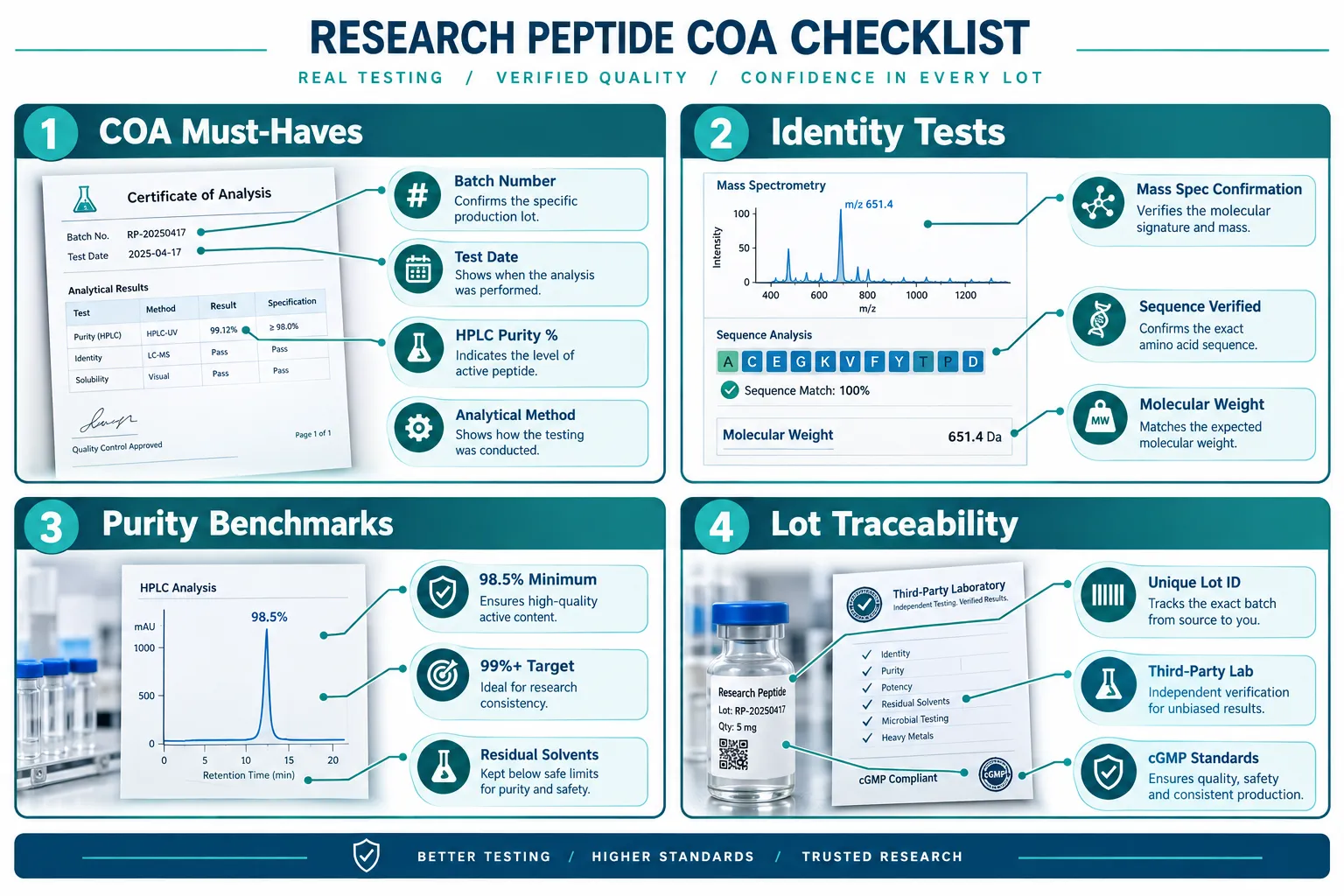
  • A legitimate COA must include batch number, test date, HPLC purity percentage, mass-spec identity confirmation, analytical method, and residual solvent data.
  • Current 2026 market standards for 5-Amino-1MQ set chromatographic purity at 98.5% minimum, with leading vendors reporting 99.15% to 99.90%.
  • Lyophilized 5-Amino-1MQ and MOTS-c should be stored at -20 °C or lower, desiccated and protected from light; reconstituted solutions are typically stable for no more than 30 days at 2-8 °C.
  • MOTS-c carries heightened regulatory scrutiny as a non-approved investigational peptide; sourcing from vendors with full documentation is non-negotiable.
  • Only vendors that supply lot-specific, third-party-verified COAs and clear storage labeling meet the minimum standard for serious research procurement.

What a Complete COA Must Contain: The Documentation Checklist
What a Complete COA Must Contain: The Documentation Checklist

The Certificate of Analysis is the single most important document in any research material procurement decision. A COA that lists only a purity number without identifying the analytical method, the lab that ran the test, or the specific lot being certified is functionally incomplete.

For a thorough introduction to how research peptides are classified and where compounds like 5-Amino-1MQ and MOTS-c fit structurally, the Peptides 101 for research-use only buyers guide provides useful foundational context.

Minimum COA checklist for 5-Amino-1MQ and MOTS-c:

COA Element What to Look For
Batch / Lot Number Unique alphanumeric ID traceable to a single production run
Test Date Specific date, not a vague range or model year
Purity Method Reversed-phase HPLC with stated column and conditions
Purity Result Numerical percentage, not just "high purity"
Identity Confirmation Mass spectrometry data matching expected molecular weight
Net Peptide Content Corrected for water and salt content
Water Content Karl Fischer or equivalent titration result
Residual Solvents Reported values for acetonitrile, TFA, or other process solvents
Third-Party Lab Name or accreditation number of the independent testing facility

"A COA without a named third-party lab and a specific test date is a marketing document, not an analytical record."

Leading vendors in 2026, including those supplying 5-Amino-1MQ at 99.35% purity with a traceable lot ID and a March 2026 test date, demonstrate that this level of documentation is achievable and should be expected as standard. Vendors operating under cGMP-comparable manufacturing standards and using accredited independent labs consistently meet or exceed 99% chromatographic purity on HPLC.


Storage Conditions: Lyophilized Powder vs. Reconstituted Solution
Storage Conditions: Lyophilized Powder vs. Reconstituted Solution

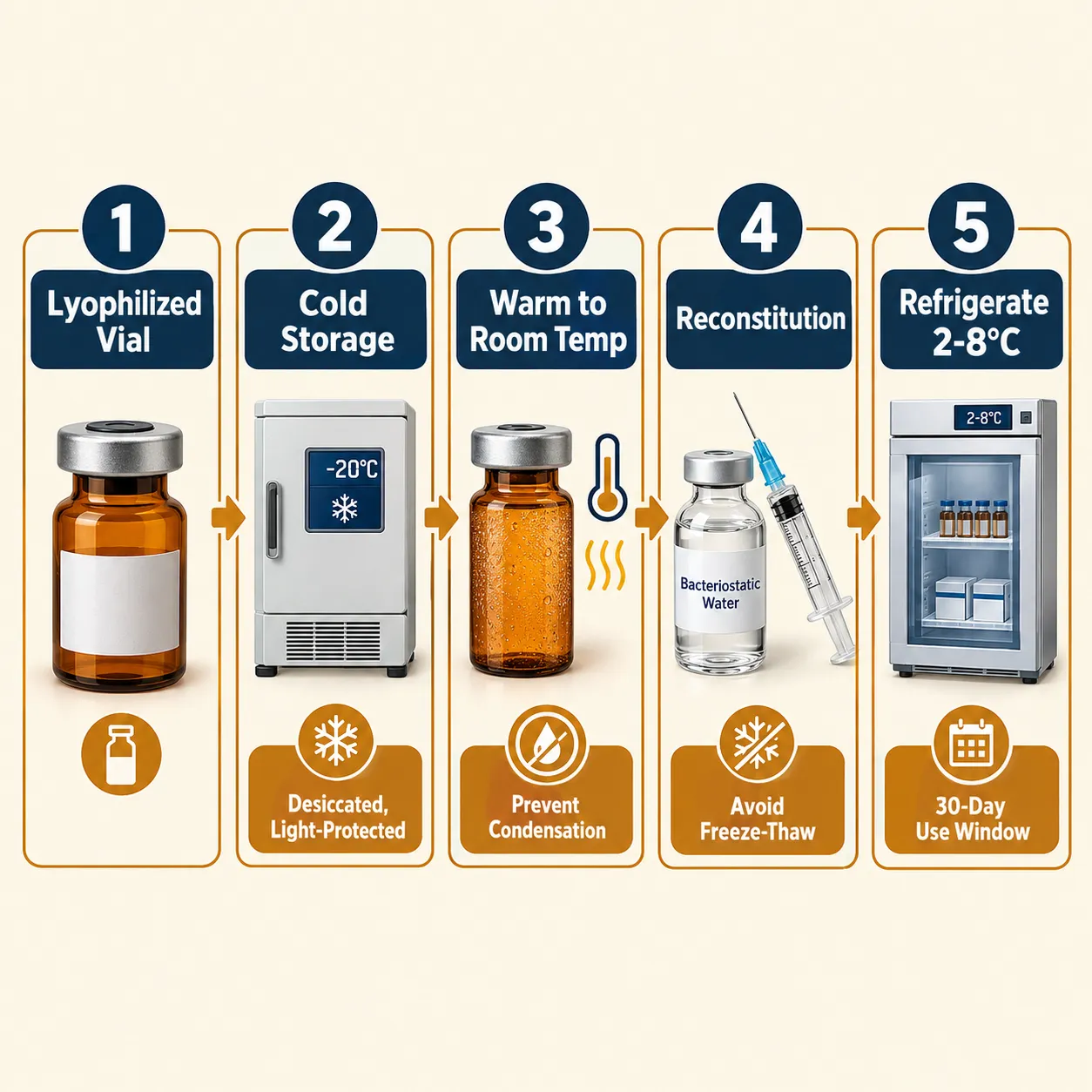
Storage requirements differ significantly depending on whether the material is still in lyophilized powder form or has been reconstituted. Conflating the two is one of the most common errors in peptide handling.

Lyophilized (dry powder) storage:

  • Store at -20 °C or lower, desiccated and protected from light
  • Sealed vials at -20 °C: powder stability of approximately 3 years
  • Sealed vials at 4 °C: powder stability of approximately 2 years
  • Room temperature (15 °C): stability drops to approximately 3 months
  • Always allow a sealed vial to warm to room temperature before opening to prevent moisture condensation from degrading the powder

Post-reconstitution storage:

  • Refrigerate at 2-8 °C immediately after reconstitution
  • Use within 30 days; do not rely on visual clarity as a stability indicator
  • Solutions stored at -20 °C are suitable for approximately 1 month
  • Solutions stored at -80 °C extend stability to approximately 6 months
  • Avoid repeated freeze-thaw cycles, which accelerate degradation

For MOTS-c specifically, an August 2026 FDA Pharmacy Compounding Advisory Committee briefing document confirms that lyophilized MOTS-c free base is stable at -20 °C when desiccated and protected from light, with reconstituted solution recommended at +4 °C for 2-7 days or below -18 °C for longer-term storage. The same document underscores that MOTS-c is not an approved drug and remains under active regulatory review.

One important exception: certain ready-to-use peptide formulations specify storage at 2-8 °C in the dark and explicitly instruct "do not freeze." These are formulation-specific requirements. Always check the lot-specific label and COA, not just general guidance, before storing any vial.

For researchers working with related mitochondrial compounds, the MOTS-c and elamipretide research overview and the SS-31 mitochondrial research themes page offer relevant comparative context.


Where to Buy 5-Amino-1MQ and MOTS-c Research Materials: Vendor Evaluation Framework
Where to Buy 5-Amino-1MQ and MOTS-c Research Materials: Vendor Evaluation Framework

Applying the COA and storage checklist above to current vendor offerings narrows the field considerably. The following framework answers the core question of where to buy 5-Amino-1MQ and MOTS-c research materials with documentation standards that support reproducible research.

5-Amino-1MQ vendor landscape (2026):

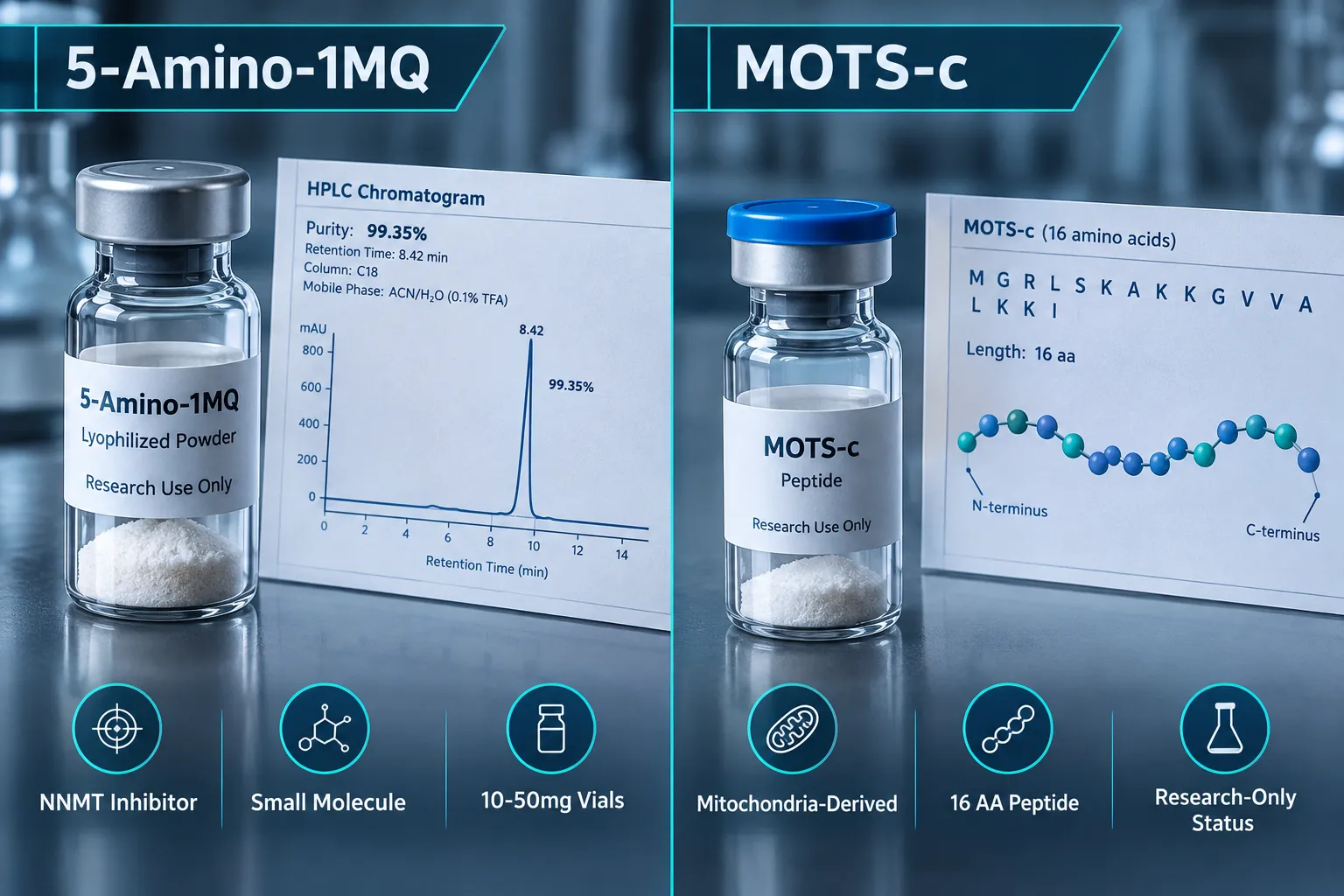
Multiple US and Canadian vendors currently supply 5-Amino-1MQ as a lyophilized research reagent with batch-specific COAs. Purity values across verified 2026 COAs range from 98.5% (HPLC measured at 99.15%) to 99.90%, with the majority of reputable suppliers clustered at 99%+. Available sizes range from 5 mg to 50 mg vials, all labeled for laboratory research use only.

For researchers specifically evaluating injectable formulations, the where to buy 5-Amino-1MQ injectable guide addresses formulation-specific sourcing considerations. The MOTS-c peptide and 5-Amino-1MQ combined research overview is also useful for researchers working with both compounds simultaneously.

MOTS-c sourcing considerations:

MOTS-c availability is more constrained than 5-Amino-1MQ. As a synthetic 16-amino-acid mitochondria-derived peptide encoded in the 12S rRNA, MOTS-c sits in a more heavily scrutinized regulatory category. Vendors supplying MOTS-c for research should provide:

  • Full lot-specific COA with mass-spec sequence confirmation
  • Explicit lyophilized storage conditions (-20 °C or -80 °C, desiccated)
  • Reconstitution and post-reconstitution handling instructions
  • Clear "research use only" labeling

The MOTS-c 10mg product page and the where to buy MOTS-c and SLUPP-332 guide are practical starting points for researchers comparing current supply options.

Red flags that disqualify a vendor:

  • No third-party lab named on the COA
  • Purity stated without an analytical method
  • No batch number or test date on the COA
  • Storage instructions absent from product listing and COA
  • No "research use only" designation

Conclusion

Sourcing 5-Amino-1MQ and MOTS-c research materials responsibly in 2026 requires more than finding a vendor with a competitive price. The COA, identity, purity, and storage checklist outlined above gives researchers a concrete, actionable framework for evaluating every supplier before purchase.

Actionable next steps:

  1. Request a lot-specific COA before ordering, not a generic template document.
  2. Confirm the COA includes HPLC purity with method, mass-spec identity, residual solvents, water content, batch number, and test date.
  3. Verify the testing was conducted by a named, accredited third-party laboratory.
  4. Match storage instructions on the COA to your available lab infrastructure before committing to a vial size.
  5. For MOTS-c, confirm the vendor acknowledges the compound's research-only regulatory status explicitly.

Researchers who apply this checklist consistently will spend less time troubleshooting assay variability and more time generating reliable data.

Tags: 5-amino-1mq, certificate of analysis, hplc purity, mots-c peptide, peptide purity, peptide storage, research materials sourcing, research peptides
https://www.puretestedpeptides.com/wp-content/uploads/2026/10/where-to-buy-5-amino-1mq-and-mots-c-research-materials-a-coa-identity-purity-and.webp 1024 1536 https://www.puretestedpeptides.com/wp-content/uploads/2026/01/buy-peptides-online.jpg 2026-10-09 13:07:022026-10-09 13:07:02Where to Buy 5-Amino-1MQ and MOTS-c Research Materials: A COA, Identity, Purity, and Storage Checklist
You might also like
Where to Buy Research-Grade MOTS-c and 5-Amino-1MQ: Vendor Selection, Purity Standards, and Certificate of Analysis Essentials Where to Buy Research-Grade MOTS-c and 5-Amino-1MQ: Vendor Selection, Purity Standards, and Certificate of Analysis Essentials
CJC-1295 With DAC Half-Life and Dosing Frequency: Why Formulation Matters in GH Research CJC-1295 With DAC Half-Life and Dosing Frequency: Why Formulation Matters in GH Research
5-Amino-1MQ and MOTS-c in Adipocyte Models: Separating Lipolysis, Mitochondrial Stress, and Viability Effects 5-Amino-1MQ and MOTS-c in Adipocyte Models: Separating Lipolysis, Mitochondrial Stress, and Viability Effects
GLP-1 Receptor Agonists vs Research Peptides: Where Retatrutide, GLP-3, and GLP-2 Fit Mechanistically GLP-1 Receptor Agonists vs Research Peptides: Where Retatrutide, GLP-3, and GLP-2 Fit Mechanistically
Advanced Glycation End-Products and Metabolic Peptides: How MOTS-c, 5-Amino-1MQ, and GLP-3 Retatrutide Are Used in AGE Research Advanced Glycation End-Products and Metabolic Peptides: How MOTS-c, 5-Amino-1MQ, and GLP-3 Retatrutide Are Used in AGE Research
Creatine Supplementation vs MOTS-c and 5-Amino-1MQ: Comparing Phosphagen and Mitochondrial Peptide Pathways in Muscle Cell Models Creatine Supplementation vs MOTS-c and 5-Amino-1MQ: Comparing Phosphagen and Mitochondrial Peptide Pathways in Muscle Cell Models
Semax Nasal Spray Research Products Compared: Formulation Transparency, Assay Documentation, and Use-Case Fit Semax Nasal Spray Research Products Compared: Formulation Transparency, Assay Documentation, and Use-Case Fit
Complement-Dependent Cytotoxicity and Peptide-Based Assays: Safety Considerations for BPC-157, GHK-Cu, and Glow Blend Research Complement-Dependent Cytotoxicity and Peptide-Based Assays: Safety Considerations for BPC-157, GHK-Cu, and Glow Blend Research
0 replies

Leave a Reply

Want to join the discussion?
Feel free to contribute!

Leave a Reply Cancel reply

Your email address will not be published. Required fields are marked *

×

Helpful Links

  • My account
  • Cart
  • Checkout
  • Refund and Returns Policy
  • Privacy Policy
  • SMS Privacy Policy
  • Login
  • My Account
  • Logout

USA Made Lab Tested Peptides

All products are sold for research, laboratory, or analytical purposes only, and are not for human consumption


Pure Tested Peptides is a chemical supplier. Pure Tested Peptides is not a compounding / chemical compounding facility as defined under 503A of the Federal Food, Drug, and Cosmetic act. Pure Tested Peptides is not an outsourcing facility as defined under 503B of the Federal Food, Drug, and Cosmetic act.

The statements made within this website have not been evaluated by the US Food and Drug Administration. The products we offer are not intended to diagnose, treat, cure or prevent any disease.

Human/Animal Consumption Prohibited. Laboratory/In-Vitro Experimental Use Only

Link to: Electrolytes in Peptide Studies: Designing Sodium, Potassium, and Fluid-Balance Controls for GLP and Growth-Hormone Models Link to: Electrolytes in Peptide Studies: Designing Sodium, Potassium, and Fluid-Balance Controls for GLP and Growth-Hormone Models Electrolytes in Peptide Studies: Designing Sodium, Potassium, and Fluid-Balance...Electrolytes in Peptide Studies: Designing Sodium, Potassium, and Fluid-Balance Controls for GLP and Growth-Hormone Models Link to: GLP-3 Retatrutide and Oral GLP-1 Concepts: How Researchers Should Compare Exposure, Gastric Emptying, and Bioavailability Link to: GLP-3 Retatrutide and Oral GLP-1 Concepts: How Researchers Should Compare Exposure, Gastric Emptying, and Bioavailability GLP-3 Retatrutide and Oral GLP-1 Concepts: How Researchers Should Compare Exposure, Gastric Emptying, and BioavailabilityGLP-3 Retatrutide and Oral GLP-1 Concepts: How Researchers Should Compare Exposure,...
Scroll to top Scroll to top Scroll to top