

5-Amino-1MQ and MOTS-c in Adipose Organoids: Separating NNMT Inhibition From Mitochondrial Stress
{"cover":"Professional landscape format (1536×1024) hero image with bold text overlay '5-Amino-1MQ and MOTS-c in Adipose' in crisp white sans-serif on a deep teal semi-transparent overlay panel, centered with 8% safe margins from every edge, two lines, balanced word breaks. Background: macro scientific editorial photograph of a glowing 3D adipose organoid sphere suspended in a laboratory environment, bioluminescent blue-green mitochondrial network visible inside the organoid, surrounded by molecular structure overlays of NNMT enzyme and peptide chains, dark navy-to-teal gradient background, high-contrast editorial lighting, magazine-quality composition.","content":["Annotated mechanism-of-action diagram, landscape 1536×1024, white background with teal and navy palette. Central illustration of a differentiated adipocyte with a detailed cross-section showing: callout line 1 pointing to nucleus labeled 'NNMT enzyme site'; callout line 2 pointing to cytoplasm labeled 'NAD+ salvage raised'; callout line 3 pointing to lipid droplets labeled 'Lipogenesis reduced ~50-70%'; callout line 4 pointing to SAM pool labeled 'SAM levels increased'; callout line 5 pointing to 1-MNA labeled '1-MNA lowered'; small inset box bottom-right shows 5-Amino-1MQ molecular quinolinium structure labeled 'IC50 ~1 µM'. Clean callout lines, editorial medical-diagram polish, no full sentences as image text.","Split-screen landscape 1536×1024 comparison diagram: left panel labeled 'MOTS-c Pathway' shows a stylized mitochondrion cross-section with three callout labels, 'Mitochondrial fusion up', 'Mitophagy enhanced', 'Antioxidant pathways active', rendered in warm amber-orange palette; right panel labeled 'NNMT Inhibition Pathway' shows a metabolic pathway flow chart with nodes: 'Nicotinamide → NAD+' and 'SAM preserved → Epigenetic shift' in cool teal-blue palette. A vertical dividing line with the label 'Distinct but complementary mechanisms' separates the two panels. Clean flat-vector style, editorial science-guide finish, high contrast between the two panels.","Numbered step-by-step process flow diagram, landscape 1536×1024, clean white background with purple-to-blue gradient accents. Four sequential horizontal steps: Step 1 labeled 'Establish Adipose Organoid' with small icon of a 3D spheroid; Step 2 labeled 'Apply 5-Amino-1MQ' with icon of a small molecule binding NNMT; Step 3 labeled 'Introduce MOTS-c Peptide' with icon of a mitochondrial network; Step 4 labeled 'Measure: Lipid Flux, Respiration, Viability' with icon of dual assay readouts. Connecting arrows between steps. Below the flow, a small two-column panel: left side 'NNMT inhibition markers: 1-MNA, NAD+, SAM', right side 'Mitochondrial markers: fusion, mitophagy, ROS'. Editorial infographic polish, no pricing or dollar amounts, all labels 1-6 words."]
Adipose tissue is not a passive energy depot. It is a metabolically active organ where enzymatic activity and mitochondrial quality control intersect in ways that drive obesity, insulin resistance, and systemic inflammation. When researchers began exploring 5-Amino-1MQ and MOTS-c in adipose organoids as a way to separate NNMT inhibition from mitochondrial stress, they uncovered a conceptual framework that is already reshaping how preclinical metabolic research is designed, even before a single co-treatment organoid experiment has been formally published.
Key Takeaways
- 5-Amino-1MQ is a selective NNMT inhibitor that raises NAD+ and SAM while reducing lipogenesis in adipocytes, its primary action is enzymatic, not mitochondrially toxic.
- MOTS-c is a mitochondrially encoded peptide that improves mitochondrial quality control through enhanced fusion, mitophagy, and antioxidant signaling.
- These two agents target distinct but conceptually overlapping axes in adipose metabolism.
- No published experiment has yet tested both compounds together in human adipose organoids; organoid application remains an anticipated next step as of 2026.
- Separating NNMT inhibition from mitochondrial stress requires carefully designed viability controls, lipid flux assays, and respiration readouts.
How 5-Amino-1MQ Targets NNMT in Adipose Tissue
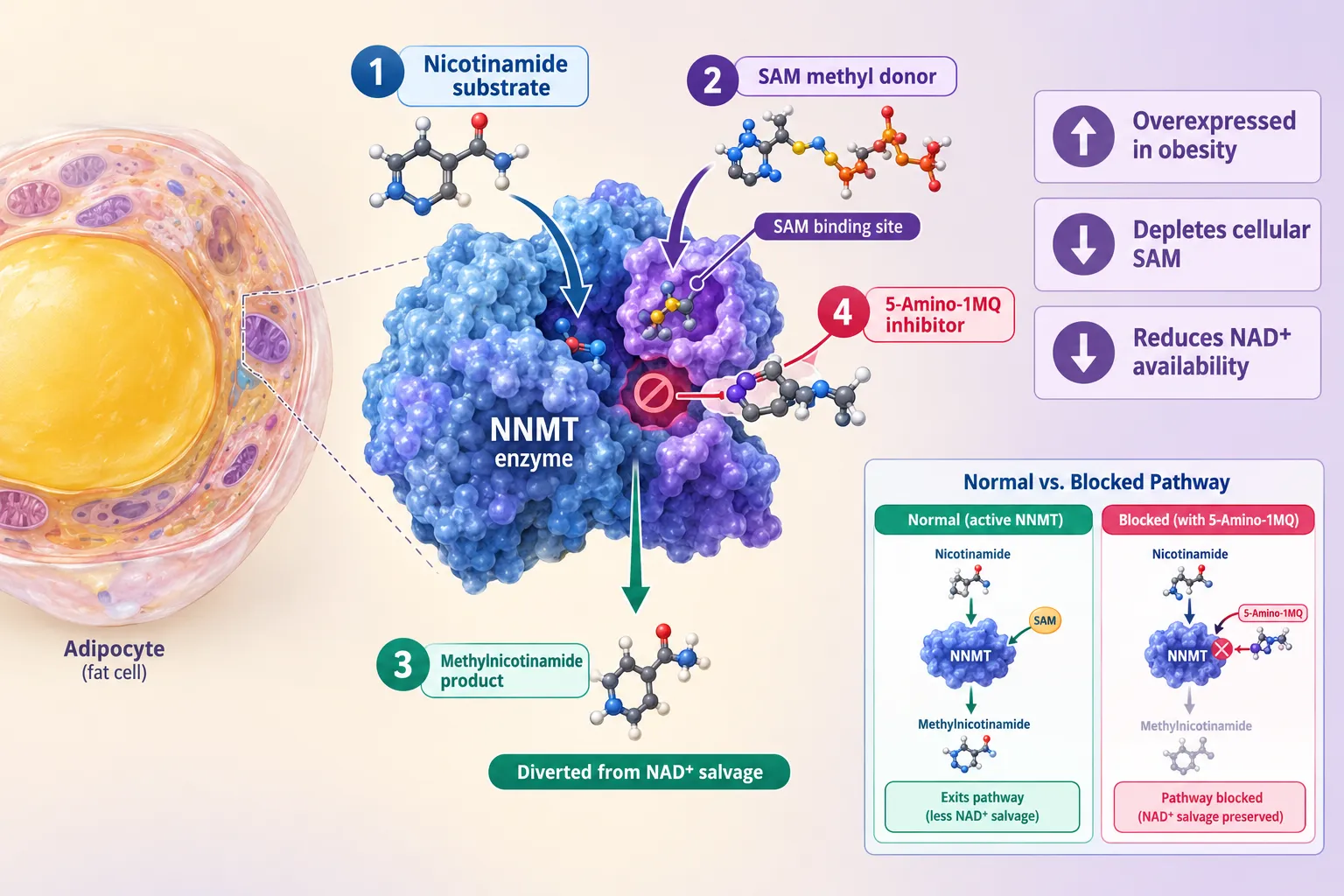
Nicotinamide N-methyltransferase (NNMT) is overexpressed in the adipose tissue of obese animals and humans. The enzyme diverts nicotinamide away from the NAD+ salvage pathway and consumes S-adenosyl-L-methionine (SAM), the cell's primary methyl donor. 5-Amino-1MQ is a membrane-permeable quinolinium compound designed to block this reaction competitively, with a biochemical IC50 of approximately 1 µM and a cellular EC50 of roughly 2.3 µM in differentiated adipocytes.
When applied to 3T3-L1 adipocytes, NNMT inhibition with 5-Amino-1MQ produces measurable shifts across several interconnected metabolic pools:
| Metabolic Marker | Direction of Change |
|---|---|
| Intracellular 1-methylnicotinamide (1-MNA) | Decreased |
| NAD+ levels | Increased |
| S-adenosyl-L-methionine (SAM) | Increased |
| Lipogenesis (at 30 µM) | Reduced ~50% |
| Lipogenesis (at 60 µM) | Reduced ~70% |
In diet-induced obese mouse models, subcutaneous 5-Amino-1MQ at 20 mg/kg three times daily over 11 days produced approximately 5.1% body weight loss versus a 1.4% gain in controls. Epididymal white adipose tissue mass fell by roughly 35%, adipocyte size by more than 30%, and plasma total cholesterol by approximately 30%, all with no change in food intake.
These outcomes are consistent with metabolic reprogramming through enzymatic blockade, not nonspecific mitochondrial toxicity. The compound can reduce NNMT activity by approximately 47% within 30 minutes in laboratory models, providing a tight mechanistic window for researchers to study.
For those researching mitochondria-adjacent peptides, the SS31 mitochondrial dynamics resource provides useful comparison context on how different interventions alter organelle behavior.
MOTS-c and the Mitochondrial Stress Axis
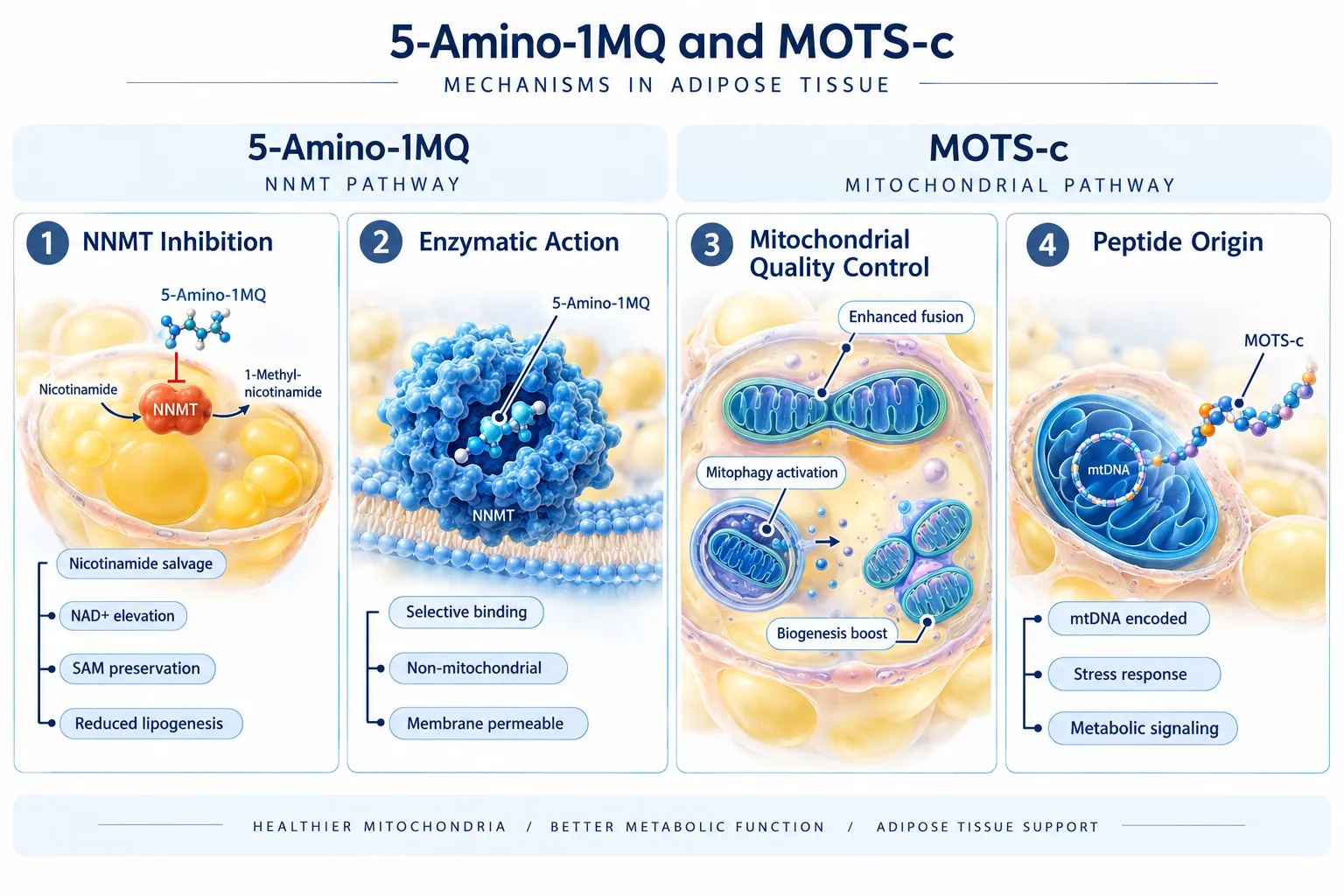
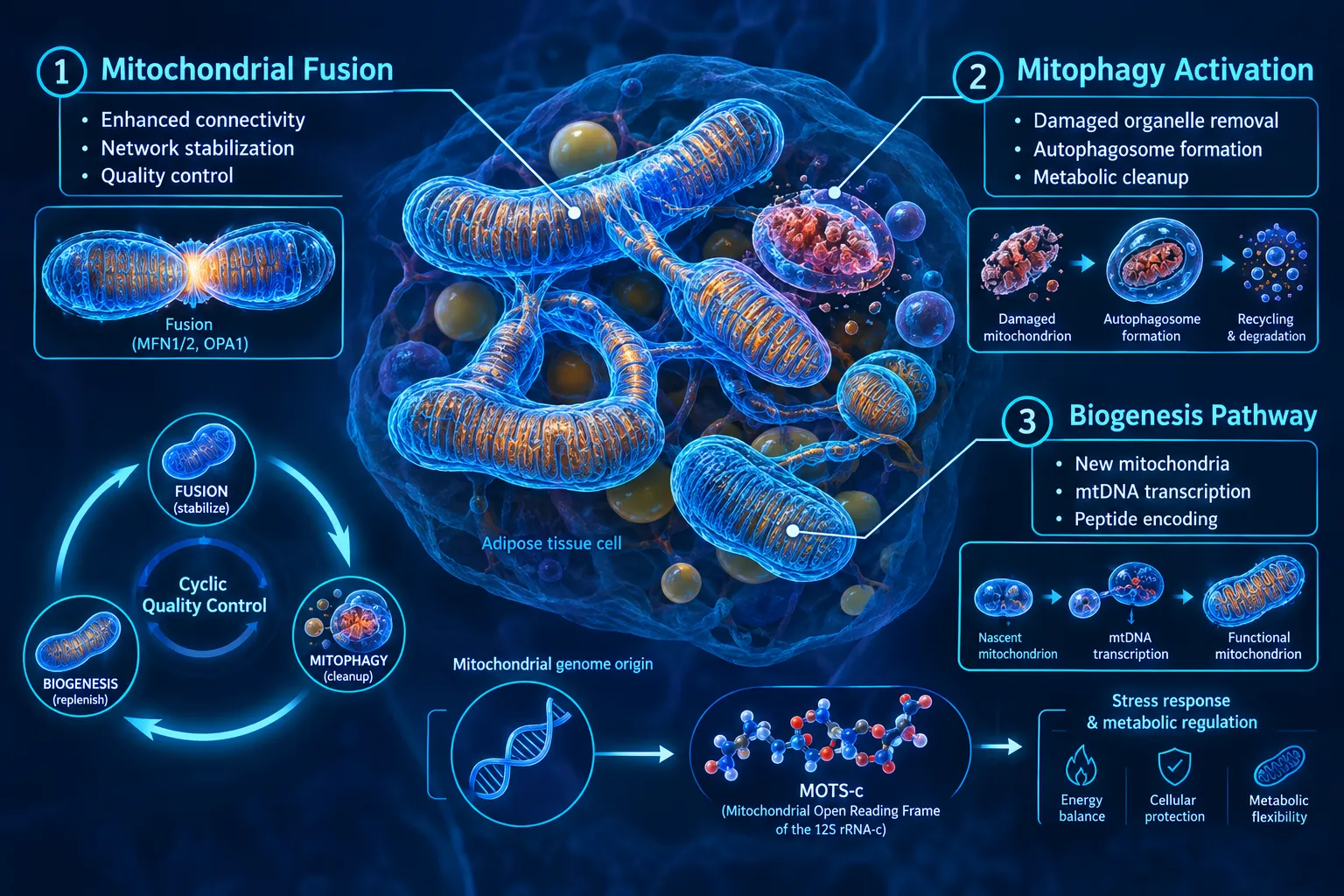
MOTS-c is encoded within mitochondrial DNA, placing it in a unique category among bioactive peptides. Its metabolic effects in adipose and hepatic tissue are rooted in mitochondrial quality control rather than direct enzymatic inhibition. Reported effects include increased mitochondrial fusion, enhanced mitophagy, and upregulated endogenous antioxidant pathways, all of which reduce the cellular burden of mitochondrial stress.
Where 5-Amino-1MQ works upstream at the SAM/NAD+ metabolic branch point, MOTS-c works at the level of organelle health. This is a critical distinction when designing experiments in any adipose model.
Key conceptual point: MOTS-c modulates mitochondrial quality; 5-Amino-1MQ modulates the nicotinamide methylation balance. These are distinct levers, even if their downstream effects on lipid accumulation and metabolic efficiency partially converge.
Researchers exploring related mitochondrial peptide research may also find the SS31 and MOTS-c comparative framework useful for understanding how mitochondrially targeted peptides differ in their mechanisms.
The SS31 mitochondrial research themes resource further illustrates how mitochondrial stress signatures can be distinguished from metabolic enzyme inhibition in structured preclinical designs.
Applying the Framework to Adipose Organoids
The question of studying 5-Amino-1MQ and MOTS-c in adipose organoids, specifically separating NNMT inhibition from mitochondrial stress, introduces a layer of experimental complexity that 2D cell culture cannot fully resolve.
Adipose organoids offer three advantages over standard adipocyte monolayers:
- Cell-state heterogeneity, organoids capture preadipocyte, mature adipocyte, and stromal-vascular cell populations, reflecting real tissue architecture.
- Lipid flux context, lipid droplet dynamics in a 3D environment better model the spatial behavior of adiposity-related changes.
- Mitochondrial respiration gradients, oxygen tension varies across organoid depth, creating naturally occurring zones of high and low mitochondrial stress.
For a co-treatment design to be interpretable, researchers need layered controls:
- Viability controls at every dose to distinguish NNMT suppression from cytotoxicity.
- 1-MNA and NAD+ measurements as NNMT-specific readouts.
- Mitochondrial membrane potential and ROS assays as MOTS-c-specific readouts.
- Lipid flux tracing to determine whether reduced lipid accumulation originates from the NAD+/SAM axis or from improved mitochondrial clearance.
As of 2026, no published study has tested these compounds together in human adipose organoids. Current data come from 2D adipocyte cultures and mouse models. The organoid setting is framed consistently in recent research commentary as a logical and necessary next step, not a completed one.
Researchers interested in peptide purity standards relevant to organoid work may find the Bachem and reference standards for robust peptide benchmarks article informative for ensuring compound quality in sensitive 3D model systems.
For labs also working on broader metabolic peptide panels, SS31 peptide and SS31 kidney health research provide additional context on how mitochondrial peptides are being applied across tissue types in parallel research programs.
Conclusion
The experimental separation of NNMT inhibition from mitochondrial stress is not merely a technical exercise, it is foundational to understanding how 5-Amino-1MQ and MOTS-c in adipose organoids could eventually yield translatable mechanistic insights.
Actionable next steps for researchers:
- Design organoid co-treatment protocols that include parallel single-agent arms to isolate NNMT versus mitochondrial effects before adding combination conditions.
- Prioritize dual-readout assays: measure both metabolic enzyme markers (1-MNA, NAD+, SAM) and mitochondrial quality markers (fusion proteins, mitophagy flux, ROS) within the same organoid preparation.
- Establish dose-response viability curves for both agents independently before committing to combined dose matrices.
- Use lipid flux tracing, not just lipid staining, to determine the mechanistic origin of any observed changes in fat accumulation.
- Monitor the peer-reviewed literature closely, as human adipose organoid co-treatment studies remain an open and active frontier as of 2026.
The framework exists. The tools are available. The organoid experiments remain to be done.


Leave a Reply
Want to join the discussion?Feel free to contribute!