

GLP-1 Pills and Research-Use Peptides: How to Compare Oral Delivery, Gastric Stability, and Exposure Without Making Clinical Claims
Oral bioavailability of approximately 79% for a GLP-1 receptor agonist was considered nearly impossible a decade ago. By 2026, it is a regulatory fact, and it forces researchers, formulators, and science communicators to rethink how they compare oral delivery formats, gastric stability profiles, and pharmacokinetic exposure data across very different molecule classes. This article addresses GLP-1 Pills and Research-Use Peptides: How to Compare Oral Delivery, Gastric Stability, and Exposure Without Making Clinical Claims by focusing on formulation science variables, protease vulnerability, food effects, gastric emptying dynamics, and PK sampling frameworks rather than therapeutic outcomes.
Key Takeaways
- Small-molecule oral GLP-1 agonists achieve high oral bioavailability by bypassing the protease sensitivity that limits peptide GLP-1 analogs in the gastrointestinal tract.
- Gastric pH, protease activity, and gastric emptying rate are the three primary stability variables that distinguish oral delivery performance between molecule classes.
- Validated pharmacokinetic metrics, bioavailability, area under the curve (AUC), maximum concentration (Cmax), and half-life, provide a non-clinical framework for comparing exposure without making outcome claims.
- Research-use peptides typically lack oral PK data, validated GI stability studies, and regulatory-grade impurity profiling, creating a measurable documentation gap versus approved oral GLP-1 tablets.
- Non-clinical comparisons should anchor to formulation class, receptor pharmacology, dosing conditions, and quantified early-phase exposure metrics, not efficacy or safety endpoints.
The Formulation Science Behind Oral GLP-1 Delivery
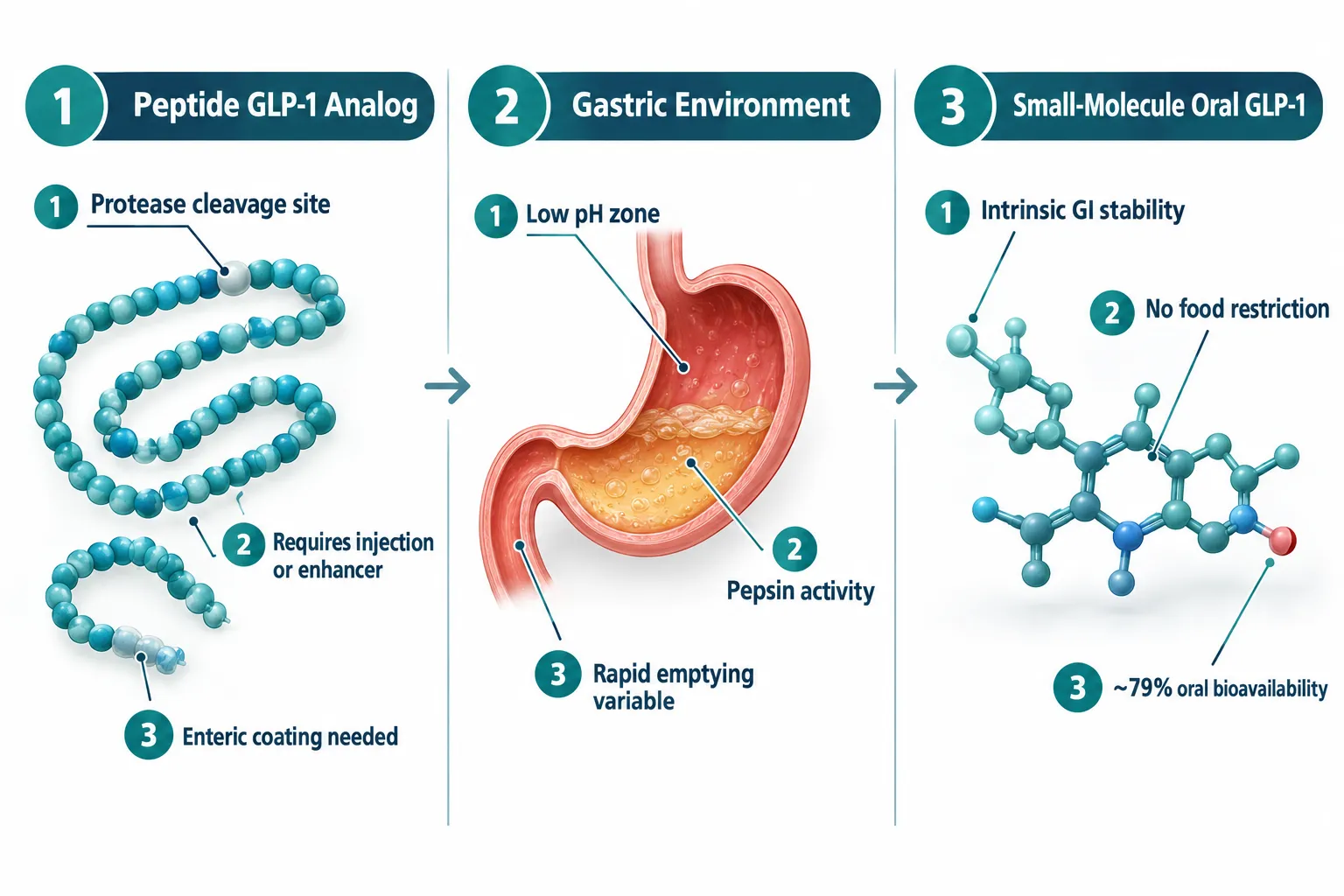
Peptide-based GLP-1 analogs face a fundamental barrier in the gastrointestinal tract: proteolytic enzymes. Pepsin in the stomach and endopeptidases in the small intestine cleave amide bonds in peptide chains rapidly and non-selectively. This is not a minor inconvenience, it is the primary reason injectable formulations became the standard route for GLP-1 receptor agonists for years.
Oral peptide GLP-1 formulations have addressed this through absorption enhancers (such as sodium N-[8-(2-hydroxybenzoyl)amino]caprylate, or SNAC) that create a localized pH shift near the gastric mucosa to reduce enzyme activity and promote transcellular absorption. This approach works, but it imposes strict administration conditions: a small volume of water, a fasting state of at least 30 minutes before and after dosing, and consistent gastric emptying timing.
The key delivery variables for any oral peptide GLP-1 formulation include:
- Gastric pH at time of dosing (fasted vs. fed state alters acid secretion and enzyme concentration)
- Gastric emptying rate (accelerated emptying reduces contact time with the absorptive enhancer)
- Luminal protease concentration (varies with meal composition and timing)
- Mucosal permeability at the absorption window
Small-molecule oral GLP-1 receptor agonists, such as orforglipron (approved in the U.S. and recommended by the European Medicines Agency in October 2026 under the name Foundayo), sidestep this framework entirely. Because the molecule is not a peptide, it has no amide bonds susceptible to pepsin or trypsin cleavage. It can be taken once daily without food or water restrictions, at any time of day, in a standard tablet formulation. This is not a convenience feature alone, it is a direct pharmacokinetic consequence of intrinsic GI stability.
"Intrinsic GI stability is a formulation outcome, not just a convenience variable, it determines whether exposure metrics gathered in fasted subjects translate to real-world dosing scenarios."
For those working in adjacent areas of peptide research, the BPC-157 core peptides documentation first research guide illustrates how formulation and stability documentation requirements apply across different peptide classes.
Comparing Research-Use Peptides Against Approved Oral GLP-1 Pills: A Non-Clinical Framework
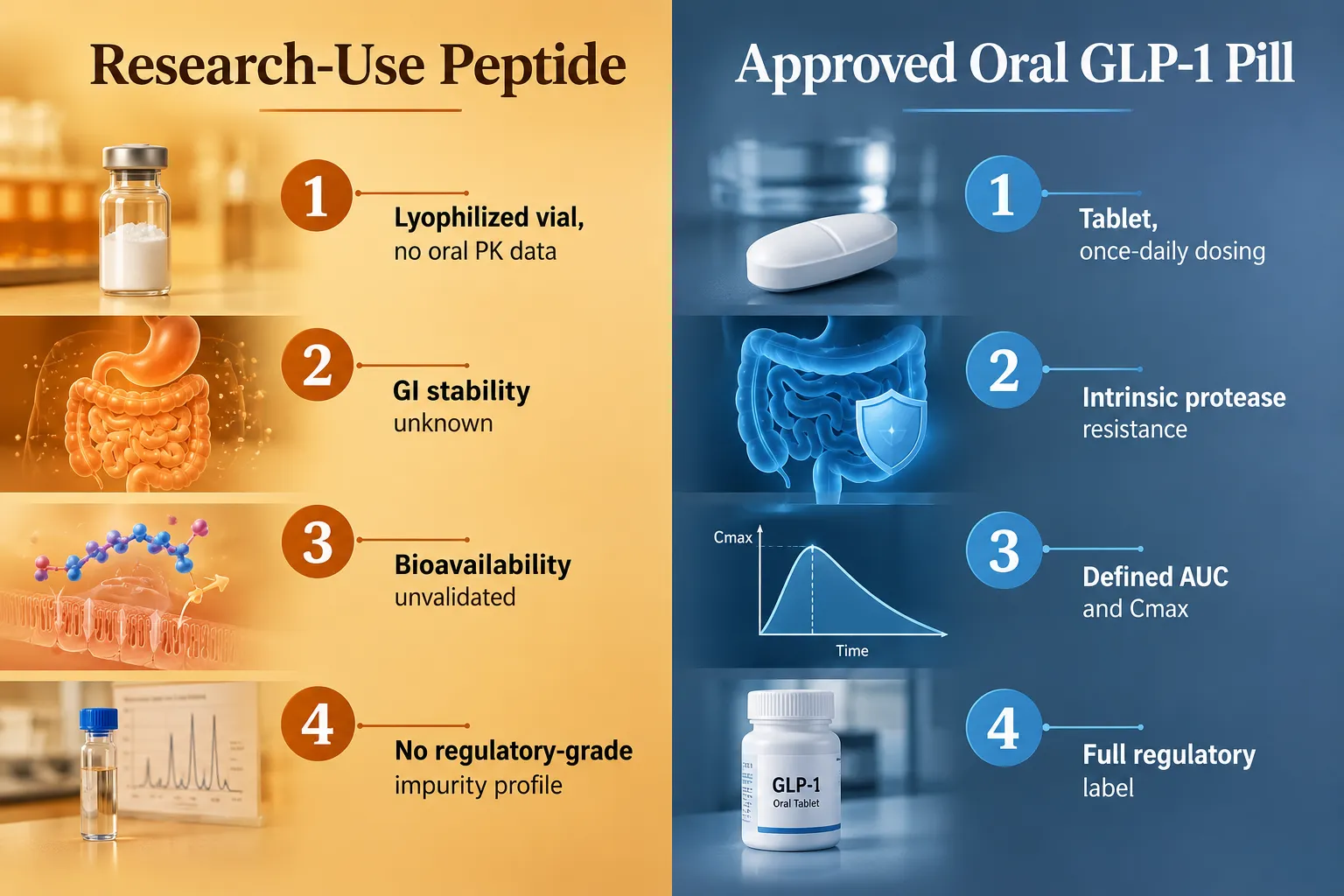
When comparing GLP-1 Pills and Research-Use Peptides: How to Compare Oral Delivery, Gastric Stability, and Exposure Without Making Clinical Claims, the most defensible structure anchors to five documented axes rather than outcome data:
| Comparison Axis | Approved Oral GLP-1 Pill | Research-Use GLP-1 Peptide |
|---|---|---|
| Molecule class | Small molecule, non-peptide | Peptide analog |
| Oral bioavailability | ~79% (documented, Phase 1/3) | Not validated for oral route |
| GI stability testing | Intrinsic, no enhancer needed | Typically absent or unpublished |
| Dosing conditions | No food or water restrictions | Fasting required (if oral attempted) |
| Regulatory documentation | Full label, impurity profile | "Not for human use," no label |
This table represents a formulation-science comparison, not a clinical one. No efficacy or safety claims are embedded in these axes. Researchers communicating about peptide receptor pharmacology, such as those studying GLP-3 peptide signaling pathway dynamics, can use this same axis structure to position their data without crossing into outcome language.
What research-use peptides commonly lack in oral delivery documentation:
- Validated oral bioavailability data in any species
- GI stability assays (simulated gastric fluid, simulated intestinal fluid)
- Food-effect interaction studies
- Defined AUC, Cmax, or effective half-life for oral administration
- Regulatory-grade manufacturing certificates with impurity profiling
This is not a criticism of research-use compounds, it reflects their intended scope. Products categorized for in-vitro or preclinical laboratory use are not required to generate this data. However, the absence of this data defines the boundary of what can be stated. Related resources such as AOD-9604 sale research method notes, storage and traceability demonstrate how documentation-first approaches apply to research-grade peptides regardless of their mechanism of action.
For researchers exploring the emerging GLP-3 receptor space, the GLP-3 RT peptide and GLP-3R 30mg peptide GA9 product categories follow the same documentation gap framework, oral delivery variables remain uncharacterized at the research-grade level.
Using PK Metrics to Structure Exposure Comparisons Without Clinical Language
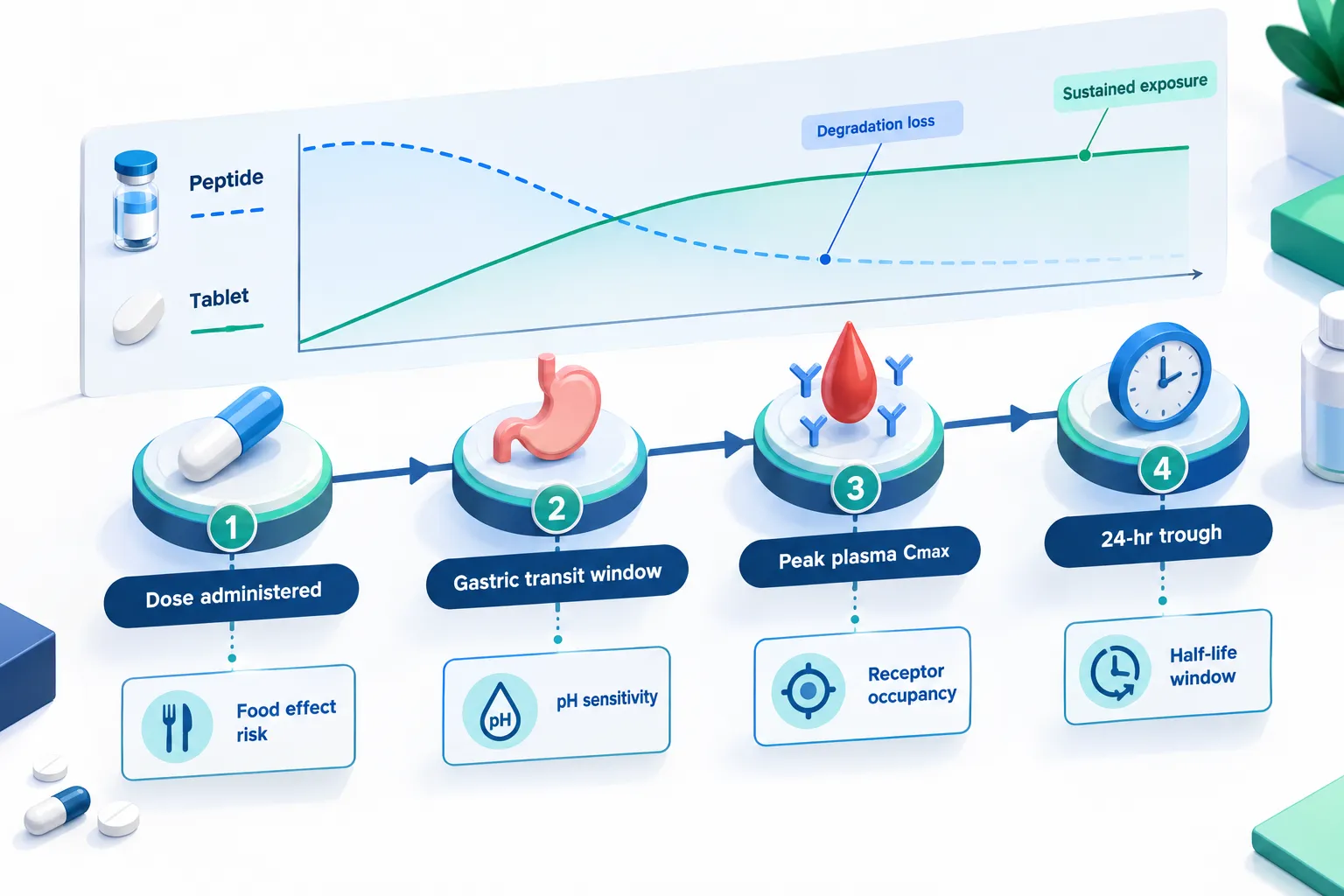
Pharmacokinetic parameters are the bridge between formulation science and non-clinical exposure comparison. They describe what a molecule does in a biological system without asserting what that means for health outcomes. This is precisely where GLP-1 Pills and Research-Use Peptides: How to Compare Oral Delivery, Gastric Stability, and Exposure Without Making Clinical Claims becomes a practical communication skill rather than just a compliance exercise.
The four PK metrics most useful for non-clinical oral delivery comparison are:
- Oral bioavailability (F%), the fraction of the administered dose reaching systemic circulation. For orforglipron, this is approximately 79%. For research-use peptide GLP-1 analogs administered orally, this value is typically undefined.
- Maximum concentration (Cmax), the peak plasma concentration after a single dose. Relevant for understanding receptor occupancy windows without invoking pharmacodynamic outcomes.
- Area under the curve (AUC), total drug exposure over time. A higher AUC from an oral route indicates better absorption relative to the administered dose.
- Effective half-life (t½), how long the molecule maintains relevant plasma concentrations. Orforglipron sustains receptor activation over approximately 24 hours, supporting once-daily dosing.
When describing an oral GLP-1 research peptide, the absence of documented AUC or half-life data is itself a meaningful statement. It means exposure cannot be characterized, not that exposure does not occur.
The Phase 3 program for orforglipron generated detailed dose-response and exposure-response data over 72 weeks and beyond, including a 52-week study evaluating oral GLP-1 as a maintenance-phase agent following prior injectable GLP-1 or GIP/GLP-1 agonist therapy. That depth of PK characterization is the standard against which research-use peptide documentation can be benchmarked. Researchers interested in peptide characterization standards may also find the cagrilinitide peptide for sale category relevant as a dual-agonist research comparator requiring similar PK framing.
For pipeline discussion, any new small-molecule or peptide oral GLP-1 candidate should be explicitly labeled as carrying unproven exposure characteristics until Phase 1 PK data are published. Orforglipron demonstrates that non-peptide design, robust GI stability, and well-characterized oral exposure are achievable, but that does not transfer automatically to structurally distinct candidates.
Those working with injectable research peptides can reference related characterization approaches in the SS-31 10mg research peptide considerations documentation as a model for how PK and stability variables are framed in non-clinical contexts.
Conclusion
The comparison between oral GLP-1 pills and research-use peptides is most credible, and most useful, when it is built on formulation variables, not outcome variables. Three actionable steps apply immediately:
- Anchor every oral delivery comparison to documented axes: molecule class, GI stability mechanism, dosing conditions, oral bioavailability, and PK profile. Where data are absent, state the absence explicitly rather than inferring equivalence.
- Use PK metrics as the non-clinical language of exposure: Cmax, AUC, bioavailability, and half-life describe what a molecule does pharmacokinetically without asserting what it achieves clinically. This language is defensible, precise, and appropriate for research-use contexts.
- Treat regulatory documentation as a benchmark, not a ceiling: The approval of an oral GLP-1 pill with a full regulatory label and validated oral bioavailability sets a documentation standard. Research-use peptides can be positioned honestly against that standard by identifying which data exist, which are pending, and which have not been generated.
Gastric stability is not an abstract concept, it determines whether a molecule survives long enough in the GI tract to reach an absorptive surface. Framing oral delivery comparisons around that physical reality, rather than clinical outcomes, keeps the science rigorous and the communication compliant.


Leave a Reply
Want to join the discussion?Feel free to contribute!