Call or Text 727-513-9780
  • Shopping Cart Shopping Cart
    0Shopping Cart
Pure Tested Peptides | America's most trusted Peptides for sale online
  • Peptides for sale
    • Oral Peptides for sale
      • Peptide Capsules for sale
      • BPC 157 Capsules 1000mcg
      • SLU-PP-332 Capsules | 1000 mcg
      • 5-Amino-1MQ 50mg Capsules
      • Tesofensine 500mcg
    • All Peptides for sale
    • Peptide Sprays
      • BPC 157 Nasal Spray Kit
      • BPC-157 TB500 Nasal Spray Kit
      • Semax Nasal Spray 10mg
      • Selank – Nasal Spray Kit – 10mg
      • Epithalon 50MG Nasal Spray Kit
      • Ipamorelin 10mg Nasal Spray
      • Klow Nasal Spray (BPC-157 + TB-500 + GHK-Cu + KPV) | 80mg
      • Hulk Nasal Spray Tesa / Ipa Blend 6/3 MG
      • Klow Nasal Spray
      • NAD + 500 mg Nasal Spray
      • PT-141 Nasal Spray Kit
    • GHRH Peptides
      • Ipa Peptides
      • CJC-1295 Peptides
        • CJC-1295 with DAC 5 mg
        • CJC-1295 without DAC 5 mg
        • CJC-1295 Ipa 10mg
      • Tesa Peptides
        • Tesa Peptide
        • Tesa 20 mg
    • GHK-Cu Peptides
      • All GHK-Cu Peptides
      • GHK-Cu 100mg
      • KLOW Peptide Blend – Buy KLOW blend online
    • BPC Peptides
      • All BPC Peptides
      • BPC-157
      • BPC-157 TB-500
      • BPC 157 capsules 1000mcg
    • SLU-PP-332 Peptides
      • All SLU-PP-332 Peptides
      • SLU-PP-332 5mg
    • GLP3 Peptides
    • PT-141 Peptides
      • PT-141 Peptides for sale
      • PT-141 10mg
      • PT-141 Nasal Spray
    • CAG Peptides
      • Lipo-C Peptide Blend
      • CAG 5mg
      • CAG 10mg
    • MOTS-C Peptides
      • MOTS-C Peptides for sale
      • MOTS-c peptide
      • MOTS-c 10mg *6 pack*
    • 5 Amino 1MQ Peptides
      • 5 Amino 1MQ Peptides for sale
      • 5-Amino-1MQ 50mg Capsules
      • 5-Amino-1MQ 5mg
    • Epithalon Peptides
      • Epithalon Peptides for sale
      • Epithalon 10mg
      • Epithalon 50mg
  • Shop
    • GLPs
      • 5-Amino-1MQ 50mg Capsules
      • 5-Amino-1MQ 5mg
      • L-Carnitine 500mg/ml
      • Tesofensine 500mcg
      • SLU-PP-332 5mg
      • MOTS-c 10mg *6 pack*
    • Epithalon & BPC Peptides
      • Epithalon 10mg
      • Epithalon 50mg
      • BPC-157
      • BPC 157 capsules 1000mcg
      • BPC-157 TB-500
      • BPC-157 TB500 Nasal Spray Kit
      • BPC 157 Nasal Spray Kit
    • BPC TB-500 & NAD+ Peptides
      • NAD+ 500 mg
      • KLOW Peptide Blend – Buy KLOW blend online
      • GLOW Peptide Blend
      • TB 500 5mg
      • BPC 157 capsules 1000mcg – Supplement
      • BPC 157 Nasal Spray Kit
      • BPC-157
      • BPC-157 TB500 Nasal Spray Kit
      • BPC-157 TB-500
      • BPC 157 capsules 1000mcg
    • LL-37 Peptide
      • LL-37 10 mg
    • MOTS-C & Selank
      • MOTS-c peptide
      • Selank 10mg
    • GHK Peptides
      • GHK-Cu 100mg
      • GLOW Peptide Blend
      • KLOW Peptide Blend – Buy KLOW blend online
  • COAs
  • Wholesale
    • Wholesale Peptides for sale
  • PTP FAQ
  • Affiliates
    • Selank Peptide: Advanced Pharmacological Mechanisms Underlying Its Anxiolytic and Nootropic Effects in Research
      • 5-Amino-1MQ Peptide: Detailed Mechanisms of NNMT Inhibition and Its Impact on Cellular Metabolism Research
        • MOTS-C Peptide: Unraveling Its Role in Mitochondrial Dynamics and Energy Metabolism Research
          • Epithalon Peptide and Telomerase Regulation: Investigating Its Impact on Cellular Senescence and Lifespan Research Models
            • GLP2-T vs GLP2 Tirz Peptide: Understanding the Naming, Mechanistic Nuances, and Research Implications for Gut Health
      • Peptides and Polypeptides in Modern Pharmacology: What Research on Metoprolol, Prednisone, and Amlodipine Reveals
        • Polypeptide Peptides vs NSAIDs: What Naproxen and Diclofenac Teach Tissue-Repair Researchers About BPC‑157 and TB‑500
          • Peptides and Polypeptides in Endocrine Pharmacology: How GLP-1, GLP-2, and GLP-3 Retatrutide Differ From Classic Drugs Like Prednisone and Amlodipine
          • 5‑Amino‑1MQ Peptide and NNMT Inhibition: How It Compares With Statins Like Atorvastatin in Adipose and Lipid Metabolism Research
      • Enclomiphene, Estrogen Receptor Signaling, and Luteinizing Phase Biology: What Hormone Researchers Should Measure
        • Mesenchymal Stem Cells, BPC‑157, and GHK‑Cu: How Tissue Repair Peptides Compare With Classic NSAIDs Like Naproxen in Injury Models
          • Peptide Calculator Use Cases Beyond Growth Hormone: Working Through GLP‑3 Retatrutide, MOTS‑c, and BPC‑157 Research Dosing
        • Polypeptide Peptides in Endocrine and Metabolic Pharmacology: Lessons From Amlodipine, Prednisone, and Metoprolol
        • Peptides Calculator for Advanced Blends: Worked Examples for Tesamorelin, CJC‑1295, and Ipamorelin Stacks
          • Peptides and Polypeptides in Human Physiology: How Molecular Size Shapes Research Applications
            • Selank Peptide: Advanced Pharmacological Mechanisms Underlying Its Anxiolytic and Nootropic Effects in Research
          • 5-Amino-1MQ Peptide: Detailed Mechanisms of NNMT Inhibition and Its Impact on Cellular Metabolism Research
            • MOTS-C Peptide: Unraveling Its Role in Mitochondrial Dynamics and Energy Metabolism Research
              • Epithalon Peptide and Telomerase Regulation: Investigating Its Impact on Cellular Senescence and Lifespan Research Models
                • GLP2-T vs GLP2 Tirz Peptide: Understanding the Naming, Mechanistic Nuances, and Research Implications for Gut Health
                  • Peptides and Polypeptides in Endocrine Pharmacology: How GLP-1, GLP-2, and GLP-3 Retatrutide Differ From Classic Drugs Like Prednisone and Amlodipine
                    • Polypeptide Peptides vs NSAIDs: What Naproxen and Diclofenac Teach Tissue-Repair Researchers About BPC‑157 and TB‑500
                      • Peptides and Polypeptides in Modern Pharmacology: What Research on Metoprolol, Prednisone, and Amlodipine Reveals
                        • 5‑Amino‑1MQ Peptide and NNMT Inhibition: How It Compares With Statins Like Atorvastatin in Adipose and Lipid Metabolism Research
                        • Enclomiphene, Estrogen Receptor Signaling, and Luteinizing Phase Biology: What Hormone Researchers Should Measure
                        • Mesenchymal Stem Cells, BPC‑157, and GHK‑Cu: How Tissue Repair Peptides Compare With Classic NSAIDs Like Naproxen in Injury Models
                        • Peptide Calculator Use Cases Beyond Growth Hormone: Working Through GLP‑3 Retatrutide, MOTS‑c, and BPC‑157 Research Dosing
                        • Polypeptide Peptides in Endocrine and Metabolic Pharmacology: Lessons From Amlodipine, Prednisone, and Metoprolol
                        • Peptides Calculator for Advanced Blends: Worked Examples for Tesamorelin, CJC‑1295, and Ipamorelin Stacks
                        • Peptides and Polypeptides in Human Physiology: How Molecular Size Shapes Research Applications
                        • Selank Peptide: Advanced Pharmacological Mechanisms Underlying Its Anxiolytic and Nootropic Effects in Research
                        • MOTS-C Peptide: Unraveling Its Role in Mitochondrial Dynamics and Energy Metabolism Research
                        • Peptides and Polypeptides in Modern Pharmacology: What Research on Metoprolol, Prednisone, and Amlodipine Reveals
                        • Peptides and Polypeptides in Endocrine Pharmacology: How GLP-1, GLP-2, and GLP-3 Retatrutide Differ From Classic Drugs Like Prednisone and Amlodipine
                        • 5-Amino-1MQ Peptide: Detailed Mechanisms of NNMT Inhibition and Its Impact on Cellular Metabolism Research
                        • Mesenchymal Stem Cells, BPC‑157, and GHK‑Cu: How Tissue Repair Peptides Compare With Classic NSAIDs Like Naproxen in Injury Models
                        • Peptide Calculator Use Cases Beyond Growth Hormone: Working Through GLP‑3 Retatrutide, MOTS‑c, and BPC‑157 Research Dosing
                        • GLP2-T vs GLP2 Tirz Peptide: Understanding the Naming, Mechanistic Nuances, and Research Implications for Gut Health
                        • Polypeptide Peptides in Endocrine and Metabolic Pharmacology: Lessons From Amlodipine, Prednisone, and Metoprolol
                        • Polypeptide Peptides vs NSAIDs: What Naproxen and Diclofenac Teach Tissue-Repair Researchers About BPC‑157 and TB‑500
                        • Peptides and Polypeptides in Human Physiology: How Molecular Size Shapes Research Applications
                        • Peptides Calculator for Advanced Blends: Worked Examples for Tesamorelin, CJC‑1295, and Ipamorelin Stacks
                        • 5‑Amino‑1MQ Peptide and NNMT Inhibition: How It Compares With Statins Like Atorvastatin in Adipose and Lipid Metabolism Research
                        • Enclomiphene, Estrogen Receptor Signaling, and Luteinizing Phase Biology: What Hormone Researchers Should Measure
                        • Epithalon Peptide and Telomerase Regulation: Investigating Its Impact on Cellular Senescence and Lifespan Research Models
                        • Best research protocol Klow blend
                        • best time to take BPC-157
                        • best time to take DSIP (Delta Sleep Inducing Peptide)
                        • best time to take CJC-1295
                        • best time to take AOD-9604
                        • best time to take Follistatin 344
                        • best time to take Ipamorelin
                        • best time to take MK-677 (Ibutamoren)
                        • best time to take Ligandrol (LGD-4033) — research compound
                        • best time to take Ostarine (MK-2866) — research compound
                        • best time to take GHK-CU
                        • best time to take TB-500
                        • best time to take MOTS-c
                        • best time to take Semax
                        • best time to take RAD-140 (Testolone) — research compound
                        • best time to take Thymosin Alpha-1
                        • best time to take PEG-MGF
                        • Biolife Plasma, Octapharma Plasma, and Research Peptides: How Plasma Donation Labs Differ From Peptide Suppliers
                        • best time to take YK-11 — research compound
                        • best time to take PT-141 (Bremelanotide)
                        • Best research protocol Klow blend
                        • 5-Amino-1MQ and MOTS-C Synergy: Metabolic Signaling, Mitochondria, and Research Design
                        • BPC-157 and TB-500: Investigating Their Combined Effects on Angiogenesis and Cellular Migration in Tissue Repair Models
                        • BPC-157 Peptide: Gut Barrier Function, Inflammation, and Tissue-Recovery Research
                        • 5‑Amino‑1MQ and MOTS‑c Synergy in Metabolic Research: Designing NNMT and Mitochondrial Biogenesis Stacks
                        • CJC-1295 with DAC vs. Without DAC: Half-Life, Release Kinetics, and Research Implications
                        • CJC‑1295 with DAC vs. Without DAC: Expanding on Half‑Life Differences Using Tesamorelin and Ipamorelin Blend Case Studies
                        • Collagen Biology and Copper‑Binding Peptides: How GHK‑Cu, Glow Blend, and Klow Blend Interact with Skin and Connective Tissue
                        • Collagen Biology and Regenerative Peptides: How GHK‑Cu, Glow Blend, and Klow Blend Affect Extracellular Matrix Research
                    • DNA, Telomeres, and Longevity Peptides: Positioning Epithalon and MOTS‑c in Genetic Aging Research
                      • Enclomiphene Citrate: serm Mechanism, Testosterone Research, and Stack Compatibility
                        • Enclomiphene vs Enclomiphene Citrate: Formulation, Bioavailability, and Research Distinctions
                        • Epithalon Peptide Research: Telomerase Activation, Aging, and Pineal Gland Function
                        • Estrogen Receptor Signaling and Enclomiphene: How Selective Modulators Compare with Classic Polypeptide Hormones
                        • GHK-Cu Peptide: Advanced Mechanisms in Extracellular Matrix Remodeling and Wound Healing Research
                        • GHK-Cu Peptide: Collagen Synthesis, Wound Repair, and Skin-Barrier Research Models
                        • GLP-1 vs GLP-3 vs GLP-2: Peptide Classification and Research Applications
                        • GLP-2 Peptide Research Guide: Gut Barrier Function, Nutrient Absorption, and Intestinal Recovery Models
                        • GLP-3 Retatrutide vs. GLP-1 Drugs: What Triple-Agonist Biology Changes in Research Models
                        • Ipamorelin and Tesamorelin Combination: Synergistic GH Secretagogue Research and Dosing Protocols
                        • GLP2 Tirz Peptide: What It Is, Why the Name Exists, and How Researchers Should Interpret It
                        • Klow Blend Peptide Nasal Spray: What the Formulation Is Trying to Do in Cognitive Research
                        • Mitochondria, NNMT Inhibition, and Peptide Modulators: Where MOTS‑c and 5‑Amino‑1MQ Fit in Cellular Energy Research
                        • MOTS-c Peptide: Mitochondrial Function, Energy Metabolism, and What Researchers Measure
                        • MOTS-c vs. 5-Amino-1MQ: Which Metabolic Research Questions Each Compound Actually Answers
                        • Nasal Spray Peptides: Bioavailability, Administration, and Semax/Selank Research Applications
                        • PT-141 Peptide Research: Mechanism of Action and Melanocortin Receptor Signaling
                        • Retatrutide for Research: Mechanism, Structure, and GLP-1/GLP-3 Dual Action
                        • Retatrutide for Obesity and Type 2 Diabetes: What the Latest Trial Data Suggest
                        • Tesofensine Peptide Research: Mechanism, Appetite Suppression, and Neuropeptide Y Pathways
  • Contact
    • Contact Customer Service
    • Text Customer Support
  • About US
  • Shop all peptides
  • Affiliate Program
    • Affiliate Signup
  • Login / Register Login / Register Page Link Login / Register Page Link
  • Click to open the search input field Click to open the search input field Search
  • Menu Menu
Klow Peptide Nasal Spray vs Single-Agent Semax or Selank: Designing a Formulation-First Comparison

Klow Peptide Nasal Spray vs Single-Agent Semax or Selank: Designing a Formulation-First Comparison

October 26, 2026/0 Comments/in Uncategorized/by

Roughly 80 mg of total peptide mass fits inside a single 10 mL nasal spray bottle, and whether that mass comes from one compound or four determines almost everything else about how researchers plan, dose, and interpret results. The Klow Peptide Nasal Spray vs Single-Agent Semax or Selank: Designing a Formulation-First Comparison is not, at its core, an efficacy debate. It is a formulation engineering question: blend complexity, excipient behavior, nasal deposition geometry, peptide stability, and the ability to attribute endpoints to a specific active ingredient.

Key Takeaways

  • KLOW nasal spray delivers four peptides (GHK-Cu, BPC-157, TB-500, KPV) at a combined 1.4 mg per spray, targeting skin and tissue-repair research pathways.
  • Single-agent Semax and Selank nasal sprays each deliver approximately 350 mcg per spray of one neuropeptide, used for cognitive and anxiolytic research respectively.
  • These two categories address fundamentally different tissue targets and research endpoints, making direct efficacy comparisons unsupported by current evidence.
  • Blend formulations increase total peptide mass per spray but complicate endpoint attribution when multiple active compounds are present simultaneously.
  • Formulation-first evaluation criteria, dose geometry, excipient choice, stability risk, and deposition, are more reliable comparison axes than unsupported efficacy rankings.

What KLOW Nasal Spray Actually Contains

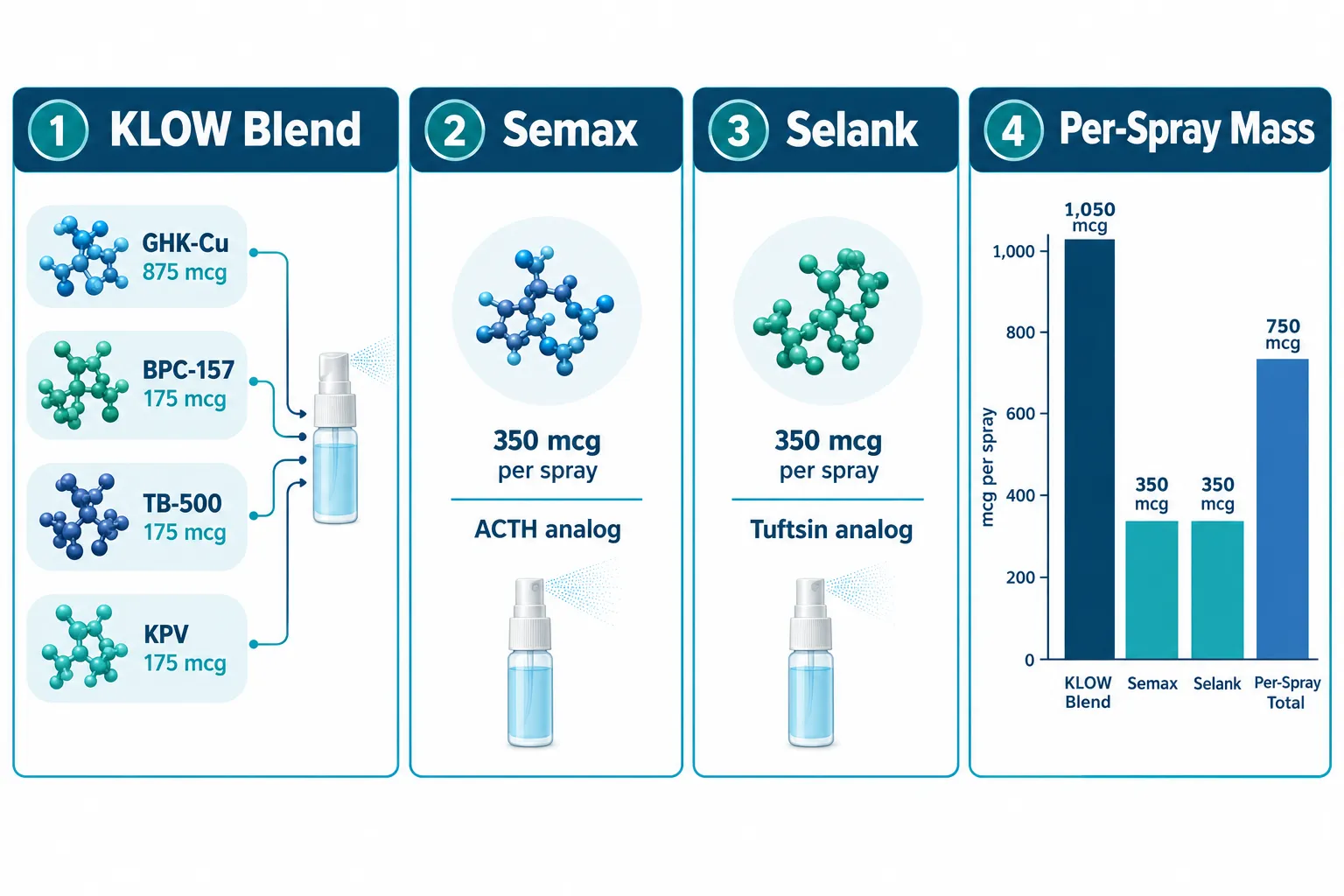
KLOW nasal spray is described by Canadian suppliers as a ready-mixed, four-peptide intranasal research product. Each 10 mL bottle contains 50 mg GHK-Cu, 10 mg BPC-157, 10 mg TB-500, and 10 mg KPV, 80 mg total, dissolved in sterile saline and delivered through a metered atomiser. Each bottle yields approximately 57 sprays, and every actuation delivers roughly 1.4 mg of total peptide: 875 mcg GHK-Cu plus 175 mcg each of BPC-157, TB-500, and KPV.

KLOW is explicitly positioned as "GLOW plus KPV." GLOW is the three-peptide base (GHK-Cu, BPC-157, TB-500); KPV is an anti-inflammatory tripeptide added to address inflammatory pathway research. This modular design philosophy, building a tissue-repair base and layering in a targeted co-peptide, is a defining feature of the KLOW formulation approach.

For researchers already familiar with documentation-first peptide protocols, the approach mirrors the sourcing discipline described in resources like the BPC-157 core peptides documentation first research guide, where understanding what is inside a formulation before designing a protocol is treated as non-negotiable.
What KLOW Nasal Spray Actually Contains

How Single-Agent Semax and Selank Nasal Sprays Are Formulated

Semax nasal spray products are typically formatted as 10 mg in 5 mL or 20 mg in 10 mL, yielding 28 or 57 sprays respectively, with each spray delivering approximately 350 mcg of the single active neuropeptide. Selank follows the same volume-and-concentration pattern.

These are clean, single-mechanism formulations. Semax is a synthetic analog of ACTH 4-10, developed for attention, memory, neuroprotection, and stroke recovery research. Selank is a tuftsin analog, studied for anxiolytic effects and immune modulation. Both have a long history of intranasal use in Russia and are not FDA-approved. Published small-study data report outcomes such as up to 60% reductions in self-rated anxiety scores with Selank and 10-20% improvements in short-term memory with Semax at daily doses of 200-600 mcg delivered in 2-3 sprays.

The Semax peptide research category is distinct from tissue-repair peptide research. When a protocol uses Semax or Selank, the endpoint is neurological. When it uses KLOW, the endpoint is dermal, connective tissue, or systemic inflammatory in nature. These are different experiments.
How Single-Agent Semax and Selank Nasal Sprays Are Formulated

Formulation-First Criteria for Comparing Blend vs Single-Agent Sprays

A rigorous Klow Peptide Nasal Spray vs Single-Agent Semax or Selank: Designing a Formulation-First Comparison must address five technical dimensions before any research endpoint discussion.

Dose Geometry

Parameter KLOW (per spray) Semax or Selank (per spray)
Total peptide mass ~1.4 mg ~0.35 mg
Active compounds 4 1
GHK-Cu contribution 875 mcg None
Neuropeptide content None 350 mcg
Carrier Sterile saline Sterile saline

On a per-spray basis, KLOW delivers four times the total peptide mass of a Semax or Selank spray, but none of that mass is a neuropeptide. The mass comparison is not interchangeable, it measures different molecules hitting different receptor classes.

Endpoint Attribution

Multi-peptide blends create an attribution problem. If a researcher observes a change in a measurable marker after using KLOW, it is not straightforward to assign that change to GHK-Cu, BPC-157, TB-500, or KPV individually. Single-agent Semax or Selank protocols avoid this entirely: one peptide, one primary mechanism, one cleaner causal chain.

No clinical trial has directly compared Semax and Selank against each other for any outcome, let alone against a four-peptide tissue-repair blend. Accordingly, any formulation-first comparison must hold its conclusions to molecular class, dosing geometry, and target tissue, not to efficacy rankings.

Stability and Excipient Effects

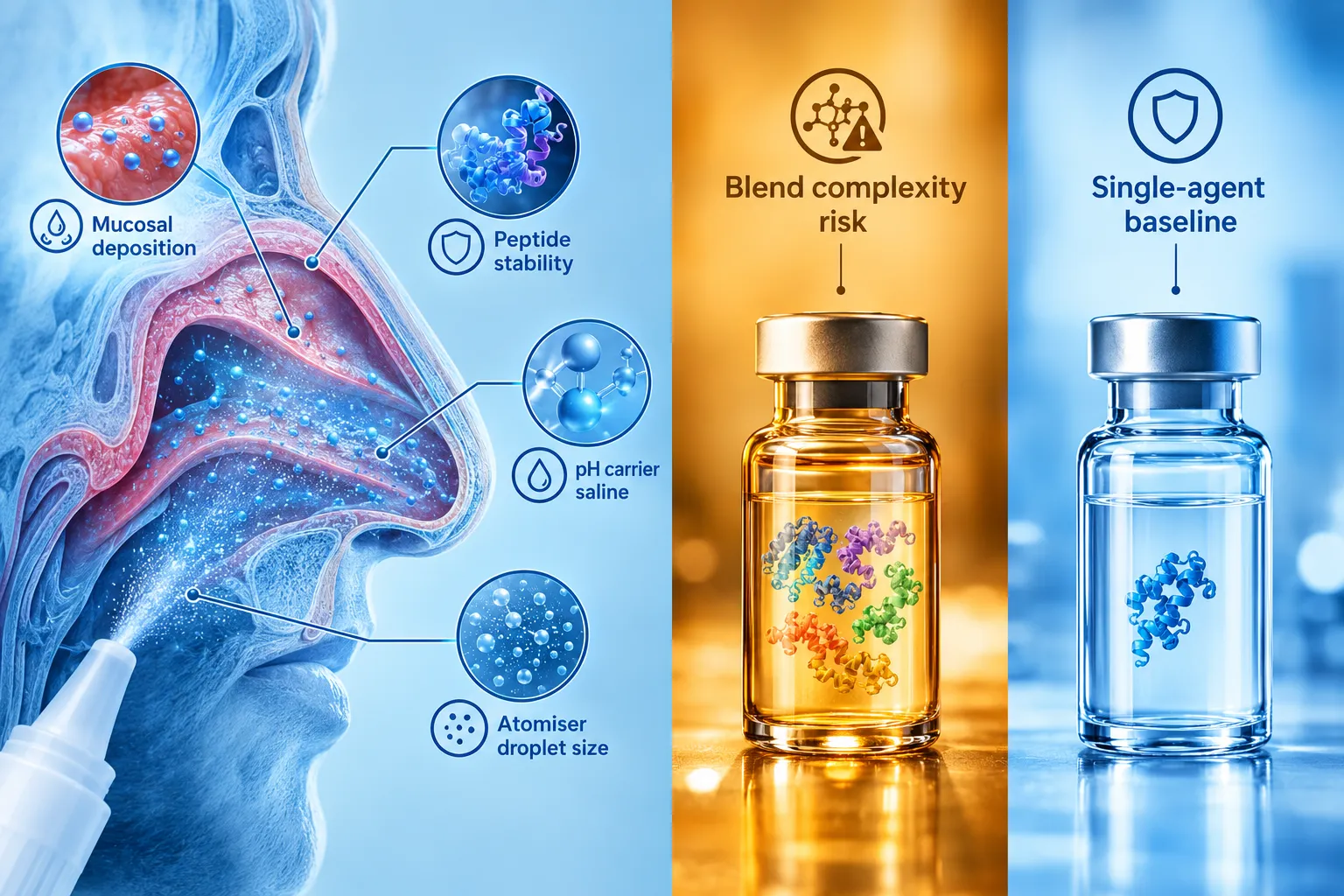
Four peptides dissolved together in a single saline solution introduce more complexity than a single-peptide solution does. Potential peptide-peptide interactions, differential degradation rates, and pH sensitivity across compounds all raise stability questions that single-agent solutions sidestep. Sterile saline is a neutral, low-risk excipient for all five compounds under discussion, but blend stability should be verified through lab tested peptides documentation before any research protocol begins.

Nasal Deposition

Metered nasal atomisers produce consistent droplet sizes and spray geometry regardless of which peptides they carry. Both KLOW and single-agent sprays use sealed metered pump systems, eliminating reconstitution steps and bacteriostatic water variables. The key delivery difference is that KLOW's higher total mass per actuation means more peptide contacts the mucosal surface per spray, but whether that translates into proportionally higher absorption depends on tissue saturation and mucociliary clearance rates, not formulation design alone.

Research Use-Case Categorization

Supplier catalogs consistently place KLOW under skin, tissue repair, and inflammation research and Semax/Selank under cognitive, neuroprotection, stress, and anxiety research. This is the clearest practical guidance available for choosing between these formulation strategies: define the research question first, then select the peptide class that addresses that tissue target.
Research Use-Case Categorization

Designing a Comparison Protocol

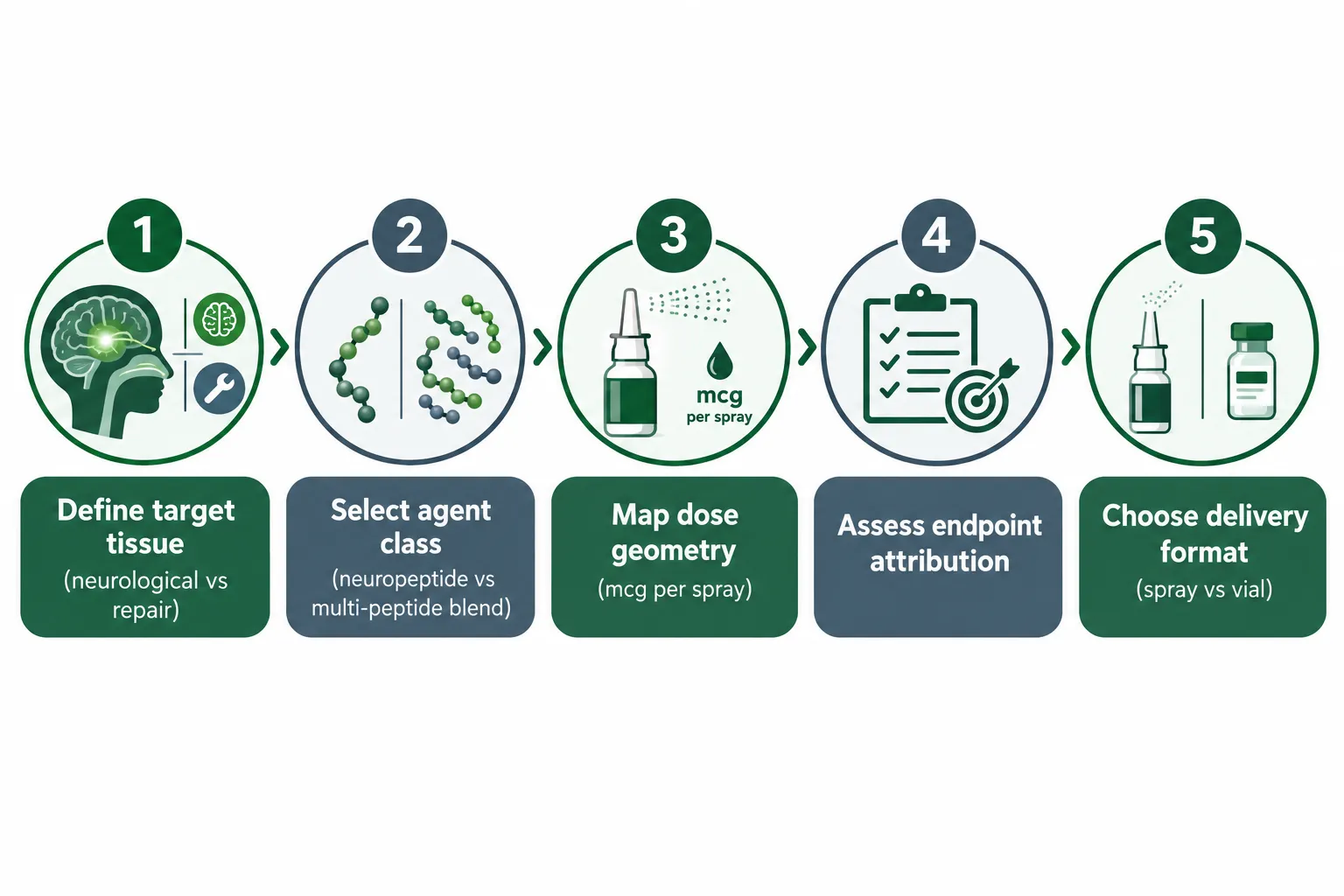
When designing a Klow Peptide Nasal Spray vs Single-Agent Semax or Selank: Designing a Formulation-First Comparison protocol for research purposes, the following steps apply:

  1. Define the target tissue, neurological versus dermal/connective tissue.
  2. Select the agent class, neuropeptide (Semax, Selank) or tissue-repair blend (KLOW).
  3. Map dose geometry, document mcg per spray, sprays per session, and daily total peptide exposure.
  4. Plan endpoint attribution, single-agent designs support cleaner causal inference.
  5. Verify formulation standards, confirm sterility, metered delivery, and stability data from the supplier.

For researchers tracking broader peptide nasal spray ecosystems, vendor catalogs in 2026 now include single-agent BPC-157, TB-500, GHK-Cu, KPV, NAD+, oxytocin, and multi-peptide blends alongside Semax, Selank, and combination Semax+Selank sprays. This expansion reflects a shift toward configurable intranasal platforms rather than isolated single-agent solutions, a trend that makes formulation-first thinking increasingly important.

Resources on adjacent peptide classes, such as tesa peptide benefits, illustrate how single-agent peptide research maintains cleaner mechanistic interpretability, a standard worth applying across any nasal spray comparison.


Conclusion

The comparison between KLOW nasal spray and single-agent Semax or Selank is fundamentally a formulation design question, not a performance contest. KLOW packs four tissue-repair peptides into 1.4 mg per spray; Semax and Selank each deliver 350 mcg of a single neuropeptide per spray. They target different tissues, serve different research endpoints, and create different attribution challenges when outcomes are measured.

Actionable next steps for researchers:

  • Start with a clearly defined target tissue and endpoint before selecting any nasal spray format.
  • Use single-agent Semax or Selank when causal clarity matters and the research focus is neurological or anxiolytic.
  • Use KLOW when the research question spans tissue repair, skin biology, and inflammation simultaneously, and document all four components in the protocol.
  • Verify formulation quality through third-party tested sources and confirm metered pump specifications before beginning any dosing schedule.
  • Treat blend complexity as a variable to control for, not a proxy for potency.

Formulation-first thinking protects research integrity and keeps interpretation grounded in what is actually known about each peptide class.

Tags: bpc-157, ghk-cu, klow peptide nasal spray, multi-peptide blend, nasal spray research, peptide formulation comparison, selank nasal spray, semax nasal spray
https://www.puretestedpeptides.com/wp-content/uploads/2026/10/klow-peptide-nasal-spray-vs-single-agent-semax-or-selank-designing-a-formulation.webp 1024 1536 https://www.puretestedpeptides.com/wp-content/uploads/2026/01/buy-peptides-online.jpg 2026-10-26 13:05:152026-10-26 13:05:15Klow Peptide Nasal Spray vs Single-Agent Semax or Selank: Designing a Formulation-First Comparison
You might also like
Best Research-Grade Nasal Spray Peptides: Comparing Excipient Disclosure, Deposition, Stability, and Documentation Best Research-Grade Nasal Spray Peptides: Comparing Excipient Disclosure, Deposition, Stability, and Documentation
Nasal Peptide Vehicle Controls: Comparing PBS, Osmolality, pH, and Deposition in Semax, Selank, and Klow Studies Nasal Peptide Vehicle Controls: Comparing PBS, Osmolality, pH, and Deposition in Semax, Selank, and Klow Studies
GHK-Cu and Glow Blend in Keratinocyte Models: Separating Copper Signaling From Multi-Peptide Formulation Effects GHK-Cu and Glow Blend in Keratinocyte Models: Separating Copper Signaling From Multi-Peptide Formulation Effects
What Is GHK-Cu? Copper-Dependent Matrix Remodeling and Fibroblast, Keratinocyte Crosstalk in Research Models What Is GHK-Cu? Copper-Dependent Matrix Remodeling and Fibroblast, Keratinocyte Crosstalk in Research Models
Tesofensine, Enclomiphene, and Peptide-Based Approaches: How Small Molecules Fit Alongside GLP-3 and GH Secretagogues in Metabolic Research Tesofensine, Enclomiphene, and Peptide-Based Approaches: How Small Molecules Fit Alongside GLP-3 and GH Secretagogues in Metabolic Research
Glow Blend Peptide vs GHK-Cu: What Skin and Tissue Research Models Actually Measure Glow Blend Peptide vs GHK-Cu: What Skin and Tissue Research Models Actually Measure
BPC-157 and TB-500 in Tendon and Muscle Models: Separating Angiogenesis, Matrix Remodeling, and Inflammation Readouts BPC-157 and TB-500 in Tendon and Muscle Models: Separating Angiogenesis, Matrix Remodeling, and Inflammation Readouts
Best Research-Use Nasal Spray Peptides: A Buyer's Checklist for Semax, Selank, Klow, and PT-141 Documentation Best Research-Use Nasal Spray Peptides: A Buyer’s Checklist for Semax, Selank, Klow, and PT-141 Documentation
0 replies

Leave a Reply

Want to join the discussion?
Feel free to contribute!

Leave a Reply Cancel reply

Your email address will not be published. Required fields are marked *

×

Helpful Links

  • My account
  • Cart
  • Checkout
  • Refund and Returns Policy
  • Privacy Policy
  • SMS Privacy Policy
  • Login
  • My Account
  • Logout

USA Made Lab Tested Peptides

All products are sold for research, laboratory, or analytical purposes only, and are not for human consumption


Pure Tested Peptides is a chemical supplier. Pure Tested Peptides is not a compounding / chemical compounding facility as defined under 503A of the Federal Food, Drug, and Cosmetic act. Pure Tested Peptides is not an outsourcing facility as defined under 503B of the Federal Food, Drug, and Cosmetic act.

The statements made within this website have not been evaluated by the US Food and Drug Administration. The products we offer are not intended to diagnose, treat, cure or prevent any disease.

Human/Animal Consumption Prohibited. Laboratory/In-Vitro Experimental Use Only

Link to: Nasal Peptide Vehicle Controls: Comparing PBS, Osmolality, pH, and Deposition in Semax, Selank, and Klow Studies Link to: Nasal Peptide Vehicle Controls: Comparing PBS, Osmolality, pH, and Deposition in Semax, Selank, and Klow Studies Nasal Peptide Vehicle Controls: Comparing PBS, Osmolality, pH, and Deposition...Nasal Peptide Vehicle Controls: Comparing PBS, Osmolality, pH, and Deposition in Semax, Selank, and Klow Studies Link to: Selecting Research Supplies for Peptides: Evaluating Phosphate-Buffered Saline pH, Excipients, and Reconstitution Vehicles Link to: Selecting Research Supplies for Peptides: Evaluating Phosphate-Buffered Saline pH, Excipients, and Reconstitution Vehicles Selecting Research Supplies for Peptides: Evaluating Phosphate-Buffered Saline pH, Excipients, and Reconstitution VehiclesSelecting Research Supplies for Peptides: Evaluating Phosphate-Buffered Saline...
Scroll to top Scroll to top Scroll to top