

GHK-Cu and Glow Blend in Keratinocyte Models: Separating Copper Signaling From Multi-Peptide Formulation Effects
Keratinocytes make up roughly 90 percent of the human epidermis, yet most peptide research in dermal biology focuses on fibroblasts. That oversight matters when evaluating GHK-Cu and Glow Blend in keratinocyte models: separating copper signaling from multi-peptide formulation effects requires a different set of assays, different readouts, and a much stricter eye for what the data actually prove.
The Glow Blend is a three-peptide research formulation containing GHK-Cu 50 mg, BPC-157 10 mg, and TB-500 10 mg in a single 70 mg vial. Each component carries its own mechanistic story, but no published study has yet tested all three together in a controlled keratinocyte model. Understanding what is known, and what is being extrapolated, is essential before drawing any conclusions about the blend's epidermal effects.
Key Takeaways
- GHK-Cu has the strongest keratinocyte-specific evidence, including biopsy-confirmed proliferation data and at least one small randomized controlled trial in humans.
- The Glow Blend (GHK-Cu 50 mg, BPC-157 10 mg, TB-500 10 mg) has no published multi-peptide keratinocyte study; all blend claims are extrapolated from single-peptide data.
- Copper signaling through GHK-Cu drives Nrf2 nuclear translocation, antioxidant response element gene expression, and barrier protein production in epidermal keratinocyte assays.
- BPC-157 and TB-500 primarily target vascularization and actin-mediated migration respectively, pathways that are secondary rather than primary in keratinocyte monolayer models.
- Research suppliers explicitly frame the Glow Blend as a hypothesis-generating tool for studying pathway complementarity, not as a validated synergistic protocol.
How Copper Signaling Works in Keratinocyte Assays
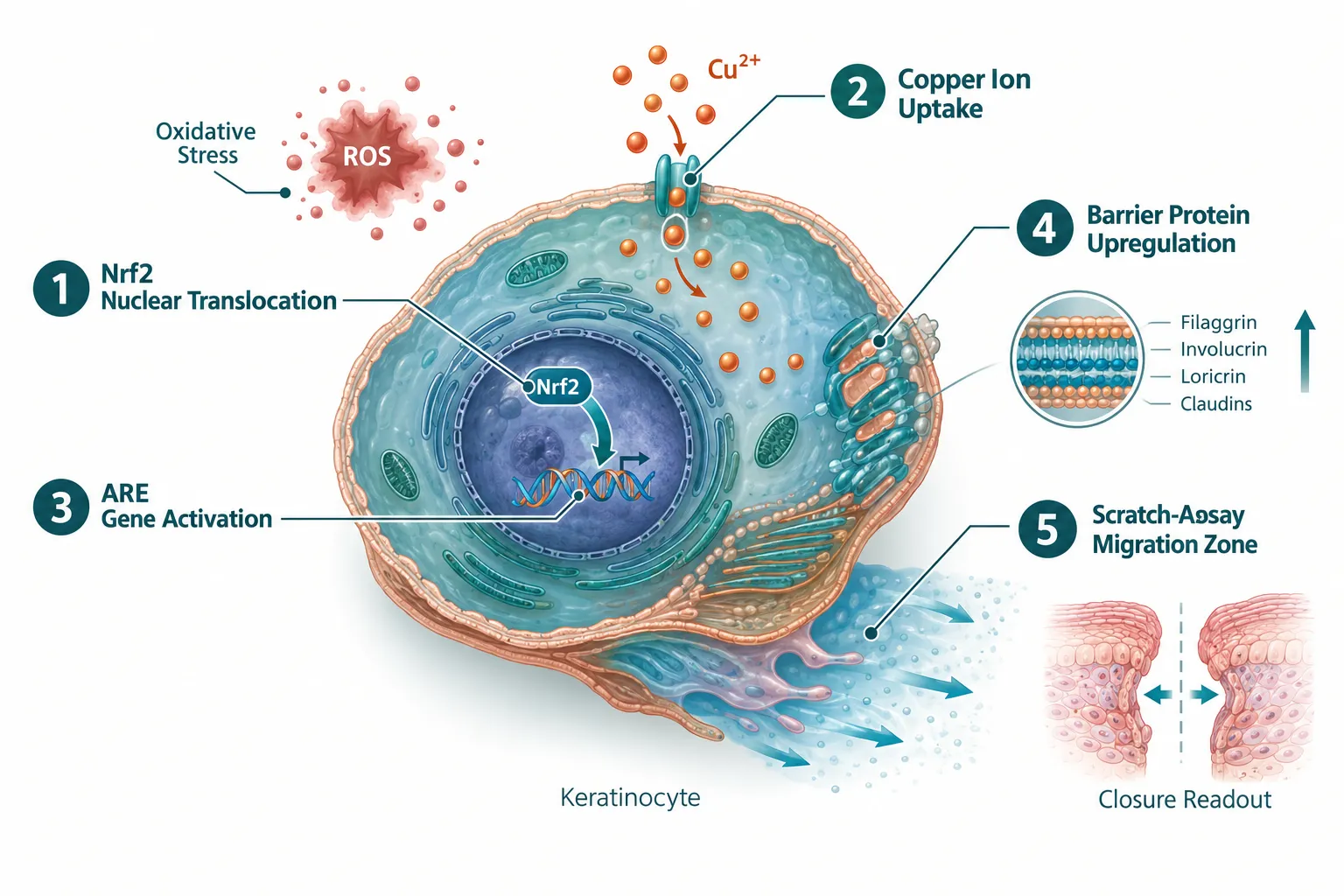
GHK-Cu (glycyl-L-histidyl-L-lysine copper complex) is the dominant copper-signaling agent in the Glow Blend, and keratinocyte assays are where its evidence base is most clearly defined. In human epidermal keratinocyte (HEK) monolayer cultures and wound-healing scratch assays, GHK-Cu has been shown to modulate the expression of thousands of genes, stimulating type I and type III collagen, elastin, and glycosaminoglycan production. More relevant to the epidermis specifically, biopsy data from a study of 67 women aged 50 to 59 using a GHK-Cu cream showed strong keratinocyte proliferation alongside improvements in laxity, clarity, and firmness.
The mechanistic pathway most studied in keratinocyte-specific models involves Nrf2 nuclear translocation and activation of antioxidant response element (ARE) gene expression. Standard HEK cultures and scratch-assay protocols allow researchers to quantify:
- Migration rate, how fast keratinocytes close a defined wound gap
- Oxidative stress markers, reactive oxygen species levels before and after copper complex exposure
- Barrier protein expression, genes associated with tight junction and cornified envelope integrity
- Proliferation index, cell count and division rate as direct readouts of copper-driven signaling
This set of readouts is distinct from the fibroblast-matrix assays that dominate most GHK-Cu literature. Separating these epidermal endpoints from fibroblast collagen endpoints is central to understanding what "copper signaling" actually does at the skin's outermost functional layer.
A 2024 study on GHK-Cu-functionalized silver nanoparticles also reported accelerated re-epithelialization and preserved keratinocyte viability in a rat full-thickness wound model, adding further support for copper-mediated repair signaling that operates independently of any multi-peptide blend. Researchers sourcing materials for these models should review the GHK-Cu peptide purchase and copper peptide research sourcing guide before designing experiments.
Parsing Each Peptide's Role: What the Glow Blend Components Do in Epidermal Models
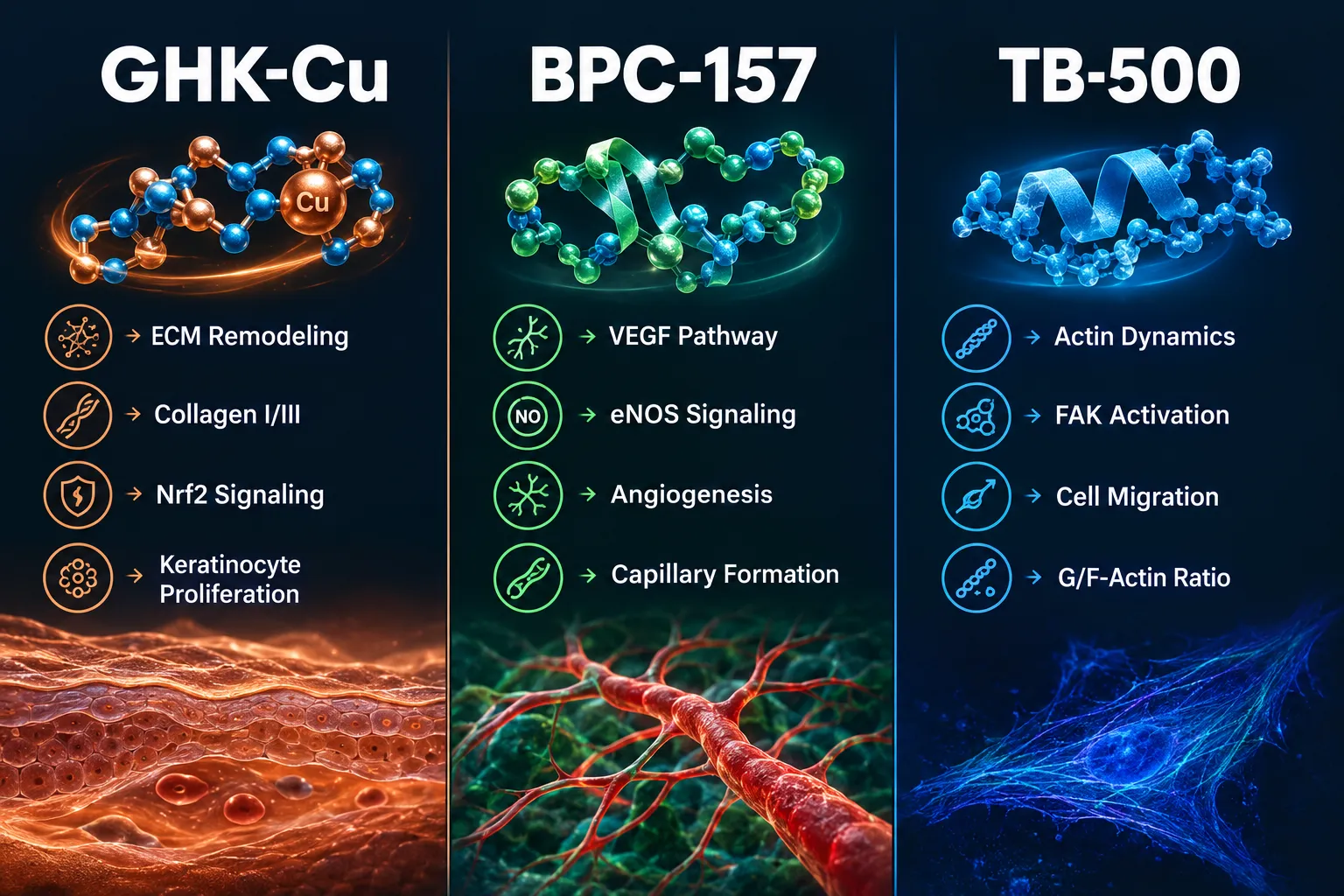
When evaluating GHK-Cu and Glow Blend in keratinocyte models: separating copper signaling from multi-peptide formulation effects depends on understanding where BPC-157 and TB-500 fit, and where they do not, in the epidermal context.
GHK-Cu functions primarily as an extracellular matrix remodeler and gene expression driver. In keratinocyte-rich models, its copper-dependent activity governs ECM remodeling and barrier gene upregulation.
BPC-157 promotes angiogenesis through VEGF and eNOS signaling pathways and drives new dermal capillary formation. These effects are more relevant to the dermis and subdermal tissue than to the epidermis itself. Keratinocyte monolayers, which lack vasculature, will show limited response to BPC-157's primary mechanism. For context on BPC-157 documentation standards in preclinical work, the BPC-157 core peptides documentation and first research guide provides a useful framework.
TB-500, the thymosin β4 fragment, regulates G/F-actin dynamics and drives keratinocyte, endothelial, and fibroblast migration. This is one area where TB-500 does have direct keratinocyte relevance: actin polymerization is central to scratch-assay closure. However, when BPC-157 and TB-500 were combined in a 2026 rat Achilles-tendon model, the combination did not outperform either peptide alone, a result that should temper assumptions about synergy in any multi-peptide context.
| Peptide | Primary Mechanism | Keratinocyte Relevance |
|---|---|---|
| GHK-Cu | ECM remodeling, Nrf2/ARE gene expression | High, direct proliferation and barrier data |
| BPC-157 | VEGF/eNOS angiogenesis | Low-to-moderate, no vasculature in monolayer |
| TB-500 | G/F-actin dynamics, migration | Moderate, scratch-assay closure readouts |
Protocols seeking to isolate GHK-Cu's keratinocyte effects should run single-peptide controls before testing any blend. Researchers can also review comparable quality-control workflows in the TB-500 buy controlled experimental models and QC workflow resource.
Evidence Gaps and the Preclinical Status of Multi-Peptide Formulation Effects
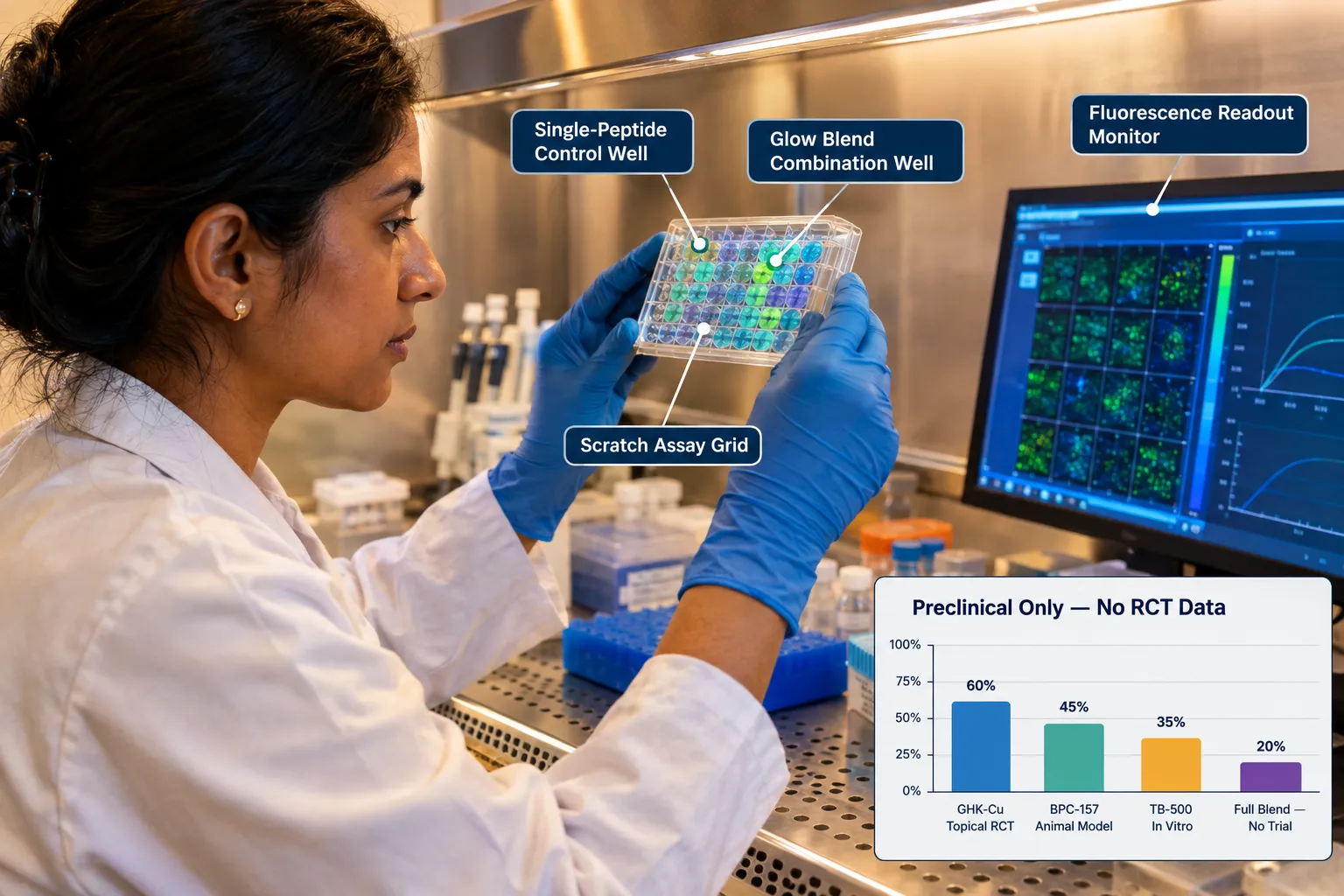
The most important point in any discussion of GHK-Cu and Glow Blend in keratinocyte models: separating copper signaling from multi-peptide formulation effects is this, the blend has never been tested as a unit in a published keratinocyte study. Every claim about how the three peptides work together in epidermal tissue is an extrapolation from single-peptide preclinical data.
GHK-Cu alone does have the highest evidence tier among the three components in skin contexts. There is at least one small randomized controlled trial (CO2-laser-resurfaced skin, n=13) showing improved patient-rated skin quality (P=0.04), though blinded assessor ratings showed no significant difference in redness or wrinkles versus control. This makes GHK-Cu's topical human evidence notable compared to the purely preclinical status of BPC-157 and TB-500 in skin applications.
The Glow Blend and related formulations such as KLOW (combining GHK-Cu with KPV) are currently supplied as research-grade materials. Published safety data for all three Glow components come from animal models, in vitro studies, or topical human applications of GHK-Cu alone. Long-term systemic safety of injected multi-peptide combinations is essentially uncharacterized. Research suppliers consistently emphasize that the blend is intended for in vitro or animal use and is not approved for human injection. For researchers comparing suppliers before sourcing blend components, the peptide supplier comparisons guide interpreting PeptideTech and PeptideSC is a practical reference. Broader guidance on sourcing is also available at where to buy peptides.
Critical gaps that future keratinocyte studies should address:
- Does TB-500 enhance GHK-Cu-driven scratch-assay closure, or does it operate redundantly?
- Does BPC-157 contribute measurable readouts in avascular epidermal monolayers?
- Are copper availability and ARE activation affected by the presence of BPC-157 or TB-500 at physiological concentrations?
- Do any of the three peptides interfere with each other's receptor binding or intracellular signaling at the concentrations used in blend formulations?
Until these questions are answered with controlled keratinocyte data, the Glow Blend should be treated as a hypothesis-generating platform rather than a validated synergistic protocol.
Conclusion
Keratinocyte models give researchers a more direct window into epidermal biology than fibroblast systems, and GHK-Cu's copper signaling record in those models is the strongest element of the Glow Blend's evidence base. Nrf2 activation, barrier protein expression, proliferation indices, and scratch-assay migration rates all offer concrete, measurable readouts that can isolate copper-dependent effects from the noise of a multi-peptide formulation.
Actionable next steps for researchers:
- Design single-peptide keratinocyte controls before introducing the full Glow Blend to any assay.
- Select readouts specific to the epidermis: barrier protein expression, oxidative stress markers, proliferation, and scratch-closure rate rather than collagen deposition alone.
- Apply the tendon-model lesson, combination did not outperform single agents, and treat synergy as a hypothesis requiring proof, not a default assumption.
- Source research-grade materials from documented, third-party-tested suppliers and maintain strict QC records throughout experimental design.
- Avoid extrapolating preclinical keratinocyte findings to clinical or injectable contexts without formal pharmacokinetic, toxicity, and interaction data.
The science of copper signaling in skin is well-grounded. The science of multi-peptide formulation effects in keratinocyte-specific models is, as of 2026, still an open question worth answering rigorously.


Leave a Reply
Want to join the discussion?Feel free to contribute!