Call or Text 727-513-9780
  • Shopping Cart Shopping Cart
    0Shopping Cart
Pure Tested Peptides | America's most trusted Peptides for sale online
  • Peptides for sale
    • Oral Peptides for sale
      • Peptide Capsules for sale
      • BPC 157 Capsules 1000mcg
      • SLU-PP-332 Capsules | 1000 mcg
      • 5-Amino-1MQ 50mg Capsules
      • Tesofensine 500mcg
    • All Peptides for sale
    • Peptide Sprays
      • BPC 157 Nasal Spray Kit
      • BPC-157 TB500 Nasal Spray Kit
      • Semax Nasal Spray 10mg
      • Selank – Nasal Spray Kit – 10mg
      • Epithalon 50MG Nasal Spray Kit
      • Ipamorelin 10mg Nasal Spray
      • Klow Nasal Spray (BPC-157 + TB-500 + GHK-Cu + KPV) | 80mg
      • Hulk Nasal Spray Tesa / Ipa Blend 6/3 MG
      • Klow Nasal Spray
      • NAD + 500 mg Nasal Spray
      • PT-141 Nasal Spray Kit
    • GHRH Peptides
      • Ipa Peptides
      • CJC-1295 Peptides
        • CJC-1295 with DAC 5 mg
        • CJC-1295 without DAC 5 mg
        • CJC-1295 Ipa 10mg
      • Tesa Peptides
        • Tesa Peptide
        • Tesa 20 mg
    • GHK-Cu Peptides
      • All GHK-Cu Peptides
      • GHK-Cu 100mg
      • KLOW Peptide Blend – Buy KLOW blend online
    • BPC Peptides
      • All BPC Peptides
      • BPC-157
      • BPC-157 TB-500
      • BPC 157 capsules 1000mcg
    • SLU-PP-332 Peptides
      • All SLU-PP-332 Peptides
      • SLU-PP-332 5mg
    • GLP3 Peptides
    • PT-141 Peptides
      • PT-141 Peptides for sale
      • PT-141 10mg
      • PT-141 Nasal Spray
    • CAG Peptides
      • Lipo-C Peptide Blend
      • CAG 5mg
      • CAG 10mg
    • MOTS-C Peptides
      • MOTS-C Peptides for sale
      • MOTS-c peptide
      • MOTS-c 10mg *6 pack*
    • 5 Amino 1MQ Peptides
      • 5 Amino 1MQ Peptides for sale
      • 5-Amino-1MQ 50mg Capsules
      • 5-Amino-1MQ 5mg
    • Epithalon Peptides
      • Epithalon Peptides for sale
      • Epithalon 10mg
      • Epithalon 50mg
  • Shop
    • GLPs
      • 5-Amino-1MQ 50mg Capsules
      • 5-Amino-1MQ 5mg
      • L-Carnitine 500mg/ml
      • Tesofensine 500mcg
      • SLU-PP-332 5mg
      • MOTS-c 10mg *6 pack*
    • Epithalon & BPC Peptides
      • Epithalon 10mg
      • Epithalon 50mg
      • BPC-157
      • BPC 157 capsules 1000mcg
      • BPC-157 TB-500
      • BPC-157 TB500 Nasal Spray Kit
      • BPC 157 Nasal Spray Kit
    • BPC TB-500 & NAD+ Peptides
      • NAD+ 500 mg
      • KLOW Peptide Blend – Buy KLOW blend online
      • GLOW Peptide Blend
      • TB 500 5mg
      • BPC 157 capsules 1000mcg – Supplement
      • BPC 157 Nasal Spray Kit
      • BPC-157
      • BPC-157 TB500 Nasal Spray Kit
      • BPC-157 TB-500
      • BPC 157 capsules 1000mcg
    • LL-37 Peptide
      • LL-37 10 mg
    • MOTS-C & Selank
      • MOTS-c peptide
      • Selank 10mg
    • GHK Peptides
      • GHK-Cu 100mg
      • GLOW Peptide Blend
      • KLOW Peptide Blend – Buy KLOW blend online
  • COAs
  • Wholesale
    • Wholesale Peptides for sale
  • PTP FAQ
  • Affiliates
    • Selank Peptide: Advanced Pharmacological Mechanisms Underlying Its Anxiolytic and Nootropic Effects in Research
      • 5-Amino-1MQ Peptide: Detailed Mechanisms of NNMT Inhibition and Its Impact on Cellular Metabolism Research
        • MOTS-C Peptide: Unraveling Its Role in Mitochondrial Dynamics and Energy Metabolism Research
          • Epithalon Peptide and Telomerase Regulation: Investigating Its Impact on Cellular Senescence and Lifespan Research Models
            • GLP2-T vs GLP2 Tirz Peptide: Understanding the Naming, Mechanistic Nuances, and Research Implications for Gut Health
      • Peptides and Polypeptides in Modern Pharmacology: What Research on Metoprolol, Prednisone, and Amlodipine Reveals
        • Polypeptide Peptides vs NSAIDs: What Naproxen and Diclofenac Teach Tissue-Repair Researchers About BPC‑157 and TB‑500
          • Peptides and Polypeptides in Endocrine Pharmacology: How GLP-1, GLP-2, and GLP-3 Retatrutide Differ From Classic Drugs Like Prednisone and Amlodipine
          • 5‑Amino‑1MQ Peptide and NNMT Inhibition: How It Compares With Statins Like Atorvastatin in Adipose and Lipid Metabolism Research
      • Enclomiphene, Estrogen Receptor Signaling, and Luteinizing Phase Biology: What Hormone Researchers Should Measure
        • Mesenchymal Stem Cells, BPC‑157, and GHK‑Cu: How Tissue Repair Peptides Compare With Classic NSAIDs Like Naproxen in Injury Models
          • Peptide Calculator Use Cases Beyond Growth Hormone: Working Through GLP‑3 Retatrutide, MOTS‑c, and BPC‑157 Research Dosing
        • Polypeptide Peptides in Endocrine and Metabolic Pharmacology: Lessons From Amlodipine, Prednisone, and Metoprolol
        • Peptides Calculator for Advanced Blends: Worked Examples for Tesamorelin, CJC‑1295, and Ipamorelin Stacks
          • Peptides and Polypeptides in Human Physiology: How Molecular Size Shapes Research Applications
            • Selank Peptide: Advanced Pharmacological Mechanisms Underlying Its Anxiolytic and Nootropic Effects in Research
          • 5-Amino-1MQ Peptide: Detailed Mechanisms of NNMT Inhibition and Its Impact on Cellular Metabolism Research
            • MOTS-C Peptide: Unraveling Its Role in Mitochondrial Dynamics and Energy Metabolism Research
              • Epithalon Peptide and Telomerase Regulation: Investigating Its Impact on Cellular Senescence and Lifespan Research Models
                • GLP2-T vs GLP2 Tirz Peptide: Understanding the Naming, Mechanistic Nuances, and Research Implications for Gut Health
                  • Peptides and Polypeptides in Endocrine Pharmacology: How GLP-1, GLP-2, and GLP-3 Retatrutide Differ From Classic Drugs Like Prednisone and Amlodipine
                    • Polypeptide Peptides vs NSAIDs: What Naproxen and Diclofenac Teach Tissue-Repair Researchers About BPC‑157 and TB‑500
                      • Peptides and Polypeptides in Modern Pharmacology: What Research on Metoprolol, Prednisone, and Amlodipine Reveals
                        • 5‑Amino‑1MQ Peptide and NNMT Inhibition: How It Compares With Statins Like Atorvastatin in Adipose and Lipid Metabolism Research
                        • Enclomiphene, Estrogen Receptor Signaling, and Luteinizing Phase Biology: What Hormone Researchers Should Measure
                        • Mesenchymal Stem Cells, BPC‑157, and GHK‑Cu: How Tissue Repair Peptides Compare With Classic NSAIDs Like Naproxen in Injury Models
                        • Peptide Calculator Use Cases Beyond Growth Hormone: Working Through GLP‑3 Retatrutide, MOTS‑c, and BPC‑157 Research Dosing
                        • Polypeptide Peptides in Endocrine and Metabolic Pharmacology: Lessons From Amlodipine, Prednisone, and Metoprolol
                        • Peptides Calculator for Advanced Blends: Worked Examples for Tesamorelin, CJC‑1295, and Ipamorelin Stacks
                        • Peptides and Polypeptides in Human Physiology: How Molecular Size Shapes Research Applications
                        • Selank Peptide: Advanced Pharmacological Mechanisms Underlying Its Anxiolytic and Nootropic Effects in Research
                        • MOTS-C Peptide: Unraveling Its Role in Mitochondrial Dynamics and Energy Metabolism Research
                        • Peptides and Polypeptides in Modern Pharmacology: What Research on Metoprolol, Prednisone, and Amlodipine Reveals
                        • Peptides and Polypeptides in Endocrine Pharmacology: How GLP-1, GLP-2, and GLP-3 Retatrutide Differ From Classic Drugs Like Prednisone and Amlodipine
                        • 5-Amino-1MQ Peptide: Detailed Mechanisms of NNMT Inhibition and Its Impact on Cellular Metabolism Research
                        • Mesenchymal Stem Cells, BPC‑157, and GHK‑Cu: How Tissue Repair Peptides Compare With Classic NSAIDs Like Naproxen in Injury Models
                        • Peptide Calculator Use Cases Beyond Growth Hormone: Working Through GLP‑3 Retatrutide, MOTS‑c, and BPC‑157 Research Dosing
                        • GLP2-T vs GLP2 Tirz Peptide: Understanding the Naming, Mechanistic Nuances, and Research Implications for Gut Health
                        • Polypeptide Peptides in Endocrine and Metabolic Pharmacology: Lessons From Amlodipine, Prednisone, and Metoprolol
                        • Polypeptide Peptides vs NSAIDs: What Naproxen and Diclofenac Teach Tissue-Repair Researchers About BPC‑157 and TB‑500
                        • Peptides and Polypeptides in Human Physiology: How Molecular Size Shapes Research Applications
                        • Peptides Calculator for Advanced Blends: Worked Examples for Tesamorelin, CJC‑1295, and Ipamorelin Stacks
                        • 5‑Amino‑1MQ Peptide and NNMT Inhibition: How It Compares With Statins Like Atorvastatin in Adipose and Lipid Metabolism Research
                        • Enclomiphene, Estrogen Receptor Signaling, and Luteinizing Phase Biology: What Hormone Researchers Should Measure
                        • Epithalon Peptide and Telomerase Regulation: Investigating Its Impact on Cellular Senescence and Lifespan Research Models
                        • Best research protocol Klow blend
                        • best time to take BPC-157
                        • best time to take DSIP (Delta Sleep Inducing Peptide)
                        • best time to take CJC-1295
                        • best time to take AOD-9604
                        • best time to take Follistatin 344
                        • best time to take Ipamorelin
                        • best time to take MK-677 (Ibutamoren)
                        • best time to take Ligandrol (LGD-4033) — research compound
                        • best time to take Ostarine (MK-2866) — research compound
                        • best time to take GHK-CU
                        • best time to take TB-500
                        • best time to take MOTS-c
                        • best time to take Semax
                        • best time to take RAD-140 (Testolone) — research compound
                        • best time to take Thymosin Alpha-1
                        • best time to take PEG-MGF
                        • Biolife Plasma, Octapharma Plasma, and Research Peptides: How Plasma Donation Labs Differ From Peptide Suppliers
                        • best time to take YK-11 — research compound
                        • best time to take PT-141 (Bremelanotide)
                        • Best research protocol Klow blend
                        • 5-Amino-1MQ and MOTS-C Synergy: Metabolic Signaling, Mitochondria, and Research Design
                        • BPC-157 and TB-500: Investigating Their Combined Effects on Angiogenesis and Cellular Migration in Tissue Repair Models
                        • BPC-157 Peptide: Gut Barrier Function, Inflammation, and Tissue-Recovery Research
                        • 5‑Amino‑1MQ and MOTS‑c Synergy in Metabolic Research: Designing NNMT and Mitochondrial Biogenesis Stacks
                        • CJC-1295 with DAC vs. Without DAC: Half-Life, Release Kinetics, and Research Implications
                        • CJC‑1295 with DAC vs. Without DAC: Expanding on Half‑Life Differences Using Tesamorelin and Ipamorelin Blend Case Studies
                        • Collagen Biology and Copper‑Binding Peptides: How GHK‑Cu, Glow Blend, and Klow Blend Interact with Skin and Connective Tissue
                        • Collagen Biology and Regenerative Peptides: How GHK‑Cu, Glow Blend, and Klow Blend Affect Extracellular Matrix Research
                    • DNA, Telomeres, and Longevity Peptides: Positioning Epithalon and MOTS‑c in Genetic Aging Research
                      • Enclomiphene Citrate: serm Mechanism, Testosterone Research, and Stack Compatibility
                        • Enclomiphene vs Enclomiphene Citrate: Formulation, Bioavailability, and Research Distinctions
                        • Epithalon Peptide Research: Telomerase Activation, Aging, and Pineal Gland Function
                        • Estrogen Receptor Signaling and Enclomiphene: How Selective Modulators Compare with Classic Polypeptide Hormones
                        • GHK-Cu Peptide: Advanced Mechanisms in Extracellular Matrix Remodeling and Wound Healing Research
                        • GHK-Cu Peptide: Collagen Synthesis, Wound Repair, and Skin-Barrier Research Models
                        • GLP-1 vs GLP-3 vs GLP-2: Peptide Classification and Research Applications
                        • GLP-2 Peptide Research Guide: Gut Barrier Function, Nutrient Absorption, and Intestinal Recovery Models
                        • GLP-3 Retatrutide vs. GLP-1 Drugs: What Triple-Agonist Biology Changes in Research Models
                        • Ipamorelin and Tesamorelin Combination: Synergistic GH Secretagogue Research and Dosing Protocols
                        • GLP2 Tirz Peptide: What It Is, Why the Name Exists, and How Researchers Should Interpret It
                        • Klow Blend Peptide Nasal Spray: What the Formulation Is Trying to Do in Cognitive Research
                        • Mitochondria, NNMT Inhibition, and Peptide Modulators: Where MOTS‑c and 5‑Amino‑1MQ Fit in Cellular Energy Research
                        • MOTS-c Peptide: Mitochondrial Function, Energy Metabolism, and What Researchers Measure
                        • MOTS-c vs. 5-Amino-1MQ: Which Metabolic Research Questions Each Compound Actually Answers
                        • Nasal Spray Peptides: Bioavailability, Administration, and Semax/Selank Research Applications
                        • PT-141 Peptide Research: Mechanism of Action and Melanocortin Receptor Signaling
                        • Retatrutide for Research: Mechanism, Structure, and GLP-1/GLP-3 Dual Action
                        • Retatrutide for Obesity and Type 2 Diabetes: What the Latest Trial Data Suggest
                        • Tesofensine Peptide Research: Mechanism, Appetite Suppression, and Neuropeptide Y Pathways
  • Contact
    • Contact Customer Service
    • Text Customer Support
  • About US
  • Shop all peptides
  • Affiliate Program
    • Affiliate Signup
  • Login / Register Login / Register Page Link Login / Register Page Link
  • Click to open the search input field Click to open the search input field Search
  • Menu Menu
Advanced Glycation End Products in Peptide Studies: Choosing Fluorescence, RAGE, and Oxidative-Stress Readouts

Advanced Glycation End Products in Peptide Studies: Choosing Fluorescence, RAGE, and Oxidative-Stress Readouts

September 27, 2026/0 Comments/in Uncategorized/by

Roughly 50 distinct molecular species qualify as advanced glycation end products (AGEs), yet most peptide researchers rely on fewer than five assay strategies to detect them, a mismatch that quietly undermines experimental conclusions. Designing a rigorous glycation study requires matching the right detection method to the right AGE species, understanding how RAGE signaling connects to downstream inflammation, and selecting oxidative-stress readouts that complement rather than duplicate fluorescence data. This article on Advanced Glycation End Products in Peptide Studies: Choosing Fluorescence, RAGE, and Oxidative-Stress Readouts walks through each decision point so researchers can build a coherent, reproducible assay panel from the start.

Key Takeaways

  • Fluorescent AGEs (fAGEs) such as pentosidine and methylglyoxal-lysine dimer (MOLD) are detected at specific excitation/emission windows, but background fluorescence often demands HPLC or immunoassay separation.
  • The RAGE signaling panel should include at minimum CML, CEL, MG-H1, sRAGE, esRAGE, HMGB1, and S100A12 for a complete picture of receptor-mediated glycation stress.
  • Oxidative-stress markers (ROS, 8-OHdG, MDA) serve as orthogonal readouts that confirm AGE-driven cellular damage without redundancy.
  • Peptide candidates such as SS-31 and GHK-Cu are evaluated in glycation models for their potential to modulate these pathways, though causality claims require controlled, multi-readout designs.
  • Choosing the correct glycation model (BSA-glucose, HSA-methylglyoxal, or collagen-ribose) determines which AGE species dominate and therefore which assays are appropriate.

Setting Up the Glycation Model: The Foundation of Every Assay

Before selecting any readout, researchers must define the glycation model. The choice of protein substrate and reducing sugar determines which AGE species accumulate, and that dictates every downstream measurement.
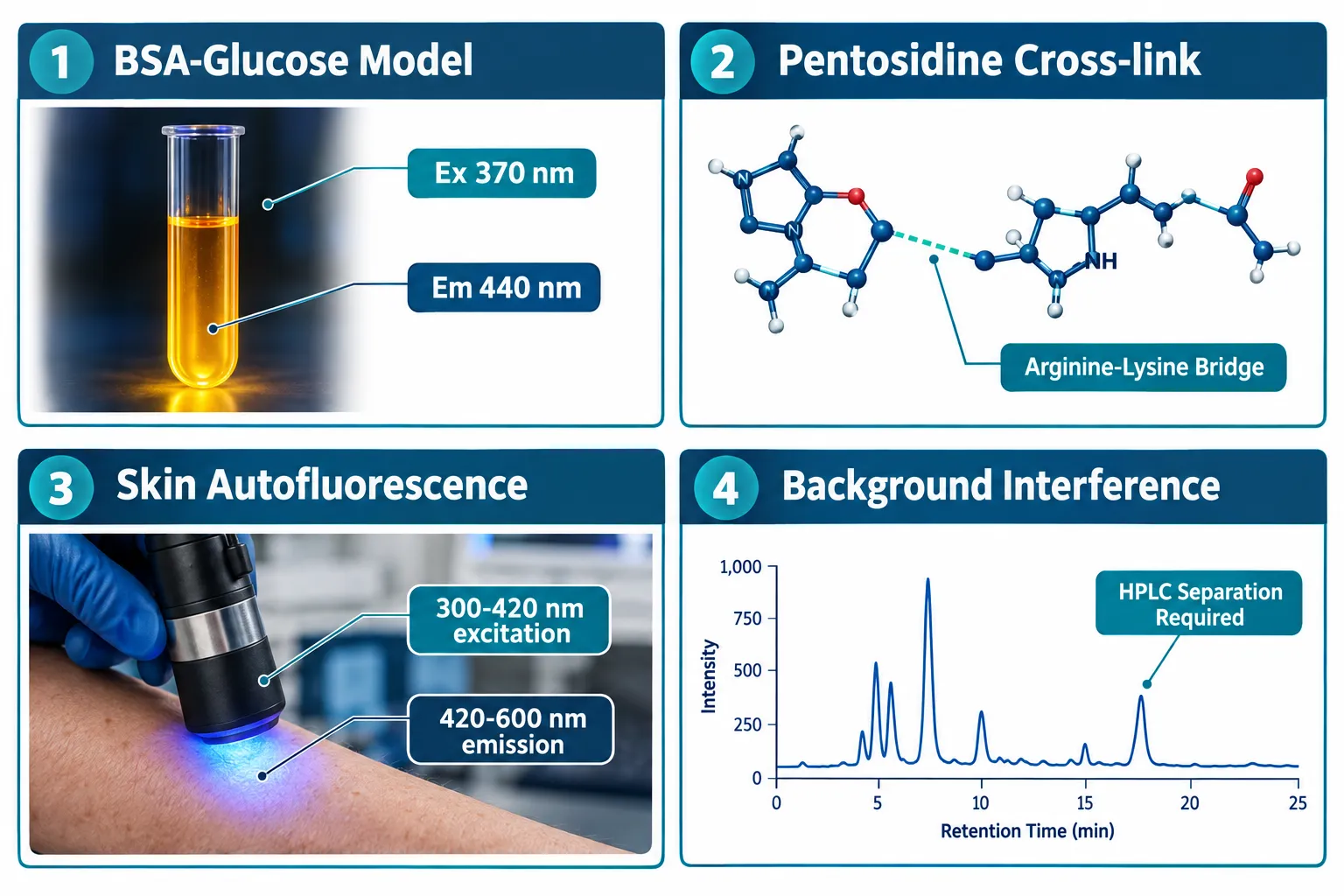
Setting Up the Glycation Model: The Foundation of Every Assay

Three models dominate the literature:

Model Primary AGEs Formed Best Readout
BSA + glucose (37 °C, 4-8 weeks) Pentosidine, CML, MOLD Fluorescence (Ex 370/Em 440 nm)
HSA + methylglyoxal (short incubation) MG-H1, CEL LC-MS/MS or ELISA
Collagen + ribose Cross-linked fAGEs, pentosidine Fluorescence + tensile assay

In a well-characterized in vitro study using the BSA-glucose model, novel peptides were screened for anti-glycation activity by measuring fluorescence at excitation 370 nm and emission 440 nm with a spectrofluorometer. This approach is cost-effective and scalable, but it captures only the fluorescent fraction of total AGEs.

Key point: Non-fluorescent AGEs such as pyrraline and CML will not appear in a standard fluorescence scan. If the research question involves receptor binding or cardiovascular risk markers, a fluorescence-only design is insufficient.


Fluorescence Readouts: Matching Excitation/Emission to the Target AGE

The fluorescence approach to Advanced Glycation End Products in Peptide Studies: Choosing Fluorescence, RAGE, and Oxidative-Stress Readouts is attractive because it requires no antibodies and delivers rapid throughput. However, precision depends on knowing the spectral fingerprint of each target species.

Major fluorescent AGEs and their windows:

  • Pentosidine, the first characterized natural fluorescent cross-link; excitation ~335 nm, emission ~385 nm
  • MOLD (methylglyoxal-lysine dimer), excitation ~370 nm, emission ~440 nm
  • Arg-P, useful for arginine-derived fAGE detection; recent mass spectrometry work has identified new cross-linked structures at arginine residues that extend this category

Cutaneous AGEs exhibit autofluorescence with excitation in the 300-420 nm range and emission between 420-600 nm, enabling non-invasive skin measurements. This principle underlies commercial skin autofluorescence readers used in diabetes monitoring.

"Background fluorescence from other sample components frequently obscures results, necessitating chromatographic or immunoassay-based separation for robust quantification."

A practical solution is the flow injection assay (FIA) integrated with HPLC, which has been validated for quantifying small fluorescent AGE-modified peptides in urine samples. For researchers evaluating skin-relevant peptides, the article on research-grade Glow Blend peptide purity and copper complexes provides useful context on how copper-complexed peptides interact with skin models where autofluorescence is a concern.


RAGE Signaling Panel: Moving Beyond Fluorescence
RAGE Signaling Panel: Moving Beyond Fluorescence

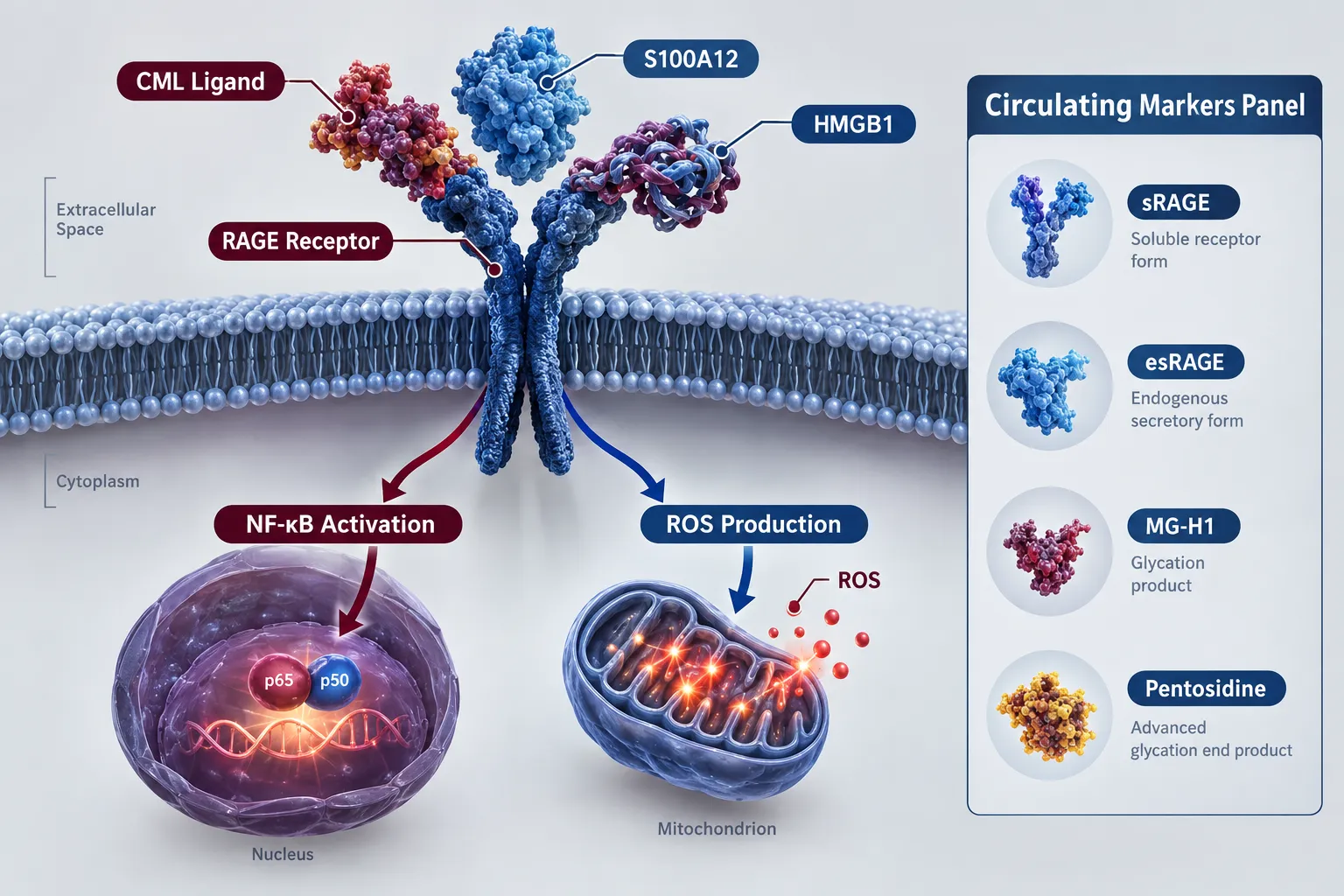
Fluorescence detects AGE accumulation, but RAGE activation is what drives pathological outcomes, NF-kB-mediated inflammation, fibrosis, and cardiomyopathy. A complete panel for Advanced Glycation End Products in Peptide Studies: Choosing Fluorescence, RAGE, and Oxidative-Stress Readouts should include both AGE ligands and RAGE-related circulating measures.

Recommended RAGE panel components:

  • AGE ligands: CML, CEL, MG-H1, pentosidine
  • Receptor variants: total soluble RAGE (sRAGE), endogenous secretory RAGE (esRAGE)
  • Danger-associated ligands: HMGB1, S100A12

The sRAGE/esRAGE ratio is particularly informative: soluble forms act as decoy receptors, sequestering AGE ligands before they engage membrane-bound RAGE. A high sRAGE level generally correlates with reduced signaling intensity.

For peptide studies with a metabolic focus, GLP-1 peptides and related incretin-axis compounds are increasingly studied in contexts where AGE-RAGE signaling intersects with glycemic control. Similarly, mitochondria-targeted peptides like SS-31 (Szeto-Schiller peptide) are evaluated in models where RAGE-driven oxidative stress is the primary endpoint, given their proposed role in mitochondrial membrane stabilization.

Measurement methods by marker:

  • CML, CEL, MG-H1: LC-MS/MS (gold standard) or competitive ELISA
  • sRAGE, esRAGE: sandwich ELISA
  • HMGB1, S100A12: ELISA or multiplex immunoassay

Oxidative-Stress Readouts: The Orthogonal Confirmation Layer
Oxidative-Stress Readouts: The Orthogonal Confirmation Layer

AGE formation and RAGE activation both generate reactive oxygen species (ROS), creating a self-amplifying loop. Oxidative-stress markers serve as orthogonal readouts that confirm biological impact without duplicating fluorescence or ELISA data.

Three-tier oxidative-stress readout strategy:

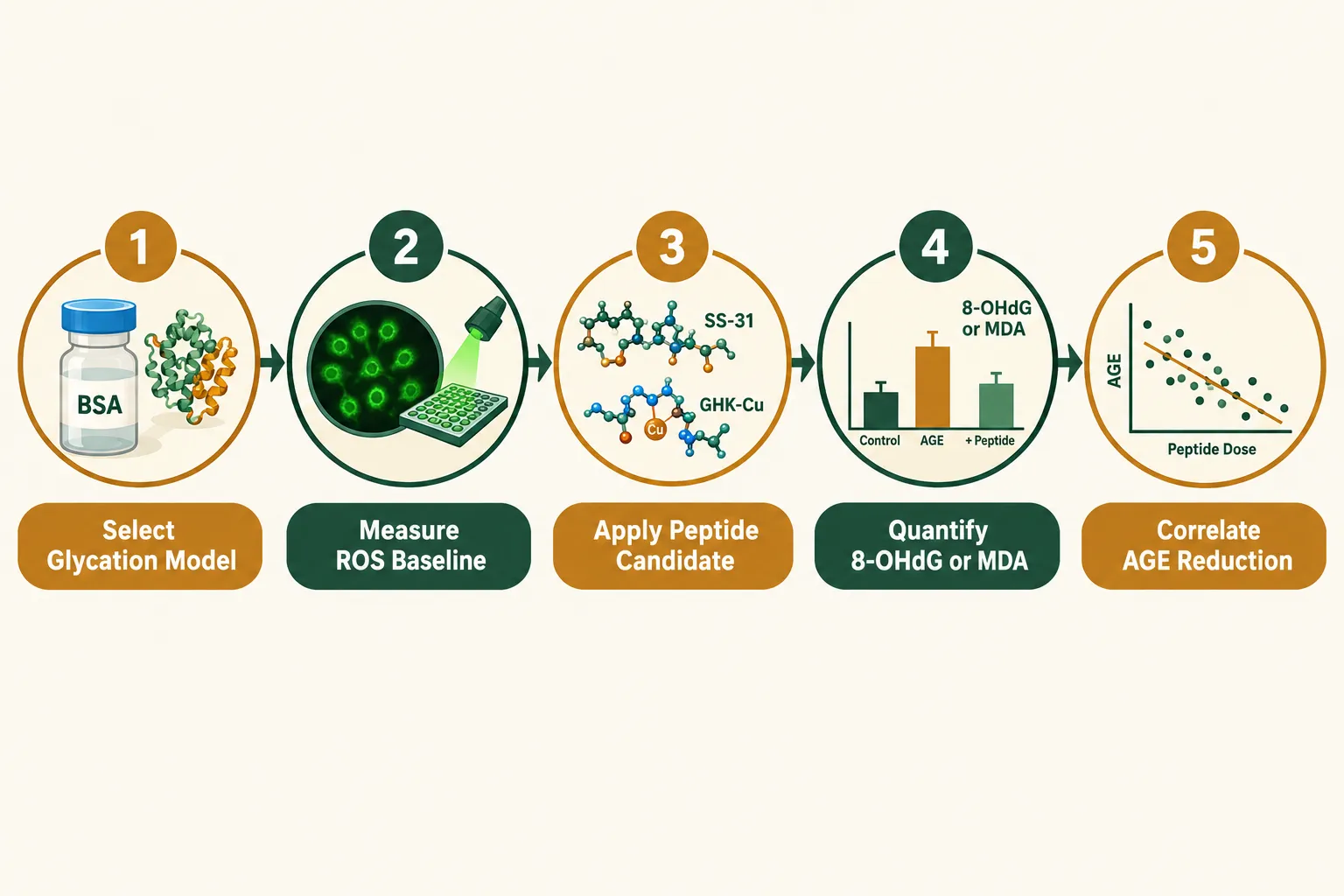
  1. ROS quantification, DCFH-DA fluorescence assay in cell-based models; captures real-time oxidative burst
  2. Lipid peroxidation, malondialdehyde (MDA) via TBARS assay; reflects membrane-level AGE-driven damage
  3. DNA oxidation, 8-hydroxy-2'-deoxyguanosine (8-OHdG) by ELISA; most specific marker of glycoxidative DNA stress

Anti-glycation agents such as metformin and pyridoxamine reduce fluorescent HSA-AGE emission intensity in HSA-dihydroxyacetone models, and this reduction correlates with decreased ROS output, demonstrating why pairing fluorescence with an ROS assay strengthens mechanistic claims.

Peptides under investigation for aging-related pathways, including those in the aging support category and mitochondria-focused compounds such as the Synergy of LL-37 and SS-31, are evaluated against these markers to assess whether observed effects align with reduced glycoxidative stress. Causal claims, however, require dose-response relationships and appropriate controls before they can be stated with confidence.

Practical tip: Always run a no-peptide glycation control and a non-glycated protein control in parallel. Without these, it is impossible to distinguish peptide-driven AGE reduction from assay variability.


Conclusion

Designing a rigorous AGE study for peptide research comes down to three sequential decisions: choose the right glycation model for the target AGE species, select fluorescence readouts matched to those species' spectral windows, and add RAGE panel markers plus orthogonal oxidative-stress assays to confirm biological relevance. Researchers should resist the temptation to rely on a single fluorescence scan as a complete answer, it captures only the fluorescent fraction and misses non-fluorescent species like CML and pyrraline that drive RAGE signaling.

Actionable next steps for 2026 research teams:

  • Establish the BSA-glucose or HSA-methylglyoxal model before introducing any peptide candidate
  • Run fluorescence scans at Ex 370/Em 440 nm alongside LC-MS/MS for CML and MG-H1
  • Include sRAGE and esRAGE ELISAs to assess receptor-level activity
  • Add at minimum one oxidative-stress readout (MDA or 8-OHdG) per experimental arm
  • Document all purity and concentration data for peptide candidates to ensure reproducibility across labs
Tags: advanced glycation end-products, age assay design, fluorescence readouts, glycation models, oxidative stress markers, pentosidine detection, peptide research, rage signaling
https://www.puretestedpeptides.com/wp-content/uploads/2026/09/advanced-glycation-end-products-in-peptide-studies-choosing-fluorescence-rage-an.webp 1024 1536 https://www.puretestedpeptides.com/wp-content/uploads/2026/01/buy-peptides-online.jpg 2026-09-27 13:03:402026-09-27 13:03:40Advanced Glycation End Products in Peptide Studies: Choosing Fluorescence, RAGE, and Oxidative-Stress Readouts
You might also like
Phosphate-Buffered Saline for Peptide Research: Osmolality, pH Drift, and Vehicle-Control Design Phosphate-Buffered Saline for Peptide Research: Osmolality, pH Drift, and Vehicle-Control Design
Peptides and Polypeptides in Modern Research: How Molecular Size Shapes Function, Stability, and Experimental Design Peptides and Polypeptides in Modern Research: How Molecular Size Shapes Function, Stability, and Experimental Design
Lisinopril, ACE Pathways, and Growth Hormone Secretagogues: Designing Safe Peptide Research With Cardiovascular Readouts Lisinopril, ACE Pathways, and Growth Hormone Secretagogues: Designing Safe Peptide Research With Cardiovascular Readouts
Best Research‑Use GH Secretagogue Peptides: Comparing CJC‑1295 (With and Without DAC), Ipamorelin, and Tesamorelin Best Research‑Use GH Secretagogue Peptides: Comparing CJC‑1295 (With and Without DAC), Ipamorelin, and Tesamorelin
LDL Cholesterol and Peptide Research: How to Interpret Lipid Changes When Weight Loss and Food Intake Also Shift LDL Cholesterol and Peptide Research: How to Interpret Lipid Changes When Weight Loss and Food Intake Also Shift
Selank Peptide: Exploring Its Anxiolytic and Nootropic Mechanisms for Cognitive Research Selank Peptide: Exploring Its Anxiolytic and Nootropic Mechanisms for Cognitive Research
PT-141 Peptide: Investigating Its Melanocortin Receptor Agonism and Applications in Sexual Function Research PT-141 Peptide: Investigating Its Melanocortin Receptor Agonism and Applications in Sexual Function Research
Semax Peptide Nasal Spray: Mechanism, Use Cases, and What Researchers Compare Before Buying Semax Peptide Nasal Spray: Mechanism, Use Cases, and What Researchers Compare Before Buying
0 replies

Leave a Reply

Want to join the discussion?
Feel free to contribute!

Leave a Reply Cancel reply

Your email address will not be published. Required fields are marked *

×

Helpful Links

  • My account
  • Cart
  • Checkout
  • Refund and Returns Policy
  • Privacy Policy
  • SMS Privacy Policy
  • Login
  • My Account
  • Logout

USA Made Lab Tested Peptides

All products are sold for research, laboratory, or analytical purposes only, and are not for human consumption


Pure Tested Peptides is a chemical supplier. Pure Tested Peptides is not a compounding / chemical compounding facility as defined under 503A of the Federal Food, Drug, and Cosmetic act. Pure Tested Peptides is not an outsourcing facility as defined under 503B of the Federal Food, Drug, and Cosmetic act.

The statements made within this website have not been evaluated by the US Food and Drug Administration. The products we offer are not intended to diagnose, treat, cure or prevent any disease.

Human/Animal Consumption Prohibited. Laboratory/In-Vitro Experimental Use Only

Link to: ACE Inhibitors and Research Peptides: Designing Blood-Pressure Controls Around Lisinopril and Growth-Hormone Secretagogues Link to: ACE Inhibitors and Research Peptides: Designing Blood-Pressure Controls Around Lisinopril and Growth-Hormone Secretagogues ACE Inhibitors and Research Peptides: Designing Blood-Pressure Controls Around...ACE Inhibitors and Research Peptides: Designing Blood-Pressure Controls Around Lisinopril and Growth-Hormone Secretagogues Link to: Biologically Effective Dose in Peptide Experiments: Translating Nominal Concentration Into Exposure and Response Link to: Biologically Effective Dose in Peptide Experiments: Translating Nominal Concentration Into Exposure and Response Biologically Effective Dose in Peptide Experiments: Translating Nominal Concentration Into Exposure and ResponseBiologically Effective Dose in Peptide Experiments: Translating Nominal Concentration...
Scroll to top Scroll to top Scroll to top