Call or Text 727-513-9780
  • Shopping Cart Shopping Cart
    0Shopping Cart
Pure Tested Peptides | America's most trusted Peptides for sale online
  • Peptides for sale
    • Oral Peptides for sale
      • Peptide Capsules for sale
      • BPC 157 Capsules 1000mcg
      • SLU-PP-332 Capsules | 1000 mcg
      • 5-Amino-1MQ 50mg Capsules
      • Tesofensine 500mcg
    • All Peptides for sale
    • Peptide Sprays
      • BPC 157 Nasal Spray Kit
      • BPC-157 TB500 Nasal Spray Kit
      • Semax Nasal Spray 10mg
      • Selank – Nasal Spray Kit – 10mg
      • Epithalon 50MG Nasal Spray Kit
      • Ipamorelin 10mg Nasal Spray
      • Klow Nasal Spray (BPC-157 + TB-500 + GHK-Cu + KPV) | 80mg
      • Hulk Nasal Spray Tesa / Ipa Blend 6/3 MG
      • Klow Nasal Spray
      • NAD + 500 mg Nasal Spray
      • PT-141 Nasal Spray Kit
    • GHRH Peptides
      • Ipa Peptides
      • CJC-1295 Peptides
        • CJC-1295 with DAC 5 mg
        • CJC-1295 without DAC 5 mg
        • CJC-1295 Ipa 10mg
      • Tesa Peptides
        • Tesa Peptide
        • Tesa 20 mg
    • GHK-Cu Peptides
      • All GHK-Cu Peptides
      • GHK-Cu 100mg
      • KLOW Peptide Blend – Buy KLOW blend online
    • BPC Peptides
      • All BPC Peptides
      • BPC-157
      • BPC-157 TB-500
      • BPC 157 capsules 1000mcg
    • SLU-PP-332 Peptides
      • All SLU-PP-332 Peptides
      • SLU-PP-332 5mg
    • GLP3 Peptides
      • GLP3-R
      • GLP3-R CAG 10mg
      • GLP3-R 20mg
    • PT-141 Peptides
      • PT-141 Peptides for sale
      • PT-141 10mg
      • PT-141 Nasal Spray
    • CAG Peptides
      • Lipo-C Peptide Blend
      • CAG 5mg
      • CAG 10mg
    • MOTS-C Peptides
      • MOTS-C Peptides for sale
      • MOTS-c peptide
      • MOTS-c 10mg *6 pack*
    • 5 Amino 1MQ Peptides
      • 5 Amino 1MQ Peptides for sale
      • 5-Amino-1MQ 50mg Capsules
      • 5-Amino-1MQ 5mg
    • Epithalon Peptides
      • Epithalon Peptides for sale
      • Epithalon 10mg
      • Epithalon 50mg
  • Shop
    • GLPs
      • 5-Amino-1MQ 50mg Capsules
      • 5-Amino-1MQ 5mg
      • GLP3-Reta
      • L-Carnitine 500mg/ml
      • Tesofensine 500mcg
      • SLU-PP-332 5mg
      • MOTS-c 10mg *6 pack*
    • Epithalon & BPC Peptides
      • Epithalon 10mg
      • Epithalon 50mg
      • BPC-157
      • BPC 157 capsules 1000mcg
      • BPC-157 TB-500
      • BPC-157 TB500 Nasal Spray Kit
      • BPC 157 Nasal Spray Kit
    • BPC TB-500 & NAD+ Peptides
      • NAD+ 500 mg
      • KLOW Peptide Blend – Buy KLOW blend online
      • GLOW Peptide Blend
      • TB 500 5mg
      • BPC 157 capsules 1000mcg – Supplement
      • BPC 157 Nasal Spray Kit
      • BPC-157
      • BPC-157 TB500 Nasal Spray Kit
      • BPC-157 TB-500
      • BPC 157 capsules 1000mcg
    • LL-37 Peptide
      • LL-37 10 mg
    • MOTS-C & Selank
      • MOTS-c peptide
      • Selank 10mg
    • GHK Peptides
      • GHK-Cu 100mg
      • GLOW Peptide Blend
      • KLOW Peptide Blend – Buy KLOW blend online
  • COAs
  • Wholesale
    • Wholesale Peptides for sale
  • PTP FAQ
  • Affiliates
    • Selank Peptide: Advanced Pharmacological Mechanisms Underlying Its Anxiolytic and Nootropic Effects in Research
      • 5-Amino-1MQ Peptide: Detailed Mechanisms of NNMT Inhibition and Its Impact on Cellular Metabolism Research
        • MOTS-C Peptide: Unraveling Its Role in Mitochondrial Dynamics and Energy Metabolism Research
          • Epithalon Peptide and Telomerase Regulation: Investigating Its Impact on Cellular Senescence and Lifespan Research Models
            • GLP2-T vs GLP2 Tirz Peptide: Understanding the Naming, Mechanistic Nuances, and Research Implications for Gut Health
      • Peptides and Polypeptides in Modern Pharmacology: What Research on Metoprolol, Prednisone, and Amlodipine Reveals
        • Polypeptide Peptides vs NSAIDs: What Naproxen and Diclofenac Teach Tissue-Repair Researchers About BPC‑157 and TB‑500
          • Peptides and Polypeptides in Endocrine Pharmacology: How GLP-1, GLP-2, and GLP-3 Retatrutide Differ From Classic Drugs Like Prednisone and Amlodipine
          • 5‑Amino‑1MQ Peptide and NNMT Inhibition: How It Compares With Statins Like Atorvastatin in Adipose and Lipid Metabolism Research
      • Enclomiphene, Estrogen Receptor Signaling, and Luteinizing Phase Biology: What Hormone Researchers Should Measure
        • Mesenchymal Stem Cells, BPC‑157, and GHK‑Cu: How Tissue Repair Peptides Compare With Classic NSAIDs Like Naproxen in Injury Models
          • Peptide Calculator Use Cases Beyond Growth Hormone: Working Through GLP‑3 Retatrutide, MOTS‑c, and BPC‑157 Research Dosing
        • Polypeptide Peptides in Endocrine and Metabolic Pharmacology: Lessons From Amlodipine, Prednisone, and Metoprolol
        • Peptides Calculator for Advanced Blends: Worked Examples for Tesamorelin, CJC‑1295, and Ipamorelin Stacks
          • Peptides and Polypeptides in Human Physiology: How Molecular Size Shapes Research Applications
            • Selank Peptide: Advanced Pharmacological Mechanisms Underlying Its Anxiolytic and Nootropic Effects in Research
          • 5-Amino-1MQ Peptide: Detailed Mechanisms of NNMT Inhibition and Its Impact on Cellular Metabolism Research
            • MOTS-C Peptide: Unraveling Its Role in Mitochondrial Dynamics and Energy Metabolism Research
              • Epithalon Peptide and Telomerase Regulation: Investigating Its Impact on Cellular Senescence and Lifespan Research Models
                • GLP2-T vs GLP2 Tirz Peptide: Understanding the Naming, Mechanistic Nuances, and Research Implications for Gut Health
                  • Peptides and Polypeptides in Endocrine Pharmacology: How GLP-1, GLP-2, and GLP-3 Retatrutide Differ From Classic Drugs Like Prednisone and Amlodipine
                    • Polypeptide Peptides vs NSAIDs: What Naproxen and Diclofenac Teach Tissue-Repair Researchers About BPC‑157 and TB‑500
                      • Peptides and Polypeptides in Modern Pharmacology: What Research on Metoprolol, Prednisone, and Amlodipine Reveals
                        • 5‑Amino‑1MQ Peptide and NNMT Inhibition: How It Compares With Statins Like Atorvastatin in Adipose and Lipid Metabolism Research
                        • Enclomiphene, Estrogen Receptor Signaling, and Luteinizing Phase Biology: What Hormone Researchers Should Measure
                        • Mesenchymal Stem Cells, BPC‑157, and GHK‑Cu: How Tissue Repair Peptides Compare With Classic NSAIDs Like Naproxen in Injury Models
                        • Peptide Calculator Use Cases Beyond Growth Hormone: Working Through GLP‑3 Retatrutide, MOTS‑c, and BPC‑157 Research Dosing
                        • Polypeptide Peptides in Endocrine and Metabolic Pharmacology: Lessons From Amlodipine, Prednisone, and Metoprolol
                        • Peptides Calculator for Advanced Blends: Worked Examples for Tesamorelin, CJC‑1295, and Ipamorelin Stacks
                        • Peptides and Polypeptides in Human Physiology: How Molecular Size Shapes Research Applications
                        • Selank Peptide: Advanced Pharmacological Mechanisms Underlying Its Anxiolytic and Nootropic Effects in Research
                        • MOTS-C Peptide: Unraveling Its Role in Mitochondrial Dynamics and Energy Metabolism Research
                        • Peptides and Polypeptides in Modern Pharmacology: What Research on Metoprolol, Prednisone, and Amlodipine Reveals
                        • Peptides and Polypeptides in Endocrine Pharmacology: How GLP-1, GLP-2, and GLP-3 Retatrutide Differ From Classic Drugs Like Prednisone and Amlodipine
                        • 5-Amino-1MQ Peptide: Detailed Mechanisms of NNMT Inhibition and Its Impact on Cellular Metabolism Research
                        • Mesenchymal Stem Cells, BPC‑157, and GHK‑Cu: How Tissue Repair Peptides Compare With Classic NSAIDs Like Naproxen in Injury Models
                        • Peptide Calculator Use Cases Beyond Growth Hormone: Working Through GLP‑3 Retatrutide, MOTS‑c, and BPC‑157 Research Dosing
                        • GLP2-T vs GLP2 Tirz Peptide: Understanding the Naming, Mechanistic Nuances, and Research Implications for Gut Health
                        • Polypeptide Peptides in Endocrine and Metabolic Pharmacology: Lessons From Amlodipine, Prednisone, and Metoprolol
                        • Polypeptide Peptides vs NSAIDs: What Naproxen and Diclofenac Teach Tissue-Repair Researchers About BPC‑157 and TB‑500
                        • Peptides and Polypeptides in Human Physiology: How Molecular Size Shapes Research Applications
                        • Peptides Calculator for Advanced Blends: Worked Examples for Tesamorelin, CJC‑1295, and Ipamorelin Stacks
                        • 5‑Amino‑1MQ Peptide and NNMT Inhibition: How It Compares With Statins Like Atorvastatin in Adipose and Lipid Metabolism Research
                        • Enclomiphene, Estrogen Receptor Signaling, and Luteinizing Phase Biology: What Hormone Researchers Should Measure
                        • Epithalon Peptide and Telomerase Regulation: Investigating Its Impact on Cellular Senescence and Lifespan Research Models
                        • Best research protocol Klow blend
                        • best time to take BPC-157
                        • best time to take DSIP (Delta Sleep Inducing Peptide)
                        • best time to take CJC-1295
                        • best time to take AOD-9604
                        • best time to take Follistatin 344
                        • best time to take Ipamorelin
                        • best time to take MK-677 (Ibutamoren)
                        • best time to take Ligandrol (LGD-4033) — research compound
                        • best time to take Ostarine (MK-2866) — research compound
                        • best time to take GHK-CU
                        • best time to take TB-500
                        • best time to take MOTS-c
                        • best time to take Semax
                        • best time to take RAD-140 (Testolone) — research compound
                        • best time to take Thymosin Alpha-1
                        • best time to take PEG-MGF
                        • Biolife Plasma, Octapharma Plasma, and Research Peptides: How Plasma Donation Labs Differ From Peptide Suppliers
                        • best time to take YK-11 — research compound
                        • best time to take PT-141 (Bremelanotide)
                        • Best research protocol Klow blend
                        • 5-Amino-1MQ and MOTS-C Synergy: Metabolic Signaling, Mitochondria, and Research Design
                        • BPC-157 and TB-500: Investigating Their Combined Effects on Angiogenesis and Cellular Migration in Tissue Repair Models
                        • BPC-157 Peptide: Gut Barrier Function, Inflammation, and Tissue-Recovery Research
                        • 5‑Amino‑1MQ and MOTS‑c Synergy in Metabolic Research: Designing NNMT and Mitochondrial Biogenesis Stacks
                        • CJC-1295 with DAC vs. Without DAC: Half-Life, Release Kinetics, and Research Implications
                        • CJC‑1295 with DAC vs. Without DAC: Expanding on Half‑Life Differences Using Tesamorelin and Ipamorelin Blend Case Studies
                        • Collagen Biology and Copper‑Binding Peptides: How GHK‑Cu, Glow Blend, and Klow Blend Interact with Skin and Connective Tissue
                        • Collagen Biology and Regenerative Peptides: How GHK‑Cu, Glow Blend, and Klow Blend Affect Extracellular Matrix Research
                    • DNA, Telomeres, and Longevity Peptides: Positioning Epithalon and MOTS‑c in Genetic Aging Research
                      • Enclomiphene Citrate: serm Mechanism, Testosterone Research, and Stack Compatibility
                        • Enclomiphene vs Enclomiphene Citrate: Formulation, Bioavailability, and Research Distinctions
                        • Epithalon Peptide Research: Telomerase Activation, Aging, and Pineal Gland Function
                        • Estrogen Receptor Signaling and Enclomiphene: How Selective Modulators Compare with Classic Polypeptide Hormones
                        • GHK-Cu Peptide: Advanced Mechanisms in Extracellular Matrix Remodeling and Wound Healing Research
                        • GHK-Cu Peptide: Collagen Synthesis, Wound Repair, and Skin-Barrier Research Models
                        • GLP-1 vs GLP-3 vs GLP-2: Peptide Classification and Research Applications
                        • GLP-2 Peptide Research Guide: Gut Barrier Function, Nutrient Absorption, and Intestinal Recovery Models
                        • GLP-3 Retatrutide vs. GLP-1 Drugs: What Triple-Agonist Biology Changes in Research Models
                        • Ipamorelin and Tesamorelin Combination: Synergistic GH Secretagogue Research and Dosing Protocols
                        • GLP2 Tirz Peptide: What It Is, Why the Name Exists, and How Researchers Should Interpret It
                        • Klow Blend Peptide Nasal Spray: What the Formulation Is Trying to Do in Cognitive Research
                        • Mitochondria, NNMT Inhibition, and Peptide Modulators: Where MOTS‑c and 5‑Amino‑1MQ Fit in Cellular Energy Research
                        • MOTS-c Peptide: Mitochondrial Function, Energy Metabolism, and What Researchers Measure
                        • MOTS-c vs. 5-Amino-1MQ: Which Metabolic Research Questions Each Compound Actually Answers
                        • Nasal Spray Peptides: Bioavailability, Administration, and Semax/Selank Research Applications
                        • PT-141 Peptide Research: Mechanism of Action and Melanocortin Receptor Signaling
                        • Retatrutide for Research: Mechanism, Structure, and GLP-1/GLP-3 Dual Action
                        • Retatrutide for Obesity and Type 2 Diabetes: What the Latest Trial Data Suggest
                        • Tesofensine Peptide Research: Mechanism, Appetite Suppression, and Neuropeptide Y Pathways
  • Contact
    • Contact Customer Service
    • Text Customer Support
  • About US
  • Shop all peptides
  • Affiliate Program
    • Affiliate Signup
  • Login / Register Login / Register Page Link Login / Register Page Link
  • Click to open the search input field Click to open the search input field Search
  • Menu Menu
Selank Peptide: Exploring Its Anxiolytic and Nootropic Mechanisms for Cognitive Research

Selank Peptide: Exploring Its Anxiolytic and Nootropic Mechanisms for Cognitive Research

August 24, 2026/0 Comments/in Uncategorized/by

Fewer than one in five people with generalized anxiety disorder achieve full remission with first-line pharmacotherapy, a stubborn gap that has pushed researchers toward novel peptide-based compounds. Among these, the Selank peptide stands out as a subject of serious scientific inquiry, offering a dual profile of anxiolytic and potential nootropic activity that distinguishes it sharply from conventional benzodiazepine treatments. Selank Peptide: Exploring Its Anxiolytic and Nootropic Mechanisms for Cognitive Research has become an increasingly active area in 2026, as laboratories seek safer, more targeted tools for studying stress, cognition, and neuroplasticity.

Key Takeaways

  • Selank is a synthetic heptapeptide derived from the endogenous immunomodulatory peptide tuftsin, with a well-characterized anxiolytic profile in preclinical and clinical models.
  • Its primary mechanisms involve allosteric modulation of GABA-A receptors, stabilization of enkephalins, and upregulation of brain-derived neurotrophic factor (BDNF).
  • Unlike benzodiazepines, Selank does not appear to produce sedation, tolerance, or significant dependency in research settings.
  • Preliminary clinical data supports efficacy in generalized anxiety disorder, with cognitive enhancement effects observed alongside anxiolysis.
  • As of 2026, Selank remains a research compound in most jurisdictions, available for laboratory use through verified peptide suppliers.

What Is Selank and How Was It Developed

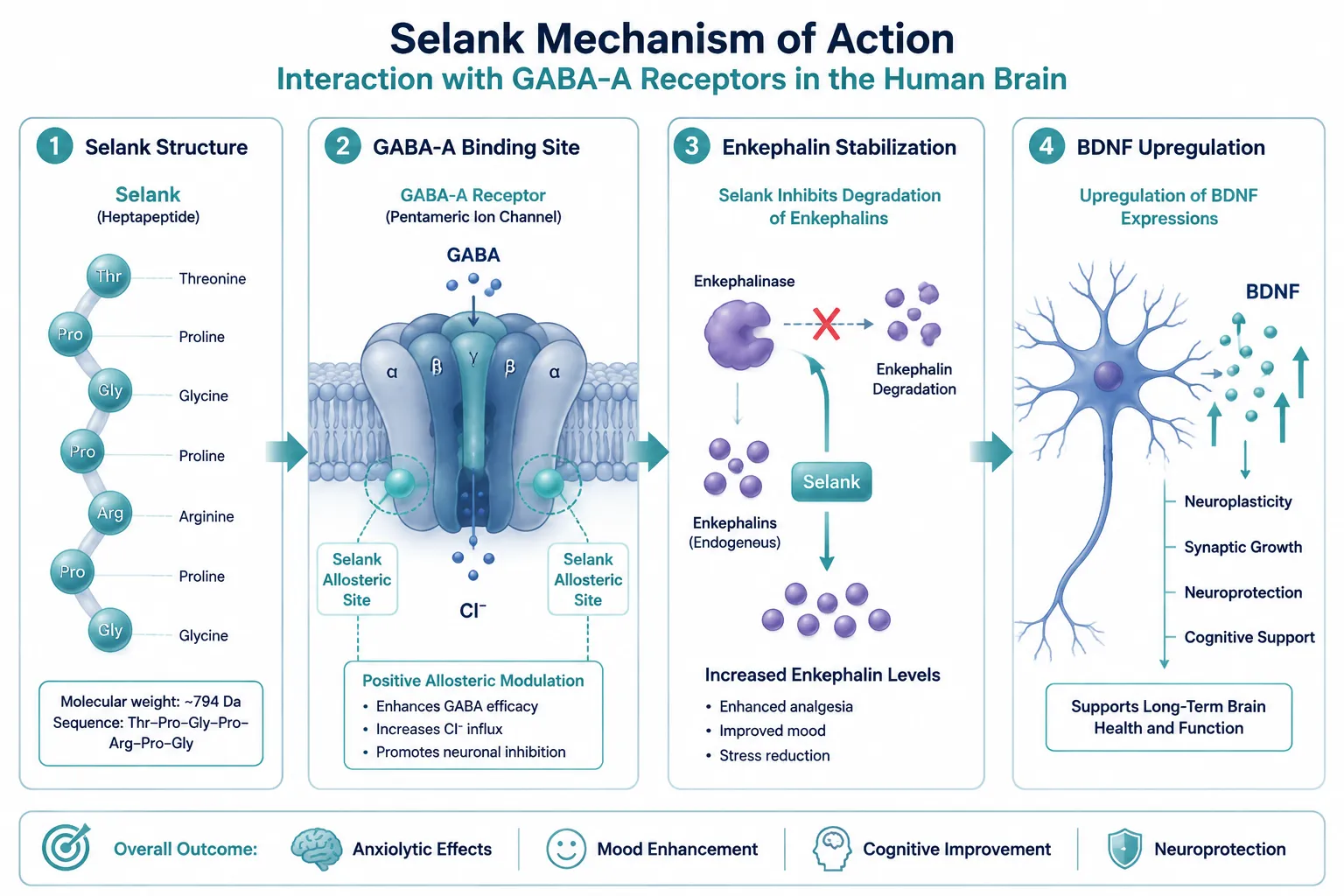
Selank (Thr-Lys-Pro-Arg-Pro-Gly-Pro) is a synthetic analog of tuftsin, a naturally occurring tetrapeptide fragment of immunoglobulin G. Russian researchers at the Institute of Molecular Genetics developed Selank by extending the tuftsin sequence to improve metabolic stability and central nervous system penetration. The addition of the Pro-Gly-Pro sequence dramatically slows enzymatic degradation, giving the peptide a longer effective window of action compared to its parent compound.

Understanding peptide classification frameworks helps researchers contextualize Selank within the broader landscape of neuropeptides, distinguishing it from growth-hormone-releasing peptides or metabolic peptides studied for different endpoints.
What Is Selank and How Was It Developed

Selank was granted approval in Russia for clinical use in anxiety disorders and as a nootropic agent, making it one of the few peptides to cross from research into regulated medical application in any jurisdiction. This regulatory history provides a meaningful evidence base that many newer peptides lack entirely.

Selank Peptide: Exploring Its Anxiolytic and Nootropic Mechanisms for Cognitive Research

GABA-A Allosteric Modulation

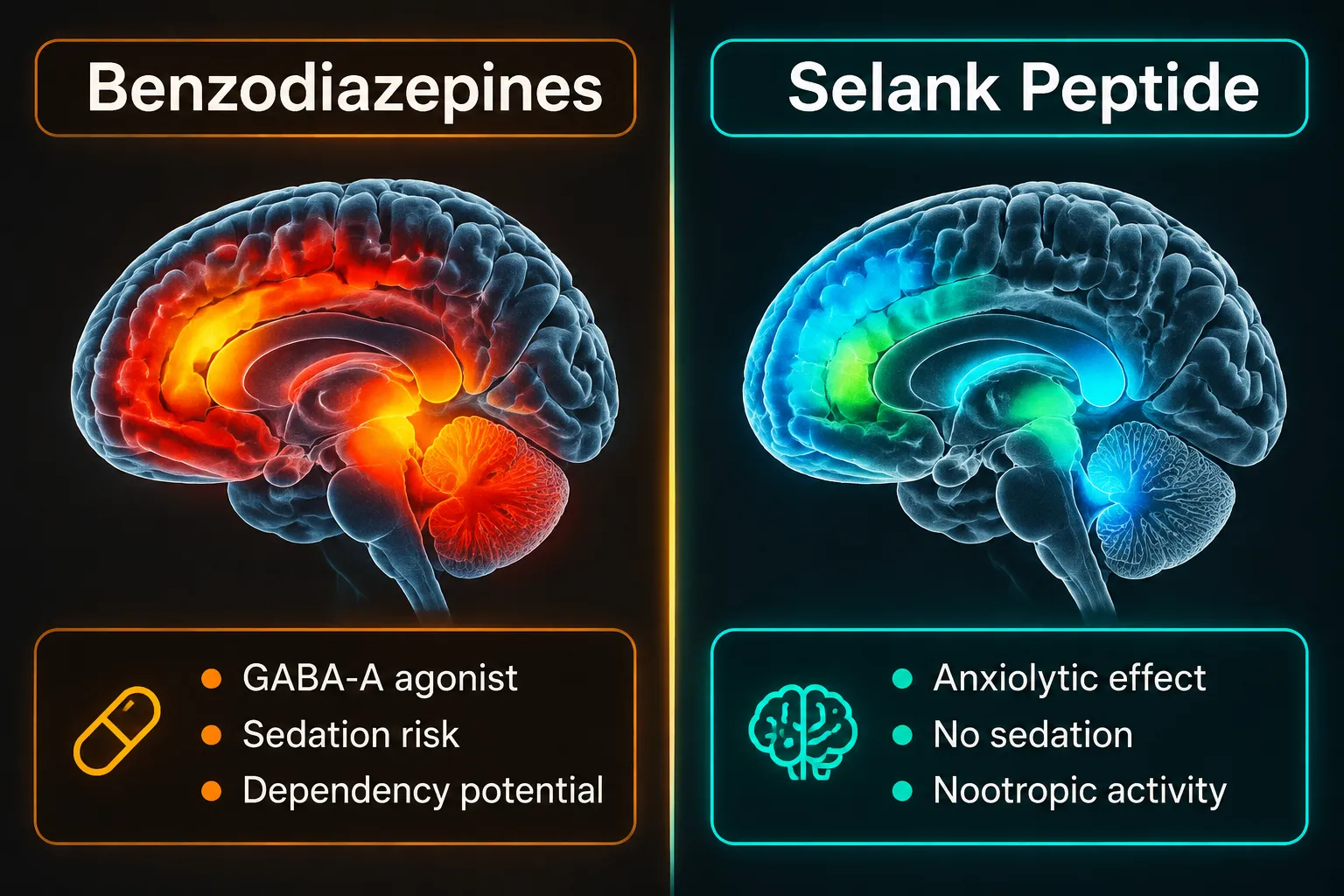
The most well-documented anxiolytic mechanism of Selank involves its interaction with the GABA-A receptor complex. Rather than acting as a direct agonist, Selank appears to function as an allosteric modulator, enhancing the receptor's sensitivity to endogenous GABA without flooding the system with exogenous activation. This distinction is critical.

"Allosteric modulation preserves the physiological feedback loop, which is precisely why Selank's anxiolytic effect does not carry the sedation and dependency burden seen with classical benzodiazepines."

Benzodiazepines bind directly to the benzodiazepine site on GABA-A receptors and produce broad, non-selective inhibition across the CNS. Selank's modulatory approach appears to produce a more targeted calming effect, preserving alertness and cognitive function, a profile highly relevant to nootropic research applications.

Enkephalin Stabilization and Stress Response

Selank also inhibits enzymes responsible for degrading endogenous enkephalins, a class of opioid peptides involved in mood regulation and stress response. By extending enkephalin half-life, Selank amplifies the natural stress-buffering system without introducing exogenous opioid activity. This mechanism complements its GABAergic effects and may explain the compound's observed ability to reduce anxiety without blunting emotional responsiveness.
Enkephalin Stabilization and Stress Response

BDNF Upregulation and Nootropic Activity

Perhaps the most compelling aspect of Selank Peptide: Exploring Its Anxiolytic and Nootropic Mechanisms for Cognitive Research is its reported effect on brain-derived neurotrophic factor. BDNF is a key regulator of neuroplasticity, synaptic strengthening, and long-term memory consolidation. Preclinical data consistently shows Selank elevating BDNF expression in hippocampal tissue, a finding that aligns with observed improvements in learning and memory tasks in animal models.

This places Selank in a meaningful comparative context alongside other neuropeptides. Researchers interested in neurogenesis and synaptic plasticity may find value in reviewing Semax and Selank peptides comparative research on neurogenesis and synaptic plasticity, which examines how these two compounds differ in their neurotrophin profiles.

Selank also modulates serotonin metabolism and dopaminergic activity, contributing to its pro-cognitive effects. Elevated serotonin turnover in the prefrontal cortex has been linked to improved working memory and executive function, outcomes that make Selank a compound of genuine interest in cognitive research protocols.

Clinical Evidence and Safety Profile

Generalized Anxiety Disorder Trials

Clinical trials conducted primarily in Russia demonstrated that Selank produced statistically significant reductions in anxiety scores in patients with generalized anxiety disorder. In one key trial, approximately 70% of participants showed meaningful symptom improvement, a response rate comparable to benzodiazepines but without the associated sedation or cognitive impairment. Cognitive performance metrics, including attention, processing speed, and memory recall, either held steady or improved during Selank administration.

Comparative Safety Advantages

Feature Benzodiazepines Selank
Anxiolytic effect Strong Moderate to strong
Sedation risk High Low
Dependency potential Significant Not observed in research
Cognitive impairment Common Not observed; may improve
BDNF modulation None reported Upregulation observed

The absence of withdrawal symptoms in research models is a particularly notable finding. Researchers working under hormone research protocols that require sustained cognitive baselines may find Selank's non-sedating profile especially relevant to study design.

Research Applications and Sourcing Considerations in 2026

Current Research Landscape

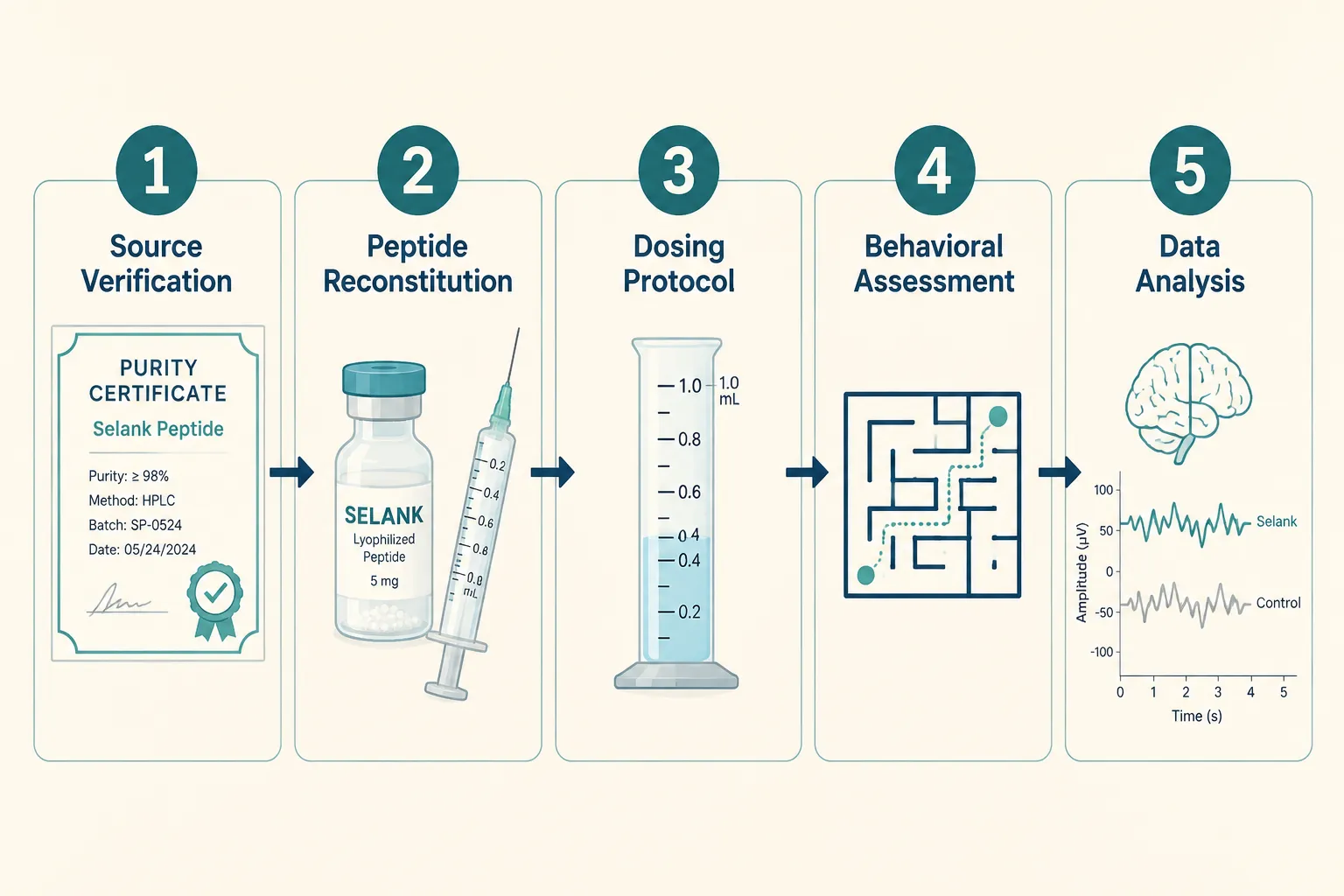
As of 2026, Selank remains a research-only compound outside Russia and a few other jurisdictions. Its use is restricted to laboratory and investigational contexts in most Western countries. Researchers are actively exploring its applications in anxiety modeling, cognitive enhancement protocols, neuroinflammation studies, and stress-resilience research.
Current Research Landscape

For researchers designing studies, sourcing high-purity material is non-negotiable. High purity peptide sourcing guidelines emphasize the importance of certificate of analysis documentation, third-party testing, and validated synthesis standards. Reviewing peptide CoA requirements before procurement ensures that experimental results reflect the compound's true activity rather than contaminant interference.

Researchers comparing peptide benchmarking standards may also benefit from reviewing Bachem and reference standards: building robust peptide benchmarks, which outlines how reference-grade materials improve reproducibility across studies.

Evidence Gaps and Future Directions

Expert commentary in 2025 and 2026 consistently identifies the need for large-scale, double-blind, placebo-controlled trials outside Russia. Most existing clinical data comes from a single regulatory system, limiting generalizability. Mechanistic studies using modern neuroimaging and receptor-binding assays are expected to clarify Selank's precise site of action at GABA-A subtypes, a question that remains partially open. Speculation within the research community suggests that subtype-selective modulation may ultimately explain why Selank produces anxiolysis without sedation, though this remains to be confirmed.

Conclusion

Selank peptide represents one of the more scientifically grounded compounds in the neuropeptide research space, combining a multi-target anxiolytic mechanism with credible nootropic activity. Its GABA-A modulatory action, enkephalin stabilization, and BDNF upregulation collectively form a mechanistic profile that distinguishes it from both classical anxiolytics and simple cognitive enhancers.

Actionable next steps for researchers in 2026:

  • Review existing Russian clinical trial data as a baseline for study design, while planning for independent replication.
  • Prioritize sourcing from suppliers who provide third-party CoA documentation and validated purity standards.
  • Design protocols that capture both anxiolytic endpoints and cognitive performance metrics to exploit Selank's dual-action profile.
  • Monitor emerging neuroimaging literature for GABA-A subtype specificity data, which will refine dosing and application hypotheses.
  • Consider comparative designs alongside structurally related peptides to isolate mechanism-specific effects.

The evidence base for Selank, while still maturing, is substantive enough to justify serious investigational attention. Researchers who engage with it rigorously, with verified materials and well-controlled protocols, are positioned to contribute meaningfully to one of the more promising frontiers in cognitive and anxiety research.

Tags: anxiolytic peptides, bdnf upregulation, cognitive enhancement, gaba-a modulation, neuropeptides, nootropic research, peptide research, selank peptide
https://www.puretestedpeptides.com/wp-content/uploads/2026/08/selank-peptide-exploring-its-anxiolytic-and-nootropic-mechanisms-for-cognitive-r.webp 1024 1536 https://www.puretestedpeptides.com/wp-content/uploads/2026/01/buy-peptides-online.jpg 2026-08-24 13:03:492026-08-24 13:03:49Selank Peptide: Exploring Its Anxiolytic and Nootropic Mechanisms for Cognitive Research
You might also like
Peptides vs Polypeptides: How Molecular Size and Structure Change Research Questions Peptides vs Polypeptides: How Molecular Size and Structure Change Research Questions
Research-Use Only Nasal Spray Peptides: Comparing Semax, Selank, and Klow Nasal for Cognitive and Anxiolytic Models Research-Use Only Nasal Spray Peptides: Comparing Semax, Selank, and Klow Nasal for Cognitive and Anxiolytic Models
Peptides Mechanism 101: From GLP‑3 Retatrutide to CJC‑1295 and MOTS‑c in Cellular and Receptor-Level Research Peptides Mechanism 101: From GLP‑3 Retatrutide to CJC‑1295 and MOTS‑c in Cellular and Receptor-Level Research
Epithalon Peptide: Unveiling Its Research Potential in Telomere Maintenance and Anti-Aging Studies Epithalon Peptide: Unveiling Its Research Potential in Telomere Maintenance and Anti-Aging Studies
Selank vs Semax: Which Nootropic Peptide Is Better Suited to Different Research Questions? Selank vs Semax: Which Nootropic Peptide Is Better Suited to Different Research Questions?
Klow Blend vs. Semax and Selank: Intranasal Nootropic Peptides Compared for Research Klow Blend vs. Semax and Selank: Intranasal Nootropic Peptides Compared for Research
Semax Peptide Nasal Spray: Mechanism, Use Cases, and What Researchers Compare Before Buying Semax Peptide Nasal Spray: Mechanism, Use Cases, and What Researchers Compare Before Buying
Complement-Dependent Cytotoxicity: What Peptide Researchers Need to Know About Immune Assays and Safety Complement-Dependent Cytotoxicity: What Peptide Researchers Need to Know About Immune Assays and Safety
0 replies

Leave a Reply

Want to join the discussion?
Feel free to contribute!

Leave a Reply Cancel reply

Your email address will not be published. Required fields are marked *

×

Helpful Links

  • My account
  • Cart
  • Checkout
  • Refund and Returns Policy
  • Privacy Policy
  • SMS Privacy Policy
  • Login
  • My Account
  • Logout

USA Made Lab Tested Peptides

All products are sold for research, laboratory, or analytical purposes only, and are not for human consumption


Pure Tested Peptides is a chemical supplier. Pure Tested Peptides is not a compounding / chemical compounding facility as defined under 503A of the Federal Food, Drug, and Cosmetic act. Pure Tested Peptides is not an outsourcing facility as defined under 503B of the Federal Food, Drug, and Cosmetic act.

The statements made within this website have not been evaluated by the US Food and Drug Administration. The products we offer are not intended to diagnose, treat, cure or prevent any disease.

Human/Animal Consumption Prohibited. Laboratory/In-Vitro Experimental Use Only

Link to: Glow Blend Peptide: Examining Its Ingredients and Research Potential for Skin Health and Collagen Synthesis Link to: Glow Blend Peptide: Examining Its Ingredients and Research Potential for Skin Health and Collagen Synthesis Glow Blend Peptide: Examining Its Ingredients and Research Potential for Skin...Glow Blend Peptide: Examining Its Ingredients and Research Potential for Skin Health and Collagen Synthesis Link to: GHK-Cu Peptide: Its Role in Copper Transport, Wound Healing, and Anti-Aging Research Link to: GHK-Cu Peptide: Its Role in Copper Transport, Wound Healing, and Anti-Aging Research GHK-Cu Peptide: Its Role in Copper Transport, Wound Healing, and Anti-Aging ResearchGHK-Cu Peptide: Its Role in Copper Transport, Wound Healing, and Anti-Aging...
Scroll to top Scroll to top Scroll to top