Call or Text 727-513-9780
  • Shopping Cart Shopping Cart
    0Shopping Cart
Pure Tested Peptides | America's most trusted Peptides for sale online
  • Peptides for sale
    • Oral Peptides for sale
      • Peptide Capsules for sale
      • BPC 157 Capsules 1000mcg
      • SLU-PP-332 Capsules | 1000 mcg
      • 5-Amino-1MQ 50mg Capsules
      • Tesofensine 500mcg
    • All Peptides for sale
    • Peptide Sprays
      • BPC 157 Nasal Spray Kit
      • BPC-157 TB500 Nasal Spray Kit
      • Semax Nasal Spray 10mg
      • Selank – Nasal Spray Kit – 10mg
      • Epithalon 50MG Nasal Spray Kit
      • Ipamorelin 10mg Nasal Spray
      • Klow Nasal Spray (BPC-157 + TB-500 + GHK-Cu + KPV) | 80mg
      • Hulk Nasal Spray Tesa / Ipa Blend 6/3 MG
      • Klow Nasal Spray
      • NAD + 500 mg Nasal Spray
      • PT-141 Nasal Spray Kit
    • GHRH Peptides
      • Ipa Peptides
      • CJC-1295 Peptides
        • CJC-1295 with DAC 5 mg
        • CJC-1295 without DAC 5 mg
        • CJC-1295 Ipa 10mg
      • Tesa Peptides
        • Tesa Peptide
        • Tesa 20 mg
    • GHK-Cu Peptides
      • All GHK-Cu Peptides
      • GHK-Cu 100mg
      • KLOW Peptide Blend – Buy KLOW blend online
    • BPC Peptides
      • All BPC Peptides
      • BPC-157
      • BPC-157 TB-500
      • BPC 157 capsules 1000mcg
    • SLU-PP-332 Peptides
      • All SLU-PP-332 Peptides
      • SLU-PP-332 5mg
    • GLP3 Peptides
    • PT-141 Peptides
      • PT-141 Peptides for sale
      • PT-141 10mg
      • PT-141 Nasal Spray
    • CAG Peptides
      • Lipo-C Peptide Blend
      • CAG 5mg
      • CAG 10mg
    • MOTS-C Peptides
      • MOTS-C Peptides for sale
      • MOTS-c peptide
      • MOTS-c 10mg *6 pack*
    • 5 Amino 1MQ Peptides
      • 5 Amino 1MQ Peptides for sale
      • 5-Amino-1MQ 50mg Capsules
      • 5-Amino-1MQ 5mg
    • Epithalon Peptides
      • Epithalon Peptides for sale
      • Epithalon 10mg
      • Epithalon 50mg
  • Shop
    • GLPs
      • 5-Amino-1MQ 50mg Capsules
      • 5-Amino-1MQ 5mg
      • L-Carnitine 500mg/ml
      • Tesofensine 500mcg
      • SLU-PP-332 5mg
      • MOTS-c 10mg *6 pack*
    • Epithalon & BPC Peptides
      • Epithalon 10mg
      • Epithalon 50mg
      • BPC-157
      • BPC 157 capsules 1000mcg
      • BPC-157 TB-500
      • BPC-157 TB500 Nasal Spray Kit
      • BPC 157 Nasal Spray Kit
    • BPC TB-500 & NAD+ Peptides
      • NAD+ 500 mg
      • KLOW Peptide Blend – Buy KLOW blend online
      • GLOW Peptide Blend
      • TB 500 5mg
      • BPC 157 capsules 1000mcg – Supplement
      • BPC 157 Nasal Spray Kit
      • BPC-157
      • BPC-157 TB500 Nasal Spray Kit
      • BPC-157 TB-500
      • BPC 157 capsules 1000mcg
    • LL-37 Peptide
      • LL-37 10 mg
    • MOTS-C & Selank
      • MOTS-c peptide
      • Selank 10mg
    • GHK Peptides
      • GHK-Cu 100mg
      • GLOW Peptide Blend
      • KLOW Peptide Blend – Buy KLOW blend online
  • COAs
  • Wholesale
    • Wholesale Peptides for sale
  • PTP FAQ
  • Affiliates
    • Selank Peptide: Advanced Pharmacological Mechanisms Underlying Its Anxiolytic and Nootropic Effects in Research
      • 5-Amino-1MQ Peptide: Detailed Mechanisms of NNMT Inhibition and Its Impact on Cellular Metabolism Research
        • MOTS-C Peptide: Unraveling Its Role in Mitochondrial Dynamics and Energy Metabolism Research
          • Epithalon Peptide and Telomerase Regulation: Investigating Its Impact on Cellular Senescence and Lifespan Research Models
            • GLP2-T vs GLP2 Tirz Peptide: Understanding the Naming, Mechanistic Nuances, and Research Implications for Gut Health
      • Peptides and Polypeptides in Modern Pharmacology: What Research on Metoprolol, Prednisone, and Amlodipine Reveals
        • Polypeptide Peptides vs NSAIDs: What Naproxen and Diclofenac Teach Tissue-Repair Researchers About BPC‑157 and TB‑500
          • Peptides and Polypeptides in Endocrine Pharmacology: How GLP-1, GLP-2, and GLP-3 Retatrutide Differ From Classic Drugs Like Prednisone and Amlodipine
          • 5‑Amino‑1MQ Peptide and NNMT Inhibition: How It Compares With Statins Like Atorvastatin in Adipose and Lipid Metabolism Research
      • Enclomiphene, Estrogen Receptor Signaling, and Luteinizing Phase Biology: What Hormone Researchers Should Measure
        • Mesenchymal Stem Cells, BPC‑157, and GHK‑Cu: How Tissue Repair Peptides Compare With Classic NSAIDs Like Naproxen in Injury Models
          • Peptide Calculator Use Cases Beyond Growth Hormone: Working Through GLP‑3 Retatrutide, MOTS‑c, and BPC‑157 Research Dosing
        • Polypeptide Peptides in Endocrine and Metabolic Pharmacology: Lessons From Amlodipine, Prednisone, and Metoprolol
        • Peptides Calculator for Advanced Blends: Worked Examples for Tesamorelin, CJC‑1295, and Ipamorelin Stacks
          • Peptides and Polypeptides in Human Physiology: How Molecular Size Shapes Research Applications
            • Selank Peptide: Advanced Pharmacological Mechanisms Underlying Its Anxiolytic and Nootropic Effects in Research
          • 5-Amino-1MQ Peptide: Detailed Mechanisms of NNMT Inhibition and Its Impact on Cellular Metabolism Research
            • MOTS-C Peptide: Unraveling Its Role in Mitochondrial Dynamics and Energy Metabolism Research
              • Epithalon Peptide and Telomerase Regulation: Investigating Its Impact on Cellular Senescence and Lifespan Research Models
                • GLP2-T vs GLP2 Tirz Peptide: Understanding the Naming, Mechanistic Nuances, and Research Implications for Gut Health
                  • Peptides and Polypeptides in Endocrine Pharmacology: How GLP-1, GLP-2, and GLP-3 Retatrutide Differ From Classic Drugs Like Prednisone and Amlodipine
                    • Polypeptide Peptides vs NSAIDs: What Naproxen and Diclofenac Teach Tissue-Repair Researchers About BPC‑157 and TB‑500
                      • Peptides and Polypeptides in Modern Pharmacology: What Research on Metoprolol, Prednisone, and Amlodipine Reveals
                        • 5‑Amino‑1MQ Peptide and NNMT Inhibition: How It Compares With Statins Like Atorvastatin in Adipose and Lipid Metabolism Research
                        • Enclomiphene, Estrogen Receptor Signaling, and Luteinizing Phase Biology: What Hormone Researchers Should Measure
                        • Mesenchymal Stem Cells, BPC‑157, and GHK‑Cu: How Tissue Repair Peptides Compare With Classic NSAIDs Like Naproxen in Injury Models
                        • Peptide Calculator Use Cases Beyond Growth Hormone: Working Through GLP‑3 Retatrutide, MOTS‑c, and BPC‑157 Research Dosing
                        • Polypeptide Peptides in Endocrine and Metabolic Pharmacology: Lessons From Amlodipine, Prednisone, and Metoprolol
                        • Peptides Calculator for Advanced Blends: Worked Examples for Tesamorelin, CJC‑1295, and Ipamorelin Stacks
                        • Peptides and Polypeptides in Human Physiology: How Molecular Size Shapes Research Applications
                        • Selank Peptide: Advanced Pharmacological Mechanisms Underlying Its Anxiolytic and Nootropic Effects in Research
                        • MOTS-C Peptide: Unraveling Its Role in Mitochondrial Dynamics and Energy Metabolism Research
                        • Peptides and Polypeptides in Modern Pharmacology: What Research on Metoprolol, Prednisone, and Amlodipine Reveals
                        • Peptides and Polypeptides in Endocrine Pharmacology: How GLP-1, GLP-2, and GLP-3 Retatrutide Differ From Classic Drugs Like Prednisone and Amlodipine
                        • 5-Amino-1MQ Peptide: Detailed Mechanisms of NNMT Inhibition and Its Impact on Cellular Metabolism Research
                        • Mesenchymal Stem Cells, BPC‑157, and GHK‑Cu: How Tissue Repair Peptides Compare With Classic NSAIDs Like Naproxen in Injury Models
                        • Peptide Calculator Use Cases Beyond Growth Hormone: Working Through GLP‑3 Retatrutide, MOTS‑c, and BPC‑157 Research Dosing
                        • GLP2-T vs GLP2 Tirz Peptide: Understanding the Naming, Mechanistic Nuances, and Research Implications for Gut Health
                        • Polypeptide Peptides in Endocrine and Metabolic Pharmacology: Lessons From Amlodipine, Prednisone, and Metoprolol
                        • Polypeptide Peptides vs NSAIDs: What Naproxen and Diclofenac Teach Tissue-Repair Researchers About BPC‑157 and TB‑500
                        • Peptides and Polypeptides in Human Physiology: How Molecular Size Shapes Research Applications
                        • Peptides Calculator for Advanced Blends: Worked Examples for Tesamorelin, CJC‑1295, and Ipamorelin Stacks
                        • 5‑Amino‑1MQ Peptide and NNMT Inhibition: How It Compares With Statins Like Atorvastatin in Adipose and Lipid Metabolism Research
                        • Enclomiphene, Estrogen Receptor Signaling, and Luteinizing Phase Biology: What Hormone Researchers Should Measure
                        • Epithalon Peptide and Telomerase Regulation: Investigating Its Impact on Cellular Senescence and Lifespan Research Models
                        • Best research protocol Klow blend
                        • best time to take BPC-157
                        • best time to take DSIP (Delta Sleep Inducing Peptide)
                        • best time to take CJC-1295
                        • best time to take AOD-9604
                        • best time to take Follistatin 344
                        • best time to take Ipamorelin
                        • best time to take MK-677 (Ibutamoren)
                        • best time to take Ligandrol (LGD-4033) — research compound
                        • best time to take Ostarine (MK-2866) — research compound
                        • best time to take GHK-CU
                        • best time to take TB-500
                        • best time to take MOTS-c
                        • best time to take Semax
                        • best time to take RAD-140 (Testolone) — research compound
                        • best time to take Thymosin Alpha-1
                        • best time to take PEG-MGF
                        • Biolife Plasma, Octapharma Plasma, and Research Peptides: How Plasma Donation Labs Differ From Peptide Suppliers
                        • best time to take YK-11 — research compound
                        • best time to take PT-141 (Bremelanotide)
                        • Best research protocol Klow blend
                        • 5-Amino-1MQ and MOTS-C Synergy: Metabolic Signaling, Mitochondria, and Research Design
                        • BPC-157 and TB-500: Investigating Their Combined Effects on Angiogenesis and Cellular Migration in Tissue Repair Models
                        • BPC-157 Peptide: Gut Barrier Function, Inflammation, and Tissue-Recovery Research
                        • 5‑Amino‑1MQ and MOTS‑c Synergy in Metabolic Research: Designing NNMT and Mitochondrial Biogenesis Stacks
                        • CJC-1295 with DAC vs. Without DAC: Half-Life, Release Kinetics, and Research Implications
                        • CJC‑1295 with DAC vs. Without DAC: Expanding on Half‑Life Differences Using Tesamorelin and Ipamorelin Blend Case Studies
                        • Collagen Biology and Copper‑Binding Peptides: How GHK‑Cu, Glow Blend, and Klow Blend Interact with Skin and Connective Tissue
                        • Collagen Biology and Regenerative Peptides: How GHK‑Cu, Glow Blend, and Klow Blend Affect Extracellular Matrix Research
                    • DNA, Telomeres, and Longevity Peptides: Positioning Epithalon and MOTS‑c in Genetic Aging Research
                      • Enclomiphene Citrate: serm Mechanism, Testosterone Research, and Stack Compatibility
                        • Enclomiphene vs Enclomiphene Citrate: Formulation, Bioavailability, and Research Distinctions
                        • Epithalon Peptide Research: Telomerase Activation, Aging, and Pineal Gland Function
                        • Estrogen Receptor Signaling and Enclomiphene: How Selective Modulators Compare with Classic Polypeptide Hormones
                        • GHK-Cu Peptide: Advanced Mechanisms in Extracellular Matrix Remodeling and Wound Healing Research
                        • GHK-Cu Peptide: Collagen Synthesis, Wound Repair, and Skin-Barrier Research Models
                        • GLP-1 vs GLP-3 vs GLP-2: Peptide Classification and Research Applications
                        • GLP-2 Peptide Research Guide: Gut Barrier Function, Nutrient Absorption, and Intestinal Recovery Models
                        • GLP-3 Retatrutide vs. GLP-1 Drugs: What Triple-Agonist Biology Changes in Research Models
                        • Ipamorelin and Tesamorelin Combination: Synergistic GH Secretagogue Research and Dosing Protocols
                        • GLP2 Tirz Peptide: What It Is, Why the Name Exists, and How Researchers Should Interpret It
                        • Klow Blend Peptide Nasal Spray: What the Formulation Is Trying to Do in Cognitive Research
                        • Mitochondria, NNMT Inhibition, and Peptide Modulators: Where MOTS‑c and 5‑Amino‑1MQ Fit in Cellular Energy Research
                        • MOTS-c Peptide: Mitochondrial Function, Energy Metabolism, and What Researchers Measure
                        • MOTS-c vs. 5-Amino-1MQ: Which Metabolic Research Questions Each Compound Actually Answers
                        • Nasal Spray Peptides: Bioavailability, Administration, and Semax/Selank Research Applications
                        • PT-141 Peptide Research: Mechanism of Action and Melanocortin Receptor Signaling
                        • Retatrutide for Research: Mechanism, Structure, and GLP-1/GLP-3 Dual Action
                        • Retatrutide for Obesity and Type 2 Diabetes: What the Latest Trial Data Suggest
                        • Tesofensine Peptide Research: Mechanism, Appetite Suppression, and Neuropeptide Y Pathways
  • Contact
    • Contact Customer Service
    • Text Customer Support
  • About US
  • Shop all peptides
  • Affiliate Program
    • Affiliate Signup
  • Login / Register Login / Register Page Link Login / Register Page Link
  • Click to open the search input field Click to open the search input field Search
  • Menu Menu
CJC-1295 With DAC vs Without DAC: Which Research Formulation Fits Pulsatile or Sustained GH Experiments?

CJC-1295 With DAC vs Without DAC: Which Research Formulation Fits Pulsatile or Sustained GH Experiments?

November 8, 2026/0 Comments/in Uncategorized/by

Growth hormone secretion is not a steady stream, it fires in discrete pulses, roughly 6 to 12 times per day in healthy adults. That biological reality makes the choice between CJC-1295 With DAC vs Without DAC: Which Research Formulation Fits Pulsatile or Sustained GH Experiments? far more consequential than a simple half-life comparison. The wrong formulation does not just alter kinetics; it can undermine the entire experimental design by masking pulse amplitude, drifting the baseline, or misaligning endpoint sampling windows.

Key Takeaways

  • CJC-1295 without DAC (Mod GRF 1-29) produces discrete, timeable GH pulses ideal for pulsatile GH experiments and secretagogue synergy protocols.
  • CJC-1295 with DAC binds albumin to create a depot effect, delivering sustained GHRH receptor stimulation and multi-day IGF-1 elevation.
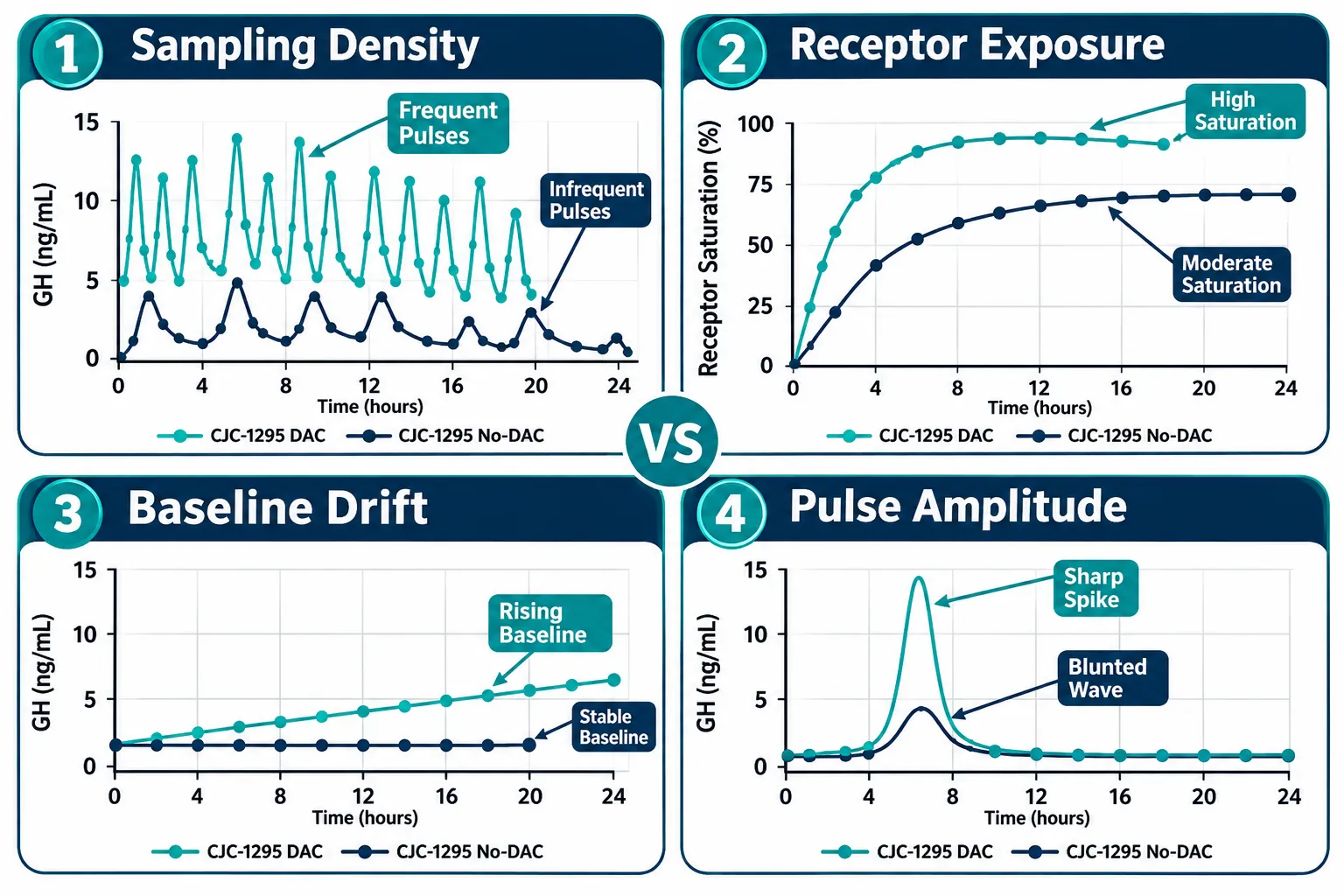
  • The selection decision should rest on five variables: sampling density, receptor exposure pattern, baseline drift tolerance, pulse amplitude requirements, and endpoint timing.
  • Combining CJC-1295 without DAC with a GHRP-class peptide amplifies pulse amplitude while preserving natural rhythm, the DAC form blunts this synergy.
  • As of 2026, pharmacokinetic and hormonal data for both forms are well-established; clinical outcome evidence remains limited to investigational use.

The Selection Matrix: Five Variables That Actually Matter

Choosing between the two formulations based on half-life alone, minutes versus roughly eight days, oversimplifies a decision that depends on experimental architecture. A more rigorous framework evaluates five variables.
The Selection Matrix: Five Variables That Actually Matter

1. Sampling Density
Experiments that require frequent blood draws, hourly or sub-hourly GH measurement, depend on predictable pulse timing. CJC-1295 without DAC allows researchers to trigger a pulse, then sample around it with precision. The DAC form creates a pharmacokinetic plateau that makes individual pulse identification nearly impossible within dense sampling windows.

2. Receptor Exposure Pattern
Continuous GHRH receptor stimulation from the DAC form risks desensitization over extended protocols. No-DAC administration preserves intermittent receptor "rest" periods, which mirrors physiological patterns and reduces tachyphylaxis risk in longer study designs.

3. Baseline Drift
The DAC formulation raises the IGF-1 baseline progressively over the first several days and holds it elevated. This is valuable when the endpoint is sustained anabolic signaling, but it introduces confounding baseline drift in studies measuring acute hormonal responses.

4. Pulse Amplitude
Co-administration with a ghrelin mimetic or GHRP-class secretagogue produces the strongest GH pulse amplitude when the GHRH component (CJC-1295 without DAC) is timed precisely at the same injection moment. See CJC-1295 Ipamorelin dosage protocols for combination research frameworks. The DAC form cannot be "timed" to amplify a co-administered pulse in the same way.

5. Endpoint Timing
If the primary endpoint is measured at a fixed time point, 24, 48, or 72 hours post-administration, the DAC form is better suited because it maintains consistent circulating levels across that window. No-DAC experiments require careful alignment of sampling to the post-injection pulse window (typically 15 to 45 minutes).

Variable No-DAC (Mod GRF 1-29) With DAC
Sampling window control High Low
Pulse amplitude precision High Blunted
Baseline stability High Progressive rise
IGF-1 elevation duration Hours Days
Receptor rest preservation Yes Limited

Mechanistic Basis: How DAC Chemistry Changes the GH Profile

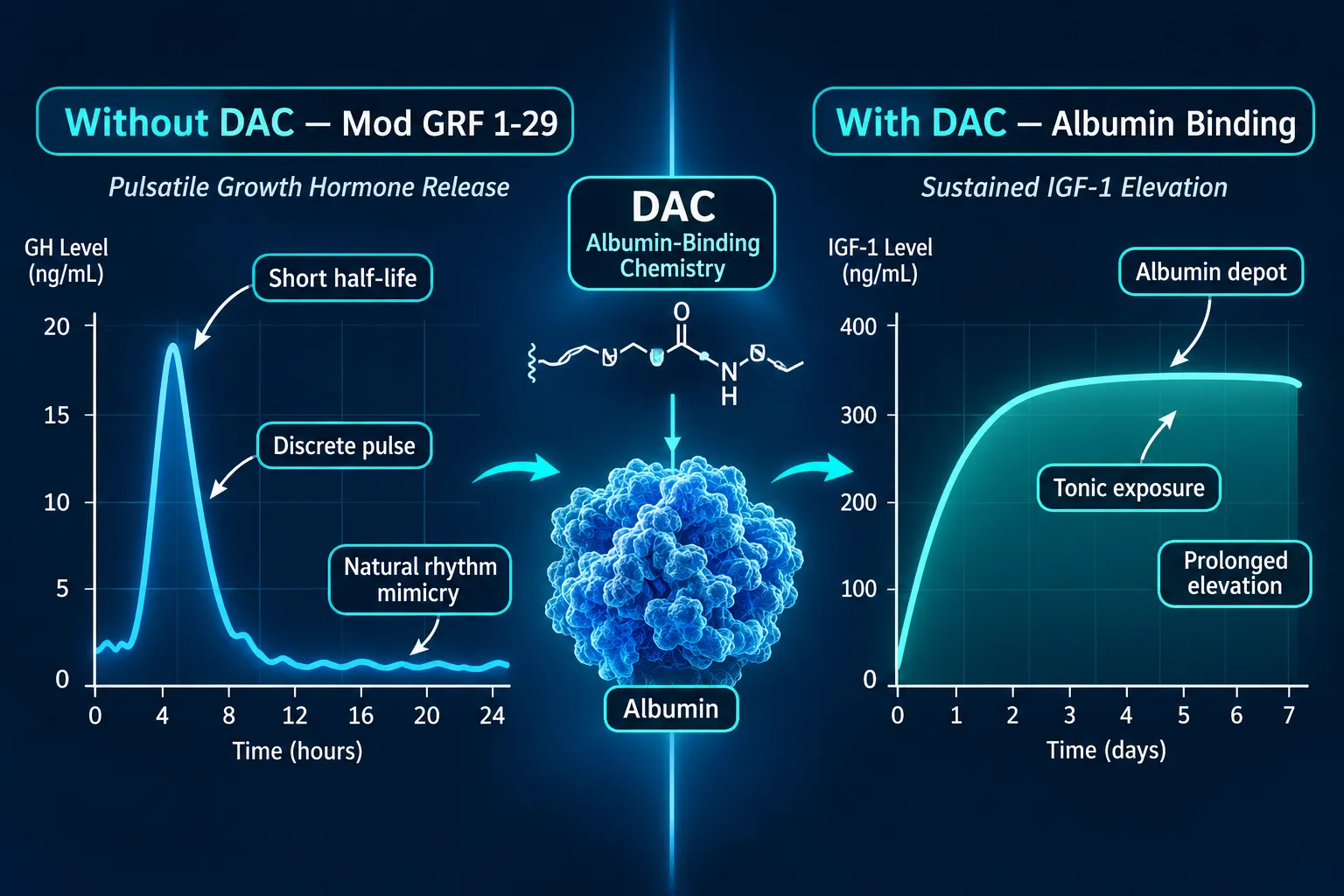
The Drug Affinity Complex (DAC) is a lysine-based side chain that binds reversibly to circulating albumin. This binding creates a molecular depot, the peptide is slowly released back into free circulation over days rather than being cleared within minutes.

The practical result is a GH and IGF-1 profile that resembles a prolonged plateau rather than a spike. Pituitary somatotrophs receive near-continuous GHRH receptor input, driving tonic growth hormone release and downstream hepatic IGF-1 production that remains elevated for the duration of the dosing interval.
Mechanistic Basis: How DAC Chemistry Changes the GH Profile

CJC-1295 without DAC lacks this modification. Its bioactive half-life, extended relative to native GHRH (1-44) by several protective amino acid substitutions but still measured in minutes to low single-digit hours, allows for a clean pulse-and-clear pharmacokinetic profile. Researchers studying growth hormone secretory dynamics, GH pulse frequency, or pituitary reserve benefit from this predictability.

For experiments exploring visceral adipose reduction or metabolic endpoints with sustained hormonal exposure, the DAC form's depot behavior is a feature, not a limitation. For related metabolic research contexts, visceral fat research resources provide useful background on GH-axis involvement in adipose regulation. Similarly, researchers exploring related GHRH analogs may find Tesamorelin benefits data instructive as a comparator for sustained GHRH-axis stimulation.


Protocol Design Guidance for 2026 Research Applications

Matching formulation to experimental design is now the consensus standard in peptide research circles as of 2026.
Protocol Design Guidance for 2026 Research Applications

When to use CJC-1295 without DAC (Mod GRF 1-29):

  • Pulsatile GH secretion studies requiring discrete, timeable events
  • Co-administration with ghrelin mimetics where pulse amplitude synergy is the endpoint (see Sermorelin Ipamorelin CJC-1295 combination research)
  • Short-term protocols where baseline drift would confound interpretation
  • Studies requiring multiple dosing events per day to replicate physiological pulse frequency

When to use CJC-1295 with DAC:

  • Multi-day IGF-1 elevation studies where frequent injections are impractical
  • Endpoints measured at 48-96 hour intervals
  • Research into tonic GHRH receptor stimulation effects
  • Protocols modeling sustained anabolic or metabolic exposure

Researchers working with multi-peptide blend formulations, such as Tesamorelin CJC-1295 Ipamorelin 12mg blend configurations, should confirm which CJC-1295 variant is present before making endpoint timing decisions, as the formulation directly determines whether the GH profile is pulsatile or sustained.

"The formulation is the experiment. Choosing DAC or no-DAC without reference to sampling strategy, baseline behavior, and endpoint timing is not a minor procedural detail, it defines what the data can and cannot show."

Accumulation and Safety Considerations
The DAC form's prolonged action raises accumulation concerns in extended protocols. Because each dose adds to residual circulating levels before full clearance, weekly dosing can produce progressive IGF-1 elevation beyond intended exposure levels. No-DAC administration carries a sharply lower accumulation risk given its rapid clearance between doses. Researchers designing multi-week protocols should factor this into inter-dose interval decisions.


Conclusion

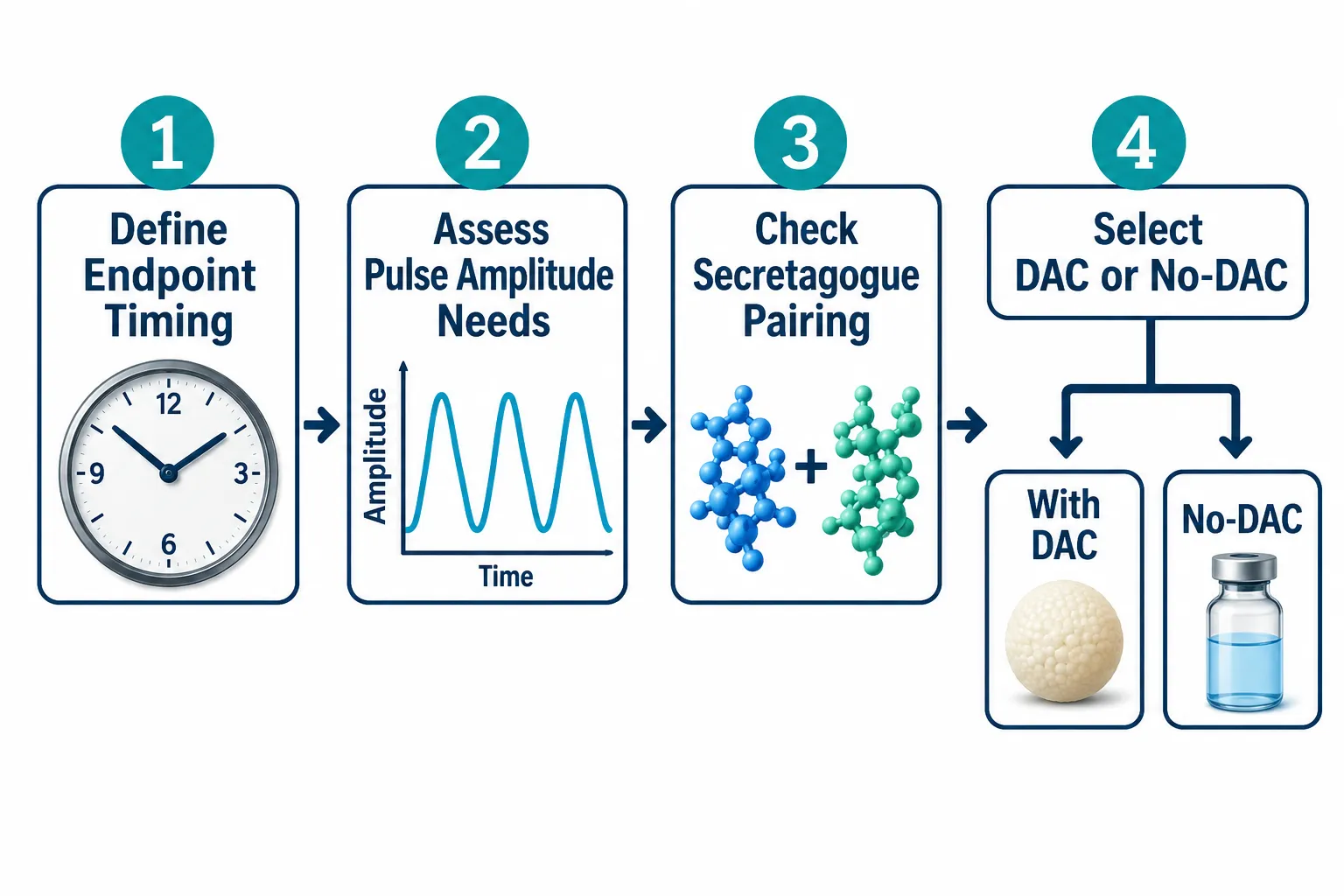
The CJC-1295 With DAC vs Without DAC: Which Research Formulation Fits Pulsatile or Sustained GH Experiments? decision is a structural one that should be made before the experimental protocol is finalized, not after. Use the five-variable selection matrix (sampling density, receptor exposure, baseline drift, pulse amplitude, endpoint timing) as the primary decision framework rather than relying on half-life figures alone.

Actionable next steps for researchers in 2026:

  1. Define the primary endpoint first: acute GH pulse measurement or sustained IGF-1 elevation.
  2. Map the sampling schedule to the pharmacokinetic profile of the chosen formulation.
  3. When co-administering a GHRP-class peptide, default to no-DAC to preserve pulse synergy.
  4. For multi-day metabolic endpoints, confirm accumulation risk by calculating residual DAC levels at the planned next dose interval.
  5. Source research-grade material with verified purity to ensure pharmacokinetic assumptions hold, batch-to-batch variability in impure material will corrupt kinetic modeling.

Peptide research continues to evolve rapidly; staying current with CJC-1295 Ipamorelin cycle protocols and updated blend formulations ensures that formulation choices remain aligned with the best available experimental evidence.

Tags: cjc-1295 with dac, cjc-1295 without dac, ghrh peptide research, growth hormone secretagogue, igf-1 elevation, mod grf 1-29, pulsatile gh research, sustained gh experiments
https://www.puretestedpeptides.com/wp-content/uploads/2026/11/cjc-1295-with-dac-vs-without-dac-which-research-formulation-fits-pulsatile-or-su.webp 1024 1536 https://www.puretestedpeptides.com/wp-content/uploads/2026/01/buy-peptides-online.jpg 2026-11-08 14:03:552026-11-08 14:03:55CJC-1295 With DAC vs Without DAC: Which Research Formulation Fits Pulsatile or Sustained GH Experiments?
You might also like
Tesamorelin and Ipamorelin Mechanism: How GH-Releasing Peptides Differ in Research Models Tesamorelin and Ipamorelin Mechanism: How GH-Releasing Peptides Differ in Research Models
CJC-1295 With DAC vs. Without DAC in Cell and Animal Studies: Sampling Windows, Washout, and Interpretation CJC-1295 With DAC vs. Without DAC in Cell and Animal Studies: Sampling Windows, Washout, and Interpretation
CJC-1295 With DAC vs Without DAC: Half-Life, Release Profile, and Research Selection Guide CJC-1295 With DAC vs Without DAC: Half-Life, Release Profile, and Research Selection Guide
CJC‑1295 With and Without DAC Beyond Growth Hormone: Emerging Questions in Metabolic and Recovery Research Models CJC‑1295 With and Without DAC Beyond Growth Hormone: Emerging Questions in Metabolic and Recovery Research Models
Peptide Calculators for Tesamorelin and Ipamorelin: Optimizing Reconstitution and Dosing Accuracy Peptide Calculators for Tesamorelin and Ipamorelin: Optimizing Reconstitution and Dosing Accuracy
CJC-1295 With DAC Half-Life and Dosing Frequency: Why Formulation Matters in GH Research CJC-1295 With DAC Half-Life and Dosing Frequency: Why Formulation Matters in GH Research
CJC-1295 With and Without DAC: A Detailed Mechanism and Pharmacokinetic Comparison for Growth Hormone Research CJC-1295 With and Without DAC: A Detailed Mechanism and Pharmacokinetic Comparison for Growth Hormone Research
CJC-1295 With DAC vs Without DAC: Mechanism, Duration, and Research Design Differences CJC-1295 With DAC vs Without DAC: Mechanism, Duration, and Research Design Differences
0 replies

Leave a Reply

Want to join the discussion?
Feel free to contribute!

Leave a Reply Cancel reply

Your email address will not be published. Required fields are marked *

×

Helpful Links

  • My account
  • Cart
  • Checkout
  • Refund and Returns Policy
  • Privacy Policy
  • SMS Privacy Policy
  • Login
  • My Account
  • Logout

USA Made Lab Tested Peptides

All products are sold for research, laboratory, or analytical purposes only, and are not for human consumption


Pure Tested Peptides is a chemical supplier. Pure Tested Peptides is not a compounding / chemical compounding facility as defined under 503A of the Federal Food, Drug, and Cosmetic act. Pure Tested Peptides is not an outsourcing facility as defined under 503B of the Federal Food, Drug, and Cosmetic act.

The statements made within this website have not been evaluated by the US Food and Drug Administration. The products we offer are not intended to diagnose, treat, cure or prevent any disease.

Human/Animal Consumption Prohibited. Laboratory/In-Vitro Experimental Use Only

Link to: Spironolactone in Peptide Research: Androgen Signaling, Potassium, and Fluid-Volume Confounders Link to: Spironolactone in Peptide Research: Androgen Signaling, Potassium, and Fluid-Volume Confounders Spironolactone in Peptide Research: Androgen Signaling, Potassium, and Fluid-Volume...Spironolactone in Peptide Research: Androgen Signaling, Potassium, and Fluid-Volume Confounders Link to: Klow Peptide Nasal Spray Stability: How to Investigate pH, Osmolality, Pump Dose Uniformity, and Storage Drift Link to: Klow Peptide Nasal Spray Stability: How to Investigate pH, Osmolality, Pump Dose Uniformity, and Storage Drift Klow Peptide Nasal Spray Stability: How to Investigate pH, Osmolality, Pump Dose Uniformity, and Storage DriftKlow Peptide Nasal Spray Stability: How to Investigate pH, Osmolality, Pump...
Scroll to top Scroll to top Scroll to top