

CJC‑1295 With and Without DAC Beyond Growth Hormone: Emerging Questions in Metabolic and Recovery Research Models
Fewer than a dozen peer-reviewed human trials have examined CJC‑1295 in any form since its synthesis, yet community dosing protocols for metabolic optimization and injury recovery have multiplied rapidly. That gap between widespread use and thin clinical evidence is exactly what makes CJC‑1295 With and Without DAC Beyond Growth Hormone: Emerging Questions in Metabolic and Recovery Research Models one of the most pressing topics in peptide science heading into 2026.
Key Takeaways
- CJC‑1295 with DAC has a confirmed extended half-life of roughly six to eight days; the without-DAC variant acts in minutes and is largely uncharacterized in peer-reviewed human literature.
- Growth hormone and IGF‑1 response data exist primarily for the DAC form; metabolic, body-composition, and recovery outcomes remain evidence gaps for both variants.
- Community dosing for recovery and metabolism is protocol-driven, not evidence-driven, creating meaningful safety unknowns.
- Stacking CJC‑1295 with Tesamorelin or Ipamorelin is a growing research model, but formal combination trial data are absent.
- Regulatory and compounding restrictions tightened between 2023 and 2026, making purity verification a critical step for any research application.
The Pharmacokinetic Foundation: DAC vs. Without DAC
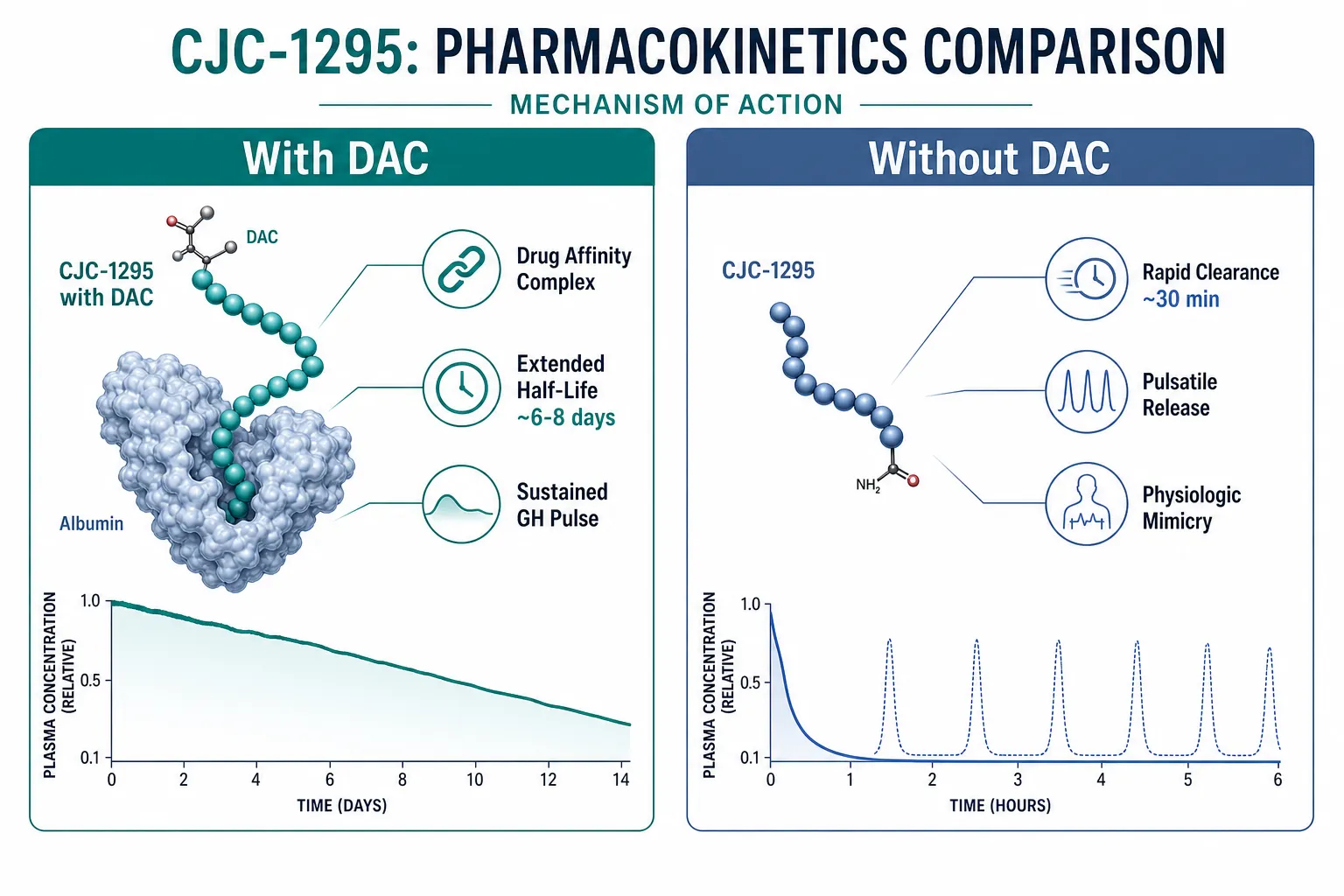
Understanding CJC‑1295 With and Without DAC Beyond Growth Hormone: Emerging Questions in Metabolic and Recovery Research Models begins with the chemistry that separates the two variants.
CJC‑1295 with DAC incorporates a Drug Affinity Complex, a chemical modification that allows the peptide to bind reversibly to serum albumin. This binding dramatically extends its half-life to approximately six to eight days, producing a sustained elevation of growth hormone-releasing hormone (GHRH) activity. The result is a prolonged, blunted GH pulse that differs significantly from the body's natural pulsatile secretion pattern.
CJC‑1295 without DAC (sometimes called Modified GRF 1-29 or Mod GRF) lacks that albumin-binding modification. Its half-life is roughly 30 minutes, making it far more aligned with physiologic GHRH signaling. This shorter window is precisely why researchers and practitioners pair it with a GHRP such as Ipamorelin, to amplify a single, timed GH pulse.
| Feature | With DAC | Without DAC |
|---|---|---|
| Half-life | ~6-8 days | ~30 minutes |
| GH pulse pattern | Sustained, blunted | Pulsatile, physiologic |
| Human trial data | Limited but present | Essentially absent |
| Peer-reviewed metabolic data | Minimal | Near zero |
For a deeper look at why half-life differences matter in research design, see CJC-1295 Without DAC: Why Half-Life Matters in Growth Hormone Research.
Metabolic and Body-Composition Research: Where the Evidence Stands

Most published data on CJC‑1295 focus narrowly on GH and IGF‑1 elevation. The metabolic story, lipolysis, insulin sensitivity, visceral fat reduction, and lean mass accrual, is far less developed.
What is reasonably supported:
- Elevated IGF‑1 is associated with improved nitrogen retention and lean tissue support in multiple GH-axis studies, though not specifically attributed to CJC‑1295 without DAC in controlled trials.
- The DAC form has shown statistically significant IGF‑1 elevation lasting up to 28 days in early human dose-escalation work.
- Tesamorelin, a distinct GHRH analog with an FDA-approved indication for HIV-associated lipodystrophy, provides the closest proxy for what sustained GHRH stimulation can do to visceral adipose tissue. Researchers comparing these agents should review Ipamorelin vs Tesamorelin for mechanistic context.
What remains speculative:
- Direct fat-loss outcomes attributable to CJC‑1295 without DAC in healthy subjects.
- Sleep quality improvements, often cited in community forums, have no controlled human data linking them specifically to either CJC‑1295 variant.
- Insulin sensitivity modulation, plausible given GH's known effects on glucose metabolism, but unstudied for this peptide directly.
"The absence of evidence is not evidence of absence, but in a regulatory and safety context, it functions as one until trials are conducted."
Recovery Models, Stacking Protocols, and the Evidence Gap
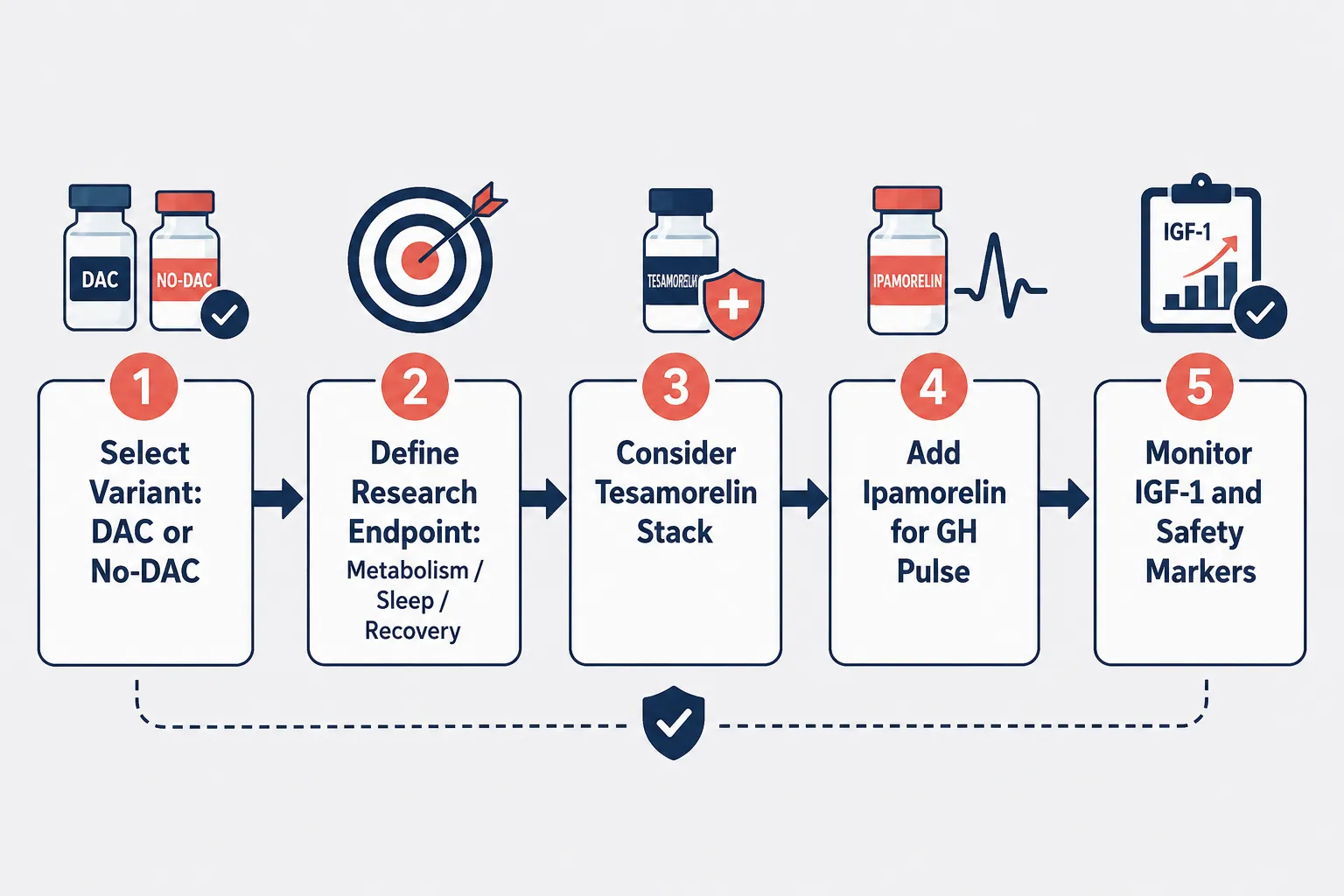
Injury recovery is perhaps the most enthusiastically discussed application of CJC‑1295 With and Without DAC Beyond Growth Hormone: Emerging Questions in Metabolic and Recovery Research Models, and the one with the least formal support.
The theoretical basis is coherent. GH and IGF‑1 both play established roles in collagen synthesis, satellite cell activation, and connective tissue repair. If CJC‑1295 reliably elevates these signals, downstream recovery benefits are biologically plausible. The problem is the inferential leap from plausibility to protocol.
Stacking With Tesamorelin and Ipamorelin
A growing number of research models combine CJC‑1295 without DAC with either Tesamorelin or Ipamorelin to target complementary points on the GH axis. Multi-peptide blends designed for this purpose are available for research use, for example, formulations such as the Tesamorelin, AOD9604, CJC-1295, Ipamorelin 12mg blend represent how researchers are structuring combination protocols in 2026.
Key considerations for combination research models:
- Receptor saturation: Stacking a GHRH analog with a GHRP creates synergistic GH release, but the ceiling effect and desensitization timeline are not well-mapped.
- IGF‑1 overshoot risk: Sustained supraphysiologic IGF‑1 carries theoretical oncogenic and insulin-resistance concerns that no long-term CJC‑1295 trial has adequately addressed.
- Protocol standardization: Community dosing is largely reverse-engineered from Tesamorelin clinical data. Researchers using Tesamorelin and CJC-1295 Ipamorelin 12mg blend formulations should treat dosing guidance as investigational, not clinical.
Regulatory and Purity Context in 2026
The FDA's tightened compounding restrictions between 2023 and 2026 have directly affected the availability and sourcing landscape for both CJC‑1295 variants. For any preclinical or in-vitro research application, purity verification through third-party Certificate of Analysis (CoA) documentation is non-negotiable. Resources on peptide CoA verification and high-purity peptide sourcing provide practical guidance for maintaining research integrity.
The clinical development program for CJC‑1295 was halted before Phase III completion, meaning no modern large-scale trial data exist. Sports and performance-enhancement literature in 2026 continues to flag both variants as prohibited substances under WADA rules, reinforcing their strictly investigational status.
Conclusion
CJC‑1295 With and Without DAC Beyond Growth Hormone: Emerging Questions in Metabolic and Recovery Research Models represents a field where biological plausibility has raced far ahead of controlled evidence. The pharmacokinetic distinction between the two variants is well-established; the metabolic, recovery, and sleep-related outcomes that dominate community discussion are not.
Actionable next steps for researchers and informed readers:
- Distinguish the variants clearly before designing any protocol, half-life differences make the two compounds functionally distinct research tools.
- Anchor expectations to Tesamorelin data when evaluating metabolic claims, as it provides the closest evidence-based proxy for GHRH analog effects on body composition.
- Prioritize purity verification, regulatory tightening in 2026 makes sourcing integrity a first-order concern, not an afterthought.
- Treat stacking protocols as hypothesis-generating, not validated, combination models with Ipamorelin or Tesamorelin are promising research directions, not proven therapies.
- Monitor the clinical trial landscape, the absence of modern Phase II/III data for either variant is the single largest obstacle to evidence-based application.
The questions surrounding CJC‑1295 beyond GH elevation are worth asking. Answering them rigorously will require the kind of controlled human research that, as of 2026, has yet to arrive.


Leave a Reply
Want to join the discussion?Feel free to contribute!