

Research-Use Only Peptides: How “Peptides” Differ From Classic Small-Molecule Drugs Like Prednisone and Atorvastatin in Lab Design
Only about 40 oral peptide drugs have ever reached clinical approval worldwide, a striking contrast to the thousands of approved small-molecule drugs that fill every pharmacy shelf. That gap is not a failure of biology; it is a direct result of how profoundly research-use only peptides differ from classic small-molecule drugs like prednisone and atorvastatin in lab design, stability, and experimental logic.
Understanding those differences is essential for any researcher sourcing, handling, or building assays around compounds such as BPC-157, MOTS-c, GLP-3, or SS-31.
Key Takeaways
- Research-use only (RUO) peptides are chains of amino acids with molecular weights typically between 500 and 5,000 Da, far larger and more structurally complex than small molecules like atorvastatin (
559 Da) or prednisone (358 Da). - Small molecules are generally orally bioavailable and metabolically stable; peptides are highly susceptible to enzymatic cleavage and require specialized formulation and storage.
- Peptides act primarily at cell-surface receptors or extracellular targets, while many classic small molecules penetrate cells or nuclei directly.
- Bioanalytical methods for RUO peptides demand different LC-MS conditions, sample preparation strategies, and stability testing protocols compared to small-molecule assays.
- The regulatory boundary between RUO labeling and therapeutic use is tightening in 2026, making proper sourcing and documentation critical for compliant research.
Structural Foundations: Size, Sequence, and Complexity
The most immediate difference between research-use only peptides and classic small-molecule drugs like prednisone and atorvastatin in lab design is sheer molecular size.
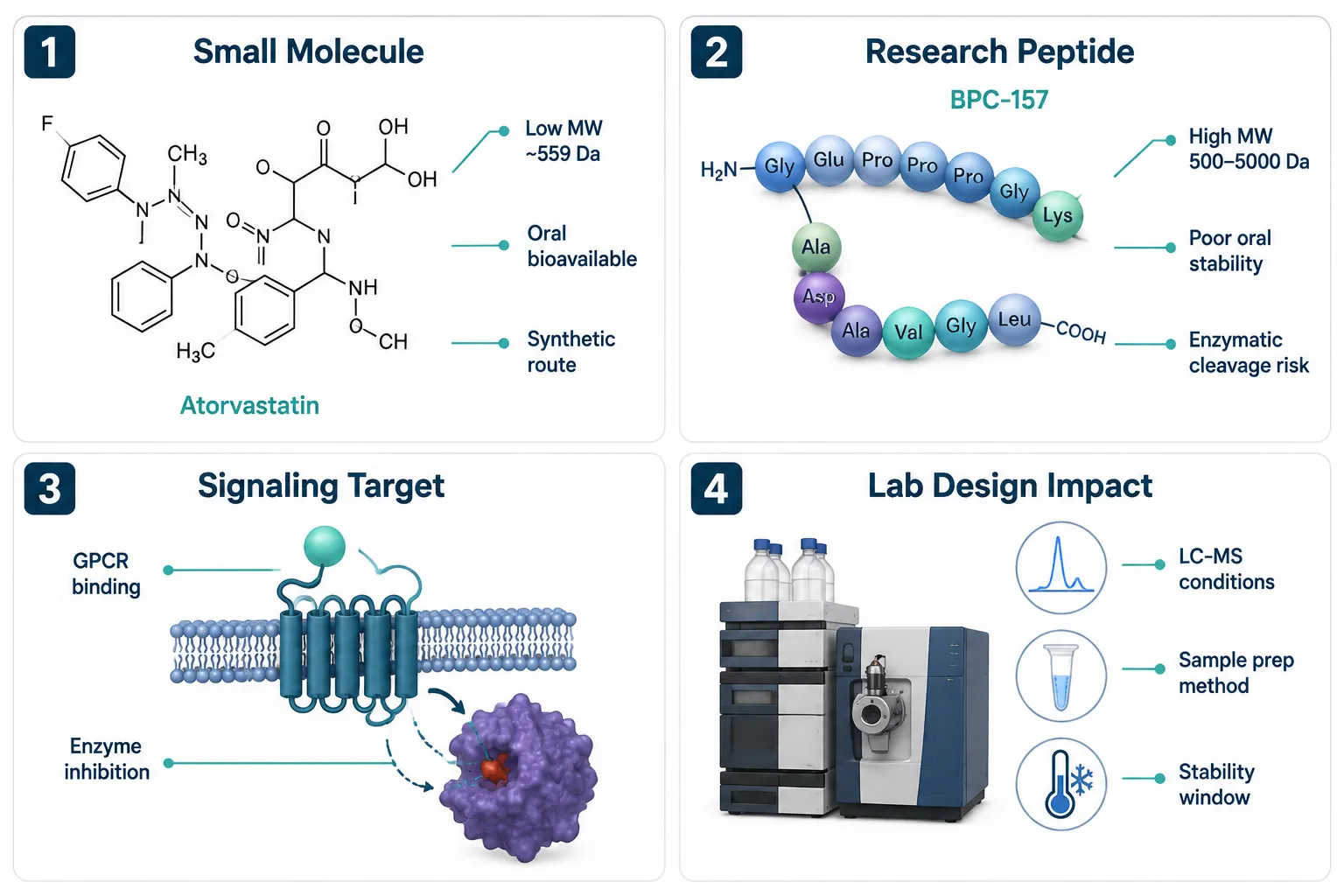
Prednisone is a steroid with a molecular weight of roughly 358 Da and a rigid, four-ring carbon scaffold. Atorvastatin (Lipitor) weighs about 559 Da and inhibits HMG-CoA reductase through a well-defined binding pocket. Both molecules are small enough to be synthesized in a few chemical steps and characterized quickly by standard NMR or HPLC methods.
Research peptides occupy a different structural tier entirely:
| Compound | Type | Approx. MW | Chain Length |
|---|---|---|---|
| Prednisone | Small molecule | 358 Da | N/A |
| Atorvastatin | Small molecule | 559 Da | N/A |
| BPC-157 | Research peptide | ~1,419 Da | 15 amino acids |
| SS-31 | Research peptide | ~639 Da | 4 amino acids |
| MOTS-c | Research peptide | ~2,174 Da | 16 amino acids |
| GLP-1 analog | Research peptide | ~3,300 Da | 30 amino acids |
Even the shortest research peptides carry multiple chiral centers, hydrogen-bond donors, and rotatable bonds that make them far more sensitive to environmental conditions than a steroid or statin.
A key principle in peptide lab design: molecular complexity drives every downstream decision, from storage temperature to the LC gradient used in bioanalysis.
Because peptide bonds are hydrolyzed by proteases found in plasma, gut lumen, and even standard laboratory buffers, stability is never assumed. Researchers working with SS-31 peptides or similar mitochondria-targeting compounds must account for degradation windows that simply do not apply to a statin dissolved in DMSO.
How Peptides Signal Differently Than Small-Molecule Drugs
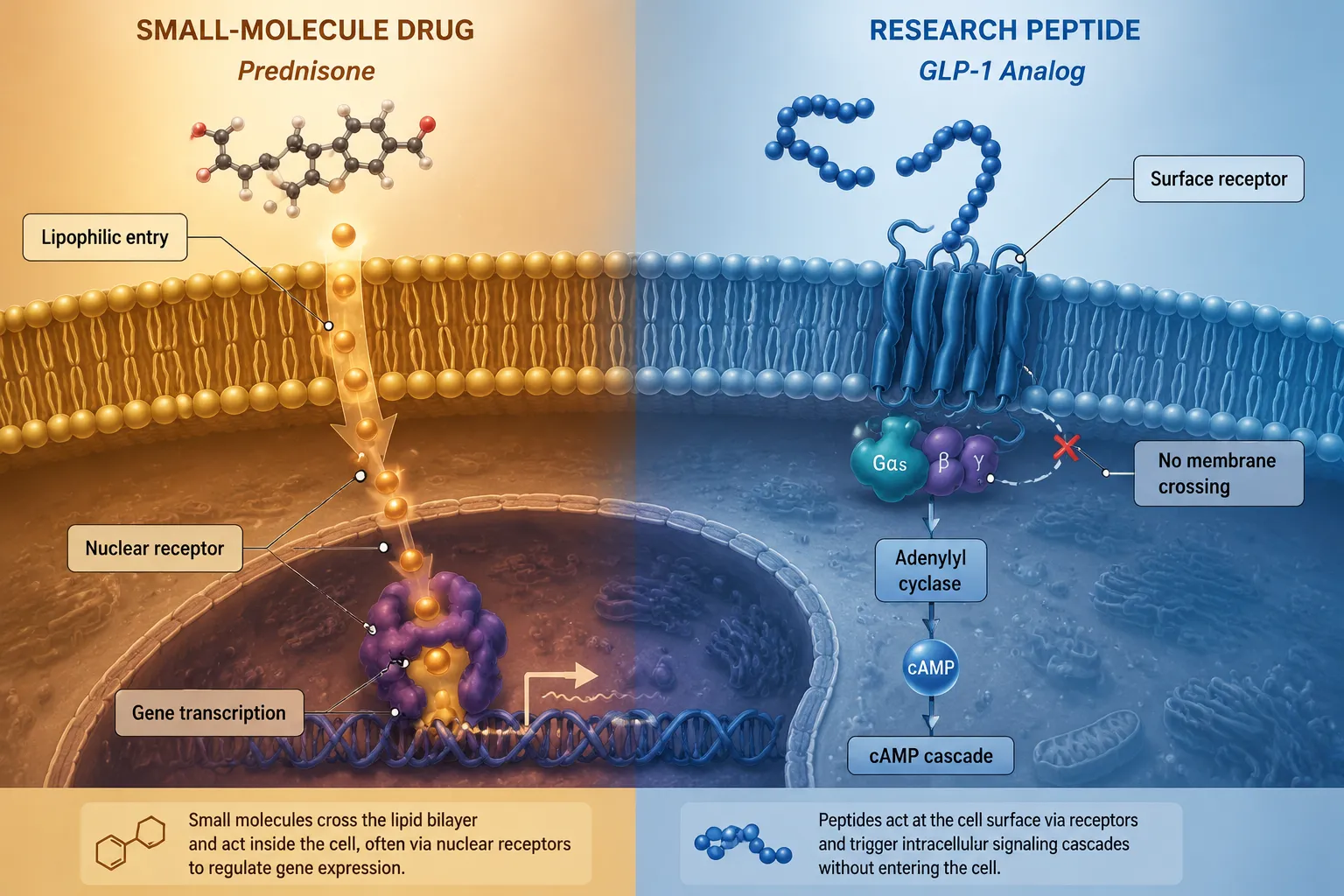
Classic small molecules often work by entering cells or even nuclei. Prednisone, after conversion to prednisolone, diffuses across the plasma membrane and binds cytoplasmic glucocorticoid receptors. The complex then translocates to the nucleus and modulates gene transcription directly. Atorvastatin reaches its target enzyme inside hepatocytes through active transport.
Most research peptides cannot follow that path. Their size and hydrophilicity prevent passive membrane diffusion. Instead, they act at:
- Cell-surface G-protein-coupled receptors (GPCRs), as seen with GLP-1 peptide analogs that activate incretin receptors
- Extracellular matrix proteins, as with BPC-157, which appears to interact with growth factor receptors and angiogenic pathways
- Mitochondrial membrane interfaces, as with SS-31, which associates with cardiolipin on the inner mitochondrial membrane without entering the matrix
This distinction reshapes every aspect of assay design. A researcher cannot simply measure nuclear translocation or enzyme inhibition with the same endpoint used for a steroid. Functional readouts, cAMP accumulation, receptor internalization, mitochondrial membrane potential, must replace or supplement traditional biochemical endpoints.
For peptides with less-characterized mechanisms, such as MOTS-c or 5-Amino-1MQ (a small-molecule/peptide-adjacent NNMT inhibitor), researchers must build multi-endpoint assays that capture pathway-level responses rather than a single molecular event.
Detailed considerations for specific compounds are covered in resources like SS-31 10mg research peptide considerations and the PT-141 peptide research context QA and controls guide.
Bioanalytical and Formulation Challenges Unique to RUO Peptides
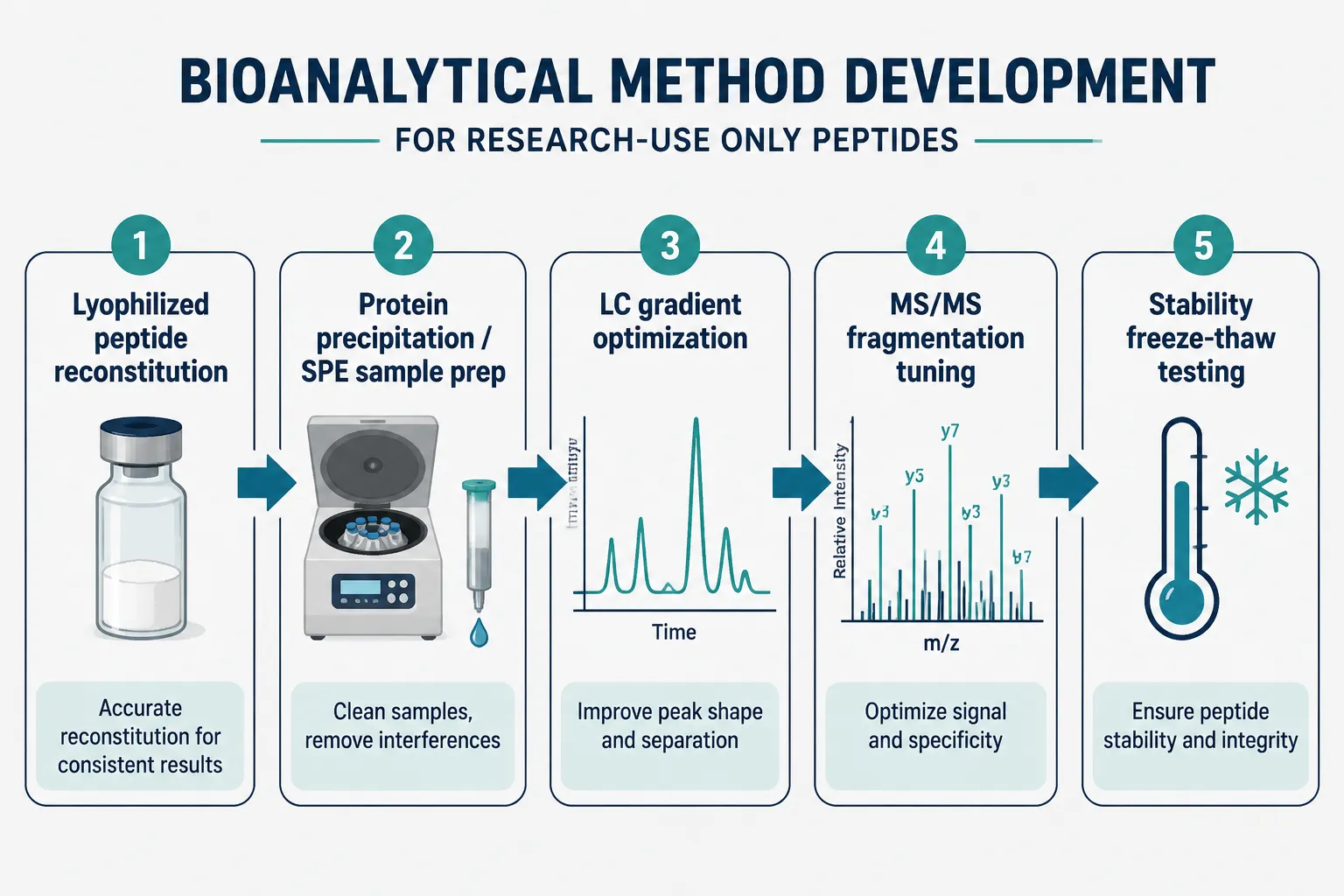
When a researcher builds a method around atorvastatin, they benefit from decades of published HPLC-UV and LC-MS/MS data, stable reference standards, and predictable protein binding. Peptides offer none of those shortcuts.
Key bioanalytical differences include:
-
Sample preparation, Protein precipitation alone is often insufficient. Solid-phase extraction (SPE) or mixed-mode sorbents are needed to recover hydrophilic peptides from plasma matrices without co-eluting interferences.
-
LC conditions, Peptides require shallow, extended gradient programs on C18 or C8 columns with ion-pairing reagents (e.g., trifluoroacetic acid or heptafluorobutyric acid) to achieve adequate retention and peak shape.
-
MS/MS fragmentation, Peptide precursor ions are multiply charged. Method developers must select the correct charge state and optimize collision energy for each unique sequence, a step irrelevant for single-charged small molecules.
-
Stability testing, Freeze-thaw cycles, bench-top stability, and long-term frozen stability must all be validated separately. Peptides can degrade within hours at room temperature, while prednisone tablets remain stable for years on a shelf.
-
Reconstitution and storage, Most RUO peptides are supplied lyophilized. Reconstitution solvent, concentration, and aliquot size must be defined before any experiment begins. Resources such as the AOD-9604 sale research method notes, storage and traceability page illustrate how seriously vendors and researchers must treat these variables.
Researchers sourcing compounds should consult verified suppliers. Guidance on where to buy peptides for research purposes highlights purity documentation and certificate-of-analysis standards that distinguish compliant RUO supply from unverified sources.
The 2026 Regulatory Context
The FDA has continued tightening its position on RUO labeling throughout 2026. Compounds sold as research-use only must not be marketed with therapeutic intent, and enforcement actions have targeted suppliers who blur that line. Researchers must ensure that procurement, labeling, and internal documentation all reflect the non-clinical, laboratory-only nature of the work. Pure Tested Peptides represents the kind of supplier model that prioritizes third-party purity testing and transparent RUO documentation to meet this evolving standard.
Conclusion
The differences between research-use only peptides and classic small-molecule drugs like prednisone and atorvastatin in lab design are not superficial. They span molecular architecture, receptor pharmacology, bioanalytical methodology, and regulatory classification.
Actionable next steps for researchers:
- Treat every peptide as structurally unique, do not transfer small-molecule assay conditions without validation.
- Build stability testing into the experimental plan from day one, not as an afterthought.
- Select suppliers who provide third-party purity data and clear RUO documentation; explore wholesale peptides for sale options only from vendors with traceable quality systems.
- Review compound-specific method notes before designing LC-MS/MS workflows.
- Stay current with FDA guidance updates in 2026, particularly around peptide compounding and bulk substance classification.
Understanding these distinctions is what separates rigorous, reproducible peptide research from experiments that fail at the method level before the biology is ever tested.


Leave a Reply
Want to join the discussion?Feel free to contribute!