

Peptides and Polypeptides in Mitochondrial Biology: How MOTS-c and 5-Amino-1MQ Compare With Classic Mitochondrial Pathways
Mitochondria consume roughly 90% of the oxygen a cell uses, yet the molecular signals that govern their health remain one of biology's most active research frontiers. Exploring peptides and polypeptides in mitochondrial biology: how MOTS-c and 5-Amino-1MQ compare with classic mitochondrial pathways gives researchers a sharper map of where newer mitochondria-targeted compounds sit relative to well-established mechanisms like oxidative phosphorylation, the electron transport chain (ETC), and mitochondrial biogenesis.
Key Takeaways
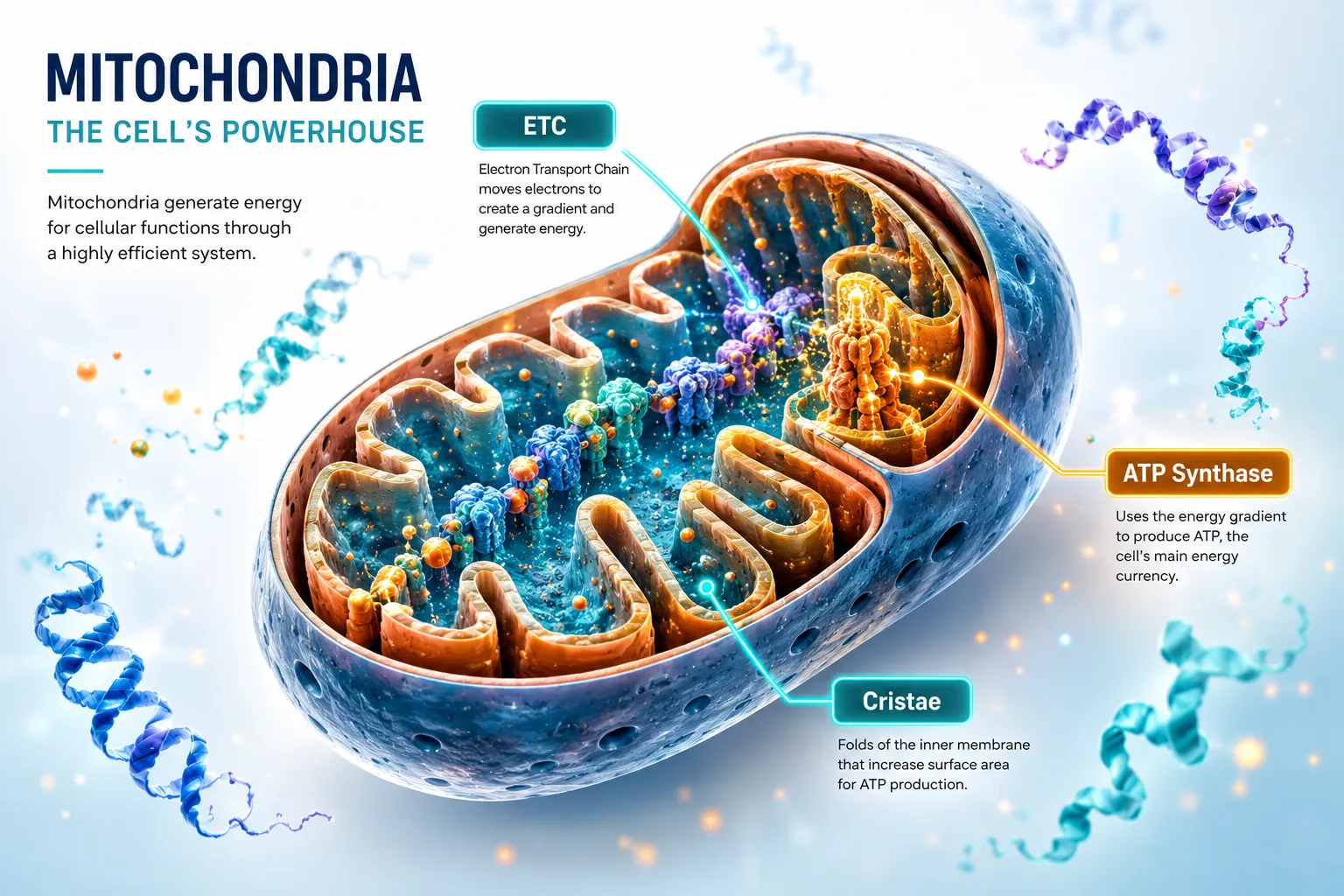
- Mitochondria rely on canonical pathways, the ETC, ATP synthase, and PGC-1alpha-driven biogenesis, to sustain cellular energy.
- MOTS-c is a mitochondria-derived peptide (MDP) encoded in mitochondrial DNA that activates AMPK and influences metabolic homeostasis.
- 5-Amino-1MQ is a small-molecule NNMT inhibitor that raises NAD+ precursor availability, indirectly supporting mitochondrial function.
- Both agents intersect classic pathways at distinct nodes, making their mechanisms complementary rather than redundant.
- Ongoing preclinical research continues to clarify how these compounds compare with established mitochondrial targets such as SS-31 (elamipretide).
Classic Mitochondrial Pathways: The Baseline for Comparison
Before mapping newer peptide research, it helps to anchor the discussion in core mitochondrial biology.
Oxidative phosphorylation (OXPHOS) is the process by which electrons from NADH and FADH2 travel through five protein complexes embedded in the inner mitochondrial membrane. This electron flow drives proton pumping, creating a gradient that ATP synthase (Complex V) converts into ATP, the cell's primary energy currency.
Mitochondrial biogenesis is the regulated growth and division of mitochondria. The transcriptional coactivator PGC-1alpha sits at the top of this regulatory cascade, coordinating nuclear respiratory factors (NRF-1, NRF-2) and mitochondrial transcription factor A (TFAM) to replicate mitochondrial DNA and build new organelles.
AMPK (AMP-activated protein kinase) acts as a cellular energy sensor. When the AMP:ATP ratio rises, signaling low energy, AMPK activates PGC-1alpha, stimulates fatty acid oxidation, and suppresses anabolic pathways that consume ATP.
NAD+ metabolism links directly to both OXPHOS and biogenesis. NAD+ is the electron acceptor that feeds Complex I of the ETC; it also activates sirtuins (SIRT1, SIRT3) that deacetylate and activate PGC-1alpha. Declining NAD+ is a hallmark of cellular aging and metabolic dysfunction.
These four nodes, OXPHOS, biogenesis via PGC-1alpha, AMPK signaling, and NAD+ flux, form the reference framework against which MOTS-c and 5-Amino-1MQ can be evaluated.
MOTS-c and 5-Amino-1MQ: Mechanisms Within Mitochondrial Pathways
MOTS-c: A Mitochondria-Derived Peptide With AMPK Activity
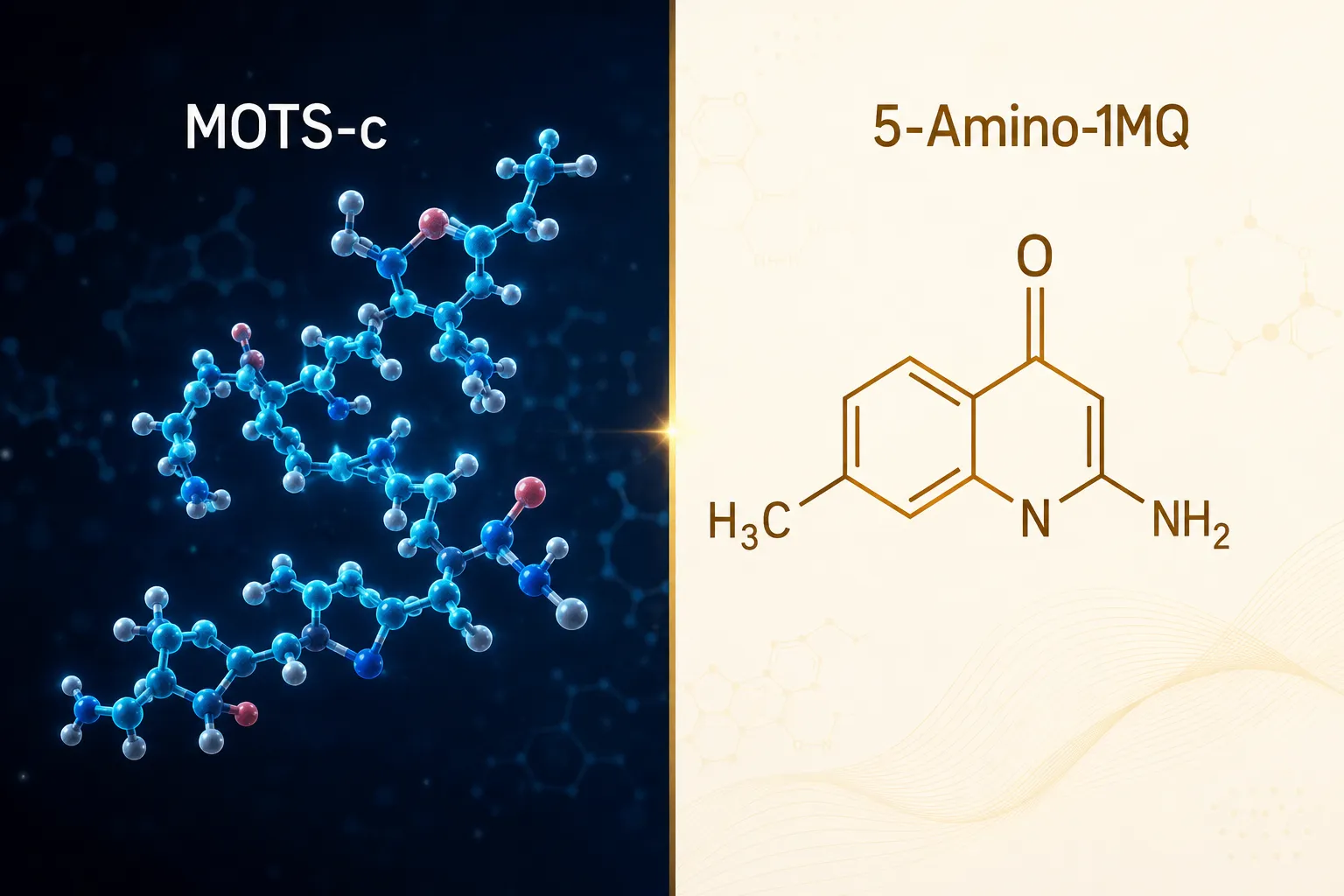
MOTS-c (Mitochondrial Open Reading Frame of the 12S rRNA-c) is a 16-amino-acid peptide encoded within the 12S rRNA gene of mitochondrial DNA. Its discovery in 2015 by Lee et al. established a new class of signaling molecules: mitochondria-derived peptides (MDPs).
Key mechanistic points:
- AMPK activation: MOTS-c translocates to the nucleus under metabolic stress and activates AMPK, mirroring the energy-sensing role that classic AMPK activators (e.g., AICAR, metformin) fulfill.
- Folate cycle interference: MOTS-c inhibits the folate cycle and de novo purine synthesis, which raises AMP levels and secondarily activates AMPK, a unique upstream mechanism not shared by conventional AMPK agonists.
- Metabolic homeostasis: Preclinical studies show MOTS-c improves insulin sensitivity and reduces diet-induced obesity in mouse models, consistent with enhanced mitochondrial substrate utilization.
Compared to the classic PGC-1alpha pathway, MOTS-c does not directly upregulate mitochondrial biogenesis genes. Instead, it optimizes existing mitochondrial function by shifting cellular metabolism toward fatty acid oxidation and away from glucose dependence.
5-Amino-1MQ: NAD+ Restoration Through NNMT Inhibition
5-Amino-1-methylquinolinium (5-Amino-1MQ) is a small-molecule inhibitor of nicotinamide N-methyltransferase (NNMT), an enzyme that consumes S-adenosylmethionine (SAM) and converts nicotinamide into 1-methylnicotinamide, effectively sequestering NAD+ precursors away from biosynthetic use.
By blocking NNMT, 5-Amino-1MQ:
- Increases intracellular nicotinamide availability, boosting NAD+ biosynthesis via the salvage pathway.
- Elevates SIRT1 and SIRT3 activity, which deacetylates and activates PGC-1alpha, linking this compound directly to mitochondrial biogenesis.
- Reduces adipogenesis in preclinical models, an effect attributed to improved mitochondrial energy expenditure.
Unlike direct NAD+ precursors (NMN, NR), 5-Amino-1MQ acts upstream by preventing precursor loss rather than supplying additional substrate. This positions it at a distinct node within NAD+ metabolism.
Comparing Peptides and Polypeptides in Mitochondrial Biology: MOTS-c, 5-Amino-1MQ, and SS-31

Understanding peptides and polypeptides in mitochondrial biology: how MOTS-c and 5-Amino-1MQ compare with classic mitochondrial pathways becomes clearer when these agents are placed alongside SS-31 (elamipretide), a well-studied mitochondria-targeted peptide. Researchers exploring SS-31 mitochondrial dynamics will recognize that SS-31 operates primarily at the inner mitochondrial membrane, stabilizing cardiolipin and protecting the structural integrity of ETC complexes, a mechanism distinct from both MOTS-c and 5-Amino-1MQ.
| Agent | Primary Target | Classic Pathway Node |
|---|---|---|
| MOTS-c | AMPK activation | Energy sensing / substrate utilization |
| 5-Amino-1MQ | NNMT inhibition | NAD+ metabolism / biogenesis |
| SS-31 | Cardiolipin stabilization | ETC structural integrity |
Those researching SS-31 elamipretide will find that its cardiolipin-targeting mechanism complements MOTS-c's metabolic signaling role rather than overlapping with it. Similarly, resources on SS-31 mechanism and research provide useful context for understanding how structural mitochondrial peptides differ from signaling MDPs.
For researchers building a broader peptide research framework, reviewing research-only peptides and quality peptides sourcing considerations remains an essential step before experimental design. Aging-focused research programs may also find value in the aging support product category when planning compound selection.
Where the Mechanisms Converge
Despite their distinct entry points, all three agents ultimately support mitochondrial efficiency:
- MOTS-c and 5-Amino-1MQ both feed into PGC-1alpha activity, MOTS-c via AMPK upstream signaling and 5-Amino-1MQ via SIRT1 activation downstream of NAD+.
- SS-31 preserves the structural platform (cristae morphology, cardiolipin integrity) on which OXPHOS complexes operate.
- Together, they represent complementary layers: structural protection, energy sensing, and metabolic substrate management.
Conclusion
Mapping peptides and polypeptides in mitochondrial biology: how MOTS-c and 5-Amino-1MQ compare with classic mitochondrial pathways reveals a layered picture. MOTS-c engages the AMPK energy-sensing node through a novel folate-cycle mechanism, while 5-Amino-1MQ restores NAD+ precursor flux by blocking NNMT, each intersecting canonical pathways at a different control point. Neither replaces the foundational biology of OXPHOS or PGC-1alpha-driven biogenesis; both modulate it.
Actionable next steps for researchers in 2026:
- Establish baseline NAD+ and AMPK activity measurements in your model system before introducing either compound.
- Consider whether structural mitochondrial protection (SS-31) should precede or accompany metabolic signaling interventions.
- Review current preclinical literature on MOTS-c dosing windows and 5-Amino-1MQ selectivity profiles before experimental design.
- Source compounds from verified, tested suppliers and document purity certificates for all research-grade materials.
The intersection of mitochondrial peptide biology with classic energy pathways is one of the most promising areas in cellular research today, and understanding where each tool fits within that map is the first step toward rigorous, reproducible science.
References
- Lee, C., et al. (2015). "The mitochondrial-derived peptide MOTS-c promotes metabolic homeostasis and reduces obesity and insulin resistance." Cell Metabolism, 21(3), 443-454.
- Neinast, M., et al. (2019). "Quantitative Analysis of the Whole-Body Metabolic Fate of Branched-Chain Amino Acids." Cell Metabolism, 29(2), 417-429.
- Hong, S., et al. (2021). "NAD+ metabolism and its roles in cellular processes during ageing." Nature Reviews Molecular Cell Biology, 22(2), 119-141.
- Bhullar, K. S., & Hubbard, B. P. (2015). "Lifespan and healthspan extension by resveratrol." Biochimica et Biophysica Acta, 1852(6), 1209-1218.
- Szeto, H. H. (2014). "First-in-class cardiolipin-protective compound as a therapeutic agent to restore mitochondrial bioenergetics." British Journal of Pharmacology, 171(8), 2029-2050.
- Eckert, M. A., et al. (2019). "Proteomics reveals NNMT as a master metabolic regulator of cancer-associated fibroblasts." Nature, 569(7758), 723-728.


Leave a Reply
Want to join the discussion?Feel free to contribute!