Call or Text 727-513-9780
  • Shopping Cart Shopping Cart
    0Shopping Cart
Pure Tested Peptides | America's most trusted Peptides for sale online
  • Peptides for sale
    • Oral Peptides for sale
      • Peptide Capsules for sale
      • BPC 157 Capsules 1000mcg
      • SLU-PP-332 Capsules | 1000 mcg
      • 5-Amino-1MQ 50mg Capsules
      • Tesofensine 500mcg
    • All Peptides for sale
    • Peptide Sprays
      • BPC 157 Nasal Spray Kit
      • BPC-157 TB500 Nasal Spray Kit
      • Semax Nasal Spray 10mg
      • Selank – Nasal Spray Kit – 10mg
      • Epithalon 50MG Nasal Spray Kit
      • Ipamorelin 10mg Nasal Spray
      • Klow Nasal Spray (BPC-157 + TB-500 + GHK-Cu + KPV) | 80mg
      • Hulk Nasal Spray Tesa / Ipa Blend 6/3 MG
      • Klow Nasal Spray
      • NAD + 500 mg Nasal Spray
      • PT-141 Nasal Spray Kit
    • GHRH Peptides
      • Ipa Peptides
      • CJC-1295 Peptides
        • CJC-1295 with DAC 5 mg
        • CJC-1295 without DAC 5 mg
        • CJC-1295 Ipa 10mg
      • Tesa Peptides
        • Tesa Peptide
        • Tesa 20 mg
    • GHK-Cu Peptides
      • All GHK-Cu Peptides
      • GHK-Cu 100mg
      • KLOW Peptide Blend – Buy KLOW blend online
    • BPC Peptides
      • All BPC Peptides
      • BPC-157
      • BPC-157 TB-500
      • BPC 157 capsules 1000mcg
    • SLU-PP-332 Peptides
      • All SLU-PP-332 Peptides
      • SLU-PP-332 5mg
    • GLP3 Peptides
      • GLP3-R
      • GLP3-R CAG 10mg
      • GLP3-R 20mg
    • PT-141 Peptides
      • PT-141 Peptides for sale
      • PT-141 10mg
      • PT-141 Nasal Spray
    • CAG Peptides
      • Lipo-C Peptide Blend
      • CAG 5mg
      • CAG 10mg
    • MOTS-C Peptides
      • MOTS-C Peptides for sale
      • MOTS-c peptide
      • MOTS-c 10mg *6 pack*
    • 5 Amino 1MQ Peptides
      • 5 Amino 1MQ Peptides for sale
      • 5-Amino-1MQ 50mg Capsules
      • 5-Amino-1MQ 5mg
    • Epithalon Peptides
      • Epithalon Peptides for sale
      • Epithalon 10mg
      • Epithalon 50mg
  • Shop
    • GLPs
      • 5-Amino-1MQ 50mg Capsules
      • 5-Amino-1MQ 5mg
      • GLP3-Reta
      • L-Carnitine 500mg/ml
      • Tesofensine 500mcg
      • SLU-PP-332 5mg
      • MOTS-c 10mg *6 pack*
    • Epithalon & BPC Peptides
      • Epithalon 10mg
      • Epithalon 50mg
      • BPC-157
      • BPC 157 capsules 1000mcg
      • BPC-157 TB-500
      • BPC-157 TB500 Nasal Spray Kit
      • BPC 157 Nasal Spray Kit
    • BPC TB-500 & NAD+ Peptides
      • NAD+ 500 mg
      • KLOW Peptide Blend – Buy KLOW blend online
      • GLOW Peptide Blend
      • TB 500 5mg
      • BPC 157 capsules 1000mcg – Supplement
      • BPC 157 Nasal Spray Kit
      • BPC-157
      • BPC-157 TB500 Nasal Spray Kit
      • BPC-157 TB-500
      • BPC 157 capsules 1000mcg
    • LL-37 Peptide
      • LL-37 10 mg
    • MOTS-C & Selank
      • MOTS-c peptide
      • Selank 10mg
    • GHK Peptides
      • GHK-Cu 100mg
      • GLOW Peptide Blend
      • KLOW Peptide Blend – Buy KLOW blend online
  • COAs
  • Wholesale
    • Wholesale Peptides for sale
  • PTP FAQ
  • Affiliates
    • Selank Peptide: Advanced Pharmacological Mechanisms Underlying Its Anxiolytic and Nootropic Effects in Research
      • 5-Amino-1MQ Peptide: Detailed Mechanisms of NNMT Inhibition and Its Impact on Cellular Metabolism Research
        • MOTS-C Peptide: Unraveling Its Role in Mitochondrial Dynamics and Energy Metabolism Research
          • Epithalon Peptide and Telomerase Regulation: Investigating Its Impact on Cellular Senescence and Lifespan Research Models
            • GLP2-T vs GLP2 Tirz Peptide: Understanding the Naming, Mechanistic Nuances, and Research Implications for Gut Health
      • Peptides and Polypeptides in Modern Pharmacology: What Research on Metoprolol, Prednisone, and Amlodipine Reveals
        • Polypeptide Peptides vs NSAIDs: What Naproxen and Diclofenac Teach Tissue-Repair Researchers About BPC‑157 and TB‑500
          • Peptides and Polypeptides in Endocrine Pharmacology: How GLP-1, GLP-2, and GLP-3 Retatrutide Differ From Classic Drugs Like Prednisone and Amlodipine
          • 5‑Amino‑1MQ Peptide and NNMT Inhibition: How It Compares With Statins Like Atorvastatin in Adipose and Lipid Metabolism Research
      • Enclomiphene, Estrogen Receptor Signaling, and Luteinizing Phase Biology: What Hormone Researchers Should Measure
        • Mesenchymal Stem Cells, BPC‑157, and GHK‑Cu: How Tissue Repair Peptides Compare With Classic NSAIDs Like Naproxen in Injury Models
          • Peptide Calculator Use Cases Beyond Growth Hormone: Working Through GLP‑3 Retatrutide, MOTS‑c, and BPC‑157 Research Dosing
        • Polypeptide Peptides in Endocrine and Metabolic Pharmacology: Lessons From Amlodipine, Prednisone, and Metoprolol
        • Peptides Calculator for Advanced Blends: Worked Examples for Tesamorelin, CJC‑1295, and Ipamorelin Stacks
          • Peptides and Polypeptides in Human Physiology: How Molecular Size Shapes Research Applications
            • Selank Peptide: Advanced Pharmacological Mechanisms Underlying Its Anxiolytic and Nootropic Effects in Research
          • 5-Amino-1MQ Peptide: Detailed Mechanisms of NNMT Inhibition and Its Impact on Cellular Metabolism Research
            • MOTS-C Peptide: Unraveling Its Role in Mitochondrial Dynamics and Energy Metabolism Research
              • Epithalon Peptide and Telomerase Regulation: Investigating Its Impact on Cellular Senescence and Lifespan Research Models
                • GLP2-T vs GLP2 Tirz Peptide: Understanding the Naming, Mechanistic Nuances, and Research Implications for Gut Health
                  • Peptides and Polypeptides in Endocrine Pharmacology: How GLP-1, GLP-2, and GLP-3 Retatrutide Differ From Classic Drugs Like Prednisone and Amlodipine
                    • Polypeptide Peptides vs NSAIDs: What Naproxen and Diclofenac Teach Tissue-Repair Researchers About BPC‑157 and TB‑500
                      • Peptides and Polypeptides in Modern Pharmacology: What Research on Metoprolol, Prednisone, and Amlodipine Reveals
                        • 5‑Amino‑1MQ Peptide and NNMT Inhibition: How It Compares With Statins Like Atorvastatin in Adipose and Lipid Metabolism Research
                        • Enclomiphene, Estrogen Receptor Signaling, and Luteinizing Phase Biology: What Hormone Researchers Should Measure
                        • Mesenchymal Stem Cells, BPC‑157, and GHK‑Cu: How Tissue Repair Peptides Compare With Classic NSAIDs Like Naproxen in Injury Models
                        • Peptide Calculator Use Cases Beyond Growth Hormone: Working Through GLP‑3 Retatrutide, MOTS‑c, and BPC‑157 Research Dosing
                        • Polypeptide Peptides in Endocrine and Metabolic Pharmacology: Lessons From Amlodipine, Prednisone, and Metoprolol
                        • Peptides Calculator for Advanced Blends: Worked Examples for Tesamorelin, CJC‑1295, and Ipamorelin Stacks
                        • Peptides and Polypeptides in Human Physiology: How Molecular Size Shapes Research Applications
                        • Selank Peptide: Advanced Pharmacological Mechanisms Underlying Its Anxiolytic and Nootropic Effects in Research
                        • MOTS-C Peptide: Unraveling Its Role in Mitochondrial Dynamics and Energy Metabolism Research
                        • Peptides and Polypeptides in Modern Pharmacology: What Research on Metoprolol, Prednisone, and Amlodipine Reveals
                        • Peptides and Polypeptides in Endocrine Pharmacology: How GLP-1, GLP-2, and GLP-3 Retatrutide Differ From Classic Drugs Like Prednisone and Amlodipine
                        • 5-Amino-1MQ Peptide: Detailed Mechanisms of NNMT Inhibition and Its Impact on Cellular Metabolism Research
                        • Mesenchymal Stem Cells, BPC‑157, and GHK‑Cu: How Tissue Repair Peptides Compare With Classic NSAIDs Like Naproxen in Injury Models
                        • Peptide Calculator Use Cases Beyond Growth Hormone: Working Through GLP‑3 Retatrutide, MOTS‑c, and BPC‑157 Research Dosing
                        • GLP2-T vs GLP2 Tirz Peptide: Understanding the Naming, Mechanistic Nuances, and Research Implications for Gut Health
                        • Polypeptide Peptides in Endocrine and Metabolic Pharmacology: Lessons From Amlodipine, Prednisone, and Metoprolol
                        • Polypeptide Peptides vs NSAIDs: What Naproxen and Diclofenac Teach Tissue-Repair Researchers About BPC‑157 and TB‑500
                        • Peptides and Polypeptides in Human Physiology: How Molecular Size Shapes Research Applications
                        • Peptides Calculator for Advanced Blends: Worked Examples for Tesamorelin, CJC‑1295, and Ipamorelin Stacks
                        • 5‑Amino‑1MQ Peptide and NNMT Inhibition: How It Compares With Statins Like Atorvastatin in Adipose and Lipid Metabolism Research
                        • Enclomiphene, Estrogen Receptor Signaling, and Luteinizing Phase Biology: What Hormone Researchers Should Measure
                        • Epithalon Peptide and Telomerase Regulation: Investigating Its Impact on Cellular Senescence and Lifespan Research Models
                        • Best research protocol Klow blend
                        • best time to take BPC-157
                        • best time to take DSIP (Delta Sleep Inducing Peptide)
                        • best time to take CJC-1295
                        • best time to take AOD-9604
                        • best time to take Follistatin 344
                        • best time to take Ipamorelin
                        • best time to take MK-677 (Ibutamoren)
                        • best time to take Ligandrol (LGD-4033) — research compound
                        • best time to take Ostarine (MK-2866) — research compound
                        • best time to take GHK-CU
                        • best time to take TB-500
                        • best time to take MOTS-c
                        • best time to take Semax
                        • best time to take RAD-140 (Testolone) — research compound
                        • best time to take Thymosin Alpha-1
                        • best time to take PEG-MGF
                        • Biolife Plasma, Octapharma Plasma, and Research Peptides: How Plasma Donation Labs Differ From Peptide Suppliers
                        • best time to take YK-11 — research compound
                        • best time to take PT-141 (Bremelanotide)
                        • Best research protocol Klow blend
                        • 5-Amino-1MQ and MOTS-C Synergy: Metabolic Signaling, Mitochondria, and Research Design
                        • BPC-157 and TB-500: Investigating Their Combined Effects on Angiogenesis and Cellular Migration in Tissue Repair Models
                        • BPC-157 Peptide: Gut Barrier Function, Inflammation, and Tissue-Recovery Research
                        • 5‑Amino‑1MQ and MOTS‑c Synergy in Metabolic Research: Designing NNMT and Mitochondrial Biogenesis Stacks
                        • CJC-1295 with DAC vs. Without DAC: Half-Life, Release Kinetics, and Research Implications
                        • CJC‑1295 with DAC vs. Without DAC: Expanding on Half‑Life Differences Using Tesamorelin and Ipamorelin Blend Case Studies
                        • Collagen Biology and Copper‑Binding Peptides: How GHK‑Cu, Glow Blend, and Klow Blend Interact with Skin and Connective Tissue
                        • Collagen Biology and Regenerative Peptides: How GHK‑Cu, Glow Blend, and Klow Blend Affect Extracellular Matrix Research
                    • DNA, Telomeres, and Longevity Peptides: Positioning Epithalon and MOTS‑c in Genetic Aging Research
                      • Enclomiphene Citrate: serm Mechanism, Testosterone Research, and Stack Compatibility
                        • Enclomiphene vs Enclomiphene Citrate: Formulation, Bioavailability, and Research Distinctions
                        • Epithalon Peptide Research: Telomerase Activation, Aging, and Pineal Gland Function
                        • Estrogen Receptor Signaling and Enclomiphene: How Selective Modulators Compare with Classic Polypeptide Hormones
                        • GHK-Cu Peptide: Advanced Mechanisms in Extracellular Matrix Remodeling and Wound Healing Research
                        • GHK-Cu Peptide: Collagen Synthesis, Wound Repair, and Skin-Barrier Research Models
                        • GLP-1 vs GLP-3 vs GLP-2: Peptide Classification and Research Applications
                        • GLP-2 Peptide Research Guide: Gut Barrier Function, Nutrient Absorption, and Intestinal Recovery Models
                        • GLP-3 Retatrutide vs. GLP-1 Drugs: What Triple-Agonist Biology Changes in Research Models
                        • Ipamorelin and Tesamorelin Combination: Synergistic GH Secretagogue Research and Dosing Protocols
                        • GLP2 Tirz Peptide: What It Is, Why the Name Exists, and How Researchers Should Interpret It
                        • Klow Blend Peptide Nasal Spray: What the Formulation Is Trying to Do in Cognitive Research
                        • Mitochondria, NNMT Inhibition, and Peptide Modulators: Where MOTS‑c and 5‑Amino‑1MQ Fit in Cellular Energy Research
                        • MOTS-c Peptide: Mitochondrial Function, Energy Metabolism, and What Researchers Measure
                        • MOTS-c vs. 5-Amino-1MQ: Which Metabolic Research Questions Each Compound Actually Answers
                        • Nasal Spray Peptides: Bioavailability, Administration, and Semax/Selank Research Applications
                        • PT-141 Peptide Research: Mechanism of Action and Melanocortin Receptor Signaling
                        • Retatrutide for Research: Mechanism, Structure, and GLP-1/GLP-3 Dual Action
                        • Retatrutide for Obesity and Type 2 Diabetes: What the Latest Trial Data Suggest
                        • Tesofensine Peptide Research: Mechanism, Appetite Suppression, and Neuropeptide Y Pathways
  • Contact
    • Contact Customer Service
    • Text Customer Support
  • About US
  • Shop all peptides
  • Affiliate Program
    • Affiliate Signup
  • Login / Register Login / Register Page Link Login / Register Page Link
  • Click to open the search input field Click to open the search input field Search
  • Menu Menu
5-Amino-1MQ and MOTS-c Synergy in Adiposity Research: How Labs Stack Mitochondrial Peptides

5-Amino-1MQ and MOTS-c Synergy in Adiposity Research: How Labs Stack Mitochondrial Peptides

August 16, 2026/0 Comments/in Uncategorized/by

Visceral fat accumulation drives metabolic disease more aggressively than subcutaneous fat, yet most research compounds target only one pathway at a time. The growing interest in combining 5-Amino-1MQ and MOTS-c synergy in adiposity research reflects a shift in how labs approach mitochondrial peptide stacking, moving from single-target interventions toward coordinated, multi-pathway designs that address the underlying bioenergetic dysfunction behind excess adiposity.

Key Takeaways

  • 5-Amino-1MQ is a small-molecule NNMT inhibitor, not a peptide, but is routinely co-studied with mitochondrial peptides because of its shared NAD+ framework.
  • MOTS-c activates AMPK and improves metabolic homeostasis, with particular relevance to visceral fat reduction in preclinical models.
  • The mechanistic rationale for stacking these two compounds is strong, but all current evidence is preclinical; no approved human indications exist as of 2026.
  • Researchers quantify synergy through specific outcome measures including AMPK phosphorylation, NAD+ levels, and body composition endpoints.
  • Combined stacks including SLUPP332 are emerging, but remain strictly research-use only pending safety and off-target risk clarification.

Understanding the Two Compounds Before Stacking
Understanding the Two Compounds Before Stacking

Before modeling a combined protocol, it is essential to understand what each compound actually does, and where common misconceptions arise.

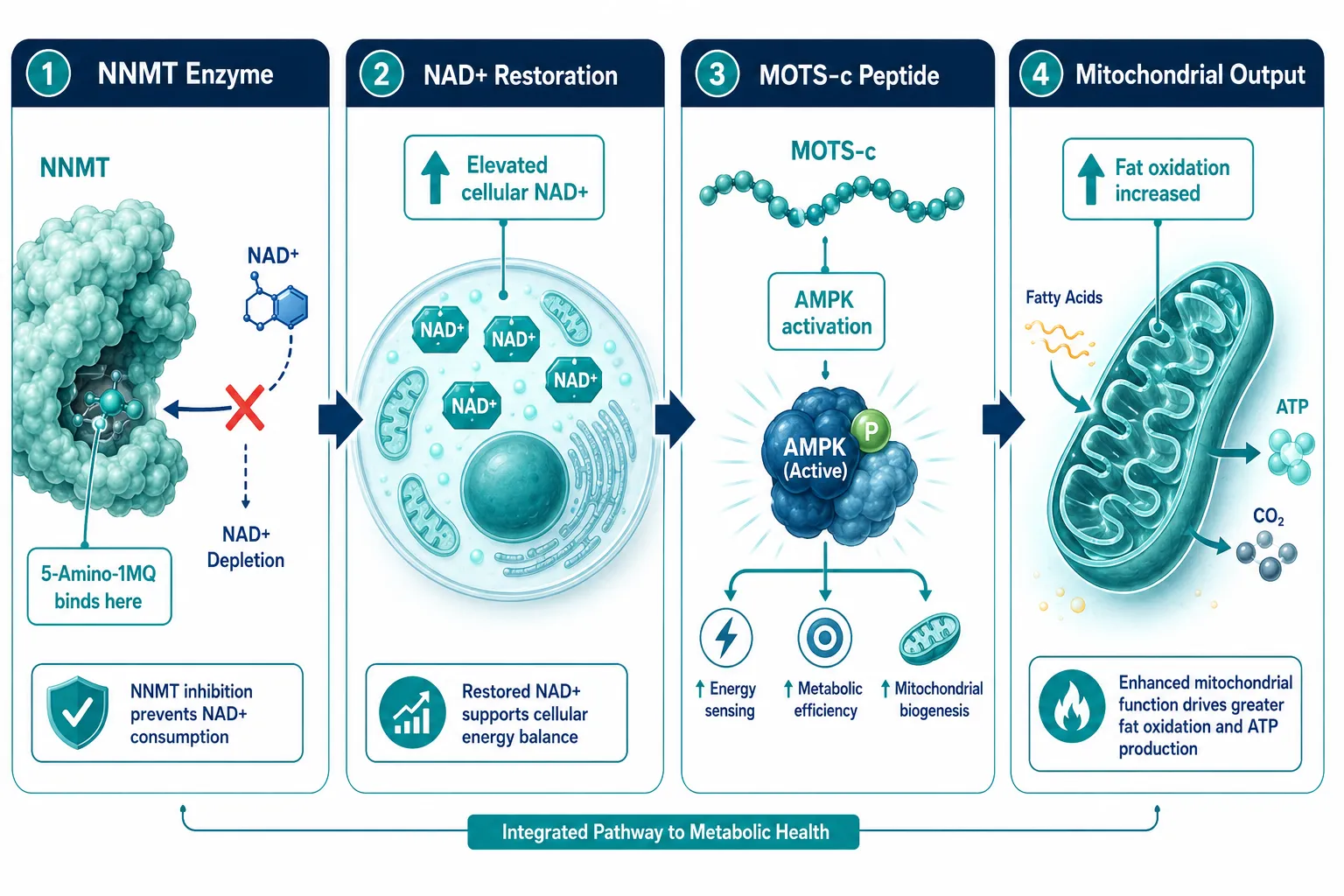
5-Amino-1MQ is a small-molecule inhibitor of nicotinamide N-methyltransferase (NNMT), the enzyme responsible for consuming SAM (S-adenosylmethionine) and degrading NAD+ precursors in adipose tissue. By blocking NNMT, 5-Amino-1MQ elevates intracellular NAD+ and reduces adipocyte hypertrophy. In diet-induced obesity (DIO) mouse models, it has demonstrated measurable reductions in total adiposity without significant lean mass loss. A critical clarification: 5-Amino-1MQ is frequently mis-grouped as a "mitochondrial peptide" in popular research blogs, but it is a non-peptide small molecule. Its inclusion in peptide stacks is based on functional overlap within the NAD+/mitochondrial axis, not structural similarity.

MOTS-c is a 16-amino-acid peptide encoded within the mitochondrial genome, specifically within the 12S rRNA region. It is a true mitochondrial-derived peptide (MDP). Its primary mechanism involves activation of AMPK (AMP-activated protein kinase), the master metabolic regulator that promotes fatty acid oxidation, suppresses lipogenesis, and improves insulin sensitivity. Industry summaries in 2026 increasingly highlight its visceral-fat-targeting effects as a distinguishing feature among metabolic research peptides. For a broader overview of how MOTS-c is positioned alongside other mitochondrial compounds, see the MOTS-c and Elamipretide research overview.

Feature 5-Amino-1MQ MOTS-c
Compound class Small molecule Mitochondrial peptide
Primary target NNMT enzyme AMPK pathway
Key metabolic effect NAD+ elevation, fat cell reduction Fatty acid oxidation, insulin sensitivity
Evidence base DIO mouse models Preclinical; human pilot data emerging
Route in research Oral Subcutaneous injection

Modeling Research Designs for 5-Amino-1MQ and MOTS-c Synergy in Adiposity Research
Modeling Research Designs for 5-Amino-1MQ and MOTS-c Synergy in Adiposity Research

Most published synergy explainers stop at mechanism. A more useful framing for researchers involves modeling how a dual-compound study would actually be structured, including dose timing, sequencing, and how synergy is quantified rather than assumed.

Dose Timing and Sequencing Rationale

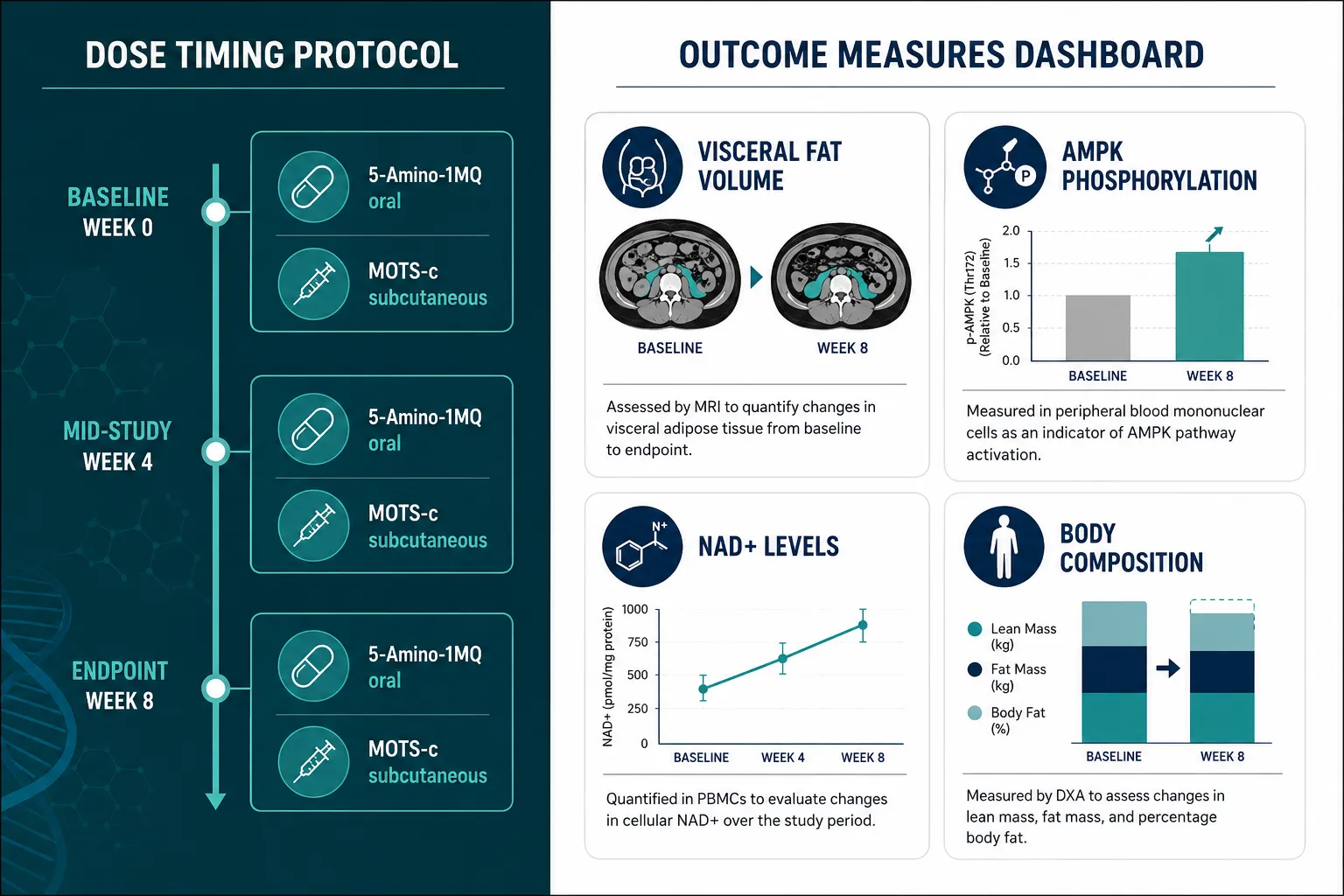
In preclinical adiposity models, the general design logic follows this sequence:

  1. Baseline assessment (Week 0): Body composition via MRI or DEXA, fasting glucose, insulin, and tissue NAD+ levels established in DIO subjects.
  2. MOTS-c administration (Weeks 1-4): Subcutaneous delivery to activate AMPK and prime mitochondrial fatty acid oxidation pathways before introducing the NNMT inhibitor.
  3. 5-Amino-1MQ introduction (Week 3 onward, overlapping): Oral administration begins while MOTS-c continues, allowing NAD+ elevation to amplify the metabolic environment already primed by AMPK activation.
  4. Mid-study checkpoint (Week 4): AMPK phosphorylation assays, plasma NAD+ metabolomics, and adipose tissue biopsy for lipid droplet morphology.
  5. Endpoint analysis (Week 8): Full body composition, visceral vs. subcutaneous fat volume, inflammatory cytokine panels, and methylation markers to monitor SAM/SAH ratios.

This staggered approach is mechanistically justified: MOTS-c's AMPK activation creates a catabolic metabolic state that may enhance the downstream effects of elevated NAD+ produced by NNMT inhibition. The two pathways are complementary rather than redundant.

Quantifying Synergy, Not Just Additive Effects

Researchers distinguish between additive and synergistic effects using the Bliss independence model or Loewe additivity framework. In a well-designed metabolic study, synergy would be demonstrated if the combined reduction in visceral fat volume exceeds the mathematical sum of each compound's individual effect at the same dose. Secondary markers for synergy include:

  • AMPK phosphorylation ratio (pAMPK/total AMPK) in adipose and liver tissue
  • Intracellular NAD+/NADH ratio in white adipose tissue
  • Adiponectin and leptin levels as functional adiposity biomarkers
  • Methylation index (SAM/SAH) to confirm NNMT inhibition without excessive methyl donor depletion

For researchers exploring how metabolic peptides are evaluated across different endpoints, the top 5 research peptides for metabolic health buyer's guide provides useful comparative context.

The Expanding Stack: SLUPP332, Evidence Gaps, and Research Outlook
The Expanding Stack: SLUPP332, Evidence Gaps, and Research Outlook

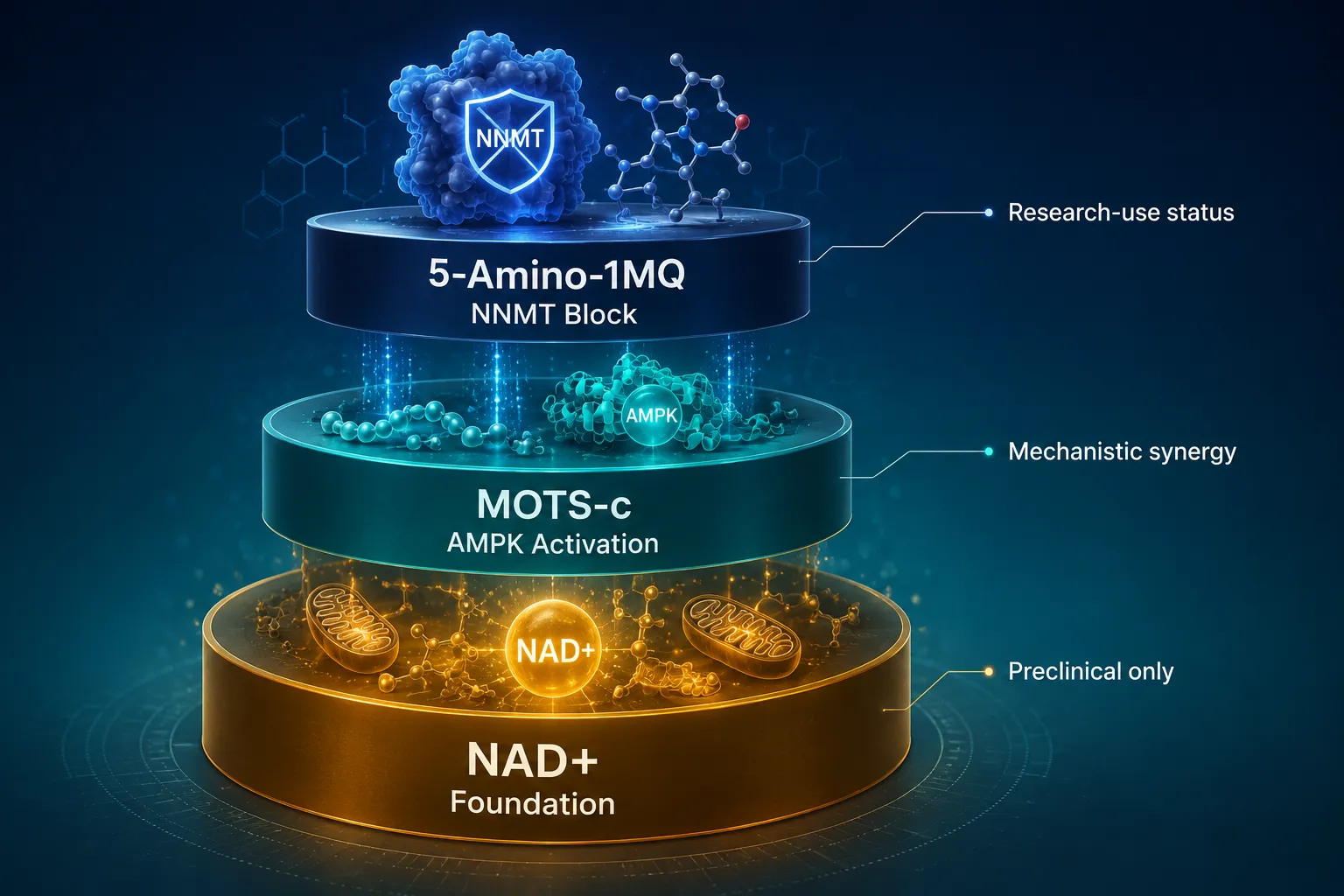
The concept of the "NAD+/MOTS-c/5-Amino-1MQ mitochondrial longevity stack" has gained traction in 2026 research community discussions, with one notable expansion: SLUPP332, a synthetic REV-ERB agonist that regulates circadian metabolic rhythms, is now being included in advanced stack models alongside MOTS-c and 5-Amino-1MQ. The rationale is that circadian dysregulation compounds adiposity by disrupting the timing of mitochondrial biogenesis, a gap that neither NNMT inhibition nor AMPK activation directly addresses.

"Mechanistic promise is not clinical proof. Every current stack model involving 5-Amino-1MQ and MOTS-c remains explicitly hypothetical until controlled human trial data exists."

This caution is not pessimism, it is the appropriate scientific framing. As of mid-2026, no formal clinical trials have been completed for this compound combination. All stacking guidance circulating in research blogs is derived from mechanistic reasoning, not outcome data. Researchers interested in adjacent mitochondrial peptide comparisons may find the LL-37 versus SS-31 peptide benefits comparison useful for understanding how different mitochondrial-targeting peptides are differentiated in research settings.

Those sourcing MOTS-c for preclinical work should review dedicated sourcing resources such as the buy MOTS-c peptide sourcing page to ensure compound purity and certificate of analysis standards are met.

Key Evidence Gaps Researchers Must Address

  • NAD+/methylation crosstalk risk: NNMT inhibition affects SAM availability; prolonged inhibition could theoretically disrupt methylation-dependent processes. No long-term safety data exists.
  • Off-target AMPK effects: Systemic AMPK activation via MOTS-c may affect cardiac and skeletal muscle tissue in ways not yet characterized at combined doses.
  • Species translation: DIO mouse model results for 5-Amino-1MQ do not automatically translate to human adiposity phenotypes, which are metabolically more heterogeneous.

For researchers working within a broader metabolic peptide framework, the GLP-1 peptide generational research concepts and sourcing notes and the Retatrutide and MASLD triple-agonist research overview offer complementary perspectives on how multi-target metabolic strategies are being evaluated in 2026.

Conclusion

The intersection of 5-Amino-1MQ and MOTS-c synergy in adiposity research represents one of the more mechanistically coherent compound stacking concepts in current metabolic science. The logic is clear: NNMT inhibition elevates NAD+ while AMPK activation drives fat oxidation, and the two pathways reinforce each other within the mitochondrial bioenergetic framework.

Actionable next steps for researchers:

  • Design studies with staggered dosing (MOTS-c preceding 5-Amino-1MQ) to allow AMPK priming before NAD+ elevation.
  • Use Bliss independence or Loewe additivity models to formally test synergy rather than assuming it from mechanism alone.
  • Include methylation index (SAM/SAH) and AMPK phosphorylation assays as mandatory secondary endpoints.
  • Source compounds with verified certificates of analysis and maintain strict research-use-only protocols.
  • Monitor the literature for early human pilot trial data, which industry analysts expect to emerge within the next few years as preclinical evidence matures.

Until controlled human data is available, the stack remains a hypothesis worth testing rigorously, not a protocol ready for translation.

Tags: 5-amino-1mq, adiposity research, ampk activation, metabolic health research, mitochondrial longevity stack, mitochondrial peptides, mots-c peptide, nad+ metabolism, nnmt inhibitor, peptide stacking, research peptides, visceral fat reduction
https://www.puretestedpeptides.com/wp-content/uploads/2026/08/5-amino-1mq-and-mots-c-synergy-in-adiposity-research-how-labs-stack-mitochondria.webp 1024 1536 https://www.puretestedpeptides.com/wp-content/uploads/2026/01/buy-peptides-online.jpg 2026-08-16 13:04:092026-08-16 13:04:095-Amino-1MQ and MOTS-c Synergy in Adiposity Research: How Labs Stack Mitochondrial Peptides
You might also like
5-Amino-1MQ Peptide: Mechanism, Metabolic Research, and How It Differs From Mitochondrial Peptides 5-Amino-1MQ Peptide: Mechanism, Metabolic Research, and How It Differs From Mitochondrial Peptides
How 5-Amino-1MQ and MOTS-c Are Studied Together in Metabolic Research How 5-Amino-1MQ and MOTS-c Are Studied Together in Metabolic Research
Carbohydrate Antigens and Peptide-Based Assays: How Glycoprotein Markers Interface With Modern Research Peptides Carbohydrate Antigens and Peptide-Based Assays: How Glycoprotein Markers Interface With Modern Research Peptides
Cellular Energy and Research Peptides: Why ATP Readouts Matter in Mitochondrial Studies Cellular Energy and Research Peptides: Why ATP Readouts Matter in Mitochondrial Studies
Where to Buy Glow Blend, Klow Blend, and Klow Nasal Peptide Sprays: Lab-Grade vs Cosmetic-Grade Options Where to Buy Glow Blend, Klow Blend, and Klow Nasal Peptide Sprays: Lab-Grade vs Cosmetic-Grade Options
Epithalon Peptide in Longevity Research: Telomeres, Cellular Aging, and What Labs Measure Epithalon Peptide in Longevity Research: Telomeres, Cellular Aging, and What Labs Measure
GLP‑3 Retatrutide in Phase 3 Trials: How Triple Agonism Is Reshaping Obesity and MASLD Research Endpoints GLP‑3 Retatrutide in Phase 3 Trials: How Triple Agonism Is Reshaping Obesity and MASLD Research Endpoints
GLP-2-T vs GLP2 Tirz Peptide: What the Naming Means and Why Researchers Confuse Them GLP-2-T vs GLP2 Tirz Peptide: What the Naming Means and Why Researchers Confuse Them
0 replies

Leave a Reply

Want to join the discussion?
Feel free to contribute!

Leave a Reply Cancel reply

Your email address will not be published. Required fields are marked *

×

Helpful Links

  • My account
  • Cart
  • Checkout
  • Refund and Returns Policy
  • Privacy Policy
  • SMS Privacy Policy
  • Login
  • My Account
  • Logout

USA Made Lab Tested Peptides

All products are sold for research, laboratory, or analytical purposes only, and are not for human consumption


Pure Tested Peptides is a chemical supplier. Pure Tested Peptides is not a compounding / chemical compounding facility as defined under 503A of the Federal Food, Drug, and Cosmetic act. Pure Tested Peptides is not an outsourcing facility as defined under 503B of the Federal Food, Drug, and Cosmetic act.

The statements made within this website have not been evaluated by the US Food and Drug Administration. The products we offer are not intended to diagnose, treat, cure or prevent any disease.

Human/Animal Consumption Prohibited. Laboratory/In-Vitro Experimental Use Only

Link to: GLP-2-T and GLP2 Tirz Peptides: Why Naming Matters for Translational Research and Trial Design Link to: GLP-2-T and GLP2 Tirz Peptides: Why Naming Matters for Translational Research and Trial Design GLP-2-T and GLP2 Tirz Peptides: Why Naming Matters for Translational Research...GLP-2-T and GLP2 Tirz Peptides: Why Naming Matters for Translational Research and Trial Design Link to: Complement-Dependent Cytotoxicity: What Peptide Researchers Need to Know About Immune Assays and Safety Link to: Complement-Dependent Cytotoxicity: What Peptide Researchers Need to Know About Immune Assays and Safety Complement-Dependent Cytotoxicity: What Peptide Researchers Need to Know About Immune Assays and SafetyComplement-Dependent Cytotoxicity: What Peptide Researchers Need to Know About...
Scroll to top Scroll to top Scroll to top