

Epithalon Peptide Formulations: How Labs Compare Lyophilized vs Solution Stability in Telomere Research
A reconstituted Epithalon solution left at room temperature can lose meaningful biological activity within a matter of days, a detail that can quietly invalidate weeks of telomere-length data if it goes unnoticed. For labs running telomerase activation assays or tracking telomere elongation across multiple time points, the choice between lyophilized and solution formulations is not a minor logistical preference. It is a core experimental variable.
This article focuses specifically on degradation kinetics, storage conditions, and formulation selection for Epithalon peptide formulations, practical intelligence for researchers already familiar with the peptide's mechanism and looking to optimize their experimental design.
Key Takeaways
- Lyophilized Epithalon stored at minus 20 C retains greater than 95% purity for up to 24 months; reconstituted solutions in bacteriostatic water are limited to approximately 28 days at 2 to 8 C.
- Solutions prepared in plain sterile water (no preservative) should be discarded within 24 hours.
- Moisture and light are the primary degradation drivers for dry powder; hydrolysis, oxidation, and temperature stress govern solution stability.
- Multi-site telomere studies increasingly ship only lyophilized vials and reconstitute locally just before use to standardize reagent quality.
- Minus 80 C storage offers maximum stability for archival lots, but standard minus 20 C freezers are adequate for routine experimental stocks.
Why Formulation Choice Matters in Epithalon Peptide Formulations for Telomere Research
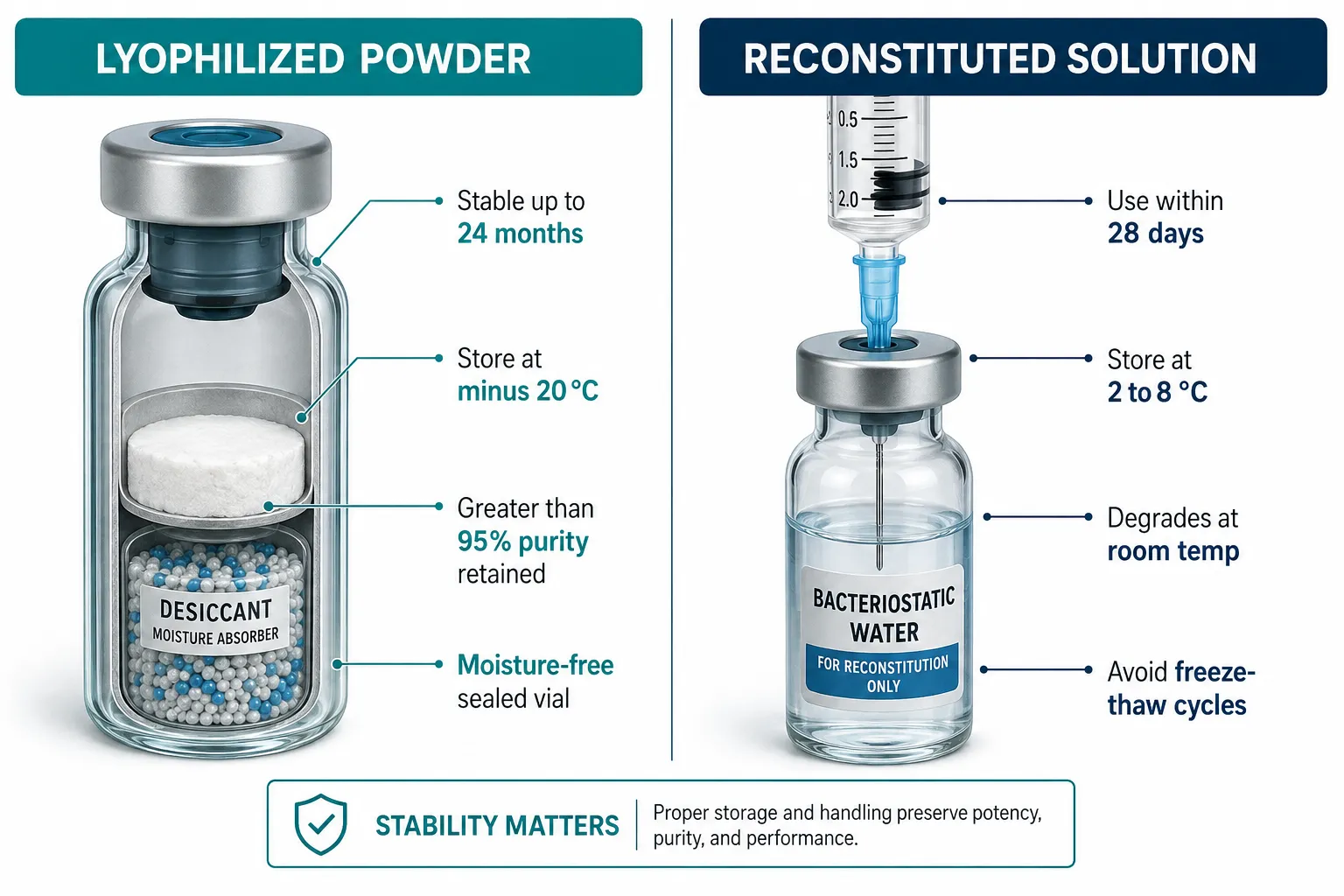
Epithalon (Ala-Glu-Asp-Gly) is a synthetic tetrapeptide supplied almost exclusively as lyophilized powder at 95 to 99% purity, typically in 10 mg vials. Research datasets have reported a 26-fold increase in telomerase activity in normal human mammary epithelial cells and approximately 33% longer telomeres in human fetal fibroblast cultures, making reagent integrity central to reproducible results.
The stability gap between the two formulation types is substantial:
| Formulation | Storage Condition | Estimated Stability |
|---|---|---|
| Lyophilized powder | minus 20 C, desiccated, dark | Up to 24 months (>95% purity) |
| Lyophilized powder | 2 to 8 C, sealed | 18 to 24 months |
| Lyophilized powder | Room temperature | Approximately 3 weeks |
| Reconstituted in bacteriostatic water | 2 to 8 C | Up to 28 days |
| Reconstituted in sterile water | 2 to 8 C | 24 hours maximum |
| Reconstituted solution | Room temperature | Up to 72 hours cumulative |
The core principle: dry-state stability is measured in years; solution stability is measured in days to weeks.
For researchers sourcing compounds alongside Epithalon, the same formulation discipline applies to related peptides. The SS-31 mitochondrial research themes resource covers analogous storage considerations for another stability-sensitive peptide used in oxidative stress models.
Degradation Mechanisms: What Destroys Each Formulation
Understanding what drives degradation helps labs design storage protocols rather than simply follow them by rote.
Lyophilized Powder Degradation
For dry Epithalon, the two dominant threats are moisture and light. Humidity exposure markedly accelerates degradation, compressing shelf life from years to months. This is why vacuum-sealed, desiccated packaging has become standard for telomere research inventories. Even brief exposure to ambient humidity during weighing or vial transfer can initiate hydrolysis at the peptide bonds.
"Exposure of lyophilized Epithalon to humidity markedly accelerates degradation, shortening usable shelf life from years to mere months."
Practical controls include:
- Working quickly in low-humidity environments when opening vials
- Using desiccant packs inside storage boxes
- Returning unused powder to sealed containers immediately
Solution Degradation
Once reconstituted, Epithalon faces a broader set of chemical stressors:
- Hydrolysis at peptide bonds, accelerated by temperature and pH
- Oxidation of susceptible residues
- Adsorption onto container surfaces, reducing effective concentration
- Microbial contamination if aseptic technique is not maintained
- Freeze-thaw stress when solutions are repeatedly cycled
Bacteriostatic water (containing 0.9% benzyl alcohol) extends usable solution life to approximately 28 days at 2 to 8 C by suppressing microbial growth. Plain sterile water provides no such protection, limiting use to 24 hours.
Frozen solutions should not undergo more than a few freeze-thaw cycles. Each cycle introduces mechanical stress and concentration gradients that accelerate structural degradation.
For context on how similar degradation principles apply across peptide classes, the BPC-157 core peptides documentation first research guide provides a useful parallel framework.
Practical Storage Protocols for Epithalon Peptide Formulations in Telomere Experiments
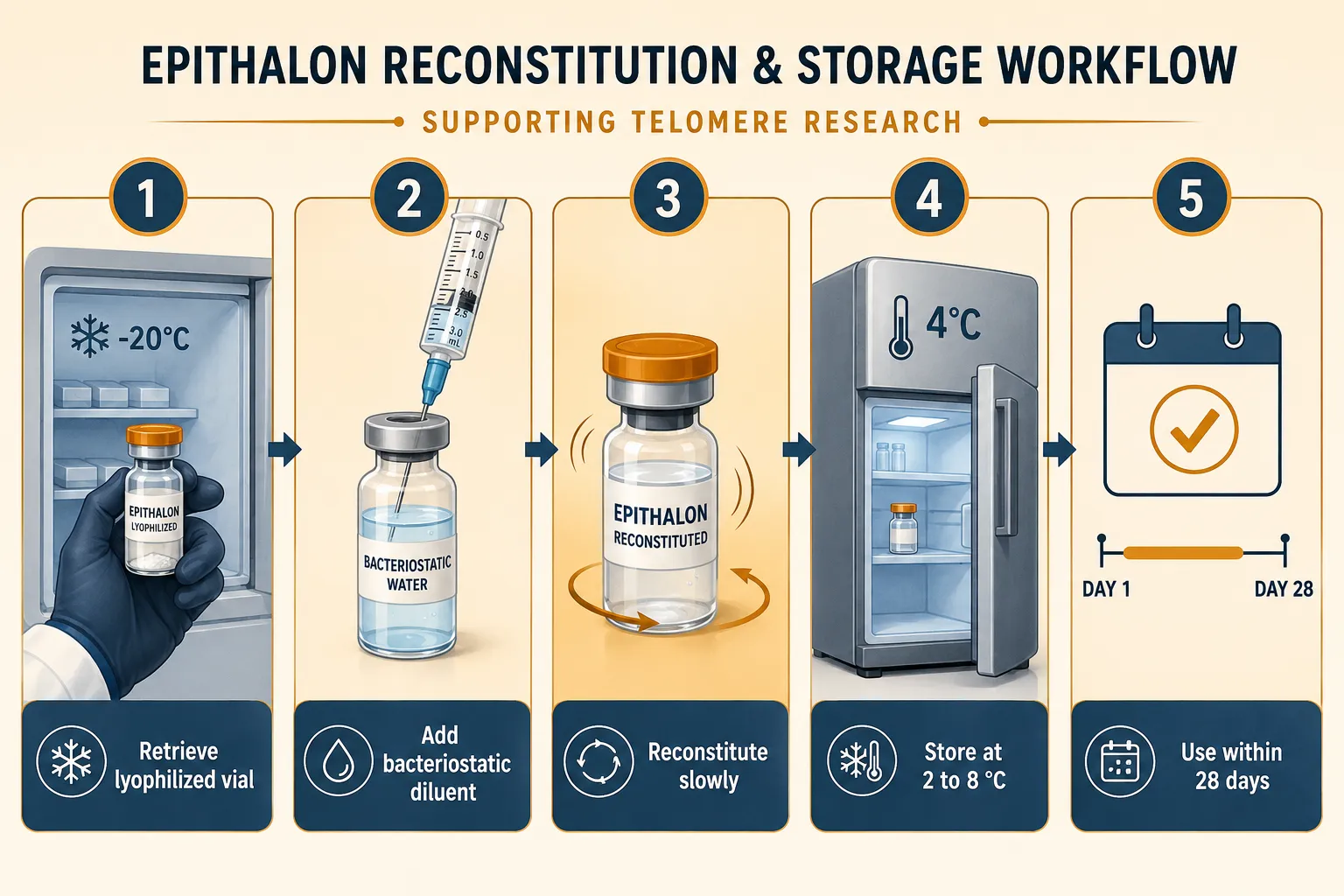
Designing a storage protocol around Epithalon peptide formulations requires matching storage tier to experimental timeline.
Three-tier storage model:
- Archival lots (multi-year studies): minus 80 C, desiccated, light-protected. While not strictly required, this tier provides maximum stability for long telomere-tracking projects where reagent consistency across years is critical.
- Active research stocks (routine use): minus 20 C, sealed vials with desiccant. This is the standard recommendation for day-to-day experimental peptide stocks and is adequate for most telomere assay workflows.
- Short-term working inventory: 2 to 8 C for lyophilized powder not expected to be used within 24 months. Purity remains above 95% for 18 to 24 months under these conditions.
Reconstitution best practices for telomere assays:
- Reconstitute immediately before use rather than preparing bulk solutions in advance
- Use bacteriostatic water as the diluent for any solution intended to be used over multiple days
- Design TRAP assays and telomere-length measurement protocols so all planned sampling falls within a 2 to 7-day window after reconstitution
- Aliquot reconstituted solution into single-use volumes to avoid repeated access to the same vial
Multi-site telomere studies have adopted a standardized approach: ship only lyophilized vials, reconstitute locally just before experimental use. This eliminates inter-site variability introduced by different solution ages and handling histories.
For labs evaluating supplier quality alongside storage planning, the peptide supplier comparisons resource interpreting PeptideTech and PeptideSC offers a structured framework for assessing documentation standards. Researchers sourcing Epithalon alongside other compounds can also consult the where to buy SS-31 and Epithalon online guide for supplier navigation. Additional quality control benchmarks relevant to research-grade peptide sourcing appear in the PT-141 peptide research context QA and controls article.
Applying Formulation Knowledge Across the Experiment Lifecycle
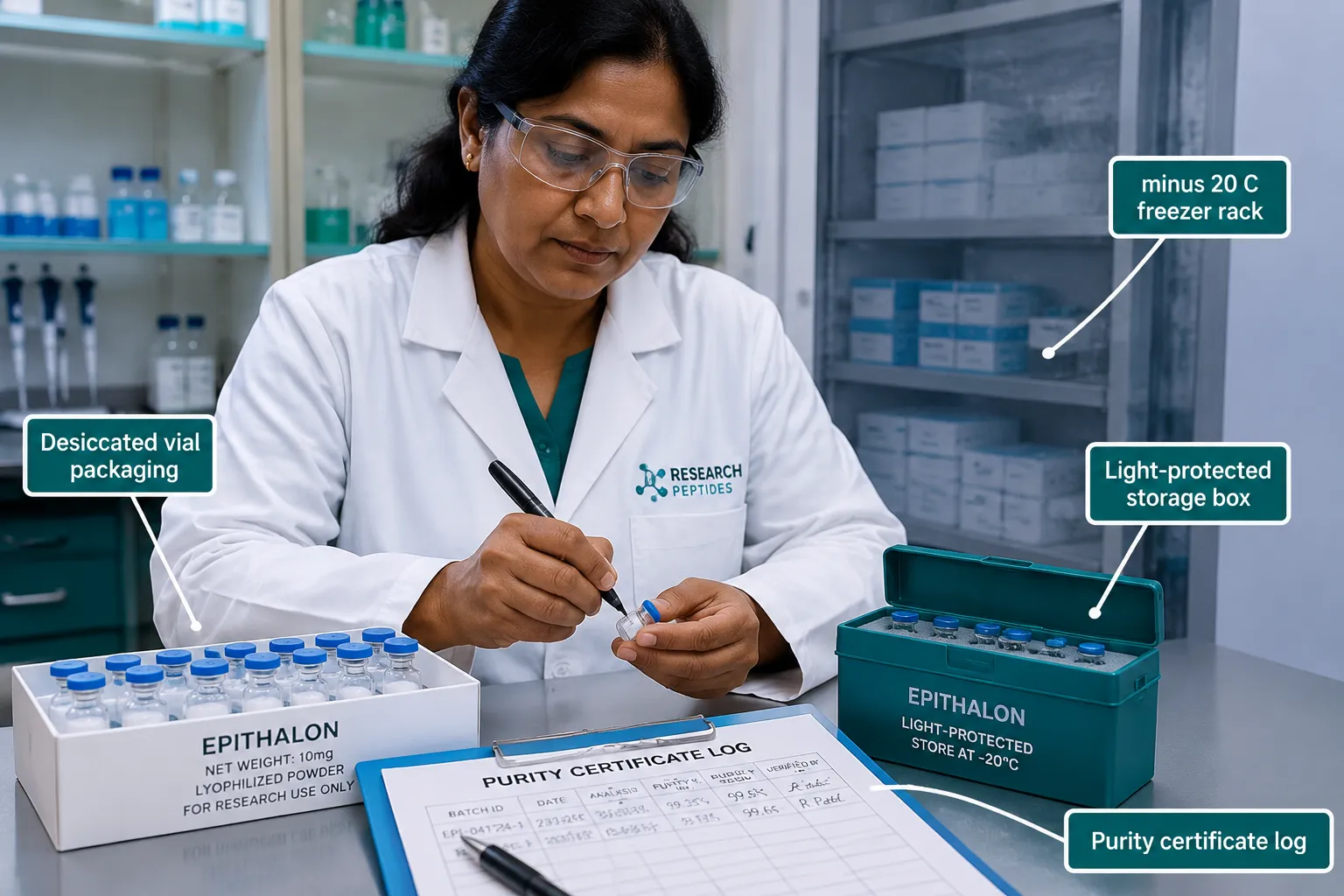
Formulation decisions intersect with every stage of a telomere study, from procurement through data collection.
At procurement: Request certificates of analysis confirming purity at or above 95%, lyophilized state, and storage conditions maintained during shipping. Cold-chain documentation matters for long-distance orders.
At intake: Log the vial arrival date, inspect packaging integrity, and transfer immediately to the appropriate storage tier. Vials showing signs of moisture ingress or color change should be quarantined.
During the experiment: Track cumulative room-temperature exposure for any reconstituted solution. The 72-hour cumulative limit at room temperature applies even if the solution has been refrigerated between uses.
At data analysis: Flag any data points collected from solutions older than the recommended stability window. Degraded Epithalon may produce attenuated telomerase activity readings, introducing systematic underestimation of effect size.
The GHK-Cu peptide purchase and copper peptide research sourcing guide demonstrates how analogous documentation practices are applied to other research-grade peptides with similar stability sensitivities.
Conclusion
Epithalon peptide formulations present a clear hierarchy of stability: lyophilized powder at minus 20 C is the gold standard for telomere research, offering verified purity above 95% for up to 24 months. Reconstituted solutions are working reagents with a defined shelf life, 28 days in bacteriostatic water at 2 to 8 C, 24 hours in plain sterile water, and no more than 72 cumulative hours at room temperature.
Actionable next steps for research teams:
- Audit current storage conditions against the three-tier model and reassign vials to the appropriate temperature tier
- Switch to bacteriostatic water as the default diluent for all reconstituted Epithalon solutions
- Build a 2 to 7-day sampling window into telomere assay protocols to align with solution stability limits
- Implement vial intake logging that captures arrival date, storage tier assignment, and first-use date
- For multi-site studies, standardize on lyophilized shipment with local reconstitution to eliminate inter-site reagent variability
Rigorous formulation management does not add complexity to telomere research, it removes a hidden source of noise that can obscure real biological signals.


Leave a Reply
Want to join the discussion?Feel free to contribute!