Call or Text 727-513-9780
  • Shopping Cart Shopping Cart
    0Shopping Cart
Pure Tested Peptides | America's most trusted Peptides for sale online
  • Peptides for sale
    • Oral Peptides for sale
      • Peptide Capsules for sale
      • BPC 157 Capsules 1000mcg
      • SLU-PP-332 Capsules | 1000 mcg
      • 5-Amino-1MQ 50mg Capsules
      • Tesofensine 500mcg
    • All Peptides for sale
    • Peptide Sprays
      • BPC 157 Nasal Spray Kit
      • BPC-157 TB500 Nasal Spray Kit
      • Semax Nasal Spray 10mg
      • Selank – Nasal Spray Kit – 10mg
      • Epithalon 50MG Nasal Spray Kit
      • Ipamorelin 10mg Nasal Spray
      • Klow Nasal Spray (BPC-157 + TB-500 + GHK-Cu + KPV) | 80mg
      • Hulk Nasal Spray Tesa / Ipa Blend 6/3 MG
      • Klow Nasal Spray
      • NAD + 500 mg Nasal Spray
      • PT-141 Nasal Spray Kit
    • GHRH Peptides
      • Ipa Peptides
      • CJC-1295 Peptides
        • CJC-1295 with DAC 5 mg
        • CJC-1295 without DAC 5 mg
        • CJC-1295 Ipa 10mg
      • Tesa Peptides
        • Tesa Peptide
        • Tesa 20 mg
    • GHK-Cu Peptides
      • All GHK-Cu Peptides
      • GHK-Cu 100mg
      • KLOW Peptide Blend – Buy KLOW blend online
    • BPC Peptides
      • All BPC Peptides
      • BPC-157
      • BPC-157 TB-500
      • BPC 157 capsules 1000mcg
    • SLU-PP-332 Peptides
      • All SLU-PP-332 Peptides
      • SLU-PP-332 5mg
    • GLP3 Peptides
      • GLP3-R
      • GLP3-R CAG 10mg
      • GLP3-R 20mg
    • PT-141 Peptides
      • PT-141 Peptides for sale
      • PT-141 10mg
      • PT-141 Nasal Spray
    • CAG Peptides
      • Lipo-C Peptide Blend
      • CAG 5mg
      • CAG 10mg
    • MOTS-C Peptides
      • MOTS-C Peptides for sale
      • MOTS-c peptide
      • MOTS-c 10mg *6 pack*
    • 5 Amino 1MQ Peptides
      • 5 Amino 1MQ Peptides for sale
      • 5-Amino-1MQ 50mg Capsules
      • 5-Amino-1MQ 5mg
    • Epithalon Peptides
      • Epithalon Peptides for sale
      • Epithalon 10mg
      • Epithalon 50mg
  • Shop
    • GLPs
      • 5-Amino-1MQ 50mg Capsules
      • 5-Amino-1MQ 5mg
      • GLP3-Reta
      • L-Carnitine 500mg/ml
      • Tesofensine 500mcg
      • SLU-PP-332 5mg
      • MOTS-c 10mg *6 pack*
    • Epithalon & BPC Peptides
      • Epithalon 10mg
      • Epithalon 50mg
      • BPC-157
      • BPC 157 capsules 1000mcg
      • BPC-157 TB-500
      • BPC-157 TB500 Nasal Spray Kit
      • BPC 157 Nasal Spray Kit
    • BPC TB-500 & NAD+ Peptides
      • NAD+ 500 mg
      • KLOW Peptide Blend – Buy KLOW blend online
      • GLOW Peptide Blend
      • TB 500 5mg
      • BPC 157 capsules 1000mcg – Supplement
      • BPC 157 Nasal Spray Kit
      • BPC-157
      • BPC-157 TB500 Nasal Spray Kit
      • BPC-157 TB-500
      • BPC 157 capsules 1000mcg
    • LL-37 Peptide
      • LL-37 10 mg
    • MOTS-C & Selank
      • MOTS-c peptide
      • Selank 10mg
    • GHK Peptides
      • GHK-Cu 100mg
      • GLOW Peptide Blend
      • KLOW Peptide Blend – Buy KLOW blend online
  • COAs
  • Wholesale
    • Wholesale Peptides for sale
  • PTP FAQ
  • Affiliates
    • Selank Peptide: Advanced Pharmacological Mechanisms Underlying Its Anxiolytic and Nootropic Effects in Research
      • 5-Amino-1MQ Peptide: Detailed Mechanisms of NNMT Inhibition and Its Impact on Cellular Metabolism Research
        • MOTS-C Peptide: Unraveling Its Role in Mitochondrial Dynamics and Energy Metabolism Research
          • Epithalon Peptide and Telomerase Regulation: Investigating Its Impact on Cellular Senescence and Lifespan Research Models
            • GLP2-T vs GLP2 Tirz Peptide: Understanding the Naming, Mechanistic Nuances, and Research Implications for Gut Health
      • Peptides and Polypeptides in Modern Pharmacology: What Research on Metoprolol, Prednisone, and Amlodipine Reveals
        • Polypeptide Peptides vs NSAIDs: What Naproxen and Diclofenac Teach Tissue-Repair Researchers About BPC‑157 and TB‑500
          • Peptides and Polypeptides in Endocrine Pharmacology: How GLP-1, GLP-2, and GLP-3 Retatrutide Differ From Classic Drugs Like Prednisone and Amlodipine
          • 5‑Amino‑1MQ Peptide and NNMT Inhibition: How It Compares With Statins Like Atorvastatin in Adipose and Lipid Metabolism Research
      • Enclomiphene, Estrogen Receptor Signaling, and Luteinizing Phase Biology: What Hormone Researchers Should Measure
        • Mesenchymal Stem Cells, BPC‑157, and GHK‑Cu: How Tissue Repair Peptides Compare With Classic NSAIDs Like Naproxen in Injury Models
          • Peptide Calculator Use Cases Beyond Growth Hormone: Working Through GLP‑3 Retatrutide, MOTS‑c, and BPC‑157 Research Dosing
        • Polypeptide Peptides in Endocrine and Metabolic Pharmacology: Lessons From Amlodipine, Prednisone, and Metoprolol
        • Peptides Calculator for Advanced Blends: Worked Examples for Tesamorelin, CJC‑1295, and Ipamorelin Stacks
          • Peptides and Polypeptides in Human Physiology: How Molecular Size Shapes Research Applications
            • Selank Peptide: Advanced Pharmacological Mechanisms Underlying Its Anxiolytic and Nootropic Effects in Research
          • 5-Amino-1MQ Peptide: Detailed Mechanisms of NNMT Inhibition and Its Impact on Cellular Metabolism Research
            • MOTS-C Peptide: Unraveling Its Role in Mitochondrial Dynamics and Energy Metabolism Research
              • Epithalon Peptide and Telomerase Regulation: Investigating Its Impact on Cellular Senescence and Lifespan Research Models
                • GLP2-T vs GLP2 Tirz Peptide: Understanding the Naming, Mechanistic Nuances, and Research Implications for Gut Health
                  • Peptides and Polypeptides in Endocrine Pharmacology: How GLP-1, GLP-2, and GLP-3 Retatrutide Differ From Classic Drugs Like Prednisone and Amlodipine
                    • Polypeptide Peptides vs NSAIDs: What Naproxen and Diclofenac Teach Tissue-Repair Researchers About BPC‑157 and TB‑500
                      • Peptides and Polypeptides in Modern Pharmacology: What Research on Metoprolol, Prednisone, and Amlodipine Reveals
                        • 5‑Amino‑1MQ Peptide and NNMT Inhibition: How It Compares With Statins Like Atorvastatin in Adipose and Lipid Metabolism Research
                        • Enclomiphene, Estrogen Receptor Signaling, and Luteinizing Phase Biology: What Hormone Researchers Should Measure
                        • Mesenchymal Stem Cells, BPC‑157, and GHK‑Cu: How Tissue Repair Peptides Compare With Classic NSAIDs Like Naproxen in Injury Models
                        • Peptide Calculator Use Cases Beyond Growth Hormone: Working Through GLP‑3 Retatrutide, MOTS‑c, and BPC‑157 Research Dosing
                        • Polypeptide Peptides in Endocrine and Metabolic Pharmacology: Lessons From Amlodipine, Prednisone, and Metoprolol
                        • Peptides Calculator for Advanced Blends: Worked Examples for Tesamorelin, CJC‑1295, and Ipamorelin Stacks
                        • Peptides and Polypeptides in Human Physiology: How Molecular Size Shapes Research Applications
                        • Selank Peptide: Advanced Pharmacological Mechanisms Underlying Its Anxiolytic and Nootropic Effects in Research
                        • MOTS-C Peptide: Unraveling Its Role in Mitochondrial Dynamics and Energy Metabolism Research
                        • Peptides and Polypeptides in Modern Pharmacology: What Research on Metoprolol, Prednisone, and Amlodipine Reveals
                        • Peptides and Polypeptides in Endocrine Pharmacology: How GLP-1, GLP-2, and GLP-3 Retatrutide Differ From Classic Drugs Like Prednisone and Amlodipine
                        • 5-Amino-1MQ Peptide: Detailed Mechanisms of NNMT Inhibition and Its Impact on Cellular Metabolism Research
                        • Mesenchymal Stem Cells, BPC‑157, and GHK‑Cu: How Tissue Repair Peptides Compare With Classic NSAIDs Like Naproxen in Injury Models
                        • Peptide Calculator Use Cases Beyond Growth Hormone: Working Through GLP‑3 Retatrutide, MOTS‑c, and BPC‑157 Research Dosing
                        • GLP2-T vs GLP2 Tirz Peptide: Understanding the Naming, Mechanistic Nuances, and Research Implications for Gut Health
                        • Polypeptide Peptides in Endocrine and Metabolic Pharmacology: Lessons From Amlodipine, Prednisone, and Metoprolol
                        • Polypeptide Peptides vs NSAIDs: What Naproxen and Diclofenac Teach Tissue-Repair Researchers About BPC‑157 and TB‑500
                        • Peptides and Polypeptides in Human Physiology: How Molecular Size Shapes Research Applications
                        • Peptides Calculator for Advanced Blends: Worked Examples for Tesamorelin, CJC‑1295, and Ipamorelin Stacks
                        • 5‑Amino‑1MQ Peptide and NNMT Inhibition: How It Compares With Statins Like Atorvastatin in Adipose and Lipid Metabolism Research
                        • Enclomiphene, Estrogen Receptor Signaling, and Luteinizing Phase Biology: What Hormone Researchers Should Measure
                        • Epithalon Peptide and Telomerase Regulation: Investigating Its Impact on Cellular Senescence and Lifespan Research Models
                        • Best research protocol Klow blend
                        • best time to take BPC-157
                        • best time to take DSIP (Delta Sleep Inducing Peptide)
                        • best time to take CJC-1295
                        • best time to take AOD-9604
                        • best time to take Follistatin 344
                        • best time to take Ipamorelin
                        • best time to take MK-677 (Ibutamoren)
                        • best time to take Ligandrol (LGD-4033) — research compound
                        • best time to take Ostarine (MK-2866) — research compound
                        • best time to take GHK-CU
                        • best time to take TB-500
                        • best time to take MOTS-c
                        • best time to take Semax
                        • best time to take RAD-140 (Testolone) — research compound
                        • best time to take Thymosin Alpha-1
                        • best time to take PEG-MGF
                        • Biolife Plasma, Octapharma Plasma, and Research Peptides: How Plasma Donation Labs Differ From Peptide Suppliers
                        • best time to take YK-11 — research compound
                        • best time to take PT-141 (Bremelanotide)
                        • Best research protocol Klow blend
                        • 5-Amino-1MQ and MOTS-C Synergy: Metabolic Signaling, Mitochondria, and Research Design
                        • BPC-157 and TB-500: Investigating Their Combined Effects on Angiogenesis and Cellular Migration in Tissue Repair Models
                        • BPC-157 Peptide: Gut Barrier Function, Inflammation, and Tissue-Recovery Research
                        • 5‑Amino‑1MQ and MOTS‑c Synergy in Metabolic Research: Designing NNMT and Mitochondrial Biogenesis Stacks
                        • CJC-1295 with DAC vs. Without DAC: Half-Life, Release Kinetics, and Research Implications
                        • CJC‑1295 with DAC vs. Without DAC: Expanding on Half‑Life Differences Using Tesamorelin and Ipamorelin Blend Case Studies
                        • Collagen Biology and Copper‑Binding Peptides: How GHK‑Cu, Glow Blend, and Klow Blend Interact with Skin and Connective Tissue
                        • Collagen Biology and Regenerative Peptides: How GHK‑Cu, Glow Blend, and Klow Blend Affect Extracellular Matrix Research
                    • DNA, Telomeres, and Longevity Peptides: Positioning Epithalon and MOTS‑c in Genetic Aging Research
                      • Enclomiphene Citrate: serm Mechanism, Testosterone Research, and Stack Compatibility
                        • Enclomiphene vs Enclomiphene Citrate: Formulation, Bioavailability, and Research Distinctions
                        • Epithalon Peptide Research: Telomerase Activation, Aging, and Pineal Gland Function
                        • Estrogen Receptor Signaling and Enclomiphene: How Selective Modulators Compare with Classic Polypeptide Hormones
                        • GHK-Cu Peptide: Advanced Mechanisms in Extracellular Matrix Remodeling and Wound Healing Research
                        • GHK-Cu Peptide: Collagen Synthesis, Wound Repair, and Skin-Barrier Research Models
                        • GLP-1 vs GLP-3 vs GLP-2: Peptide Classification and Research Applications
                        • GLP-2 Peptide Research Guide: Gut Barrier Function, Nutrient Absorption, and Intestinal Recovery Models
                        • GLP-3 Retatrutide vs. GLP-1 Drugs: What Triple-Agonist Biology Changes in Research Models
                        • Ipamorelin and Tesamorelin Combination: Synergistic GH Secretagogue Research and Dosing Protocols
                        • GLP2 Tirz Peptide: What It Is, Why the Name Exists, and How Researchers Should Interpret It
                        • Klow Blend Peptide Nasal Spray: What the Formulation Is Trying to Do in Cognitive Research
                        • Mitochondria, NNMT Inhibition, and Peptide Modulators: Where MOTS‑c and 5‑Amino‑1MQ Fit in Cellular Energy Research
                        • MOTS-c Peptide: Mitochondrial Function, Energy Metabolism, and What Researchers Measure
                        • MOTS-c vs. 5-Amino-1MQ: Which Metabolic Research Questions Each Compound Actually Answers
                        • Nasal Spray Peptides: Bioavailability, Administration, and Semax/Selank Research Applications
                        • PT-141 Peptide Research: Mechanism of Action and Melanocortin Receptor Signaling
                        • Retatrutide for Research: Mechanism, Structure, and GLP-1/GLP-3 Dual Action
                        • Retatrutide for Obesity and Type 2 Diabetes: What the Latest Trial Data Suggest
                        • Tesofensine Peptide Research: Mechanism, Appetite Suppression, and Neuropeptide Y Pathways
  • Contact
    • Contact Customer Service
    • Text Customer Support
  • About US
  • Shop all peptides
  • Affiliate Program
    • Affiliate Signup
  • Login / Register Login / Register Page Link Login / Register Page Link
  • Click to open the search input field Click to open the search input field Search
  • Menu Menu
Glow Blend vs Klow Blend Peptides: Ingredient Comparison and Research Applications

Glow Blend vs Klow Blend Peptides: Ingredient Comparison and Research Applications

August 20, 2026/0 Comments/in Uncategorized/by

Two peptide blends with nearly identical names are causing real confusion among researchers in 2026, and that confusion has a cost. Choosing the wrong formulation for a study protocol can skew results, waste materials, and delay timelines. The Glow Blend vs Klow Blend Peptides: Ingredient Comparison and Research Applications question is not just a naming issue; it reflects a meaningful difference in research intent, ingredient composition, and target tissue.

This article breaks down both blends side by side, explains what each is designed to study, and helps researchers make an informed decision.

Key Takeaways

  • Glow Blend and Klow Blend share three core peptides but differ by one critical addition: KPV is exclusive to Klow Blend
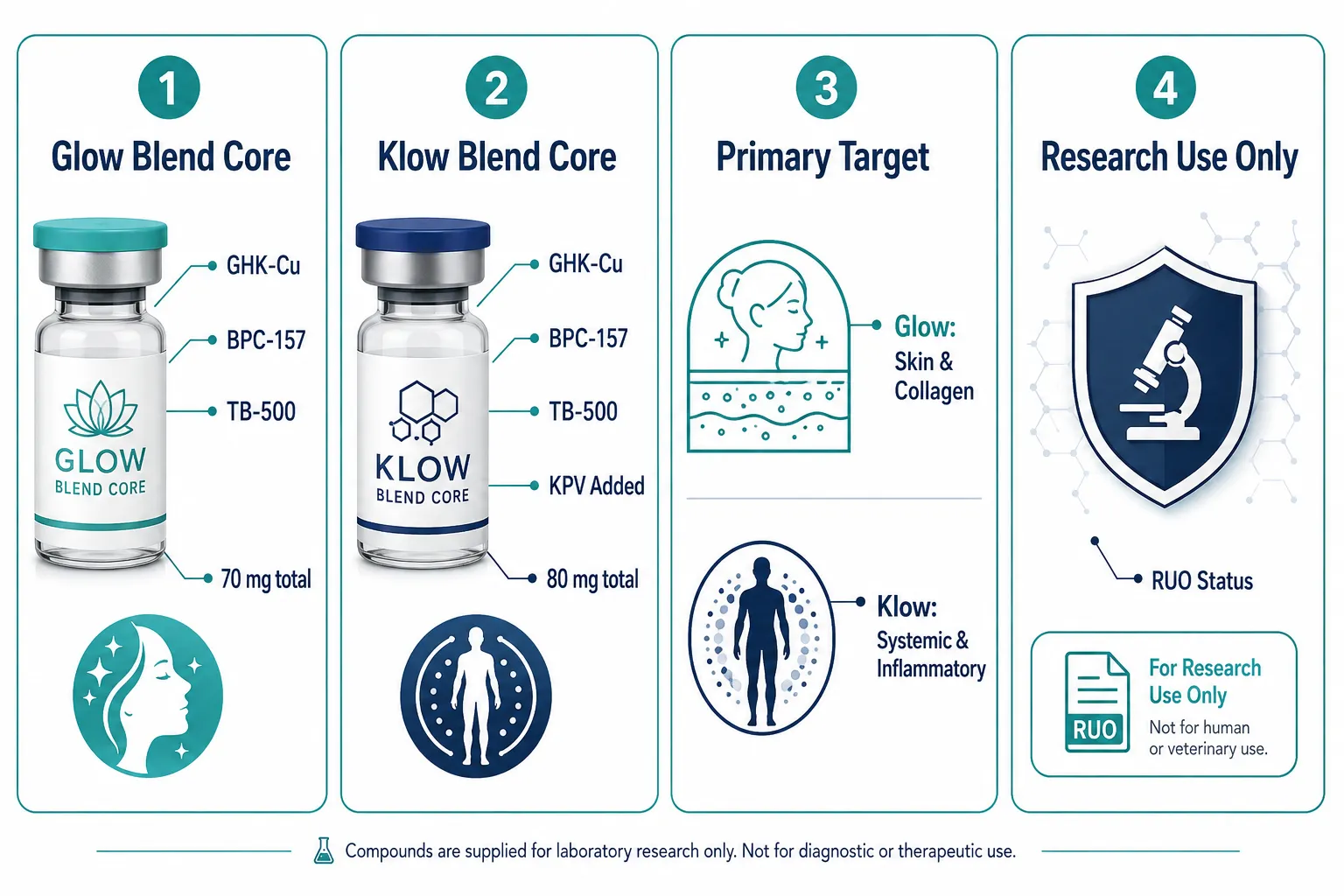
  • Klow Blend carries a higher total mass (80 mg) versus Glow Blend (70 mg), reflecting the added KPV component
  • Glow Blend is positioned for skin, collagen, and tissue-repair research; Klow Blend targets systemic and inflammatory models
  • Both blends are research-use-only (RUO) compounds and are not approved therapeutic agents
  • Understanding the ingredient-level differences is essential before selecting either blend for a study protocol

What Are Glow Blend and Klow Blend?

Glow Blend and Klow Blend are proprietary multi-peptide research formulations. Both contain a combination of well-documented research peptides, GHK-Cu, BPC-157, and TB-500, in comparable ratios. The core architecture of each blend is nearly identical, which is the primary source of buyer confusion.
What Are Glow Blend and Klow Blend?

The key structural difference is straightforward: Klow Blend adds KPV, a tripeptide fragment derived from alpha-melanocyte-stimulating hormone (alpha-MSH). This single addition shifts the blend's total mass from 70 mg (Glow) to 80 mg (Klow) and meaningfully expands its research scope beyond dermal applications.

Shared Core Ingredients

Ingredient Known Research Focus
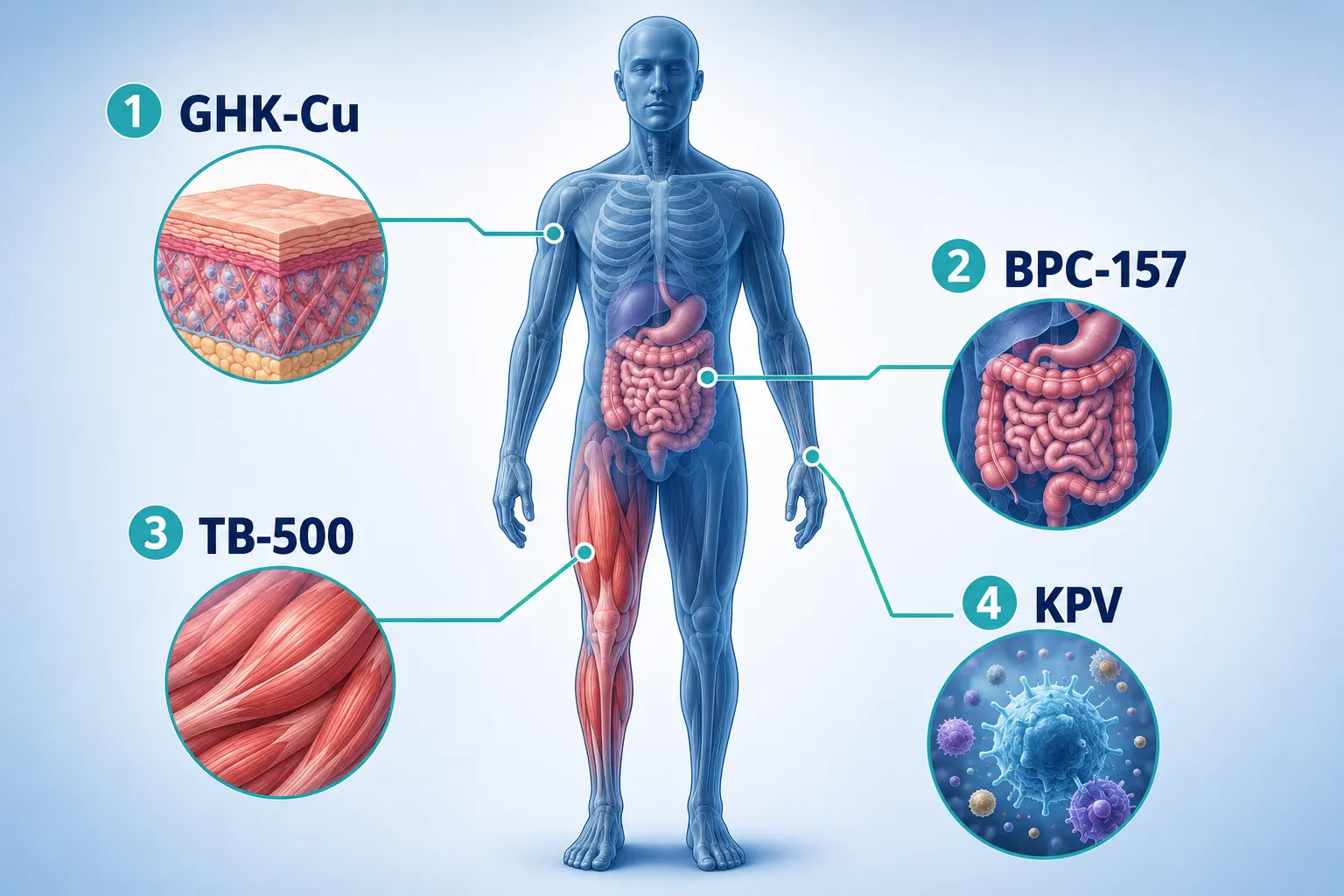
GHK-Cu Collagen synthesis, wound healing, antioxidant signaling
BPC-157 Tendon repair, gut mucosal healing, angiogenesis
TB-500 Actin regulation, tissue regeneration, mobility models

All three ingredients appear in both blends at comparable ratios. Researchers already familiar with individual peptide studies, such as those exploring BDNF peptides or growth hormone secretagogue stacks, will recognize these components from adjacent research areas.

Glow Blend vs Klow Blend Peptides: Ingredient Comparison and Research Applications in Detail

The ingredient-level differences between these two blends directly determine which research applications each one fits.

Glow Blend: Skin and Collagen Research Focus

Glow Blend, at 70 mg total, is formulated with dermal and connective tissue research as its primary orientation. The combination of GHK-Cu and BPC-157 is well-suited to studies examining:

  • Collagen remodeling and extracellular matrix repair
  • Wound healing kinetics in skin tissue models
  • Fibroblast activity and dermal regeneration
  • Oxidative stress reduction in aging skin models

GHK-Cu has been studied extensively for its role in upregulating collagen and elastin gene expression. BPC-157 contributes to angiogenic signaling, which supports tissue repair at the vascular level. TB-500 rounds out the blend by addressing actin polymerization, a process relevant to cell migration during wound closure.

For researchers focused on dermatological or cosmetic science applications, Glow Blend offers a clean, targeted formulation without additional systemic variables.

Klow Blend: Systemic and Inflammatory Research Focus

Klow Blend, at 80 mg total, builds on the same core but adds KPV, a tripeptide with documented research interest in inflammatory signaling pathways. This addition repositions the blend for multi-tissue and systemic research models.

KPV has been studied in the context of:

  • Intestinal inflammation and mucosal barrier function
  • Immune modulation via melanocortin receptor pathways
  • Skin inflammation as a secondary application
  • Systemic anti-inflammatory signaling in preclinical models

For researchers comparing intranasal or systemic peptide delivery models, the Klow Blend vs. Semax and Selank: Intranasal Nootropic Peptides resource provides useful context on how Klow fits within the broader nootropic and neuroimmune peptide landscape.

Key distinction: Glow Blend is optimized for localized tissue research. Klow Blend is designed for studies where inflammatory modulation across multiple tissue types is a variable.
Klow Blend: Systemic and Inflammatory Research Focus

Regulatory Status, Sourcing, and Research Considerations

Both Glow Blend and Klow Blend carry research-use-only (RUO) status. Neither is an approved therapeutic, and neither should be represented as such. This classification is consistent with how the broader peptide research market operates in 2026.

Researchers sourcing either blend should prioritize vendors that provide:

  • Certificate of Analysis (COA) from third-party laboratories
  • Documented purity levels above 98%
  • Accurate mass verification per vial

Understanding peptide COA verification is a foundational step before incorporating any blend into a formal study. Similarly, researchers should review peptide measurement standards to ensure accurate reconstitution and dosing in experimental protocols.

For those building broader metabolic or regenerative research panels, the top 5 research peptides for metabolic health guide offers useful comparative context for positioning either blend within a wider stack.

Choosing Between the Two Blends

The decision framework is relatively direct:

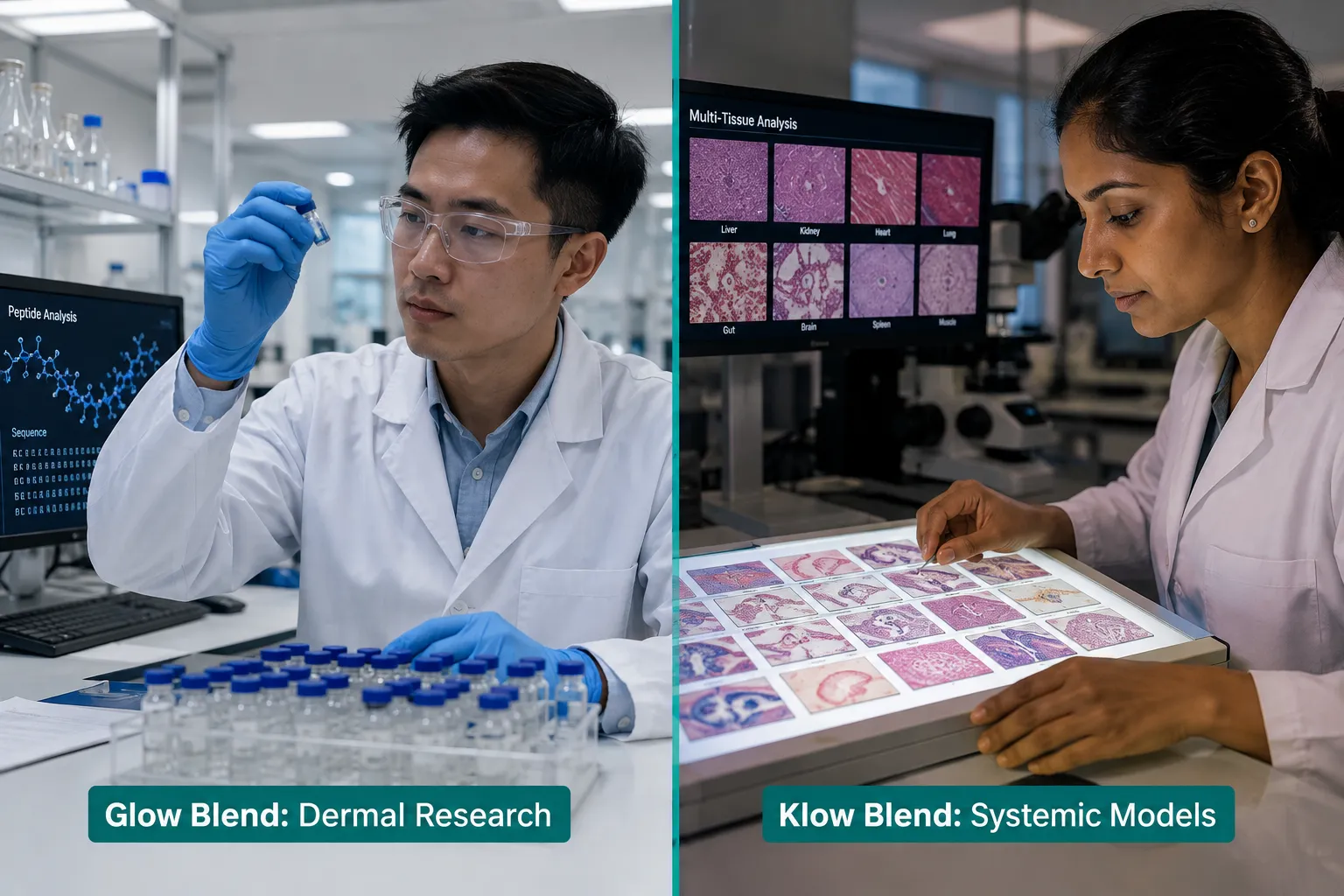
  • Choose Glow Blend when the study is focused on dermal tissue, collagen dynamics, or wound repair, and when introducing an inflammatory variable (KPV) would confound results
  • Choose Klow Blend when the study requires an anti-inflammatory component, involves gut or immune tissue models, or is designed to assess multi-system responses

Researchers also exploring growth hormone secretagogue combinations, such as those detailed in the Tesamorelin CJC-1295 Ipamorelin 12mg Blend dosage guide, may find that either blend can serve as a complementary formulation depending on the study's primary endpoint.
Choosing Between the Two Blends

Conclusion

The Glow Blend vs Klow Blend Peptides: Ingredient Comparison and Research Applications comparison ultimately comes down to one ingredient and one research intent. Both blends share a strong core of GHK-Cu, BPC-157, and TB-500. Klow Blend adds KPV, raises the total mass to 80 mg, and opens the door to inflammatory and systemic research models that Glow Blend is not designed to address.

Actionable next steps for researchers:

  1. Define the primary tissue target and whether inflammatory modulation is a study variable before ordering
  2. Request COA documentation from any vendor and verify third-party purity testing
  3. Review reconstitution and measurement protocols specific to multi-peptide blends
  4. Cross-reference with adjacent research literature on individual components before designing dosing protocols
  5. Consult the where to buy peptides resource to identify vendors with verified RUO-grade supply chains

Naming confusion between these two blends is real, but the underlying science is clear. Matching the formulation to the research question is the most important step any investigator can take before beginning a study.

Tags: bpc-157, ghk-cu research, glow blend, klow blend, kpv peptide, peptide blends, research peptides, tb-500
https://www.puretestedpeptides.com/wp-content/uploads/2026/08/glow-blend-vs-klow-blend-peptides-ingredient-comparison-and-research-application.webp 1024 1536 https://www.puretestedpeptides.com/wp-content/uploads/2026/01/buy-peptides-online.jpg 2026-08-20 13:04:592026-08-20 13:04:59Glow Blend vs Klow Blend Peptides: Ingredient Comparison and Research Applications
You might also like
Complete Guide to Research Peptides: Types, Mechanisms, and Laboratory Use Cases Complete Guide to Research Peptides: Types, Mechanisms, and Laboratory Use Cases
GHK-Cu Peptide: Collagen Synthesis, Tissue Repair, and Longevity Research Applications GHK-Cu Peptide: Collagen Synthesis, Tissue Repair, and Longevity Research Applications
Peptides and Polypeptides Explained: Connecting DNA, Mitochondria, and Modern Research-Use Compounds Like MOTS-c and 5-Amino-1MQ Peptides and Polypeptides Explained: Connecting DNA, Mitochondria, and Modern Research-Use Compounds Like MOTS-c and 5-Amino-1MQ
Peptides vs Classic Small-Molecule Drugs: How Compounds Like Prednisone, Amlodipine, and Metoprolol Differ From Modern Research-Use Peptides Peptides vs Classic Small-Molecule Drugs: How Compounds Like Prednisone, Amlodipine, and Metoprolol Differ From Modern Research-Use Peptides
What Are Polypeptide Peptides? From Collagen and Hormones to Advanced Research Compounds Like GLP-3 Retatrutide What Are Polypeptide Peptides? From Collagen and Hormones to Advanced Research Compounds Like GLP-3 Retatrutide
How Researchers Use Tesamorelin and Ipamorelin Together vs Separately How Researchers Use Tesamorelin and Ipamorelin Together vs Separately
Klow Blend vs Glow Blend in Skin and Hair Research: How GHK‑Cu, BPC‑157, and Other Components Are Combined in Lab Formulations Klow Blend vs Glow Blend in Skin and Hair Research: How GHK‑Cu, BPC‑157, and Other Components Are Combined in Lab Formulations
Research-Use Only Nasal Spray Peptides: Comparing Semax, Selank, and Klow Nasal for Cognitive and Anxiolytic Models Research-Use Only Nasal Spray Peptides: Comparing Semax, Selank, and Klow Nasal for Cognitive and Anxiolytic Models
0 replies

Leave a Reply

Want to join the discussion?
Feel free to contribute!

Leave a Reply Cancel reply

Your email address will not be published. Required fields are marked *

×

Helpful Links

  • My account
  • Cart
  • Checkout
  • Refund and Returns Policy
  • Privacy Policy
  • SMS Privacy Policy
  • Login
  • My Account
  • Logout

USA Made Lab Tested Peptides

All products are sold for research, laboratory, or analytical purposes only, and are not for human consumption


Pure Tested Peptides is a chemical supplier. Pure Tested Peptides is not a compounding / chemical compounding facility as defined under 503A of the Federal Food, Drug, and Cosmetic act. Pure Tested Peptides is not an outsourcing facility as defined under 503B of the Federal Food, Drug, and Cosmetic act.

The statements made within this website have not been evaluated by the US Food and Drug Administration. The products we offer are not intended to diagnose, treat, cure or prevent any disease.

Human/Animal Consumption Prohibited. Laboratory/In-Vitro Experimental Use Only

Link to: Understanding Polypeptide Peptides: Mechanism of Action in Research Applications Link to: Understanding Polypeptide Peptides: Mechanism of Action in Research Applications Understanding Polypeptide Peptides: Mechanism of Action in Research Applica...Understanding Polypeptide Peptides: Mechanism of Action in Research Applications Link to: Cellular Energy and Research Peptides: Why ATP Readouts Matter in Mitochondrial Studies Link to: Cellular Energy and Research Peptides: Why ATP Readouts Matter in Mitochondrial Studies Cellular Energy and Research Peptides: Why ATP Readouts Matter in Mitochondrial StudiesCellular Energy and Research Peptides: Why ATP Readouts Matter in Mitochondrial...
Scroll to top Scroll to top Scroll to top