

Nasal Spray Peptides: Bioavailability, Administration Routes, and Research Design Considerations
Only about 1% of parathyroid hormone (PTH 1-34) administered as a nasal spray reaches systemic circulation compared to subcutaneous injection, a stark reminder that the intranasal route is far from a simple swap for the needle. For researchers studying peptides such as Semax, Selank, or experimental blends, understanding the pharmacokinetic realities of nasal delivery is not optional. It is foundational.
This guide covers the core principles behind Nasal Spray Peptides: Bioavailability, Administration Routes, and Research Design Considerations, giving researchers the framework needed to design rigorous, reproducible studies.
Key Takeaways
- Nasal bioavailability for most peptides remains in the low single digits, with molecular weight being the primary limiting factor.
- Small peptides under approximately 1 kDa can achieve meaningfully higher nasal absorption in optimized formulations.
- Device type and spray deposition can alter bioavailability by two to three times compared to nasal drops.
- The nose-to-brain pathway offers a unique research advantage: direct CNS exposure without proportionally high systemic levels.
- Robust study design for intranasal peptides requires specific pharmacokinetic controls, formulation documentation, and safety monitoring of the nasal mucosa.
Bioavailability Fundamentals for Intranasal Peptides
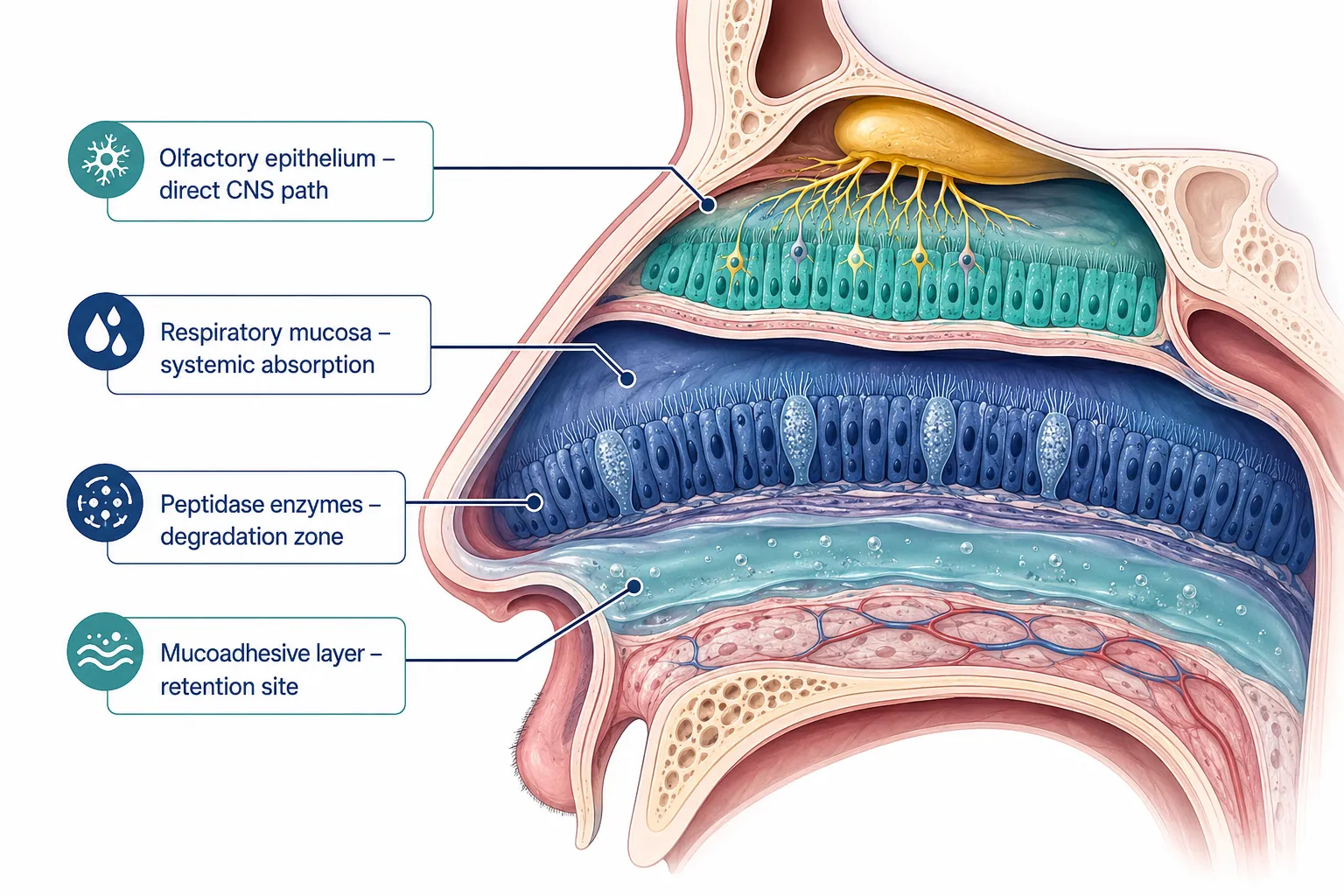
The nasal mucosa presents both an opportunity and a barrier. On one hand, it offers a highly vascularized surface with relatively thin epithelium. On the other hand, active peptidase enzymes, rapid mucociliary clearance, and tight epithelial junctions work against peptide absorption.
Molecular weight is the single most predictive factor. Peptides above roughly 1,000 to 2,000 Daltons rarely exceed 10 to 20% nasal bioavailability, even when absorption enhancers are used. Smaller peptides, those under approximately 1 kDa, can be outliers. In optimized spray formulations, some small peptides achieve bioavailability figures that rival alternative non-injectable routes.
The broader consensus, however, is sobering: most nasal peptide sprays available for research lack any published human pharmacokinetic data. This gap makes it difficult to draw firm conclusions about relative bioavailability without controlled study conditions.
"For peptides above 2,000 Da, researchers should treat nasal bioavailability as a variable to be measured, not assumed."
Peptides like Selank, studied for intranasal delivery, illustrate the complexity well. Their small size and neuropeptide profile make them candidates for meaningful nasal absorption, yet precise human PK data remains limited in the published literature. Similarly, Semax research protocols frequently reference intranasal administration as the primary route, underlining the practical importance of understanding these delivery dynamics.
Key bioavailability factors at a glance:
| Factor | Effect on Nasal Bioavailability |
|---|---|
| Molecular weight >2,000 Da | Strongly reduces absorption |
| Peptidase activity | Degrades peptide before absorption |
| Mucociliary clearance | Removes formulation before uptake |
| Mucoadhesive excipients | Extends contact time, improves uptake |
| Absorption enhancers | Can improve permeation but carry toxicity risk |
Administration Routes and Formulation Choices
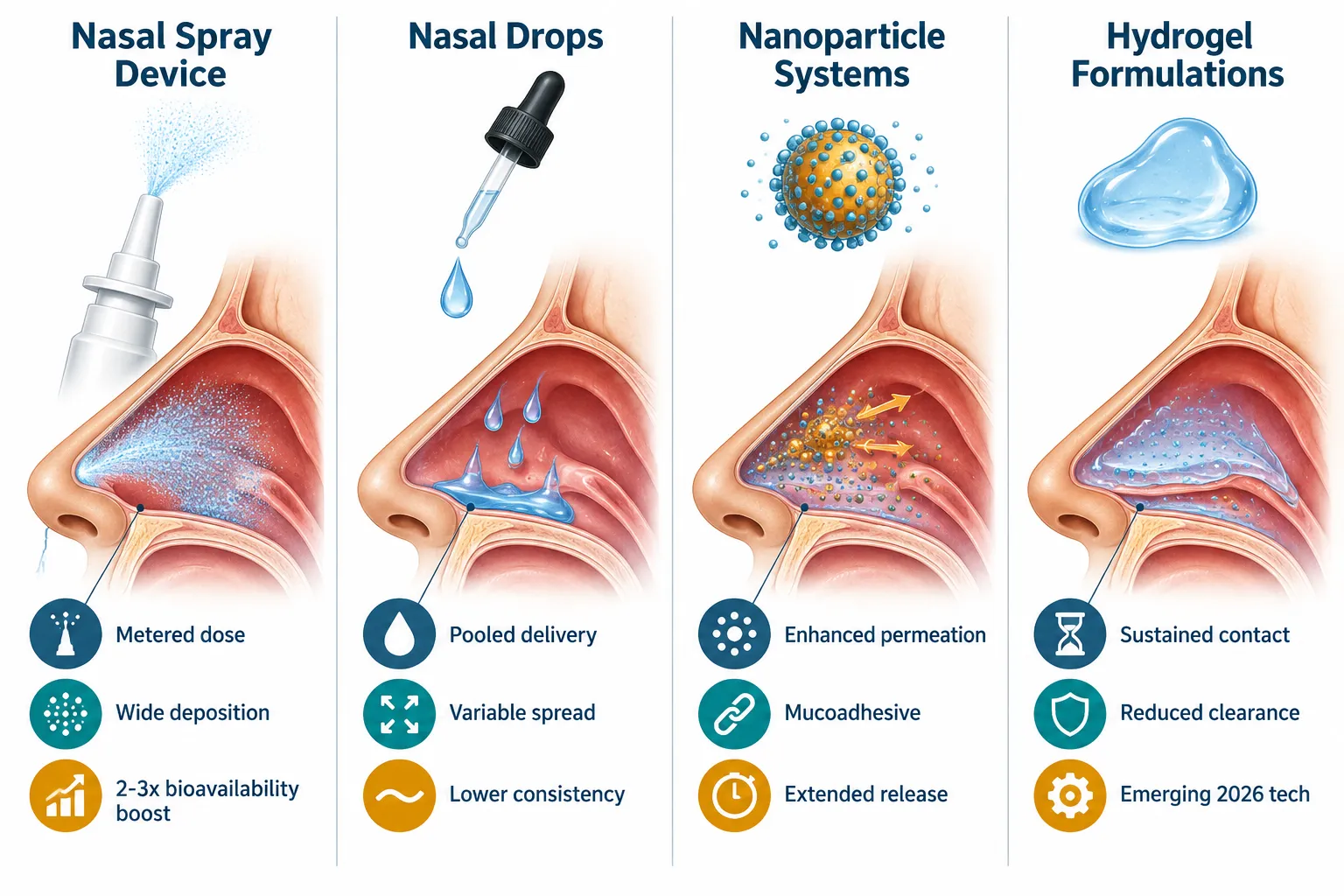
Not all intranasal delivery is equal. The physical device and formulation together determine how much peptide reaches the absorptive epithelium, and in what condition.
Spray versus drops is the most fundamental choice. Research data consistently shows that a well-calibrated nasal spray device can deliver two to three times the bioavailability of simple nasal drops for the same peptide formulation. Sprays create finer droplets with wider mucosal coverage, while drops tend to pool in the anterior nasal cavity and drain quickly.
Advanced delivery systems are a major focus of 2026 research activity:
- Nanoparticle systems, Encapsulate the peptide, protect it from peptidases, and improve epithelial permeation.
- Mucoadhesive hydrogels, Extend residence time on the mucosal surface, reducing the impact of mucociliary clearance.
- Cyclodextrin complexes, Improve solubility and membrane interaction for hydrophobic peptides.
The nose-to-brain (N2B) pathway deserves special attention. Imaging studies confirm that certain neuropeptides can reach the CNS via olfactory and trigeminal nerve pathways without generating proportionally high systemic plasma levels. This makes intranasal delivery uniquely valuable for signaling peptides targeting neurological endpoints, where systemic exposure may be undesirable.
For researchers exploring systemic peptide research alongside intranasal routes, it is worth noting that the N2B pathway and systemic absorption are not mutually exclusive, both can occur simultaneously, complicating PK interpretation if not controlled for.
Research Design Considerations for Nasal Spray Peptide Studies
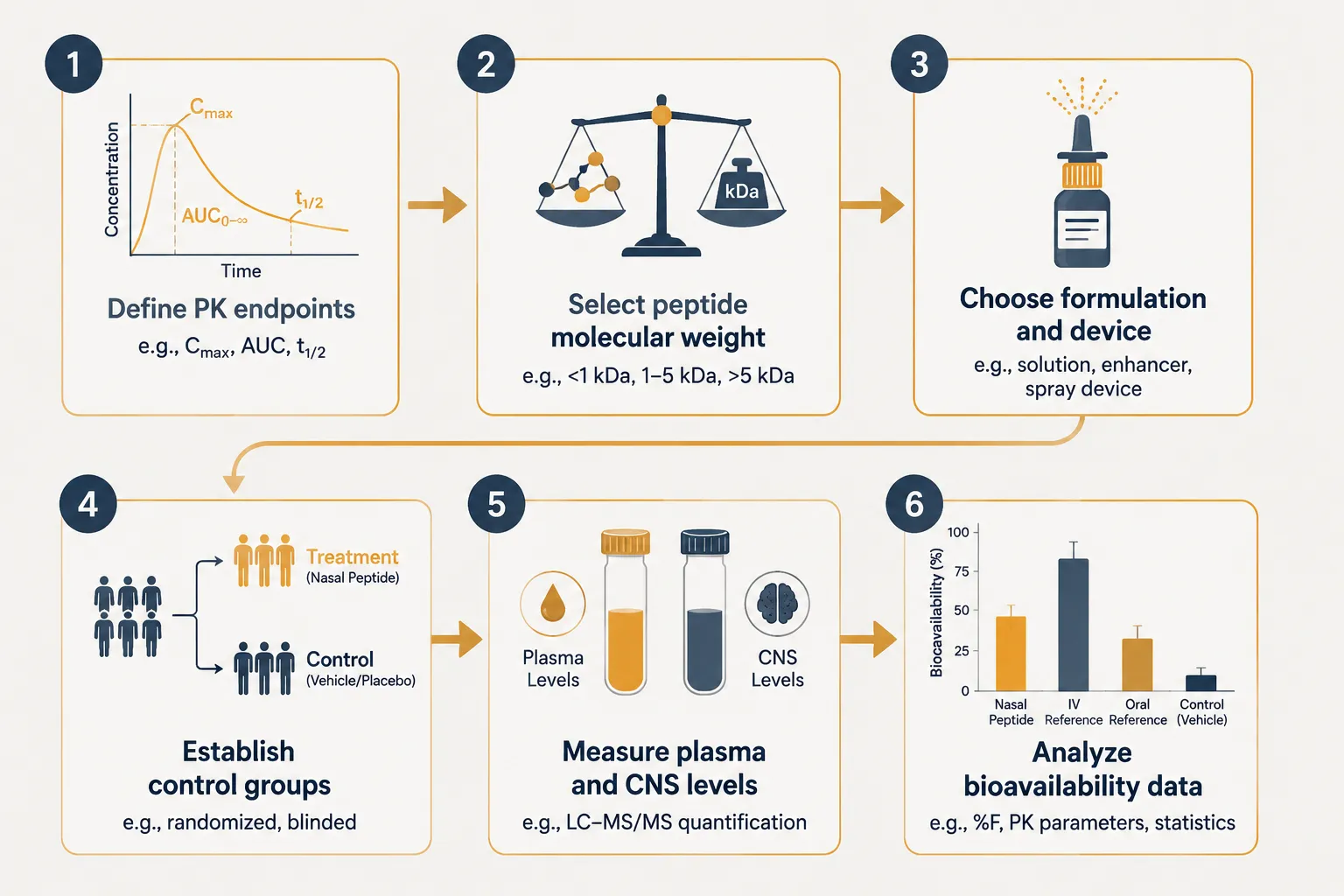
Designing a rigorous study around Nasal Spray Peptides: Bioavailability, Administration Routes, and Research Design Considerations requires attention to variables that injectable peptide studies often ignore.
Critical design elements include:
- Pharmacokinetic endpoint selection, Define whether the study measures systemic plasma levels, CNS exposure (via CSF sampling in animal models), or tissue-specific concentrations.
- Molecular weight documentation, Record the exact peptide mass and purity. Impurities can alter absorption profiles significantly. Third-party peptide testing is a non-negotiable quality step before any PK study.
- Device standardization, Specify the spray device, actuation force, droplet size distribution, and delivered dose per actuation. Variation here destroys reproducibility.
- Formulation controls, Document pH, osmolarity, excipient identity, and enhancer concentration. Enhancers such as chitosan or bile salts improve absorption but carry dose-dependent mucosal toxicity risks.
- Comparison arms, Include a subcutaneous or intravenous reference arm to calculate relative bioavailability. Without this, absolute absorption data is uninterpretable.
- Nasal mucosa safety monitoring, Assess ciliotoxicity, mucosal inflammation, and barrier integrity, particularly in repeat-dose designs.
Researchers working with study design peptides should also account for inter-subject variability in nasal anatomy, mucosal hydration, and baseline peptidase activity. These factors can create wide confidence intervals if sample sizes are not powered appropriately.
For neuropeptide-focused investigations, the Selank research literature provides useful precedent for combining behavioral endpoints with PK measurements in rodent models, a design approach transferable to other intranasal peptide candidates.
Common research design pitfalls:
- Assuming bioavailability from one peptide applies to another of similar size
- Failing to control for nasal congestion or mucosal inflammation in subjects
- Using non-validated spray devices with inconsistent dose delivery
- Omitting a systemic reference arm, making relative bioavailability calculations impossible
Conclusion
Intranasal peptide delivery sits at the intersection of pharmacology, formulation science, and study design rigor. The core message from available research is clear: bioavailability for most nasal spray peptides is low, highly variable, and heavily dependent on molecular weight, formulation, and device quality.
Actionable next steps for researchers:
- Confirm peptide molecular weight and purity through third-party peptide testing before initiating any PK study.
- Select a calibrated, metered-dose spray device and document all device parameters.
- Design studies with a subcutaneous or IV reference arm to calculate true relative bioavailability.
- Consider advanced formulation strategies, nanoparticles, mucoadhesive systems, for peptides above 1,000 Da.
- Monitor nasal mucosal safety in all repeat-dose protocols.
Understanding Nasal Spray Peptides: Bioavailability, Administration Routes, and Research Design Considerations at this level of detail is what separates publishable, reproducible research from inconclusive data. The intranasal route holds genuine promise, but only for researchers who respect its pharmacokinetic constraints.


Leave a Reply
Want to join the discussion?Feel free to contribute!