Call or Text 727-513-9780
  • Shopping Cart Shopping Cart
    0Shopping Cart
Pure Tested Peptides | America's most trusted Peptides for sale online
  • Peptides for sale
    • Oral Peptides for sale
      • Peptide Capsules for sale
      • BPC 157 Capsules 1000mcg
      • SLU-PP-332 Capsules | 1000 mcg
      • 5-Amino-1MQ 50mg Capsules
      • Tesofensine 500mcg
    • All Peptides for sale
    • Peptide Sprays
      • BPC 157 Nasal Spray Kit
      • BPC-157 TB500 Nasal Spray Kit
      • Semax Nasal Spray 10mg
      • Selank – Nasal Spray Kit – 10mg
      • Epithalon 50MG Nasal Spray Kit
      • Ipamorelin 10mg Nasal Spray
      • Klow Nasal Spray (BPC-157 + TB-500 + GHK-Cu + KPV) | 80mg
      • Hulk Nasal Spray Tesa / Ipa Blend 6/3 MG
      • Klow Nasal Spray
      • NAD + 500 mg Nasal Spray
      • PT-141 Nasal Spray Kit
    • GHRH Peptides
      • Ipa Peptides
      • CJC-1295 Peptides
        • CJC-1295 with DAC 5 mg
        • CJC-1295 without DAC 5 mg
        • CJC-1295 Ipa 10mg
      • Tesa Peptides
        • Tesa Peptide
        • Tesa 20 mg
    • GHK-Cu Peptides
      • All GHK-Cu Peptides
      • GHK-Cu 100mg
      • KLOW Peptide Blend – Buy KLOW blend online
    • BPC Peptides
      • All BPC Peptides
      • BPC-157
      • BPC-157 TB-500
      • BPC 157 capsules 1000mcg
    • SLU-PP-332 Peptides
      • All SLU-PP-332 Peptides
      • SLU-PP-332 5mg
    • GLP3 Peptides
    • PT-141 Peptides
      • PT-141 Peptides for sale
      • PT-141 10mg
      • PT-141 Nasal Spray
    • CAG Peptides
      • Lipo-C Peptide Blend
      • CAG 5mg
      • CAG 10mg
    • MOTS-C Peptides
      • MOTS-C Peptides for sale
      • MOTS-c peptide
      • MOTS-c 10mg *6 pack*
    • 5 Amino 1MQ Peptides
      • 5 Amino 1MQ Peptides for sale
      • 5-Amino-1MQ 50mg Capsules
      • 5-Amino-1MQ 5mg
    • Epithalon Peptides
      • Epithalon Peptides for sale
      • Epithalon 10mg
      • Epithalon 50mg
  • Shop
    • GLPs
      • 5-Amino-1MQ 50mg Capsules
      • 5-Amino-1MQ 5mg
      • L-Carnitine 500mg/ml
      • Tesofensine 500mcg
      • SLU-PP-332 5mg
      • MOTS-c 10mg *6 pack*
    • Epithalon & BPC Peptides
      • Epithalon 10mg
      • Epithalon 50mg
      • BPC-157
      • BPC 157 capsules 1000mcg
      • BPC-157 TB-500
      • BPC-157 TB500 Nasal Spray Kit
      • BPC 157 Nasal Spray Kit
    • BPC TB-500 & NAD+ Peptides
      • NAD+ 500 mg
      • KLOW Peptide Blend – Buy KLOW blend online
      • GLOW Peptide Blend
      • TB 500 5mg
      • BPC 157 capsules 1000mcg – Supplement
      • BPC 157 Nasal Spray Kit
      • BPC-157
      • BPC-157 TB500 Nasal Spray Kit
      • BPC-157 TB-500
      • BPC 157 capsules 1000mcg
    • LL-37 Peptide
      • LL-37 10 mg
    • MOTS-C & Selank
      • MOTS-c peptide
      • Selank 10mg
    • GHK Peptides
      • GHK-Cu 100mg
      • GLOW Peptide Blend
      • KLOW Peptide Blend – Buy KLOW blend online
  • COAs
  • Wholesale
    • Wholesale Peptides for sale
  • PTP FAQ
  • Affiliates
    • Selank Peptide: Advanced Pharmacological Mechanisms Underlying Its Anxiolytic and Nootropic Effects in Research
      • 5-Amino-1MQ Peptide: Detailed Mechanisms of NNMT Inhibition and Its Impact on Cellular Metabolism Research
        • MOTS-C Peptide: Unraveling Its Role in Mitochondrial Dynamics and Energy Metabolism Research
          • Epithalon Peptide and Telomerase Regulation: Investigating Its Impact on Cellular Senescence and Lifespan Research Models
            • GLP2-T vs GLP2 Tirz Peptide: Understanding the Naming, Mechanistic Nuances, and Research Implications for Gut Health
      • Peptides and Polypeptides in Modern Pharmacology: What Research on Metoprolol, Prednisone, and Amlodipine Reveals
        • Polypeptide Peptides vs NSAIDs: What Naproxen and Diclofenac Teach Tissue-Repair Researchers About BPC‑157 and TB‑500
          • Peptides and Polypeptides in Endocrine Pharmacology: How GLP-1, GLP-2, and GLP-3 Retatrutide Differ From Classic Drugs Like Prednisone and Amlodipine
          • 5‑Amino‑1MQ Peptide and NNMT Inhibition: How It Compares With Statins Like Atorvastatin in Adipose and Lipid Metabolism Research
      • Enclomiphene, Estrogen Receptor Signaling, and Luteinizing Phase Biology: What Hormone Researchers Should Measure
        • Mesenchymal Stem Cells, BPC‑157, and GHK‑Cu: How Tissue Repair Peptides Compare With Classic NSAIDs Like Naproxen in Injury Models
          • Peptide Calculator Use Cases Beyond Growth Hormone: Working Through GLP‑3 Retatrutide, MOTS‑c, and BPC‑157 Research Dosing
        • Polypeptide Peptides in Endocrine and Metabolic Pharmacology: Lessons From Amlodipine, Prednisone, and Metoprolol
        • Peptides Calculator for Advanced Blends: Worked Examples for Tesamorelin, CJC‑1295, and Ipamorelin Stacks
          • Peptides and Polypeptides in Human Physiology: How Molecular Size Shapes Research Applications
            • Selank Peptide: Advanced Pharmacological Mechanisms Underlying Its Anxiolytic and Nootropic Effects in Research
          • 5-Amino-1MQ Peptide: Detailed Mechanisms of NNMT Inhibition and Its Impact on Cellular Metabolism Research
            • MOTS-C Peptide: Unraveling Its Role in Mitochondrial Dynamics and Energy Metabolism Research
              • Epithalon Peptide and Telomerase Regulation: Investigating Its Impact on Cellular Senescence and Lifespan Research Models
                • GLP2-T vs GLP2 Tirz Peptide: Understanding the Naming, Mechanistic Nuances, and Research Implications for Gut Health
                  • Peptides and Polypeptides in Endocrine Pharmacology: How GLP-1, GLP-2, and GLP-3 Retatrutide Differ From Classic Drugs Like Prednisone and Amlodipine
                    • Polypeptide Peptides vs NSAIDs: What Naproxen and Diclofenac Teach Tissue-Repair Researchers About BPC‑157 and TB‑500
                      • Peptides and Polypeptides in Modern Pharmacology: What Research on Metoprolol, Prednisone, and Amlodipine Reveals
                        • 5‑Amino‑1MQ Peptide and NNMT Inhibition: How It Compares With Statins Like Atorvastatin in Adipose and Lipid Metabolism Research
                        • Enclomiphene, Estrogen Receptor Signaling, and Luteinizing Phase Biology: What Hormone Researchers Should Measure
                        • Mesenchymal Stem Cells, BPC‑157, and GHK‑Cu: How Tissue Repair Peptides Compare With Classic NSAIDs Like Naproxen in Injury Models
                        • Peptide Calculator Use Cases Beyond Growth Hormone: Working Through GLP‑3 Retatrutide, MOTS‑c, and BPC‑157 Research Dosing
                        • Polypeptide Peptides in Endocrine and Metabolic Pharmacology: Lessons From Amlodipine, Prednisone, and Metoprolol
                        • Peptides Calculator for Advanced Blends: Worked Examples for Tesamorelin, CJC‑1295, and Ipamorelin Stacks
                        • Peptides and Polypeptides in Human Physiology: How Molecular Size Shapes Research Applications
                        • Selank Peptide: Advanced Pharmacological Mechanisms Underlying Its Anxiolytic and Nootropic Effects in Research
                        • MOTS-C Peptide: Unraveling Its Role in Mitochondrial Dynamics and Energy Metabolism Research
                        • Peptides and Polypeptides in Modern Pharmacology: What Research on Metoprolol, Prednisone, and Amlodipine Reveals
                        • Peptides and Polypeptides in Endocrine Pharmacology: How GLP-1, GLP-2, and GLP-3 Retatrutide Differ From Classic Drugs Like Prednisone and Amlodipine
                        • 5-Amino-1MQ Peptide: Detailed Mechanisms of NNMT Inhibition and Its Impact on Cellular Metabolism Research
                        • Mesenchymal Stem Cells, BPC‑157, and GHK‑Cu: How Tissue Repair Peptides Compare With Classic NSAIDs Like Naproxen in Injury Models
                        • Peptide Calculator Use Cases Beyond Growth Hormone: Working Through GLP‑3 Retatrutide, MOTS‑c, and BPC‑157 Research Dosing
                        • GLP2-T vs GLP2 Tirz Peptide: Understanding the Naming, Mechanistic Nuances, and Research Implications for Gut Health
                        • Polypeptide Peptides in Endocrine and Metabolic Pharmacology: Lessons From Amlodipine, Prednisone, and Metoprolol
                        • Polypeptide Peptides vs NSAIDs: What Naproxen and Diclofenac Teach Tissue-Repair Researchers About BPC‑157 and TB‑500
                        • Peptides and Polypeptides in Human Physiology: How Molecular Size Shapes Research Applications
                        • Peptides Calculator for Advanced Blends: Worked Examples for Tesamorelin, CJC‑1295, and Ipamorelin Stacks
                        • 5‑Amino‑1MQ Peptide and NNMT Inhibition: How It Compares With Statins Like Atorvastatin in Adipose and Lipid Metabolism Research
                        • Enclomiphene, Estrogen Receptor Signaling, and Luteinizing Phase Biology: What Hormone Researchers Should Measure
                        • Epithalon Peptide and Telomerase Regulation: Investigating Its Impact on Cellular Senescence and Lifespan Research Models
                        • Best research protocol Klow blend
                        • best time to take BPC-157
                        • best time to take DSIP (Delta Sleep Inducing Peptide)
                        • best time to take CJC-1295
                        • best time to take AOD-9604
                        • best time to take Follistatin 344
                        • best time to take Ipamorelin
                        • best time to take MK-677 (Ibutamoren)
                        • best time to take Ligandrol (LGD-4033) — research compound
                        • best time to take Ostarine (MK-2866) — research compound
                        • best time to take GHK-CU
                        • best time to take TB-500
                        • best time to take MOTS-c
                        • best time to take Semax
                        • best time to take RAD-140 (Testolone) — research compound
                        • best time to take Thymosin Alpha-1
                        • best time to take PEG-MGF
                        • Biolife Plasma, Octapharma Plasma, and Research Peptides: How Plasma Donation Labs Differ From Peptide Suppliers
                        • best time to take YK-11 — research compound
                        • best time to take PT-141 (Bremelanotide)
                        • Best research protocol Klow blend
                        • 5-Amino-1MQ and MOTS-C Synergy: Metabolic Signaling, Mitochondria, and Research Design
                        • BPC-157 and TB-500: Investigating Their Combined Effects on Angiogenesis and Cellular Migration in Tissue Repair Models
                        • BPC-157 Peptide: Gut Barrier Function, Inflammation, and Tissue-Recovery Research
                        • 5‑Amino‑1MQ and MOTS‑c Synergy in Metabolic Research: Designing NNMT and Mitochondrial Biogenesis Stacks
                        • CJC-1295 with DAC vs. Without DAC: Half-Life, Release Kinetics, and Research Implications
                        • CJC‑1295 with DAC vs. Without DAC: Expanding on Half‑Life Differences Using Tesamorelin and Ipamorelin Blend Case Studies
                        • Collagen Biology and Copper‑Binding Peptides: How GHK‑Cu, Glow Blend, and Klow Blend Interact with Skin and Connective Tissue
                        • Collagen Biology and Regenerative Peptides: How GHK‑Cu, Glow Blend, and Klow Blend Affect Extracellular Matrix Research
                    • DNA, Telomeres, and Longevity Peptides: Positioning Epithalon and MOTS‑c in Genetic Aging Research
                      • Enclomiphene Citrate: serm Mechanism, Testosterone Research, and Stack Compatibility
                        • Enclomiphene vs Enclomiphene Citrate: Formulation, Bioavailability, and Research Distinctions
                        • Epithalon Peptide Research: Telomerase Activation, Aging, and Pineal Gland Function
                        • Estrogen Receptor Signaling and Enclomiphene: How Selective Modulators Compare with Classic Polypeptide Hormones
                        • GHK-Cu Peptide: Advanced Mechanisms in Extracellular Matrix Remodeling and Wound Healing Research
                        • GHK-Cu Peptide: Collagen Synthesis, Wound Repair, and Skin-Barrier Research Models
                        • GLP-1 vs GLP-3 vs GLP-2: Peptide Classification and Research Applications
                        • GLP-2 Peptide Research Guide: Gut Barrier Function, Nutrient Absorption, and Intestinal Recovery Models
                        • GLP-3 Retatrutide vs. GLP-1 Drugs: What Triple-Agonist Biology Changes in Research Models
                        • Ipamorelin and Tesamorelin Combination: Synergistic GH Secretagogue Research and Dosing Protocols
                        • GLP2 Tirz Peptide: What It Is, Why the Name Exists, and How Researchers Should Interpret It
                        • Klow Blend Peptide Nasal Spray: What the Formulation Is Trying to Do in Cognitive Research
                        • Mitochondria, NNMT Inhibition, and Peptide Modulators: Where MOTS‑c and 5‑Amino‑1MQ Fit in Cellular Energy Research
                        • MOTS-c Peptide: Mitochondrial Function, Energy Metabolism, and What Researchers Measure
                        • MOTS-c vs. 5-Amino-1MQ: Which Metabolic Research Questions Each Compound Actually Answers
                        • Nasal Spray Peptides: Bioavailability, Administration, and Semax/Selank Research Applications
                        • PT-141 Peptide Research: Mechanism of Action and Melanocortin Receptor Signaling
                        • Retatrutide for Research: Mechanism, Structure, and GLP-1/GLP-3 Dual Action
                        • Retatrutide for Obesity and Type 2 Diabetes: What the Latest Trial Data Suggest
                        • Tesofensine Peptide Research: Mechanism, Appetite Suppression, and Neuropeptide Y Pathways
  • Contact
    • Contact Customer Service
    • Text Customer Support
  • About US
  • Shop all peptides
  • Affiliate Program
    • Affiliate Signup
  • Login / Register Login / Register Page Link Login / Register Page Link
  • Click to open the search input field Click to open the search input field Search
  • Menu Menu
Retatrutide Phase 3 Diabetes Results: How Researchers Should Interpret Dose, A1C, Weight, and Discontinuation Data

Retatrutide Phase 3 Diabetes Results: How Researchers Should Interpret Dose, A1C, Weight, and Discontinuation Data

October 12, 2026/0 Comments/in Uncategorized/by

Fewer than 1 in 10 glucose-lowering drugs tested in Phase 2 trials ever produce weight loss exceeding 15% of body weight in people with type 2 diabetes. Retatrutide, a triple GIP/GLP-1/glucagon receptor agonist, has now done exactly that across two large Phase 3 programs, making the Retatrutide Phase 3 Diabetes Results: How Researchers Should Interpret Dose, A1C, Weight, and Discontinuation Data question one of the most important analytical tasks in metabolic research in 2026.

This guide is written for researchers, clinicians, and evidence reviewers who need a structured framework for reading the trial data accurately, not as a clinical recommendation or treatment guide.


Key Takeaways

  • Two Phase 3 trials, TRANSCEND-T2D-1 and TRIUMPH-2, provide the core evidence base for retatrutide in type 2 diabetes.
  • A1C reductions showed a clear dose-response pattern, roughly doubling the effect of placebo at the highest dose.
  • Weight loss was substantial and, in the 40-week trial, had not yet plateaued at study end.
  • Discontinuation due to adverse events was dose-dependent and driven primarily by gastrointestinal symptoms.
  • Tolerability, not efficacy, is likely to determine real-world dose selection and patient retention.

Understanding the Two Core Phase 3 Trials

Before analyzing any endpoint, researchers must distinguish between the two trials, because they enrolled different populations and ran for different durations.

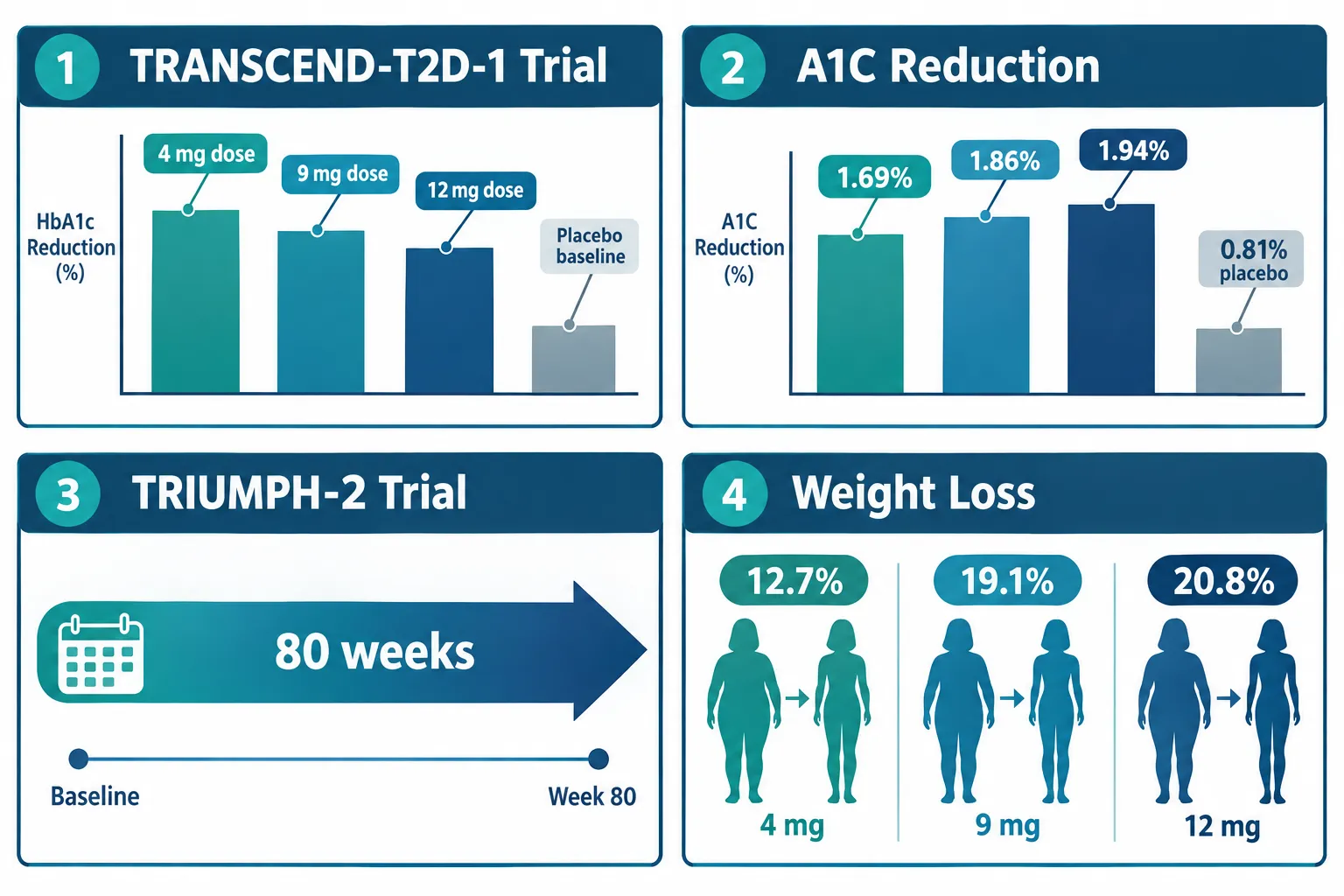
TRANSCEND-T2D-1 enrolled 537 adults with recent-onset type 2 diabetes, A1C between 7.0% and 9.5%, and BMI of 23 or higher. Participants received retatrutide monotherapy at 4, 9, or 12 mg once weekly for 40 weeks, with no background glucose-lowering medications. This design isolates the drug's intrinsic glycemic effect.

TRIUMPH-2 enrolled adults with established type 2 diabetes plus obesity or overweight and ran for 80 weeks. This longer trial captures durability and applies to a more complex metabolic phenotype seen frequently in clinical practice.

Conflating results from these two trials is one of the most common analytical errors. Baseline disease severity, background therapy status, and trial duration all affect the magnitude of observed A1C and weight outcomes.
Understanding the Two Core Phase 3 Trials

Researchers reviewing GLP-3 receptor agonist peptide research should note that retatrutide's triple-agonist mechanism distinguishes it from dual or single-target agents, which affects how dose-response curves should be modeled.


Interpreting A1C and Weight Data From Retatrutide Phase 3 Diabetes Results

A1C Reduction: Reading the Dose-Response Signal

In TRANSCEND-T2D-1, mean A1C reductions from a baseline of approximately 7.9% were:

Dose Mean A1C Reduction vs. Placebo
4 mg ~1.69% ~2x placebo
9 mg ~1.86% ~2.3x placebo
12 mg ~1.94% ~2.4x placebo
Placebo ~0.81% Reference

The incremental gain between 9 mg and 12 mg is small (roughly 0.08 percentage points), which researchers should weigh carefully against the larger jump in discontinuation risk at the highest dose.

In TRIUMPH-2, A1C reductions were somewhat smaller (approximately 1.4% to 1.6%), consistent with the more established disease state and likely background medication use in that population. Notably, up to 79.2% of participants achieved A1C at or below 6.5% on retatrutide versus roughly 26.3% on placebo, a clinically meaningful responder-rate difference.

Key analytical point: Absolute A1C reduction and responder rates (percentage reaching target) are different estimands. Both should be reported to avoid misleading summaries.

Weight Loss: A Metabolic Signal That Deserves Separate Analysis

Weight loss in these trials is not merely a secondary benefit. It is a primary metabolic outcome that may independently drive glycemic improvement.

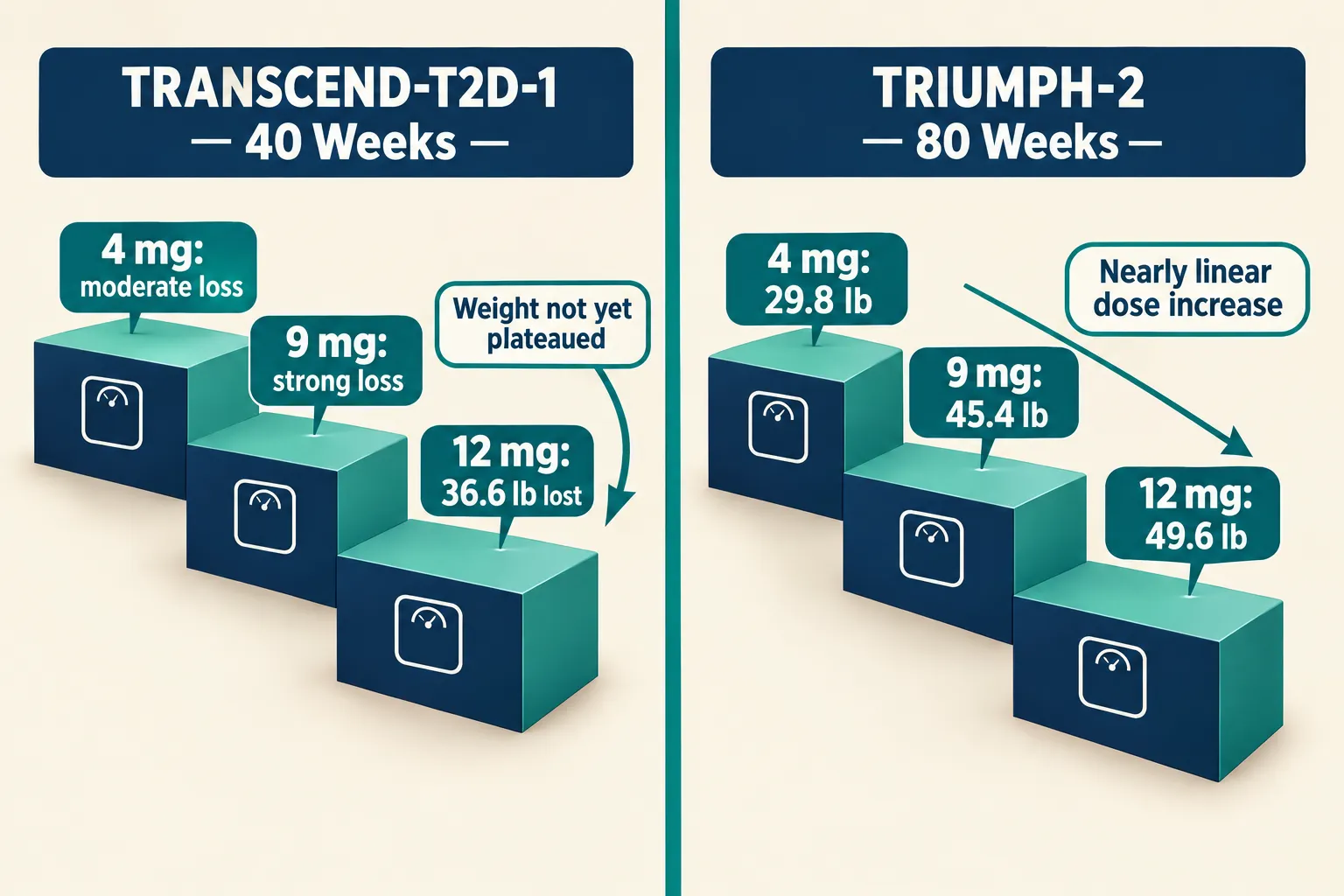
In TRANSCEND-T2D-1 at 40 weeks:

  • 12 mg: approximately 36.6 lb (16.8% of body weight)
  • Weight loss curves had not plateaued, meaning the 40-week figure likely underestimates the drug's full effect.

In TRIUMPH-2 at 80 weeks:

  • 4 mg: approximately 29.8 lb (12.7%)
  • 9 mg: approximately 45.4 lb (19.1%)
  • 12 mg: approximately 49.6 lb (20.8%)

This near-linear dose-weight relationship positions retatrutide among the most potent pharmacologic weight-loss agents tested in diabetic populations. Researchers studying visceral fat reduction mechanisms will find the 80-week TRIUMPH-2 data particularly relevant for modeling adipose tissue dynamics.

For those sourcing research-grade material, GLP-3 Reta 30mg and GLP-3 Reta 20mg represent formulation options used in preclinical and translational research contexts.
Weight Loss: A Metabolic Signal That Deserves Separate Analysis


Discontinuation Data: The Critical Safety Estimand in Retatrutide Phase 3 Diabetes Results

Discontinuation due to adverse events is often under-analyzed in metabolic drug trials. For retatrutide, it is arguably the most important variable for predicting real-world uptake.

TRANSCEND-T2D-1 Discontinuation Rates

  • 4 mg: ~4.1%
  • 9 mg: ~6.9%
  • 12 mg: ~11.3%
  • Placebo: ~4.9%

The 12 mg arm saw discontinuation more than double the placebo rate. Gastrointestinal symptoms, primarily nausea, vomiting, and diarrhea, were the dominant drivers, consistent with other incretin-based agents.

TRIUMPH-2 Discontinuation Pattern

  • 4 mg: ~3.8%
  • 9 mg: ~11.6%
  • 12 mg: ~7.7%
  • Placebo: ~4.9%

A critical observation: In TRIUMPH-2, the 9 mg dose showed higher discontinuation than the 12 mg dose. This non-monotonic pattern suggests that intermediate doses may carry the greatest early tolerability burden, possibly because titration schedules at 9 mg produced faster GI exposure than at 12 mg. Researchers should not assume a simple linear relationship between dose and dropout risk.

Researchers examining peptide tolerability profiles, including those reviewing Reta peptide research formulations, should factor titration speed into any safety analysis. The Glp3 Reta 10mg formulation is relevant for lower-dose preclinical work where tolerability thresholds are being established.


A Framework for Benefit-Risk Modeling

When synthesizing Retatrutide Phase 3 Diabetes Results: How Researchers Should Interpret Dose, A1C, Weight, and Discontinuation Data into a coherent benefit-risk model, the following structure is recommended:

  1. Separate efficacy estimands – Distinguish A1C reduction, responder rates, and weight loss as distinct outcomes.
  2. Account for trial duration – 40-week data underestimates long-term weight outcomes.
  3. Model incremental gains vs. incremental risk – The 9-to-12 mg A1C gain is small; the discontinuation increase is not.
  4. Examine non-monotonic safety signals – TRIUMPH-2 discontinuation data requires dose-specific, not dose-linear, interpretation.
  5. Apply population context – Early monotherapy results do not transfer directly to established diabetes with obesity.

Expert commentary has characterized retatrutide as a breakthrough triple-hormone therapy whose tolerability profile, rather than its efficacy ceiling, will determine preferred clinical doses. Future research priorities include optimized titration schedules, head-to-head comparisons with tirzepatide and semaglutide, and structured evaluation in populations with chronic kidney disease and obstructive sleep apnea.


Conclusion

The Retatrutide Phase 3 Diabetes Results: How Researchers Should Interpret Dose, A1C, Weight, and Discontinuation Data evidence base is both robust and nuanced. The TRANSCEND-T2D-1 and TRIUMPH-2 trials confirm a strong, consistent efficacy signal, but accurate interpretation demands attention to trial design differences, the gap between absolute and responder-rate endpoints, the non-linear discontinuation pattern across doses, and the fact that weight loss curves had not plateaued at 40 weeks.

Actionable next steps for researchers:

  • Apply separate analytical frameworks to each trial rather than pooling results.
  • Report both mean A1C reduction and the percentage of participants reaching glycemic targets.
  • Treat the TRIUMPH-2 discontinuation pattern as a titration-schedule hypothesis, not a dose-safety anomaly.
  • Prioritize long-term follow-up data as it becomes available, particularly for weight plateau and cardiovascular outcomes.
  • When sourcing research-grade retatrutide formulations, consult verified suppliers such as those offering GLP-3 Reta 20mg Ga1 for structured preclinical protocols.

The data is strong. The interpretation requires precision.

Tags: a1c reduction, glp-3 agonist, retatrutide, retatrutide phase 3, transcend-t2d-1, triumph-2 trial, type 2 diabetes research, weight loss peptide
https://www.puretestedpeptides.com/wp-content/uploads/2026/10/retatrutide-phase-3-diabetes-results-how-researchers-should-interpret-dose-a1c-w.webp 1024 1536 https://www.puretestedpeptides.com/wp-content/uploads/2026/01/buy-peptides-online.jpg 2026-10-12 13:13:532026-10-12 13:13:53Retatrutide Phase 3 Diabetes Results: How Researchers Should Interpret Dose, A1C, Weight, and Discontinuation Data
You might also like
GLP-3 Retatrutide and Oral GLP-1 Concepts: How Researchers Should Compare Exposure, Gastric Emptying, and Bioavailability GLP-3 Retatrutide and Oral GLP-1 Concepts: How Researchers Should Compare Exposure, Gastric Emptying, and Bioavailability
Atorvastatin, LDL Cholesterol, and Metabolic Peptides: Where MOTS-c, 5-Amino-1MQ, and GLP-3 Retatrutide Fit in Lipid Research Atorvastatin, LDL Cholesterol, and Metabolic Peptides: Where MOTS-c, 5-Amino-1MQ, and GLP-3 Retatrutide Fit in Lipid Research
GLP-3 Retatrutide: Exploring the Mechanism of Action and Research Potential Beyond GLP-1 and GLP-2 GLP-3 Retatrutide: Exploring the Mechanism of Action and Research Potential Beyond GLP-1 and GLP-2
Tesofensine vs GLP-3 Retatrutide: Comparing Appetite, Dopamine, Noradrenergic, and Incretin Signaling Tesofensine vs GLP-3 Retatrutide: Comparing Appetite, Dopamine, Noradrenergic, and Incretin Signaling
GLP-1 Receptor Agonists vs Research Peptides: Where Retatrutide, GLP-3, and GLP-2 Fit Mechanistically GLP-1 Receptor Agonists vs Research Peptides: Where Retatrutide, GLP-3, and GLP-2 Fit Mechanistically
Prostate Specific Antigen and Hormone-Modulating Compounds: How PSA Monitoring Interfaces With Enclomiphene and GLP-Class Peptide Research Prostate Specific Antigen and Hormone-Modulating Compounds: How PSA Monitoring Interfaces With Enclomiphene and GLP-Class Peptide Research
GLP-3 Retatrutide: Researching Its Triple-Agonist Mechanism Beyond GLP-1 and GLP-2 Pathways GLP-3 Retatrutide: Researching Its Triple-Agonist Mechanism Beyond GLP-1 and GLP-2 Pathways
Triple Agonist Therapies Beyond GLP‑3: What Retatrutide’s Success Means for Future Multi-Target Peptide Design Triple Agonist Therapies Beyond GLP‑3: What Retatrutide’s Success Means for Future Multi-Target Peptide Design
0 replies

Leave a Reply

Want to join the discussion?
Feel free to contribute!

Leave a Reply Cancel reply

Your email address will not be published. Required fields are marked *

×

Helpful Links

  • My account
  • Cart
  • Checkout
  • Refund and Returns Policy
  • Privacy Policy
  • SMS Privacy Policy
  • Login
  • My Account
  • Logout

USA Made Lab Tested Peptides

All products are sold for research, laboratory, or analytical purposes only, and are not for human consumption


Pure Tested Peptides is a chemical supplier. Pure Tested Peptides is not a compounding / chemical compounding facility as defined under 503A of the Federal Food, Drug, and Cosmetic act. Pure Tested Peptides is not an outsourcing facility as defined under 503B of the Federal Food, Drug, and Cosmetic act.

The statements made within this website have not been evaluated by the US Food and Drug Administration. The products we offer are not intended to diagnose, treat, cure or prevent any disease.

Human/Animal Consumption Prohibited. Laboratory/In-Vitro Experimental Use Only

Link to: What Is a Diuretic? HCTZ, Furosemide, and Fluid-Balance Controls in GLP and Growth-Hormone Peptide Research Link to: What Is a Diuretic? HCTZ, Furosemide, and Fluid-Balance Controls in GLP and Growth-Hormone Peptide Research What Is a Diuretic? HCTZ, Furosemide, and Fluid-Balance Controls in GLP and...What Is a Diuretic? HCTZ, Furosemide, and Fluid-Balance Controls in GLP and Growth-Hormone Peptide Research Link to: Spironolactone and Peptide Metabolism Studies: Aldosterone, Potassium, Fluid Volume, and Hormonal Readouts Link to: Spironolactone and Peptide Metabolism Studies: Aldosterone, Potassium, Fluid Volume, and Hormonal Readouts Spironolactone and Peptide Metabolism Studies: Aldosterone, Potassium, Fluid Volume, and Hormonal ReadoutsSpironolactone and Peptide Metabolism Studies: Aldosterone, Potassium, Fluid...
Scroll to top Scroll to top Scroll to top