

CJC-1295 With DAC and Ipamorelin: Sampling Design for Pulsatile Growth-Hormone Research
Growth hormone is not secreted in a steady stream. It fires in discrete pulses, and that biological fact creates a measurement problem that most researchers underestimate. When studying CJC-1295 With DAC and Ipamorelin: Sampling Design for Pulsatile Growth-Hormone Research, the challenge is not simply capturing how much GH rises, it is capturing when it rises, how sharply, and whether the natural pulse architecture survives pharmacological intervention. Getting the sampling design wrong means the most important signals disappear into noise.
Key Takeaways
- CJC-1295 with DAC elevates mean GH for six or more days after a single dose, creating a rising baseline that can obscure pulse detection if sampling is sparse.
- Ipamorelin triggers short, discrete GH pulses through a separate receptor pathway (GHS-R1a), making it a useful experimental tool for probing pulse amplitude under long-acting GHRH stimulation.
- The validated template for pulsatile GH analysis uses 20-minute blood draw intervals across a 12-hour overnight window, yielding approximately 36 samples per session.
- At least two intensive sampling windows are needed: one at true baseline and one at expected peak GH elevation (days 5-7 post-dose).
- Neither CJC-1295 with DAC nor ipamorelin is FDA-approved, and the combination has no published controlled human trial, all research use should occur in rigorously monitored investigational settings.
Why Pulsatility Matters in CJC-1295 With DAC and Ipamorelin Research
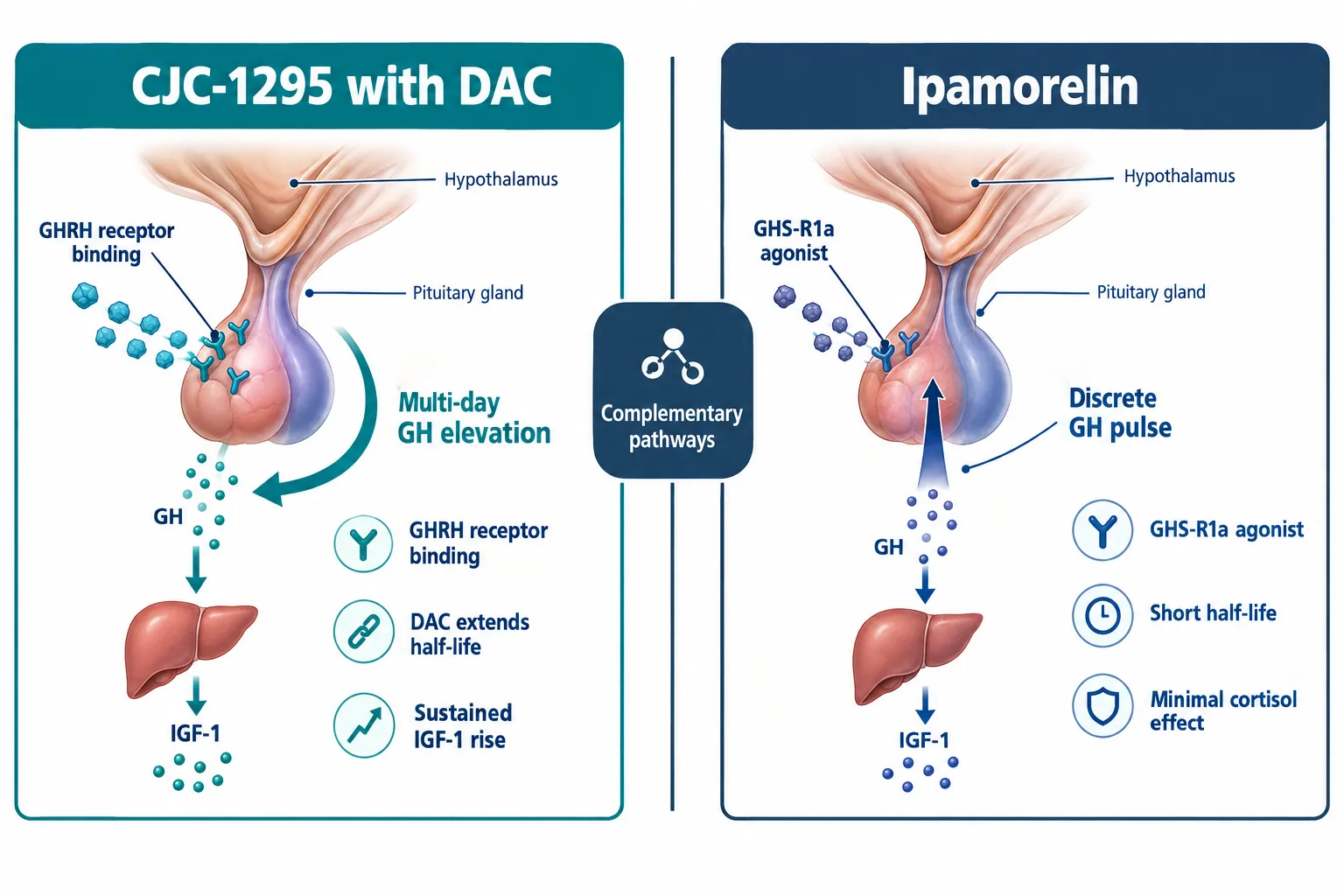
The pituitary releases GH in bursts driven by two competing signals: growth hormone-releasing hormone (GHRH) amplifies pulse height, and somatostatin suppresses it. CJC-1295 with DAC is a long-acting GHRH analogue, the Drug Affinity Complex (DAC) technology binds the peptide to circulating albumin, dramatically extending its half-life and keeping the GHRH receptor persistently activated for days. Ipamorelin, by contrast, is a selective ghrelin-receptor (GHS-R1a) agonist with a short half-life that triggers individual, time-limited GH pulses with minimal impact on cortisol, prolactin, or ACTH.
These two mechanisms are not redundant. They are complementary. CJC-1295 with DAC raises the "floor" of GH availability, while ipamorelin fires individual pulses on top of that elevated platform. For researchers reviewing the CJC 1295 and ipamorelin combination, understanding this mechanistic split is the first prerequisite for designing a valid experiment.
The core measurement tension: DAC-mediated CJC-1295 elevates mean plasma GH two- to tenfold and sustains elevated IGF-1 for 9 to 11 days after a single dose. That sustained elevation is not a pulse, it is a shift in the trough. If a researcher samples GH only once or twice daily, the elevated trough looks like a continuous rise, and any ipamorelin-induced pulse is invisible. Deconvolution analysis, which mathematically separates pulse events from baseline drift, only works when sampling density is high enough to resolve individual secretory bursts.
"The question is not whether GH went up, it is whether the pulsatile architecture was preserved, amplified, or replaced by a flat elevation."
Building the Sampling Architecture for CJC-1295 With DAC and Ipamorelin: Sampling Design for Pulsatile Growth-Hormone Research
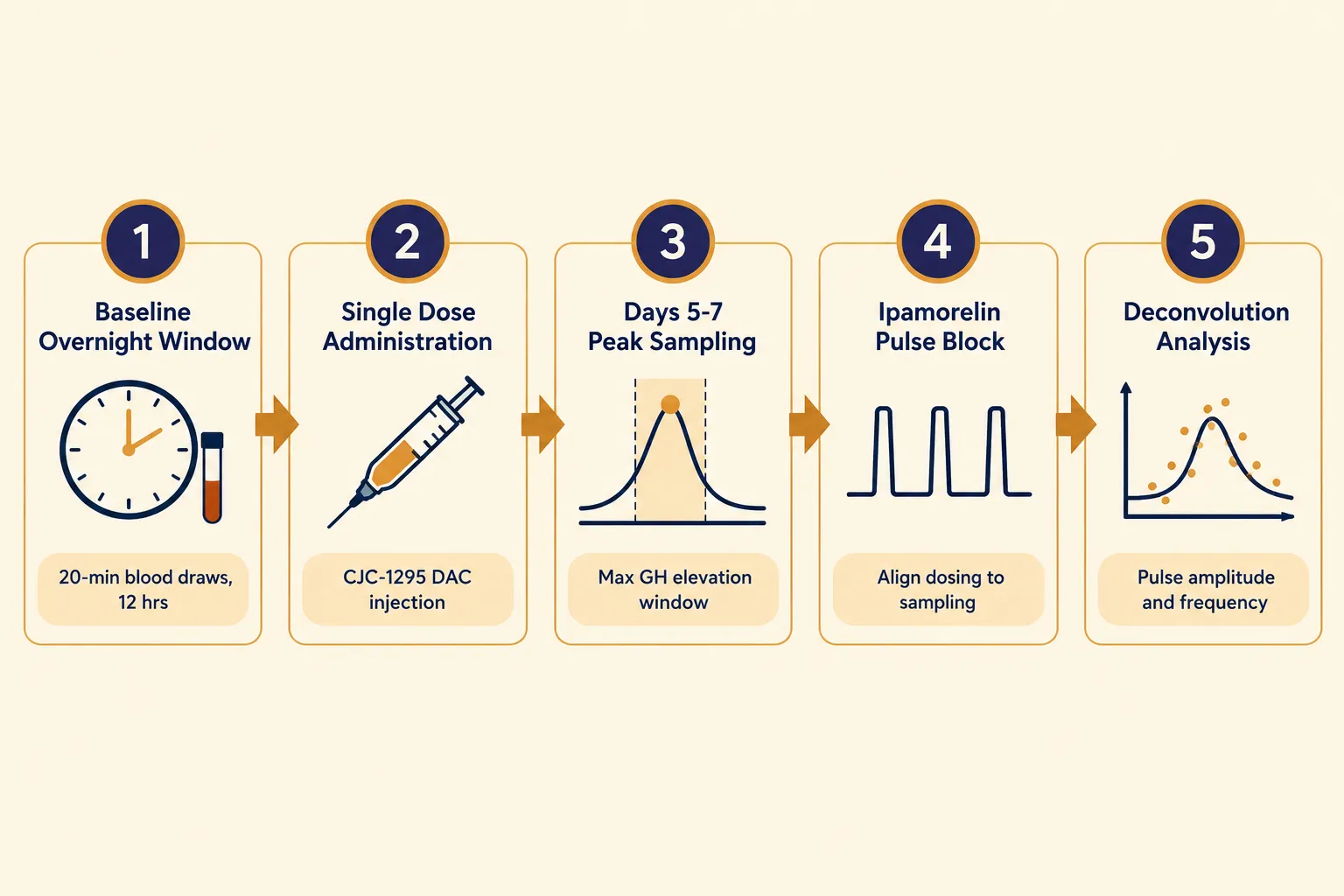
The authoritative template for pulsatile GH analysis under CJC-1295 uses blood draws every 20 minutes across a 12-hour overnight window in healthy adults. This protocol generates approximately 36 time-points per session and captures the full nocturnal GH secretory cycle, which is when the largest natural pulses occur. Two sessions are the minimum: one at true pre-dose baseline and one at the window of expected maximal steady-state GH elevation, typically days 5 to 7 after a single DAC-CJC-1295 injection.
Session Structure and Timing
| Session | Timing | Purpose |
|---|---|---|
| Baseline | Night before dosing | Establish individual pulse frequency, amplitude, trough |
| Peak window | Days 5-7 post-dose | Quantify amplitude change and trough elevation |
| Sparse daytime draws | Days 1, 3, 9, 11 | Track IGF-1 trajectory and GH trough over time |
Why days 5-7? Single-dose pharmacokinetic data from the foundational Teichman et al. ascending-dose trials showed that GH elevation peaks in this window, with IGF-1 remaining above baseline for up to 28 days in some subjects under repeated dosing. Sampling too early (day 1-2) captures the ascending phase but not the plateau; sampling too late (day 10+) risks missing peak amplitude.
Integrating Ipamorelin Into the Protocol
Ipamorelin's short half-life is both an asset and a constraint. Because it produces a pulse lasting only a few hours, the timing of the ipamorelin dose relative to the sampling block must be precise. Researchers using the CJC 1295 IPA 10mg combination in an investigational context should administer ipamorelin at a fixed interval before the dense sampling window begins, typically 30 to 60 minutes prior, so that the induced pulse falls within the captured time series rather than before or after it.
Failure to synchronize ipamorelin dosing with the sampling window is one of the most common design errors. The pulse may be real and robust, but if it occurs outside the sampling block, the data will show only the elevated DAC baseline with no detectable pulse event.
For a detailed pre-study checklist covering assay selection and sourcing, the CJC 1295 Ipamorelin assay planning and sourcing checklist provides a structured reference.
DAC Versus No-DAC: How Formulation Choice Changes Interpretation
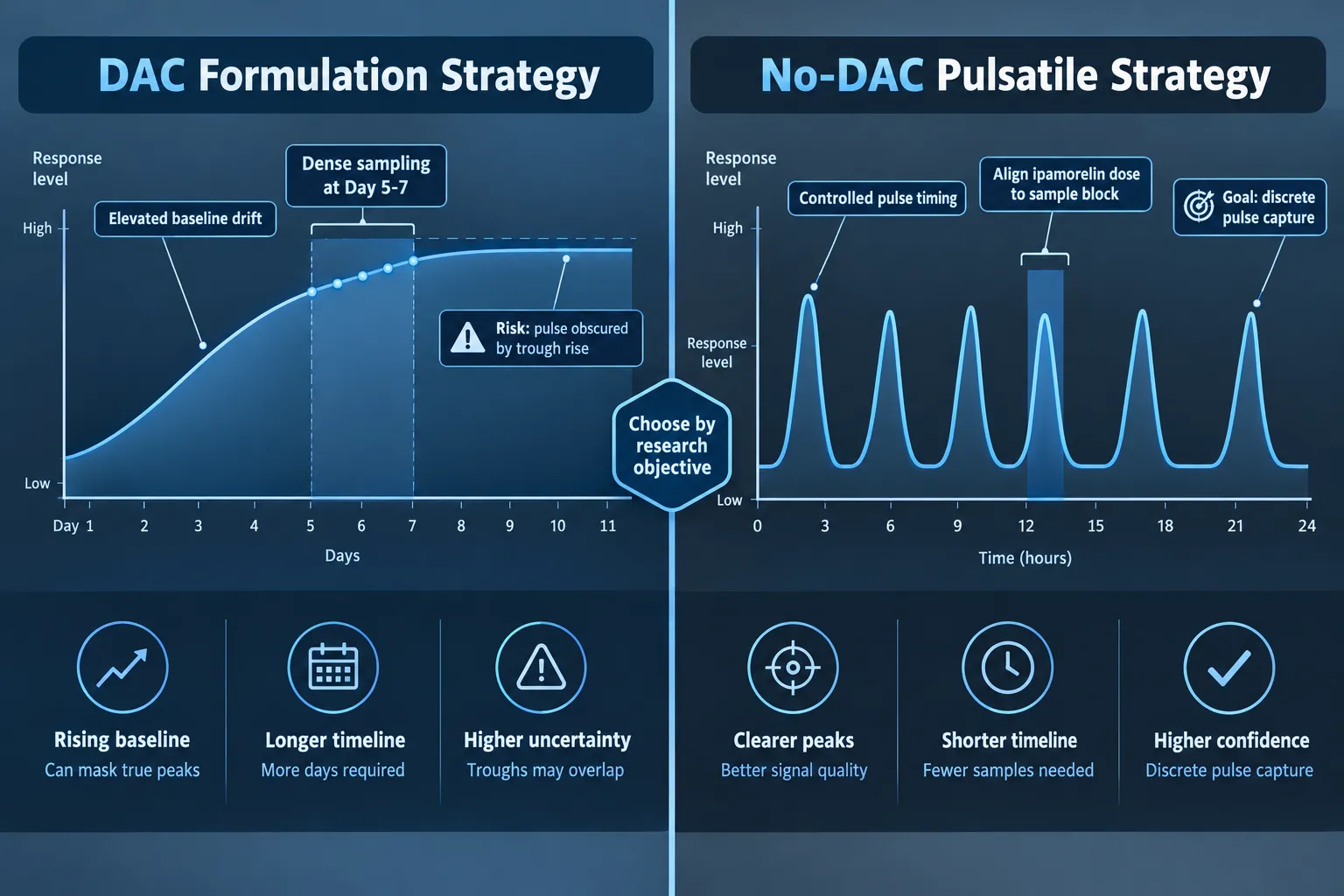
The choice between CJC-1295 with DAC and CJC-1295 without DAC is not cosmetic, it fundamentally changes what the experiment can measure and how data must be interpreted in the context of CJC-1295 With DAC and Ipamorelin: Sampling Design for Pulsatile Growth-Hormone Research.
With DAC: The multi-day GH elevation creates a rising and then slowly declining baseline. Deconvolution algorithms must account for this non-stationary trough when identifying pulse events. Any ipamorelin-induced pulses are superimposed on this elevated platform, which means pulse amplitude is measured relative to a moving floor, not a stable one. Researchers need to model the trough trajectory explicitly, or pulse amplitudes will be systematically underestimated on the ascending phase and overestimated on the descending phase.
Without DAC: Removing the drug-affinity complex shortens CJC-1295's effective duration substantially, allowing investigators to control GH pulse timing with greater precision when paired with ipamorelin. When the research goal is studying discrete, experimentally controlled pulses rather than multi-day mean GH elevation, the no-DAC formulation combined with ipamorelin offers cleaner pulse architecture. The trough returns to near-baseline between doses, making deconvolution more straightforward.
Researchers exploring triple-combination designs should also review the Sermorelin Ipamorelin CJC-1295 framework, which adds a shorter-acting GHRH analogue to the stack and introduces additional timing variables that require careful sampling alignment.
Baseline Drift: The Hidden Confounder
One underappreciated issue in DAC-CJC-1295 studies is baseline drift, the progressive elevation of GH trough levels between pulses. Even at days 5-7, when mean GH is highest, trough GH is not zero. It may be two to four times the pre-dose trough. If a researcher compares a single post-dose pulse amplitude to a pre-dose pulse amplitude without accounting for this elevated trough, the apparent "amplification" of the pulse will be inflated.
The solution is to report both absolute pulse amplitude (peak minus trough within the same session) and net increment above pre-dose trough as separate outcomes. This dual reporting approach is consistent with how the original pulsatility studies in healthy men handled the data, and it prevents the elevated baseline from being misread as an amplified pulse.
For researchers interested in how visceral fat outcomes relate to GH axis changes in these protocols, the visceral fat research tag provides relevant background on metabolic endpoints that often accompany GH secretion studies.
Regulatory Context and Evidence Boundaries
Before finalizing any protocol, researchers must understand the current regulatory landscape. As of 2026, neither CJC-1295 with DAC nor ipamorelin is FDA-approved for any therapeutic indication. A 2024 FDA advisory committee reviewing peptide compounding concluded that both peptides should not be permitted in compounding formulations, citing safety concerns and inadequate evidence.
The combination of CJC-1295 and ipamorelin has never been tested in a published controlled human trial, and no registered study of the combination appears on ClinicalTrials.gov. A Phase II trial in HIV patients with visceral obesity (NCT00267527) was terminated after a participant death and produced no full peer-reviewed dataset. These facts do not invalidate the mechanistic rationale for studying the combination, but they do define the evidence tier: all available data on the combination derive from mechanistic extrapolation and individual peptide pharmacology, not head-to-head human trials.
For researchers building multi-peptide protocols, the IPA Sermorelin stack research resource provides comparative context on stacking strategies and their evidence bases.
Any investigational use must occur within a rigorously monitored research setting with appropriate ethical oversight, adverse event monitoring, and pre-specified stopping rules.
Conclusion
Designing a valid pulsatile GH study with CJC-1295 with DAC and ipamorelin requires solving three problems simultaneously: capturing enough time-points to resolve individual pulses, accounting for the multi-day baseline drift introduced by the DAC formulation, and synchronizing ipamorelin dosing precisely with the sampling window. The validated 20-minute, 12-hour overnight protocol remains the strongest methodological template, and two intensive sessions, baseline plus peak-window, are the minimum for meaningful deconvolution analysis.
Actionable next steps for researchers:
- Pre-specify whether the research goal is mean GH elevation (favoring DAC formulation) or discrete pulse characterization (favoring no-DAC plus ipamorelin).
- Plan at least two overnight dense-sampling sessions and add sparse daytime draws on days 1, 3, 9, and 11 to track IGF-1 and trough GH trajectory.
- Align ipamorelin dosing 30-60 minutes before the sampling block begins to ensure the induced pulse falls within the captured window.
- Report absolute pulse amplitude and net increment above pre-dose trough as separate outcomes to prevent baseline drift from inflating apparent pulse amplification.
- Ensure all protocols operate within current regulatory and ethical frameworks, given that neither peptide is approved and the combination lacks controlled human trial data.
Rigorous sampling design is not a procedural formality, it is what separates interpretable data from expensive noise.


Leave a Reply
Want to join the discussion?Feel free to contribute!