

Enclomiphene Base vs Enclomiphene Citrate: Solubility, Salt-Form Identity, and Analytical Method Selection
A single misidentified salt form in a batch record can invalidate an entire HPLC assay, trigger potency miscalculations, and compromise regulatory filings. That is the practical stakes behind understanding Enclomiphene Base vs Enclomiphene Citrate: Solubility, Salt-Form Identity, and Analytical Method Selection, a topic that sits at the intersection of medicinal chemistry, formulation science, and quality control. Whether you are reviewing a certificate of analysis, developing a dissolution method, or selecting a reference standard, the distinction between these two chemical identities is not cosmetic. It is foundational.
Key Takeaways
- Enclomiphene base and enclomiphene citrate share the same active stereoisomer but differ in molecular weight, counterion, and solubility profile, all of which affect assay calculations.
- Enclomiphene citrate shows superior aqueous solubility and is the preferred pharmaceutical salt form; the base exhibits greater lipophilicity and requires organic solvents for reliable dissolution.
- Reverse-phase HPLC with UV detection at 254 nm is the primary analytical platform for both forms, but mobile phase composition and reference standard selection must match the specific salt identity.
- Salt-form identity must be confirmed before any quantitative analysis; using a base-form reference standard against a citrate-form sample introduces a systematic mass correction error if not accounted for.
- Proper batch documentation should explicitly state salt form, CAS number, and conversion factor to prevent downstream analytical and formulation errors.
Salt-Form Identity: What Sets Enclomiphene Base Apart from Enclomiphene Citrate
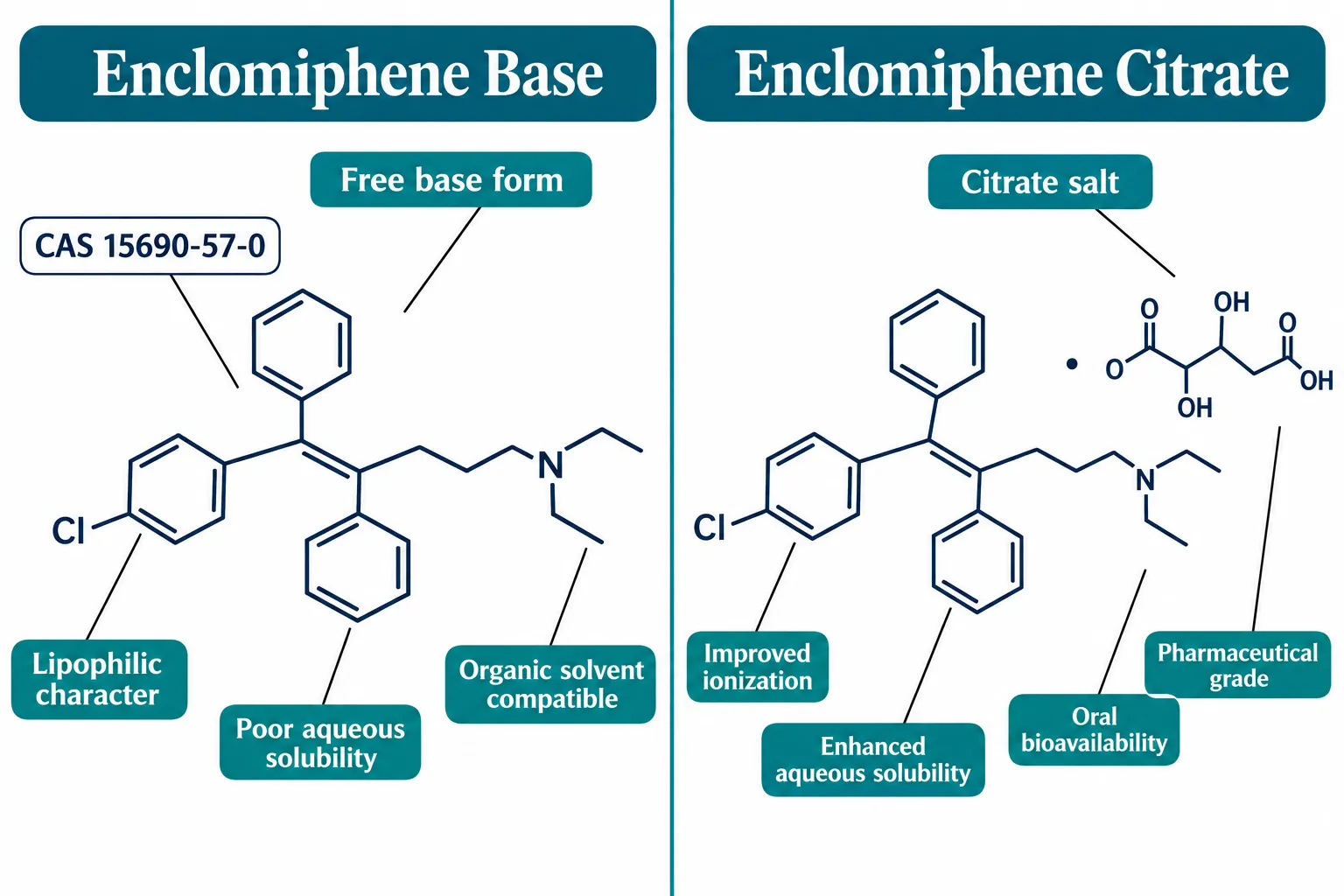
Enclomiphene is the trans-geometric isomer of clomiphene, a selective estrogen receptor modulator (serm) used in research and clinical contexts related to gonadotropin stimulation. The free base form (CAS 15690-57-0) is the parent compound, a lipophilic, crystalline solid with limited water solubility. Enclomiphene citrate is the pharmaceutically preferred salt formed by combining the base with citric acid, producing a more ionizable, water-compatible compound with a higher molecular weight.
This distinction in salt-form identity carries direct consequences for every downstream process:
| Property | Enclomiphene Base | Enclomiphene Citrate |
|---|---|---|
| Molecular weight | ~405.9 g/mol | ~598.1 g/mol |
| Aqueous solubility | Poor | Moderate to good |
| Organic solvent solubility | High | Moderate |
| Ionization in acidic media | Low | Enhanced |
| Primary pharmaceutical use | Reference, synthesis | Oral formulation |
The molecular weight difference alone, nearly 200 g/mol, means that a researcher who weighs 10 mg of citrate salt and calculates potency against a free-base standard will introduce a significant error unless a salt conversion factor is applied. This is not a theoretical concern; it is one of the most common analytical mistakes in compound characterization workflows.
Researchers working with serms and related hormonal compounds in research settings should also familiarize themselves with combined peptide protocols, such as those discussed in guides covering serm, Ipamorelin, and CJC-1295 combinations, where compound identity and purity have similar downstream relevance.
Solubility Profiles: Enclomiphene Base vs Enclomiphene Citrate in Aqueous and Organic Systems
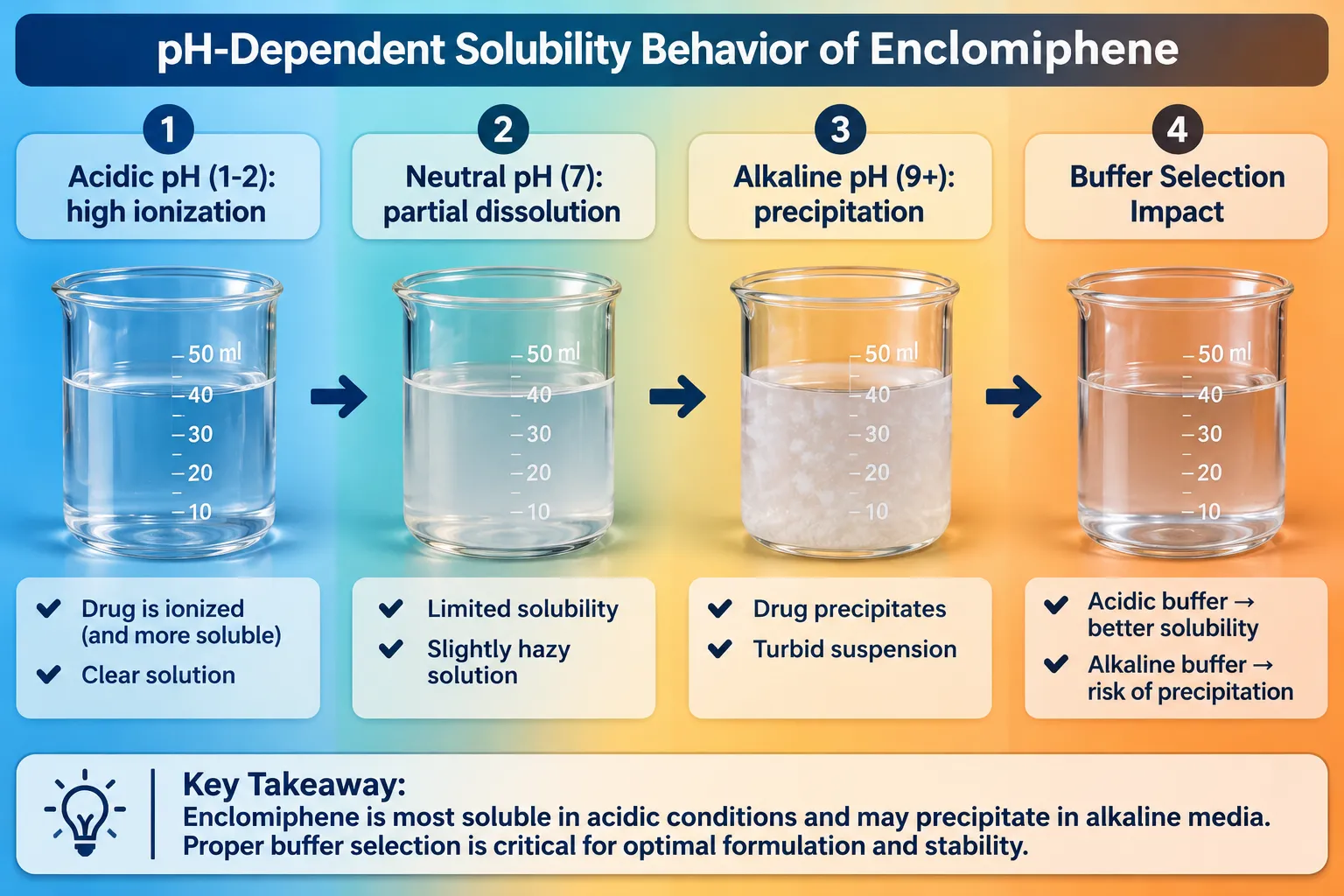
Solubility behavior is arguably the most consequential physicochemical difference between these two forms, affecting dissolution testing, formulation design, and analytical sample preparation.
Aqueous Solubility
Enclomiphene citrate demonstrates meaningfully better water solubility compared to the base. This is a direct result of the citrate counterion improving ionization under acidic to neutral pH conditions. In simulated gastric fluid (pH ~1.2), enclomiphene citrate dissolves readily, which supports its use in oral solid dosage forms. As pH increases toward neutral and alkaline ranges, solubility decreases, a classic behavior for weak-base salt forms.
Enclomiphene base, by contrast, exhibits poor aqueous solubility across most physiologically relevant pH ranges. Its log P (lipophilicity index) is substantially higher, placing it firmly in the category of poorly water-soluble compounds that require solubility enhancement strategies for formulation.
Organic Solvent Solubility
The base form dissolves well in common organic solvents including methanol, ethanol, dimethyl sulfoxide (DMSO), and acetonitrile. Enclomiphene citrate is soluble in these solvents as well, though sometimes at lower concentrations due to the salt's greater polarity.
Practical implication: When preparing HPLC stock solutions, both forms are typically dissolved in methanol or acetonitrile. However, the diluent choice for final sample preparation, particularly in dissolution testing or bioavailability studies, must reflect the expected physiological environment, which favors aqueous systems compatible with the citrate salt form.
This parallels solubility considerations seen across other research compound classes. For researchers sourcing verified compounds, guidance on where to buy peptides and research compounds remains relevant context for understanding purity and salt-form documentation standards.
Analytical Method Selection for Enclomiphene Base vs Enclomiphene Citrate: Solubility, Salt-Form Identity, and Analytical Method Selection
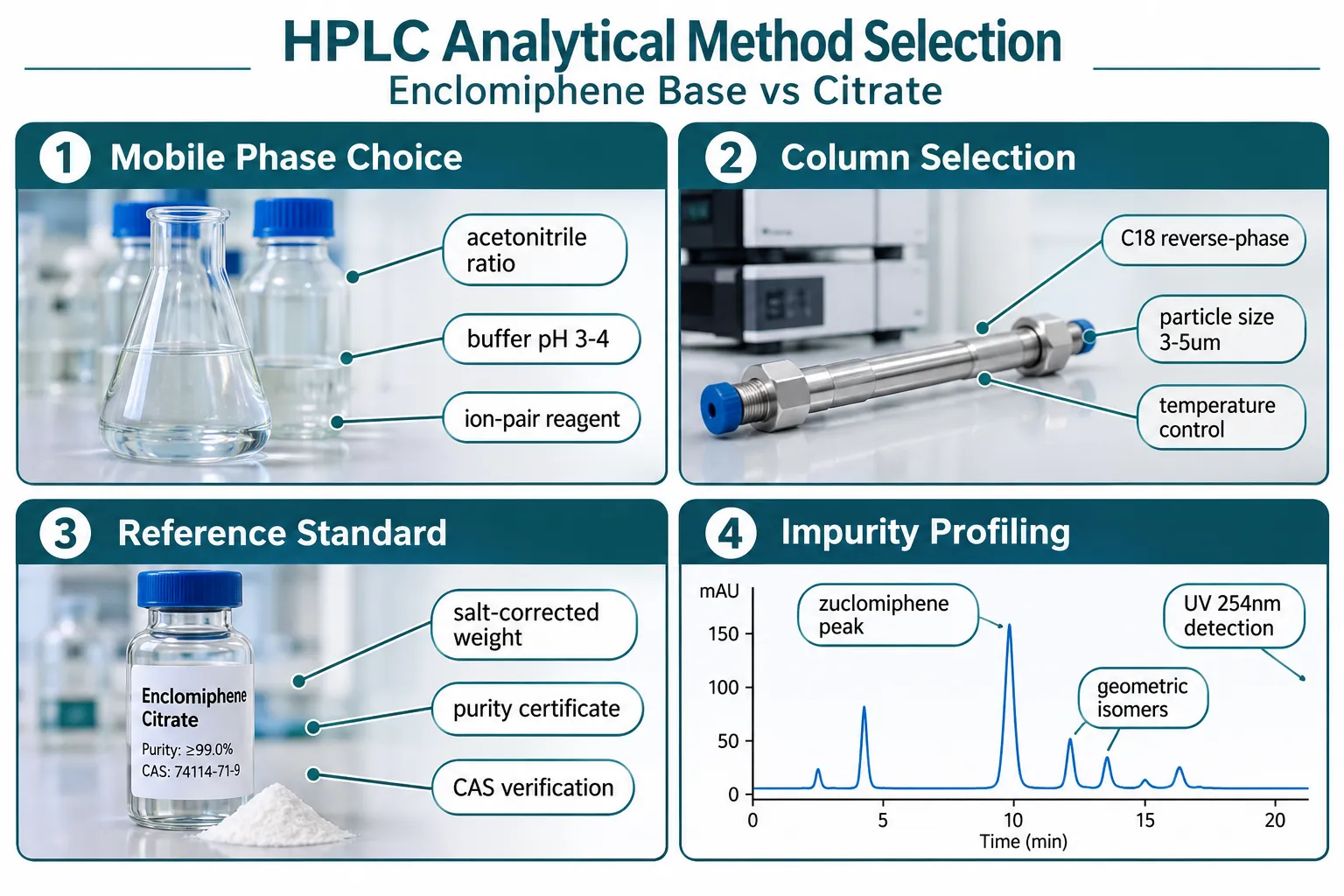
Reverse-phase HPLC is the established analytical platform for enclomiphene quantification, applicable to both salt forms. However, several method parameters must be calibrated specifically to the salt form being analyzed.
Chromatographic Considerations
Column: A C18 reverse-phase column with 3-5 micron particle size is standard. The hydrophobic character of the enclomiphene core is well-retained under typical reversed-phase conditions.
Mobile phase: Gradient elution using acetonitrile and an aqueous buffer (pH 3.0-4.0, typically ammonium formate or phosphate-based) provides adequate resolution. The slightly acidic buffer suppresses ionization of the amine group, sharpening peak shape for both base and citrate forms.
Detection: UV detection at 254 nm exploits the compound's aromatic chromophore. Mass spectrometry (MS) detection adds specificity for isomer confirmation and impurity identification.
Reference Standard Selection and Salt Correction
This is the most critical method parameter. When the reference standard and the test sample are in different salt forms, the calculation must include a correction factor:
Correction factor = MW of sample salt form / MW of reference standard form
Failing to apply this factor when using a base standard to quantify a citrate sample will overstate purity by approximately 32%. Certificates of analysis should always state the salt form and any applied correction.
Isomer Control: Zuclomiphene Impurity
Because enclomiphene is the trans-isomer and zuclomiphene is the cis-isomer, isomeric purity testing is a regulatory and quality expectation. Both isomers elute under standard C18 conditions, but their resolution is method-dependent. A well-developed method should achieve baseline resolution between enclomiphene and zuclomiphene peaks. HPLC-MS allows definitive isomer confirmation where UV alone may be insufficient.
Researchers familiar with impurity profiling in peptide compounds, such as those reviewing peptide supplier comparisons and interpreting analytical data from PeptideTech and PeptideSC, will recognize that the same documentation rigor applies here. Similar QC principles apply when sourcing compounds like Sermorelin, where method-verified purity is essential.
Batch Documentation Requirements
Every batch record involving enclomiphene should include:
- Full IUPAC name and CAS number for the specific salt form
- Molecular weight used in all potency calculations
- Salt conversion factor if reference standard and sample forms differ
- HPLC method version tied to the validated salt form
- Isomeric purity (enclomiphene vs zuclomiphene ratio)
These documentation standards are consistent with broader expectations for research-grade compounds, including GLP-class peptide compounds where identity confirmation is required before use.
Conclusion
The distinction between enclomiphene base and enclomiphene citrate is not a naming convention, it is a chemically and analytically significant difference that affects solubility, molecular weight, reference standard selection, and every quantitative calculation derived from HPLC data. In 2026, as research into selective estrogen receptor modulators continues to expand, getting salt-form identity right from the beginning of any analytical workflow is both a quality imperative and a practical necessity.
Actionable next steps:
- Confirm the exact salt form on your certificate of analysis before any gravimetric or volumetric preparation.
- Match your reference standard to your sample salt form, or apply and document a verified conversion factor.
- Validate your HPLC method specifically for the salt form in use, including resolution of the zuclomiphene impurity peak.
- Ensure all batch documentation explicitly records CAS number, molecular weight, and salt-form identity.
- When sourcing reference-grade compounds, request isomeric purity data alongside standard purity certificates.


Leave a Reply
Want to join the discussion?Feel free to contribute!