Call or Text 727-513-9780
  • Shopping Cart Shopping Cart
    0Shopping Cart
Pure Tested Peptides | America's most trusted Peptides for sale online
  • Peptides for sale
    • Oral Peptides for sale
      • Peptide Capsules for sale
      • BPC 157 Capsules 1000mcg
      • SLU-PP-332 Capsules | 1000 mcg
      • 5-Amino-1MQ 50mg Capsules
      • Tesofensine 500mcg
    • All Peptides for sale
    • Peptide Sprays
      • BPC 157 Nasal Spray Kit
      • BPC-157 TB500 Nasal Spray Kit
      • Semax Nasal Spray 10mg
      • Selank – Nasal Spray Kit – 10mg
      • Epithalon 50MG Nasal Spray Kit
      • Ipamorelin 10mg Nasal Spray
      • Klow Nasal Spray (BPC-157 + TB-500 + GHK-Cu + KPV) | 80mg
      • Hulk Nasal Spray Tesa / Ipa Blend 6/3 MG
      • Klow Nasal Spray
      • NAD + 500 mg Nasal Spray
      • PT-141 Nasal Spray Kit
    • GHRH Peptides
      • Ipa Peptides
      • CJC-1295 Peptides
        • CJC-1295 with DAC 5 mg
        • CJC-1295 without DAC 5 mg
        • CJC-1295 Ipa 10mg
      • Tesa Peptides
        • Tesa Peptide
        • Tesa 20 mg
    • GHK-Cu Peptides
      • All GHK-Cu Peptides
      • GHK-Cu 100mg
      • KLOW Peptide Blend – Buy KLOW blend online
    • BPC Peptides
      • All BPC Peptides
      • BPC-157
      • BPC-157 TB-500
      • BPC 157 capsules 1000mcg
    • SLU-PP-332 Peptides
      • All SLU-PP-332 Peptides
      • SLU-PP-332 5mg
    • GLP3 Peptides
      • GLP3-R
      • GLP3-R CAG 10mg
      • GLP3-R 20mg
    • PT-141 Peptides
      • PT-141 Peptides for sale
      • PT-141 10mg
      • PT-141 Nasal Spray
    • CAG Peptides
      • Lipo-C Peptide Blend
      • CAG 5mg
      • CAG 10mg
    • MOTS-C Peptides
      • MOTS-C Peptides for sale
      • MOTS-c peptide
      • MOTS-c 10mg *6 pack*
    • 5 Amino 1MQ Peptides
      • 5 Amino 1MQ Peptides for sale
      • 5-Amino-1MQ 50mg Capsules
      • 5-Amino-1MQ 5mg
    • Epithalon Peptides
      • Epithalon Peptides for sale
      • Epithalon 10mg
      • Epithalon 50mg
  • Shop
    • GLPs
      • 5-Amino-1MQ 50mg Capsules
      • 5-Amino-1MQ 5mg
      • GLP3-Reta
      • L-Carnitine 500mg/ml
      • Tesofensine 500mcg
      • SLU-PP-332 5mg
      • MOTS-c 10mg *6 pack*
    • Epithalon & BPC Peptides
      • Epithalon 10mg
      • Epithalon 50mg
      • BPC-157
      • BPC 157 capsules 1000mcg
      • BPC-157 TB-500
      • BPC-157 TB500 Nasal Spray Kit
      • BPC 157 Nasal Spray Kit
    • BPC TB-500 & NAD+ Peptides
      • NAD+ 500 mg
      • KLOW Peptide Blend – Buy KLOW blend online
      • GLOW Peptide Blend
      • TB 500 5mg
      • BPC 157 capsules 1000mcg – Supplement
      • BPC 157 Nasal Spray Kit
      • BPC-157
      • BPC-157 TB500 Nasal Spray Kit
      • BPC-157 TB-500
      • BPC 157 capsules 1000mcg
    • LL-37 Peptide
      • LL-37 10 mg
    • MOTS-C & Selank
      • MOTS-c peptide
      • Selank 10mg
    • GHK Peptides
      • GHK-Cu 100mg
      • GLOW Peptide Blend
      • KLOW Peptide Blend – Buy KLOW blend online
  • COAs
  • Wholesale
    • Wholesale Peptides for sale
  • PTP FAQ
  • Affiliates
    • Selank Peptide: Advanced Pharmacological Mechanisms Underlying Its Anxiolytic and Nootropic Effects in Research
      • 5-Amino-1MQ Peptide: Detailed Mechanisms of NNMT Inhibition and Its Impact on Cellular Metabolism Research
        • MOTS-C Peptide: Unraveling Its Role in Mitochondrial Dynamics and Energy Metabolism Research
          • Epithalon Peptide and Telomerase Regulation: Investigating Its Impact on Cellular Senescence and Lifespan Research Models
            • GLP2-T vs GLP2 Tirz Peptide: Understanding the Naming, Mechanistic Nuances, and Research Implications for Gut Health
      • Peptides and Polypeptides in Modern Pharmacology: What Research on Metoprolol, Prednisone, and Amlodipine Reveals
        • Polypeptide Peptides vs NSAIDs: What Naproxen and Diclofenac Teach Tissue-Repair Researchers About BPC‑157 and TB‑500
          • Peptides and Polypeptides in Endocrine Pharmacology: How GLP-1, GLP-2, and GLP-3 Retatrutide Differ From Classic Drugs Like Prednisone and Amlodipine
          • 5‑Amino‑1MQ Peptide and NNMT Inhibition: How It Compares With Statins Like Atorvastatin in Adipose and Lipid Metabolism Research
      • Enclomiphene, Estrogen Receptor Signaling, and Luteinizing Phase Biology: What Hormone Researchers Should Measure
        • Mesenchymal Stem Cells, BPC‑157, and GHK‑Cu: How Tissue Repair Peptides Compare With Classic NSAIDs Like Naproxen in Injury Models
          • Peptide Calculator Use Cases Beyond Growth Hormone: Working Through GLP‑3 Retatrutide, MOTS‑c, and BPC‑157 Research Dosing
        • Polypeptide Peptides in Endocrine and Metabolic Pharmacology: Lessons From Amlodipine, Prednisone, and Metoprolol
        • Peptides Calculator for Advanced Blends: Worked Examples for Tesamorelin, CJC‑1295, and Ipamorelin Stacks
          • Peptides and Polypeptides in Human Physiology: How Molecular Size Shapes Research Applications
            • Selank Peptide: Advanced Pharmacological Mechanisms Underlying Its Anxiolytic and Nootropic Effects in Research
          • 5-Amino-1MQ Peptide: Detailed Mechanisms of NNMT Inhibition and Its Impact on Cellular Metabolism Research
            • MOTS-C Peptide: Unraveling Its Role in Mitochondrial Dynamics and Energy Metabolism Research
              • Epithalon Peptide and Telomerase Regulation: Investigating Its Impact on Cellular Senescence and Lifespan Research Models
                • GLP2-T vs GLP2 Tirz Peptide: Understanding the Naming, Mechanistic Nuances, and Research Implications for Gut Health
                  • Peptides and Polypeptides in Endocrine Pharmacology: How GLP-1, GLP-2, and GLP-3 Retatrutide Differ From Classic Drugs Like Prednisone and Amlodipine
                    • Polypeptide Peptides vs NSAIDs: What Naproxen and Diclofenac Teach Tissue-Repair Researchers About BPC‑157 and TB‑500
                      • Peptides and Polypeptides in Modern Pharmacology: What Research on Metoprolol, Prednisone, and Amlodipine Reveals
                        • 5‑Amino‑1MQ Peptide and NNMT Inhibition: How It Compares With Statins Like Atorvastatin in Adipose and Lipid Metabolism Research
                        • Enclomiphene, Estrogen Receptor Signaling, and Luteinizing Phase Biology: What Hormone Researchers Should Measure
                        • Mesenchymal Stem Cells, BPC‑157, and GHK‑Cu: How Tissue Repair Peptides Compare With Classic NSAIDs Like Naproxen in Injury Models
                        • Peptide Calculator Use Cases Beyond Growth Hormone: Working Through GLP‑3 Retatrutide, MOTS‑c, and BPC‑157 Research Dosing
                        • Polypeptide Peptides in Endocrine and Metabolic Pharmacology: Lessons From Amlodipine, Prednisone, and Metoprolol
                        • Peptides Calculator for Advanced Blends: Worked Examples for Tesamorelin, CJC‑1295, and Ipamorelin Stacks
                        • Peptides and Polypeptides in Human Physiology: How Molecular Size Shapes Research Applications
                        • Selank Peptide: Advanced Pharmacological Mechanisms Underlying Its Anxiolytic and Nootropic Effects in Research
                        • MOTS-C Peptide: Unraveling Its Role in Mitochondrial Dynamics and Energy Metabolism Research
                        • Peptides and Polypeptides in Modern Pharmacology: What Research on Metoprolol, Prednisone, and Amlodipine Reveals
                        • Peptides and Polypeptides in Endocrine Pharmacology: How GLP-1, GLP-2, and GLP-3 Retatrutide Differ From Classic Drugs Like Prednisone and Amlodipine
                        • 5-Amino-1MQ Peptide: Detailed Mechanisms of NNMT Inhibition and Its Impact on Cellular Metabolism Research
                        • Mesenchymal Stem Cells, BPC‑157, and GHK‑Cu: How Tissue Repair Peptides Compare With Classic NSAIDs Like Naproxen in Injury Models
                        • Peptide Calculator Use Cases Beyond Growth Hormone: Working Through GLP‑3 Retatrutide, MOTS‑c, and BPC‑157 Research Dosing
                        • GLP2-T vs GLP2 Tirz Peptide: Understanding the Naming, Mechanistic Nuances, and Research Implications for Gut Health
                        • Polypeptide Peptides in Endocrine and Metabolic Pharmacology: Lessons From Amlodipine, Prednisone, and Metoprolol
                        • Polypeptide Peptides vs NSAIDs: What Naproxen and Diclofenac Teach Tissue-Repair Researchers About BPC‑157 and TB‑500
                        • Peptides and Polypeptides in Human Physiology: How Molecular Size Shapes Research Applications
                        • Peptides Calculator for Advanced Blends: Worked Examples for Tesamorelin, CJC‑1295, and Ipamorelin Stacks
                        • 5‑Amino‑1MQ Peptide and NNMT Inhibition: How It Compares With Statins Like Atorvastatin in Adipose and Lipid Metabolism Research
                        • Enclomiphene, Estrogen Receptor Signaling, and Luteinizing Phase Biology: What Hormone Researchers Should Measure
                        • Epithalon Peptide and Telomerase Regulation: Investigating Its Impact on Cellular Senescence and Lifespan Research Models
                        • Best research protocol Klow blend
                        • best time to take BPC-157
                        • best time to take DSIP (Delta Sleep Inducing Peptide)
                        • best time to take CJC-1295
                        • best time to take AOD-9604
                        • best time to take Follistatin 344
                        • best time to take Ipamorelin
                        • best time to take MK-677 (Ibutamoren)
                        • best time to take Ligandrol (LGD-4033) — research compound
                        • best time to take Ostarine (MK-2866) — research compound
                        • best time to take GHK-CU
                        • best time to take TB-500
                        • best time to take MOTS-c
                        • best time to take Semax
                        • best time to take RAD-140 (Testolone) — research compound
                        • best time to take Thymosin Alpha-1
                        • best time to take PEG-MGF
                        • Biolife Plasma, Octapharma Plasma, and Research Peptides: How Plasma Donation Labs Differ From Peptide Suppliers
                        • best time to take YK-11 — research compound
                        • best time to take PT-141 (Bremelanotide)
                        • Best research protocol Klow blend
                        • 5-Amino-1MQ and MOTS-C Synergy: Metabolic Signaling, Mitochondria, and Research Design
                        • BPC-157 and TB-500: Investigating Their Combined Effects on Angiogenesis and Cellular Migration in Tissue Repair Models
                        • BPC-157 Peptide: Gut Barrier Function, Inflammation, and Tissue-Recovery Research
                        • 5‑Amino‑1MQ and MOTS‑c Synergy in Metabolic Research: Designing NNMT and Mitochondrial Biogenesis Stacks
                        • CJC-1295 with DAC vs. Without DAC: Half-Life, Release Kinetics, and Research Implications
                        • CJC‑1295 with DAC vs. Without DAC: Expanding on Half‑Life Differences Using Tesamorelin and Ipamorelin Blend Case Studies
                        • Collagen Biology and Copper‑Binding Peptides: How GHK‑Cu, Glow Blend, and Klow Blend Interact with Skin and Connective Tissue
                        • Collagen Biology and Regenerative Peptides: How GHK‑Cu, Glow Blend, and Klow Blend Affect Extracellular Matrix Research
                    • DNA, Telomeres, and Longevity Peptides: Positioning Epithalon and MOTS‑c in Genetic Aging Research
                      • Enclomiphene Citrate: serm Mechanism, Testosterone Research, and Stack Compatibility
                        • Enclomiphene vs Enclomiphene Citrate: Formulation, Bioavailability, and Research Distinctions
                        • Epithalon Peptide Research: Telomerase Activation, Aging, and Pineal Gland Function
                        • Estrogen Receptor Signaling and Enclomiphene: How Selective Modulators Compare with Classic Polypeptide Hormones
                        • GHK-Cu Peptide: Advanced Mechanisms in Extracellular Matrix Remodeling and Wound Healing Research
                        • GHK-Cu Peptide: Collagen Synthesis, Wound Repair, and Skin-Barrier Research Models
                        • GLP-1 vs GLP-3 vs GLP-2: Peptide Classification and Research Applications
                        • GLP-2 Peptide Research Guide: Gut Barrier Function, Nutrient Absorption, and Intestinal Recovery Models
                        • GLP-3 Retatrutide vs. GLP-1 Drugs: What Triple-Agonist Biology Changes in Research Models
                        • Ipamorelin and Tesamorelin Combination: Synergistic GH Secretagogue Research and Dosing Protocols
                        • GLP2 Tirz Peptide: What It Is, Why the Name Exists, and How Researchers Should Interpret It
                        • Klow Blend Peptide Nasal Spray: What the Formulation Is Trying to Do in Cognitive Research
                        • Mitochondria, NNMT Inhibition, and Peptide Modulators: Where MOTS‑c and 5‑Amino‑1MQ Fit in Cellular Energy Research
                        • MOTS-c Peptide: Mitochondrial Function, Energy Metabolism, and What Researchers Measure
                        • MOTS-c vs. 5-Amino-1MQ: Which Metabolic Research Questions Each Compound Actually Answers
                        • Nasal Spray Peptides: Bioavailability, Administration, and Semax/Selank Research Applications
                        • PT-141 Peptide Research: Mechanism of Action and Melanocortin Receptor Signaling
                        • Retatrutide for Research: Mechanism, Structure, and GLP-1/GLP-3 Dual Action
                        • Retatrutide for Obesity and Type 2 Diabetes: What the Latest Trial Data Suggest
                        • Tesofensine Peptide Research: Mechanism, Appetite Suppression, and Neuropeptide Y Pathways
  • Contact
    • Contact Customer Service
    • Text Customer Support
  • About US
  • Shop all peptides
  • Affiliate Program
    • Affiliate Signup
  • Login / Register Login / Register Page Link Login / Register Page Link
  • Click to open the search input field Click to open the search input field Search
  • Menu Menu
GHK-Cu Peptide: Collagen Signaling, Wound Models, and Skin Research Applications

GHK-Cu Peptide: Collagen Signaling, Wound Models, and Skin Research Applications

August 14, 2026/0 Comments/in Uncategorized/by

A three-amino-acid fragment naturally present in human plasma has generated more peer-reviewed attention in regenerative biology than most full-length proteins. That compound is GHK-Cu, glycine-histidine-lysine bound to a copper ion, and in 2026, research interest in its collagen signaling properties, wound model performance, and skin biology applications continues to accelerate. This article examines the mechanistic evidence behind GHK-Cu peptide: collagen signaling, wound models, and skin research applications, covering copper-binding biology, preclinical data, emerging clinical work, and delivery science.

Key Takeaways

  • GHK-Cu is a copper-chelating tripeptide that activates collagen synthesis pathways, primarily through TGF-beta receptor signaling and MMP modulation.
  • Preclinical wound models using hydrogels and liposomal delivery systems show measurable improvements in closure rates and collagen deposition compared to controls.
  • Human trial data remains limited but growing, with a Phase 2 trial (CuHeal, NCT07437586) launched in 2026 for acute wounds.
  • Topical formulations demonstrate skin-brightening effects linked to tyrosinase modulation and reduced melanin output.
  • Delivery technology, particularly liposomal and nanoparticle systems, is the primary frontier for improving GHK-Cu bioavailability in research models.

Copper-Binding Biology and the GHK-Cu Mechanism
Copper-Binding Biology and the GHK-Cu Mechanism

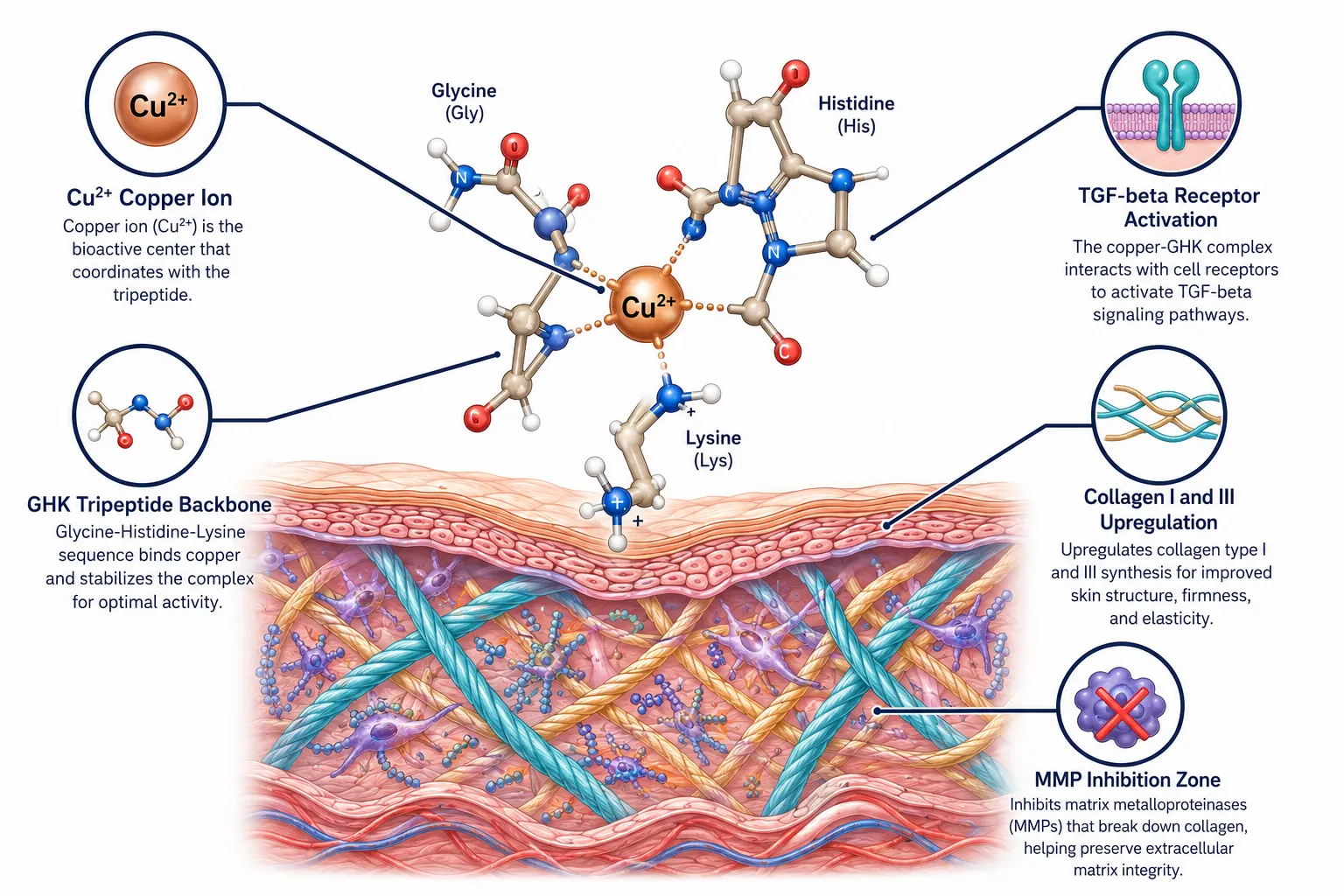
GHK (glycine-histidine-lysine) was first isolated from human albumin in the early 1970s. Its affinity for copper(II) ions is exceptionally high, and this copper-chelating property is central to nearly every biological effect attributed to the compound. When GHK binds Cu2+, the resulting complex, commonly written GHK-Cu, gains the ability to interact with cell surface receptors and intracellular signaling cascades that regulate tissue remodeling.

Core signaling pathways identified in research include:

  • TGF-beta activation: GHK-Cu upregulates transforming growth factor-beta, a master regulator of collagen I and collagen III synthesis in fibroblasts.
  • MMP modulation: The peptide simultaneously inhibits matrix metalloproteinases (MMPs) responsible for collagen degradation, creating a net pro-collagen environment.
  • Integrin engagement: Evidence from cell culture models suggests GHK-Cu interacts with integrin receptors, influencing cell migration and adhesion.
  • Antioxidant gene expression: Copper-bound GHK activates superoxide dismutase pathways, reducing oxidative stress in fibroblast and keratinocyte cultures.

For a deeper look at how copper-binding polypeptides interact with classic collagen pathways, the article on GHK-Cu peptide and collagen interactions in skin and tissue research provides detailed mechanistic context.

"GHK-Cu does not simply add collagen, it appears to recalibrate the entire remodeling environment, shifting the balance from degradation toward synthesis."

This dual action, stimulating production while slowing breakdown, makes GHK-Cu a compelling subject for researchers studying both acute wound repair and chronic skin aging.

GHK-Cu Peptide in Wound Models and Skin Research Applications
GHK-Cu Peptide in Wound Models and Skin Research Applications

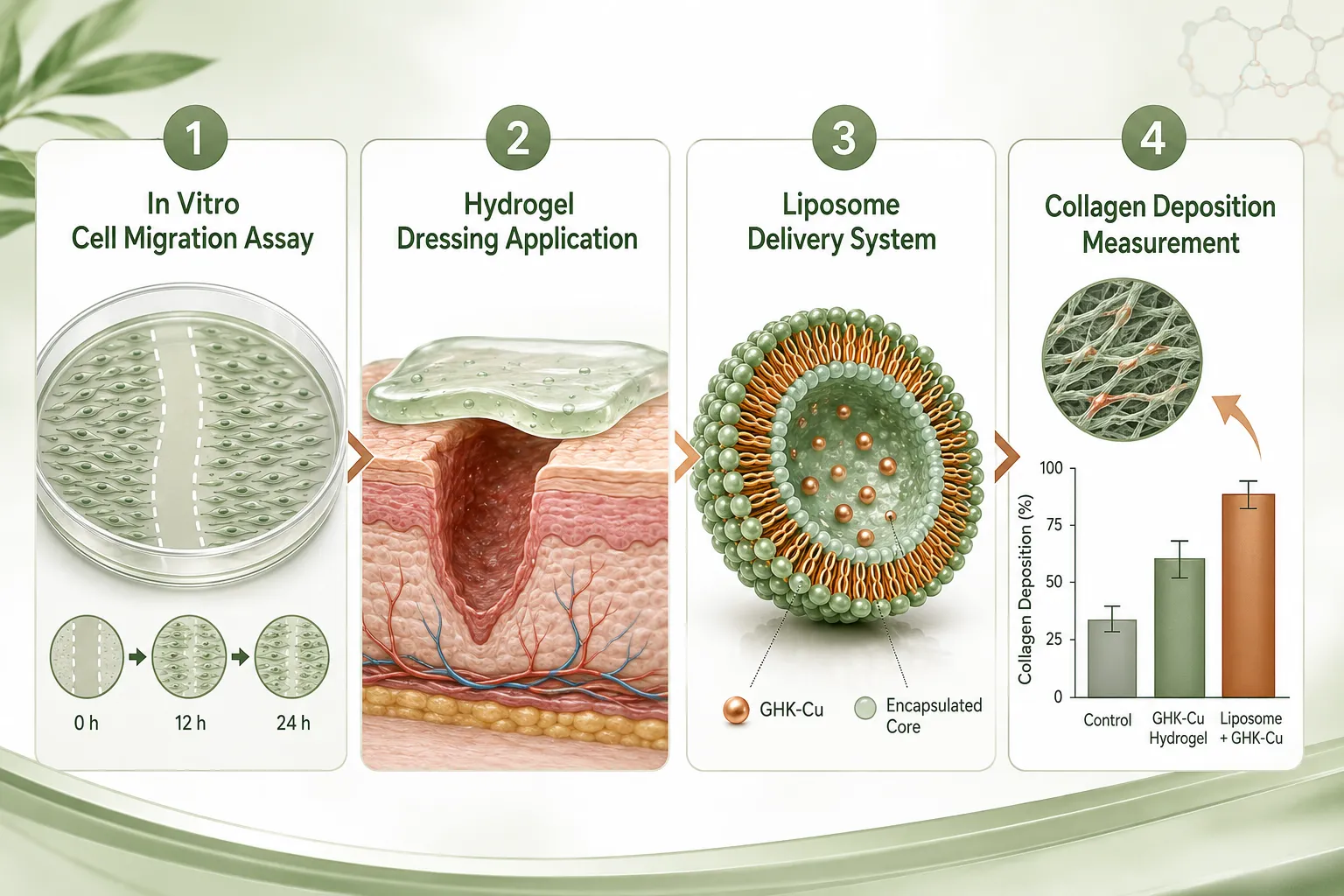
The wound-healing literature on GHK-Cu spans several decades, but the most rigorous preclinical data has emerged between 2022 and 2025. Researchers have tested the peptide across multiple model formats, each revealing distinct aspects of its repair biology.

Preclinical Model Performance

Hydrogel dressing models have shown that GHK-Cu-loaded hydrogels accelerate wound closure in excisional rodent models by 30-45% compared to vehicle controls in several published datasets. Collagen deposition, measured by hydroxyproline content and histological staining, is consistently elevated in treated wounds.

Liposomal delivery systems represent a significant advance. Because GHK-Cu is a small, hydrophilic tripeptide, passive skin penetration is limited. Encapsulating the compound in phospholipid liposomes improves dermal delivery by an estimated 3- to 5-fold in ex vivo skin models, based on 2025 physicochemical data. This has direct implications for topical anti-aging and wound dressing research.

Nanoparticle dressings incorporating GHK-Cu alongside bioactive scaffolds have demonstrated synergistic effects on fibroblast proliferation and vascular endothelial growth factor (VEGF) expression in vitro.

Human and Clinical Data

Human evidence remains the thinner side of the literature. A notable early trial by Mulder and colleagues examined GHK-Cu in diabetic ulcer patients and reported modest but positive outcomes. Current wound care guidelines do not yet endorse GHK-Cu as a standard-of-care agent, reflecting the gap between preclinical promise and large-scale clinical validation.

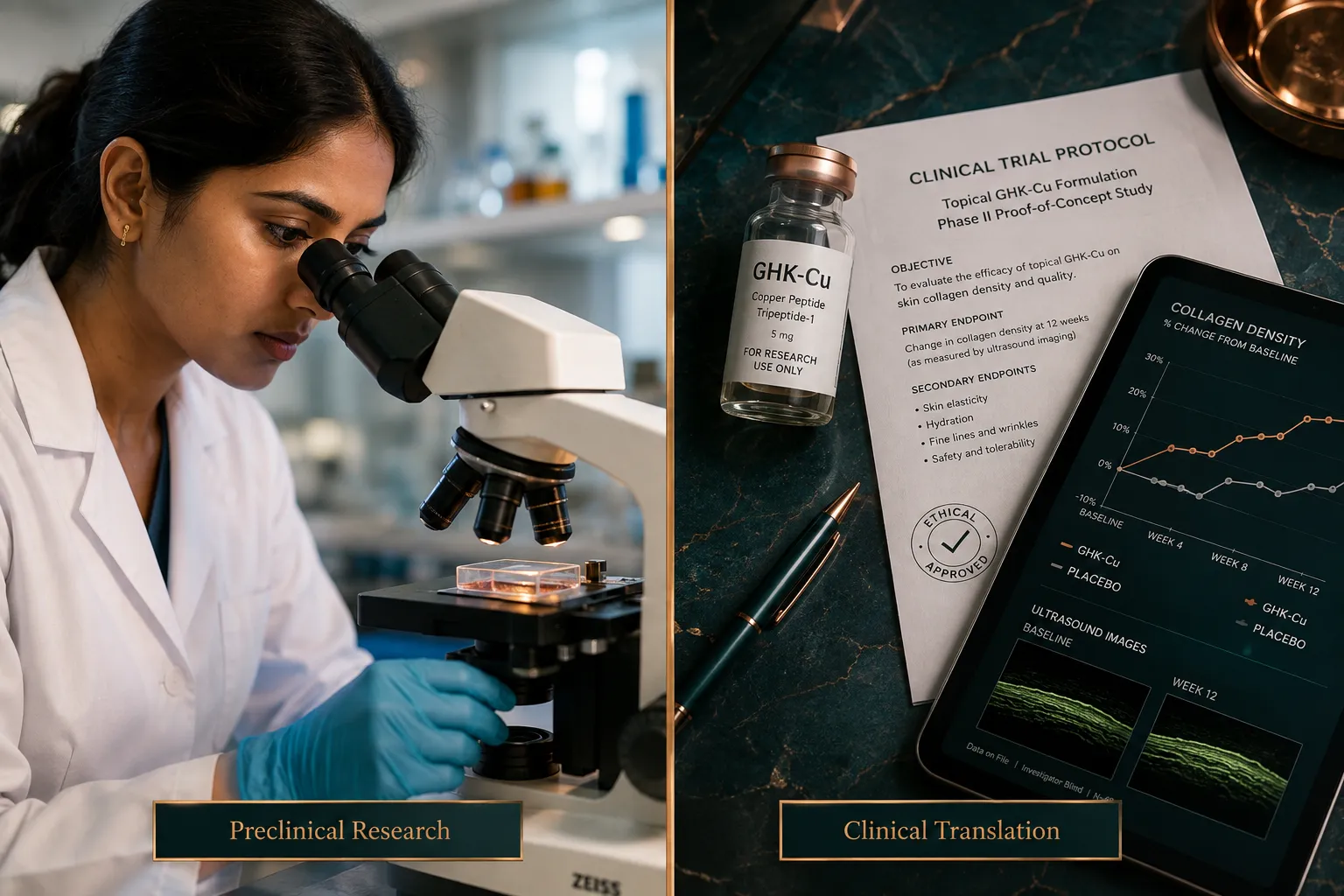
That gap is beginning to close. The CuHeal Phase 2 trial (NCT07437586), launched in 2026, is the most significant human study to date, enrolling patients with acute wounds to evaluate GHK-Cu dressings against standard care. Results are anticipated in the late 2020s and are widely expected to shape guideline discussions.

Researchers interested in how peptide-based compounds perform in regenerative models may also find value in reviewing mesenchymal stem cells and peptide-based modulators including GHK-Cu in regenerative research.

Skin Brightening and Pigmentation Research

A separate but growing body of work examines GHK-Cu's effect on melanin synthesis. In keratinocyte and melanocyte co-culture models, GHK-Cu reduces tyrosinase activity, the rate-limiting enzyme in melanin production, leading to measurable decreases in pigmentation output. This positions the peptide as a research subject for hyperpigmentation and photoaging models, distinct from its wound-healing applications.

Delivery Systems, Safety Profile, and Research Outlook
Delivery Systems, Safety Profile, and Research Outlook

The practical value of GHK-Cu in research settings depends heavily on formulation. Raw peptide applied topically without a delivery vehicle shows limited dermal penetration due to the skin's barrier function.

Current delivery approaches under investigation:

Delivery System Key Advantage Research Stage
Phospholipid liposomes 3-5x improved dermal penetration Active (2025-2026 data)
Hydrogel scaffolds Sustained release, wound contact Preclinical, rodent models
Nanoparticle carriers Synergistic scaffold integration In vitro, early preclinical
Topical cream/serum Consumer accessibility Human anti-aging trials

Safety Profile as of 2026

GHK-Cu has a well-characterized safety profile at concentrations used in topical research (typically 0.1-2% w/v). No significant systemic toxicity has been reported in preclinical studies at these ranges. Systemic administration at higher doses in animal models has not produced organ-level adverse effects in published datasets, though human systemic data remains sparse.

Researchers comparing peptide safety profiles across compound classes may find the discussion of complement-dependent cytotoxicity and peptide safety including GHK-Cu a useful reference.

For broader context on how research-use peptides are classified and sourced, the Peptides 101 guide for research-use only buyers covers structural and mechanistic fundamentals.

Forward-Looking Research Directions

Dermatologist and industry perspectives in 2026 point to three near-term priorities:

  1. Liposomal and nanoparticle optimization, improving delivery efficiency without altering the peptide's copper-chelating geometry.
  2. Combination protocols, pairing GHK-Cu with growth factors or other regenerative peptides to amplify collagen outcomes. Research on BPC-157 core peptide documentation highlights how multi-peptide approaches are increasingly common in wound models.
  3. Clinical proof-of-concept, translating the CuHeal Phase 2 data into actionable dosing and formulation guidelines for wound care researchers.

Conclusion

GHK-Cu peptide research in 2026 sits at a productive intersection: mechanistic understanding is strong, preclinical models are compelling, and the first adequately powered human trial is underway. The collagen signaling biology, centered on TGF-beta activation, MMP inhibition, and copper-dependent antioxidant pathways, provides a coherent rationale for the wound-healing and anti-aging effects observed across models.

Actionable next steps for researchers:

  • Prioritize liposomal or nanoparticle formulations when designing topical GHK-Cu experiments to maximize dermal penetration.
  • Monitor CuHeal (NCT07437586) trial updates, as Phase 2 results will likely define the next generation of wound dressing protocols.
  • Consider GHK-Cu as part of multi-peptide regenerative panels, particularly in fibroblast and keratinocyte culture models where collagen remodeling is a primary endpoint.
  • Review pigmentation model data if skin-brightening outcomes are relevant to the research question, given emerging tyrosinase inhibition findings.

The peptide's small size, high copper affinity, and broad signaling reach make it one of the most versatile tools in skin and wound biology research, and the late 2020s are likely to produce the clinical validation the field has long needed.

Tags: anti-aging peptides, collagen signaling, copper peptide, fibroblast collagen synthesis, ghk-cu peptide, liposomal peptide delivery, peptide delivery systems, regenerative research, skin research peptides, tgf-beta signaling, wound healing research, wound models
https://www.puretestedpeptides.com/wp-content/uploads/2026/08/ghk-cu-peptide-collagen-signaling-wound-models-and-skin-research-applications.webp 1024 1536 https://www.puretestedpeptides.com/wp-content/uploads/2026/01/buy-peptides-online.jpg 2026-08-14 13:06:322026-08-14 13:06:32GHK-Cu Peptide: Collagen Signaling, Wound Models, and Skin Research Applications
You might also like
Mesenchymal Stem Cells and Peptide Signaling: Where MOTS-c, BPC-157, and GHK-Cu Fit in Regenerative Research Mesenchymal Stem Cells and Peptide Signaling: Where MOTS-c, BPC-157, and GHK-Cu Fit in Regenerative Research
Epithalon Peptide in Longevity Research: Telomeres, Cellular Aging, and What Labs Measure Epithalon Peptide in Longevity Research: Telomeres, Cellular Aging, and What Labs Measure
Collagen Research Peptides: Where GHK-Cu, Glow Blend, and Skin-Focused Formulas Fit in Laboratory Models Collagen Research Peptides: Where GHK-Cu, Glow Blend, and Skin-Focused Formulas Fit in Laboratory Models
GHK-Cu Peptide: Copper Complex Chemistry, Research Stability, and Lab Use Considerations GHK-Cu Peptide: Copper Complex Chemistry, Research Stability, and Lab Use Considerations
GHK-Cu Peptide and Collagen: How Copper-Binding Polypeptides Interact With Classic Collagen Pathways in Skin and Tissue Research GHK-Cu Peptide and Collagen: How Copper-Binding Polypeptides Interact With Classic Collagen Pathways in Skin and Tissue Research
Collagen, GHK-Cu, and Glow Blend: How Classic Collagen Biology Intersects With Copper Peptide Research Collagen, GHK-Cu, and Glow Blend: How Classic Collagen Biology Intersects With Copper Peptide Research
GHK-Cu vs Glow Blend vs Klow Blend: What Each Copper- and Skin-Focused Formula Is Used For in Research GHK-Cu vs Glow Blend vs Klow Blend: What Each Copper- and Skin-Focused Formula Is Used For in Research
Collagen Signaling and Copper Peptides: What Researchers Measure With GHK-Cu and Related Skin Models Collagen Signaling and Copper Peptides: What Researchers Measure With GHK-Cu and Related Skin Models
0 replies

Leave a Reply

Want to join the discussion?
Feel free to contribute!

Leave a Reply Cancel reply

Your email address will not be published. Required fields are marked *

×

Helpful Links

  • My account
  • Cart
  • Checkout
  • Refund and Returns Policy
  • Privacy Policy
  • SMS Privacy Policy
  • Login
  • My Account
  • Logout

USA Made Lab Tested Peptides

All products are sold for research, laboratory, or analytical purposes only, and are not for human consumption


Pure Tested Peptides is a chemical supplier. Pure Tested Peptides is not a compounding / chemical compounding facility as defined under 503A of the Federal Food, Drug, and Cosmetic act. Pure Tested Peptides is not an outsourcing facility as defined under 503B of the Federal Food, Drug, and Cosmetic act.

The statements made within this website have not been evaluated by the US Food and Drug Administration. The products we offer are not intended to diagnose, treat, cure or prevent any disease.

Human/Animal Consumption Prohibited. Laboratory/In-Vitro Experimental Use Only

Link to: 5-Amino-1MQ Peptide: How Researchers Frame NAD+ and Metabolic Pathway Questions Link to: 5-Amino-1MQ Peptide: How Researchers Frame NAD+ and Metabolic Pathway Questions 5-Amino-1MQ Peptide: How Researchers Frame NAD+ and Metabolic Pathway Quest...5-Amino-1MQ Peptide: How Researchers Frame NAD+ and Metabolic Pathway Questions Link to: Complete Guide to Research Peptides: Types, Mechanisms, and Laboratory Use Cases Link to: Complete Guide to Research Peptides: Types, Mechanisms, and Laboratory Use Cases Complete Guide to Research Peptides: Types, Mechanisms, and Laboratory Use CasesComplete Guide to Research Peptides: Types, Mechanisms, and Laboratory Use ...
Scroll to top Scroll to top Scroll to top