

Collagen and GHK-Cu Peptides: How Copper-Dependent Collagen Signaling Differs From Classic Collagen Supplements in Research
{"cover":"Professional landscape format (1536×1024) hero image with bold text overlay 'Collagen and GHK-Cu Peptides: How' in crisp white modern sans-serif centered on a deep teal semi-transparent overlay panel, 8% safe margins from every edge, no character touches the border. Background: stunning macro editorial photograph of copper-toned molecular lattice structures blending into luminous skin-tone dermal fiber networks, with a subtle copper peptide vial in soft focus at lower right, rich teal and copper color palette, editorial science magazine aesthetic, bright studio lighting, high contrast, professional depth of field.","content":["Annotated mechanism-of-action diagram landscape format (1536×1024): two-panel split-screen comparison guide. Left panel labeled 'Classic Collagen Supplement' shows a stylized oral capsule releasing glycine-proline-hydroxyproline peptide fragments into a bloodstream illustration, with callout labels: 'Amino acid substrate supply', 'Systemic fibroblast stimulation', 'No copper delivery', 'Hydration and elasticity endpoint'. Right panel labeled 'GHK-Cu Copper Peptide' shows a molecular tripeptide structure with a copper ion chelated at center, callout lines pointing to: 'Cu(II) cofactor delivery', 'Lysyl oxidase activation', 'Collagen cross-linking', 'TGF-beta signaling cascade'. Clean white background, teal-and-copper palette, thin callout lines, editorial medical-science illustration style, sharp typography, 5% safe margins on all labels.","Numbered step-by-step mechanism flow diagram landscape format (1536×1024): five sequential horizontal steps illustrating GHK-Cu signal cascade in human dermal fibroblasts. Step 1 labeled 'GHK-Cu binds fibroblast receptor' with small copper-tripeptide icon. Step 2 labeled 'TGF-beta1 and Smad2/3 phosphorylation' with phosphorylation arrow icon. Step 3 labeled 'COL1A1 and COL3A1 gene transcription' with DNA helix icon. Step 4 labeled 'NRF2-HO-1 antioxidant activation' with shield icon. Step 5 labeled 'MMP-TIMP rebalancing and ECM remodeling' with matrix fiber network icon. Each step in a rounded card with copper-to-teal gradient progression, thin connecting arrows between cards, dark navy background for contrast, bold white short labels, editorial scientific infographic style, fully inside 5% safe margins.","Split-screen editorial documentary photograph landscape format (1536×1024): left half shows a close-up of a laboratory bench with small glass vials of hydrolyzed collagen powder supplement beside a measuring scoop, warm natural studio lighting, soft-focus background of clinical trial documents and skin elasticity measurement printouts, label overlay 'Oral Collagen: Substrate Supply' in clean navy sans-serif. Right half shows a high-magnification microscopy-style rendering of copper peptide molecular structures in a dermal collagen fiber matrix, glowing copper and teal bioluminescent tones, label overlay 'GHK-Cu: Signal Plus Cofactor' in white sans-serif. Central dividing line is a thin copper-colored vertical rule. Magazine editorial quality, high contrast, rich color separation between warm left and cool right panels, all labels inside 5% safe margins, 1536×1024 landscape."]
A single copper ion bound to a three-amino-acid peptide can trigger a cascade of collagen synthesis, antioxidant defense, and matrix remodeling that no amount of hydrolyzed collagen powder has been shown to replicate. That distinction sits at the heart of the growing research interest in GHK-Cu, and it is precisely why understanding collagen and GHK-Cu peptides: how copper-dependent collagen signaling differs from classic collagen supplements in research matters for anyone working in skin biology, tissue repair, or peptide science.
Key Takeaways
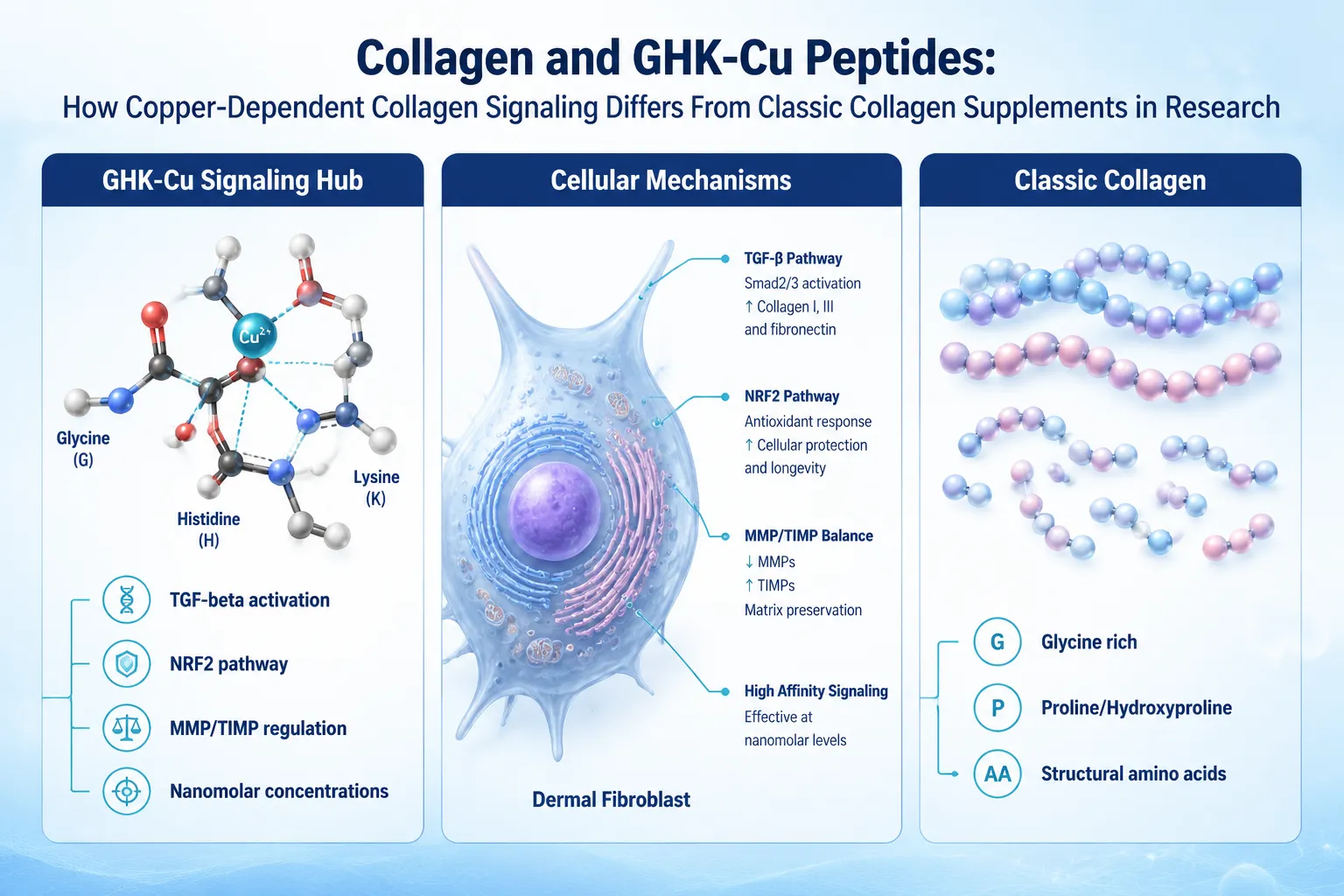
- GHK-Cu is a copper-chelating tripeptide that acts as a signaling hub, activating TGF-beta, NRF2, and MMP/TIMP pathways in dermal fibroblasts at nanomolar concentrations.
- Classic hydrolyzed collagen supplements supply structural amino acids and bioactive fragments that modestly improve skin hydration and elasticity but do not deliver targeted copper or activate the same enzymatic pathways.
- GHK-Cu provides copper as a cofactor for lysyl oxidase, the enzyme that cross-links collagen and elastin fibers, a function oral collagen supplements do not perform.
- In vitro studies report collagen synthesis increases of roughly 70-200% with GHK-Cu at optimal concentrations, while clinical trials of oral collagen show small-to-moderate standardized mean differences of approximately 0.4-0.6 for hydration and elasticity.
- Oral collagen has multiple large randomized controlled trials supporting cosmetic benefits; GHK-Cu's human clinical evidence is still emerging as of 2026.
What Are Classic Collagen Supplements and What Does the Research Show?
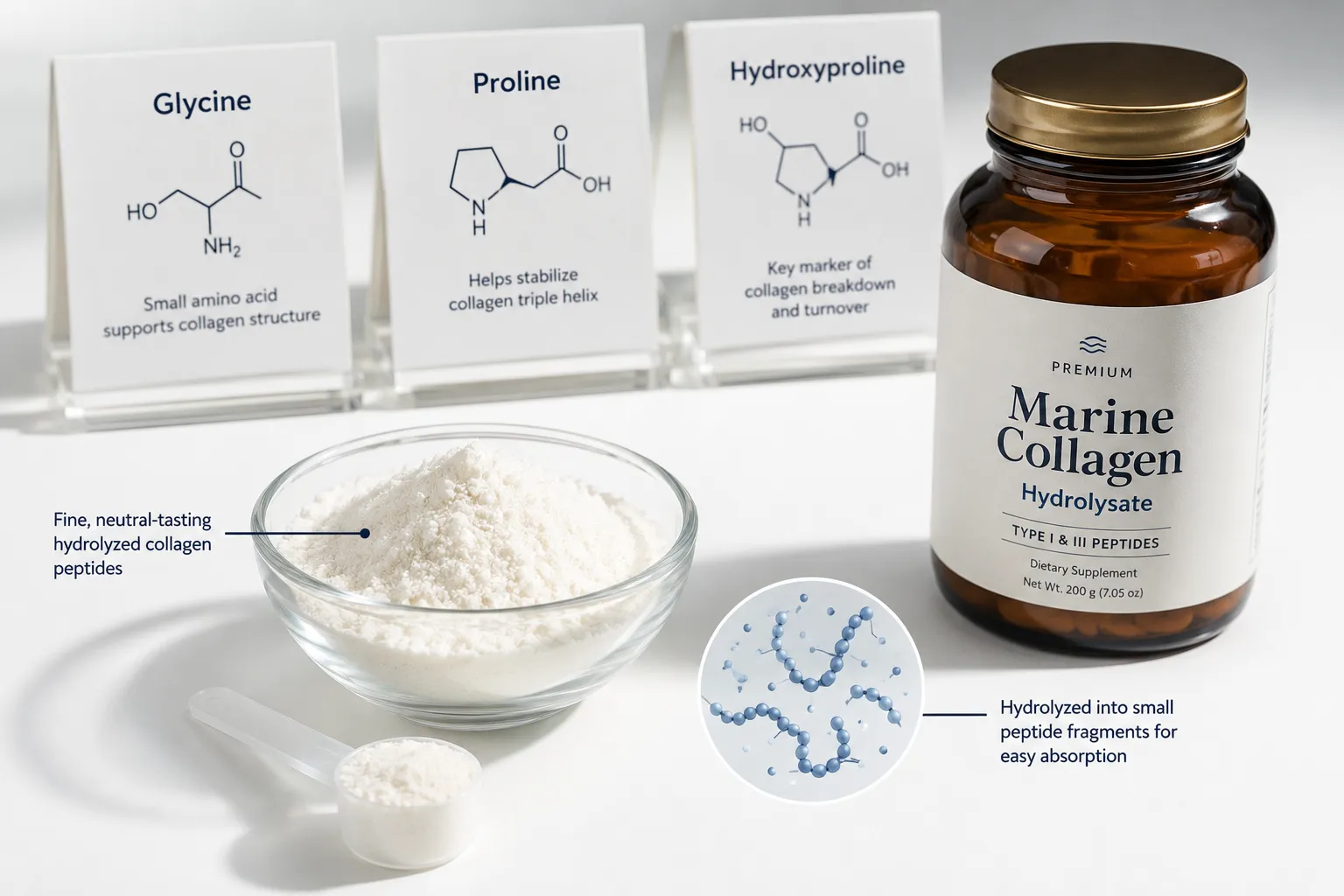
Hydrolyzed collagen supplements, sold as collagen peptides, collagen hydrolysate, or marine collagen, are produced by enzymatically breaking down animal connective tissue into short peptide fragments. These fragments are rich in glycine, proline, and hydroxyproline, the same amino acids that form the triple-helix backbone of structural collagen in human skin, tendons, and cartilage.
The clinical evidence base for oral collagen is now substantial. A July 2026 meta-analysis of 35 randomized controlled trials involving 2,534 participants found that oral collagen peptides significantly improved instrumental measures of skin hydration (standardized mean difference approximately 0.44), elasticity (SMD approximately 0.62), and reduced transepidermal water loss. A separate August 2026 systematic review examining 11 studies and 805 patients confirmed gains in skin elasticity, hydration, and dermal collagen density, with favorable short-to-medium-term safety. A 2024 double-blind, placebo-controlled trial using confocal laser scanning microscopy even documented measurable improvements in facial skin collagen architecture after 12 weeks of supplementation.
However, current expert consensus describes oral collagen as a "functional systemic moisturizer" with modest anti-aging effects. Effect sizes are real but not dramatic, most studies use daily doses of 1.6-10 grams over 8-12 weeks, and a notable proportion of the research is industry-sponsored. Critically, oral collagen does not deliver copper, does not directly activate enzymatic cross-linking, and shows little evidence of finely tuning matrix metalloproteinase (MMP) or tissue inhibitor of metalloproteinase (TIMP) balance. For deeper context on skin biology research and how dermal structure is studied, that distinction becomes increasingly important.
GHK-Cu as a Copper-Dependent Collagen Signaling Hub
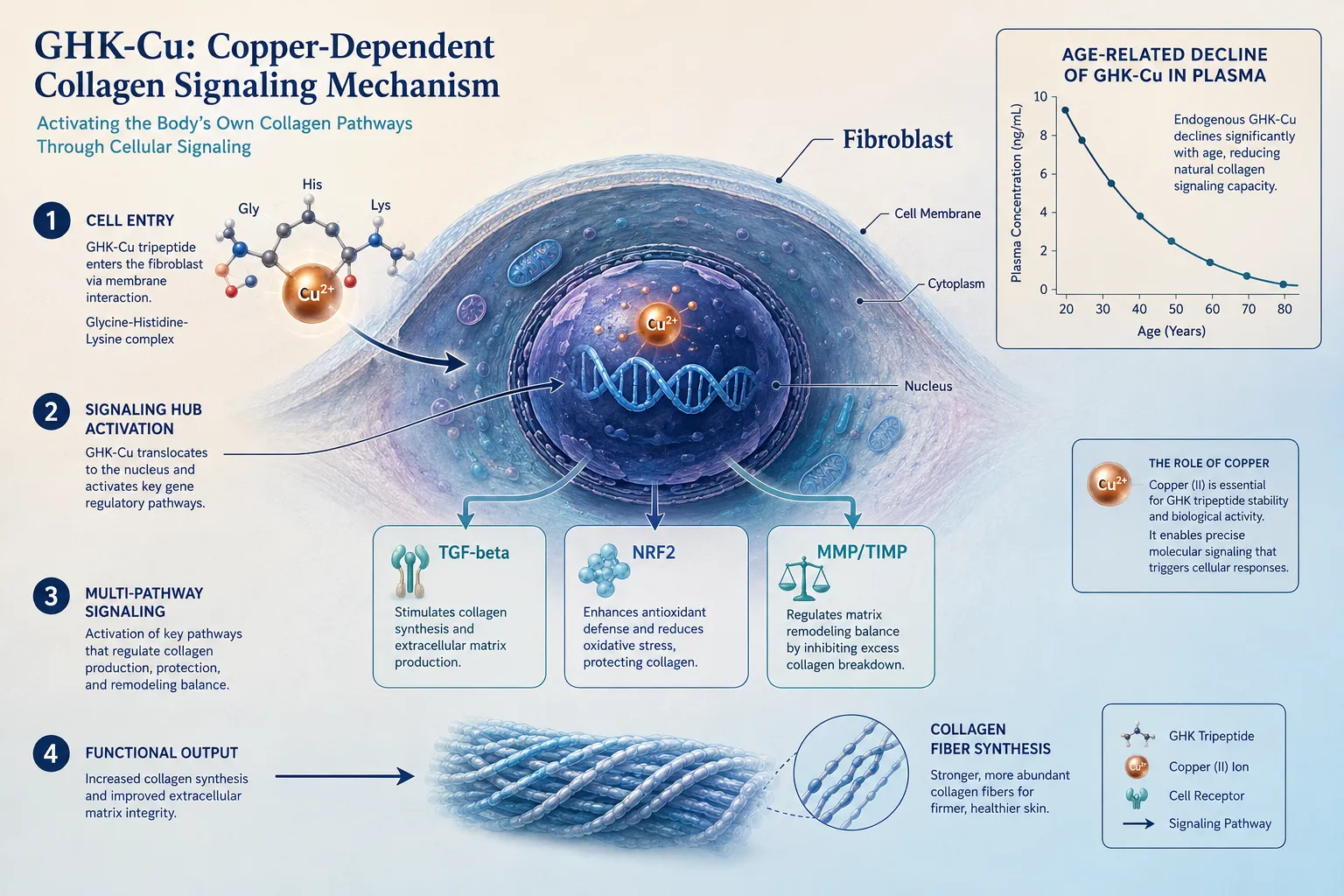
GHK-Cu (glycine-histidine-lysine complexed with copper II) is a naturally occurring tripeptide found in human plasma, saliva, and urine. Its concentration declines significantly with age, which has prompted research interest in its role in skin aging and tissue repair research.
What separates GHK-Cu from a simple collagen precursor is its dual identity as both a signaling molecule and a copper delivery vehicle.
Signal cascades activated by GHK-Cu include:
- TGF-beta1/beta2 with Smad2/3 phosphorylation, driving transcription of COL1A1 and COL3A1 (the genes for collagen types I and III)
- PI3K-Akt survival signaling in fibroblasts, supporting cell viability during remodeling
- NRF2-HO-1 antioxidant pathway, upregulating protective enzymes in the dermal matrix
- MMP/TIMP rebalancing, suppressing excessive matrix degradation while allowing controlled remodeling
In human dermal fibroblast studies, GHK-Cu upregulates collagen types I and III, elastin, and glycosaminoglycans, with collagen synthesis increases in the range of 70-200% versus controls at optimal nanomolar concentrations. Notably, these effects begin at picomolar-to-nanomolar concentrations (roughly 10^-12 to 10^-9 M) and are independent of cell proliferation, meaning GHK-Cu is stimulating biosynthesis, not simply causing cells to divide.
This level of targeted pathway engagement is not observed with oral collagen supplementation, which primarily provides amino acid substrate and may stimulate fibroblasts indirectly through systemic peptide absorption. For researchers exploring therapeutic peptides with multi-pathway activity, GHK-Cu represents a mechanistically distinct category.
How Copper-Dependent Collagen Signaling Differs From Classic Collagen Supplements in Research: The Enzymatic Cofactor Argument
The most structurally important distinction in the collagen and GHK-Cu peptides: how copper-dependent collagen signaling differs from classic collagen supplements in research debate is the role of copper itself.
Collagen fibers require cross-linking to achieve tensile strength. This cross-linking is catalyzed by lysyl oxidase, a copper-dependent enzyme. Without adequate copper delivery to the extracellular matrix, newly synthesized collagen chains cannot be properly cross-linked, resulting in structurally weaker fibers. GHK-Cu delivers Cu(II) directly to this enzymatic machinery. It also contributes superoxide-dismutase-like antioxidant activity, protecting the dermal matrix from oxidative degradation.
Classic collagen supplements provide none of this. They supply the raw amino acid building blocks, the bricks, but not the mortar or the construction crew.
This distinction also extends to matrix turnover. GHK-Cu actively coordinates both synthesis and controlled breakdown of extracellular matrix (ECM) components, modulating MMPs and TIMPs to favor constructive remodeling over scarring. Oral collagen trials report changes in hydration, elasticity, and transepidermal water loss, but provide little direct evidence of finely tuned ECM turnover dynamics.
For researchers interested in tissue recovery research or synergistic peptides that act on overlapping pathways, GHK-Cu's multi-target profile is particularly relevant.
Clinical Evidence and Safety: Where Each Approach Stands in 2026
| Factor | Oral Collagen Supplements | GHK-Cu Peptide |
|---|---|---|
| Mechanism | Amino acid substrate; indirect fibroblast stimulation | Multi-pathway signaling; copper cofactor delivery |
| Effective dose range | 1.6-10 g/day oral | Picomolar, nanomolar (in vitro) |
| Human RCT evidence | 35+ RCTs; meta-analyses available | Early wound-healing trial registered 2026 (NCT07437586) |
| Effect size (human) | SMD ~0.4-0.6 for hydration and elasticity | Not yet established in large RCTs |
| Safety profile | Well-established; no serious AEs in 12-week trials | Favorable preclinical and cosmetic history; formal data emerging |
| Copper delivery | None | Yes, Cu(II) for lysyl oxidase and antioxidant defense |
Oral collagen's safety record is strong. Multiple randomized trials report no serious adverse events over 12 weeks, with normal lab parameters and only occasional mild gastrointestinal complaints. GHK-Cu has a long track record in experimental and cosmetic applications, with mechanistic work suggesting low toxicity and broad protective actions. However, formal safety data from large, controlled human trials are still being generated, with the 2026 registered wound-healing study marking a meaningful step toward that evidence base.
Researchers interested in translational research design will note that the gap between GHK-Cu's in vitro effect sizes (70-200% collagen synthesis increases) and its as-yet-undefined human effect sizes is one of the most important open questions in the field. For those sourcing materials for preclinical work, lab tested peptides and third party peptide testing standards are essential considerations.
Conclusion
The research landscape in 2026 draws a clear line between two fundamentally different approaches to collagen biology. Oral hydrolyzed collagen supplements are well-supported by clinical trial data for modest, consistent cosmetic improvements in skin hydration and elasticity, they work as substrate-level interventions that feed the collagen production system. GHK-Cu operates at a different level entirely: it signals fibroblasts through multiple gene-regulatory pathways, delivers copper as an enzymatic cofactor for cross-linking, and coordinates active ECM remodeling in ways that oral collagen cannot replicate.
Actionable next steps for researchers and practitioners:
- When evaluating collagen-related interventions, distinguish between substrate-supply mechanisms (oral collagen) and signaling-plus-cofactor mechanisms (GHK-Cu) before drawing comparisons.
- Prioritize mechanistic outcome measures, MMP/TIMP ratios, COL1A1 transcription, lysyl oxidase activity, when designing GHK-Cu studies, as these capture effects that standard hydration and elasticity endpoints miss.
- Monitor the 2026 wound-healing RCT (NCT07437586) for the first regulated human efficacy and safety data on topical GHK-Cu.
- For preclinical work, ensure peptide purity through verified third party peptide testing to maintain experimental validity.
- Consider GHK-Cu within the broader context of skin biology research and tissue repair research rather than as a direct substitute for or upgrade of oral collagen, they address different biological targets.
Understanding collagen and GHK-Cu peptides: how copper-dependent collagen signaling differs from classic collagen supplements in research is not about choosing one over the other. It is about applying the right tool to the right biological question, and that requires knowing exactly what each tool does at the molecular level.


Leave a Reply
Want to join the discussion?Feel free to contribute!