Call or Text 727-513-9780
  • Shopping Cart Shopping Cart
    0Shopping Cart
Pure Tested Peptides | America's most trusted Peptides for sale online
  • Peptides for sale
    • Oral Peptides for sale
      • Peptide Capsules for sale
      • BPC 157 Capsules 1000mcg
      • SLU-PP-332 Capsules | 1000 mcg
      • 5-Amino-1MQ 50mg Capsules
      • Tesofensine 500mcg
    • All Peptides for sale
    • Peptide Sprays
      • BPC 157 Nasal Spray Kit
      • BPC-157 TB500 Nasal Spray Kit
      • Semax Nasal Spray 10mg
      • Selank – Nasal Spray Kit – 10mg
      • Epithalon 50MG Nasal Spray Kit
      • Ipamorelin 10mg Nasal Spray
      • Klow Nasal Spray (BPC-157 + TB-500 + GHK-Cu + KPV) | 80mg
      • Hulk Nasal Spray Tesa / Ipa Blend 6/3 MG
      • Klow Nasal Spray
      • NAD + 500 mg Nasal Spray
      • PT-141 Nasal Spray Kit
    • GHRH Peptides
      • Ipa Peptides
      • CJC-1295 Peptides
        • CJC-1295 with DAC 5 mg
        • CJC-1295 without DAC 5 mg
        • CJC-1295 Ipa 10mg
      • Tesa Peptides
        • Tesa Peptide
        • Tesa 20 mg
    • GHK-Cu Peptides
      • All GHK-Cu Peptides
      • GHK-Cu 100mg
      • KLOW Peptide Blend – Buy KLOW blend online
    • BPC Peptides
      • All BPC Peptides
      • BPC-157
      • BPC-157 TB-500
      • BPC 157 capsules 1000mcg
    • SLU-PP-332 Peptides
      • All SLU-PP-332 Peptides
      • SLU-PP-332 5mg
    • GLP3 Peptides
    • PT-141 Peptides
      • PT-141 Peptides for sale
      • PT-141 10mg
      • PT-141 Nasal Spray
    • CAG Peptides
      • Lipo-C Peptide Blend
      • CAG 5mg
      • CAG 10mg
    • MOTS-C Peptides
      • MOTS-C Peptides for sale
      • MOTS-c peptide
      • MOTS-c 10mg *6 pack*
    • 5 Amino 1MQ Peptides
      • 5 Amino 1MQ Peptides for sale
      • 5-Amino-1MQ 50mg Capsules
      • 5-Amino-1MQ 5mg
    • Epithalon Peptides
      • Epithalon Peptides for sale
      • Epithalon 10mg
      • Epithalon 50mg
  • Shop
    • GLPs
      • 5-Amino-1MQ 50mg Capsules
      • 5-Amino-1MQ 5mg
      • L-Carnitine 500mg/ml
      • Tesofensine 500mcg
      • SLU-PP-332 5mg
      • MOTS-c 10mg *6 pack*
    • Epithalon & BPC Peptides
      • Epithalon 10mg
      • Epithalon 50mg
      • BPC-157
      • BPC 157 capsules 1000mcg
      • BPC-157 TB-500
      • BPC-157 TB500 Nasal Spray Kit
      • BPC 157 Nasal Spray Kit
    • BPC TB-500 & NAD+ Peptides
      • NAD+ 500 mg
      • KLOW Peptide Blend – Buy KLOW blend online
      • GLOW Peptide Blend
      • TB 500 5mg
      • BPC 157 capsules 1000mcg – Supplement
      • BPC 157 Nasal Spray Kit
      • BPC-157
      • BPC-157 TB500 Nasal Spray Kit
      • BPC-157 TB-500
      • BPC 157 capsules 1000mcg
    • LL-37 Peptide
      • LL-37 10 mg
    • MOTS-C & Selank
      • MOTS-c peptide
      • Selank 10mg
    • GHK Peptides
      • GHK-Cu 100mg
      • GLOW Peptide Blend
      • KLOW Peptide Blend – Buy KLOW blend online
  • COAs
  • Wholesale
    • Wholesale Peptides for sale
  • PTP FAQ
  • Affiliates
    • Selank Peptide: Advanced Pharmacological Mechanisms Underlying Its Anxiolytic and Nootropic Effects in Research
      • 5-Amino-1MQ Peptide: Detailed Mechanisms of NNMT Inhibition and Its Impact on Cellular Metabolism Research
        • MOTS-C Peptide: Unraveling Its Role in Mitochondrial Dynamics and Energy Metabolism Research
          • Epithalon Peptide and Telomerase Regulation: Investigating Its Impact on Cellular Senescence and Lifespan Research Models
            • GLP2-T vs GLP2 Tirz Peptide: Understanding the Naming, Mechanistic Nuances, and Research Implications for Gut Health
      • Peptides and Polypeptides in Modern Pharmacology: What Research on Metoprolol, Prednisone, and Amlodipine Reveals
        • Polypeptide Peptides vs NSAIDs: What Naproxen and Diclofenac Teach Tissue-Repair Researchers About BPC‑157 and TB‑500
          • Peptides and Polypeptides in Endocrine Pharmacology: How GLP-1, GLP-2, and GLP-3 Retatrutide Differ From Classic Drugs Like Prednisone and Amlodipine
          • 5‑Amino‑1MQ Peptide and NNMT Inhibition: How It Compares With Statins Like Atorvastatin in Adipose and Lipid Metabolism Research
      • Enclomiphene, Estrogen Receptor Signaling, and Luteinizing Phase Biology: What Hormone Researchers Should Measure
        • Mesenchymal Stem Cells, BPC‑157, and GHK‑Cu: How Tissue Repair Peptides Compare With Classic NSAIDs Like Naproxen in Injury Models
          • Peptide Calculator Use Cases Beyond Growth Hormone: Working Through GLP‑3 Retatrutide, MOTS‑c, and BPC‑157 Research Dosing
        • Polypeptide Peptides in Endocrine and Metabolic Pharmacology: Lessons From Amlodipine, Prednisone, and Metoprolol
        • Peptides Calculator for Advanced Blends: Worked Examples for Tesamorelin, CJC‑1295, and Ipamorelin Stacks
          • Peptides and Polypeptides in Human Physiology: How Molecular Size Shapes Research Applications
            • Selank Peptide: Advanced Pharmacological Mechanisms Underlying Its Anxiolytic and Nootropic Effects in Research
          • 5-Amino-1MQ Peptide: Detailed Mechanisms of NNMT Inhibition and Its Impact on Cellular Metabolism Research
            • MOTS-C Peptide: Unraveling Its Role in Mitochondrial Dynamics and Energy Metabolism Research
              • Epithalon Peptide and Telomerase Regulation: Investigating Its Impact on Cellular Senescence and Lifespan Research Models
                • GLP2-T vs GLP2 Tirz Peptide: Understanding the Naming, Mechanistic Nuances, and Research Implications for Gut Health
                  • Peptides and Polypeptides in Endocrine Pharmacology: How GLP-1, GLP-2, and GLP-3 Retatrutide Differ From Classic Drugs Like Prednisone and Amlodipine
                    • Polypeptide Peptides vs NSAIDs: What Naproxen and Diclofenac Teach Tissue-Repair Researchers About BPC‑157 and TB‑500
                      • Peptides and Polypeptides in Modern Pharmacology: What Research on Metoprolol, Prednisone, and Amlodipine Reveals
                        • 5‑Amino‑1MQ Peptide and NNMT Inhibition: How It Compares With Statins Like Atorvastatin in Adipose and Lipid Metabolism Research
                        • Enclomiphene, Estrogen Receptor Signaling, and Luteinizing Phase Biology: What Hormone Researchers Should Measure
                        • Mesenchymal Stem Cells, BPC‑157, and GHK‑Cu: How Tissue Repair Peptides Compare With Classic NSAIDs Like Naproxen in Injury Models
                        • Peptide Calculator Use Cases Beyond Growth Hormone: Working Through GLP‑3 Retatrutide, MOTS‑c, and BPC‑157 Research Dosing
                        • Polypeptide Peptides in Endocrine and Metabolic Pharmacology: Lessons From Amlodipine, Prednisone, and Metoprolol
                        • Peptides Calculator for Advanced Blends: Worked Examples for Tesamorelin, CJC‑1295, and Ipamorelin Stacks
                        • Peptides and Polypeptides in Human Physiology: How Molecular Size Shapes Research Applications
                        • Selank Peptide: Advanced Pharmacological Mechanisms Underlying Its Anxiolytic and Nootropic Effects in Research
                        • MOTS-C Peptide: Unraveling Its Role in Mitochondrial Dynamics and Energy Metabolism Research
                        • Peptides and Polypeptides in Modern Pharmacology: What Research on Metoprolol, Prednisone, and Amlodipine Reveals
                        • Peptides and Polypeptides in Endocrine Pharmacology: How GLP-1, GLP-2, and GLP-3 Retatrutide Differ From Classic Drugs Like Prednisone and Amlodipine
                        • 5-Amino-1MQ Peptide: Detailed Mechanisms of NNMT Inhibition and Its Impact on Cellular Metabolism Research
                        • Mesenchymal Stem Cells, BPC‑157, and GHK‑Cu: How Tissue Repair Peptides Compare With Classic NSAIDs Like Naproxen in Injury Models
                        • Peptide Calculator Use Cases Beyond Growth Hormone: Working Through GLP‑3 Retatrutide, MOTS‑c, and BPC‑157 Research Dosing
                        • GLP2-T vs GLP2 Tirz Peptide: Understanding the Naming, Mechanistic Nuances, and Research Implications for Gut Health
                        • Polypeptide Peptides in Endocrine and Metabolic Pharmacology: Lessons From Amlodipine, Prednisone, and Metoprolol
                        • Polypeptide Peptides vs NSAIDs: What Naproxen and Diclofenac Teach Tissue-Repair Researchers About BPC‑157 and TB‑500
                        • Peptides and Polypeptides in Human Physiology: How Molecular Size Shapes Research Applications
                        • Peptides Calculator for Advanced Blends: Worked Examples for Tesamorelin, CJC‑1295, and Ipamorelin Stacks
                        • 5‑Amino‑1MQ Peptide and NNMT Inhibition: How It Compares With Statins Like Atorvastatin in Adipose and Lipid Metabolism Research
                        • Enclomiphene, Estrogen Receptor Signaling, and Luteinizing Phase Biology: What Hormone Researchers Should Measure
                        • Epithalon Peptide and Telomerase Regulation: Investigating Its Impact on Cellular Senescence and Lifespan Research Models
                        • Best research protocol Klow blend
                        • best time to take BPC-157
                        • best time to take DSIP (Delta Sleep Inducing Peptide)
                        • best time to take CJC-1295
                        • best time to take AOD-9604
                        • best time to take Follistatin 344
                        • best time to take Ipamorelin
                        • best time to take MK-677 (Ibutamoren)
                        • best time to take Ligandrol (LGD-4033) — research compound
                        • best time to take Ostarine (MK-2866) — research compound
                        • best time to take GHK-CU
                        • best time to take TB-500
                        • best time to take MOTS-c
                        • best time to take Semax
                        • best time to take RAD-140 (Testolone) — research compound
                        • best time to take Thymosin Alpha-1
                        • best time to take PEG-MGF
                        • Biolife Plasma, Octapharma Plasma, and Research Peptides: How Plasma Donation Labs Differ From Peptide Suppliers
                        • best time to take YK-11 — research compound
                        • best time to take PT-141 (Bremelanotide)
                        • Best research protocol Klow blend
                        • 5-Amino-1MQ and MOTS-C Synergy: Metabolic Signaling, Mitochondria, and Research Design
                        • BPC-157 and TB-500: Investigating Their Combined Effects on Angiogenesis and Cellular Migration in Tissue Repair Models
                        • BPC-157 Peptide: Gut Barrier Function, Inflammation, and Tissue-Recovery Research
                        • 5‑Amino‑1MQ and MOTS‑c Synergy in Metabolic Research: Designing NNMT and Mitochondrial Biogenesis Stacks
                        • CJC-1295 with DAC vs. Without DAC: Half-Life, Release Kinetics, and Research Implications
                        • CJC‑1295 with DAC vs. Without DAC: Expanding on Half‑Life Differences Using Tesamorelin and Ipamorelin Blend Case Studies
                        • Collagen Biology and Copper‑Binding Peptides: How GHK‑Cu, Glow Blend, and Klow Blend Interact with Skin and Connective Tissue
                        • Collagen Biology and Regenerative Peptides: How GHK‑Cu, Glow Blend, and Klow Blend Affect Extracellular Matrix Research
                    • DNA, Telomeres, and Longevity Peptides: Positioning Epithalon and MOTS‑c in Genetic Aging Research
                      • Enclomiphene Citrate: serm Mechanism, Testosterone Research, and Stack Compatibility
                        • Enclomiphene vs Enclomiphene Citrate: Formulation, Bioavailability, and Research Distinctions
                        • Epithalon Peptide Research: Telomerase Activation, Aging, and Pineal Gland Function
                        • Estrogen Receptor Signaling and Enclomiphene: How Selective Modulators Compare with Classic Polypeptide Hormones
                        • GHK-Cu Peptide: Advanced Mechanisms in Extracellular Matrix Remodeling and Wound Healing Research
                        • GHK-Cu Peptide: Collagen Synthesis, Wound Repair, and Skin-Barrier Research Models
                        • GLP-1 vs GLP-3 vs GLP-2: Peptide Classification and Research Applications
                        • GLP-2 Peptide Research Guide: Gut Barrier Function, Nutrient Absorption, and Intestinal Recovery Models
                        • GLP-3 Retatrutide vs. GLP-1 Drugs: What Triple-Agonist Biology Changes in Research Models
                        • Ipamorelin and Tesamorelin Combination: Synergistic GH Secretagogue Research and Dosing Protocols
                        • GLP2 Tirz Peptide: What It Is, Why the Name Exists, and How Researchers Should Interpret It
                        • Klow Blend Peptide Nasal Spray: What the Formulation Is Trying to Do in Cognitive Research
                        • Mitochondria, NNMT Inhibition, and Peptide Modulators: Where MOTS‑c and 5‑Amino‑1MQ Fit in Cellular Energy Research
                        • MOTS-c Peptide: Mitochondrial Function, Energy Metabolism, and What Researchers Measure
                        • MOTS-c vs. 5-Amino-1MQ: Which Metabolic Research Questions Each Compound Actually Answers
                        • Nasal Spray Peptides: Bioavailability, Administration, and Semax/Selank Research Applications
                        • PT-141 Peptide Research: Mechanism of Action and Melanocortin Receptor Signaling
                        • Retatrutide for Research: Mechanism, Structure, and GLP-1/GLP-3 Dual Action
                        • Retatrutide for Obesity and Type 2 Diabetes: What the Latest Trial Data Suggest
                        • Tesofensine Peptide Research: Mechanism, Appetite Suppression, and Neuropeptide Y Pathways
  • Contact
    • Contact Customer Service
    • Text Customer Support
  • About US
  • Shop all peptides
  • Affiliate Program
    • Affiliate Signup
  • Login / Register Login / Register Page Link Login / Register Page Link
  • Click to open the search input field Click to open the search input field Search
  • Menu Menu
MOTS-c and 5-Amino-1MQ: A Practical Guide to Separating Mitochondrial, NNMT, and Energy-Flux Readouts

MOTS-c and 5-Amino-1MQ: A Practical Guide to Separating Mitochondrial, NNMT, and Energy-Flux Readouts

October 1, 2026/0 Comments/in Uncategorized/by

Attributing an observed metabolic effect to the wrong mechanism is one of the most common errors in multi-compound research protocols. When two agents act on overlapping but distinct pathways, as MOTS-c and 5-Amino-1MQ do, a poorly designed assay panel can make a mitochondrial signal look like an NAD+ effect, or vice versa. This practical guide to MOTS-c and 5-Amino-1MQ covers how to separate mitochondrial, NNMT, and energy-flux readouts so that each intervention gets credited for what it actually does.

Key Takeaways

  • MOTS-c is a mitochondrial-derived peptide that activates AMPK primarily in skeletal muscle, driving glucose uptake and fatty-acid oxidation.
  • 5-Amino-1MQ inhibits NNMT, preserving the intracellular NAD+ pool and activating sirtuin-linked pathways mainly in white adipose tissue and liver.
  • Both compounds can influence NAD+ levels, but through mechanistically different routes that require distinct assays to distinguish.
  • A well-designed study pairs mitochondrial respiration assays, NAD-related measurements, NNMT-linked markers, ATP quantification, and cell-viability controls in the same protocol.
  • The evidence base for both agents remains preclinical; neither is an approved therapeutic.

Understanding the Two Pathways Before Designing Any Assay
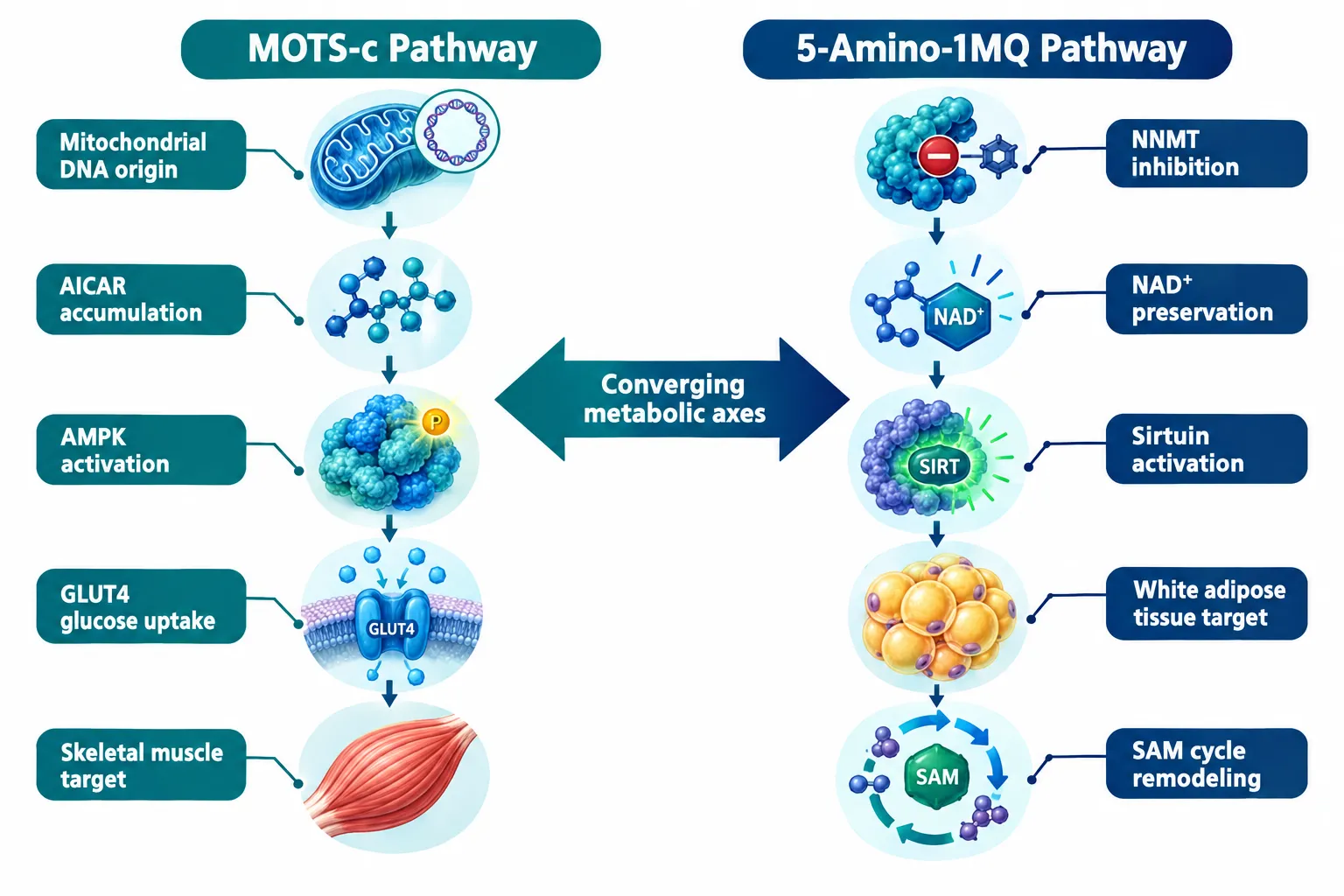
Understanding the Two Pathways Before Designing Any Assay

Any practical guide to MOTS-c and 5-Amino-1MQ must begin with a clear picture of what each compound does independently. Confusing their mechanisms at the design stage leads to assay panels that cannot answer the questions being asked.

MOTS-c is a 16-amino-acid peptide encoded within mitochondrial DNA, first characterized by a University of Southern California research group in 2015. It interferes with the folate-methionine one-carbon cycle and de novo purine biosynthesis inside cells, causing AICAR to accumulate. AICAR is a well-established indirect activator of AMP-activated protein kinase (AMPK). The downstream result is increased fatty-acid oxidation, enhanced GLUT4-mediated glucose uptake, and improved insulin sensitivity, effects observed most strongly in skeletal muscle in animal models. Animal studies have shown prevention of diet-induced obesity and age-related insulin resistance.

Researchers interested in MOTS-c peptide research materials should note that its primary readout territory is mitochondrial bioenergetics and substrate oxidation, not direct NAD+ salvage.

5-Amino-1MQ (5-amino-1-methylquinolinium) is a small, membrane-permeable molecule that directly inhibits nicotinamide N-methyltransferase (NNMT). NNMT converts nicotinamide to 1-methylnicotinamide, consuming S-adenosylmethionine (SAM) in the process. By blocking this enzyme, 5-Amino-1MQ reduces SAM consumption, preserves the intracellular NAD+ pool, and activates NAD+-dependent pathways including sirtuins and mitochondrial biogenesis. Preclinical mouse data have shown reductions in fat mass without reduced food intake. Its primary action zone is white adipose tissue and liver, where NNMT is upregulated in obesity.

"Both compounds can nudge NAD+ levels upward, but they pull different levers to get there, and conflating those levers produces uninterpretable data."

This mechanistic divergence is exactly why a guide to separating mitochondrial, NNMT, and energy-flux readouts is necessary before any combined protocol begins.


How to Separate Mitochondrial, NNMT, and Energy-Flux Readouts in Practice
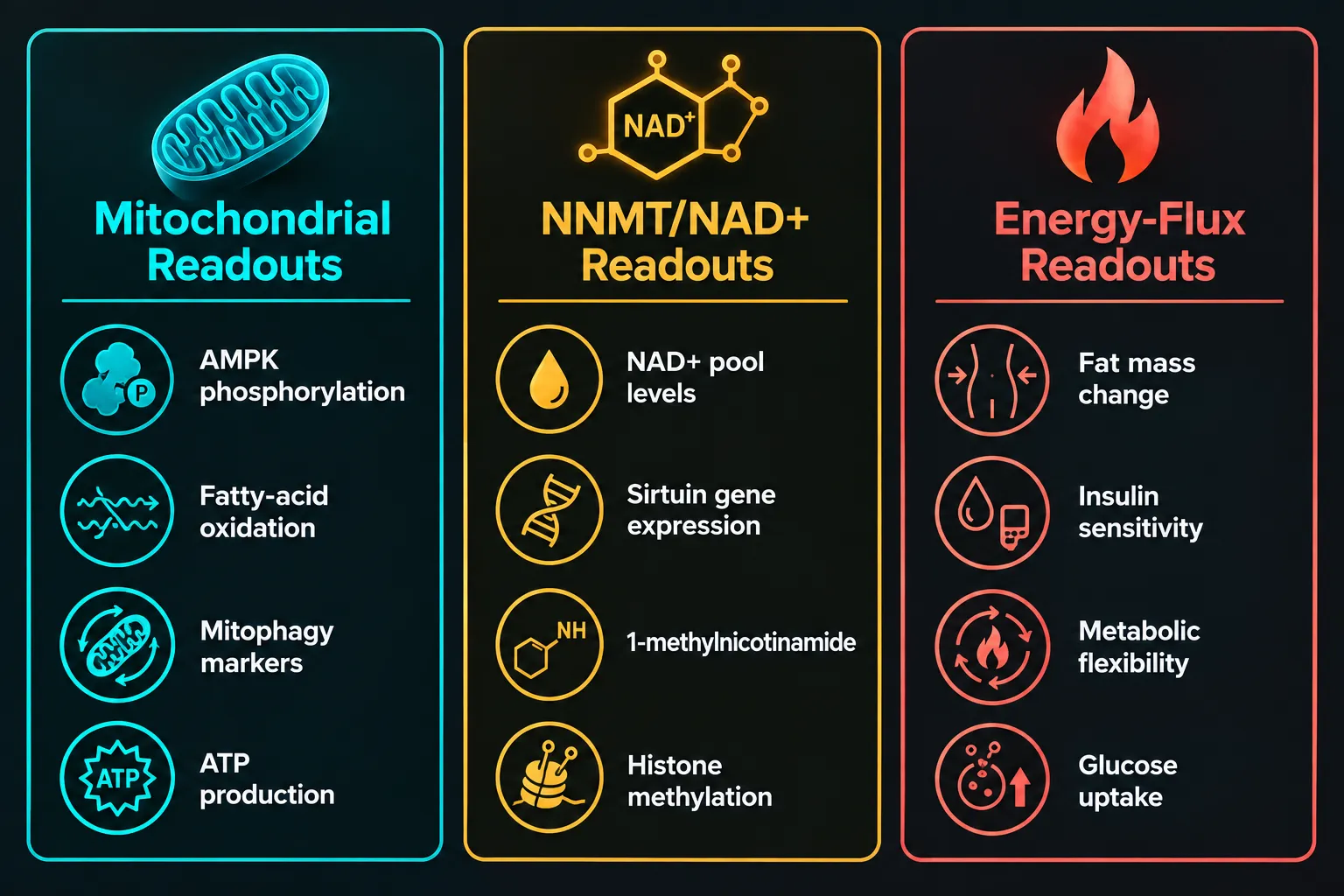
How to Separate Mitochondrial, NNMT, and Energy-Flux Readouts in Practice

The core design principle is simple: assign each readout category its own assay layer, and run all three layers in the same experimental unit so that confounding is controlled rather than ignored.

Mitochondrial Readouts

These assays capture AMPK-centric activity attributable to MOTS-c.

Readout Recommended Assay What It Captures
AMPK activation Western blot for p-AMPK/AMPK ratio Direct MOTS-c downstream signal
Oxygen consumption rate (OCR) Seahorse XF Analyzer Mitochondrial respiration flux
Fatty-acid oxidation Radiolabeled palmitate oxidation Substrate shift toward lipids
Mitophagy/biogenesis LC3-II, PGC-1alpha expression Mitochondrial quality control

NNMT and NAD+ Readouts

These assays isolate the 5-Amino-1MQ contribution.

  • NAD+/NADH ratio: A direct readout of NAD+ pool preservation. If 5-Amino-1MQ is working, this ratio rises without a proportional change in NAMPT activity.
  • 1-methylnicotinamide (MNA) levels: MNA is the product of NNMT activity. Reduced MNA confirms NNMT inhibition, not just a generic NAD+ boost.
  • SAM/SAH ratio: Reflects the methylation economy downstream of NNMT blockade.
  • Sirtuin-linked gene expression: SIRT1 and SIRT3 targets confirm NAD+-dependent pathway activation.

Critically, if MOTS-c is present in the same well and AMPK is active, NAD+ consumption will increase through energy-demanding pathways. That can mask 5-Amino-1MQ's preserving effect. Measuring MNA and SAM/SAH alongside NAD+/NADH disambiguates the source.

Energy-Flux Readouts

These whole-system markers capture the integrated output of both interventions.

  • Fat mass change (in animal models): Reflects combined lipolytic and oxidative effects.
  • Insulin sensitivity: Glucose tolerance tests and HOMA-IR scores capture GLUT4-mediated improvements driven by MOTS-c.
  • Metabolic flexibility: The ability to switch between glucose and fat oxidation, measurable via respiratory exchange ratio (RER).
  • ATP quantification: Total cellular ATP reflects the net energy-production outcome and serves as a cross-check on both mitochondrial respiration and NAD+ pathway activity.

For context on how other mitochondrial-targeting peptides are studied, the SS-31 mitochondrial research themes resource illustrates how cardiolipin-targeted agents use similar OCR-based designs, offering useful methodological parallels. Additional background on SS-31 elamipretide research approaches can inform how to structure mitochondrial membrane integrity controls.


Building an Attribution-Proof Protocol: Step-by-Step
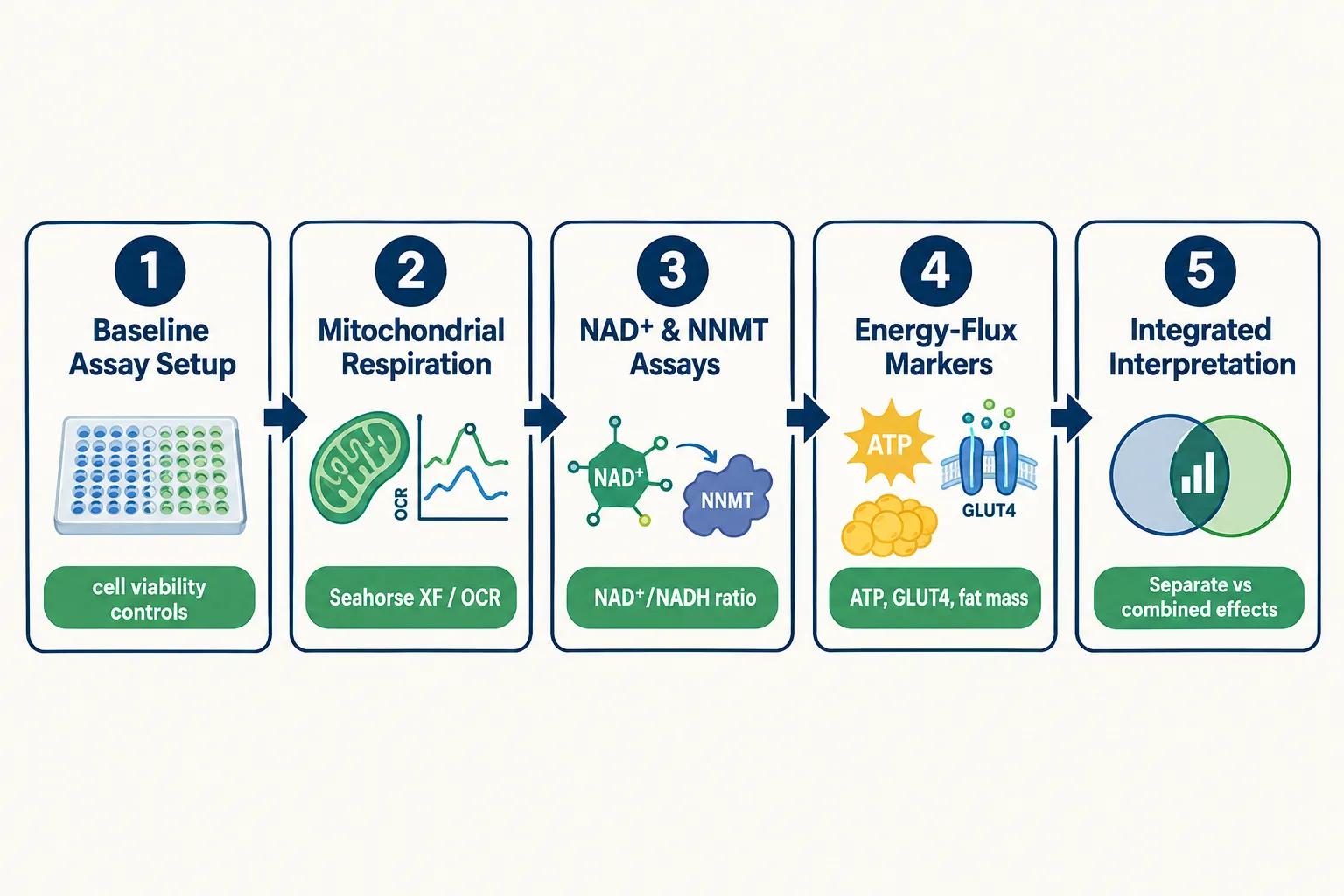
Building an Attribution-Proof Protocol: Step-by-Step

The following five-step framework minimizes attribution error when running MOTS-c and 5-Amino-1MQ together.

Step 1, Establish baseline cell viability controls. Run MTT or CellTiter-Glo assays at every dose tested. If viability drops, any observed change in OCR or NAD+ is a toxicity artifact, not a mechanism signal.

Step 2, Run single-agent arms first. Before combining, characterize each compound alone. This produces a mechanistic fingerprint: MOTS-c alone should shift OCR and raise p-AMPK; 5-Amino-1MQ alone should lower MNA and raise the NAD+/NADH ratio.

Step 3, Apply the full assay panel to the combination arm. All readouts from Steps 1 and 2 must be measured simultaneously. Partial panels in the combination arm are the primary source of attribution errors.

Step 4, Use pathway inhibitors as mechanistic controls. An AMPK inhibitor (such as Compound C) can silence the MOTS-c arm pharmacologically, allowing the NNMT signal to be read in isolation within the same combined-treatment context. An NNMT-overexpression control does the reverse.

Step 5, Interpret energy-flux markers last. Fat mass, insulin sensitivity, and ATP changes are downstream integrations of both pathways. They should be interpreted only after the upstream mitochondrial and NNMT readouts have been attributed.

For researchers also exploring growth-hormone-mediated metabolic comparisons, reviewing how peptides in cardiometabolic models differ from small-molecule drugs provides useful framing for why AMPK agonists, NNMT inhibitors, and GH-driven agents require separate readout categories. Similarly, understanding visceral fat research methodology helps contextualize fat-mass endpoints.


Conclusion

A practical guide to MOTS-c and 5-Amino-1MQ separating mitochondrial, NNMT, and energy-flux readouts comes down to one discipline: never let overlapping downstream effects collapse distinct upstream mechanisms into a single unattributed signal.

Actionable next steps for researchers:

  1. Map each compound to its primary assay layer before designing the protocol.
  2. Always include MNA quantification alongside NAD+/NADH to distinguish NNMT inhibition from AMPK-driven NAD+ consumption.
  3. Run single-agent arms before the combination arm to establish mechanistic fingerprints.
  4. Include cell-viability controls at every dose and time point.
  5. Reserve energy-flux endpoints (fat mass, insulin sensitivity, ATP) for last-stage interpretation, not primary attribution.

Both MOTS-c and 5-Amino-1MQ remain research-stage compounds with a predominantly preclinical evidence base. No large, controlled human trials have confirmed the animal findings, and neither agent is an approved drug. All protocols should be conducted within appropriate research frameworks and regulatory guidelines.

Tags: 5-amino-1mq, ampk activation, energy flux assays, mitochondrial research, mitochondrial-derived peptide, mots-c peptide, nad+ pathway, nnmt inhibitor
https://www.puretestedpeptides.com/wp-content/uploads/2026/10/mots-c-and-5-amino-1mq-a-practical-guide-to-separating-mitochondrial-nnmt-and-en.webp 1024 1536 https://www.puretestedpeptides.com/wp-content/uploads/2026/01/buy-peptides-online.jpg 2026-10-01 13:04:082026-10-01 13:04:08MOTS-c and 5-Amino-1MQ: A Practical Guide to Separating Mitochondrial, NNMT, and Energy-Flux Readouts
You might also like
Where to Buy Research-Grade MOTS‑c and 5‑Amino‑1MQ: Quality Criteria for Mitochondrial Peptide Studies Where to Buy Research-Grade MOTS‑c and 5‑Amino‑1MQ: Quality Criteria for Mitochondrial Peptide Studies
Where to Buy 5-Amino-1MQ and MOTS-c Research Materials: A COA, Identity, Purity, and Storage Checklist Where to Buy 5-Amino-1MQ and MOTS-c Research Materials: A COA, Identity, Purity, and Storage Checklist
5-Amino-1MQ Peptide: How Researchers Frame NAD+ and Metabolic Pathway Questions 5-Amino-1MQ Peptide: How Researchers Frame NAD+ and Metabolic Pathway Questions
Polypeptide Peptides and Drug Mechanisms: What Common Medications Reveal About Research-Use Peptide Pharmacology Polypeptide Peptides and Drug Mechanisms: What Common Medications Reveal About Research-Use Peptide Pharmacology
Creatine Supplementation vs MOTS-c and 5-Amino-1MQ: Comparing Phosphagen and Mitochondrial Peptide Pathways in Muscle Cell Models Creatine Supplementation vs MOTS-c and 5-Amino-1MQ: Comparing Phosphagen and Mitochondrial Peptide Pathways in Muscle Cell Models
Prednisone and Peptide Research Models: Separating Glucocorticoid Metabolic Effects From Tissue-Repair Signals Prednisone and Peptide Research Models: Separating Glucocorticoid Metabolic Effects From Tissue-Repair Signals
Statin Therapy and Liver Enzymatic Readouts in Metabolic Peptide Models: Atorvastatin vs. MOTS-c and 5-Amino-1MQ Statin Therapy and Liver Enzymatic Readouts in Metabolic Peptide Models: Atorvastatin vs. MOTS-c and 5-Amino-1MQ
Peptides and Polypeptides in Mitochondrial Research: How MOTS-c and 5-Amino-1MQ Interact With Mitochondria and ATP Peptides and Polypeptides in Mitochondrial Research: How MOTS-c and 5-Amino-1MQ Interact With Mitochondria and ATP
0 replies

Leave a Reply

Want to join the discussion?
Feel free to contribute!

Leave a Reply Cancel reply

Your email address will not be published. Required fields are marked *

×

Helpful Links

  • My account
  • Cart
  • Checkout
  • Refund and Returns Policy
  • Privacy Policy
  • SMS Privacy Policy
  • Login
  • My Account
  • Logout

USA Made Lab Tested Peptides

All products are sold for research, laboratory, or analytical purposes only, and are not for human consumption


Pure Tested Peptides is a chemical supplier. Pure Tested Peptides is not a compounding / chemical compounding facility as defined under 503A of the Federal Food, Drug, and Cosmetic act. Pure Tested Peptides is not an outsourcing facility as defined under 503B of the Federal Food, Drug, and Cosmetic act.

The statements made within this website have not been evaluated by the US Food and Drug Administration. The products we offer are not intended to diagnose, treat, cure or prevent any disease.

Human/Animal Consumption Prohibited. Laboratory/In-Vitro Experimental Use Only

Link to: BPC-157 and TB-500 in Tendon and Muscle Models: Separating Angiogenesis, Matrix Remodeling, and Inflammation Readouts Link to: BPC-157 and TB-500 in Tendon and Muscle Models: Separating Angiogenesis, Matrix Remodeling, and Inflammation Readouts BPC-157 and TB-500 in Tendon and Muscle Models: Separating Angiogenesis, Matrix...BPC-157 and TB-500 in Tendon and Muscle Models: Separating Angiogenesis, Matrix Remodeling, and Inflammation Readouts Link to: Retatrutide, GLP-1 Pills, and Small-Molecule Weight-Loss Options: What Researchers Should Compare Before Selecting a Model Link to: Retatrutide, GLP-1 Pills, and Small-Molecule Weight-Loss Options: What Researchers Should Compare Before Selecting a Model Retatrutide, GLP-1 Pills, and Small-Molecule Weight-Loss Options: What Researchers Should Compare Before Selecting a ModelRetatrutide, GLP-1 Pills, and Small-Molecule Weight-Loss Options: What Researchers...
Scroll to top Scroll to top Scroll to top