Call or Text 727-513-9780
  • Shopping Cart Shopping Cart
    0Shopping Cart
Pure Tested Peptides | America's most trusted Peptides for sale online
  • Peptides for sale
    • Oral Peptides for sale
      • Peptide Capsules for sale
      • BPC 157 Capsules 1000mcg
      • SLU-PP-332 Capsules | 1000 mcg
      • 5-Amino-1MQ 50mg Capsules
      • Tesofensine 500mcg
    • All Peptides for sale
    • Peptide Sprays
      • BPC 157 Nasal Spray Kit
      • BPC-157 TB500 Nasal Spray Kit
      • Semax Nasal Spray 10mg
      • Selank – Nasal Spray Kit – 10mg
      • Epithalon 50MG Nasal Spray Kit
      • Ipamorelin 10mg Nasal Spray
      • Klow Nasal Spray (BPC-157 + TB-500 + GHK-Cu + KPV) | 80mg
      • Hulk Nasal Spray Tesa / Ipa Blend 6/3 MG
      • Klow Nasal Spray
      • NAD + 500 mg Nasal Spray
      • PT-141 Nasal Spray Kit
    • GHRH Peptides
      • Ipa Peptides
      • CJC-1295 Peptides
        • CJC-1295 with DAC 5 mg
        • CJC-1295 without DAC 5 mg
        • CJC-1295 Ipa 10mg
      • Tesa Peptides
        • Tesa Peptide
        • Tesa 20 mg
    • GHK-Cu Peptides
      • All GHK-Cu Peptides
      • GHK-Cu 100mg
      • KLOW Peptide Blend – Buy KLOW blend online
    • BPC Peptides
      • All BPC Peptides
      • BPC-157
      • BPC-157 TB-500
      • BPC 157 capsules 1000mcg
    • SLU-PP-332 Peptides
      • All SLU-PP-332 Peptides
      • SLU-PP-332 5mg
    • GLP3 Peptides
    • PT-141 Peptides
      • PT-141 Peptides for sale
      • PT-141 10mg
      • PT-141 Nasal Spray
    • CAG Peptides
      • Lipo-C Peptide Blend
      • CAG 5mg
      • CAG 10mg
    • MOTS-C Peptides
      • MOTS-C Peptides for sale
      • MOTS-c peptide
      • MOTS-c 10mg *6 pack*
    • 5 Amino 1MQ Peptides
      • 5 Amino 1MQ Peptides for sale
      • 5-Amino-1MQ 50mg Capsules
      • 5-Amino-1MQ 5mg
    • Epithalon Peptides
      • Epithalon Peptides for sale
      • Epithalon 10mg
      • Epithalon 50mg
  • Shop
    • GLPs
      • 5-Amino-1MQ 50mg Capsules
      • 5-Amino-1MQ 5mg
      • L-Carnitine 500mg/ml
      • Tesofensine 500mcg
      • SLU-PP-332 5mg
      • MOTS-c 10mg *6 pack*
    • Epithalon & BPC Peptides
      • Epithalon 10mg
      • Epithalon 50mg
      • BPC-157
      • BPC 157 capsules 1000mcg
      • BPC-157 TB-500
      • BPC-157 TB500 Nasal Spray Kit
      • BPC 157 Nasal Spray Kit
    • BPC TB-500 & NAD+ Peptides
      • NAD+ 500 mg
      • KLOW Peptide Blend – Buy KLOW blend online
      • GLOW Peptide Blend
      • TB 500 5mg
      • BPC 157 capsules 1000mcg – Supplement
      • BPC 157 Nasal Spray Kit
      • BPC-157
      • BPC-157 TB500 Nasal Spray Kit
      • BPC-157 TB-500
      • BPC 157 capsules 1000mcg
    • LL-37 Peptide
      • LL-37 10 mg
    • MOTS-C & Selank
      • MOTS-c peptide
      • Selank 10mg
    • GHK Peptides
      • GHK-Cu 100mg
      • GLOW Peptide Blend
      • KLOW Peptide Blend – Buy KLOW blend online
  • COAs
  • Wholesale
    • Wholesale Peptides for sale
  • PTP FAQ
  • Affiliates
    • Selank Peptide: Advanced Pharmacological Mechanisms Underlying Its Anxiolytic and Nootropic Effects in Research
      • 5-Amino-1MQ Peptide: Detailed Mechanisms of NNMT Inhibition and Its Impact on Cellular Metabolism Research
        • MOTS-C Peptide: Unraveling Its Role in Mitochondrial Dynamics and Energy Metabolism Research
          • Epithalon Peptide and Telomerase Regulation: Investigating Its Impact on Cellular Senescence and Lifespan Research Models
            • GLP2-T vs GLP2 Tirz Peptide: Understanding the Naming, Mechanistic Nuances, and Research Implications for Gut Health
      • Peptides and Polypeptides in Modern Pharmacology: What Research on Metoprolol, Prednisone, and Amlodipine Reveals
        • Polypeptide Peptides vs NSAIDs: What Naproxen and Diclofenac Teach Tissue-Repair Researchers About BPC‑157 and TB‑500
          • Peptides and Polypeptides in Endocrine Pharmacology: How GLP-1, GLP-2, and GLP-3 Retatrutide Differ From Classic Drugs Like Prednisone and Amlodipine
          • 5‑Amino‑1MQ Peptide and NNMT Inhibition: How It Compares With Statins Like Atorvastatin in Adipose and Lipid Metabolism Research
      • Enclomiphene, Estrogen Receptor Signaling, and Luteinizing Phase Biology: What Hormone Researchers Should Measure
        • Mesenchymal Stem Cells, BPC‑157, and GHK‑Cu: How Tissue Repair Peptides Compare With Classic NSAIDs Like Naproxen in Injury Models
          • Peptide Calculator Use Cases Beyond Growth Hormone: Working Through GLP‑3 Retatrutide, MOTS‑c, and BPC‑157 Research Dosing
        • Polypeptide Peptides in Endocrine and Metabolic Pharmacology: Lessons From Amlodipine, Prednisone, and Metoprolol
        • Peptides Calculator for Advanced Blends: Worked Examples for Tesamorelin, CJC‑1295, and Ipamorelin Stacks
          • Peptides and Polypeptides in Human Physiology: How Molecular Size Shapes Research Applications
            • Selank Peptide: Advanced Pharmacological Mechanisms Underlying Its Anxiolytic and Nootropic Effects in Research
          • 5-Amino-1MQ Peptide: Detailed Mechanisms of NNMT Inhibition and Its Impact on Cellular Metabolism Research
            • MOTS-C Peptide: Unraveling Its Role in Mitochondrial Dynamics and Energy Metabolism Research
              • Epithalon Peptide and Telomerase Regulation: Investigating Its Impact on Cellular Senescence and Lifespan Research Models
                • GLP2-T vs GLP2 Tirz Peptide: Understanding the Naming, Mechanistic Nuances, and Research Implications for Gut Health
                  • Peptides and Polypeptides in Endocrine Pharmacology: How GLP-1, GLP-2, and GLP-3 Retatrutide Differ From Classic Drugs Like Prednisone and Amlodipine
                    • Polypeptide Peptides vs NSAIDs: What Naproxen and Diclofenac Teach Tissue-Repair Researchers About BPC‑157 and TB‑500
                      • Peptides and Polypeptides in Modern Pharmacology: What Research on Metoprolol, Prednisone, and Amlodipine Reveals
                        • 5‑Amino‑1MQ Peptide and NNMT Inhibition: How It Compares With Statins Like Atorvastatin in Adipose and Lipid Metabolism Research
                        • Enclomiphene, Estrogen Receptor Signaling, and Luteinizing Phase Biology: What Hormone Researchers Should Measure
                        • Mesenchymal Stem Cells, BPC‑157, and GHK‑Cu: How Tissue Repair Peptides Compare With Classic NSAIDs Like Naproxen in Injury Models
                        • Peptide Calculator Use Cases Beyond Growth Hormone: Working Through GLP‑3 Retatrutide, MOTS‑c, and BPC‑157 Research Dosing
                        • Polypeptide Peptides in Endocrine and Metabolic Pharmacology: Lessons From Amlodipine, Prednisone, and Metoprolol
                        • Peptides Calculator for Advanced Blends: Worked Examples for Tesamorelin, CJC‑1295, and Ipamorelin Stacks
                        • Peptides and Polypeptides in Human Physiology: How Molecular Size Shapes Research Applications
                        • Selank Peptide: Advanced Pharmacological Mechanisms Underlying Its Anxiolytic and Nootropic Effects in Research
                        • MOTS-C Peptide: Unraveling Its Role in Mitochondrial Dynamics and Energy Metabolism Research
                        • Peptides and Polypeptides in Modern Pharmacology: What Research on Metoprolol, Prednisone, and Amlodipine Reveals
                        • Peptides and Polypeptides in Endocrine Pharmacology: How GLP-1, GLP-2, and GLP-3 Retatrutide Differ From Classic Drugs Like Prednisone and Amlodipine
                        • 5-Amino-1MQ Peptide: Detailed Mechanisms of NNMT Inhibition and Its Impact on Cellular Metabolism Research
                        • Mesenchymal Stem Cells, BPC‑157, and GHK‑Cu: How Tissue Repair Peptides Compare With Classic NSAIDs Like Naproxen in Injury Models
                        • Peptide Calculator Use Cases Beyond Growth Hormone: Working Through GLP‑3 Retatrutide, MOTS‑c, and BPC‑157 Research Dosing
                        • GLP2-T vs GLP2 Tirz Peptide: Understanding the Naming, Mechanistic Nuances, and Research Implications for Gut Health
                        • Polypeptide Peptides in Endocrine and Metabolic Pharmacology: Lessons From Amlodipine, Prednisone, and Metoprolol
                        • Polypeptide Peptides vs NSAIDs: What Naproxen and Diclofenac Teach Tissue-Repair Researchers About BPC‑157 and TB‑500
                        • Peptides and Polypeptides in Human Physiology: How Molecular Size Shapes Research Applications
                        • Peptides Calculator for Advanced Blends: Worked Examples for Tesamorelin, CJC‑1295, and Ipamorelin Stacks
                        • 5‑Amino‑1MQ Peptide and NNMT Inhibition: How It Compares With Statins Like Atorvastatin in Adipose and Lipid Metabolism Research
                        • Enclomiphene, Estrogen Receptor Signaling, and Luteinizing Phase Biology: What Hormone Researchers Should Measure
                        • Epithalon Peptide and Telomerase Regulation: Investigating Its Impact on Cellular Senescence and Lifespan Research Models
                        • Best research protocol Klow blend
                        • best time to take BPC-157
                        • best time to take DSIP (Delta Sleep Inducing Peptide)
                        • best time to take CJC-1295
                        • best time to take AOD-9604
                        • best time to take Follistatin 344
                        • best time to take Ipamorelin
                        • best time to take MK-677 (Ibutamoren)
                        • best time to take Ligandrol (LGD-4033) — research compound
                        • best time to take Ostarine (MK-2866) — research compound
                        • best time to take GHK-CU
                        • best time to take TB-500
                        • best time to take MOTS-c
                        • best time to take Semax
                        • best time to take RAD-140 (Testolone) — research compound
                        • best time to take Thymosin Alpha-1
                        • best time to take PEG-MGF
                        • Biolife Plasma, Octapharma Plasma, and Research Peptides: How Plasma Donation Labs Differ From Peptide Suppliers
                        • best time to take YK-11 — research compound
                        • best time to take PT-141 (Bremelanotide)
                        • Best research protocol Klow blend
                        • 5-Amino-1MQ and MOTS-C Synergy: Metabolic Signaling, Mitochondria, and Research Design
                        • BPC-157 and TB-500: Investigating Their Combined Effects on Angiogenesis and Cellular Migration in Tissue Repair Models
                        • BPC-157 Peptide: Gut Barrier Function, Inflammation, and Tissue-Recovery Research
                        • 5‑Amino‑1MQ and MOTS‑c Synergy in Metabolic Research: Designing NNMT and Mitochondrial Biogenesis Stacks
                        • CJC-1295 with DAC vs. Without DAC: Half-Life, Release Kinetics, and Research Implications
                        • CJC‑1295 with DAC vs. Without DAC: Expanding on Half‑Life Differences Using Tesamorelin and Ipamorelin Blend Case Studies
                        • Collagen Biology and Copper‑Binding Peptides: How GHK‑Cu, Glow Blend, and Klow Blend Interact with Skin and Connective Tissue
                        • Collagen Biology and Regenerative Peptides: How GHK‑Cu, Glow Blend, and Klow Blend Affect Extracellular Matrix Research
                    • DNA, Telomeres, and Longevity Peptides: Positioning Epithalon and MOTS‑c in Genetic Aging Research
                      • Enclomiphene Citrate: serm Mechanism, Testosterone Research, and Stack Compatibility
                        • Enclomiphene vs Enclomiphene Citrate: Formulation, Bioavailability, and Research Distinctions
                        • Epithalon Peptide Research: Telomerase Activation, Aging, and Pineal Gland Function
                        • Estrogen Receptor Signaling and Enclomiphene: How Selective Modulators Compare with Classic Polypeptide Hormones
                        • GHK-Cu Peptide: Advanced Mechanisms in Extracellular Matrix Remodeling and Wound Healing Research
                        • GHK-Cu Peptide: Collagen Synthesis, Wound Repair, and Skin-Barrier Research Models
                        • GLP-1 vs GLP-3 vs GLP-2: Peptide Classification and Research Applications
                        • GLP-2 Peptide Research Guide: Gut Barrier Function, Nutrient Absorption, and Intestinal Recovery Models
                        • GLP-3 Retatrutide vs. GLP-1 Drugs: What Triple-Agonist Biology Changes in Research Models
                        • Ipamorelin and Tesamorelin Combination: Synergistic GH Secretagogue Research and Dosing Protocols
                        • GLP2 Tirz Peptide: What It Is, Why the Name Exists, and How Researchers Should Interpret It
                        • Klow Blend Peptide Nasal Spray: What the Formulation Is Trying to Do in Cognitive Research
                        • Mitochondria, NNMT Inhibition, and Peptide Modulators: Where MOTS‑c and 5‑Amino‑1MQ Fit in Cellular Energy Research
                        • MOTS-c Peptide: Mitochondrial Function, Energy Metabolism, and What Researchers Measure
                        • MOTS-c vs. 5-Amino-1MQ: Which Metabolic Research Questions Each Compound Actually Answers
                        • Nasal Spray Peptides: Bioavailability, Administration, and Semax/Selank Research Applications
                        • PT-141 Peptide Research: Mechanism of Action and Melanocortin Receptor Signaling
                        • Retatrutide for Research: Mechanism, Structure, and GLP-1/GLP-3 Dual Action
                        • Retatrutide for Obesity and Type 2 Diabetes: What the Latest Trial Data Suggest
                        • Tesofensine Peptide Research: Mechanism, Appetite Suppression, and Neuropeptide Y Pathways
  • Contact
    • Contact Customer Service
    • Text Customer Support
  • About US
  • Shop all peptides
  • Affiliate Program
    • Affiliate Signup
  • Login / Register Login / Register Page Link Login / Register Page Link
  • Click to open the search input field Click to open the search input field Search
  • Menu Menu
Trazodone, Appetite, and Peptide Weight-Loss Models: Controlling Sedation, Sleep, and Food-Intake Confounders

Trazodone, Appetite, and Peptide Weight-Loss Models: Controlling Sedation, Sleep, and Food-Intake Confounders

October 13, 2026/0 Comments/in Uncategorized/by

Roughly 40% of adults prescribed trazodone use it primarily for sleep rather than depression, yet most peptide weight-loss trials fail to screen for concurrent sedative use. That gap is not trivial. When a sedating psychotropic runs alongside a metabolic peptide like retatrutide or a GLP-1 receptor agonist, the result is a tangled web of overlapping effects on sleep architecture, daytime activity, meal timing, and caloric intake. Untangling those effects is exactly what rigorous study design demands. Understanding trazodone, appetite, and peptide weight-loss models: controlling sedation, sleep, and food-intake confounders is therefore essential for anyone designing or interpreting metabolic research in 2026.

Key Takeaways

  • Trazodone is largely weight-neutral but can shift sleep timing, reduce daytime activity, and alter meal patterns, all of which confound peptide weight-loss data.
  • GLP-1 and related peptides reduce weight primarily by cutting caloric intake, not by raising energy expenditure, making food-intake measurement especially critical.
  • Sleep duration and quality are independent predictors of weight-loss success; trazodone's sleep-extending effects must be separated from peptide-driven changes.
  • Late-evening eating and compressed pre-sleep intervals measurably undermine peptide efficacy, and trazodone can shift both behaviors.
  • Researchers should apply standardized confounder controls, actigraphy, meal-timing logs, sedation scales, before attributing weight outcomes to peptide pharmacology alone.

Trazodone's Pharmacological Profile and Its Weight Implications
Trazodone's Pharmacological Profile and Its Weight Implications

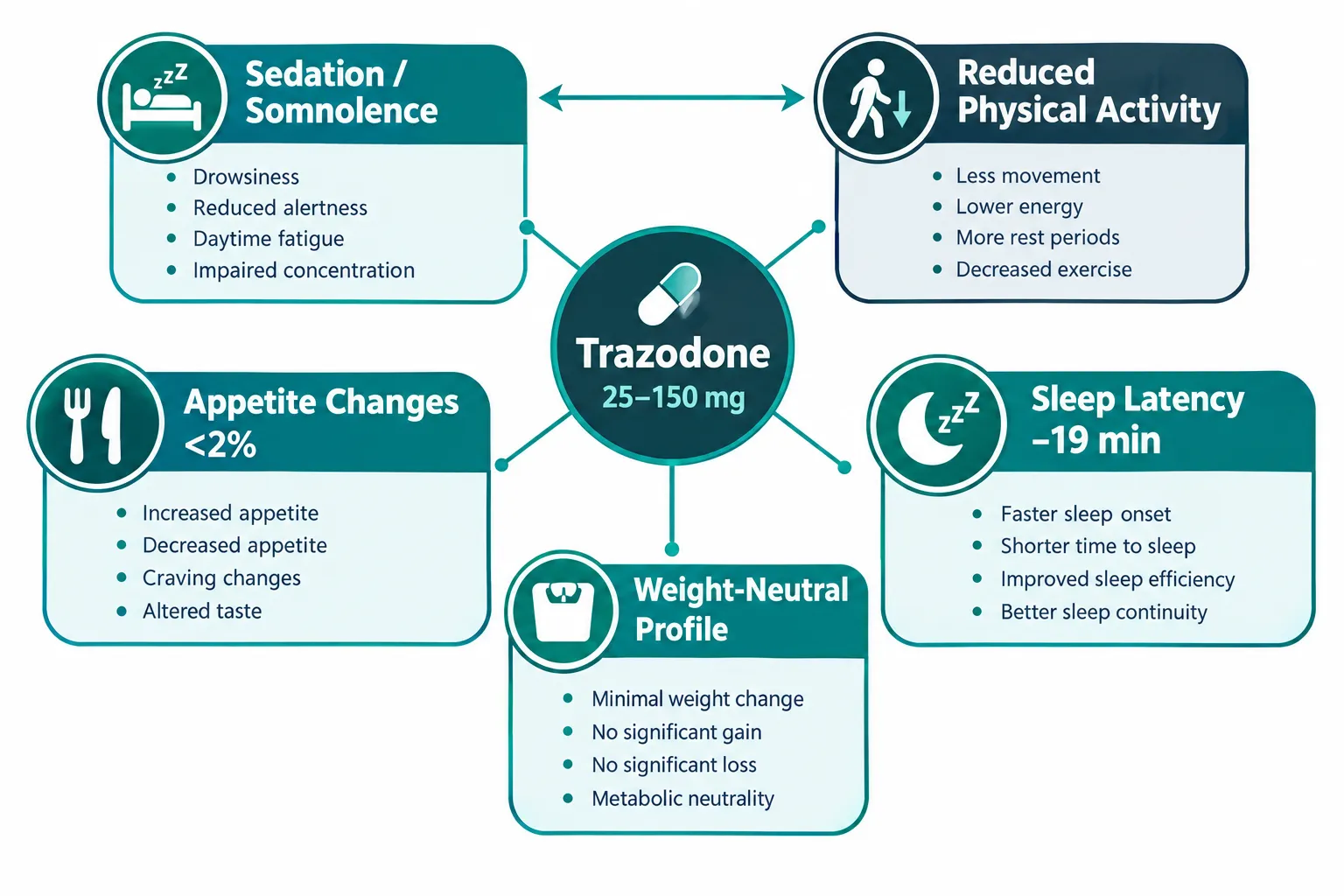
Trazodone is a serotonin antagonist and reuptake inhibitor (SARI) with pronounced sedative and anxiolytic properties at low doses of 25-75 mg, reaching full antidepressant effect at 150-300 mg. Its sedation profile places it alongside mirtazapine and tricyclics in terms of CNS burden, a fact that distinguishes it sharply from activating agents such as bupropion.

On appetite and weight, the picture is reassuring but nuanced:

  • Increased appetite is listed as an adverse reaction with an incidence below 2% in controlled trials.
  • Roughly equal proportions of trial participants gained weight (about 5%) and lost weight (about 6%), supporting a predominantly weight-neutral classification.
  • Long-term data show minimal impact on glucose metabolism or body composition.
  • Any observed weight change may partly reflect improved depressive symptoms rather than direct pharmacologic action on appetite circuits.

"Trazodone lacks the appetite-stimulating profile seen with mirtazapine and many antipsychotics, but its sedation burden is a separate and underappreciated confounder in metabolic studies."

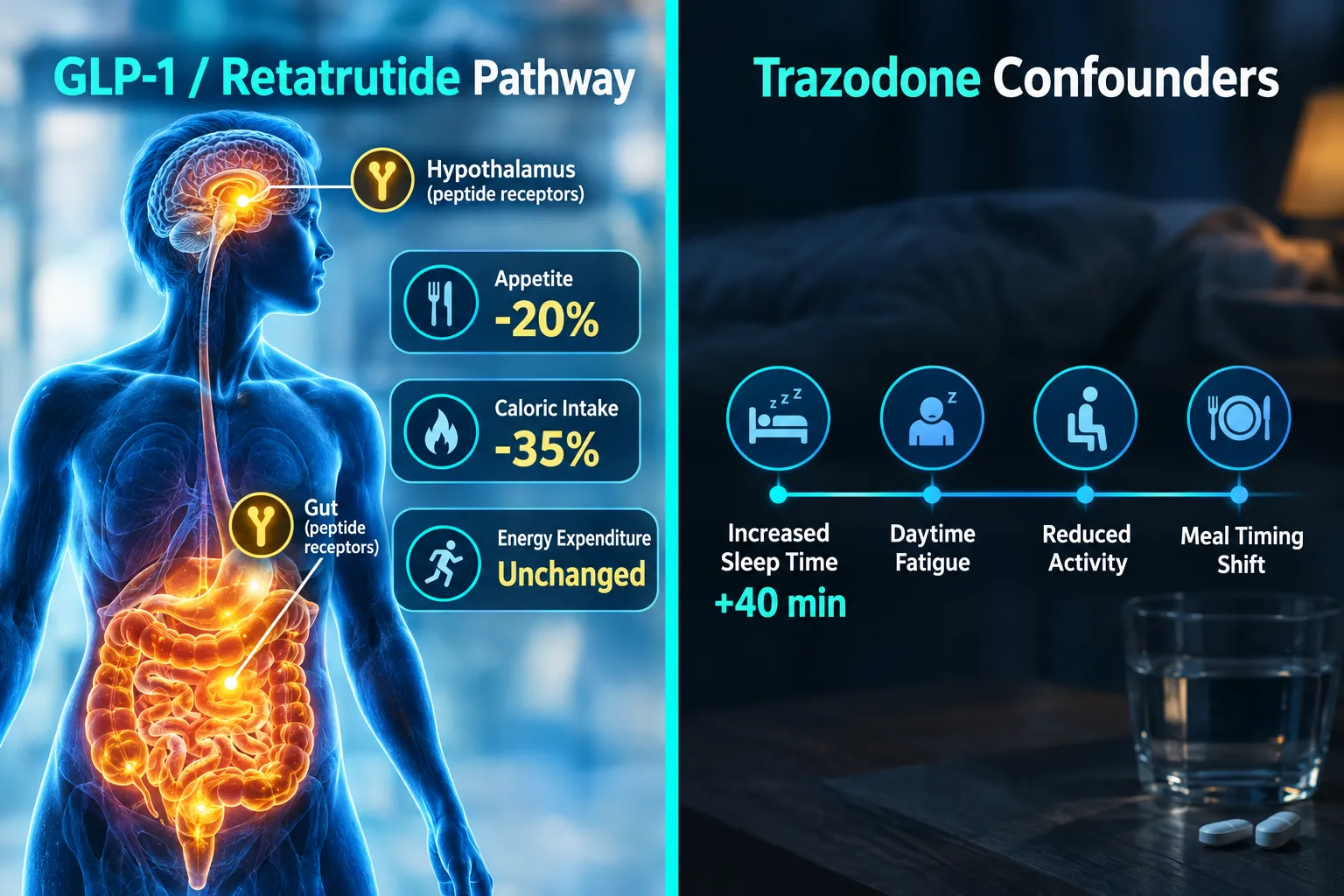
Where trazodone becomes problematic in research is not through appetite stimulation but through behavioral pathways: increased total sleep time (approximately 40 minutes in randomized trials), reduced sleep-onset latency (roughly 19 minutes), and daytime grogginess that suppresses physical activity. These effects are most prominent at 50-150 mg, the exact range used off-label for insomnia.

Importantly, the American Academy of Sleep Medicine and VA/DoD guidelines advise against trazodone for chronic insomnia disorder, recommending it only when other options fail or comorbid depression is present. Despite this, off-label prescribing remains widespread, meaning researchers enrolling metabolic-study participants will frequently encounter undisclosed trazodone use.


GLP-1 and Retatrutide Mechanisms: Why Food Intake Measurement Is Non-Negotiable
GLP-1 and Retatrutide Mechanisms: Why Food Intake Measurement Is Non-Negotiable

Understanding the intersection of trazodone, appetite, and peptide weight-loss models: controlling sedation, sleep, and food-intake confounders requires clarity on how peptide agents actually produce weight loss.

GLP-1 receptor agonists and next-generation multi-agonist peptides such as retatrutide reduce subjective appetite by approximately 0-20% and lower ad libitum energy intake by up to 35% in both obese and non-obese subjects. Crucially, across multiple studies, GLP-1 receptor agonist monotherapy or combination therapy showed non-significant effects on energy expenditure in a substantial proportion of trial datasets. Weight loss is therefore driven almost entirely by decreased caloric intake, not by metabolic rate changes.

This has a direct implication: any co-administered agent that alters eating behavior, meal timing, or sleep-related food consumption will distort the apparent efficacy of the peptide.

Key peptide-relevant confounders introduced by trazodone:

Confounder Mechanism Direction of Bias
Extended sleep duration Reduces waking hours available for eating May falsely amplify peptide weight loss
Daytime sedation Lowers physical activity and NEAT May reduce energy expenditure independently
Meal timing shift Sedation can delay or compress eating windows Interacts with peptide gastric-emptying effects
Grogginess / dizziness Reduces adherence to structured meal protocols Introduces noise in intake measurements

Researchers exploring what is the strongest peptide for weight loss need to account for these behavioral confounders before drawing mechanistic conclusions from body-weight endpoints.

GLP-1 agonists do improve obstructive sleep apnea, but this benefit is driven largely by weight loss rather than direct effects on sleep physiology. A concurrent sedative like trazodone can alter arousal threshold and sleep continuity in ways that mimic or mask those improvements, making it essential to model the two pharmacologic effects separately. Studies examining GLP-3 peptide variants or agents like cagrilintide peptide face the same confounding challenge when participants use sedating psychotropics.


Designing Confounder Controls for Trazodone in Peptide Weight-Loss Studies
Designing Confounder Controls for Trazodone in Peptide Weight-Loss Studies

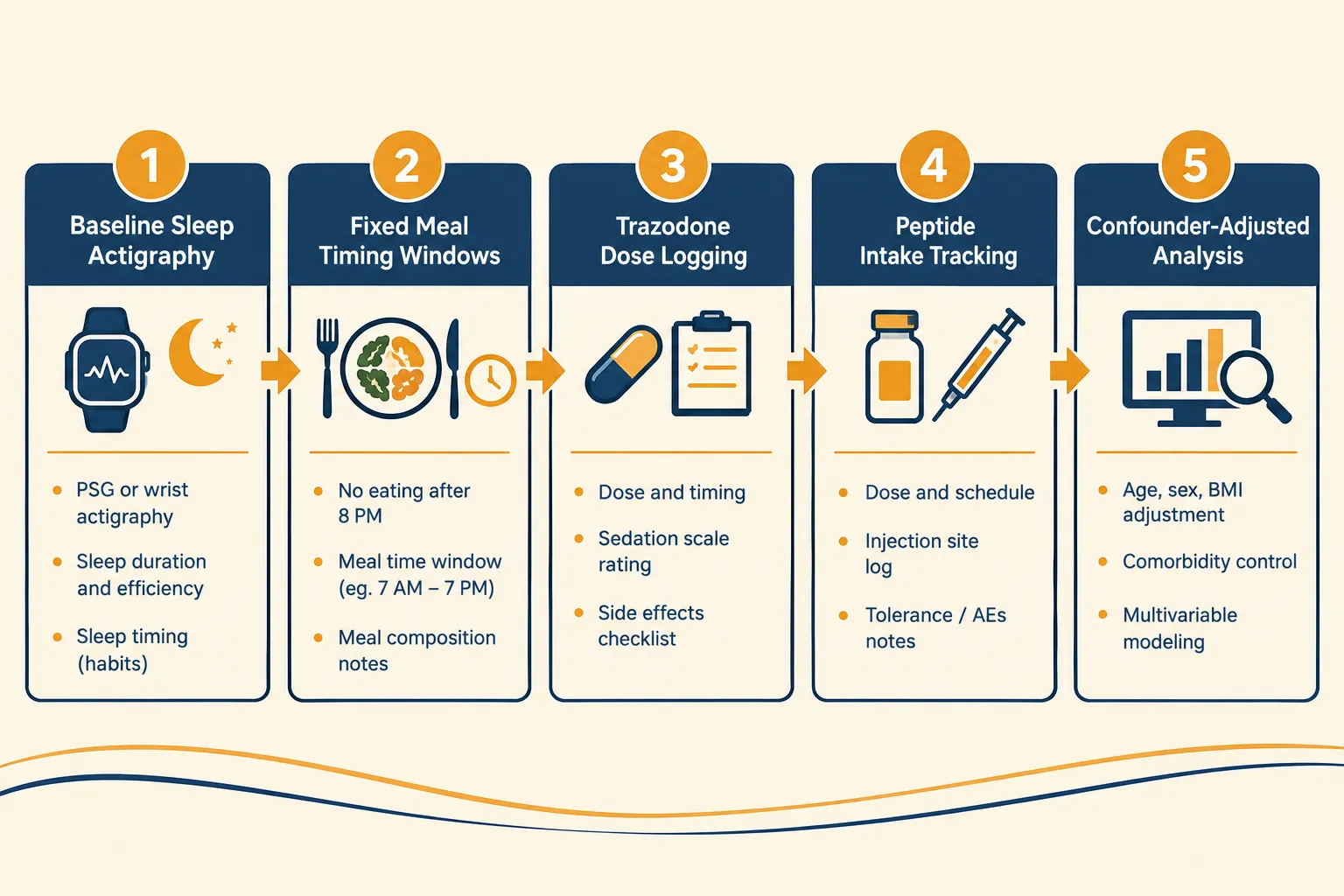
Addressing trazodone, appetite, and peptide weight-loss models: controlling sedation, sleep, and food-intake confounders at the design stage is far more effective than attempting statistical adjustment after data collection.

Sleep and activity controls:

  • Wrist actigraphy or polysomnography at baseline and follow-up intervals
  • Standardized sedation rating scales administered at each study visit
  • Daily step counts or accelerometry to capture trazodone-driven reductions in non-exercise activity thermogenesis (NEAT)

Meal-timing and food-intake controls:

  • Fixed eating windows with no food intake after 8:00 p.m.
  • A minimum three-hour gap between the last meal and sleep onset
  • Validated 24-hour dietary recall or continuous food logging apps

Research published in 2025 found that severe stress, late dinner timing (after 9 p.m.), and less than three hours between dinner and bedtime significantly undermined peptide-based weight-loss treatment by disrupting sleep. Trazodone can shift all three of these variables simultaneously, compressing the pre-sleep interval by advancing sleep onset while leaving dinner timing unchanged.

Short objective sleep duration also predicts poor long-term weight-loss maintenance independently of intervention type, age, and sex. Worse perceived sleep quality during caloric restriction is associated with less total weight loss. This means trazodone's sleep-extending effect could artificially improve weight-loss outcomes in short trials while masking inadequate peptide response.

Recommended stratification variables:

  • Trazodone dose (none / low 25-75 mg / therapeutic 150-300 mg)
  • Baseline insomnia severity index score
  • Comorbid depression status (since weight change may reflect mood improvement)
  • BMI and type 2 diabetes status, both of which confound GLP-1 treatment selection and baseline disease severity

For researchers sourcing compounds for mechanistic studies, lab tested peptides with verified purity are a prerequisite for isolating pharmacologic effects from analytical noise. Similarly, understanding peptide half life is critical when scheduling blood draws and behavioral assessments around trazodone's own pharmacokinetic curve.

Emerging multi-receptor peptide agents, including those reviewed under buy reta peptide research tags, present additional complexity because their CNS effects, including possible alterations in sleep architecture and arousal, have not been fully characterized. A 2025 editorial in a leading sleep journal raised concerns that GLP-1 class agents may affect sleep continuity and circadian regulation in patients predisposed to hyperarousal, and called for systematic assessment of insomnia alongside peptide therapy. When trazodone is also present, combined CNS effects could mask or exaggerate true drug-related changes in both sleep and weight.


Conclusion

Trazodone's weight-neutral pharmacology does not make it a benign bystander in peptide weight-loss research. Its sedating effects extend sleep, suppress daytime activity, shift meal timing, and introduce behavioral confounders that can inflate, deflate, or simply obscure the true metabolic signal of GLP-1 agonists, retatrutide, and related compounds.

Actionable next steps for researchers and clinicians:

  1. Screen all participants for current trazodone use and dose at enrollment, not just at baseline questionnaire.
  2. Stratify or exclude trazodone users in primary analyses; include them in sensitivity analyses with dose as a covariate.
  3. Deploy objective sleep measurement (actigraphy minimum, polysomnography preferred) at baseline and at each major timepoint.
  4. Enforce meal-timing protocols with a hard cutoff at least three hours before trazodone-adjusted sleep onset.
  5. Separate sleep-quality improvements from peptide-driven weight loss using validated insomnia and sleep-apnea measures before attributing outcome differences to appetite suppression.

Rigorous control of these confounders is not methodological perfectionism, it is the minimum standard for generating trustworthy data on peptide-based metabolic therapies in a real-world population where sedative co-prescribing is common.

Tags: food intake measurement, glp-1 receptor agonists, metabolic peptide studies, peptide weight loss, retatrutide research, sedation and weight loss, sleep confounders, trazodone appetite effects
https://www.puretestedpeptides.com/wp-content/uploads/2026/10/trazodone-appetite-and-peptide-weight-loss-models-controlling-sedation-sleep-and.webp 1024 1536 https://www.puretestedpeptides.com/wp-content/uploads/2026/01/buy-peptides-online.jpg 2026-10-13 13:05:052026-10-13 13:05:05Trazodone, Appetite, and Peptide Weight-Loss Models: Controlling Sedation, Sleep, and Food-Intake Confounders
You might also like
Tesofensine vs GLP-3 Peptides in Metabolic Research: How Labs Decide Which Compounds to Order Tesofensine vs GLP-3 Peptides in Metabolic Research: How Labs Decide Which Compounds to Order
Methylprednisolone, Dexamethasone, and Peptide-Based Immunomodulation: Designing Inflammation Studies With BPC-157 and GLP-Class Adjuncts Methylprednisolone, Dexamethasone, and Peptide-Based Immunomodulation: Designing Inflammation Studies With BPC-157 and GLP-Class Adjuncts
Peptides vs Classic Heart Drugs: How GLP-3 Retatrutide and GLP-2-T Compare With Atorvastatin in Cardiometabolic Research Models Peptides vs Classic Heart Drugs: How GLP-3 Retatrutide and GLP-2-T Compare With Atorvastatin in Cardiometabolic Research Models
Metoprolol in Incretin and Growth-Hormone Studies: Separating Heart-Rate Effects From Peptide Responses Metoprolol in Incretin and Growth-Hormone Studies: Separating Heart-Rate Effects From Peptide Responses
Hemoglobin, LDL Cholesterol, and Blood Pressure in Peptide Studies: Building a Cardiometabolic Monitoring Panel Hemoglobin, LDL Cholesterol, and Blood Pressure in Peptide Studies: Building a Cardiometabolic Monitoring Panel
Complete Guide to Peptide Mechanisms: How GLP-1, GLP-3, and Growth Hormone Peptides Work at the Molecular Level Complete Guide to Peptide Mechanisms: How GLP-1, GLP-3, and Growth Hormone Peptides Work at the Molecular Level
Peptide Research and Omeprazole: What Acid-Suppressing Drugs Mean for GLP-2 and Gut-Focused Studies Peptide Research and Omeprazole: What Acid-Suppressing Drugs Mean for GLP-2 and Gut-Focused Studies
Where to Buy Research-Grade GLP-3 Retatrutide: Purity Standards, Vendor Selection, and Lab Considerations Where to Buy Research-Grade GLP-3 Retatrutide: Purity Standards, Vendor Selection, and Lab Considerations
0 replies

Leave a Reply

Want to join the discussion?
Feel free to contribute!

Leave a Reply Cancel reply

Your email address will not be published. Required fields are marked *

×

Helpful Links

  • My account
  • Cart
  • Checkout
  • Refund and Returns Policy
  • Privacy Policy
  • SMS Privacy Policy
  • Login
  • My Account
  • Logout

USA Made Lab Tested Peptides

All products are sold for research, laboratory, or analytical purposes only, and are not for human consumption


Pure Tested Peptides is a chemical supplier. Pure Tested Peptides is not a compounding / chemical compounding facility as defined under 503A of the Federal Food, Drug, and Cosmetic act. Pure Tested Peptides is not an outsourcing facility as defined under 503B of the Federal Food, Drug, and Cosmetic act.

The statements made within this website have not been evaluated by the US Food and Drug Administration. The products we offer are not intended to diagnose, treat, cure or prevent any disease.

Human/Animal Consumption Prohibited. Laboratory/In-Vitro Experimental Use Only

Link to: Ondansetron Beyond Nausea: Serotonin-Receptor Controls for Gastric Emptying, Intake, and GLP-Class Peptide Experiments Link to: Ondansetron Beyond Nausea: Serotonin-Receptor Controls for Gastric Emptying, Intake, and GLP-Class Peptide Experiments Ondansetron Beyond Nausea: Serotonin-Receptor Controls for Gastric Emptying,...Ondansetron Beyond Nausea: Serotonin-Receptor Controls for Gastric Emptying, Intake, and GLP-Class Peptide Experiments Link to: Prednisone and Metabolic Peptides: A Glucocorticoid-Control Framework for Glucose, Appetite, and Inflammation Experiments Link to: Prednisone and Metabolic Peptides: A Glucocorticoid-Control Framework for Glucose, Appetite, and Inflammation Experiments Prednisone and Metabolic Peptides: A Glucocorticoid-Control Framework for Glucose, Appetite, and Inflammation ExperimentsPrednisone and Metabolic Peptides: A Glucocorticoid-Control Framework for Glucose,...
Scroll to top Scroll to top Scroll to top