

DNA, Mitochondria, and Research Peptides: How MOTS-c and 5-Amino-1MQ Interface With Cellular Energy and Genomic Pathways
Fewer than 37 genes in the human mitochondrial genome were thought to matter for decades, until researchers discovered that a tiny open reading frame within one of those genes encodes a peptide capable of reshaping whole-body metabolism. That discovery opened an entirely new field. Today, the study of DNA, mitochondria, and research peptides, specifically how MOTS-c and 5-Amino-1MQ interface with cellular energy and genomic pathways, sits at the frontier of metabolic biology and peptide science.
Key Takeaways
- MOTS-c is a 16-amino-acid peptide encoded directly within mitochondrial DNA, making it one of the few known peptides with a purely mitochondrial genetic origin.
- MOTS-c activates AMPK and PGC-1alpha, two master regulators that link mitochondrial signaling to nuclear gene expression and energy metabolism.
- 5-Amino-1MQ is a small-molecule NNMT inhibitor that modulates cellular energy balance by influencing NAD+ metabolism and mitochondrial function.
- Both compounds are strictly research-use compounds studied in preclinical and early clinical models, neither is approved for human therapeutic use.
- Understanding how these agents interact with mitochondrial and genomic pathways helps contextualize the broader landscape of experimental metabolic peptides.
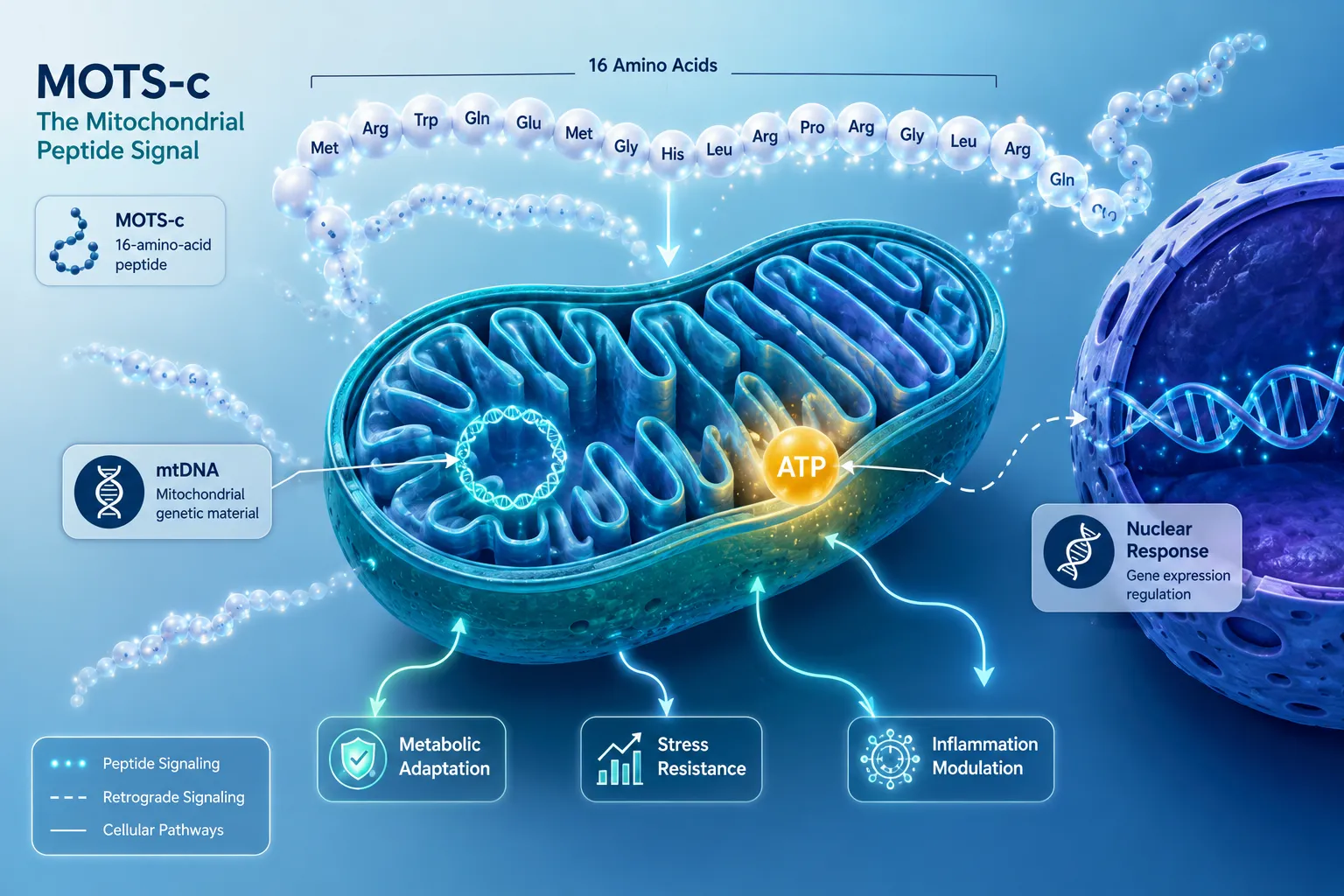
The Mitochondrial Genome: A Hidden Source of Bioactive Peptides
Most biology courses teach that the mitochondrial genome encodes only structural components, ribosomal RNAs, transfer RNAs, and a handful of proteins involved in oxidative phosphorylation. That picture is now incomplete.
Mitochondrial-derived peptides (MDPs) are a class of small signaling molecules translated from short open reading frames within mitochondrial DNA. MOTS-c is among the most studied. Its full sequence, MRWQEMGYIFYPRKLR, is translated from within the MT-RNR1 gene, which codes for the 12S ribosomal RNA. The fact that a metabolically active signaling peptide emerges from what was once considered a purely structural gene region underscores how much remains to be learned about the mitochondrial genome.
This discovery matters because it reframes the mitochondrion not just as an energy factory, but as an active endocrine organ, one capable of producing peptides that travel to distant tissues and influence gene expression at the nuclear level.
For researchers already familiar with mitochondria-targeting compounds, this connects directly to work on other mitochondrial research themes, such as those explored in SS-31 mitochondrial research contexts, where membrane-targeted peptides address oxidative stress and bioenergetic efficiency from a different mechanistic angle.
How MOTS-c Interfaces With Cellular Energy and Genomic Pathways
The central question in the study of DNA, mitochondria, and research peptides, specifically how MOTS-c and 5-Amino-1MQ interface with cellular energy and genomic pathways, is mechanistic: exactly how does a peptide born in the mitochondria influence the nucleus?
AMPK and PGC-1alpha: The Genomic Bridge
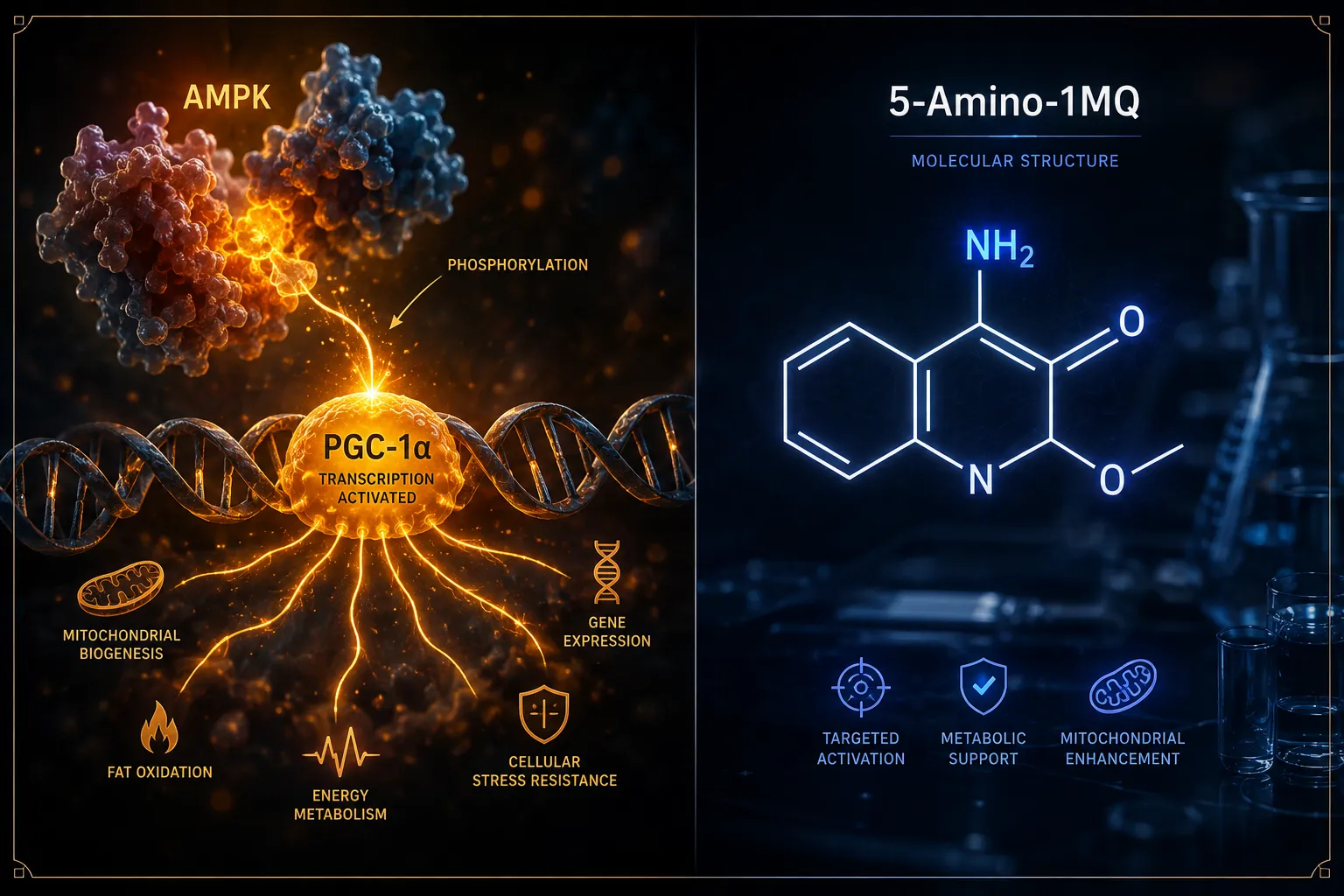
MOTS-c activates AMP-activated protein kinase (AMPK), a cellular energy sensor that responds to low ATP states. AMPK activation triggers a cascade that includes upregulation of PGC-1alpha, a transcriptional coactivator that controls mitochondrial biogenesis and oxidative metabolism genes housed in nuclear DNA.
"MOTS-c essentially acts as a messenger that tells the nucleus: the mitochondria need more capacity, build it."
A 2026 transgenic mouse study confirmed this pathway directly. In two distinct mouse strains, exogenous MOTS-c increased intrinsic muscle mitochondrial performance, with measurable improvements in oxidative phosphorylation and ATP output. The dependency on AMPK and PGC-1alpha was mechanistically confirmed, positioning MOTS-c as a genuine bridge between mitochondrial peptide signaling and nuclear genomic programs.
Metabolic Flexibility and the "Exercise Mimetic" Concept
MOTS-c has been described in research literature as a mitochondrial exercise mimetic, a compound that replicates some metabolic adaptations normally triggered by physical exercise. These include:
- Improved fatty acid oxidation
- Enhanced glucose uptake in skeletal muscle
- Greater resistance to metabolic stress
- Upregulation of mitochondrial biogenesis markers
Human clinical development has advanced to at least one Phase 2a trial examining insulin sensitivity, suggesting that the preclinical findings are compelling enough to warrant early human investigation.
Researchers sourcing compounds for mitochondrial pathway studies can also explore the SS-31 and MOTS-c product tag for catalog context, or review SS-31 mitochondrial dynamics research for comparative mechanistic reading.
5-Amino-1MQ: NAD+ Metabolism and Mitochondrial Energy Balance
While MOTS-c originates from mitochondrial DNA itself, 5-Amino-1MQ approaches the same energy-regulation problem from a different direction. It is a small-molecule inhibitor of nicotinamide N-methyltransferase (NNMT), an enzyme that consumes SAM (S-adenosylmethionine) and diverts nicotinamide away from NAD+ synthesis.
Why NNMT Inhibition Matters for Mitochondria
NAD+ is essential for mitochondrial function. It serves as a critical electron carrier in the oxidative phosphorylation chain and as a substrate for sirtuins, NAD+-dependent deacetylases that regulate mitochondrial biogenesis and stress response. When NNMT is overactive, NAD+ availability drops, and mitochondrial efficiency suffers.
By inhibiting NNMT, 5-Amino-1MQ research models have demonstrated:
| Effect | Mechanism |
|---|---|
| Increased NAD+ levels | Reduced nicotinamide diversion |
| Elevated cellular energy expenditure | Enhanced mitochondrial activity |
| Reduced lipid accumulation | Improved fatty acid oxidation |
| Potential epigenetic effects | SAM availability for methylation reactions |
This positions 5-Amino-1MQ as a metabolic amplifier that works upstream of mitochondrial function, influencing the availability of molecules the mitochondria depend on to generate ATP efficiently.
Researchers interested in broader metabolic peptide stacks may find relevant context in IPA-Sermorelin stack research or explore Epithalon peptide research, which touches on genomic longevity pathways from a telomere-based perspective.

Comparing the Two Compounds: Convergent Pathways, Distinct Origins
Understanding DNA, mitochondria, and research peptides, and how MOTS-c and 5-Amino-1MQ interface with cellular energy and genomic pathways, is clearer when both compounds are viewed side by side.
MOTS-c acts top-down: it is produced by the mitochondria, released into circulation, and signals back to the nucleus via AMPK/PGC-1alpha to increase mitochondrial capacity. 5-Amino-1MQ acts bottom-up: it preserves NAD+ availability so the mitochondria have the substrates needed to function optimally.
Both compounds are strictly for research use in preclinical and early clinical models. Neither has received regulatory approval for therapeutic application. Researchers working in this space should source compounds through verified, tested suppliers. Those evaluating supplier quality can consult peptide supplier comparison resources before procurement.
For researchers building broader experimental protocols, the SS-31 ideal dosage research page offers a useful reference for how dosing rationale is developed in mitochondria-targeted peptide research.
Conclusion
The intersection of DNA, mitochondria, and research peptides, specifically how MOTS-c and 5-Amino-1MQ interface with cellular energy and genomic pathways, represents one of the most mechanistically rich areas in current metabolic science. MOTS-c demonstrates that mitochondrial DNA is not a passive bystander but an active producer of signaling molecules that reach the nucleus and reshape gene expression. 5-Amino-1MQ shows that protecting the metabolic inputs mitochondria depend on can produce measurable bioenergetic benefits in research models.
Actionable next steps for researchers:
- Review the primary literature on MOTS-c transgenic mouse models to understand AMPK/PGC-1alpha dependency before designing protocols.
- Evaluate NAD+ pathway data for 5-Amino-1MQ in the context of your specific cell or animal model.
- Source both compounds only from suppliers with documented purity testing and COA availability.
- Consider comparative mitochondrial peptide models, including SS-31, to build mechanistically layered experimental designs.
As 2026 research continues to clarify the clinical relevance of these pathways, the foundational preclinical work on MOTS-c and 5-Amino-1MQ provides a strong framework for understanding how mitochondrial biology and genomic regulation are far more intertwined than once believed.


Leave a Reply
Want to join the discussion?Feel free to contribute!