Call or Text 727-513-9780
  • Shopping Cart Shopping Cart
    0Shopping Cart
Pure Tested Peptides | America's most trusted Peptides for sale online
  • Peptides for sale
    • Oral Peptides for sale
      • Peptide Capsules for sale
      • BPC 157 Capsules 1000mcg
      • SLU-PP-332 Capsules | 1000 mcg
      • 5-Amino-1MQ 50mg Capsules
      • Tesofensine 500mcg
    • All Peptides for sale
    • Peptide Sprays
      • BPC 157 Nasal Spray Kit
      • BPC-157 TB500 Nasal Spray Kit
      • Semax Nasal Spray 10mg
      • Selank – Nasal Spray Kit – 10mg
      • Epithalon 50MG Nasal Spray Kit
      • Ipamorelin 10mg Nasal Spray
      • Klow Nasal Spray (BPC-157 + TB-500 + GHK-Cu + KPV) | 80mg
      • Hulk Nasal Spray Tesa / Ipa Blend 6/3 MG
      • Klow Nasal Spray
      • NAD + 500 mg Nasal Spray
      • PT-141 Nasal Spray Kit
    • GHRH Peptides
      • Ipa Peptides
      • CJC-1295 Peptides
        • CJC-1295 with DAC 5 mg
        • CJC-1295 without DAC 5 mg
        • CJC-1295 Ipa 10mg
      • Tesa Peptides
        • Tesa Peptide
        • Tesa 20 mg
    • GHK-Cu Peptides
      • All GHK-Cu Peptides
      • GHK-Cu 100mg
      • KLOW Peptide Blend – Buy KLOW blend online
    • BPC Peptides
      • All BPC Peptides
      • BPC-157
      • BPC-157 TB-500
      • BPC 157 capsules 1000mcg
    • SLU-PP-332 Peptides
      • All SLU-PP-332 Peptides
      • SLU-PP-332 5mg
    • GLP3 Peptides
      • GLP3-R
      • GLP3-R CAG 10mg
      • GLP3-R 20mg
    • PT-141 Peptides
      • PT-141 Peptides for sale
      • PT-141 10mg
      • PT-141 Nasal Spray
    • CAG Peptides
      • Lipo-C Peptide Blend
      • CAG 5mg
      • CAG 10mg
    • MOTS-C Peptides
      • MOTS-C Peptides for sale
      • MOTS-c peptide
      • MOTS-c 10mg *6 pack*
    • 5 Amino 1MQ Peptides
      • 5 Amino 1MQ Peptides for sale
      • 5-Amino-1MQ 50mg Capsules
      • 5-Amino-1MQ 5mg
    • Epithalon Peptides
      • Epithalon Peptides for sale
      • Epithalon 10mg
      • Epithalon 50mg
  • Shop
    • GLPs
      • 5-Amino-1MQ 50mg Capsules
      • 5-Amino-1MQ 5mg
      • GLP3-Reta
      • L-Carnitine 500mg/ml
      • Tesofensine 500mcg
      • SLU-PP-332 5mg
      • MOTS-c 10mg *6 pack*
    • Epithalon & BPC Peptides
      • Epithalon 10mg
      • Epithalon 50mg
      • BPC-157
      • BPC 157 capsules 1000mcg
      • BPC-157 TB-500
      • BPC-157 TB500 Nasal Spray Kit
      • BPC 157 Nasal Spray Kit
    • BPC TB-500 & NAD+ Peptides
      • NAD+ 500 mg
      • KLOW Peptide Blend – Buy KLOW blend online
      • GLOW Peptide Blend
      • TB 500 5mg
      • BPC 157 capsules 1000mcg – Supplement
      • BPC 157 Nasal Spray Kit
      • BPC-157
      • BPC-157 TB500 Nasal Spray Kit
      • BPC-157 TB-500
      • BPC 157 capsules 1000mcg
    • LL-37 Peptide
      • LL-37 10 mg
    • MOTS-C & Selank
      • MOTS-c peptide
      • Selank 10mg
    • GHK Peptides
      • GHK-Cu 100mg
      • GLOW Peptide Blend
      • KLOW Peptide Blend – Buy KLOW blend online
  • COAs
  • Wholesale
    • Wholesale Peptides for sale
  • PTP FAQ
  • Affiliates
    • Selank Peptide: Advanced Pharmacological Mechanisms Underlying Its Anxiolytic and Nootropic Effects in Research
      • 5-Amino-1MQ Peptide: Detailed Mechanisms of NNMT Inhibition and Its Impact on Cellular Metabolism Research
        • MOTS-C Peptide: Unraveling Its Role in Mitochondrial Dynamics and Energy Metabolism Research
          • Epithalon Peptide and Telomerase Regulation: Investigating Its Impact on Cellular Senescence and Lifespan Research Models
            • GLP2-T vs GLP2 Tirz Peptide: Understanding the Naming, Mechanistic Nuances, and Research Implications for Gut Health
      • Peptides and Polypeptides in Modern Pharmacology: What Research on Metoprolol, Prednisone, and Amlodipine Reveals
        • Polypeptide Peptides vs NSAIDs: What Naproxen and Diclofenac Teach Tissue-Repair Researchers About BPC‑157 and TB‑500
          • Peptides and Polypeptides in Endocrine Pharmacology: How GLP-1, GLP-2, and GLP-3 Retatrutide Differ From Classic Drugs Like Prednisone and Amlodipine
          • 5‑Amino‑1MQ Peptide and NNMT Inhibition: How It Compares With Statins Like Atorvastatin in Adipose and Lipid Metabolism Research
      • Enclomiphene, Estrogen Receptor Signaling, and Luteinizing Phase Biology: What Hormone Researchers Should Measure
        • Mesenchymal Stem Cells, BPC‑157, and GHK‑Cu: How Tissue Repair Peptides Compare With Classic NSAIDs Like Naproxen in Injury Models
          • Peptide Calculator Use Cases Beyond Growth Hormone: Working Through GLP‑3 Retatrutide, MOTS‑c, and BPC‑157 Research Dosing
        • Polypeptide Peptides in Endocrine and Metabolic Pharmacology: Lessons From Amlodipine, Prednisone, and Metoprolol
        • Peptides Calculator for Advanced Blends: Worked Examples for Tesamorelin, CJC‑1295, and Ipamorelin Stacks
          • Peptides and Polypeptides in Human Physiology: How Molecular Size Shapes Research Applications
            • Selank Peptide: Advanced Pharmacological Mechanisms Underlying Its Anxiolytic and Nootropic Effects in Research
          • 5-Amino-1MQ Peptide: Detailed Mechanisms of NNMT Inhibition and Its Impact on Cellular Metabolism Research
            • MOTS-C Peptide: Unraveling Its Role in Mitochondrial Dynamics and Energy Metabolism Research
              • Epithalon Peptide and Telomerase Regulation: Investigating Its Impact on Cellular Senescence and Lifespan Research Models
                • GLP2-T vs GLP2 Tirz Peptide: Understanding the Naming, Mechanistic Nuances, and Research Implications for Gut Health
                  • Peptides and Polypeptides in Endocrine Pharmacology: How GLP-1, GLP-2, and GLP-3 Retatrutide Differ From Classic Drugs Like Prednisone and Amlodipine
                    • Polypeptide Peptides vs NSAIDs: What Naproxen and Diclofenac Teach Tissue-Repair Researchers About BPC‑157 and TB‑500
                      • Peptides and Polypeptides in Modern Pharmacology: What Research on Metoprolol, Prednisone, and Amlodipine Reveals
                        • 5‑Amino‑1MQ Peptide and NNMT Inhibition: How It Compares With Statins Like Atorvastatin in Adipose and Lipid Metabolism Research
                        • Enclomiphene, Estrogen Receptor Signaling, and Luteinizing Phase Biology: What Hormone Researchers Should Measure
                        • Mesenchymal Stem Cells, BPC‑157, and GHK‑Cu: How Tissue Repair Peptides Compare With Classic NSAIDs Like Naproxen in Injury Models
                        • Peptide Calculator Use Cases Beyond Growth Hormone: Working Through GLP‑3 Retatrutide, MOTS‑c, and BPC‑157 Research Dosing
                        • Polypeptide Peptides in Endocrine and Metabolic Pharmacology: Lessons From Amlodipine, Prednisone, and Metoprolol
                        • Peptides Calculator for Advanced Blends: Worked Examples for Tesamorelin, CJC‑1295, and Ipamorelin Stacks
                        • Peptides and Polypeptides in Human Physiology: How Molecular Size Shapes Research Applications
                        • Selank Peptide: Advanced Pharmacological Mechanisms Underlying Its Anxiolytic and Nootropic Effects in Research
                        • MOTS-C Peptide: Unraveling Its Role in Mitochondrial Dynamics and Energy Metabolism Research
                        • Peptides and Polypeptides in Modern Pharmacology: What Research on Metoprolol, Prednisone, and Amlodipine Reveals
                        • Peptides and Polypeptides in Endocrine Pharmacology: How GLP-1, GLP-2, and GLP-3 Retatrutide Differ From Classic Drugs Like Prednisone and Amlodipine
                        • 5-Amino-1MQ Peptide: Detailed Mechanisms of NNMT Inhibition and Its Impact on Cellular Metabolism Research
                        • Mesenchymal Stem Cells, BPC‑157, and GHK‑Cu: How Tissue Repair Peptides Compare With Classic NSAIDs Like Naproxen in Injury Models
                        • Peptide Calculator Use Cases Beyond Growth Hormone: Working Through GLP‑3 Retatrutide, MOTS‑c, and BPC‑157 Research Dosing
                        • GLP2-T vs GLP2 Tirz Peptide: Understanding the Naming, Mechanistic Nuances, and Research Implications for Gut Health
                        • Polypeptide Peptides in Endocrine and Metabolic Pharmacology: Lessons From Amlodipine, Prednisone, and Metoprolol
                        • Polypeptide Peptides vs NSAIDs: What Naproxen and Diclofenac Teach Tissue-Repair Researchers About BPC‑157 and TB‑500
                        • Peptides and Polypeptides in Human Physiology: How Molecular Size Shapes Research Applications
                        • Peptides Calculator for Advanced Blends: Worked Examples for Tesamorelin, CJC‑1295, and Ipamorelin Stacks
                        • 5‑Amino‑1MQ Peptide and NNMT Inhibition: How It Compares With Statins Like Atorvastatin in Adipose and Lipid Metabolism Research
                        • Enclomiphene, Estrogen Receptor Signaling, and Luteinizing Phase Biology: What Hormone Researchers Should Measure
                        • Epithalon Peptide and Telomerase Regulation: Investigating Its Impact on Cellular Senescence and Lifespan Research Models
                        • Best research protocol Klow blend
                        • best time to take BPC-157
                        • best time to take DSIP (Delta Sleep Inducing Peptide)
                        • best time to take CJC-1295
                        • best time to take AOD-9604
                        • best time to take Follistatin 344
                        • best time to take Ipamorelin
                        • best time to take MK-677 (Ibutamoren)
                        • best time to take Ligandrol (LGD-4033) — research compound
                        • best time to take Ostarine (MK-2866) — research compound
                        • best time to take GHK-CU
                        • best time to take TB-500
                        • best time to take MOTS-c
                        • best time to take Semax
                        • best time to take RAD-140 (Testolone) — research compound
                        • best time to take Thymosin Alpha-1
                        • best time to take PEG-MGF
                        • Biolife Plasma, Octapharma Plasma, and Research Peptides: How Plasma Donation Labs Differ From Peptide Suppliers
                        • best time to take YK-11 — research compound
                        • best time to take PT-141 (Bremelanotide)
                        • Best research protocol Klow blend
                        • 5-Amino-1MQ and MOTS-C Synergy: Metabolic Signaling, Mitochondria, and Research Design
                        • BPC-157 and TB-500: Investigating Their Combined Effects on Angiogenesis and Cellular Migration in Tissue Repair Models
                        • BPC-157 Peptide: Gut Barrier Function, Inflammation, and Tissue-Recovery Research
                        • 5‑Amino‑1MQ and MOTS‑c Synergy in Metabolic Research: Designing NNMT and Mitochondrial Biogenesis Stacks
                        • CJC-1295 with DAC vs. Without DAC: Half-Life, Release Kinetics, and Research Implications
                        • CJC‑1295 with DAC vs. Without DAC: Expanding on Half‑Life Differences Using Tesamorelin and Ipamorelin Blend Case Studies
                        • Collagen Biology and Copper‑Binding Peptides: How GHK‑Cu, Glow Blend, and Klow Blend Interact with Skin and Connective Tissue
                        • Collagen Biology and Regenerative Peptides: How GHK‑Cu, Glow Blend, and Klow Blend Affect Extracellular Matrix Research
                    • DNA, Telomeres, and Longevity Peptides: Positioning Epithalon and MOTS‑c in Genetic Aging Research
                      • Enclomiphene Citrate: serm Mechanism, Testosterone Research, and Stack Compatibility
                        • Enclomiphene vs Enclomiphene Citrate: Formulation, Bioavailability, and Research Distinctions
                        • Epithalon Peptide Research: Telomerase Activation, Aging, and Pineal Gland Function
                        • Estrogen Receptor Signaling and Enclomiphene: How Selective Modulators Compare with Classic Polypeptide Hormones
                        • GHK-Cu Peptide: Advanced Mechanisms in Extracellular Matrix Remodeling and Wound Healing Research
                        • GHK-Cu Peptide: Collagen Synthesis, Wound Repair, and Skin-Barrier Research Models
                        • GLP-1 vs GLP-3 vs GLP-2: Peptide Classification and Research Applications
                        • GLP-2 Peptide Research Guide: Gut Barrier Function, Nutrient Absorption, and Intestinal Recovery Models
                        • GLP-3 Retatrutide vs. GLP-1 Drugs: What Triple-Agonist Biology Changes in Research Models
                        • Ipamorelin and Tesamorelin Combination: Synergistic GH Secretagogue Research and Dosing Protocols
                        • GLP2 Tirz Peptide: What It Is, Why the Name Exists, and How Researchers Should Interpret It
                        • Klow Blend Peptide Nasal Spray: What the Formulation Is Trying to Do in Cognitive Research
                        • Mitochondria, NNMT Inhibition, and Peptide Modulators: Where MOTS‑c and 5‑Amino‑1MQ Fit in Cellular Energy Research
                        • MOTS-c Peptide: Mitochondrial Function, Energy Metabolism, and What Researchers Measure
                        • MOTS-c vs. 5-Amino-1MQ: Which Metabolic Research Questions Each Compound Actually Answers
                        • Nasal Spray Peptides: Bioavailability, Administration, and Semax/Selank Research Applications
                        • PT-141 Peptide Research: Mechanism of Action and Melanocortin Receptor Signaling
                        • Retatrutide for Research: Mechanism, Structure, and GLP-1/GLP-3 Dual Action
                        • Retatrutide for Obesity and Type 2 Diabetes: What the Latest Trial Data Suggest
                        • Tesofensine Peptide Research: Mechanism, Appetite Suppression, and Neuropeptide Y Pathways
  • Contact
    • Contact Customer Service
    • Text Customer Support
  • About US
  • Shop all peptides
  • Affiliate Program
    • Affiliate Signup
  • Login / Register Login / Register Page Link Login / Register Page Link
  • Click to open the search input field Click to open the search input field Search
  • Menu Menu
Cellular Energy and Research Peptides: Why ATP Readouts Matter in Mitochondrial Studies

Cellular Energy and Research Peptides: Why ATP Readouts Matter in Mitochondrial Studies

August 20, 2026/0 Comments/in Uncategorized/by

Mitochondria generate roughly 90 percent of the ATP a mammalian cell requires to survive, yet for decades researchers lacked a fast, reliable way to watch that production change in real time. The convergence of cellular energy and research peptides, and specifically the question of why ATP readouts matter in mitochondrial studies, has become one of the most active methodological discussions in preclinical biology in 2026. Understanding the biology behind ATP measurement is essential before interpreting any peptide-related mitochondrial data.

Key Takeaways

  • ATP concentration is the most direct proxy for mitochondrial metabolic activity available to researchers today.
  • The luciferin-luciferase bioluminescence reaction is the gold-standard method for quantifying cellular ATP in high-throughput formats.
  • Compartment-specific luciferase probes now allow researchers to distinguish mitochondrial ATP from cytosolic ATP in living cells.
  • Mitochondrial-targeted peptides such as SS-31 and MOTS-c are evaluated partly through ATP-linked bioenergetic endpoints in both preclinical and clinical settings.
  • Timing, signal stability, and assay dynamic range are critical variables that determine whether an ATP readout is genuinely quantitative.

Why ATP Is the Right Proxy for Mitochondrial Activity
Why ATP Is the Right Proxy for Mitochondrial Activity

Adenosine triphosphate is not simply a fuel molecule, it is a real-time indicator of how well the entire oxidative phosphorylation chain is functioning. When mitochondria are stressed, damaged, or pharmacologically targeted, ATP output drops before most other measurable parameters shift. That sensitivity is exactly why intracellular ATP measurement is now established as a primary proxy for mitochondrial activity in research settings.

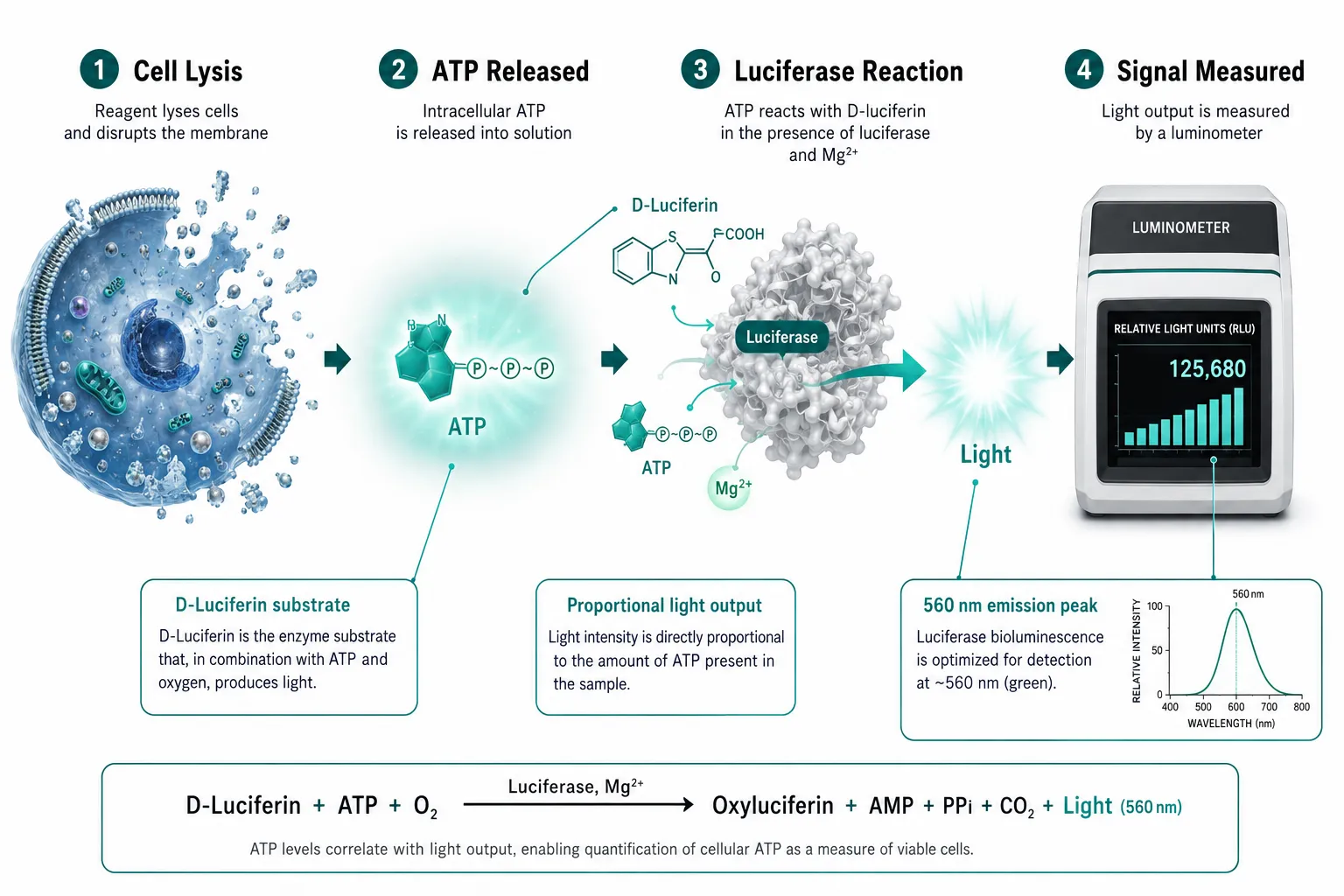
The dominant detection method is the luciferin-luciferase bioluminescence assay. Firefly luciferase catalyzes a reaction between D-luciferin and ATP, producing light. Because luminescence intensity is directly proportional to ATP concentration when ATP is the limiting reagent, the assay delivers a quantitative signal without requiring radioactive tracers or complex instrumentation. Most current protocols use a single working reagent that simultaneously lyses cells and generates luminescence, with measurements taken within one minute to prevent signal drift.

A standard workflow looks like this:

  1. Add equal volumes of sample and working solution to a 96-well plate.
  2. Incubate at 25 degrees Celsius for a fixed period (commonly 10 minutes per validated protocols).
  3. Read luminescence immediately to capture peak signal before kinetic decay.

Timing matters. Even a two-minute delay after adding the reaction mixture can introduce measurable error. Researchers building mitochondrial assay panels must treat the ATP readout as a time-sensitive endpoint, not a stable colorimetric measurement.

One additional consideration is dynamic range. When cell density is high or mitochondrial activity is elevated, the luminescent signal can saturate. Adjusting substrate volume or diluting lysate before adding the luciferase reagent is standard practice to keep measurements within the linear range of the assay.

Compartment-Specific Measurement and the Role of Cellular Energy and Research Peptides in Mitochondrial Studies
Compartment-Specific Measurement and the Role of Cellular Energy and Research Peptides in Mitochondrial Studies

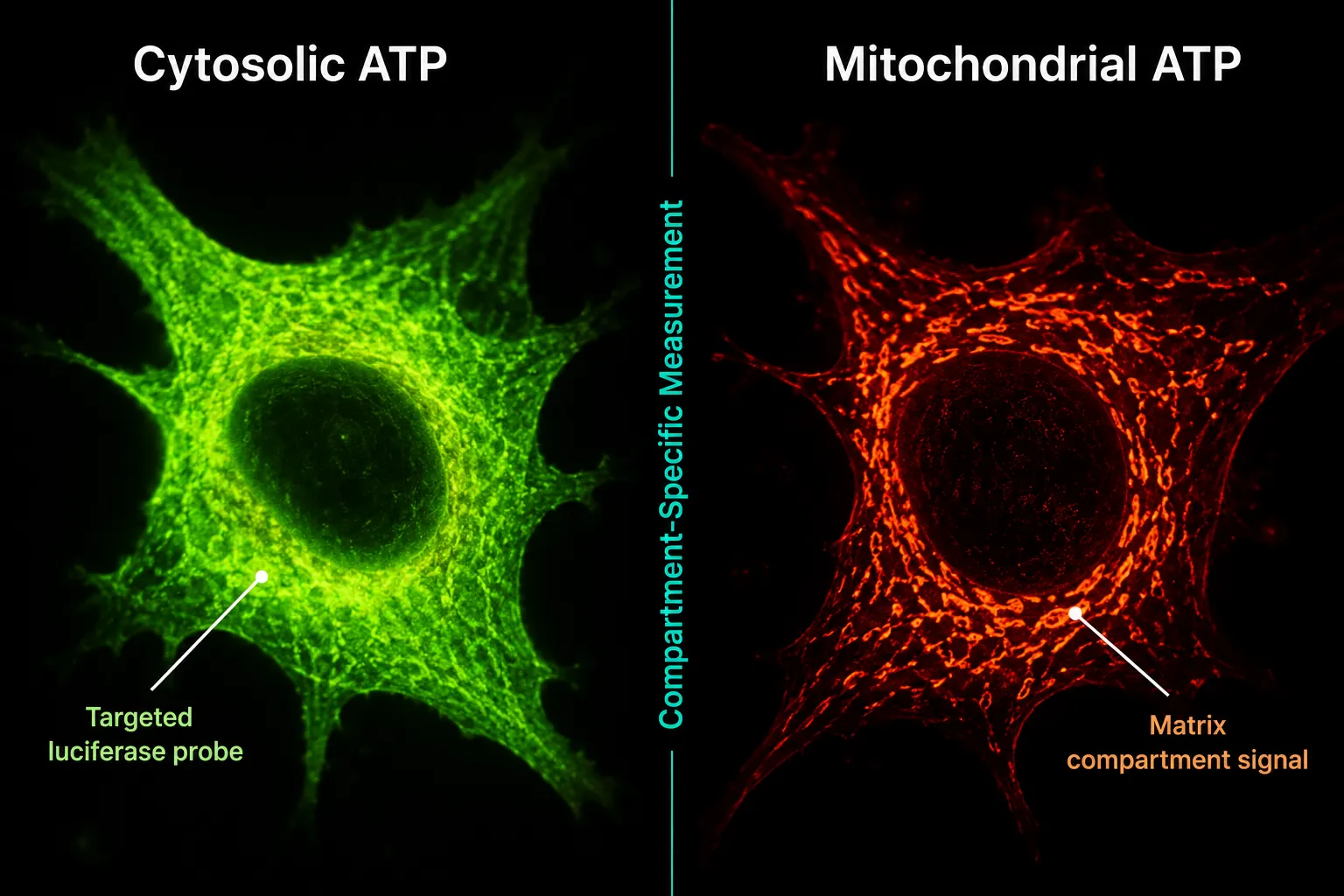
A whole-cell ATP readout captures the sum of all nucleotide pools, cytosolic, mitochondrial, and pericellular. For many screening applications that aggregate signal is sufficient. But when the research question is specifically about how a peptide alters mitochondrial energy production, a whole-cell number can obscure the answer.

Targeted luciferase chimeras solve this problem. By fusing a luciferase gene to a mitochondrial matrix-targeting sequence, researchers can direct the reporter protein to a specific subcellular compartment. Luminescence from that probe reflects only the ATP pool in that location. The same strategy works for the cytosol and pericellular space, enabling simultaneous multi-compartment profiling across multi-day experiments.

This level of resolution matters for evaluating SS-31 mitochondrial dynamics because the peptide's proposed mechanism involves direct interaction with cardiolipin in the inner mitochondrial membrane. A whole-cell ATP assay might show a modest aggregate increase, while a matrix-targeted probe could reveal a substantially larger improvement confined to the mitochondrial compartment, a distinction with real mechanistic significance.

Beyond single-nucleotide assays, dual-detection platforms now allow simultaneous quantitation of both GTP and ATP from the same sample well. This matters because GTP is a direct product of the TCA cycle succinyl-CoA synthetase reaction, making it an independent indicator of mitochondrial metabolic flux. Combining GTP and ATP readouts in a single luminescent assay provides a more complete picture of cellular energy metabolism than either measurement alone.

For researchers mapping metabolic pathway dependency, ATP assays also help distinguish how much a cell relies on glycolysis versus oxidative phosphorylation. By selectively inhibiting one pathway and measuring the ATP response, investigators can characterize a cell line's bioenergetic phenotype, information that is directly relevant when screening peptide candidates for metabolic effects. Readers exploring that intersection may find the top 5 research peptides for metabolic health guide a useful companion resource.

Translating ATP Readouts to Peptide Research: Clinical and Preclinical Implications
Translating ATP Readouts to Peptide Research: Clinical and Preclinical Implications

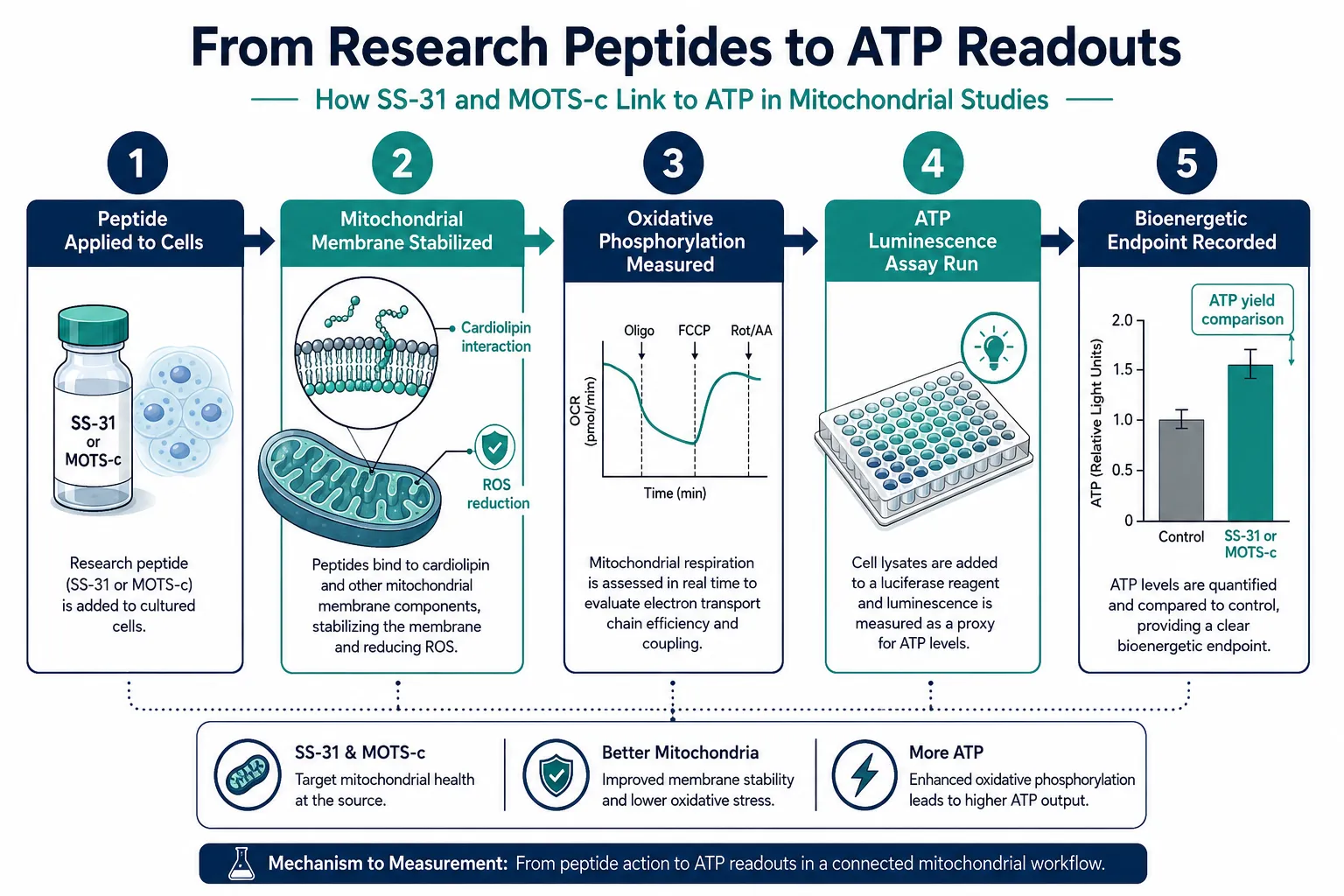
The question of why ATP readouts matter in mitochondrial studies becomes most concrete when examining how mitochondrial-targeted peptides are actually evaluated in research programs. Two peptides illustrate the point clearly.

Elamipretide (SS-31) is a small, cell-permeable tetrapeptide that associates with cardiolipin in the inner mitochondrial membrane. Preclinical data consistently show that it improves mitochondrial respiration, reduces reactive oxygen species, and enhances ATP production. In clinical heart failure trials, even when primary endpoints such as infarct size reduction were not met, improvements in mitochondrial function and reductions in cardiac injury biomarkers were observed. This pattern suggests that ATP-linked bioenergetic measures may be more sensitive indicators of therapeutic effect than some anatomical endpoints. Two ongoing Phase 3 trials, ReNEW and ReGAIN, are expected to report data in 2026, and bioenergetic endpoints will be central to interpreting those results. Researchers can review the SS-31 mechanism and research overview for additional background on its mitochondrial targets.

MOTS-c is a mitochondria-encoded peptide that has entered human trials, with Phase 1 completion projected for mid-2026 and Phase 2 initiation anticipated later in the year. Mitochondrial respiratory capacity is a planned endpoint, and ATP and respiration measures are expected to quantify metabolic responses. The SS-31 mitochondrial research themes resource provides relevant context on how mitochondrial endpoints are structured across similar peptide programs.

The broader implication is that ATP assays are transitioning from purely preclinical screening tools to clinically meaningful biomarkers. As late-2026 trial data accumulate, consistent improvements in ATP-linked markers alongside clinical outcomes would further validate ATP readouts as surrogate endpoints for mitochondrial peptide therapies.

For research teams sourcing compounds for these studies, working with lab-tested peptides ensures that purity data are available to separate compound-related effects from assay artifacts, a non-trivial concern when ATP luminescence is the primary readout.

Peptide Primary Mitochondrial Target ATP-Related Endpoint Trial Stage (2026)
Elamipretide (SS-31) Cardiolipin / inner membrane ATP production, ROS reduction Phase 3 (ReNEW, ReGAIN)
MOTS-c Mitochondrial genome / AMPK Respiratory capacity, insulin sensitivity Phase 1 completion / Phase 2 initiation

Conclusion

ATP concentration is not a peripheral metric in mitochondrial research, it is the most direct, quantifiable signal of whether the organelle is doing its job. The luciferin-luciferase platform has made high-throughput ATP measurement practical, but reliable data require strict attention to timing, dynamic range, and compartment specificity. As the fields of cellular energy and research peptides converge more tightly, ATP readouts are becoming the common language between bench assays and clinical endpoints.

Actionable next steps for research teams:

  • Validate assay timing protocols before comparing treatment groups; even small delays introduce quantitative error.
  • Consider compartment-targeted luciferase probes when the research question is specifically about mitochondrial (not total cellular) ATP.
  • Pair ATP assays with GTP or oxygen consumption measurements to capture a fuller bioenergetic profile.
  • When evaluating mitochondrial peptides such as SS-31, design studies to capture ATP-linked secondary endpoints alongside primary anatomical or functional measures.
  • Source compounds from verified suppliers and review the SS-31 kidney health research literature to understand how ATP endpoints have been applied across different tissue models.

The 2026 clinical readouts from ongoing mitochondrial peptide trials will test whether ATP-based bioenergetic markers can carry the weight of surrogate endpoints. The methodology to support that claim is already in place.

Tags: atp readouts, cellular energy, luciferin-luciferase assay, mitochondrial function, mitochondrial studies, mots-c, research peptides, ss-31 peptide
https://www.puretestedpeptides.com/wp-content/uploads/2026/08/cellular-energy-and-research-peptides-why-atp-readouts-matter-in-mitochondrial-s.webp 1024 1536 https://www.puretestedpeptides.com/wp-content/uploads/2026/01/buy-peptides-online.jpg 2026-08-20 13:05:152026-08-20 13:05:15Cellular Energy and Research Peptides: Why ATP Readouts Matter in Mitochondrial Studies
You might also like
Polypeptide Peptides and Drug Mechanisms: What Common Medications Reveal About Research-Use Peptide Pharmacology Polypeptide Peptides and Drug Mechanisms: What Common Medications Reveal About Research-Use Peptide Pharmacology
Semax Peptide Nasal Spray: Cognitive Enhancement, Neuroprotection, and Research Protocols Semax Peptide Nasal Spray: Cognitive Enhancement, Neuroprotection, and Research Protocols
CJC-1295 with Ipamorelin: What the Combination Means for Growth Hormone Research Models CJC-1295 with Ipamorelin: What the Combination Means for Growth Hormone Research Models
Peptides and Polypeptides in Mitochondrial Biology: How MOTS-c and 5-Amino-1MQ Compare With Classic Mitochondrial Pathways Peptides and Polypeptides in Mitochondrial Biology: How MOTS-c and 5-Amino-1MQ Compare With Classic Mitochondrial Pathways
5-Amino-1MQ Peptide: Investigating Its Impact on NAD+ Metabolism and Cellular Energetics in Research Models 5-Amino-1MQ Peptide: Investigating Its Impact on NAD+ Metabolism and Cellular Energetics in Research Models
Top 5 Research Peptides for Metabolic Health: An Updated Buyer's Guide Top 5 Research Peptides for Metabolic Health: An Updated Buyer’s Guide
Peptides and Polypeptides Explained: Connecting DNA, Mitochondria, and Modern Research-Use Compounds Like MOTS-c and 5-Amino-1MQ Peptides and Polypeptides Explained: Connecting DNA, Mitochondria, and Modern Research-Use Compounds Like MOTS-c and 5-Amino-1MQ
Peptide Calculators for Tesamorelin and Ipamorelin: Optimizing Reconstitution and Dosing Accuracy Peptide Calculators for Tesamorelin and Ipamorelin: Optimizing Reconstitution and Dosing Accuracy
0 replies

Leave a Reply

Want to join the discussion?
Feel free to contribute!

Leave a Reply Cancel reply

Your email address will not be published. Required fields are marked *

×

Helpful Links

  • My account
  • Cart
  • Checkout
  • Refund and Returns Policy
  • Privacy Policy
  • SMS Privacy Policy
  • Login
  • My Account
  • Logout

USA Made Lab Tested Peptides

All products are sold for research, laboratory, or analytical purposes only, and are not for human consumption


Pure Tested Peptides is a chemical supplier. Pure Tested Peptides is not a compounding / chemical compounding facility as defined under 503A of the Federal Food, Drug, and Cosmetic act. Pure Tested Peptides is not an outsourcing facility as defined under 503B of the Federal Food, Drug, and Cosmetic act.

The statements made within this website have not been evaluated by the US Food and Drug Administration. The products we offer are not intended to diagnose, treat, cure or prevent any disease.

Human/Animal Consumption Prohibited. Laboratory/In-Vitro Experimental Use Only

Link to: Glow Blend vs Klow Blend Peptides: Ingredient Comparison and Research Applications Link to: Glow Blend vs Klow Blend Peptides: Ingredient Comparison and Research Applications Glow Blend vs Klow Blend Peptides: Ingredient Comparison and Research Appli...Glow Blend vs Klow Blend Peptides: Ingredient Comparison and Research Applications Link to: Semax Peptide Nasal Spray: Mechanism, Use Cases, and What Researchers Compare Before Buying Link to: Semax Peptide Nasal Spray: Mechanism, Use Cases, and What Researchers Compare Before Buying Semax Peptide Nasal Spray: Mechanism, Use Cases, and What Researchers Compare Before BuyingSemax Peptide Nasal Spray: Mechanism, Use Cases, and What Researchers Compare...
Scroll to top Scroll to top Scroll to top