

Vitamin D and Mitochondrial Peptides: How D3 Supplementation Interacts With MOTS-c and 5-Amino-1MQ Signaling in Cellular Energy Research
{"cover":"Professional landscape format (1536×1024) hero image with bold text overlay 'Vitamin D and Mitochondrial Peptides' in crisp white modern sans-serif on a deep semi-transparent navy overlay panel, centered with 8% safe margins from every edge, two balanced lines. Background: stunning macro editorial photograph of a glowing mitochondrion cross-section rendered in bioluminescent teal and gold, surrounded by molecular structures and soft light refractions suggesting cellular energy, bright scientific editorial aesthetic, magazine-cover polish, high contrast teal-navy-gold palette.","content":["Annotated mechanism-of-action diagram, landscape format (1536×1024), illustrating Vitamin D3's role in mitochondrial biogenesis across three labeled panels on a clean white background with teal and amber accents. Panel 1 labeled 'VDR Activation' shows a nucleus with VDR receptor binding 1,25(OH)2D3, callout lines pointing to PGC-1alpha and MYC gene targets. Panel 2 labeled 'Respiratory Chain Upregulation' shows mitochondrial inner membrane with Complex I through V labeled, arrows indicating increased ATP output. Panel 3 labeled 'Redox Defense' shows SOD and glutathione icons with ROS reduction arrows. Thin callout lines, short 1-5 word labels, editorial medical-illustration style, navy-teal-amber palette.","Split-screen landscape format (1536×1024) comparison diagram contrasting MOTS-c and 5-Amino-1MQ signaling pathways. Left half titled 'MOTS-c: AMPK Pathway' on a cool slate-blue background shows a stylized mitochondrion releasing a 16-amino-acid peptide chain traveling to a cell nucleus, with labeled callouts: '12S rRNA encoded', 'AMPK activation', 'Nuclear stress response', 'Senescence suppression'. Right half titled '5-Amino-1MQ: NNMT Inhibition' on a warm amber background shows an NNMT enzyme being blocked by a small molecule, with labeled callouts: 'NAD+ pool preservation', 'SAM pathway shift', 'IC50 ~1.2 µM', 'Energy expenditure rise'. Center dividing line with a small Venn overlap zone labeled 'Shared: NAD+/Redox Node'. Clean infographic style, bold sans-serif labels, editorial science-magazine quality.","Numbered step-by-step process flow diagram, landscape format (1536×1024), depicting the three-node convergence model for Vitamin D3, MOTS-c, and 5-Amino-1MQ in cellular energy research, on a deep charcoal background with bright teal and white labels. Step 1 node labeled 'D3 Sets Mitochondrial Baseline' shows VDR icon and mitochondrial biogenesis arrow. Step 2 node labeled 'MOTS-c Activates AMPK Stress Response' shows peptide-to-nucleus translocation icon. Step 3 node labeled '5-Amino-1MQ Preserves NAD+ Pools' shows NNMT inhibition icon. Connecting arrows between nodes labeled 'Complementary Nodes' and 'No Co-Admin Data Yet'. Bottom banner labeled 'Research Stage Only, No Human Trials for Combination'. Bold, clean scientific infographic, teal-white-charcoal palette, editorial quality."]
Roughly one billion people worldwide are estimated to be vitamin D deficient, and emerging cellular research suggests that deficit may do far more than weaken bones. Vitamin D and mitochondrial peptides research, specifically examining how D3 supplementation interacts with MOTS-c and 5-Amino-1MQ signaling in cellular energy research, is revealing a layered network of nuclear receptor signaling, AMPK activation, and NAD+ metabolism that could reshape how scientists design future metabolic studies.
Key Takeaways
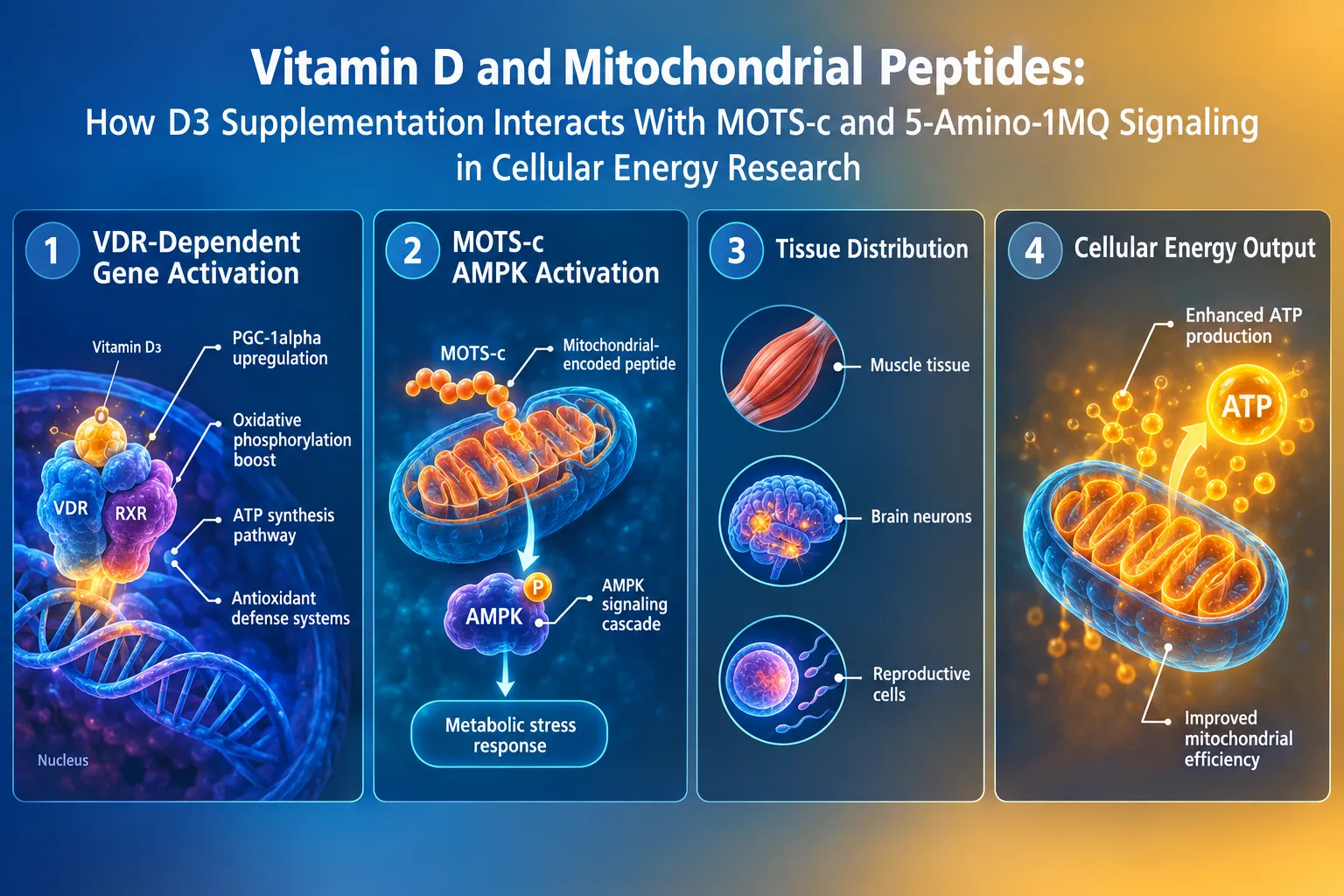
- Vitamin D3 acts as a systemic mitochondrial conditioner by activating VDR-dependent gene programs that upregulate oxidative phosphorylation, ATP synthesis, and antioxidant defenses across muscle, brain, and reproductive tissues.
- MOTS-c is a mitochondrial-encoded peptide that activates AMPK and translocates to the nucleus under metabolic stress, operating through a distinct upstream node from vitamin D.
- 5-Amino-1MQ is a small-molecule NNMT inhibitor that preserves intracellular NAD+ pools and shifts SAM usage, acting as a metabolic switch rather than a peptide.
- All three agents converge conceptually on mitochondrial energy regulation, but no peer-reviewed study has tested their combined effects in any model system.
- MOTS-c has entered a Phase 2a human trial in 2026; 5-Amino-1MQ remains strictly preclinical with no registered human trials.
How Vitamin D3 Programs Mitochondrial Function at the Cellular Level
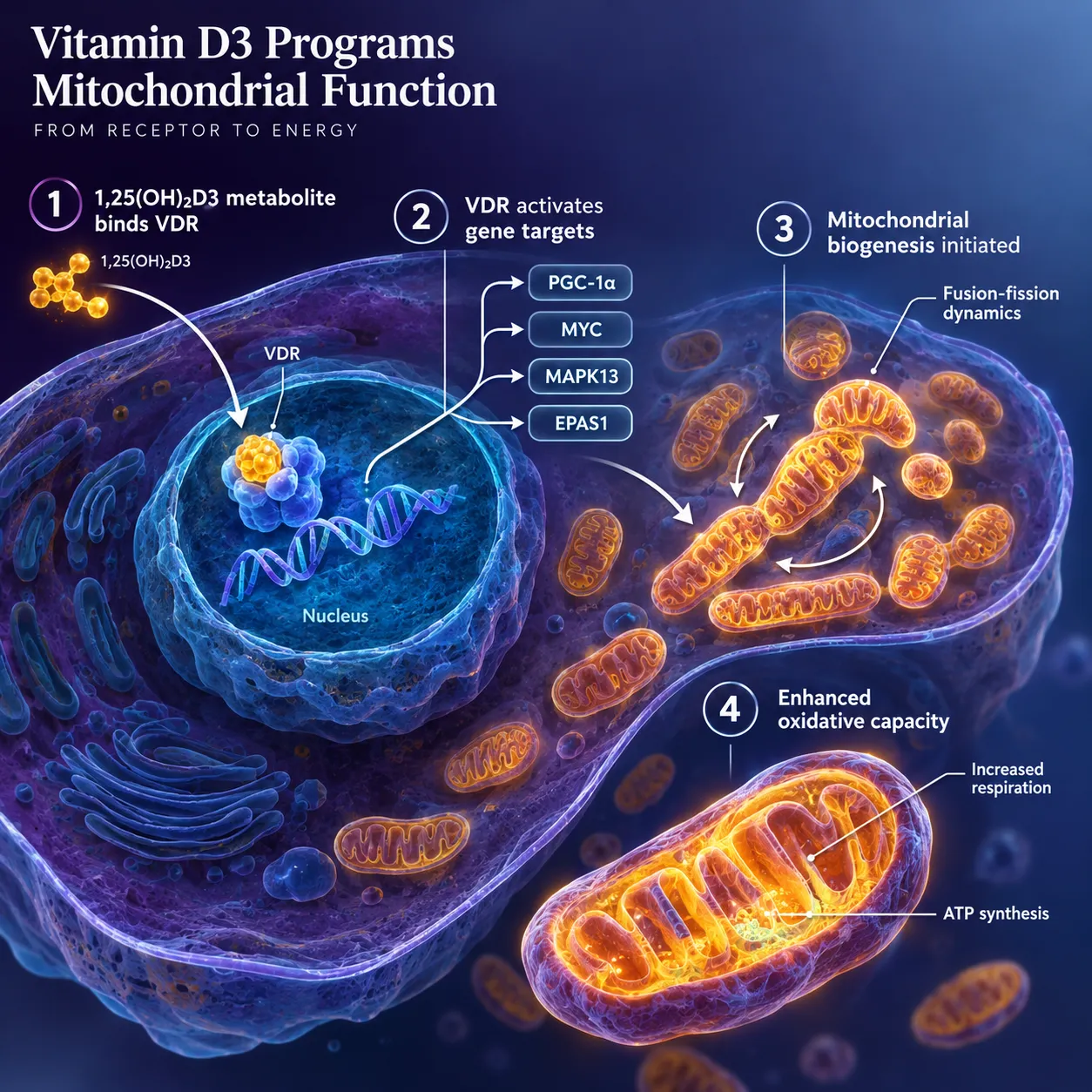
Vitamin D3's influence on mitochondria begins at the vitamin D receptor (VDR), a nuclear receptor that, once bound by the active metabolite 1,25(OH)2D3, regulates a broad set of gene targets including PGC-1alpha, MYC, MAPK13, and EPAS1. These targets directly govern mitochondrial biogenesis, fusion-fission dynamics, and respiratory complex subunit expression.
In skeletal muscle, adequate vitamin D status is associated with higher oxidative phosphorylation capacity and greater mitochondrial density. Deficiency, by contrast, correlates with impaired complex I-driven energy production and accelerated sarcopenia. Human myoblast studies show that 1,25(OH)2D3 exposure increases mitochondrial oxygen consumption, maximum respiration, and ATP production, with mitochondrial protein mRNAs rising by nearly 80% in some experimental models.
The effect extends beyond muscle. A 2026 preprint demonstrated that vitamin D3 improves brain mitochondrial respiratory control ratios using both complex I and complex II substrates, reduces succinate-driven hydrogen peroxide generation, and elevates superoxide dismutase and glutathione levels. In granulosa cells from polycystic ovary syndrome models, 24-hour vitamin D3 exposure increased mitochondrial DNA copy number, activated MAPK signaling, and lowered reactive oxygen species, pointing to a direct bioenergetic and redox benefit.
"Vitamin D3 does not merely support calcium homeostasis; it functions as a systemic mitochondrial conditioning factor that sets the bioenergetic context for downstream signaling."
This baseline-setting role is precisely why vitamin D status is increasingly recognized as a critical variable, and potential confounder, in any cellular energy experiment involving mitochondrial peptides or small-molecule metabolic modulators. Researchers sourcing lab tested peptides for cellular energy studies should account for the vitamin D status of their model systems.
MOTS-c and 5-Amino-1MQ: Distinct Nodes in the Same Energy Network
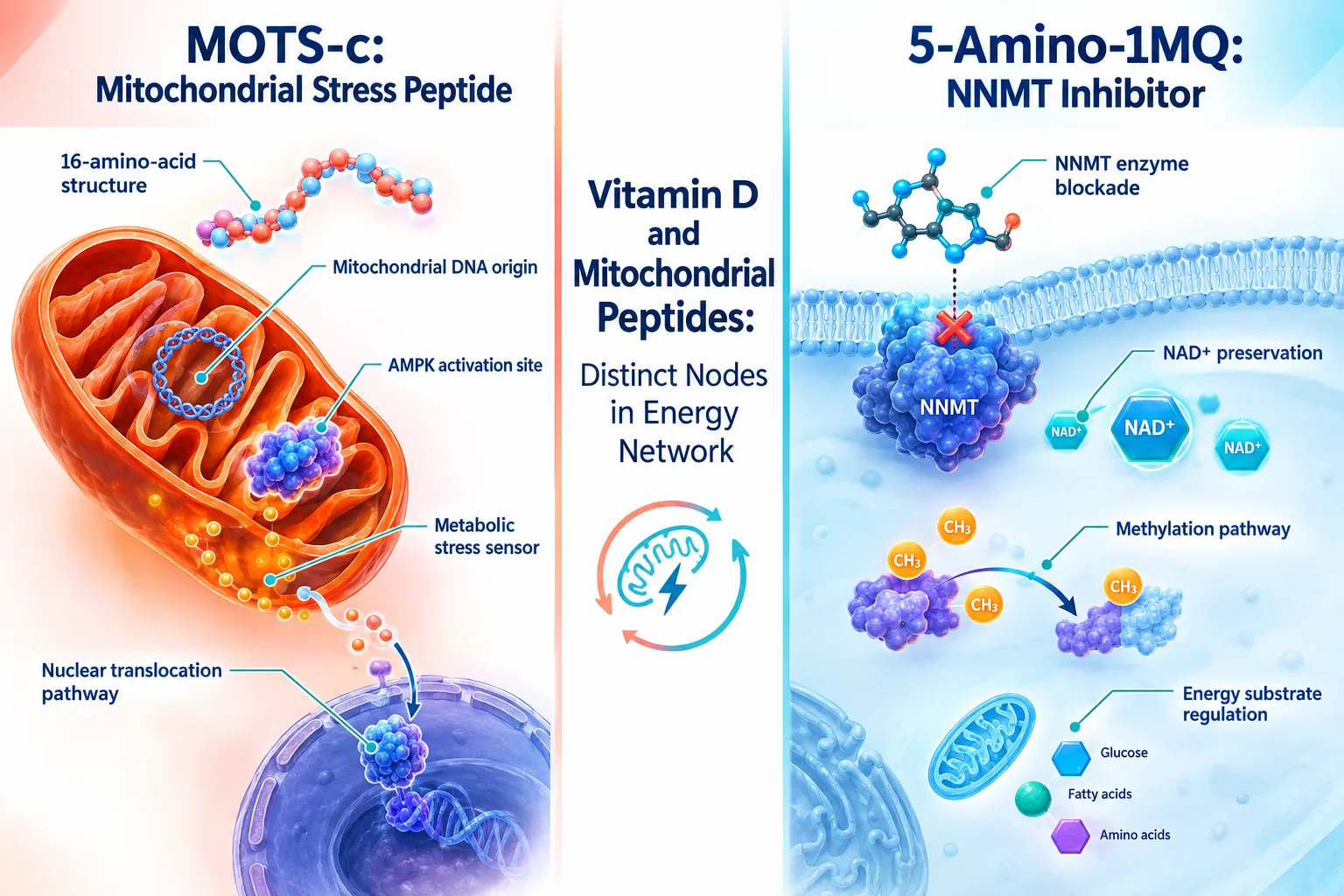
Understanding vitamin D and mitochondrial peptides, specifically how D3 supplementation interacts with MOTS-c and 5-Amino-1MQ signaling in cellular energy research, requires mapping where each agent acts within the cell.
MOTS-c: The Mitochondrial Stress Peptide
MOTS-c is a 16-amino-acid peptide encoded within the mitochondrial 12S ribosomal RNA gene. Under metabolic stress, it translocates from the mitochondria to the nucleus, where it modulates adaptive gene expression programs tied to AMPK activation and metabolic homeostasis.
Recent work in skeletal muscle confirms that exogenous MOTS-c improves intrinsic mitochondrial function and systemic metabolic parameters. A 2026 study in pancreatic islets showed MOTS-c limits cellular senescence, positioning it as a potential senotherapeutic agent. Other research demonstrates suppression of systemic inflammatory signaling alongside restoration of mitochondrial homeostasis in disease models.
Researchers can explore MOTS-c 10mg formulations for preclinical study. It is important to note that MOTS-c carries no FDA-approved indication and is prohibited by the World Anti-Doping Agency under Section S4.4 as an AMPK activator. A Phase 2a randomized controlled trial (NCT07505745) launched in 2026 is testing 12 weeks of subcutaneous MOTS-c on insulin sensitivity in approximately 120 adults with prediabetes, with results expected around 2028.
5-Amino-1MQ: The NNMT Inhibitor
5-Amino-1MQ is not a peptide but a synthetic quinolinium salt that selectively and competitively inhibits nicotinamide N-methyltransferase (NNMT). By blocking NNMT, it suppresses formation of 1-methylnicotinamide, preserves free nicotinamide for NAD+ regeneration, and reduces S-adenosylmethionine (SAM) consumption. The downstream result is a shift in cellular redox state and epigenetic methylation potential.
Preclinical data report an NNMT IC50 of approximately 1.2 µM and high membrane permeability. Mouse models demonstrate reversal of high-fat-diet-induced obesity and improved type 2 diabetes markers through increased energy expenditure and reduced white adipose tissue mass. Those interested in this compound for research can review 5-Amino-1MQ capsules and related NAD peptides resources for context on NAD+ pathway modulation.
As of 2026, 5-Amino-1MQ has no registered human trials, no Investigational New Drug application on public record, and no completed Phase 1 through Phase 3 studies. It is classified strictly as a research compound.
| Agent | Primary Target | Pathway Node | Human Trial Status (2026) |
|---|---|---|---|
| Vitamin D3 | VDR (nuclear receptor) | PGC-1alpha / biogenesis | Approved supplement |
| MOTS-c | AMPK / nuclear stress genes | Mitochondrial stress response | Phase 2a ongoing |
| 5-Amino-1MQ | NNMT enzyme | NAD+ / SAM / redox | No trials registered |
The Convergence Hypothesis: Where D3, MOTS-c, and 5-Amino-1MQ Overlap
The central question in vitamin D and mitochondrial peptides research, specifically how D3 supplementation interacts with MOTS-c and 5-Amino-1MQ signaling in cellular energy research, is whether these three agents act synergistically or simply in parallel.
Current expert analysis frames the three as acting on complementary but non-overlapping nodes:
- Vitamin D3 operates through VDR-dependent transcriptional control of mitochondrial biogenesis and respiratory chain assembly, establishing the structural and enzymatic baseline for oxidative phosphorylation.
- MOTS-c activates AMPK and stress-response gene programs in response to acute metabolic challenge, functioning as a dynamic regulator rather than a constitutive one.
- 5-Amino-1MQ preserves NAD+ pools and shifts methylation potential by blocking NNMT, acting upstream of several redox and epigenetic processes that both D3 and MOTS-c ultimately influence.
The conceptual convergence point is the NAD+/redox node. Vitamin D3 increases antioxidant enzyme activity; MOTS-c restores mitochondrial homeostasis under stress; 5-Amino-1MQ directly expands NAD+ availability. In theory, each agent could amplify the others' effects. In practice, no peer-reviewed study has tested co-administration in any cell line, animal model, or human cohort.
This gap matters for study design. Vitamin D deficiency has been shown to impair complex I-driven energy production, the same pathway MOTS-c and 5-Amino-1MQ experiments depend on for measurable readouts. A vitamin D-deficient cell culture or animal model may produce artificially blunted responses to either compound. Forward-looking metabolic researchers are beginning to treat vitamin D status as a mandatory baseline variable, much like SS-31 mitochondrial research protocols already account for baseline mitochondrial membrane potential.
Analysts covering the MOTS-c trial pipeline anticipate future studies in sarcopenia and insulin-resistant states. Technical reviews of 5-Amino-1MQ suggest its role will remain confined to mechanistic NAD+/NNMT research absent a formal regulatory pathway. Neither compound currently has a trial protocol that mandates vitamin D normalization or includes NNMT inhibitor co-therapy, though researchers in the peptides and polypeptides in endocrine pharmacology space have begun raising this as a design consideration.
Conclusion
The intersection of vitamin D3, MOTS-c, and 5-Amino-1MQ represents one of the more intellectually compelling frontiers in cellular energy research, and one of the most under-tested. Vitamin D3 is the most established of the three, with robust evidence for its role in mitochondrial biogenesis, respiratory chain function, and redox defense across muscle, brain, and reproductive tissues. MOTS-c is advancing through formal clinical evaluation, with its AMPK-linked stress-response mechanism making it a strong candidate for metabolic disease research. 5-Amino-1MQ remains a preclinical NNMT inhibitor with promising rodent data but no human safety profile.
Actionable next steps for researchers:
- Measure and normalize vitamin D status in any cell or animal model before introducing MOTS-c or 5-Amino-1MQ to avoid confounded readouts.
- Track MOTS-c Phase 2a trial results from NCT07505745, expected around 2028, for the first human data on dosing and metabolic endpoints.
- Treat any combined D3-MOTS-c-5-Amino-1MQ protocol as a hypothesis requiring independent experimental validation, no co-administration data exist as of 2026.
- Consult current regulatory guidance before any use outside a formal research context; MOTS-c is WADA-prohibited and 5-Amino-1MQ carries no approved indication anywhere.
The synergy concept is scientifically plausible and mechanistically grounded. It is not yet evidence-based. That distinction is what separates a research hypothesis from a clinical recommendation, and closing that gap is the work ahead.


Leave a Reply
Want to join the discussion?Feel free to contribute!