Call or Text 727-513-9780
  • Shopping Cart Shopping Cart
    0Shopping Cart
Pure Tested Peptides | America's most trusted Peptides for sale online
  • Peptides for sale
    • Oral Peptides for sale
      • Peptide Capsules for sale
      • BPC 157 Capsules 1000mcg
      • SLU-PP-332 Capsules | 1000 mcg
      • 5-Amino-1MQ 50mg Capsules
      • Tesofensine 500mcg
    • All Peptides for sale
    • Peptide Sprays
      • BPC 157 Nasal Spray Kit
      • BPC-157 TB500 Nasal Spray Kit
      • Semax Nasal Spray 10mg
      • Selank – Nasal Spray Kit – 10mg
      • Epithalon 50MG Nasal Spray Kit
      • Ipamorelin 10mg Nasal Spray
      • Klow Nasal Spray (BPC-157 + TB-500 + GHK-Cu + KPV) | 80mg
      • Hulk Nasal Spray Tesa / Ipa Blend 6/3 MG
      • Klow Nasal Spray
      • NAD + 500 mg Nasal Spray
      • PT-141 Nasal Spray Kit
    • GHRH Peptides
      • Ipa Peptides
      • CJC-1295 Peptides
        • CJC-1295 with DAC 5 mg
        • CJC-1295 without DAC 5 mg
        • CJC-1295 Ipa 10mg
      • Tesa Peptides
        • Tesa Peptide
        • Tesa 20 mg
    • GHK-Cu Peptides
      • All GHK-Cu Peptides
      • GHK-Cu 100mg
      • KLOW Peptide Blend – Buy KLOW blend online
    • BPC Peptides
      • All BPC Peptides
      • BPC-157
      • BPC-157 TB-500
      • BPC 157 capsules 1000mcg
    • SLU-PP-332 Peptides
      • All SLU-PP-332 Peptides
      • SLU-PP-332 5mg
    • GLP3 Peptides
    • PT-141 Peptides
      • PT-141 Peptides for sale
      • PT-141 10mg
      • PT-141 Nasal Spray
    • CAG Peptides
      • Lipo-C Peptide Blend
      • CAG 5mg
      • CAG 10mg
    • MOTS-C Peptides
      • MOTS-C Peptides for sale
      • MOTS-c peptide
      • MOTS-c 10mg *6 pack*
    • 5 Amino 1MQ Peptides
      • 5 Amino 1MQ Peptides for sale
      • 5-Amino-1MQ 50mg Capsules
      • 5-Amino-1MQ 5mg
    • Epithalon Peptides
      • Epithalon Peptides for sale
      • Epithalon 10mg
      • Epithalon 50mg
  • Shop
    • GLPs
      • 5-Amino-1MQ 50mg Capsules
      • 5-Amino-1MQ 5mg
      • L-Carnitine 500mg/ml
      • Tesofensine 500mcg
      • SLU-PP-332 5mg
      • MOTS-c 10mg *6 pack*
    • Epithalon & BPC Peptides
      • Epithalon 10mg
      • Epithalon 50mg
      • BPC-157
      • BPC 157 capsules 1000mcg
      • BPC-157 TB-500
      • BPC-157 TB500 Nasal Spray Kit
      • BPC 157 Nasal Spray Kit
    • BPC TB-500 & NAD+ Peptides
      • NAD+ 500 mg
      • KLOW Peptide Blend – Buy KLOW blend online
      • GLOW Peptide Blend
      • TB 500 5mg
      • BPC 157 capsules 1000mcg – Supplement
      • BPC 157 Nasal Spray Kit
      • BPC-157
      • BPC-157 TB500 Nasal Spray Kit
      • BPC-157 TB-500
      • BPC 157 capsules 1000mcg
    • LL-37 Peptide
      • LL-37 10 mg
    • MOTS-C & Selank
      • MOTS-c peptide
      • Selank 10mg
    • GHK Peptides
      • GHK-Cu 100mg
      • GLOW Peptide Blend
      • KLOW Peptide Blend – Buy KLOW blend online
  • COAs
  • Wholesale
    • Wholesale Peptides for sale
  • PTP FAQ
  • Affiliates
    • Selank Peptide: Advanced Pharmacological Mechanisms Underlying Its Anxiolytic and Nootropic Effects in Research
      • 5-Amino-1MQ Peptide: Detailed Mechanisms of NNMT Inhibition and Its Impact on Cellular Metabolism Research
        • MOTS-C Peptide: Unraveling Its Role in Mitochondrial Dynamics and Energy Metabolism Research
          • Epithalon Peptide and Telomerase Regulation: Investigating Its Impact on Cellular Senescence and Lifespan Research Models
            • GLP2-T vs GLP2 Tirz Peptide: Understanding the Naming, Mechanistic Nuances, and Research Implications for Gut Health
      • Peptides and Polypeptides in Modern Pharmacology: What Research on Metoprolol, Prednisone, and Amlodipine Reveals
        • Polypeptide Peptides vs NSAIDs: What Naproxen and Diclofenac Teach Tissue-Repair Researchers About BPC‑157 and TB‑500
          • Peptides and Polypeptides in Endocrine Pharmacology: How GLP-1, GLP-2, and GLP-3 Retatrutide Differ From Classic Drugs Like Prednisone and Amlodipine
          • 5‑Amino‑1MQ Peptide and NNMT Inhibition: How It Compares With Statins Like Atorvastatin in Adipose and Lipid Metabolism Research
      • Enclomiphene, Estrogen Receptor Signaling, and Luteinizing Phase Biology: What Hormone Researchers Should Measure
        • Mesenchymal Stem Cells, BPC‑157, and GHK‑Cu: How Tissue Repair Peptides Compare With Classic NSAIDs Like Naproxen in Injury Models
          • Peptide Calculator Use Cases Beyond Growth Hormone: Working Through GLP‑3 Retatrutide, MOTS‑c, and BPC‑157 Research Dosing
        • Polypeptide Peptides in Endocrine and Metabolic Pharmacology: Lessons From Amlodipine, Prednisone, and Metoprolol
        • Peptides Calculator for Advanced Blends: Worked Examples for Tesamorelin, CJC‑1295, and Ipamorelin Stacks
          • Peptides and Polypeptides in Human Physiology: How Molecular Size Shapes Research Applications
            • Selank Peptide: Advanced Pharmacological Mechanisms Underlying Its Anxiolytic and Nootropic Effects in Research
          • 5-Amino-1MQ Peptide: Detailed Mechanisms of NNMT Inhibition and Its Impact on Cellular Metabolism Research
            • MOTS-C Peptide: Unraveling Its Role in Mitochondrial Dynamics and Energy Metabolism Research
              • Epithalon Peptide and Telomerase Regulation: Investigating Its Impact on Cellular Senescence and Lifespan Research Models
                • GLP2-T vs GLP2 Tirz Peptide: Understanding the Naming, Mechanistic Nuances, and Research Implications for Gut Health
                  • Peptides and Polypeptides in Endocrine Pharmacology: How GLP-1, GLP-2, and GLP-3 Retatrutide Differ From Classic Drugs Like Prednisone and Amlodipine
                    • Polypeptide Peptides vs NSAIDs: What Naproxen and Diclofenac Teach Tissue-Repair Researchers About BPC‑157 and TB‑500
                      • Peptides and Polypeptides in Modern Pharmacology: What Research on Metoprolol, Prednisone, and Amlodipine Reveals
                        • 5‑Amino‑1MQ Peptide and NNMT Inhibition: How It Compares With Statins Like Atorvastatin in Adipose and Lipid Metabolism Research
                        • Enclomiphene, Estrogen Receptor Signaling, and Luteinizing Phase Biology: What Hormone Researchers Should Measure
                        • Mesenchymal Stem Cells, BPC‑157, and GHK‑Cu: How Tissue Repair Peptides Compare With Classic NSAIDs Like Naproxen in Injury Models
                        • Peptide Calculator Use Cases Beyond Growth Hormone: Working Through GLP‑3 Retatrutide, MOTS‑c, and BPC‑157 Research Dosing
                        • Polypeptide Peptides in Endocrine and Metabolic Pharmacology: Lessons From Amlodipine, Prednisone, and Metoprolol
                        • Peptides Calculator for Advanced Blends: Worked Examples for Tesamorelin, CJC‑1295, and Ipamorelin Stacks
                        • Peptides and Polypeptides in Human Physiology: How Molecular Size Shapes Research Applications
                        • Selank Peptide: Advanced Pharmacological Mechanisms Underlying Its Anxiolytic and Nootropic Effects in Research
                        • MOTS-C Peptide: Unraveling Its Role in Mitochondrial Dynamics and Energy Metabolism Research
                        • Peptides and Polypeptides in Modern Pharmacology: What Research on Metoprolol, Prednisone, and Amlodipine Reveals
                        • Peptides and Polypeptides in Endocrine Pharmacology: How GLP-1, GLP-2, and GLP-3 Retatrutide Differ From Classic Drugs Like Prednisone and Amlodipine
                        • 5-Amino-1MQ Peptide: Detailed Mechanisms of NNMT Inhibition and Its Impact on Cellular Metabolism Research
                        • Mesenchymal Stem Cells, BPC‑157, and GHK‑Cu: How Tissue Repair Peptides Compare With Classic NSAIDs Like Naproxen in Injury Models
                        • Peptide Calculator Use Cases Beyond Growth Hormone: Working Through GLP‑3 Retatrutide, MOTS‑c, and BPC‑157 Research Dosing
                        • GLP2-T vs GLP2 Tirz Peptide: Understanding the Naming, Mechanistic Nuances, and Research Implications for Gut Health
                        • Polypeptide Peptides in Endocrine and Metabolic Pharmacology: Lessons From Amlodipine, Prednisone, and Metoprolol
                        • Polypeptide Peptides vs NSAIDs: What Naproxen and Diclofenac Teach Tissue-Repair Researchers About BPC‑157 and TB‑500
                        • Peptides and Polypeptides in Human Physiology: How Molecular Size Shapes Research Applications
                        • Peptides Calculator for Advanced Blends: Worked Examples for Tesamorelin, CJC‑1295, and Ipamorelin Stacks
                        • 5‑Amino‑1MQ Peptide and NNMT Inhibition: How It Compares With Statins Like Atorvastatin in Adipose and Lipid Metabolism Research
                        • Enclomiphene, Estrogen Receptor Signaling, and Luteinizing Phase Biology: What Hormone Researchers Should Measure
                        • Epithalon Peptide and Telomerase Regulation: Investigating Its Impact on Cellular Senescence and Lifespan Research Models
                        • Best research protocol Klow blend
                        • best time to take BPC-157
                        • best time to take DSIP (Delta Sleep Inducing Peptide)
                        • best time to take CJC-1295
                        • best time to take AOD-9604
                        • best time to take Follistatin 344
                        • best time to take Ipamorelin
                        • best time to take MK-677 (Ibutamoren)
                        • best time to take Ligandrol (LGD-4033) — research compound
                        • best time to take Ostarine (MK-2866) — research compound
                        • best time to take GHK-CU
                        • best time to take TB-500
                        • best time to take MOTS-c
                        • best time to take Semax
                        • best time to take RAD-140 (Testolone) — research compound
                        • best time to take Thymosin Alpha-1
                        • best time to take PEG-MGF
                        • Biolife Plasma, Octapharma Plasma, and Research Peptides: How Plasma Donation Labs Differ From Peptide Suppliers
                        • best time to take YK-11 — research compound
                        • best time to take PT-141 (Bremelanotide)
                        • Best research protocol Klow blend
                        • 5-Amino-1MQ and MOTS-C Synergy: Metabolic Signaling, Mitochondria, and Research Design
                        • BPC-157 and TB-500: Investigating Their Combined Effects on Angiogenesis and Cellular Migration in Tissue Repair Models
                        • BPC-157 Peptide: Gut Barrier Function, Inflammation, and Tissue-Recovery Research
                        • 5‑Amino‑1MQ and MOTS‑c Synergy in Metabolic Research: Designing NNMT and Mitochondrial Biogenesis Stacks
                        • CJC-1295 with DAC vs. Without DAC: Half-Life, Release Kinetics, and Research Implications
                        • CJC‑1295 with DAC vs. Without DAC: Expanding on Half‑Life Differences Using Tesamorelin and Ipamorelin Blend Case Studies
                        • Collagen Biology and Copper‑Binding Peptides: How GHK‑Cu, Glow Blend, and Klow Blend Interact with Skin and Connective Tissue
                        • Collagen Biology and Regenerative Peptides: How GHK‑Cu, Glow Blend, and Klow Blend Affect Extracellular Matrix Research
                    • DNA, Telomeres, and Longevity Peptides: Positioning Epithalon and MOTS‑c in Genetic Aging Research
                      • Enclomiphene Citrate: serm Mechanism, Testosterone Research, and Stack Compatibility
                        • Enclomiphene vs Enclomiphene Citrate: Formulation, Bioavailability, and Research Distinctions
                        • Epithalon Peptide Research: Telomerase Activation, Aging, and Pineal Gland Function
                        • Estrogen Receptor Signaling and Enclomiphene: How Selective Modulators Compare with Classic Polypeptide Hormones
                        • GHK-Cu Peptide: Advanced Mechanisms in Extracellular Matrix Remodeling and Wound Healing Research
                        • GHK-Cu Peptide: Collagen Synthesis, Wound Repair, and Skin-Barrier Research Models
                        • GLP-1 vs GLP-3 vs GLP-2: Peptide Classification and Research Applications
                        • GLP-2 Peptide Research Guide: Gut Barrier Function, Nutrient Absorption, and Intestinal Recovery Models
                        • GLP-3 Retatrutide vs. GLP-1 Drugs: What Triple-Agonist Biology Changes in Research Models
                        • Ipamorelin and Tesamorelin Combination: Synergistic GH Secretagogue Research and Dosing Protocols
                        • GLP2 Tirz Peptide: What It Is, Why the Name Exists, and How Researchers Should Interpret It
                        • Klow Blend Peptide Nasal Spray: What the Formulation Is Trying to Do in Cognitive Research
                        • Mitochondria, NNMT Inhibition, and Peptide Modulators: Where MOTS‑c and 5‑Amino‑1MQ Fit in Cellular Energy Research
                        • MOTS-c Peptide: Mitochondrial Function, Energy Metabolism, and What Researchers Measure
                        • MOTS-c vs. 5-Amino-1MQ: Which Metabolic Research Questions Each Compound Actually Answers
                        • Nasal Spray Peptides: Bioavailability, Administration, and Semax/Selank Research Applications
                        • PT-141 Peptide Research: Mechanism of Action and Melanocortin Receptor Signaling
                        • Retatrutide for Research: Mechanism, Structure, and GLP-1/GLP-3 Dual Action
                        • Retatrutide for Obesity and Type 2 Diabetes: What the Latest Trial Data Suggest
                        • Tesofensine Peptide Research: Mechanism, Appetite Suppression, and Neuropeptide Y Pathways
  • Contact
    • Contact Customer Service
    • Text Customer Support
  • About US
  • Shop all peptides
  • Affiliate Program
    • Affiliate Signup
  • Login / Register Login / Register Page Link Login / Register Page Link
  • Click to open the search input field Click to open the search input field Search
  • Menu Menu
Electrolytes in Peptide Studies: Designing Sodium, Potassium, and Fluid-Balance Controls for GLP and Growth-Hormone Models

Electrolytes in Peptide Studies: Designing Sodium, Potassium, and Fluid-Balance Controls for GLP and Growth-Hormone Models

October 9, 2026/0 Comments/in Uncategorized/by

Fluid retention of just 1-2 liters can add more than 1 kg to a subject's body weight overnight, a shift large enough to mask or mimic a meaningful treatment effect in a peptide study. When the compounds under investigation are GLP-1 agonists or growth-hormone analogues, both of which directly alter renal sodium handling and total body water, uncontrolled electrolyte variables are not a minor nuisance. They are a primary source of confounding. Designing rigorous electrolyte controls is therefore central to valid endpoint measurement in these models, and the field of electrolytes in peptide studies: designing sodium, potassium, and fluid-balance controls for GLP and growth-hormone models has matured considerably in 2026.

Key Takeaways

  • GLP-1 agonists suppress thirst and reduce fluid intake, creating real dehydration and hyponatremia risk that must be controlled prospectively.
  • Growth hormone is anti-natriuretic: it promotes sodium and water retention through direct renal mechanisms, altering body weight and blood pressure readouts.
  • Serum sodium and potassium can appear stable even when total-body balances are significantly altered, making urine and fluid-intake logs essential.
  • Sampling standardization, fixed fasting state, fixed hydration window, morning collection, is non-negotiable for reproducible electrolyte endpoints.
  • Exclusion criteria for baseline electrolyte abnormalities protect data integrity and reduce the risk of confounded renal and cardiovascular readouts.

Why Electrolyte Physiology Matters in GLP and GH Peptide Research

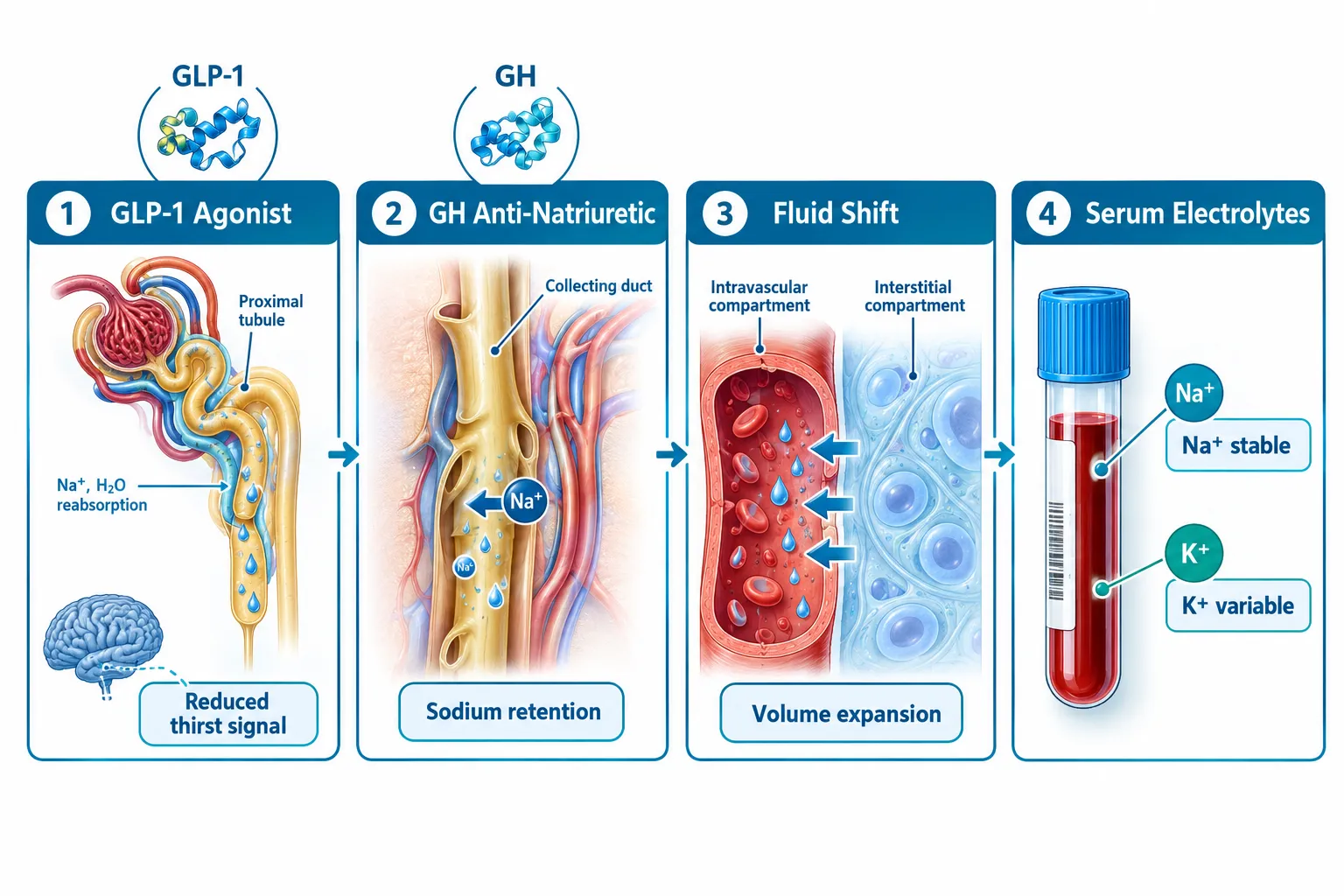
Both GLP-1 receptor agonists and growth-hormone-related peptides interact with the kidney in ways that directly alter sodium excretion, potassium distribution, and extracellular fluid volume. Understanding these mechanisms is the first step toward building controls that actually work.
Why Electrolyte Physiology Matters in GLP and GH Peptide Research

GLP-1 agonists reduce appetite and caloric intake, but they also suppress thirst, a phenomenon now described as hypodipsia. Subjects in GLP-1 models frequently show reduced spontaneous fluid consumption, raising the risk of mild-to-moderate dehydration. This matters because dehydration concentrates serum sodium, elevates hematocrit, and reduces glomerular filtration rate (GFR). If these changes are not tracked, a researcher may misattribute them to the peptide's metabolic action rather than to simple fluid deficit. Researchers working with GLP-3 R Peptide GA3 or GLP-3 R Peptide GA4 should treat hydration monitoring as a core protocol element, not an afterthought.

Growth hormone operates through a different but equally important mechanism. GH is anti-natriuretic: it increases renal tubular sodium reabsorption, expands extracellular fluid volume, and raises total body water. In GH-deficient subjects receiving replacement therapy, serum sodium and potassium often remain within normal reference ranges even as total-body sodium and water increase measurably. This dissociation between serum values and actual balance is a critical insight. Relying solely on a serum electrolyte panel will miss the fluid-volume shifts that inflate body weight and raise blood pressure, two of the most common endpoints in GH analogue studies.


Designing GLP-1 Models: Sodium, Potassium, and Hydration Controls

A well-designed GLP-1 model requires prospective hydration targets and a formalized electrolyte monitoring schedule built into the protocol from day one.

Hydration targets should be set at a defined minimum daily fluid intake, typically 30-35 mL per kilogram of body weight, and documented through daily fluid-intake logs. Subjects who fall below threshold on two or more consecutive days should trigger a protocol review. Urine-specific gravity measured at each morning sample collection provides a rapid, low-cost hydration proxy.

Sodium monitoring in GLP-1 models should include:

  • Baseline serum sodium before compound administration
  • Weekly serum sodium during active dosing
  • Urine sodium-to-creatinine ratio at baseline and at key timepoints
  • Dietary sodium standardization (target: 2,000-2,300 mg/day) or at minimum, a validated dietary recall at each visit

Potassium deserves separate attention. Rapid weight loss, which GLP-1 agonists can accelerate, increases the risk of hypokalemia through reduced dietary intake and increased renal losses. A serum potassium below 3.5 mEq/L should be a pre-specified action threshold: halt dose escalation, initiate dietary supplementation, and re-test within 72 hours.

"The most common electrolyte error in GLP-1 peptide models is treating hydration as a background variable rather than a controlled input."

For researchers sourcing compounds like Cagrilintide peptide or Retatrutide peptide, agents that combine GLP-1 and other receptor activity, the electrolyte burden is compounded, and monitoring frequency should increase accordingly.


Designing GH Models: Fluid Volume, Renal Endpoints, and Sampling Standards

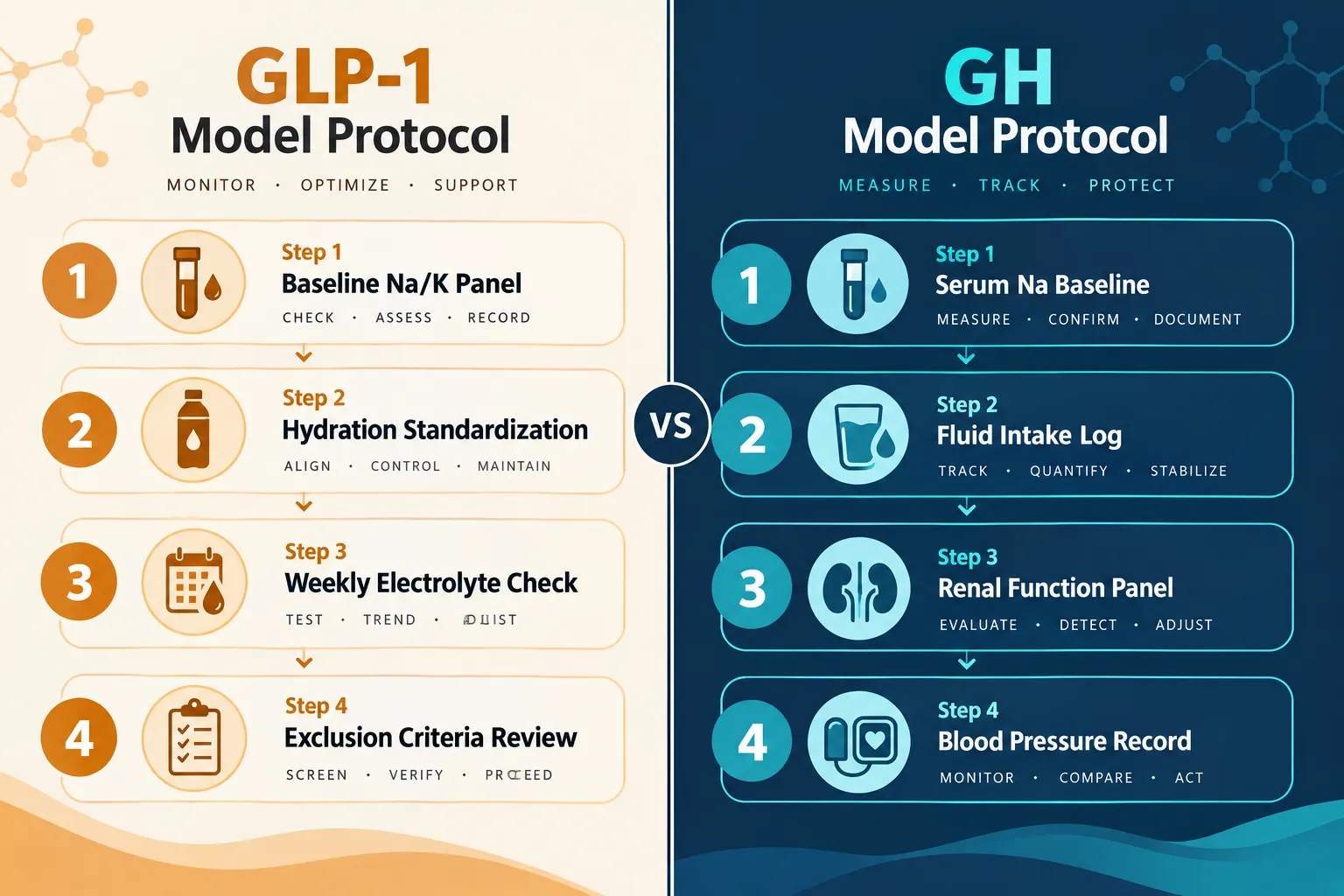
Growth-hormone models present a different design challenge. Because GH expands extracellular fluid without reliably shifting serum sodium outside normal ranges, standard chemistry panels alone are insufficient as electrolyte controls.
Designing GH Models: Fluid Volume, Renal Endpoints, and Sampling Standards

Recommended control variables for GH models include:

Variable Measurement Method Frequency
Serum sodium Venous blood draw Baseline, weeks 2, 4, 8
Total body water Bioimpedance or deuterium dilution Baseline and end-of-study
Blood pressure Standardized seated measurement Every visit
Urine sodium Spot urine Na/Cr ratio Baseline and monthly
Body weight Morning, post-void, fasted Every visit

The key principle here is morning, post-void, fasted body weight. Because GH-driven fluid retention fluctuates with activity, posture, and dietary sodium intake, weight measurements taken at inconsistent times introduce noise that can easily exceed the magnitude of the treatment effect being studied.

Researchers using GH analogue peptides or PEG-MGF peptide should also pre-specify renal endpoints. GH's anti-natriuretic effect is mediated partly through IGF-1-dependent increases in GFR and partly through direct tubular action. Both pathways can alter creatinine clearance, so eGFR should be tracked alongside electrolytes rather than treated as a separate safety variable.


Sampling Standardization and Exclusion Criteria

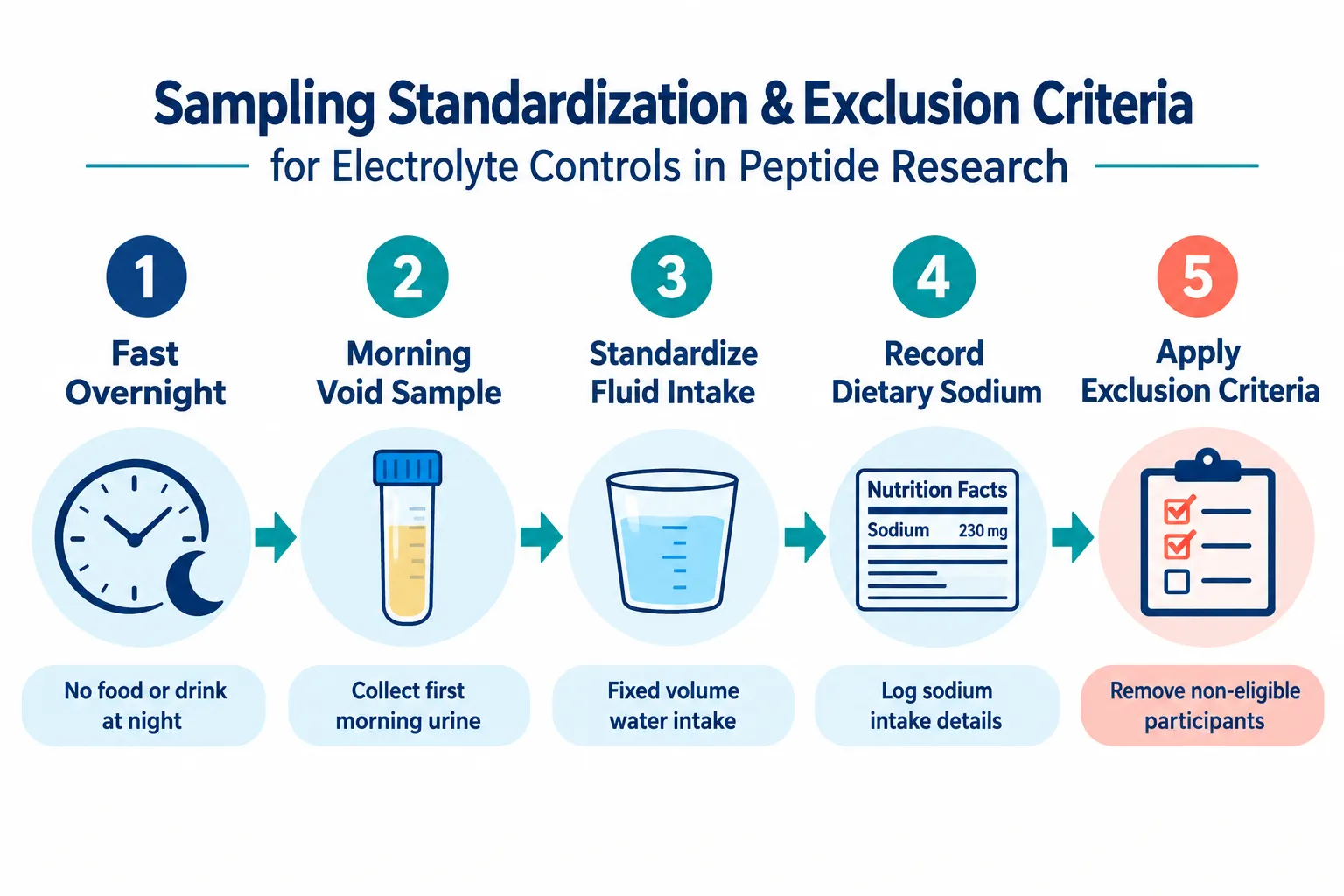
Reproducible electrolyte data requires standardized collection conditions. Variability in fasting duration, hydration state, or posture at blood draw can shift serum sodium by 2-4 mEq/L and potassium by 0.3-0.5 mEq/L, differences large enough to cross clinical action thresholds.
Sampling Standardization and Exclusion Criteria

Standardization checklist for every electrolyte sample:

  1. Overnight fast of at least 8 hours
  2. Morning collection (6:00-9:00 AM window)
  3. Seated rest for 10 minutes before venipuncture
  4. No strenuous exercise in the prior 24 hours
  5. Standardized fluid intake the evening before (250-500 mL water, no electrolyte beverages)
  6. Document any diuretic, laxative, or supplement use within 48 hours

Exclusion criteria should be applied at screening to protect endpoint validity. Subjects with baseline serum sodium below 135 or above 145 mEq/L, potassium below 3.5 or above 5.0 mEq/L, or eGFR below 60 mL/min/1.73 m² should be excluded from electrolyte-sensitive peptide models. These thresholds reduce the risk that a pre-existing imbalance will be misread as a compound effect.

For models involving MOTS-C peptide, which influences mitochondrial and metabolic function, or BPC-157 / TB-500 peptide in wound healing models, electrolyte controls serve a secondary but still meaningful role in ensuring that inflammatory and fluid shifts do not confound tissue-repair endpoints.


Conclusion

The integrity of GLP and growth-hormone peptide research depends on treating electrolytes and fluid balance as primary controlled variables, not secondary safety checks. Actionable next steps for researchers in 2026 include:

  • Build electrolyte monitoring into the protocol at study design, not as an amendment after data collection begins.
  • Set pre-specified action thresholds for sodium, potassium, and hydration markers with clear decision rules for dose adjustment or subject review.
  • Standardize all sampling conditions, fasting state, time of day, posture, and prior-evening fluid intake, and document deviations as protocol deviations, not minor notes.
  • Apply strict exclusion criteria at screening to remove subjects with baseline electrolyte abnormalities that would confound interpretation.
  • Separate serum values from total-body balance in GH models by adding bioimpedance or urine electrolyte measures alongside standard chemistry panels.

Electrolytes in peptide studies, specifically designing sodium, potassium, and fluid-balance controls for GLP and growth-hormone models, is no longer an optional refinement. It is a prerequisite for data that can withstand scrutiny and support meaningful conclusions.

Tags: electrolyte disturbance, electrolytes in peptide studies, fluid balance, glp-1 peptide research, growth hormone models, peptide study design, potassium monitoring, sodium control
https://www.puretestedpeptides.com/wp-content/uploads/2026/10/electrolytes-in-peptide-studies-designing-sodium-potassium-and-fluid-balance-con.webp 1024 1536 https://www.puretestedpeptides.com/wp-content/uploads/2026/01/buy-peptides-online.jpg 2026-10-09 13:05:152026-10-09 13:05:15Electrolytes in Peptide Studies: Designing Sodium, Potassium, and Fluid-Balance Controls for GLP and Growth-Hormone Models
You might also like
Peptides vs Classic Small-Molecule Drugs: How Compounds Like Prednisone, Amlodipine, and Metoprolol Differ From Modern Research-Use Peptides Peptides vs Classic Small-Molecule Drugs: How Compounds Like Prednisone, Amlodipine, and Metoprolol Differ From Modern Research-Use Peptides
Amlodipine in Peptide Research: Separating Calcium-Channel Effects From Blood-Pressure and Vascular Readouts Amlodipine in Peptide Research: Separating Calcium-Channel Effects From Blood-Pressure and Vascular Readouts
Prednisone and Metabolic Peptides: A Glucocorticoid-Control Framework for Glucose, Appetite, and Inflammation Experiments Prednisone and Metabolic Peptides: A Glucocorticoid-Control Framework for Glucose, Appetite, and Inflammation Experiments
Spironolactone and Peptide Research: Interpreting Potassium, Renal, Hormonal, and Fluid-Balance Variables Spironolactone and Peptide Research: Interpreting Potassium, Renal, Hormonal, and Fluid-Balance Variables
CJC-1295 With Ipamorelin: How to Separate Additive GH-Pulse Effects From Blend and Timing Artifacts CJC-1295 With Ipamorelin: How to Separate Additive GH-Pulse Effects From Blend and Timing Artifacts
Metoprolol in Incretin and Growth-Hormone Studies: Separating Heart-Rate Effects From Peptide Responses Metoprolol in Incretin and Growth-Hormone Studies: Separating Heart-Rate Effects From Peptide Responses
CJC-1295 With DAC vs Without DAC: Mechanism, Duration, and Research Design Differences CJC-1295 With DAC vs Without DAC: Mechanism, Duration, and Research Design Differences
PT-141 Peptide Research Safety Guide: Dosing, Timing, and Tolerability Questions Labs Ask PT-141 Peptide Research Safety Guide: Dosing, Timing, and Tolerability Questions Labs Ask
0 replies

Leave a Reply

Want to join the discussion?
Feel free to contribute!

Leave a Reply Cancel reply

Your email address will not be published. Required fields are marked *

×

Helpful Links

  • My account
  • Cart
  • Checkout
  • Refund and Returns Policy
  • Privacy Policy
  • SMS Privacy Policy
  • Login
  • My Account
  • Logout

USA Made Lab Tested Peptides

All products are sold for research, laboratory, or analytical purposes only, and are not for human consumption


Pure Tested Peptides is a chemical supplier. Pure Tested Peptides is not a compounding / chemical compounding facility as defined under 503A of the Federal Food, Drug, and Cosmetic act. Pure Tested Peptides is not an outsourcing facility as defined under 503B of the Federal Food, Drug, and Cosmetic act.

The statements made within this website have not been evaluated by the US Food and Drug Administration. The products we offer are not intended to diagnose, treat, cure or prevent any disease.

Human/Animal Consumption Prohibited. Laboratory/In-Vitro Experimental Use Only

Link to: GLP-3 Retatrutide Research Models: How to Separate GLP-1, GIP, and Glucagon Receptor Contributions Link to: GLP-3 Retatrutide Research Models: How to Separate GLP-1, GIP, and Glucagon Receptor Contributions GLP-3 Retatrutide Research Models: How to Separate GLP-1, GIP, and Glucagon...GLP-3 Retatrutide Research Models: How to Separate GLP-1, GIP, and Glucagon Receptor Contributions Link to: Where to Buy 5-Amino-1MQ and MOTS-c Research Materials: A COA, Identity, Purity, and Storage Checklist Link to: Where to Buy 5-Amino-1MQ and MOTS-c Research Materials: A COA, Identity, Purity, and Storage Checklist Where to Buy 5-Amino-1MQ and MOTS-c Research Materials: A COA, Identity, Purity, and Storage ChecklistWhere to Buy 5-Amino-1MQ and MOTS-c Research Materials: A COA, Identity, Purity,...
Scroll to top Scroll to top Scroll to top