

BPC-157 and TB-500 Combination Research: How to Test Additivity Without Assuming Synergy
Only three small pilot human studies of BPC-157 exist in the published literature, with a combined enrollment of roughly 30 participants, and not a single controlled trial has tested BPC-157 alongside TB-500 in people. Yet use of the so-called "Wolverine stack", combining these two peptides, has surged 33-fold between 2020 and 2026 in one observational dataset, driven largely by preclinical rodent data and influencer-led extrapolation. The gap between that popularity and the actual evidence base makes rigorous BPC-157 and TB-500 combination research not just useful, but necessary.
Key Takeaways
- No human clinical trial has ever tested BPC-157 and TB-500 together; all combination claims are extrapolated from animal or cell data.
- Synergy is a specific, measurable pharmacological claim, it must be distinguished from simple additivity using factorial designs and isobolograms.
- The correct experimental framework uses four groups: vehicle control, BPC-157 alone, TB-500 alone, and the combination.
- Relevant outcome measures include matrix remodeling markers, angiogenesis indices, barrier recovery scores, inflammation panels, and cell viability assays.
- Researchers should apply formal interaction statistics before reporting any combined effect as synergistic rather than merely additive or even antagonistic.
Why the Synergy Assumption Is a Research Problem
The phrase "synergy" is used loosely in peptide communities, but in pharmacology it carries a precise meaning: two agents together produce an effect greater than the sum of their individual effects at equivalent doses. Calling the BPC-157 and TB-500 combination synergistic without testing that claim is not a minor semantic issue, it shapes dosing rationale, safety expectations, and downstream regulatory arguments.
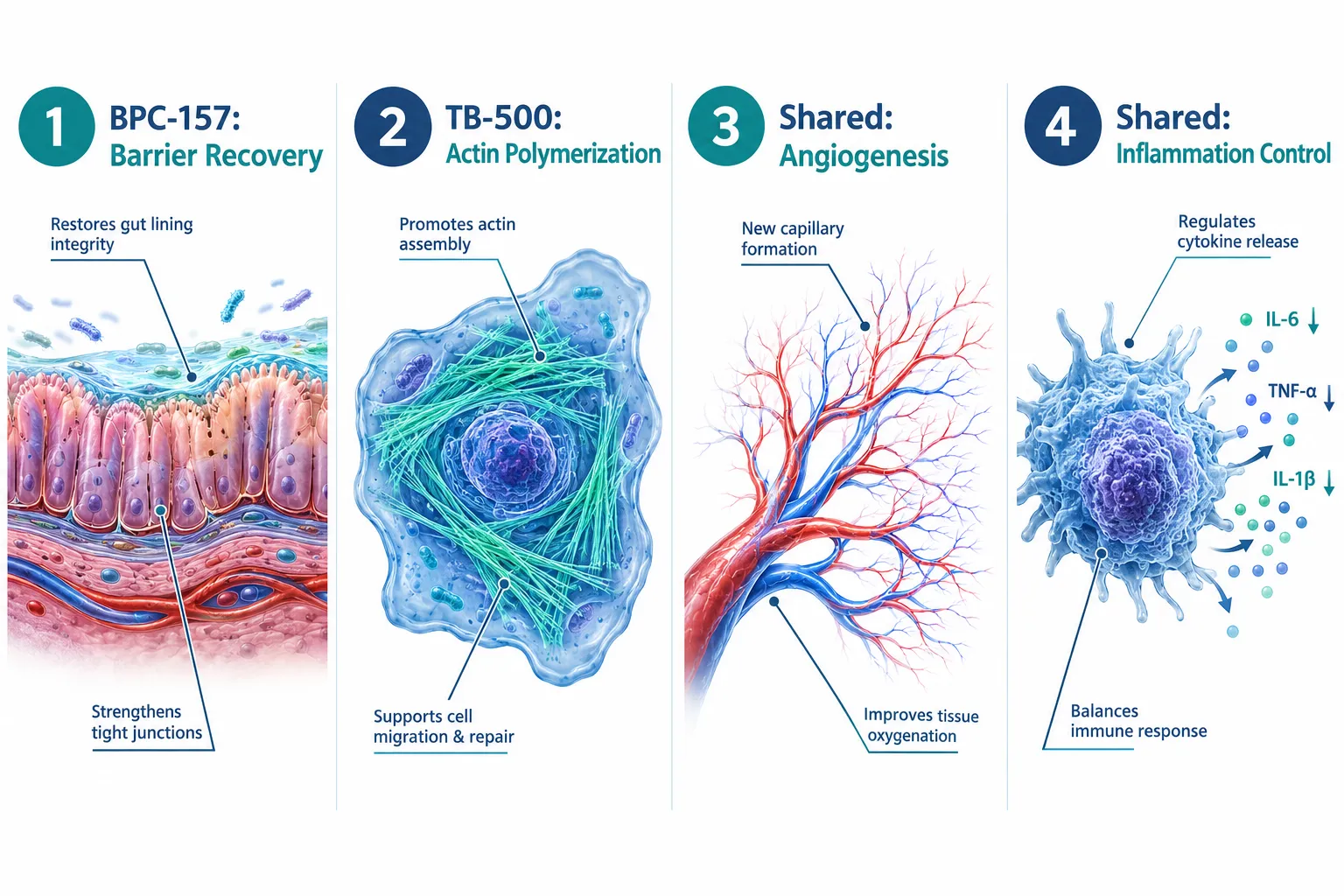
BPC-157 is a synthetic pentadecapeptide derived from a gastric protein. Its primary research interests include barrier recovery in gastrointestinal epithelium, modulation of nitric oxide signaling, and tendon-to-bone interface healing. TB-500 is a synthetic fragment of thymosin-beta-4, a protein involved in actin sequestration and cell migration. Its preclinical research focus centers on angiogenesis, satellite cell activation, and extracellular matrix remodeling. These two peptides act through partially overlapping but mechanistically distinct pathways.
That partial overlap is exactly why assuming synergy is problematic. When two agents share downstream targets, such as VEGF-driven angiogenesis or TGF-beta-mediated collagen synthesis, their combined effect may be purely additive, meaning each contributes its portion without amplifying the other. Some preclinical rodent models of tendon and muscle injury have shown that concurrent BPC-157 and TB-500 administration accelerated healing timelines compared with either peptide alone, with histological evidence of more organized collagen fiber deposition and earlier vascular network formation. However, none of those studies presented isobolograms, dose-response surfaces, or formal interaction statistics. Descriptive observations of faster healing cannot distinguish true synergy from additivity, and at least one preclinical summary noted that combined treatment did not provide additional benefit over individual peptides in certain models, directly undermining the universal synergy assumption.
"Descriptive observations of faster healing cannot distinguish true synergy from additivity without a formal interaction test."
The Factorial Design Framework for BPC-157 and TB-500 Combination Research
The gold standard for testing whether two agents interact, rather than simply add, is the factorial experiment. Applied to BPC-157 and TB-500 combination research, this means assigning subjects or cell preparations to four groups in a 2×2 matrix.
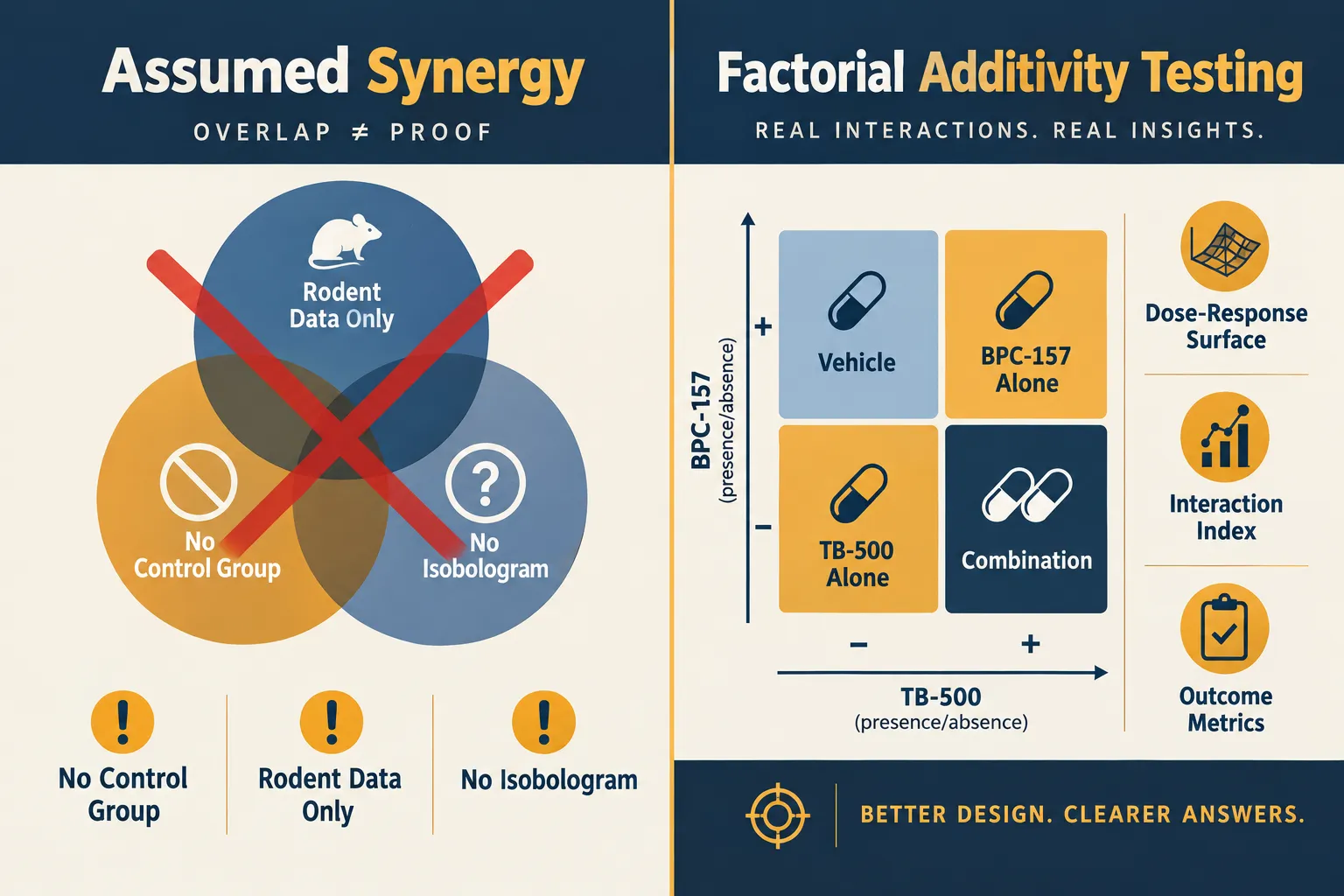
The four required groups:
| Group | BPC-157 | TB-500 |
|---|---|---|
| Vehicle control | No | No |
| BPC-157 alone | Yes | No |
| TB-500 alone | No | Yes |
| Combination | Yes | Yes |
Without all four groups, no interaction can be calculated. Many published preclinical studies compare only the combination group against a vehicle control, which conflates the individual contributions and makes it impossible to isolate any interaction term.
Selecting the right outcome measures matters equally. For BPC-157 and TB-500 combination research to generate interpretable data, endpoints should map to each peptide's known mechanism:
- Matrix remodeling: collagen type I/III ratio, MMP-2 and MMP-9 activity, hydroxyproline content
- Angiogenesis: CD31 staining density, VEGF expression, tube-formation assays in endothelial cells
- Barrier recovery: transepithelial electrical resistance, tight-junction protein expression (ZO-1, occludin)
- Inflammation: IL-6, TNF-alpha, IL-10 cytokine panels at defined time points
- Cell viability: MTT or ATP-based assays to confirm non-toxicity at tested concentrations
Once dose-response curves are established for each agent individually, the isobologram method plots equieffective dose combinations. Points falling on the line of additivity confirm simple additivity; points below it indicate synergy; points above indicate antagonism. The combination index (CI) derived from the Chou-Talalay method provides a quantitative summary statistic that is reportable and reproducible.
Applying the Framework: Practical Steps for Researchers
Translating the factorial framework into a workable protocol requires sequencing experiments carefully to avoid wasting resources on combination doses that fall outside the informative range.
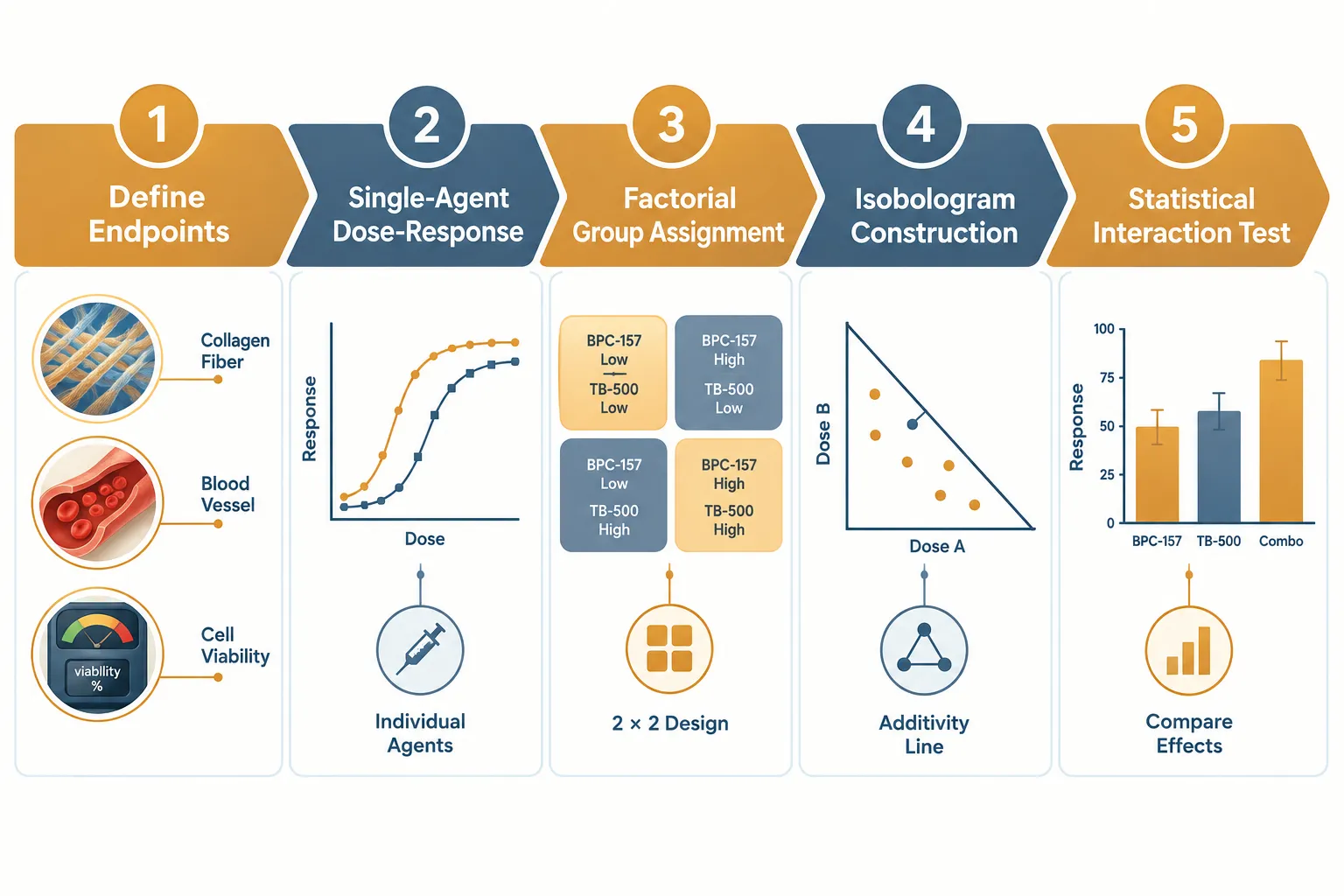
Step 1, Establish single-agent dose-response curves. Run BPC-157 and TB-500 individually across at least five concentrations bracketing the expected EC50. Use the outcome measures listed above, not just a single readout. This step is non-negotiable; without it, combination doses are chosen arbitrarily.
Step 2, Select fixed-ratio combination doses. Choose doses that correspond to fractions of each agent's EC50 (for example, 1:1, 2:1, 1:2 ratios). This preserves the ability to construct a meaningful isobologram.
Step 3, Run the full factorial experiment. Include vehicle, each single agent at each selected dose, and the combination at matched ratios. Blind outcome assessors to group assignment.
Step 4, Calculate the interaction index. Apply the CI method or a two-way ANOVA interaction term. Report the confidence interval around the interaction estimate, not just the point estimate.
Step 5, Replicate before concluding. A single experiment showing a sub-additive or supra-additive result is not sufficient. Biological replicates across at least two independent cell passages or animal cohorts are required before any interaction claim is published.
Researchers sourcing peptides for in vitro or preclinical work should consult a peptide supplier comparisons guide to evaluate purity documentation, as impure preparations introduce confounders that invalidate interaction analyses. Purity certificates and mass spectrometry data should accompany any research-grade material. For those exploring related dual-peptide interaction designs, the synergy of LL-37 and SS-31 framework offers a parallel methodological reference. Broader sourcing considerations are covered in the where to buy peptides resource. Researchers interested in other peptides with overlapping angiogenic or tissue-repair mechanisms may also find the GHK-Cu peptide sourcing guide and the SS-31 mitochondrial research themes overview useful for contextualizing multi-peptide experimental designs. For those examining growth-factor-adjacent peptides in musculoskeletal models, IGF-1 LR3 research products represent another mechanistically relevant comparison arm.
Conclusion
BPC-157 and TB-500 combination research sits at a critical juncture in 2026. Preclinical observations are intriguing, but they have been systematically over-interpreted as proof of synergy when the data support, at best, a hypothesis worth testing. The human evidence base, three small pilot BPC-157 studies, no TB-500 human trials, and no combination data whatsoever, cannot support clinical claims of any kind, let alone synergistic ones.
Actionable next steps for researchers:
- Design every combination experiment with all four factorial groups before collecting a single data point.
- Establish individual dose-response curves first; do not skip to combination testing.
- Choose outcome measures that map to the specific mechanisms of each peptide: matrix remodeling, angiogenesis, barrier recovery, inflammation, and cell viability.
- Apply the isobologram or CI method and report interaction confidence intervals.
- Replicate findings across independent biological systems before drawing conclusions about interaction type.
- Clearly label any findings as preclinical and resist extrapolating to human dosing or clinical benefit.
The scientific value of BPC-157 and TB-500 combination research will only be realized when the field replaces assumption-driven stacking narratives with interaction-design frameworks built on measurable, reproducible pharmacological evidence.


Leave a Reply
Want to join the discussion?Feel free to contribute!