

Retatrutide vs Ozempic in the 2026 Diabetes Trial: How Researchers Should Interpret A1C, Weight, and Cardiometabolic Endpoints
Fewer than 20% of type 2 diabetes patients in landmark GLP-1 trials have ever achieved near-normoglycemia, an HbA1c below 5.7%. That threshold may now be within reach for a substantial proportion of patients treated with retatrutide, a finding that fundamentally changes how researchers must frame comparative endpoints. As phase 3 programs for retatrutide advance in 2026, the question surrounding Retatrutide vs Ozempic in the 2026 Diabetes Trial: How Researchers Should Interpret A1C, Weight, and Cardiometabolic Endpoints is no longer simply "which drug works better" but rather how to design and interpret endpoints that accurately capture a mechanistically distinct compound against an already-approved standard of care.
Key Takeaways
- Retatrutide is a triple agonist targeting GIP, GLP-1, and glucagon receptors, while Ozempic (semaglutide) acts on GLP-1 receptors alone, a distinction that shapes every endpoint interpretation decision.
- Phase 2 diabetes data show retatrutide lowering HbA1c by up to 2.0 percentage points and driving body weight loss of approximately 16.9% at the highest dose, figures that exceed typical diabetes-dose semaglutide benchmarks.
- No completed head-to-head trial against Ozempic exists as of late 2026; all comparative claims remain cross-trial projections.
- Researchers must treat cardiometabolic endpoints, blood pressure, lipids, fasting glucose, as co-primary or key secondary outcomes rather than exploratory add-ons.
- Estimand choice, background medication tracking, and duration of follow-up are critical methodological factors that can confound or clarify drug-mediated effects.
Understanding the Receptor Biology Before Interpreting Trial Outcomes
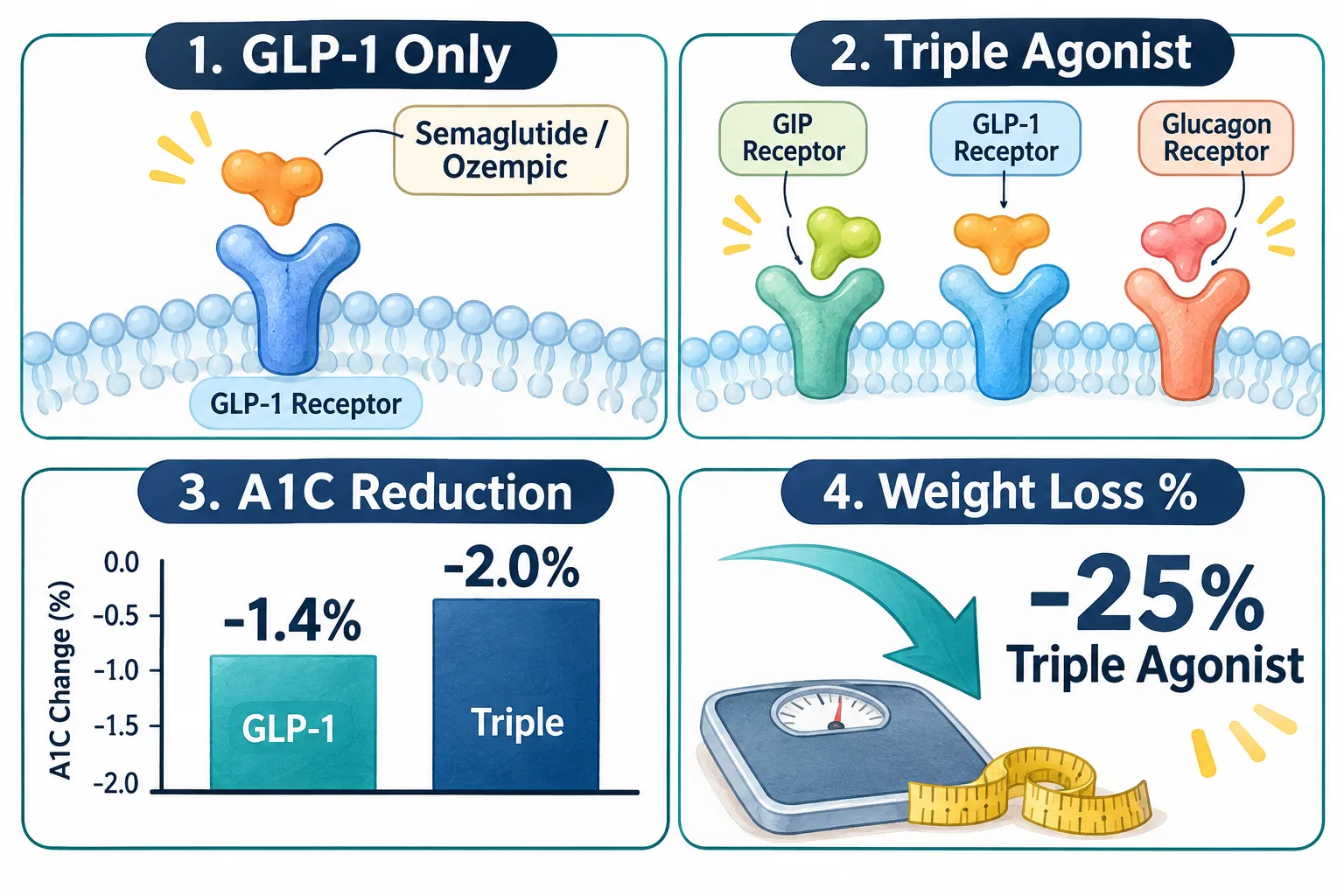
Any rigorous interpretation of Retatrutide vs Ozempic in the 2026 Diabetes Trial: How Researchers Should Interpret A1C, Weight, and Cardiometabolic Endpoints must begin at the receptor level. Retatrutide, sometimes referred to in research sourcing contexts as a GLP-3 Reta compound, simultaneously engages GIP, GLP-1, and glucagon receptors. Ozempic engages only the GLP-1 receptor. This is not a minor pharmacological nuance; it determines the magnitude and character of every downstream outcome.
Why this matters for A1C interpretation:
- GLP-1 receptor activation suppresses glucagon and enhances insulin secretion.
- GIP receptor co-activation further amplifies insulin response and may enhance beta-cell preservation.
- Glucagon receptor agonism drives hepatic glucose output and energy expenditure, effects absent with semaglutide.
In phase 2 diabetes trials, retatrutide at 4 to 12 mg weekly reduced HbA1c by approximately 1.3 to 2.0 percentage points over six months. Up to 82% of participants reached HbA1c below 6.5%, and up to 31% achieved levels below 5.7%. Comparable dulaglutide arms in the same trial showed a 1.4-percentage-point reduction, placing single-agent GLP-1 benchmarks in context.
Researchers comparing these figures to Ozempic must account for the fact that the active comparator in retatrutide's diabetes trial was dulaglutide, not semaglutide. Cross-trial comparisons introduce confounding from different populations, baseline HbA1c distributions, and background therapies. Any direct retatrutide vs Ozempic claim, until a shared-protocol head-to-head trial is published, is a projection, not a conclusion.
Endpoint Harmonization: A1C, Weight, and the Problem of Siloed Outcomes
The core methodological challenge for researchers working on trials comparing retatrutide and semaglutide is endpoint siloing, the historical practice of analyzing A1C as the primary outcome and treating weight loss as secondary. For a triple agonist whose glucagon receptor activity drives meaningful energy expenditure independent of glucose metabolism, this framework is insufficient.
Recommended endpoint structure for 2026 diabetes trials:
| Endpoint Category | Specific Measures | Priority Level |
|---|---|---|
| Glycemic | HbA1c, fasting glucose, % achieving <6.5% and <5.7% | Co-primary |
| Body Weight | Absolute change (kg) and percent change from baseline | Co-primary |
| Cardiometabolic | Systolic/diastolic BP, LDL, triglycerides, total cholesterol | Key secondary |
| Composite | Composite cardiometabolic risk score | Exploratory |
Phase 2 retatrutide obesity data reported mean weight reductions of approximately 17.6% at 4 mg, 23.7% at 9 mg, and 25.0% at 12 mg versus roughly 3.9% with placebo. These reductions rival or exceed high-dose semaglutide obesity data, but they come from a shorter phase 2 program with a different population. Researchers should resist the temptation to stack these figures against Ozempic's diabetes-dose weight outcomes, which typically fall in the 4 to 6% range.
Estimand selection is non-negotiable. Two primary estimand strategies apply:
- Treatment-regimen estimand, captures all data regardless of treatment discontinuation. Preferred for real-world effectiveness modeling.
- Efficacy estimand, captures outcomes only while participants remain on treatment. Better for understanding drug biology.
Given retatrutide's dose-dependent gastrointestinal side effect profile at higher doses, discontinuation rates will differ meaningfully between arms. Without pre-specifying the estimand, the same dataset can produce materially different conclusions.
For researchers sourcing retatrutide for preclinical or laboratory investigation, formulations such as GLP3 Reta CAG 10mg for sale and GLP3 Reta 20mg GA5 are available through specialized peptide suppliers, allowing receptor-level mechanistic work independent of ongoing clinical programs.
Cardiometabolic Endpoints: Hypothesis-Generating, Not Definitive

The third dimension of Retatrutide vs Ozempic in the 2026 Diabetes Trial: How Researchers Should Interpret A1C, Weight, and Cardiometabolic Endpoints concerns the breadth of metabolic markers beyond glucose and weight. Across phase 2 obesity and diabetes studies, retatrutide consistently produced reductions in systolic and diastolic blood pressure, LDL cholesterol, triglycerides, total cholesterol, fasting glucose, and fasting insulin at both 24 and 48 weeks.
A 2026 study in obstructive sleep apnea patients, a cardiometabolic high-risk group, provided up to 80 weeks of data at 9 mg and 12 mg doses, showing durable weight loss and parallel improvement in metabolic risk markers. This longer follow-up is valuable, but OSA populations carry different baseline cardiovascular risk profiles than classic type 2 diabetes cohorts.
Key cautions for researchers interpreting cardiometabolic signals:
- These are largely phase 2 findings without a dedicated cardiovascular outcome trial. They are hypothesis-generating, not cardioprotective proof.
- Blood pressure reductions may be driven primarily by weight loss rather than direct receptor-mediated effects. Researchers must track concomitant antihypertensive and lipid-lowering therapy use throughout the trial period to isolate drug-specific contributions.
- Ozempic carries established cardiovascular outcome trial data from SUSTAIN-6. Retatrutide does not yet have an equivalent.
The triple agonist mechanism does, in theory, offer a broader "metabolic reset" than GLP-1 alone, glucagon receptor activity drives thermogenesis and hepatic lipid metabolism in ways semaglutide does not. Expert commentary in 2026 has described retatrutide as a potential next-generation metabolic drug if phase 3 safety and durability data confirm what phase 2 suggests.
Researchers exploring this mechanism at the laboratory level can access buy GLP-3 Reta formulations and GLP-3 Reta 20mg preparations for in vitro and preclinical receptor binding and signaling studies. Those working on complementary mitochondrial or oxidative stress pathways may also find value in reviewing SS-31 mechanism and research as a parallel investigative reference.
Phase 3 retatrutide programs are expected to incorporate more rigorous cardiovascular and renal endpoints and may include active semaglutide comparator arms. Until those trials read out, any direct retatrutide vs Ozempic cardiometabolic claim should be framed explicitly as a projection, not a data-driven conclusion.
Conclusion
The critical lesson from examining Retatrutide vs Ozempic in the 2026 Diabetes Trial: How Researchers Should Interpret A1C, Weight, and Cardiometabolic Endpoints is that standard single-axis endpoint frameworks fail to capture the mechanistic breadth of a triple agonist. Researchers must move beyond A1C as a standalone primary outcome and adopt co-primary structures that equally weight glycemic control, body weight, and a defined cardiometabolic panel.
Actionable next steps for investigators:
- Pre-specify estimand type before any retatrutide-semaglutide comparative analysis.
- Include both absolute and percent body weight change as co-primary endpoints alongside HbA1c.
- Document concomitant antihypertensive and lipid-lowering therapies at baseline and throughout follow-up.
- Classify cardiometabolic findings as hypothesis-generating until cardiovascular outcome trials confirm durability.
- Await phase 3 shared-protocol data before publishing direct head-to-head efficacy claims.
The 2026 landscape positions retatrutide as a compelling investigational candidate, but rigorous methodology, not enthusiasm, must drive how its trial outcomes are interpreted against established agents like Ozempic.


Leave a Reply
Want to join the discussion?Feel free to contribute!