

Nasal Spray Peptides: Delivery Methods, Bioavailability, and Research Advantages
Oral peptide drugs lose up to 98% of their active compound before reaching systemic circulation, a pharmacokinetic obstacle that has pushed researchers toward alternative administration routes for decades. Among those alternatives, intranasal delivery has emerged as one of the most scientifically compelling options. Understanding nasal spray peptides: delivery methods, bioavailability, and research advantages is now central to designing effective preclinical protocols and advancing peptide science.
Key Takeaways
- Intranasal delivery bypasses first-pass hepatic metabolism, dramatically improving peptide bioavailability compared to oral routes.
- The nasal mucosa and the olfactory pathway offer two distinct absorption mechanisms, each with different speed and target profiles.
- Peptides such as Semax, Selank, and blend formulations have been studied specifically for intranasal administration.
- Formulation variables, including pH, viscosity, and particle size, directly affect how much peptide reaches systemic or central targets.
- Researchers sourcing compounds for intranasal studies benefit from verified purity data to ensure consistent experimental outcomes.
Why Delivery Route Defines Peptide Research Outcomes
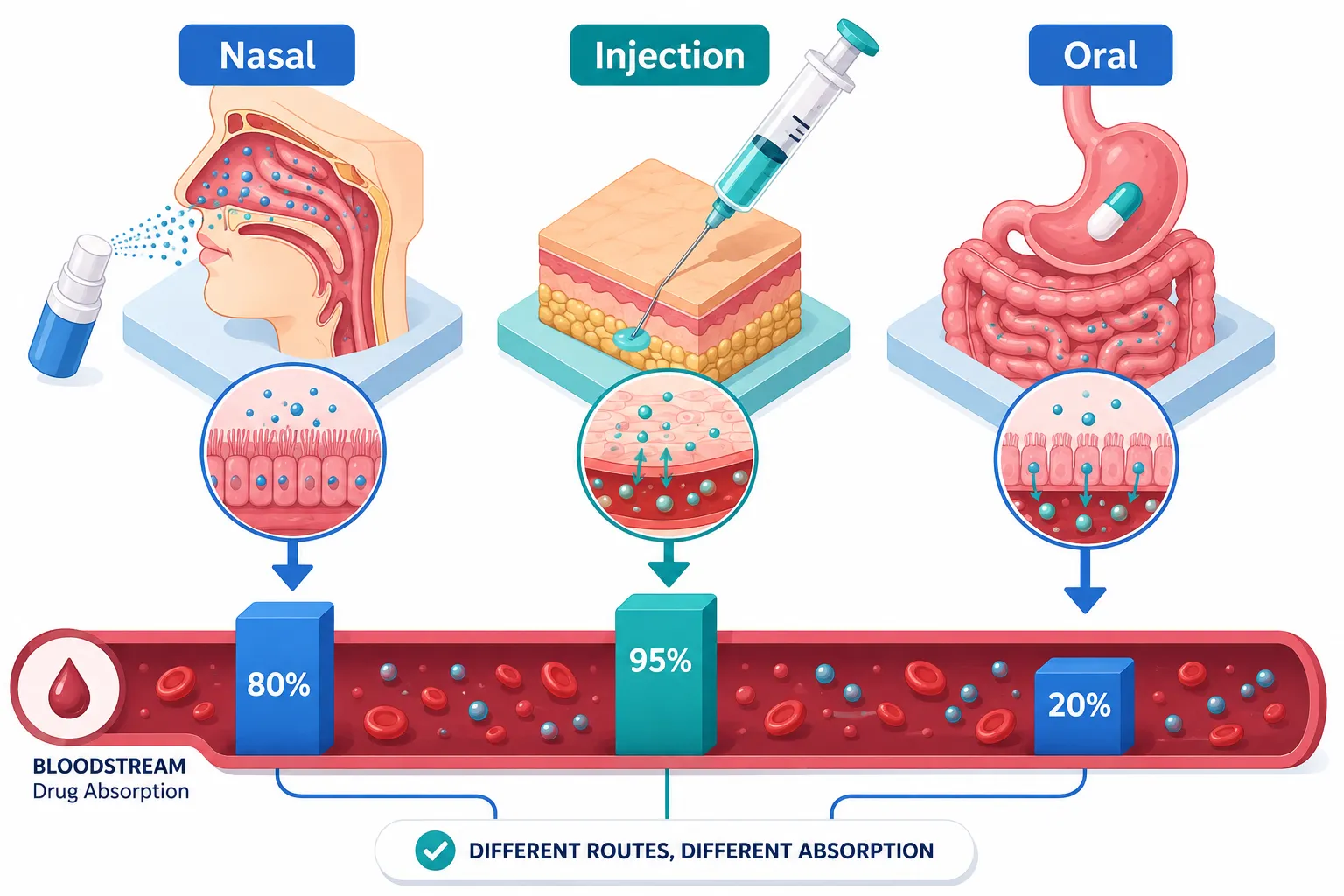
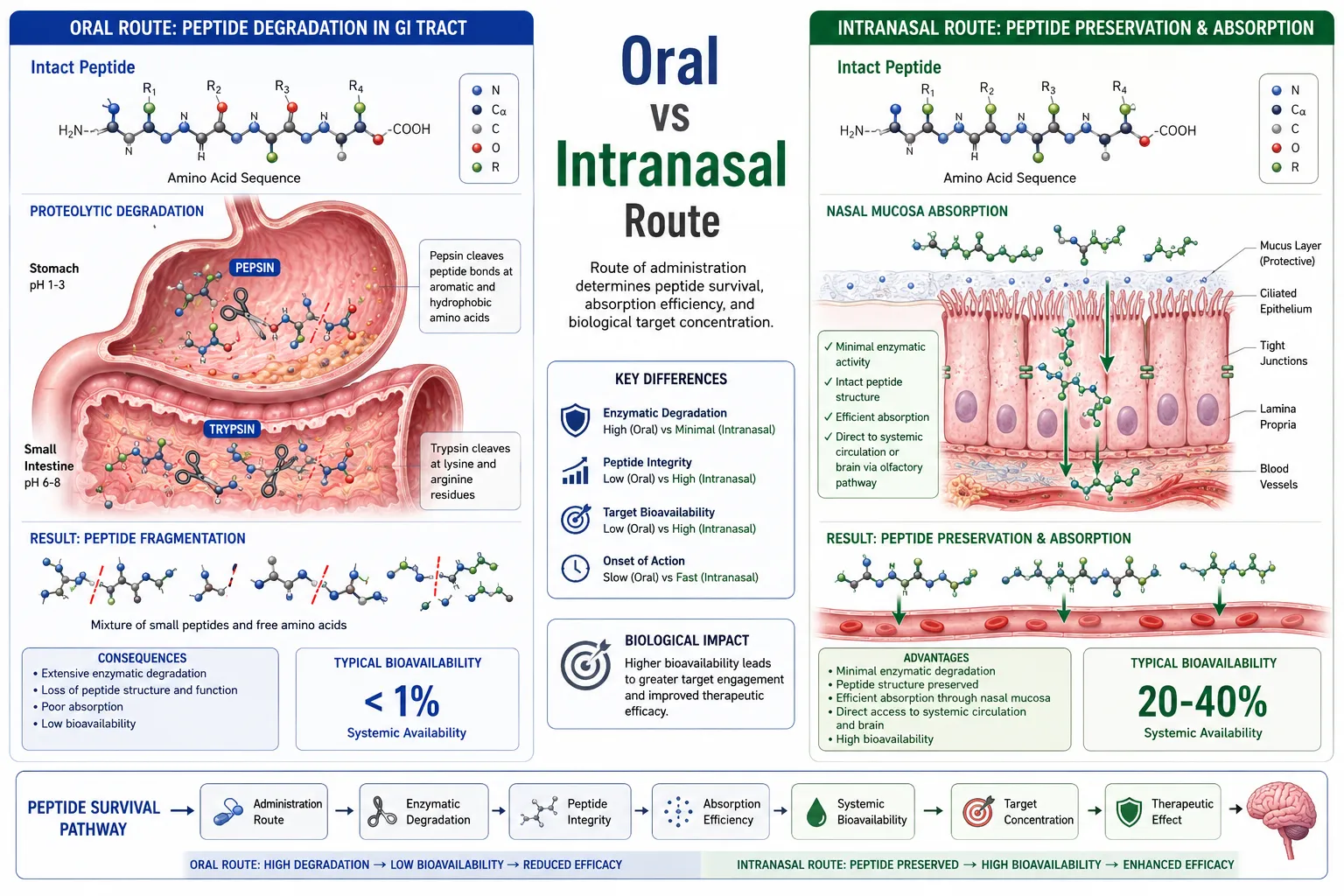
The route of administration is not a minor logistical detail, it is a primary determinant of whether a peptide compound reaches its biological target at a meaningful concentration. Peptides are chains of amino acids. When taken orally, proteolytic enzymes in the gastrointestinal tract cleave those chains aggressively, and the liver further metabolizes whatever survives absorption. The result is negligible systemic exposure.
Injection, subcutaneous or intravenous, solves the degradation problem but introduces practical constraints in research settings: sterility requirements, tissue trauma at repeated dosing sites, and compliance challenges in longer study designs.
Intranasal delivery occupies a unique middle ground. The nasal epithelium is highly vascularized. Peptides applied to the nasal mucosa can diffuse directly into submucosal capillaries, entering systemic circulation without hepatic first-pass processing. For researchers studying peptides like those found in BPC-157 and TB-500 blend formulations, understanding how delivery route affects compound behavior is foundational.
The Olfactory Pathway: A Direct CNS Route
Beyond systemic absorption, the nasal cavity offers something injection cannot easily replicate: a potential direct route to the central nervous system via the olfactory epithelium. The olfactory nerve fibers run from the nasal roof to the olfactory bulb, bypassing the blood-brain barrier. This pathway has been studied extensively for neuropeptides, where CNS exposure is the primary research objective.
Peptides designed for cognitive or neurological research models, including Semax and Selank, are frequently formulated as nasal sprays precisely because this pathway may deliver compound to brain tissue faster and at higher concentrations than peripheral injection followed by CNS diffusion.
Bioavailability Factors in Nasal Spray Peptide Formulations
Bioavailability from nasal delivery is not automatic. Several formulation variables determine how efficiently a peptide crosses the nasal epithelium.
Key Formulation Variables
| Variable | Effect on Bioavailability |
|---|---|
| Molecular weight | Peptides under 1,000 Da absorb more readily |
| pH of solution | Must match nasal mucosa range (6.4-7.4) |
| Viscosity | Higher viscosity extends mucosal contact time |
| Particle/droplet size | 10-50 micron range targets turbinate deposition |
| Permeation enhancers | Cyclodextrins and chitosan improve epithelial crossing |
Mucociliary clearance is the main competing force. The nasal mucosa clears deposited material toward the nasopharynx within 15-20 minutes. Formulations must either absorb rapidly or use mucoadhesive agents to extend residence time.
Preservatives matter too. Benzalkonium chloride, commonly used in commercial nasal sprays, has shown ciliotoxic effects at certain concentrations in research models. Researchers using peptide nasal sprays in controlled studies often prefer preservative-free formulations to avoid confounding variables.
For researchers exploring Klow blend peptides or Glow blend peptides, formulation details are directly relevant to how intranasal administration protocols are designed.
Research Advantages of Nasal Spray Peptides: Delivery Methods, Bioavailability, and Research Advantages in Practice

The scientific case for intranasal peptide delivery in research settings rests on several converging advantages.
Rapid Onset and CNS Accessibility
Nasal absorption produces measurable plasma concentrations within minutes. For time-sensitive research endpoints, acute behavioral studies, rapid neurological assessments, this speed is a significant protocol advantage over subcutaneous injection, which typically peaks at 20-40 minutes post-dose depending on compound and vehicle.
Reduced Systemic Burden
Because intranasal delivery can target CNS endpoints via the olfactory route, researchers can potentially achieve meaningful brain exposure at lower total doses than systemic injection would require. Lower doses reduce off-target peripheral effects, which simplifies data interpretation.
Non-Invasive Repeated Dosing
Chronic study designs benefit enormously from non-invasive administration. Repeated injection introduces stress variables and injection-site pathology that can confound longitudinal data. Nasal spray administration reduces these confounders, improving data quality across multi-week protocols.
Researchers comparing growth hormone-related peptides, such as those reviewed in GHRP-2 versus Sermorelin research comparisons, often evaluate delivery route as part of their experimental design because administration method directly affects pharmacokinetic profiles.
Compound Integrity and Purity Requirements
Intranasal formulations demand high compound purity. Endotoxin contamination or degradation byproducts that might be tolerable in some systemic models become more significant when compound is delivered near olfactory nerve tissue. Researchers sourcing peptides from verified peptide stores with documented third-party testing reduce this risk substantially.
For compounds like those in the IPA peptides category, purity documentation is not optional, it is a baseline requirement for credible intranasal research design.
Conclusion
Nasal spray peptides: delivery methods, bioavailability, and research advantages represent a convergence of pharmacokinetics, formulation science, and practical research design. The intranasal route bypasses hepatic metabolism, offers potential direct CNS access via the olfactory pathway, and supports non-invasive repeated dosing, three properties that make it uniquely valuable for peptide research.
Actionable next steps for researchers:
- Evaluate molecular weight and lipophilicity of target peptides before selecting intranasal as the primary route.
- Specify formulation parameters (pH, viscosity, particle size) in protocols to ensure reproducibility.
- Source compounds with verified purity certificates and endotoxin testing data.
- Compare intranasal pharmacokinetic data against subcutaneous controls in pilot studies before committing to full experimental runs.
- Review published olfactory pathway research to understand CNS exposure assumptions for specific peptide classes.
Delivery science is not secondary to compound selection, it is half the experiment.


Leave a Reply
Want to join the discussion?Feel free to contribute!