

Peptides and Polypeptides in Basic Cell Biology: How GLP-3, MOTS-c, and 5-Amino-1MQ Are Used to Probe Mitochondria and ATP Production
{"cover":"Professional landscape format (1536×1024) hero image with bold text overlay 'Peptides and Polypeptides in Basic Cell' in crisp white sans-serif on a deep teal semi-transparent overlay panel, centered with 8% safe margins from every edge, no character touches the edge. Background: stunning macro scientific illustration of a glowing mitochondrion cross-section with ATP molecule structures floating around it, molecular chain peptide strands woven through the composition, electric blue and teal bioluminescent glow against a deep navy background, editorial biomedical magazine aesthetic, ultra-sharp, high contrast.","content":["Annotated mechanism-of-action diagram, landscape format (1536×1024), showing three distinct labeled panels side by side on a clean white background with teal-and-navy palette. Panel 1 labeled 'GLP-3 / Retatrutide' shows a stylized gut-to-brain signaling arc with callout labels: 'Triple Agonist', 'Systemic Energy', 'Incretin Axis'. Panel 2 labeled 'MOTS-c' shows a mitochondria cross-section with callout lines pointing to 'AMPK Activation', 'AMP/ATP Ratio', 'Mitochondrial Genome'. Panel 3 labeled '5-Amino-1MQ' shows a NAD+ salvage pathway arrow diagram with labels 'NNMT Inhibitor', 'NAD+ Boost', 'Seahorse Assay'. Thin black callout lines, editorial medical-guide polish, each panel separated by a thin rule line.","Split-screen annotated diagram, landscape format (1536×1024), cool blue-and-white laboratory palette. Left half: a detailed cross-section illustration of a mitochondrion with labeled inner membrane cristae, ATP synthase complex, electron transport chain, and MOTS-c peptide binding site marked with a bright orange callout dot and label 'MOTS-c Entry Point'. Right half: a Seahorse XF analyzer assay readout graph illustration showing three colored curves labeled 'Basal Respiration', 'Maximal Capacity', 'ATP-Linked OCR' with 5-Amino-1MQ treatment annotations, clean gridlines, sharp scientific poster aesthetic, no pricing or dollar figures.","Numbered step-by-step process flow diagram, landscape format (1536×1024), warm amber and slate-gray palette on a light cream background. Five horizontal steps connected by thick directional arrows: Step 1 'Select Research Peptide' with small icons for GLP-3, MOTS-c, 5-Amino-1MQ; Step 2 'Verify Purity and CoA' with a certificate icon; Step 3 'Design Cell Model' showing a petri dish icon; Step 4 'Run Metabolic Assay' showing a Seahorse instrument icon; Step 5 'Analyze ATP Output' showing a bar graph icon. Each step box has a short 3-word sub-label beneath it. Clean editorial infographic style, bold step numbers in amber circles, non-overlapping labels inside 5% safe margin."]
Mitochondria produce roughly 90% of the ATP that keeps every mammalian cell alive, yet the molecular tools researchers use to interrogate that process have expanded dramatically in just the past few years. The study of peptides and polypeptides in basic cell biology, specifically how GLP-3, MOTS-c, and 5-Amino-1MQ are used to probe mitochondria and ATP production, now sits at the center of metabolic research. Each of these agents targets a distinct node in cellular energy metabolism, giving investigators complementary windows into how cells generate, sense, and adapt their energy supply.
Key Takeaways
- MOTS-c is a mitochondria-derived peptide that activates the AMPK pathway and directly signals cellular energy stress through changes in the AMP/ATP ratio.
- 5-Amino-1MQ is a selective NNMT inhibitor that raises NAD+ availability and measurably increases mitochondrial respiration in preclinical cell models.
- GLP-3 (as part of the retatrutide triple-agonist platform) probes systemic energy expenditure rather than direct mitochondrial ATP synthesis.
- All three agents remain strictly research-grade tools as of 2026; no human clinical trials for 5-Amino-1MQ have been published, and regulatory status for each is limited.
- Purity and documentation standards are essential when sourcing any of these compounds for laboratory use.
Understanding the Three Agents: GLP-3, MOTS-c, and 5-Amino-1MQ
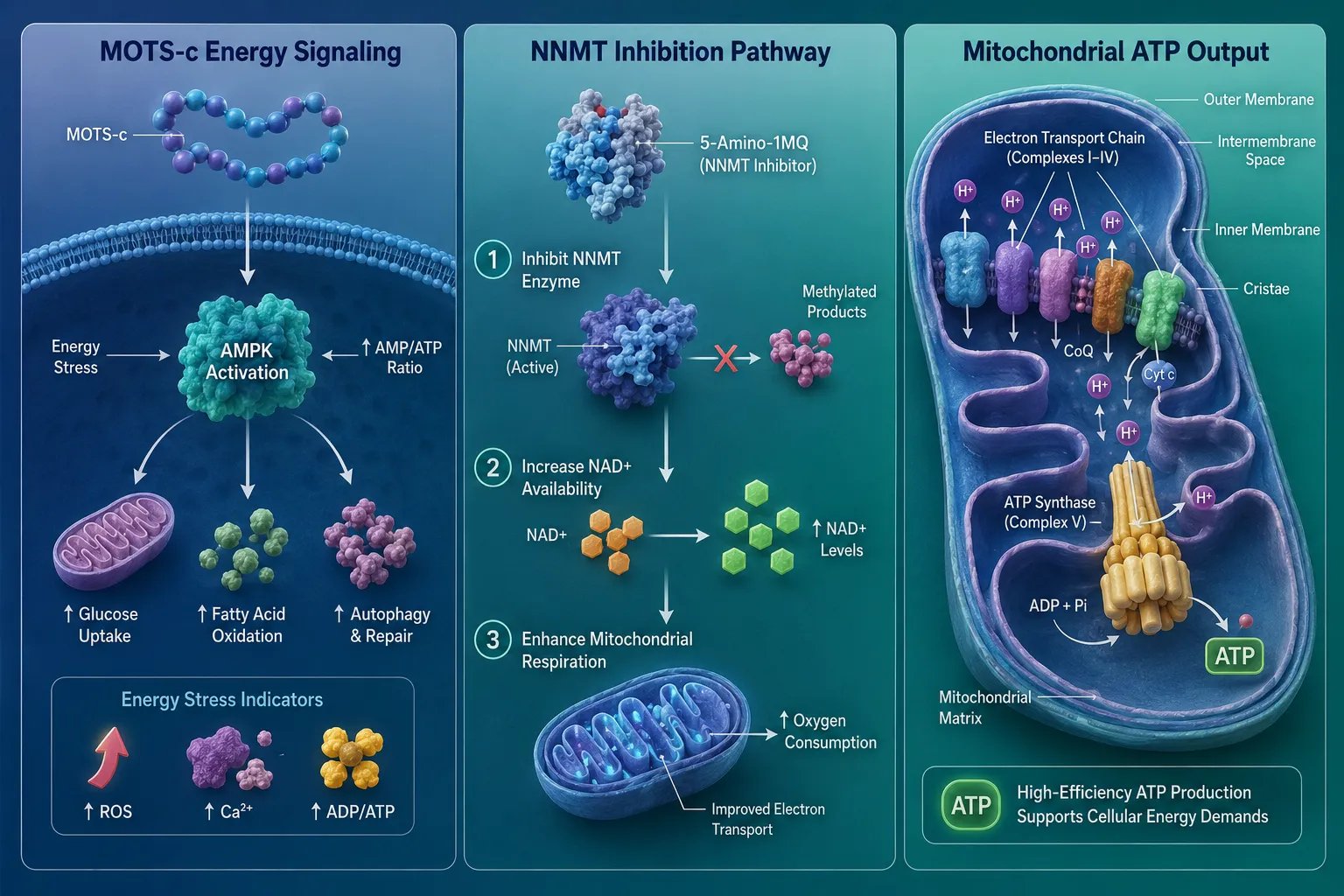
To appreciate how peptides and polypeptides in basic cell biology, including GLP-3, MOTS-c, and 5-Amino-1MQ, are used to probe mitochondria and ATP production, it helps to understand what each molecule actually is and where it acts.
GLP-3 and the Retatrutide Platform
GLP-3 is not a standalone peptide in the same sense as MOTS-c. In current research contexts, "GLP-3" most often refers to the glucagon-like peptide-3 component within retatrutide, a triple agonist that simultaneously targets GIP, GLP-1, and glucagon receptors. Retatrutide is currently in Phase 3 clinical development. Its research value lies in probing systemic energy expenditure, how the body allocates and burns fuel across tissues, rather than directly measuring mitochondrial ATP synthesis. Researchers studying incretin biology can explore GLP peptide frameworks to understand how receptor co-activation reshapes whole-body metabolism.
"GLP-3/retatrutide functions as a systemic energy sensor, making it a powerful tool for studying fuel partitioning across tissues rather than ATP generation at the organelle level."
MOTS-c: A Peptide Encoded in the Mitochondrial Genome
MOTS-c is a 16-amino-acid peptide encoded directly within the mitochondrial 12S rRNA gene. This origin makes it unique: it is one of the few known peptides that the mitochondria themselves produce. Its primary research mechanism involves activating AMPK (AMP-activated protein kinase) by raising the intracellular AMP/ATP ratio. When ATP levels drop and AMP accumulates, MOTS-c signals that the cell is under energy stress, triggering compensatory metabolic responses.
Recent preclinical data published in mid-2025 showed that MOTS-c can restore mitochondrial respiration in a diabetic heart model without proportionally increasing the ATP production rate, a nuanced finding that reveals how mitochondrial quality can be decoupled from raw ATP output. For researchers building mitochondrial assay panels, MOTS-c and Elamipretide represent complementary tools for interrogating different layers of organelle function. Those looking to source this compound for laboratory work can review options to buy MOTS-c peptide through verified suppliers.
5-Amino-1MQ: NNMT Inhibition and the NAD+ Salvage Pathway
5-Amino-1MQ is a small, membrane-permeable molecule that selectively inhibits NNMT (nicotinamide N-methyltransferase). NNMT consumes SAM (S-adenosylmethionine) and nicotinamide, effectively diverting nicotinamide away from NAD+ synthesis. By blocking NNMT, 5-Amino-1MQ redirects nicotinamide into the NAD+ salvage pathway, raising intracellular NAD+ concentrations.
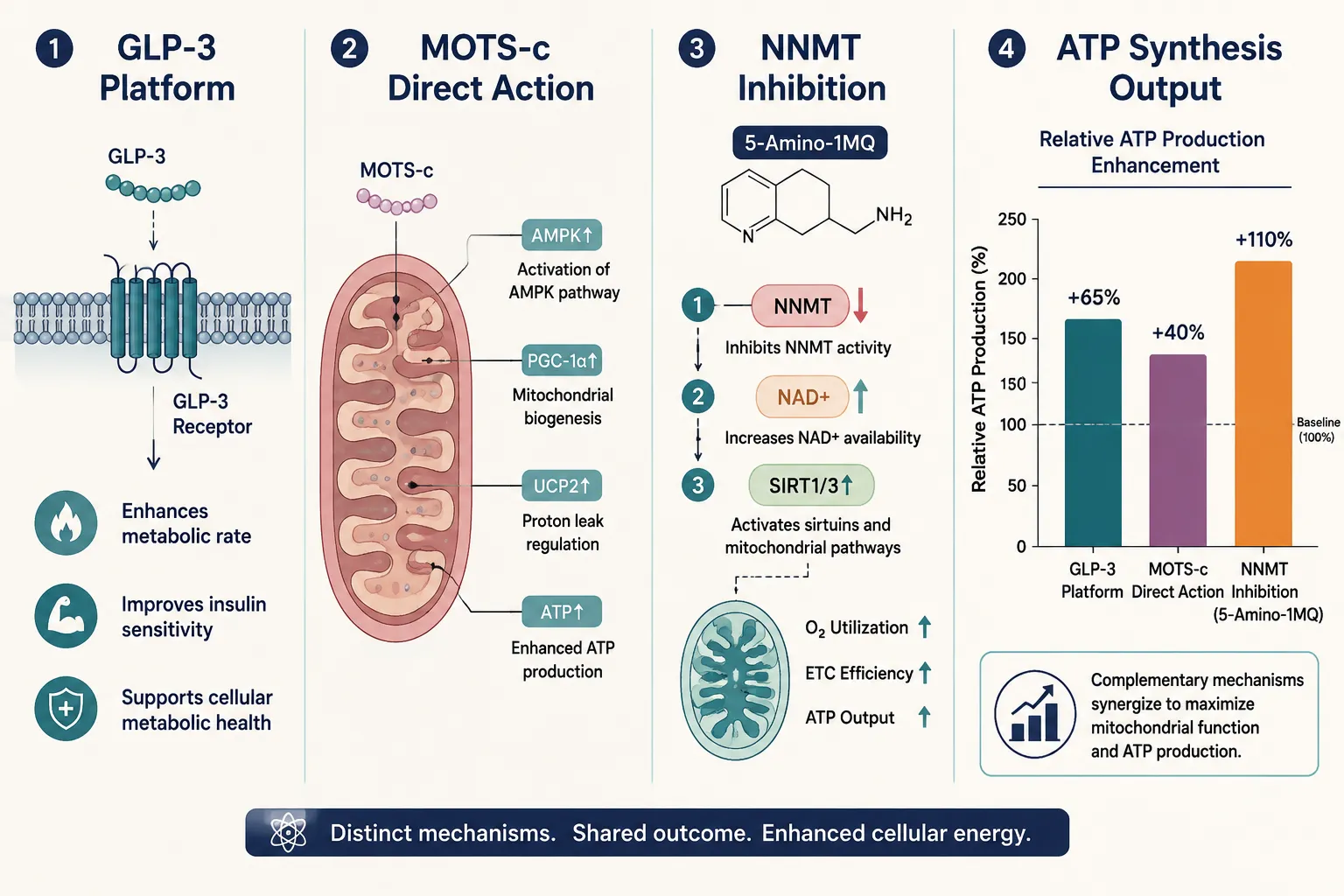
In 2026 research updates using Seahorse XF metabolic flux analyzers, 5-Amino-1MQ treatment increased basal respiration, maximal respiratory capacity, and ATP-linked oxygen consumption rate (OCR) in both adipocytes and myoblasts. Rodent studies have reported 40-60% increases in adipose NAD+ within two weeks of treatment, accompanied by a shift toward fat oxidation and reduced lipogenesis. Emerging translational commentary also links NNMT inhibition to improved muscle strength and potential applications in sarcopenia research through enhanced NAD+ synthesis.
Important caveat: As of mid-2026, no published human clinical trials for 5-Amino-1MQ exist. Human-equivalent doses remain extrapolations from animal data.
How These Peptides Probe Mitochondrial Function and ATP Production
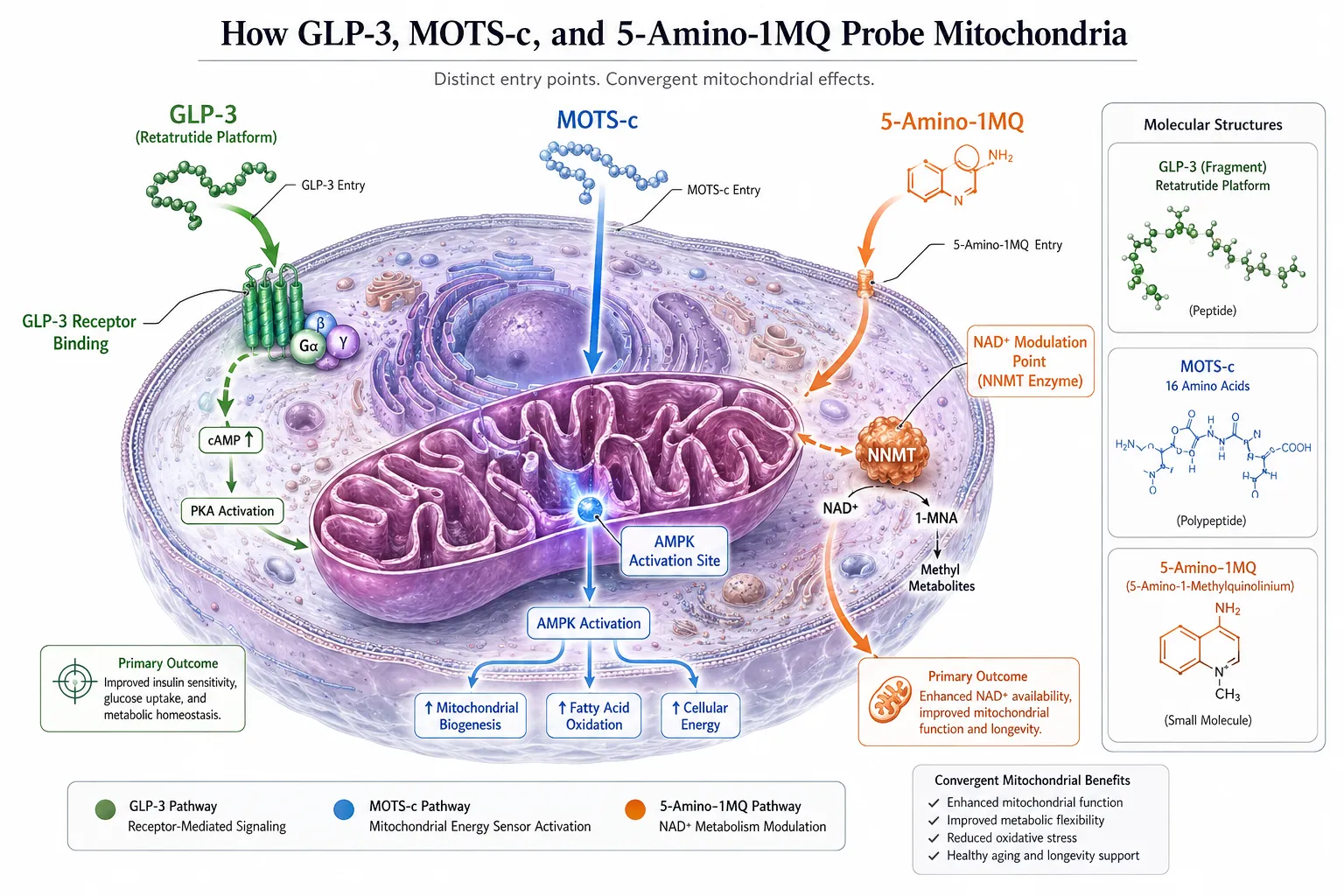
The practical power of studying peptides and polypeptides in basic cell biology, specifically how GLP-3, MOTS-c, and 5-Amino-1MQ are used to probe mitochondria and ATP production, comes from the complementary nature of their mechanisms.
A Comparative Overview
| Agent | Primary Target | ATP Relevance | Research Model |
|---|---|---|---|
| GLP-3 / Retatrutide | GIP/GLP-1/Glucagon receptors | Systemic energy expenditure | In vivo, Phase 3 trials |
| MOTS-c | AMPK via AMP/ATP ratio | Mitochondrial respiration quality | Cell lines, rodent models |
| 5-Amino-1MQ | NNMT / NAD+ salvage | Basal and maximal OCR | Adipocytes, myoblasts |
The AMPK Axis and Energy Stress Sensing
When researchers apply MOTS-c to a cell model, they are essentially asking: how does this cell respond to perceived energy deficit? MOTS-c raises the AMP/ATP ratio, which AMPK reads as a low-energy signal. This triggers downstream pathways that suppress anabolic processes and stimulate catabolism, including mitochondrial biogenesis and fatty acid oxidation. This makes MOTS-c a precise probe for studying mitochondrial stress responses. For broader context on mitochondrial peptide dynamics, the SS31 mitochondrial dynamics resource provides useful comparative framing.
Seahorse Assays and NAD+ Flux
5-Amino-1MQ's effects are most clearly quantified using Seahorse XF technology, which measures real-time oxygen consumption rate (OCR) and extracellular acidification rate (ECAR) in live cells. Researchers use sequential injections of oligomycin, FCCP, and rotenone/antimycin A to dissect:
- Basal respiration, baseline mitochondrial activity
- ATP-linked respiration, the fraction of OCR coupled to ATP synthesis
- Maximal capacity, total electron transport chain potential
- Spare respiratory capacity, the cell's metabolic reserve
5-Amino-1MQ treatment elevates all three of the first metrics in preclinical models, providing a quantifiable readout of how NNMT inhibition reshapes mitochondrial output.
Understanding peptides and polypeptides in modern research and how molecular size shapes function adds important context here, since the membrane permeability of small molecules like 5-Amino-1MQ versus larger peptides like MOTS-c directly affects assay design and delivery strategy.
Research Design Considerations and Sourcing Standards
Designing rigorous experiments with any of these agents requires attention to several practical factors.
Purity, Documentation, and Regulatory Status
All three agents, GLP-3/retatrutide components, MOTS-c, and 5-Amino-1MQ, are research-grade tools only. Expert and vendor analyses consistently emphasize that regulatory approval for human use is either absent or limited. Long-term safety profiles remain unknown. Researchers must source compounds with verifiable certificates of analysis (CoA) and third-party purity testing. Lab tested peptides with documented analytical standards are the baseline requirement for any publishable preclinical work.
Experimental Controls and Model Selection
- Cell model choice matters: 5-Amino-1MQ effects have been demonstrated in adipocytes and myoblasts; extrapolating to other cell types requires independent validation.
- MOTS-c concentration windows: Dose-response curves in mitochondrial assays must account for the fact that MOTS-c can restore respiration without proportionally increasing ATP output, a distinction that requires careful endpoint selection.
- GLP-3 / retatrutide studies: These are better suited to whole-animal or organoid models than isolated mitochondrial preparations, given their receptor distribution.
Analysts in 2026 position NNMT inhibitors and mitochondrial peptides as potential late-2020s candidates for metabolic and cardiovascular indications, though these projections remain speculative. For researchers interested in the SS-31 peptides for sale category, pairing SS-31 with MOTS-c in the same mitochondrial assay panel can provide richer mechanistic data on inner membrane integrity versus energy sensing.
Conclusion
The intersection of peptides and polypeptides in basic cell biology, and specifically how GLP-3, MOTS-c, and 5-Amino-1MQ are used to probe mitochondria and ATP production, represents one of the most productive frontiers in metabolic research today. Each agent illuminates a different layer: GLP-3/retatrutide maps systemic fuel allocation, MOTS-c decodes mitochondrial stress signaling through the AMPK axis, and 5-Amino-1MQ quantifies how NAD+ availability shapes real-time respiratory output.
Actionable next steps for researchers:
- Establish baseline Seahorse OCR/ECAR profiles in your target cell line before introducing any of these agents.
- Source compounds exclusively from suppliers providing third-party CoA documentation and verified purity data.
- Design dose-response experiments rather than single-dose protocols to capture the full mechanistic range of each agent.
- Treat GLP-3/retatrutide, MOTS-c, and 5-Amino-1MQ as complementary tools within a single experimental framework rather than standalone probes.
- Monitor the regulatory landscape closely, the status of these compounds is evolving, and compliance requirements may shift before the end of the decade.


Leave a Reply
Want to join the discussion?Feel free to contribute!