Call or Text 727-513-9780
  • Shopping Cart Shopping Cart
    0Shopping Cart
Pure Tested Peptides | America's most trusted Peptides for sale online
  • Peptides for sale
    • Oral Peptides for sale
      • Peptide Capsules for sale
      • BPC 157 Capsules 1000mcg
      • SLU-PP-332 Capsules | 1000 mcg
      • 5-Amino-1MQ 50mg Capsules
      • Tesofensine 500mcg
    • All Peptides for sale
    • Peptide Sprays
      • BPC 157 Nasal Spray Kit
      • BPC-157 TB500 Nasal Spray Kit
      • Semax Nasal Spray 10mg
      • Selank – Nasal Spray Kit – 10mg
      • Epithalon 50MG Nasal Spray Kit
      • Ipamorelin 10mg Nasal Spray
      • Klow Nasal Spray (BPC-157 + TB-500 + GHK-Cu + KPV) | 80mg
      • Hulk Nasal Spray Tesa / Ipa Blend 6/3 MG
      • Klow Nasal Spray
      • NAD + 500 mg Nasal Spray
      • PT-141 Nasal Spray Kit
    • GHRH Peptides
      • Ipa Peptides
      • CJC-1295 Peptides
        • CJC-1295 with DAC 5 mg
        • CJC-1295 without DAC 5 mg
        • CJC-1295 Ipa 10mg
      • Tesa Peptides
        • Tesa Peptide
        • Tesa 20 mg
    • GHK-Cu Peptides
      • All GHK-Cu Peptides
      • GHK-Cu 100mg
      • KLOW Peptide Blend – Buy KLOW blend online
    • BPC Peptides
      • All BPC Peptides
      • BPC-157
      • BPC-157 TB-500
      • BPC 157 capsules 1000mcg
    • SLU-PP-332 Peptides
      • All SLU-PP-332 Peptides
      • SLU-PP-332 5mg
    • GLP3 Peptides
    • PT-141 Peptides
      • PT-141 Peptides for sale
      • PT-141 10mg
      • PT-141 Nasal Spray
    • CAG Peptides
      • Lipo-C Peptide Blend
      • CAG 5mg
      • CAG 10mg
    • MOTS-C Peptides
      • MOTS-C Peptides for sale
      • MOTS-c peptide
      • MOTS-c 10mg *6 pack*
    • 5 Amino 1MQ Peptides
      • 5 Amino 1MQ Peptides for sale
      • 5-Amino-1MQ 50mg Capsules
      • 5-Amino-1MQ 5mg
    • Epithalon Peptides
      • Epithalon Peptides for sale
      • Epithalon 10mg
      • Epithalon 50mg
  • Shop
    • GLPs
      • 5-Amino-1MQ 50mg Capsules
      • 5-Amino-1MQ 5mg
      • L-Carnitine 500mg/ml
      • Tesofensine 500mcg
      • SLU-PP-332 5mg
      • MOTS-c 10mg *6 pack*
    • Epithalon & BPC Peptides
      • Epithalon 10mg
      • Epithalon 50mg
      • BPC-157
      • BPC 157 capsules 1000mcg
      • BPC-157 TB-500
      • BPC-157 TB500 Nasal Spray Kit
      • BPC 157 Nasal Spray Kit
    • BPC TB-500 & NAD+ Peptides
      • NAD+ 500 mg
      • KLOW Peptide Blend – Buy KLOW blend online
      • GLOW Peptide Blend
      • TB 500 5mg
      • BPC 157 capsules 1000mcg – Supplement
      • BPC 157 Nasal Spray Kit
      • BPC-157
      • BPC-157 TB500 Nasal Spray Kit
      • BPC-157 TB-500
      • BPC 157 capsules 1000mcg
    • LL-37 Peptide
      • LL-37 10 mg
    • MOTS-C & Selank
      • MOTS-c peptide
      • Selank 10mg
    • GHK Peptides
      • GHK-Cu 100mg
      • GLOW Peptide Blend
      • KLOW Peptide Blend – Buy KLOW blend online
  • COAs
  • Wholesale
    • Wholesale Peptides for sale
  • PTP FAQ
  • Affiliates
    • Selank Peptide: Advanced Pharmacological Mechanisms Underlying Its Anxiolytic and Nootropic Effects in Research
      • 5-Amino-1MQ Peptide: Detailed Mechanisms of NNMT Inhibition and Its Impact on Cellular Metabolism Research
        • MOTS-C Peptide: Unraveling Its Role in Mitochondrial Dynamics and Energy Metabolism Research
          • Epithalon Peptide and Telomerase Regulation: Investigating Its Impact on Cellular Senescence and Lifespan Research Models
            • GLP2-T vs GLP2 Tirz Peptide: Understanding the Naming, Mechanistic Nuances, and Research Implications for Gut Health
      • Peptides and Polypeptides in Modern Pharmacology: What Research on Metoprolol, Prednisone, and Amlodipine Reveals
        • Polypeptide Peptides vs NSAIDs: What Naproxen and Diclofenac Teach Tissue-Repair Researchers About BPC‑157 and TB‑500
          • Peptides and Polypeptides in Endocrine Pharmacology: How GLP-1, GLP-2, and GLP-3 Retatrutide Differ From Classic Drugs Like Prednisone and Amlodipine
          • 5‑Amino‑1MQ Peptide and NNMT Inhibition: How It Compares With Statins Like Atorvastatin in Adipose and Lipid Metabolism Research
      • Enclomiphene, Estrogen Receptor Signaling, and Luteinizing Phase Biology: What Hormone Researchers Should Measure
        • Mesenchymal Stem Cells, BPC‑157, and GHK‑Cu: How Tissue Repair Peptides Compare With Classic NSAIDs Like Naproxen in Injury Models
          • Peptide Calculator Use Cases Beyond Growth Hormone: Working Through GLP‑3 Retatrutide, MOTS‑c, and BPC‑157 Research Dosing
        • Polypeptide Peptides in Endocrine and Metabolic Pharmacology: Lessons From Amlodipine, Prednisone, and Metoprolol
        • Peptides Calculator for Advanced Blends: Worked Examples for Tesamorelin, CJC‑1295, and Ipamorelin Stacks
          • Peptides and Polypeptides in Human Physiology: How Molecular Size Shapes Research Applications
            • Selank Peptide: Advanced Pharmacological Mechanisms Underlying Its Anxiolytic and Nootropic Effects in Research
          • 5-Amino-1MQ Peptide: Detailed Mechanisms of NNMT Inhibition and Its Impact on Cellular Metabolism Research
            • MOTS-C Peptide: Unraveling Its Role in Mitochondrial Dynamics and Energy Metabolism Research
              • Epithalon Peptide and Telomerase Regulation: Investigating Its Impact on Cellular Senescence and Lifespan Research Models
                • GLP2-T vs GLP2 Tirz Peptide: Understanding the Naming, Mechanistic Nuances, and Research Implications for Gut Health
                  • Peptides and Polypeptides in Endocrine Pharmacology: How GLP-1, GLP-2, and GLP-3 Retatrutide Differ From Classic Drugs Like Prednisone and Amlodipine
                    • Polypeptide Peptides vs NSAIDs: What Naproxen and Diclofenac Teach Tissue-Repair Researchers About BPC‑157 and TB‑500
                      • Peptides and Polypeptides in Modern Pharmacology: What Research on Metoprolol, Prednisone, and Amlodipine Reveals
                        • 5‑Amino‑1MQ Peptide and NNMT Inhibition: How It Compares With Statins Like Atorvastatin in Adipose and Lipid Metabolism Research
                        • Enclomiphene, Estrogen Receptor Signaling, and Luteinizing Phase Biology: What Hormone Researchers Should Measure
                        • Mesenchymal Stem Cells, BPC‑157, and GHK‑Cu: How Tissue Repair Peptides Compare With Classic NSAIDs Like Naproxen in Injury Models
                        • Peptide Calculator Use Cases Beyond Growth Hormone: Working Through GLP‑3 Retatrutide, MOTS‑c, and BPC‑157 Research Dosing
                        • Polypeptide Peptides in Endocrine and Metabolic Pharmacology: Lessons From Amlodipine, Prednisone, and Metoprolol
                        • Peptides Calculator for Advanced Blends: Worked Examples for Tesamorelin, CJC‑1295, and Ipamorelin Stacks
                        • Peptides and Polypeptides in Human Physiology: How Molecular Size Shapes Research Applications
                        • Selank Peptide: Advanced Pharmacological Mechanisms Underlying Its Anxiolytic and Nootropic Effects in Research
                        • MOTS-C Peptide: Unraveling Its Role in Mitochondrial Dynamics and Energy Metabolism Research
                        • Peptides and Polypeptides in Modern Pharmacology: What Research on Metoprolol, Prednisone, and Amlodipine Reveals
                        • Peptides and Polypeptides in Endocrine Pharmacology: How GLP-1, GLP-2, and GLP-3 Retatrutide Differ From Classic Drugs Like Prednisone and Amlodipine
                        • 5-Amino-1MQ Peptide: Detailed Mechanisms of NNMT Inhibition and Its Impact on Cellular Metabolism Research
                        • Mesenchymal Stem Cells, BPC‑157, and GHK‑Cu: How Tissue Repair Peptides Compare With Classic NSAIDs Like Naproxen in Injury Models
                        • Peptide Calculator Use Cases Beyond Growth Hormone: Working Through GLP‑3 Retatrutide, MOTS‑c, and BPC‑157 Research Dosing
                        • GLP2-T vs GLP2 Tirz Peptide: Understanding the Naming, Mechanistic Nuances, and Research Implications for Gut Health
                        • Polypeptide Peptides in Endocrine and Metabolic Pharmacology: Lessons From Amlodipine, Prednisone, and Metoprolol
                        • Polypeptide Peptides vs NSAIDs: What Naproxen and Diclofenac Teach Tissue-Repair Researchers About BPC‑157 and TB‑500
                        • Peptides and Polypeptides in Human Physiology: How Molecular Size Shapes Research Applications
                        • Peptides Calculator for Advanced Blends: Worked Examples for Tesamorelin, CJC‑1295, and Ipamorelin Stacks
                        • 5‑Amino‑1MQ Peptide and NNMT Inhibition: How It Compares With Statins Like Atorvastatin in Adipose and Lipid Metabolism Research
                        • Enclomiphene, Estrogen Receptor Signaling, and Luteinizing Phase Biology: What Hormone Researchers Should Measure
                        • Epithalon Peptide and Telomerase Regulation: Investigating Its Impact on Cellular Senescence and Lifespan Research Models
                        • Best research protocol Klow blend
                        • best time to take BPC-157
                        • best time to take DSIP (Delta Sleep Inducing Peptide)
                        • best time to take CJC-1295
                        • best time to take AOD-9604
                        • best time to take Follistatin 344
                        • best time to take Ipamorelin
                        • best time to take MK-677 (Ibutamoren)
                        • best time to take Ligandrol (LGD-4033) — research compound
                        • best time to take Ostarine (MK-2866) — research compound
                        • best time to take GHK-CU
                        • best time to take TB-500
                        • best time to take MOTS-c
                        • best time to take Semax
                        • best time to take RAD-140 (Testolone) — research compound
                        • best time to take Thymosin Alpha-1
                        • best time to take PEG-MGF
                        • Biolife Plasma, Octapharma Plasma, and Research Peptides: How Plasma Donation Labs Differ From Peptide Suppliers
                        • best time to take YK-11 — research compound
                        • best time to take PT-141 (Bremelanotide)
                        • Best research protocol Klow blend
                        • 5-Amino-1MQ and MOTS-C Synergy: Metabolic Signaling, Mitochondria, and Research Design
                        • BPC-157 and TB-500: Investigating Their Combined Effects on Angiogenesis and Cellular Migration in Tissue Repair Models
                        • BPC-157 Peptide: Gut Barrier Function, Inflammation, and Tissue-Recovery Research
                        • 5‑Amino‑1MQ and MOTS‑c Synergy in Metabolic Research: Designing NNMT and Mitochondrial Biogenesis Stacks
                        • CJC-1295 with DAC vs. Without DAC: Half-Life, Release Kinetics, and Research Implications
                        • CJC‑1295 with DAC vs. Without DAC: Expanding on Half‑Life Differences Using Tesamorelin and Ipamorelin Blend Case Studies
                        • Collagen Biology and Copper‑Binding Peptides: How GHK‑Cu, Glow Blend, and Klow Blend Interact with Skin and Connective Tissue
                        • Collagen Biology and Regenerative Peptides: How GHK‑Cu, Glow Blend, and Klow Blend Affect Extracellular Matrix Research
                    • DNA, Telomeres, and Longevity Peptides: Positioning Epithalon and MOTS‑c in Genetic Aging Research
                      • Enclomiphene Citrate: serm Mechanism, Testosterone Research, and Stack Compatibility
                        • Enclomiphene vs Enclomiphene Citrate: Formulation, Bioavailability, and Research Distinctions
                        • Epithalon Peptide Research: Telomerase Activation, Aging, and Pineal Gland Function
                        • Estrogen Receptor Signaling and Enclomiphene: How Selective Modulators Compare with Classic Polypeptide Hormones
                        • GHK-Cu Peptide: Advanced Mechanisms in Extracellular Matrix Remodeling and Wound Healing Research
                        • GHK-Cu Peptide: Collagen Synthesis, Wound Repair, and Skin-Barrier Research Models
                        • GLP-1 vs GLP-3 vs GLP-2: Peptide Classification and Research Applications
                        • GLP-2 Peptide Research Guide: Gut Barrier Function, Nutrient Absorption, and Intestinal Recovery Models
                        • GLP-3 Retatrutide vs. GLP-1 Drugs: What Triple-Agonist Biology Changes in Research Models
                        • Ipamorelin and Tesamorelin Combination: Synergistic GH Secretagogue Research and Dosing Protocols
                        • GLP2 Tirz Peptide: What It Is, Why the Name Exists, and How Researchers Should Interpret It
                        • Klow Blend Peptide Nasal Spray: What the Formulation Is Trying to Do in Cognitive Research
                        • Mitochondria, NNMT Inhibition, and Peptide Modulators: Where MOTS‑c and 5‑Amino‑1MQ Fit in Cellular Energy Research
                        • MOTS-c Peptide: Mitochondrial Function, Energy Metabolism, and What Researchers Measure
                        • MOTS-c vs. 5-Amino-1MQ: Which Metabolic Research Questions Each Compound Actually Answers
                        • Nasal Spray Peptides: Bioavailability, Administration, and Semax/Selank Research Applications
                        • PT-141 Peptide Research: Mechanism of Action and Melanocortin Receptor Signaling
                        • Retatrutide for Research: Mechanism, Structure, and GLP-1/GLP-3 Dual Action
                        • Retatrutide for Obesity and Type 2 Diabetes: What the Latest Trial Data Suggest
                        • Tesofensine Peptide Research: Mechanism, Appetite Suppression, and Neuropeptide Y Pathways
  • Contact
    • Contact Customer Service
    • Text Customer Support
  • About US
  • Shop all peptides
  • Affiliate Program
    • Affiliate Signup
  • Login / Register Login / Register Page Link Login / Register Page Link
  • Click to open the search input field Click to open the search input field Search
  • Menu Menu
ACE Inhibitors and Research Peptides: Designing Blood-Pressure Controls Around Lisinopril and Growth-Hormone Secretagogues

ACE Inhibitors and Research Peptides: Designing Blood-Pressure Controls Around Lisinopril and Growth-Hormone Secretagogues

September 27, 2026/0 Comments/in Uncategorized/by

Nearly one billion adults worldwide live with hypertension, yet a growing number of researchers are simultaneously exploring growth-hormone secretagogue peptides whose hemodynamic effects remain poorly characterized. That overlap creates a real experimental design problem. When studying ACE inhibitors and research peptides, specifically designing blood-pressure controls around lisinopril and growth-hormone secretagogues, researchers must understand how ACE-pathway modulation shapes blood pressure, renal readouts, and fluid balance, and how those changes can confound or clarify CJC-1295, ipamorelin, and tesa experiments.

Key Takeaways

  • Lisinopril is a long-acting, evidence-backed ACE inhibitor with well-defined effects on blood pressure, cardiac events, and kidney function.
  • Growth-hormone secretagogues such as ipamorelin, CJC-1295, and tesa can cause fluid retention and potential blood-pressure elevation, particularly in stage 2 hypertension.
  • No rigorous human study has directly measured blood-pressure changes attributable to ipamorelin alone, creating a significant data gap.
  • ACE-pathway suppression alters aldosterone levels and glomerular filtration, which directly affects how renal endpoints are interpreted in peptide research.
  • Designing valid research protocols requires establishing stable lisinopril dosing before introducing GH-axis peptides, then monitoring BP at every injection-period review.

How the ACE Pathway Controls Blood Pressure and Renal Readouts

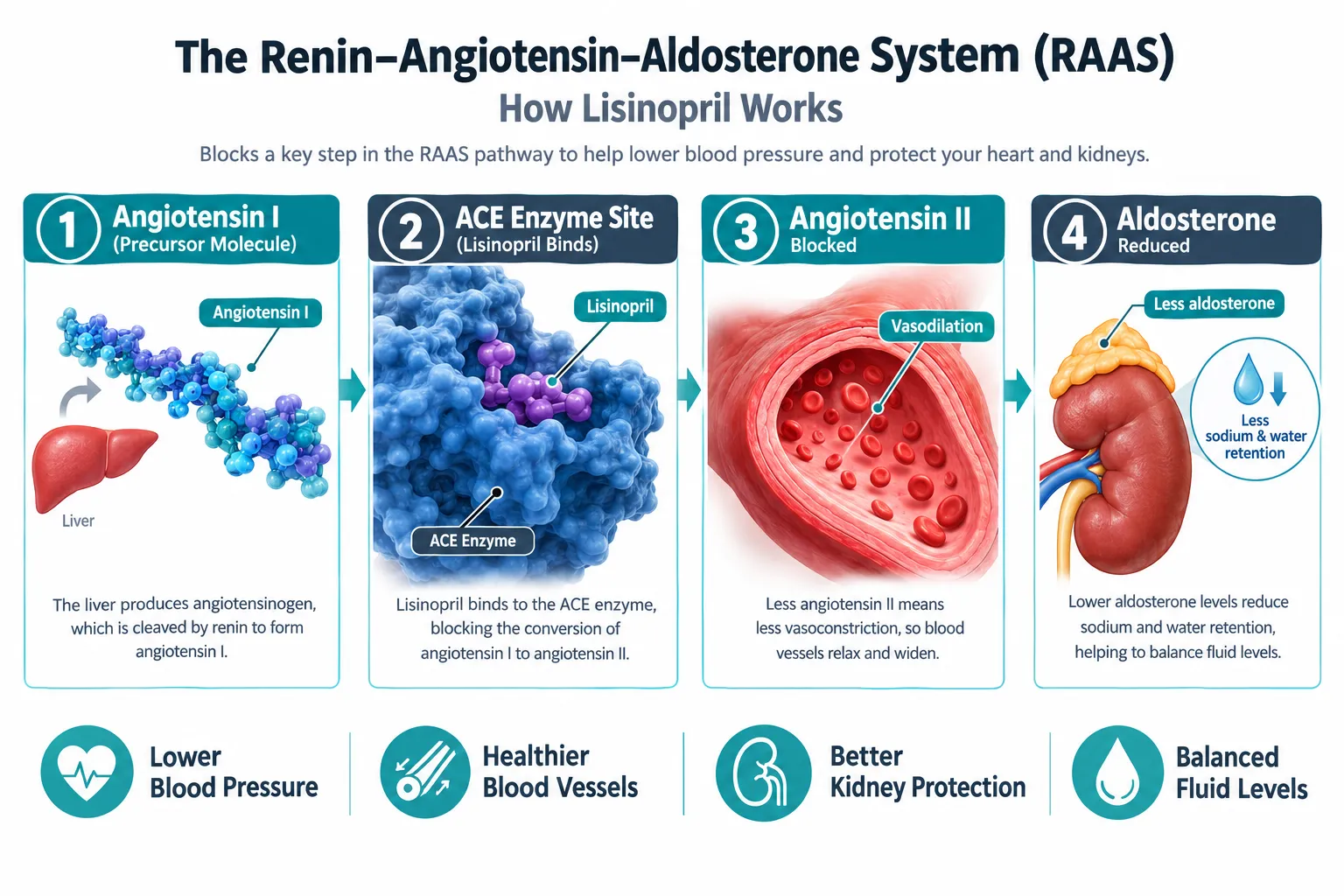
The renin-angiotensin-aldosterone system (RAAS) is the body's primary long-term blood-pressure regulator. Angiotensin-converting enzyme (ACE) converts angiotensin I into angiotensin II, a potent vasoconstrictor that also stimulates aldosterone release. Aldosterone drives sodium and water retention, raising blood volume and pressure.
How the ACE Pathway Controls Blood Pressure and Renal Readouts

Lisinopril blocks this conversion step directly. As an oral, long-acting ACE inhibitor, it is indicated for hypertension, heart failure, post-myocardial infarction management, and proteinuric diabetic kidney disease. Its pharmacological footprint extends well beyond simple vasodilation:

Effect Mechanism Research Relevance
Blood-pressure reduction Reduced angiotensin II, lower vascular resistance Establishes hemodynamic baseline
Natriuresis Decreased aldosterone, increased sodium excretion Alters fluid-balance readouts
Reduced GFR acutely Efferent arteriole dilation Affects creatinine and eGFR endpoints
Anti-proteinuric Reduced intraglomerular pressure Confounds albumin-to-creatinine ratio data

For any experiment measuring renal or cardiovascular endpoints, these effects are not background noise, they are active variables. A researcher who introduces a GH secretagogue without first stabilizing ACE inhibitor dosing will be unable to separate peptide-driven changes from ongoing RAAS modulation.


Clinical Evidence Anchoring Lisinopril as the Control Agent

Understanding the evidentiary weight behind lisinopril matters when selecting it as a research control. Its role in ACE inhibitors and research peptides protocols, designing blood-pressure controls around lisinopril and growth-hormone secretagogues, is justified by decades of outcome data, not convention alone.

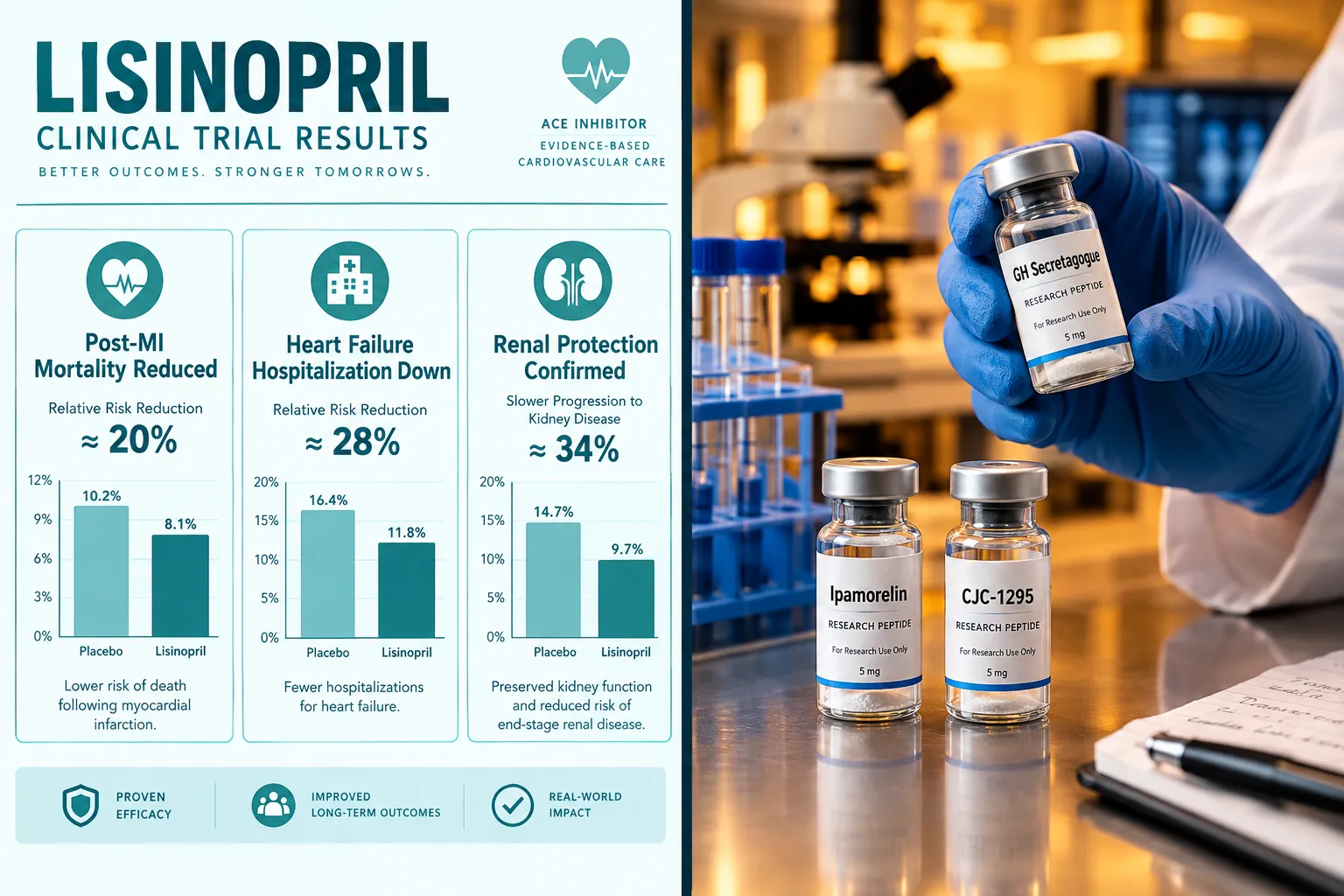
Post-MI data: In the GISSI-3 trial, nearly 19,400 acute myocardial infarction patients were randomized in a factorial design. Lisinopril-treated patients experienced roughly an 11% lower risk of death at six weeks compared with controls (6.4% versus 7.2%), establishing short-term ACE inhibition as a mortality-reducing intervention after cardiac events.

Heart failure dosing: A study in over 3,100 chronic heart-failure patients followed for a median of 46 months found that high-dose lisinopril produced a 12% risk reduction in the combined endpoint of all-cause mortality and hospitalization, and a 24% reduction in heart-failure hospitalizations specifically, compared with low-dose therapy. This supports titrating toward higher target doses when tolerated.

Renal protection: The VA NEPHRON trial enrolled 1,448 patients with type 2 diabetes, elevated urinary-albumin-to-creatinine ratios, and reduced eGFR (30-89.9 mL/min), randomizing them to lisinopril or placebo on a background of losartan. This underscores lisinopril's role in intensive renal-risk management.

Key point: Because lisinopril independently alters urinary albumin excretion and eGFR, any peptide experiment using renal endpoints must document lisinopril dose stability for at least four to six weeks before baseline measurements are taken.

For researchers exploring peptide fundamentals, the Peptides 101 for Research-Use Only Buyers guide provides useful structural and mechanistic context.
Clinical Evidence Anchoring Lisinopril as the Control Agent


GH Secretagogues, Fluid Balance, and Blood-Pressure Risk

Growth-hormone secretagogues, including ipamorelin, CJC-1295, and tesa, stimulate the pituitary to release growth hormone, which in turn elevates IGF-1. This GH-axis activation carries hemodynamic consequences that directly complicate blood-pressure research design.

The fluid-retention problem: GH promotes sodium and water retention through IGF-1-mediated renal tubular effects. In a subject already on lisinopril, which promotes natriuresis, the opposing forces can mask or amplify fluid shifts, making weight and edema measurements unreliable without careful protocol design.

Blood-pressure uncertainty: No identified human study has directly measured blood-pressure changes attributable to ipamorelin alone. That data gap is critical. Safety reviews in 2026 flag that GH-axis secretagogues can raise blood pressure through both fluid retention and sympathomimetic effects of elevated GH. Specific concern exists at stage 2 hypertension (systolic BP above 160 mmHg), where persistent elevation refractory to standard management is considered a serious adverse event warranting reconsideration of peptide use.

Practical monitoring thresholds:

  • Blood pressure should be checked at every injection-period review
  • Persistent systolic BP above 160 mmHg flags a serious adverse event
  • Patients with cardiovascular disease require cardiologist consultation before GH secretagogue exposure
  • Fluid retention should be tracked via daily weight and ankle circumference measurements

Researchers interested in the IPA Sermorelin stack research protocols will find these monitoring principles directly applicable. For peptide sourcing considerations, the best peptide supplier resource is worth reviewing alongside purity documentation.
GH Secretagogues, Fluid Balance, and Blood-Pressure Risk


Designing a Valid Research Protocol

Translating the above into a workable experimental framework requires sequencing interventions carefully. The core principle in ACE inhibitors and research peptides design, blood-pressure controls around lisinopril and growth-hormone secretagogues, is that the ACE inhibitor must be the stable foundation, not an active variable.

Recommended sequencing:

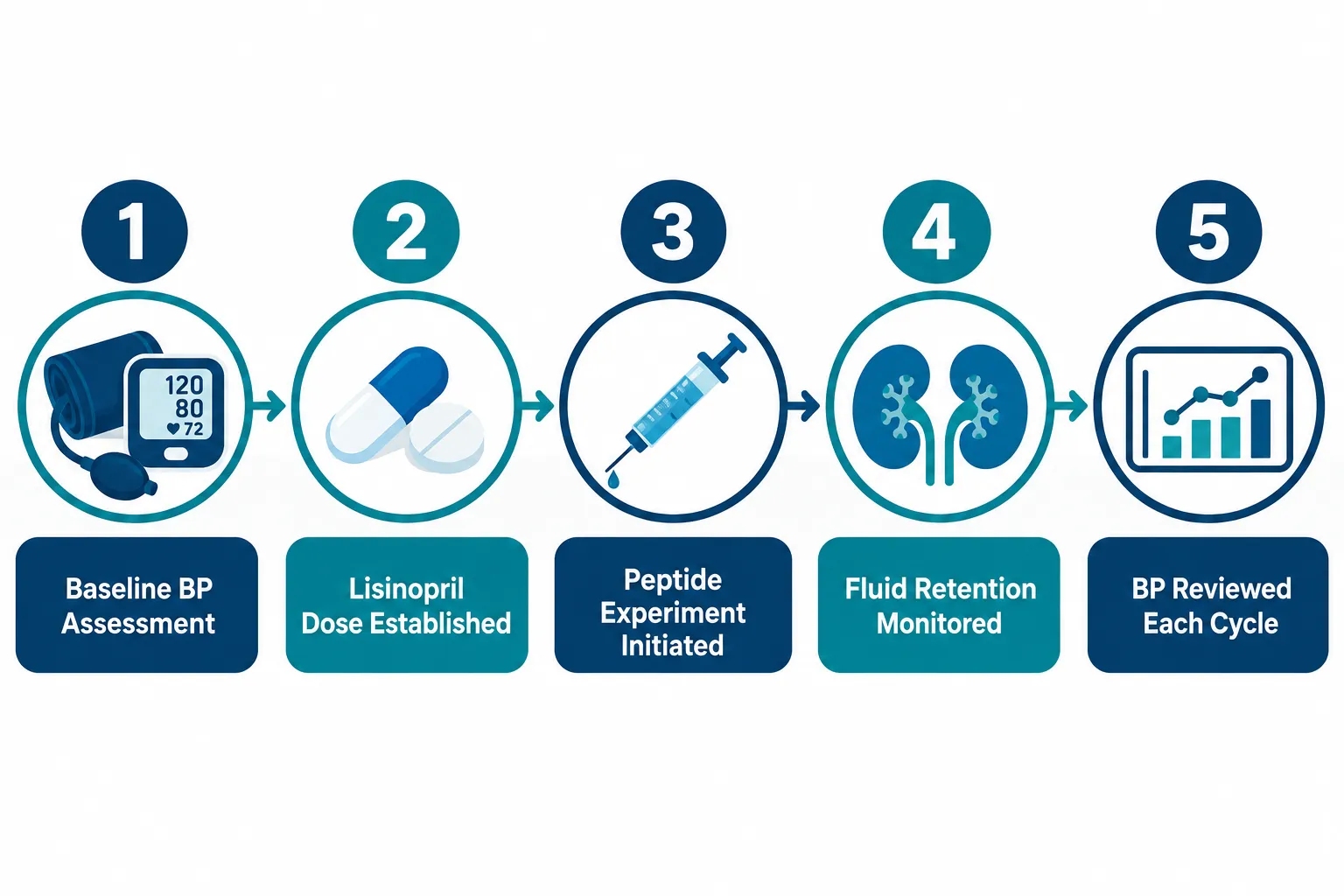
  1. Establish baseline hemodynamics, Record resting BP, eGFR, urinary albumin-to-creatinine ratio, and body weight before any intervention.
  2. Stabilize lisinopril dose, Allow four to six weeks at target dose with three consecutive BP readings within 10 mmHg of each other before proceeding.
  3. Document renal endpoints at steady state, Creatinine, eGFR, and urinary albumin reflect the lisinopril-stabilized baseline, not a moving target.
  4. Introduce the GH secretagogue, Begin ipamorelin, CJC-1295, or tesa at the lowest research dose.
  5. Monitor BP at every injection period, Flag any systolic reading above 160 mmHg as a protocol-defined serious event.
  6. Track fluid balance independently, Daily weight, edema scoring, and sodium intake logs separate peptide-driven fluid shifts from RAAS modulation.

Researchers studying mitochondrial or cytoprotective peptides alongside cardiovascular endpoints may also find the synergy of LL-37 and SS-31 research relevant, as SS-31 has distinct renal mitochondrial effects that interact with RAAS-modulated tissue. Similarly, SS-31 peptide benefits documentation provides useful comparative context when designing multi-peptide cardiovascular studies.

For researchers sourcing MOTS-c or related metabolic peptides alongside GH secretagogues, the MOTS-c peptide category offers additional product and mechanism information.


Conclusion

Designing rigorous blood-pressure controls in peptide research is not optional, it is the difference between interpretable data and noise. Lisinopril's well-characterized effects on RAAS, fluid balance, and renal endpoints make it a logical anchor for cardiovascular control arms, but only when its dose is stabilized before GH secretagogue introduction. Ipamorelin, CJC-1295, and tesa all carry real, if incompletely quantified, risks of fluid retention and blood-pressure elevation that can obscure experimental signals or create genuine safety events.

Actionable next steps for researchers in 2026:

  • Audit existing protocols to confirm lisinopril dose stability windows are documented before baseline renal measurements
  • Add systolic BP above 160 mmHg as a pre-specified serious adverse event criterion in any GH secretagogue study
  • Track fluid balance with daily weight logs, not just clinical BP readings
  • Consult cardiology input for any subject with pre-existing cardiovascular disease before GH-axis peptide exposure
  • Review purity certificates for all research peptides to ensure experimental variables are limited to pharmacology, not contaminant effects
Tags: ace inhibitors, blood pressure control, cjc-1295, growth hormone secretagogues, ipamorelin, lisinopril, raas modulation, research peptides
https://www.puretestedpeptides.com/wp-content/uploads/2026/09/ace-inhibitors-and-research-peptides-designing-blood-pressure-controls-around-li.webp 1024 1536 https://www.puretestedpeptides.com/wp-content/uploads/2026/01/buy-peptides-online.jpg 2026-09-27 13:03:392026-09-27 13:03:39ACE Inhibitors and Research Peptides: Designing Blood-Pressure Controls Around Lisinopril and Growth-Hormone Secretagogues
You might also like
Peptides 101 for Research-Use Only Buyers: Structure, Mechanisms, and Where GLP-3, MOTS-c, and 5-Amino-1MQ Fit In Peptides 101 for Research-Use Only Buyers: Structure, Mechanisms, and Where GLP-3, MOTS-c, and 5-Amino-1MQ Fit In
Spironolactone and Peptide Metabolism Studies: Aldosterone, Potassium, Fluid Volume, and Hormonal Readouts Spironolactone and Peptide Metabolism Studies: Aldosterone, Potassium, Fluid Volume, and Hormonal Readouts
Best Research‑Use GH Secretagogue Peptides: Comparing CJC‑1295 (With and Without DAC), Ipamorelin, and Tesamorelin Best Research‑Use GH Secretagogue Peptides: Comparing CJC‑1295 (With and Without DAC), Ipamorelin, and Tesamorelin
Peptide Calculators for Tesamorelin and Ipamorelin: Optimizing Reconstitution and Dosing Accuracy Peptide Calculators for Tesamorelin and Ipamorelin: Optimizing Reconstitution and Dosing Accuracy
Enclomiphene Research Materials: Enclomiphene Base vs Citrate for Identity, Solubility, and COA Review Enclomiphene Research Materials: Enclomiphene Base vs Citrate for Identity, Solubility, and COA Review
Semax Nasal Spray Research Products: How to Compare Concentration, Excipient Disclosure, and Analytical Documentation Semax Nasal Spray Research Products: How to Compare Concentration, Excipient Disclosure, and Analytical Documentation
The Best Research Peptides for Mitochondrial Function: A Comparative Review of MOTS-c and 5-Amino-1MQ The Best Research Peptides for Mitochondrial Function: A Comparative Review of MOTS-c and 5-Amino-1MQ
Tesamorelin, Ipamorelin, and CJC-1295 With DAC: How Different GHRH Mimetic Profiles Shape Growth Hormone Study Outcomes Tesamorelin, Ipamorelin, and CJC-1295 With DAC: How Different GHRH Mimetic Profiles Shape Growth Hormone Study Outcomes
0 replies

Leave a Reply

Want to join the discussion?
Feel free to contribute!

Leave a Reply Cancel reply

Your email address will not be published. Required fields are marked *

×

Helpful Links

  • My account
  • Cart
  • Checkout
  • Refund and Returns Policy
  • Privacy Policy
  • SMS Privacy Policy
  • Login
  • My Account
  • Logout

USA Made Lab Tested Peptides

All products are sold for research, laboratory, or analytical purposes only, and are not for human consumption


Pure Tested Peptides is a chemical supplier. Pure Tested Peptides is not a compounding / chemical compounding facility as defined under 503A of the Federal Food, Drug, and Cosmetic act. Pure Tested Peptides is not an outsourcing facility as defined under 503B of the Federal Food, Drug, and Cosmetic act.

The statements made within this website have not been evaluated by the US Food and Drug Administration. The products we offer are not intended to diagnose, treat, cure or prevent any disease.

Human/Animal Consumption Prohibited. Laboratory/In-Vitro Experimental Use Only

Link to: Cholesterol and Research Peptides: Separating LDL, Triglyceride, and Non-HDL Effects in Metabolic Models Link to: Cholesterol and Research Peptides: Separating LDL, Triglyceride, and Non-HDL Effects in Metabolic Models Cholesterol and Research Peptides: Separating LDL, Triglyceride, and Non-HDL...Cholesterol and Research Peptides: Separating LDL, Triglyceride, and Non-HDL Effects in Metabolic Models Link to: Advanced Glycation End Products in Peptide Studies: Choosing Fluorescence, RAGE, and Oxidative-Stress Readouts Link to: Advanced Glycation End Products in Peptide Studies: Choosing Fluorescence, RAGE, and Oxidative-Stress Readouts Advanced Glycation End Products in Peptide Studies: Choosing Fluorescence, RAGE, and Oxidative-Stress ReadoutsAdvanced Glycation End Products in Peptide Studies: Choosing Fluorescence, RAGE,...
Scroll to top Scroll to top Scroll to top