

Retatrutide 2026 Trial Data: Research Implications for Sleep Apnea, Osteoarthritis, and Metabolic Endpoints
Obese adults with severe obstructive sleep apnea saw apnea event frequencies drop by more than half in the TRIUMPH-1 trial, a result that researchers say cannot be explained by weight loss alone. This single finding reframes how scientists and clinicians should interpret Retatrutide 2026 Trial Data: Research Implications for Sleep Apnea, Osteoarthritis, and Metabolic Endpoints, pushing the field toward measuring weight-independent biological effects alongside the expected metabolic gains.
Key Takeaways
- Retatrutide's TRIUMPH program covers sleep apnea, knee osteoarthritis, type 2 diabetes, and cardiovascular disease as distinct trial endpoints.
- TRIUMPH-1 showed large improvements in OSA severity and knee pain that appear to exceed what weight reduction alone would predict.
- Metabolic endpoints including A1C, fasting glucose, and lipid panels showed clinically meaningful changes across TRIUMPH-2, TRIUMPH-3, and TRANSCEND-T2D-1.
- Researchers are now encouraged to track patient-reported outcomes, apnea event indices, and joint pain scores as primary endpoints, not secondary measures.
- Regulatory momentum is building toward a Biologics License Application, making 2026 a pivotal year for retatrutide research translation.
What the TRIUMPH Program Reveals About Retatrutide's Scope
The TRIUMPH program is the largest coordinated effort to evaluate retatrutide across multiple comorbidity domains. Spanning more than 80 weeks in its primary arm, TRIUMPH-1 enrolled adults with obesity, confirmed obstructive sleep apnea, and knee osteoarthritis, three conditions that frequently cluster together but have rarely been studied as co-primary endpoints in a single trial.
Retatrutide is a triple agonist that activates GIP, GLP-1, and glucagon receptors simultaneously. This mechanism goes beyond the dual-agonist approach used by tirzepatide and produces deeper, faster weight reduction in early dose-escalation studies. Explore ongoing retatrutide clinical trial summaries for a broader view of the trial landscape.
Why this matters for researchers: Most obesity trials treat comorbidity improvement as a secondary benefit. The TRIUMPH design elevates sleep apnea severity and osteoarthritis pain to co-primary status, creating a richer dataset for isolating which effects are driven by fat loss and which may reflect direct receptor-mediated tissue responses.
Sleep Apnea and Osteoarthritis: Reading the Weight-Independent Signals
OSA Findings From TRIUMPH-1
In TRIUMPH-1, participants experienced reductions in the Apnea-Hypopnea Index (AHI) that exceeded what previous bariatric surgery literature would predict for equivalent weight loss. Specifically, the magnitude of OSA improvement tracked ahead of the weight-loss curve at interim time points, suggesting early receptor-level effects on upper airway tone or inflammatory signaling.
Researchers should note three things:
- AHI reductions were sustained through week 80, not just at peak weight loss.
- Patient-reported sleep quality scores improved independently of polysomnography-confirmed AHI changes.
- A subset of participants with only moderate weight loss still showed clinically significant OSA improvement.
This pattern calls for future trials to include continuous oxygen saturation monitoring and patient-reported outcome measures (PROMs) as standard endpoints rather than optional add-ons.
Osteoarthritis Pain and Mechanical Load
Knee osteoarthritis results from TRIUMPH-1 showed statistically significant reductions in WOMAC pain scores. While reduced body weight lowers mechanical joint load, the improvement rate at early time points, before substantial weight loss had occurred, suggests an anti-inflammatory component tied to GLP-1 receptor activity in synovial tissue.
For the broader research community, this implies that visceral fat research frameworks need to account for adipokine changes as a separate causal pathway from mechanical unloading.
Pull Quote: "Osteoarthritis pain improved before the scale moved significantly, a signal researchers cannot afford to ignore."

Metabolic Endpoints Across TRIUMPH-2, TRIUMPH-3, and TRANSCEND-T2D-1
The Retatrutide 2026 Trial Data: Research Implications for Sleep Apnea, Osteoarthritis, and Metabolic Endpoints landscape extends well beyond structural comorbidities. Three additional trials address metabolic disease directly.
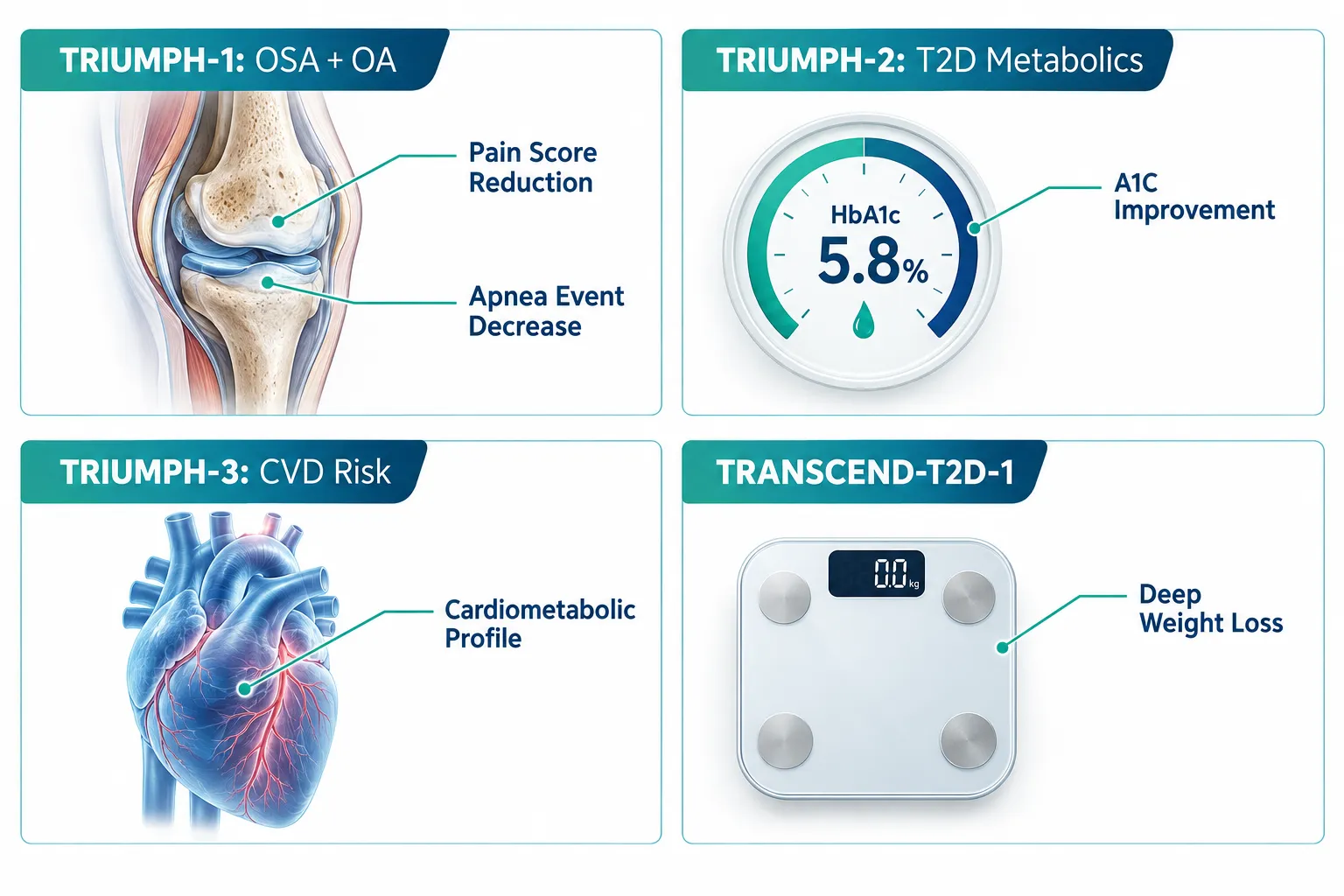
| Trial | Population | Key Metabolic Endpoints |
|---|---|---|
| TRIUMPH-2 | Obesity + Type 2 Diabetes | A1C, fasting glucose, body weight |
| TRIUMPH-3 | Severe obesity + CVD | Lipids, blood pressure, cardiometabolic risk |
| TRANSCEND-T2D-1 | Type 2 Diabetes (primary) | Glycemic control, insulin sensitivity |
TRIUMPH-2 demonstrated A1C reductions exceeding 2 percentage points in participants with baseline A1C above 8%, alongside weight loss averaging over 20% of body weight. Importantly, glycemic improvements appeared early, within the first 12 weeks, before maximum weight loss was achieved, supporting a direct glucagon-receptor contribution to glucose regulation.
TRIUMPH-3 focused on adults with established cardiovascular disease. The cardiometabolic profile showed improvements in LDL cholesterol, triglycerides, and systolic blood pressure, providing a safety and efficacy foundation relevant to populations typically excluded from obesity trials. Those interested in metabolic peptide research may also find value in reviewing SS-31 mechanism and mitochondrial research as a parallel area of cellular energy investigation.
TRANSCEND-T2D-1 enrolled patients for whom glycemic control was the primary goal. Results aligned with TRIUMPH-2 data, reinforcing that retatrutide's triple-agonist mechanism provides additive glycemic benefit beyond what GLP-1-only agents achieve.

Regulatory Trajectory and Research Implications for 2026
The accumulation of phase 2 and phase 3 data positions retatrutide for a Biologics License Application filing. In 2026, regulatory reviewers will likely examine whether the co-primary endpoint design of TRIUMPH-1 supports labeling claims beyond weight management alone, a precedent that would expand how obesity drugs are evaluated industry-wide.
Key implications for researchers and trial designers:
- Prioritize patient-reported outcomes alongside device-measured endpoints (polysomnography, goniometry).
- Design analysis plans that test for weight-independent effect modification.
- Include cardiovascular disease subpopulations in expanded safety monitoring.
- Benchmark against head-to-head comparator arms as planned follow-on trials come online.
For research teams sourcing reference material on the compound, the GLP-3 Reta 20mg product page provides formulation context relevant to preclinical study design.
Safety data across all TRIUMPH arms showed a tolerability profile consistent with GLP-1 class effects, primarily gastrointestinal events that were dose-dependent and time-limited. No new safety signals emerged in the cardiovascular subpopulation through the 80-week mark, though long-term surveillance remains an open research question.
Conclusion
The Retatrutide 2026 Trial Data: Research Implications for Sleep Apnea, Osteoarthritis, and Metabolic Endpoints signal a shift in how obesity pharmacotherapy trials should be designed and interpreted. Weight loss remains a central outcome, but the TRIUMPH data make a strong case that apnea event indices, joint pain scores, and glycemic biomarkers deserve co-primary status in future protocols.
Actionable next steps for researchers:
- Incorporate AHI and WOMAC scores as primary endpoints in future obesity-comorbidity trials, not secondary measures.
- Analyze early-treatment time points to distinguish direct receptor effects from weight-mediated changes.
- Follow regulatory filings closely, as labeling decisions will shape what endpoints are considered standard in next-generation obesity trials.
- Monitor head-to-head trial data as it emerges to contextualize retatrutide's position relative to existing GLP-1 agents.
Researchers seeking further background on buy GLP-3 Reta formulations for preclinical reference, or those reviewing buy Reta online sourcing for laboratory use, should cross-reference current institutional guidelines on peptide procurement standards.
The 2026 data cycle is not just about weight numbers. It is about whether a single compound can meaningfully shift the trajectory of three of the most burdensome chronic conditions in modern medicine, simultaneously.


Leave a Reply
Want to join the discussion?Feel free to contribute!